 Скачать презентацию International Experience Employability of African Graduates James
db3ce1e55024fbf210d04ca68e08b44e.ppt
- Количество слайдов: 25



International Experience & Employability of African Graduates James Otieno Jowi Coordinator African Network for Internationalization of Education (ANIE) Moi University, Kenya Presentation at the EDULINK AUDIS Project, Maputo, Mozambique ( October 7 -9, 2009)
Introduction ► Purpose of presentation ► Meaning of internationalization ► International experience? ► At home/abroad ► Relating to employability ► Trends ► What research says.
Internationalization of HE ► Means Different things § to different people § in different countries § in different types of HEIs § in different disciplines and sectors § in different professions § by different stakeholders § by different education actors, (Knight, 2009)
Working definition Internationalization ……. . …. is a process of integrating an international, intercultural, global dimension into the goals, teaching/learning, research, service delivery of higher education institutions and systems… (Knight, 2008)
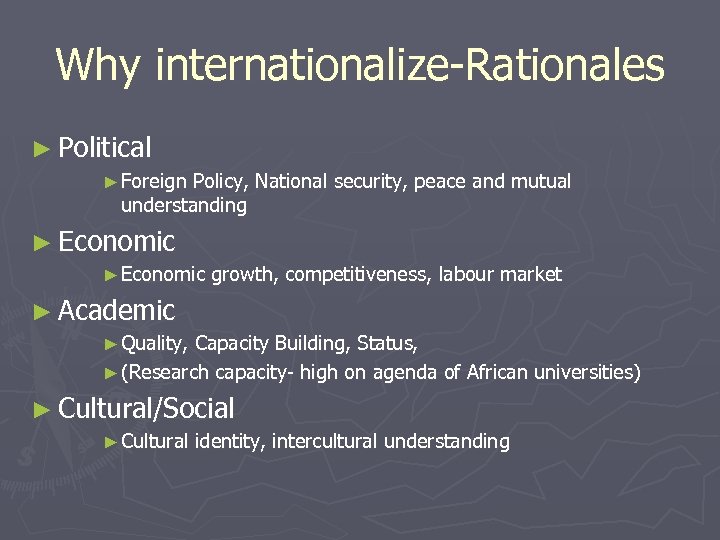
Why internationalize-Rationales ► Political ► Foreign Policy, National security, peace and mutual understanding ► Economic growth, competitiveness, labour market ► Academic ► Quality, Capacity Building, Status, ► (Research capacity- high on agenda of African universities) ► Cultural/Social ► Cultural identity, intercultural understanding
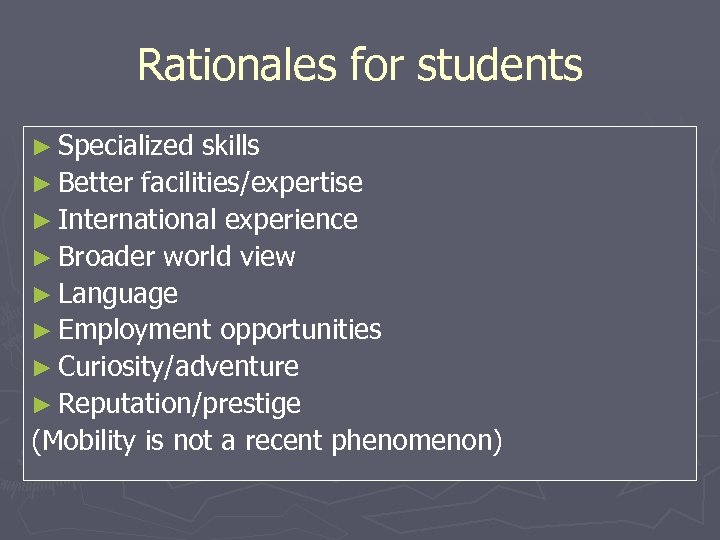
Rationales for students ► Specialized skills ► Better facilities/expertise ► International experience ► Broader world view ► Language ► Employment opportunities ► Curiosity/adventure ► Reputation/prestige (Mobility is not a recent phenomenon)
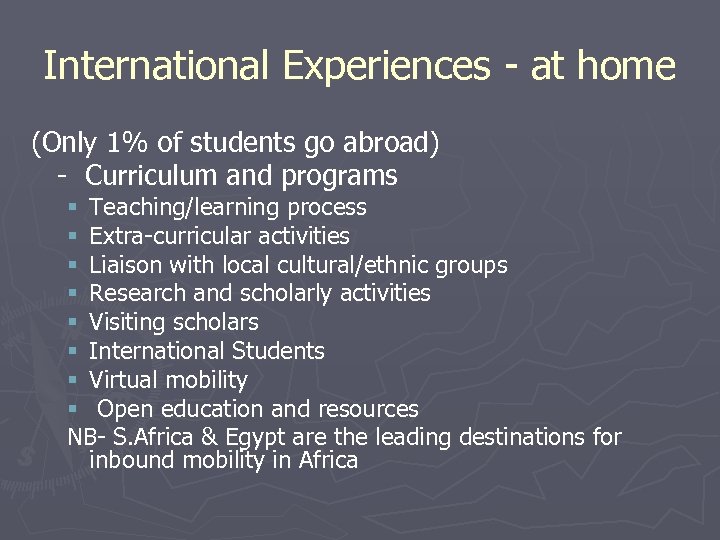
International Experiences - at home (Only 1% of students go abroad) - Curriculum and programs § Teaching/learning process § Extra-curricular activities § Liaison with local cultural/ethnic groups § Research and scholarly activities § Visiting scholars § International Students § Virtual mobility § Open education and resources NB- S. Africa & Egypt are the leading destinations for inbound mobility in Africa
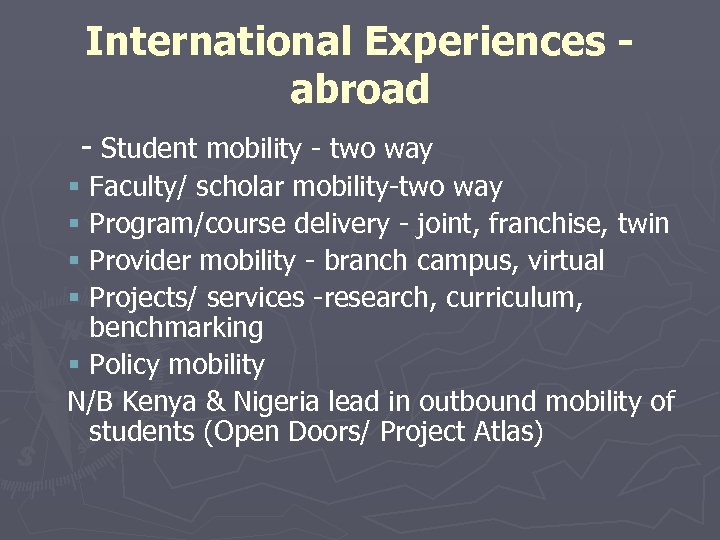
International Experiences abroad - Student mobility - two way § Faculty/ scholar mobility-two way § Program/course delivery - joint, franchise, twin § Provider mobility - branch campus, virtual § Projects/ services -research, curriculum, benchmarking § Policy mobility N/B Kenya & Nigeria lead in outbound mobility of students (Open Doors/ Project Atlas)
Global student mobility & employability Defining global mobility: “An internationally mobile student is a student having crossed a national border in order to study or to undertake other study-related activities for at least a certain unit of a study program or a certain period of time in the country they have moved to. ” (Richters/Teichler, 2006) · · Changing forms of mobility: distance education, virtual learning, branch campuses, and many others · Why is global student mobility important?
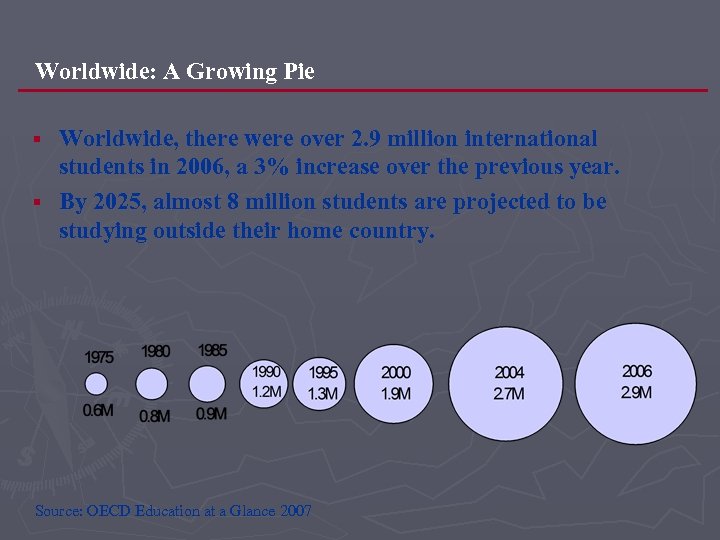
Worldwide: A Growing Pie Worldwide, there were over 2. 9 million international students in 2006, a 3% increase over the previous year. § By 2025, almost 8 million students are projected to be studying outside their home country. § Source: OECD Education at a Glance 2007
![Employability ► The value of [a students] international experience goes beyond purely the acquisition](https://present5.com/presentation/db3ce1e55024fbf210d04ca68e08b44e/image-11.jpg "Employability ► The value of [a students] international experience goes beyond purely the acquisition")
Employability ► The value of [a students] international experience goes beyond purely the acquisition of language- it lies in the ability to see business and personal issues from other than your own cultural perspective - Charles Macleod, Pricewaterhouse, UK Coopers. ► Increasing globalization and internationalization has heightened need for graduates with abilities to operate in culturally diverse contexts and with diverse skills……(Corossman & Clarke, 2009)
What employers want ► ► ► degree of skills Highly marketable work related skills CBI (2008) Research shows that -30% employers have problems with graduates on generic employability skills such as team working, communication, and problem solving -25% disappointed with graduates attitude to work -33% self-management -44% business awareness -49% foreign language skills -Employers are increasingly going global- thus need graduates from different countries/cultures. -Mismatch btw what market demands and what's offered in western market as fewer students gain international experience. -Skills deficit in graduates. -Enhancing employability skills (Archer & Davisson, 2008).
The Global Competition for Talent ► Rapidly changing market for International students ► Strategic approach – USA (CSHE, 2009)…University of California. . . says that USA should double its international student enrolments from current 625, 000 to 1. 25 m by 2020 ► Aim-to capitalize on the global pool of mobile students. ► Immigration of talented students and professionals enabled the USA to grow ► Current shift…needs coherent higher education policy…
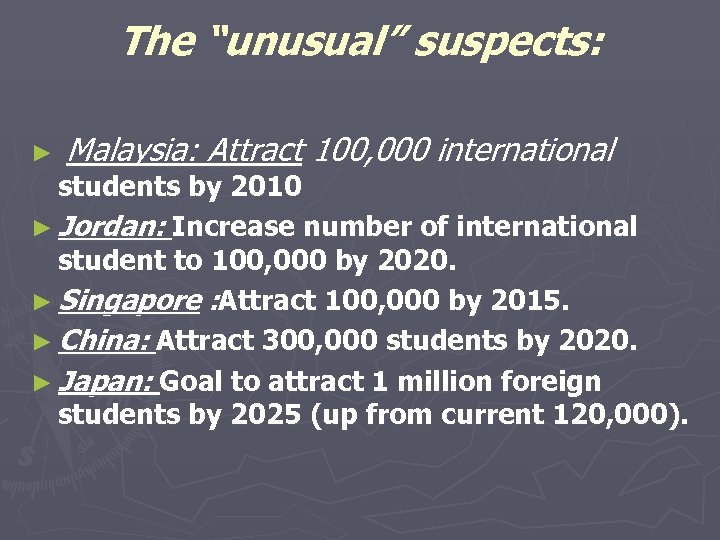
The “unusual” suspects: ► Malaysia: Attract 100, 000 international students by 2010 ► Jordan: Increase number of international student to 100, 000 by 2020. ► Singapore : Attract 100, 000 by 2015. ► China: Attract 300, 000 students by 2020. ► Japan: Goal to attract 1 million foreign students by 2025 (up from current 120, 000).
Africa's Intellectual Diaspora Big resource ► Data? ► Big risk ► Could be utilized ► Return to sender ► Different efforts (Teferra, 2008) ► Brain gain ► Brain circulation ► Brain trust for Africa ► A continuing risk ► Challenges in mitigation ►
International Experience- African graduates Might mean different things ► Attained in different ways (formal & informal) ► Formal – may include academic training ► Varying modes/qualifications ► Internationalization has been there since pre-colonial times ► Immense Contribution to Africa's development ► Pioneer African graduates were trained abroad ► Immediate post independence universities were very international ► ½ senior faculty have part of their training abroad ► Associated advantages ►
African graduates…. . cont ► Prestigious qualifications ► Great bulk trained at home…do they have international experience? ► International employment ► International organizations ► Multiculturalists/ plurality of viewpoints ► Different was of doing things ► Networked society ► Wastage of African talent abroad- odd jobs ► Rough terrain
African graduates …cont Employability locally Influenced by several other factors -Skills shortage- opportunities -Higher education –pedestal -Specialized areas. -Expanding lobour market -International agencies-locally -Labour market shrinking -Competition -Graduate level training- employment ► What degree- matters ► What about international experience (qualifications) from other African universities? ► Change of degrees/degrees of change ► ►
New trends ► ► ► ► Rejuvenation of African HE Changing rationales/ Changing destinations Renewed interests/ New partnerships- Europe, USA, China Challenges/risks/opportunities (brain-drain/commodification) Intra-Africa mobility Expansion of the sector Africa's- Centers of excellence/ Specialized training Supportive regional bodies/ Regional protocols e. g. SADC, EAC Harmonization of programs/systems Regional labour mobility trends Historical imbalances…. Internationalization & Africa's challenges? Development/MDGs
Points to note ► Even though international experiences could enhance employability…… § § § § Accreditation Recognition Degree mills Credentials evaluation/Comparability Verification Forgeries & falsifications Legal constraints International experience is necessary but not sufficient for employability No empirically established link between international experience & employability (Corossman & Clarke, 2009)…. causality ► Tiechler (2009)- international experience does not enhance employability/earning ► Different contexts ► Need for tracer studies of different types of graduates ► ►
Common Agenda: Same players ► ► ► Another EDULINK Project 8 African Universities involved “ African Universities Develop Strategies to Address the Implications of Globalization” Aims to increase expertise of 8 African universities in developing strategies that will deliver graduates to tap global knowledge for local/regional development. Relates closely/ almost synonymous with internationalization Includes six experts University leaders……. (leadership is crucial) Self assessment of capacity Development of strategies for internationalization Pursuing academic excellence Will be published into a book/Shared experiences. Continuity after end of project
African Network for Internationalization of Education (ANIE) A non-profit making, non-governmental, African network ► committed to the advancement of high quality research, capacity building, information sharing and advocacy on internationalization of higher education with prime focus on Africa. ► Membership based ►
Constructing a network ► ANIE developed out of a project - Higher Education in Africa: The ► Comparative analysis of trends in internationalization of higher education in Africa. Book co-published AAU and CIHE, Boston College, USA. Co-editors-Damtew Teferra (CIHE) & Jane Knight (OISE) 12 African countries Revealing & pioneering work Senior/ young scholars Cairo- NGG/NESI Exposure/Trainings Gaps identified ► ► ► ► International Dimension
Developments ► ► ► ► ► Project partners meeting in April 2008 decided on formation of network. Partners requested Moi University, Kenya to host secretariat and provide staff Founding documents developed 1 st Annual Conference 1 -4 Sept 2009, Moi University 2 nd Conference- 1 st week of Nov 2010, Makerere, Uganda…. . welcome Membership & partnerships (IEASA, AAU, IUCEA, EAIE) Virtual resource Research/Advocacy……, call for grants for research on internationalization New Generation Group Dissemination/Publicity - IAU September issue, JSIE, portal, conferences
Contacts African Network for Internationalization of Education (ANIE) Margaret Thatcher Library Building (LS 03) Moi University P. O. Box 3900. Eldoret, Kenya. Email. sec@anienetwork. org www. anienetwork. org
Скачать презентацию International Experience Employability of African Graduates James
db3ce1e55024fbf210d04ca68e08b44e.ppt