


 Скачать презентацию International Entrepreneurship com Lecture 4 A World of
5cb8592a394d789fbd389810e884e341.ppt
- Количество слайдов: 23
 International. Entrepreneurship. com Lecture 4: A World of Small Business The internationalization of new, small, and mediumsized enterprises
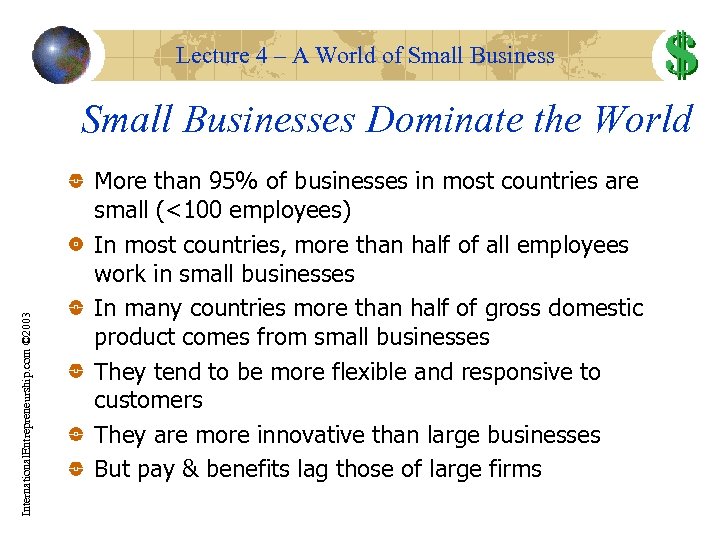 Lecture 4 – A World of Small Business International. Entrepreneurship. com © 2003 Small Businesses Dominate the World More than 95% of businesses in most countries are small (<100 employees) In most countries, more than half of all employees work in small businesses In many countries more than half of gross domestic product comes from small businesses They tend to be more flexible and responsive to customers They are more innovative than large businesses But pay & benefits lag those of large firms
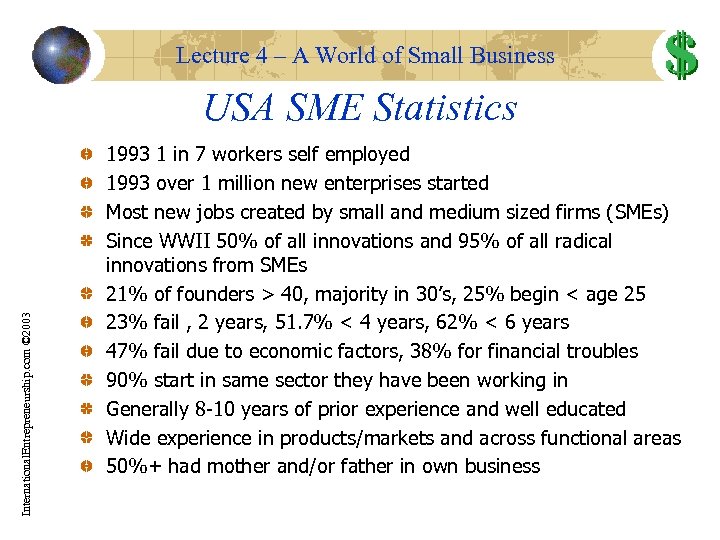 Lecture 4 – A World of Small Business International. Entrepreneurship. com © 2003 USA SME Statistics 1993 1 in 7 workers self employed 1993 over 1 million new enterprises started Most new jobs created by small and medium sized firms (SMEs) Since WWII 50% of all innovations and 95% of all radical innovations from SMEs 21% of founders > 40, majority in 30’s, 25% begin < age 25 23% fail , 2 years, 51. 7% < 4 years, 62% < 6 years 47% fail due to economic factors, 38% for financial troubles 90% start in same sector they have been working in Generally 8 -10 years of prior experience and well educated Wide experience in products/markets and across functional areas 50%+ had mother and/or father in own business
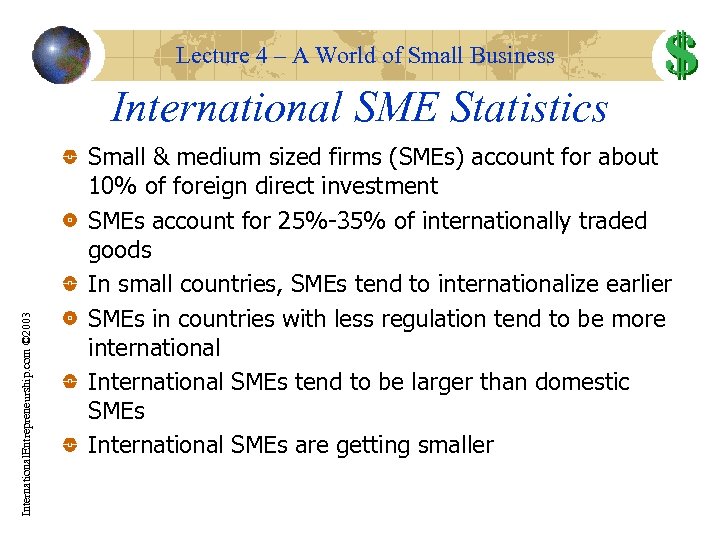 Lecture 4 – A World of Small Business International. Entrepreneurship. com © 2003 International SME Statistics Small & medium sized firms (SMEs) account for about 10% of foreign direct investment SMEs account for 25%-35% of internationally traded goods In small countries, SMEs tend to internationalize earlier SMEs in countries with less regulation tend to be more international International SMEs tend to be larger than domestic SMEs International SMEs are getting smaller
 Lecture 4 – A World of Small Business International. Entrepreneurship. com © 2003 SME Internationalization Practices Often involves little planning Often involves complex combinations of exporting, FDI, licensing, & alliances An independent approach that maintains equity & control is preferred Initial internationalization is often to culturally or geographically close countries Marketing tends to internationalize before management, finance, or R&D
 Lecture 4 – A World of Small Business International. Entrepreneurship. com © 2003 Factors Sustaining SME Internationalization Attention to customers--willingness to adapt products & attention to quality Sufficient time & commitment to international issues by top managers Managers with international experience Reliable & timely information about foreign markets Decreasing trade barriers Internationalization seems to be speeding up What used to take ten years now takes five
 Lecture 4 – A World of Small Business International. Entrepreneurship. com © 2003 Why Go Global Access to other markets. 95% of world’s population is outside USA Spreading of costs and economies of scale (e. g. pharmaceuticals) Declining domestic market. Different life cycles of products in different markets (e. g. old VW Beetle, Singer sewing machines) Increasing regulations or decreasing consumer demand (e. g. Cigarettes, fatty foods) Seasonal differences (opposite seasons create continuous markets) Take advantage of lower costs structures in product creation. Global branding (Coke Cola, Kodak, Microsoft, Caterpillar) economies Global economies of scale (manufacturing, distribution, purchasing, development, HR, services) Competitive edge (exploiting a barrier to entry) Cross subsidization (using global money to target markets)
 Lecture 4 – A World of Small Business International. Entrepreneurship. com © 2003 Global Initiatives by SME’s Requests from foreign customers Follow existing customer internationally Need to match competition Government programs Opening up of markets (EU, NAFTA) Availability of inputs from another country Special technology advantage Diversification of risk, products or markets Chance meetings and personal contacts more important than strategy
 Lecture 4 – A World of Small Business International. Entrepreneurship. com © 2003 SME’s Global Strategies No consistent process Larger ones tend to involve more forward planning Initial entry is normally via sales and marketing Initial entry is normally to nearby country (Holland Belgium, Australia - NZ, USA- Canada) Generally does not occur until employee > 50 Larger SME’s use smaller SME’s in other countries to expand Time to globalize is decreasing Some SME’s begin global (Communications, Internet, Software) Avoid equity dilution in expansion internationally
 Lecture 4 – A World of Small Business International. Entrepreneurship. com © 2003 Industry Influences In mature global industries (autos, aerospace), international SMEs are subcontractors In mature less concentrated industries (textiles, furniture), international SMEs use large firms as distributors In niche markets and new industries (instruments, special software), international SMEs operate independently
 Lecture 4 – A World of Small Business International. Entrepreneurship. com © 2003 Regional Patterns In Europe, SME internationalization is mainly “Europeanization” In Asia, SME internationalization means trade with North Am & Europe, but intra-Asia trade & investment is increasing In North Am, SME internationalization has been among US, Canada, & Mexico, but commerce with Latin America is increasing
 Lecture 4 – A World of Small Business Common Expansion Paths Israel To the US (NYC or Boston), or Amsterdam/London Sweden/Norway International. Entrepreneurship. com © 2003 To northern Europe, London, EU, then US, Japan UK/Ireland To EU and US, late to Japan India To US (CA) and EU (London), little to north Asia Greater China To US, some to EU United States Little global expansion, EU first, then Japan, then Asia
 Lecture 4 – A World of Small Business International. Entrepreneurship. com © 2003 Why are SMEs Important to an Economy Major source of new jobs More flexible and more likely to innovate Higher risk tolerance Will exploit niche opportunities Higher potential of exploiting management and product potential Need to be more effective to survive. Large firms can protect inefficient operations Provides feedstock to large enterprises (products, skills, ideas, markets, people) Provides economic diversity and resilience to national economies
 Lecture 4 – A World of Small Business International. Entrepreneurship. com © 2003 The Role of the SME’s in the Global Economy 25 -35% of world manufactured exports Exports account for 4 -6% GDP for OECD and 12% for Asia 1% of SME are global - about 30, 000 -40, 000 manufacturing firms in the OECD countries 5 -10% of SME are internationalized - about 150, 000 - 300, 000 firms in OECD countries 10 -20% derive 10 -40% of turnover from international activity - about 300, 000 - 600, 000 firms in OECD countries SME’s grow 2 -3 times faster than their economies 99% of all firms, 30 -70% of GDP, 50 -70% of employment In OECD countries up to 70% of net new jobs created by SME’s 10% of SME’s make FDI 10 -15% of SME’s have franchises, licenses, other arrangements with external firms Tend to be more efficient, higher R&D, 25% last > 5 years
 Lecture 4 – A World of Small Business International. Entrepreneurship. com © 2003 Future Growth of Global SME’s § § § § Advancing technology will make SME internationalization easier & cheaper Increasing globalization of industries, especially in services, will require SME internationalization Deregulation will favor SME internationalization The internationalization SMEs will accelerate Trade & investment opportunities will change Deregulation, privatization and the liberalization of trade and investment regimes Integration of markets (EU, NAFTA) lowering barriers to trade Increased international sourcing by large enterprises Reduction in administrative procedures, wider adoption of standards High technology tends to globalise faster even for SME’s Changing attitudes towards working internationally Many countries now offering advice, finance and market assistance for exporting Improved efficiency through innovation, communication and cost of transport
 Lecture 4 – A World of Small Business International. Entrepreneurship. com © 2003 C-Corp Partnership Sole Proprietorship S-Corp LLC 401 c 3 Tax and Tort Issues Cost of Maintenance Intel. Property Protections Things to Size and Complexity Consider Local Regs. = GA Rt. To Work State Desire to Sell Shares Easily GET A LAWYER!!!!! Types of New Corporations o o o
 Lecture 4 – A World of Small Business C-Corps International. Entrepreneurship. com © 2003 Formation – Greatest Cost of Entity Choices, esp. Maintenance Costs Subscription Document for Stock Corporate Charter with Sec State = Delaware By-Laws Board of Directors Meeting Books, Records, Home Office of Corp. File Reports Autonomous Legal Entity Apart from Shareholders, Officers or Directors Can Sue or Be Sued, Own, Buy, Sell Property = Individual Rights No Real Minority Rights Continuity of Existence Perpetuity Can be Dissolved by Vote of Shareholders or a Court Order
 Lecture 4 – A World of Small Business C-Corps Part 2 Lack of Pass-through Tax Treatment Downside for Small Business = No Flow Through Double Taxation Issues Avoided in Small Businesses by Paying Larger Salaries to Cut Profits International. Entrepreneurship. com © 2003 Limited Liability Shareholders NOT Liable for Corp. Debts Investment is Maximum Sum Risked Even if Owe 100%, Owner Separate Unless ‘Pierces the Corporate Veil’ - Regas and Adelphia in Buffalo – Records, Artifice, Shell Owner NOT Liable for Acts of Employees Personal Guarantees Required Anyway = Jim’s Personal Problem Ease of Adding Investors and Selling Interests Good in Big Business Bad in Small Business (shifting partners) – Shareholder Agreements Changing Type of Business Entity is Painless & Mildly Expensive
 Lecture 4 – A World of Small Business International. Entrepreneurship. com © 2003 Partnerships General and Limited (Liable to Invested Amount) Formation, Maintenance Easy (Agreement Formed, Hopefully) End Usually Foreseen in Agreement (Death) Shared Liability with Partners (Anderson, divorce) ‘Jointly and severally liable for the acts of partners’ (Doctors) Your Home Can Be Seized to Pay Partner’s Debt Selling Business Very Difficult – Easy to Exclude (Law Firms) Income Distributed Pro Rata to Partners who Pay Personal Tax on Income – Hard to Have Retained Earnings Partnership Can Act to Sue, Own
 Lecture 4 – A World of Small Business International. Entrepreneurship. com © 2003 Sole Proprietorship You & the Business Are the Same Basically Selling Very Difficult – Who wants to be you? If You Die, the Business Does Too You Have COMPLETE Liability for Debt, Etc. All Taxable Income Is Yours
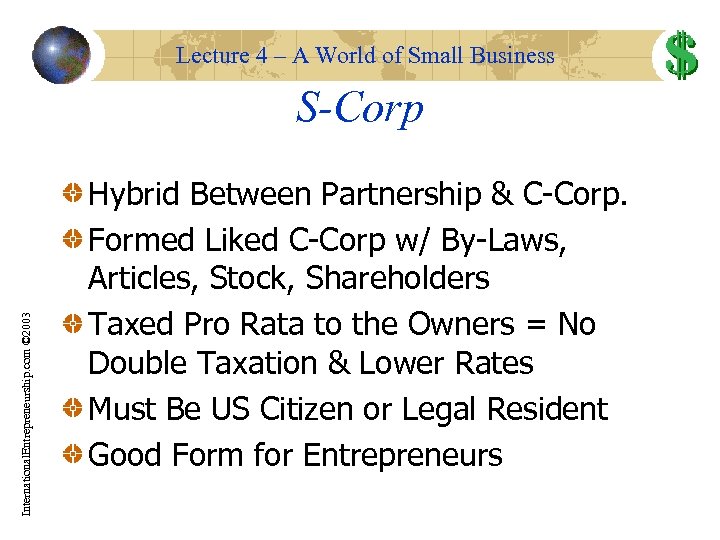 Lecture 4 – A World of Small Business International. Entrepreneurship. com © 2003 S-Corp Hybrid Between Partnership & C-Corp. Formed Liked C-Corp w/ By-Laws, Articles, Stock, Shareholders Taxed Pro Rata to the Owners = No Double Taxation & Lower Rates Must Be US Citizen or Legal Resident Good Form for Entrepreneurs
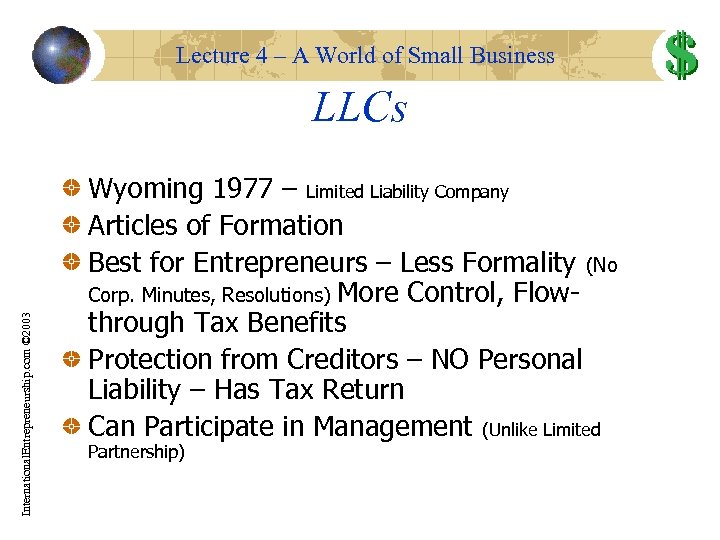 Lecture 4 – A World of Small Business International. Entrepreneurship. com © 2003 LLCs Wyoming 1977 – Limited Liability Company Articles of Formation Best for Entrepreneurs – Less Formality (No Corp. Minutes, Resolutions) More Control, Flowthrough Tax Benefits Protection from Creditors – NO Personal Liability – Has Tax Return Can Participate in Management (Unlike Limited Partnership)
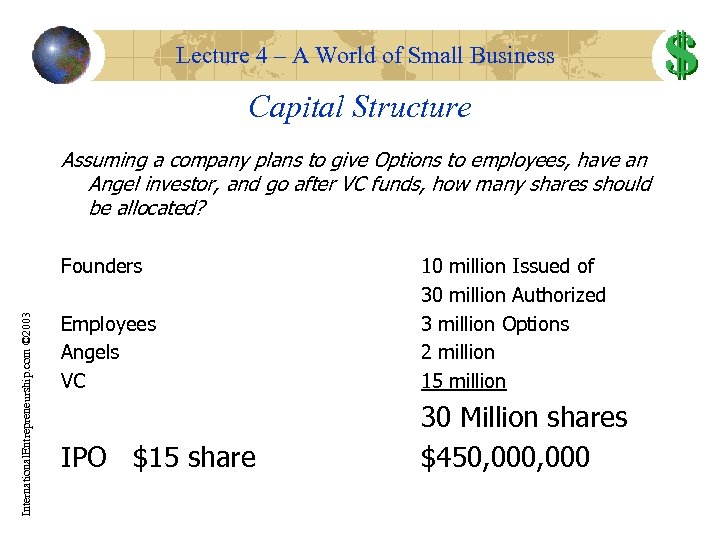 Lecture 4 – A World of Small Business Capital Structure Assuming a company plans to give Options to employees, have an Angel investor, and go after VC funds, how many shares should be allocated? International. Entrepreneurship. com © 2003 Founders Employees Angels VC 10 million Issued of 30 million Authorized 3 million Options 2 million 15 million IPO $15 share 30 Million shares $450, 000