


 Скачать презентацию International Educational Corporation Handouts Topic 3
3 The role of Religious Studies in human culture.pptx
- Количество слайдов: 25
 International Educational Corporation Handouts • Topic № 3 The role of Religious Studies in human culture (Hinduism) • Religious Studies 2016 -2017 years • 2 credits 1/2 Semester • assoc. professor Yerkin Massanov
 The brief content: • 1. The definition of national religion; • 2. Hinduism as a national religion; • 3. The four Caste System.
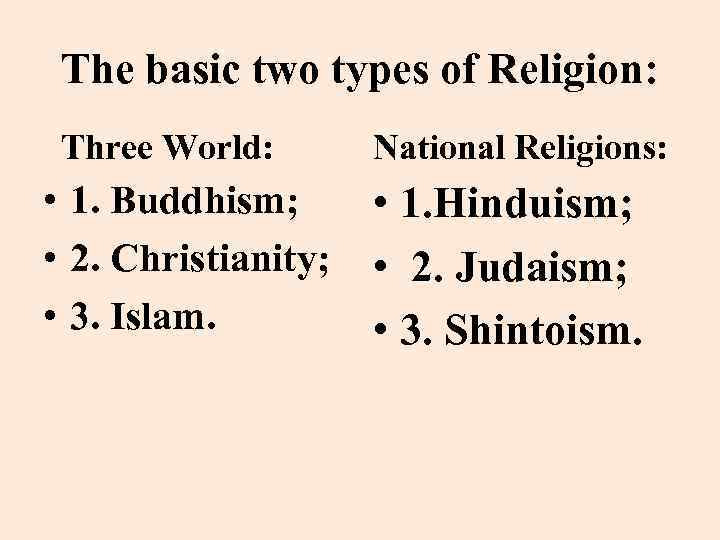 The basic two types of Religion: Three World: • 1. Buddhism; • 2. Christianity; • 3. Islam. National Religions: • 1. Hinduism; • 2. Judaism; • 3. Shintoism.
 The national religion Ø a religion that spread and addressed to a certain nation, nationality, ethnic group. These religions often accompany the process of formation and development of ethnic communities and has therefore act as components of its history.
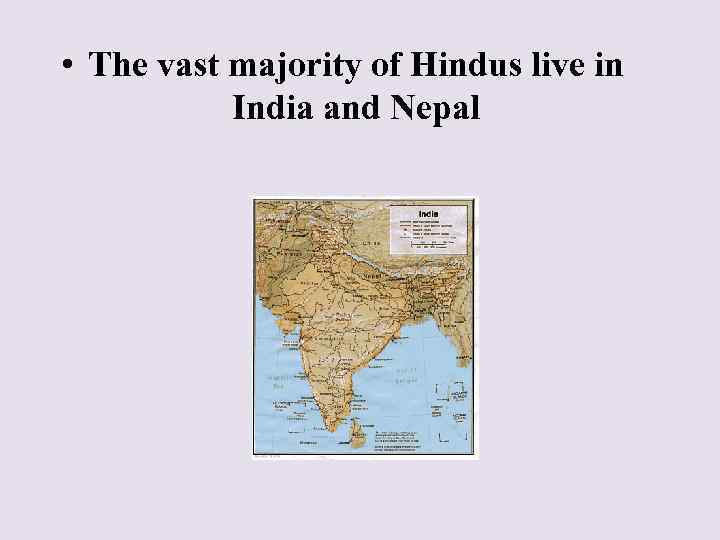 • The vast majority of Hindus live in India and Nepal
 Goal of Hinduism: • Moksha: “release or liberation • United forever with the divine • Infinite bliss and awareness.
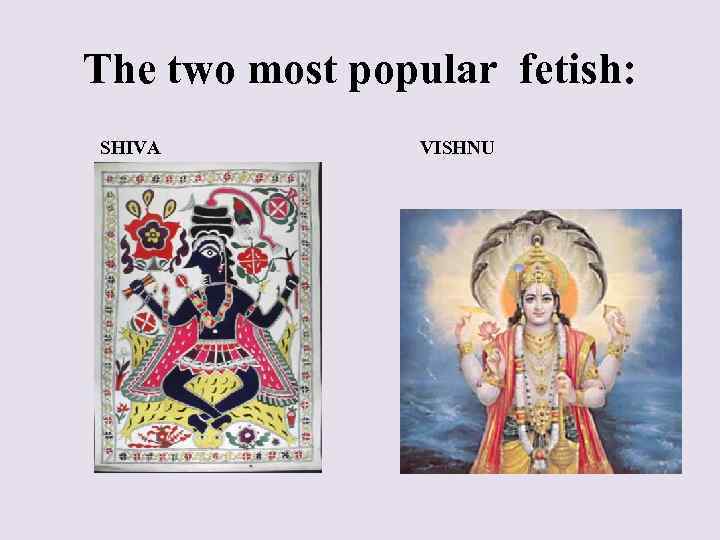 The two most popular fetish: SHIVA VISHNU
 Reincarnation: • Samsara is the wheel of rebirth which means the soul is reborn • from one life form to another. • People may be reincarnated at a higher or lower level of existence depending on their karma from their present life. • People may be reborn as plants or animals or they may be elevated to a higher caste as a human. • Death is not final for Hindus as they expect to be reborn many times.
 Origins of the Hindu Faith: • The earliest records of Hinduism are Aryan • - The Aryans brought their spoken language of Sanskrit to India with them • - This language evolved into written form • - Aryans also brought a rich collection of myths (tales of their many gods they believed controlled the forces of nature) • - Aryan priests memorized long poems and hymns suited to different religious rituals
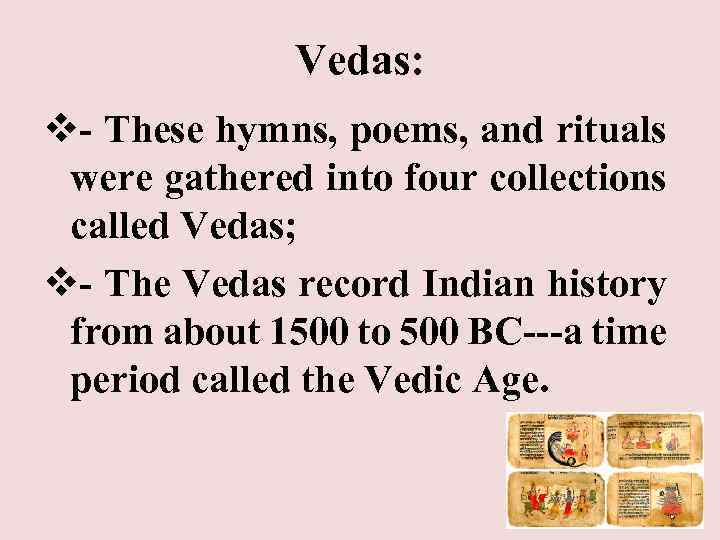 Vedas: v- These hymns, poems, and rituals were gathered into four collections called Vedas; v- The Vedas record Indian history from about 1500 to 500 BC---a time period called the Vedic Age.
 Sacred Texts - Veda: - The oldest and most important Veda is the Rig-Veda; - Rig Veda: Hinduism’s oldest text- nearly 4000 years; - It includes 1, 028 hymns of praise;
 The Term Moksha: • All wise Hindus must seek to reach a state of perfect understanding called moksha. At this point the self will disappear and merge with Brahman.
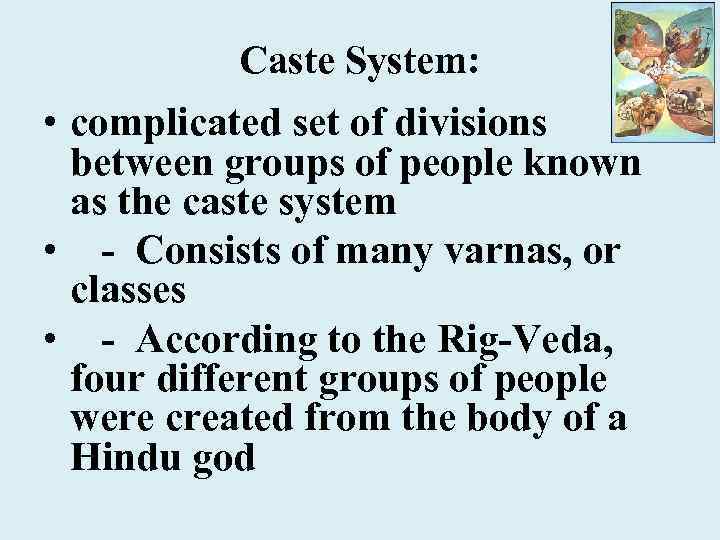 Caste System: • complicated set of divisions between groups of people known as the caste system • - Consists of many varnas, or classes • - According to the Rig-Veda, four different groups of people were created from the body of a Hindu god
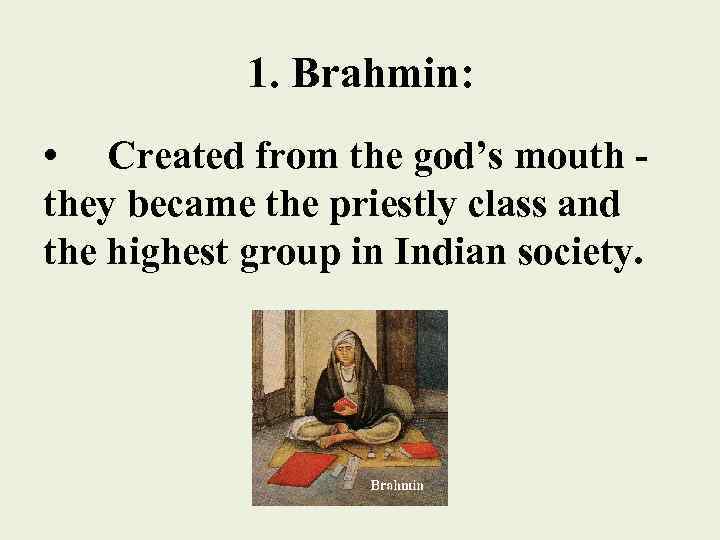 1. Brahmin: • Created from the god’s mouth they became the priestly class and the highest group in Indian society.
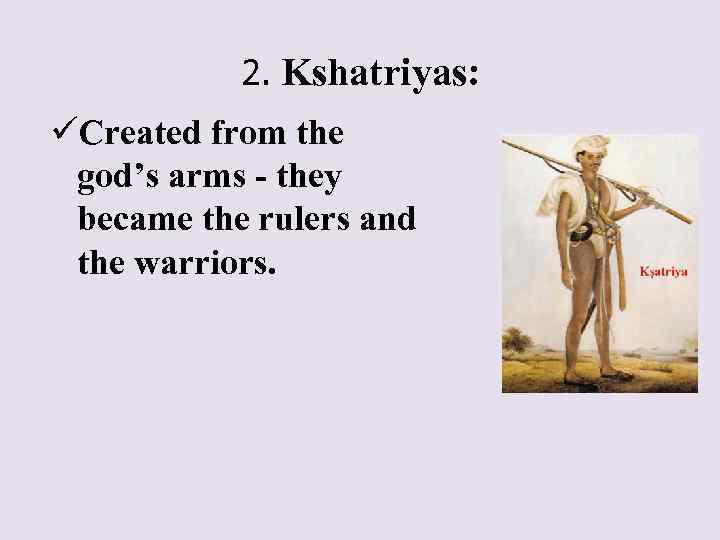 2. Kshatriyas: üCreated from the god’s arms - they became the rulers and the warriors.
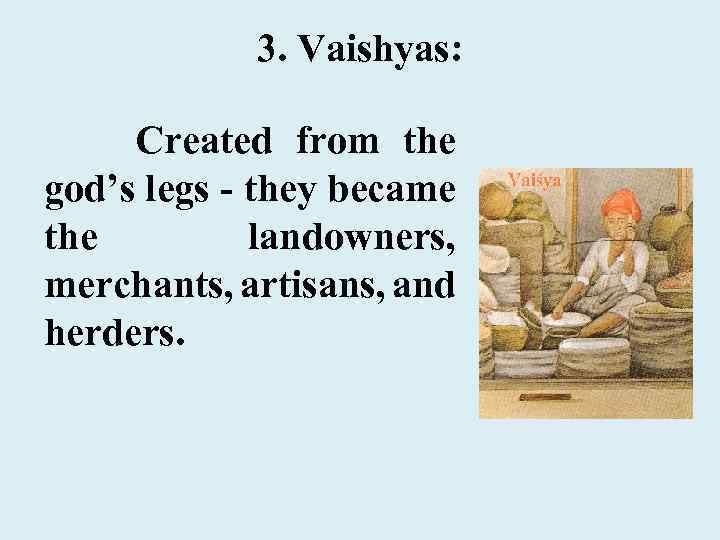 3. Vaishyas: Created from the god’s legs - they became the landowners, merchants, artisans, and herders.
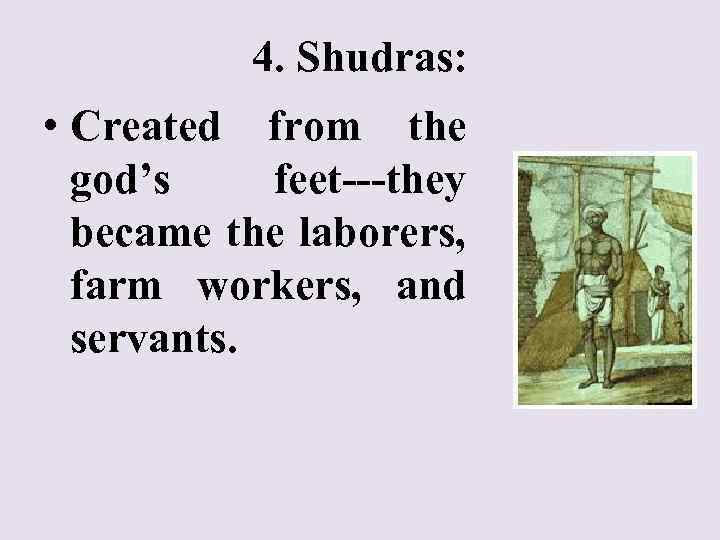 4. Shudras: • Created from the god’s feet---they became the laborers, farm workers, and servants.
 Four Stages of Life: • 1. Stage One: Student stage • 2. Stage Two: Householder • 3. Stage Three: Forest-dweller after the birth of first grandchild • 4. Stage Four: Sannyasin wondering ascetic
 The Upanishads teach that: Ø A universal spirit is present within all living things - Brahman. This is thought to be the mighty spirit that creates and destroys life Ø The Brahman is One but expresses itself as Many Ø Everything in nature is tied together by Brahman Ø Because all living things are considered a part of Brahman, Hindus forbade the killing of animals
 Upanishads: Ø Around 400 BC, the wisest Hindu teachers tried to interpret and explain the hidden meanings of the Vedic hymns and rituals Ø Their answers were recorded in a collection of essays called the Upanishads.
 Karma & Dharma: • Karma: “action” or “deeds” • Every action produces a Justified effect based on its moral worthiness. • Karma determines all the particular circumstances and Situations of one’s life. • Dharma: ethical duty based on the divine order of reality. The word is the closest equivalent to “religion. ”
 Dharma: • To earn good rebirth a person had to be a good member of his or her caste • - Each caste had its particular duty or set of obligations called dharma • - The individual’s wishes did not matter • - It was better to do your duty badly than to do someone else’s duty well.
 Karma: : • Hindus believed in an ethical law of cause and effect called karma • - Moral behavior in one life guaranteed rebirth in a higher caste • -Immoral behavior automatically dropped a reborn soul to a lower caste
 The Ganges River: • Falling from. Its source of Vishnu’s feet onto hiva’s head and out from his hair, the water of the Ganges is sacred enough to purify all sins.
 The control questions: • 1. The main differences of National religion? • 2. Basic Idea of Hindu Religion? • 3. Give description of concepts: Karma, Dharma, Reincarnation and Moksha etc.