


 Скачать презентацию INTERNATIONAL ECONOMICS THEORY APPLICATION AND POLICY Charles van
26dcd274764e17346a60c9bf2e5e0af3.ppt
- Количество слайдов: 7
 INTERNATIONAL ECONOMICS: THEORY, APPLICATION, AND POLICY; Charles van Marrewijk, 2006; 1 Comparative advantage (technology differences) International trade based on differences in technology assumptions • 2 countries; A and B • 2 goods; X and Y • 1 factor of production; labor L • Constant returns to scale; CRS • Labor mobility between sectors, not between countries • Perfect competition • No transport costs unit labor requirement = units of labor required to produce one unit of a final good By assumption this is independent of the number of laborers active in a sector (CRS), but may differ between the two countries. Let ax be the unit labor requirement for good X in country A, etc
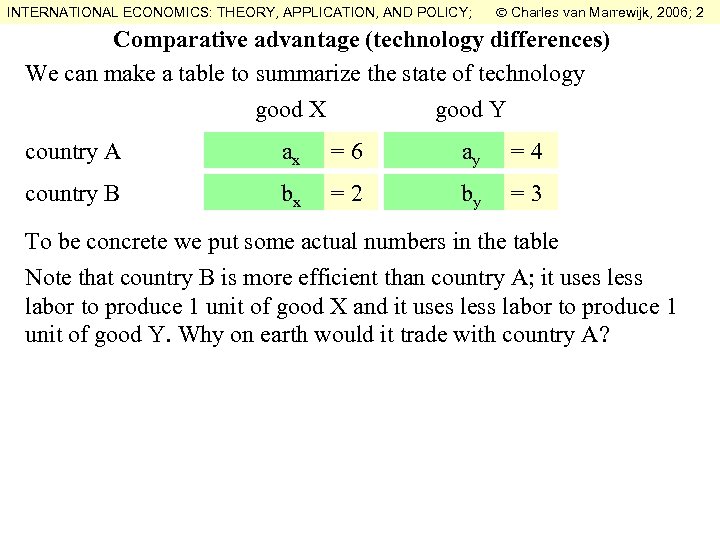 INTERNATIONAL ECONOMICS: THEORY, APPLICATION, AND POLICY; Charles van Marrewijk, 2006; 2 Comparative advantage (technology differences) We can make a table to summarize the state of technology good X good Y country A ax =6 ay =4 country B bx =2 by =3 To be concrete we put some actual numbers in the table Note that country B is more efficient than country A; it uses less labor to produce 1 unit of good X and it uses less labor to produce 1 unit of good Y. Why on earth would it trade with country A?
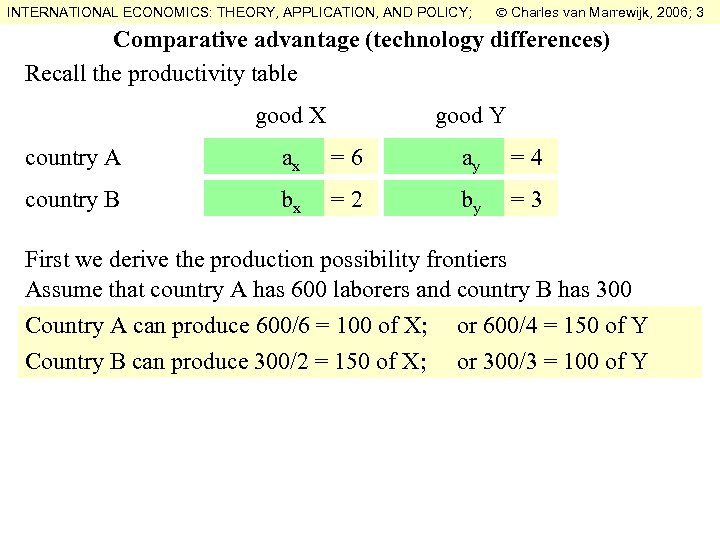 INTERNATIONAL ECONOMICS: THEORY, APPLICATION, AND POLICY; Charles van Marrewijk, 2006; 3 Comparative advantage (technology differences) Recall the productivity table good X good Y country A ax =6 ay =4 country B bx =2 by =3 First we derive the production possibility frontiers Assume that country A has 600 laborers and country B has 300 Country A can produce 600/6 = 100 of X; or 600/4 = 150 of Y Country B can produce 300/2 = 150 of X; or 300/3 = 100 of Y
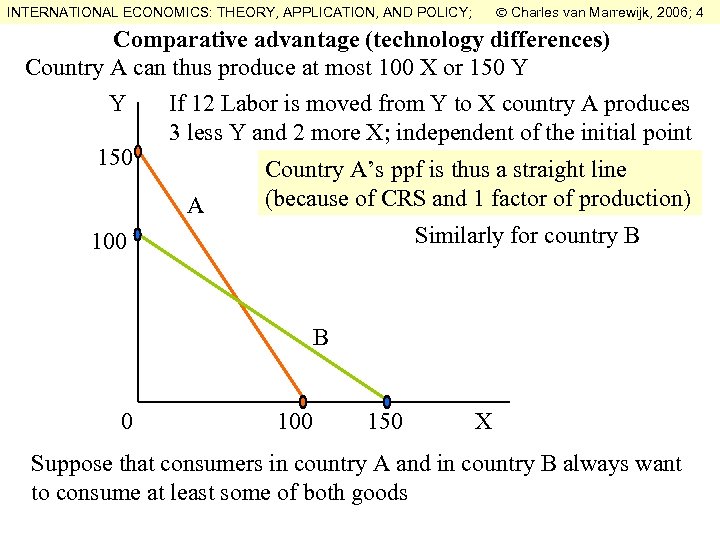 Charles van Marrewijk, 2006; 4 INTERNATIONAL ECONOMICS: THEORY, APPLICATION, AND POLICY; Comparative advantage (technology differences) Country A can thus produce at most 100 X or 150 Y If 12 Labor is moved from Y to X country A produces Y 3 less Y and 2 more X; independent of the initial point 150 Country A’s ppf is thus a straight line A (because of CRS and 1 factor of production) Similarly for country B 100 B 0 100 150 X Suppose that consumers in country A and in country B always want to consume at least some of both goods
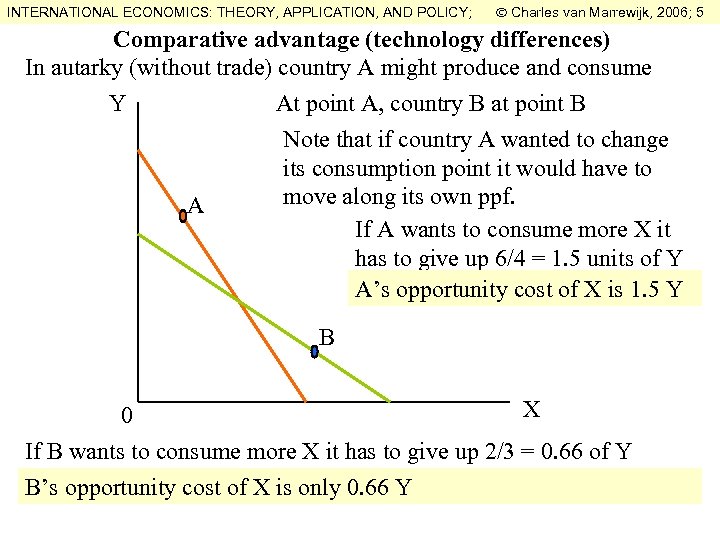 INTERNATIONAL ECONOMICS: THEORY, APPLICATION, AND POLICY; Charles van Marrewijk, 2006; 5 Comparative advantage (technology differences) In autarky (without trade) country A might produce and consume At point A, country B at point B Y Note that if country A wanted to change its consumption point it would have to move along its own ppf. A If A wants to consume more X it has to give up 6/4 = 1. 5 units of Y A’s opportunity cost of X is 1. 5 Y B X 0 If B wants to consume more X it has to give up 2/3 = 0. 66 of Y B’s opportunity cost of X is only 0. 66 Y
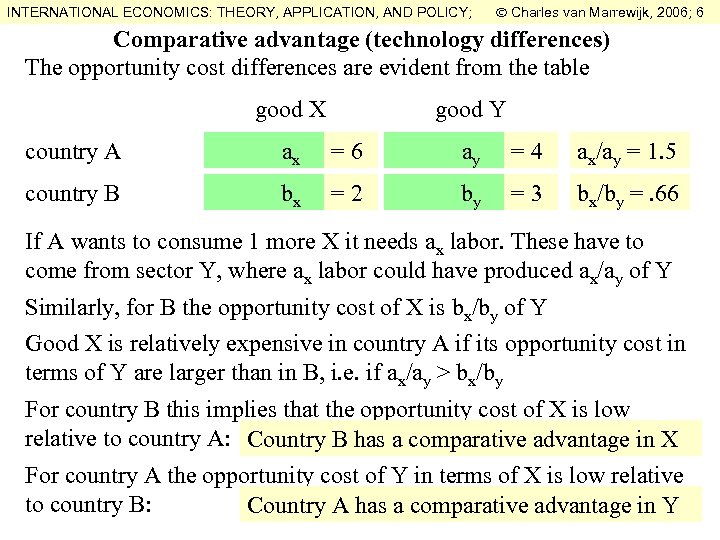 INTERNATIONAL ECONOMICS: THEORY, APPLICATION, AND POLICY; Charles van Marrewijk, 2006; 6 Comparative advantage (technology differences) The opportunity cost differences are evident from the table good X good Y country A ax =6 ay =4 ax/ay = 1. 5 country B bx =2 by =3 bx/by =. 66 If A wants to consume 1 more X it needs ax labor. These have to come from sector Y, where ax labor could have produced ax/ay of Y Similarly, for B the opportunity cost of X is bx/by of Y Good X is relatively expensive in country A if its opportunity cost in terms of Y are larger than in B, i. e. if ax/ay > bx/by For country B this implies that the opportunity cost of X is low relative to country A: Country B has a comparative advantage in X For country A the opportunity cost of Y in terms of X is low relative to country B: Country A has a comparative advantage in Y
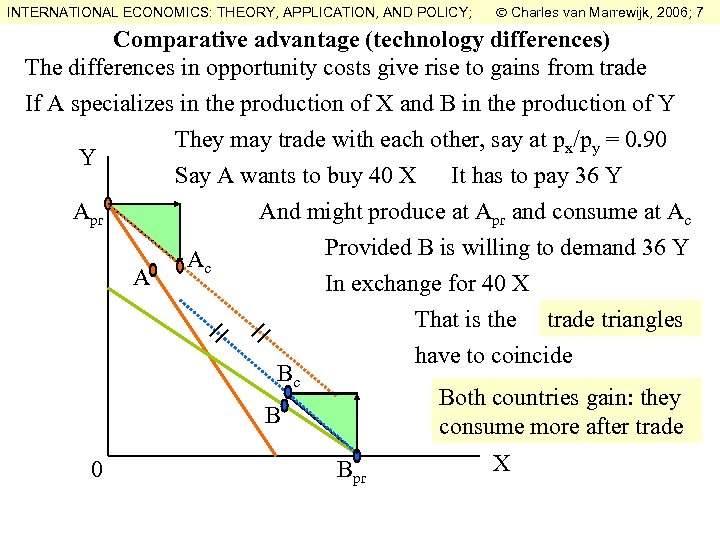 INTERNATIONAL ECONOMICS: THEORY, APPLICATION, AND POLICY; Charles van Marrewijk, 2006; 7 Comparative advantage (technology differences) The differences in opportunity costs give rise to gains from trade If A specializes in the production of X and B in the production of Y They may trade with each other, say at px/py = 0. 90 Y Say A wants to buy 40 X It has to pay 36 Y And might produce at Apr and consume at Ac Apr Provided B is willing to demand 36 Y Ac A In exchange for 40 X That is the trade triangles have to coincide Bc Both countries gain: they B consume more after trade 0 Bpr X