


 Скачать презентацию International Economic Policies Governance and the New Economics
222d69bcfb3cee45856cdc05e51f6062.ppt
- Количество слайдов: 14
 International Economic Policies, Governance and the New Economics Thursday 12 April 2012 St Catharine's College A Progressive International Monetary System: Growth enhancing, speculation reducing and cross-country equity John Weeks Professor Emeritus SOAS, University of London
 I treat open economy adjustment in detail in my book: (2012), The Irreconcilable Inconsistencies of Neoclassical Macroeconomics (Routledge) Chap 12 -14 And in "Open Economy Monetary Policy Reconsidered, " Review of Political Economy (forthcoming, Issue 1, 2013) [PDF's available]
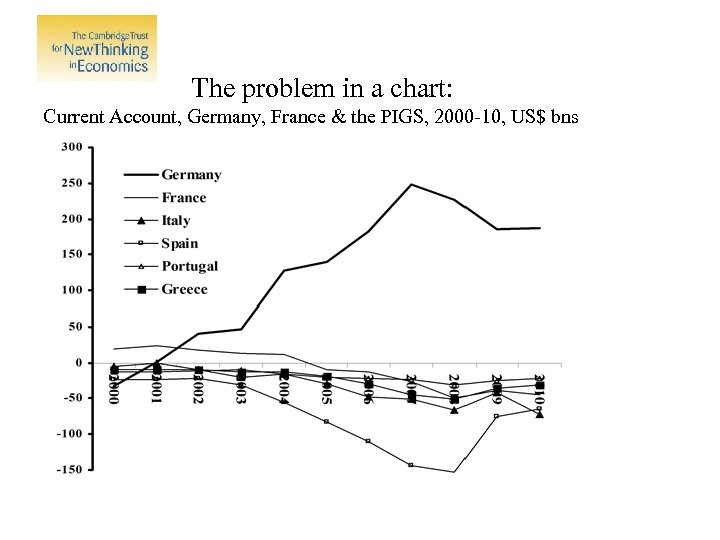 The problem in a chart: Current Account, Germany, France & the PIGS, 2000 -10, US$ bns
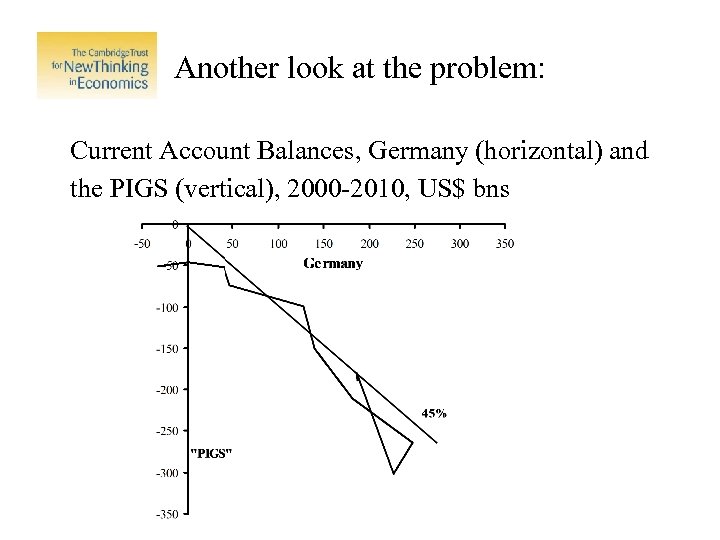 Another look at the problem: Current Account Balances, Germany (horizontal) and the PIGS (vertical), 2000 -2010, US$ bns
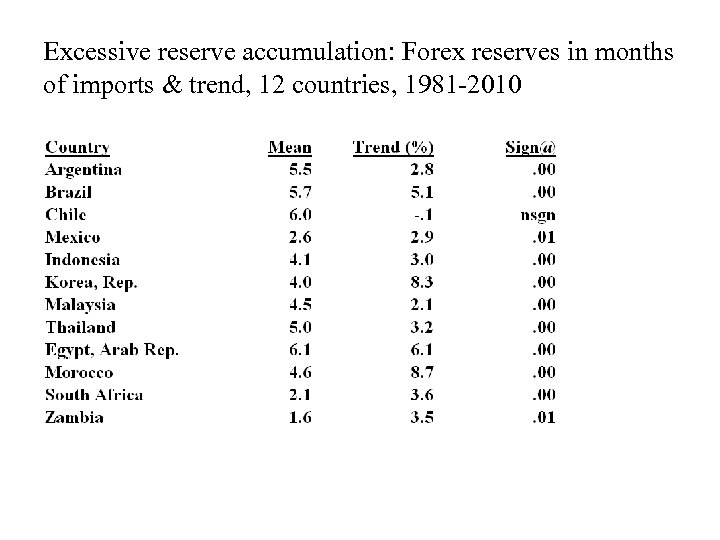 Excessive reserve accumulation: Forex reserves in months of imports & trend, 12 countries, 1981 -2010
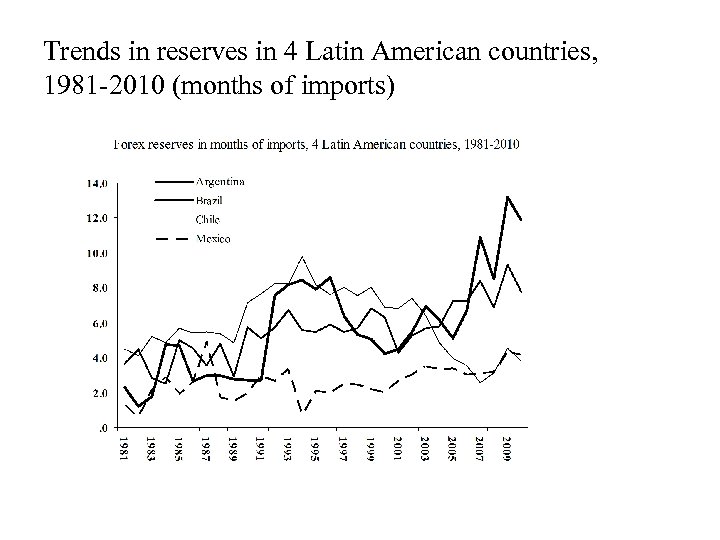 Trends in reserves in 4 Latin American countries, 1981 -2010 (months of imports)
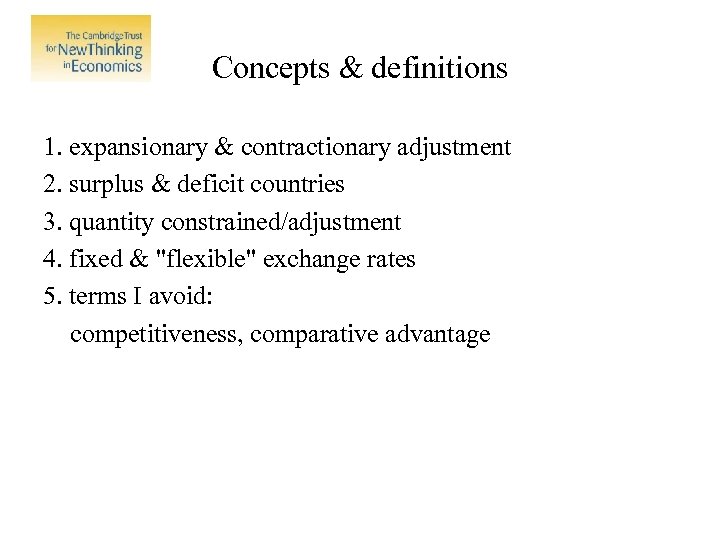 Concepts & definitions 1. expansionary & contractionary adjustment 2. surplus & deficit countries 3. quantity constrained/adjustment 4. fixed & "flexible" exchange rates 5. terms I avoid: competitiveness, comparative advantage
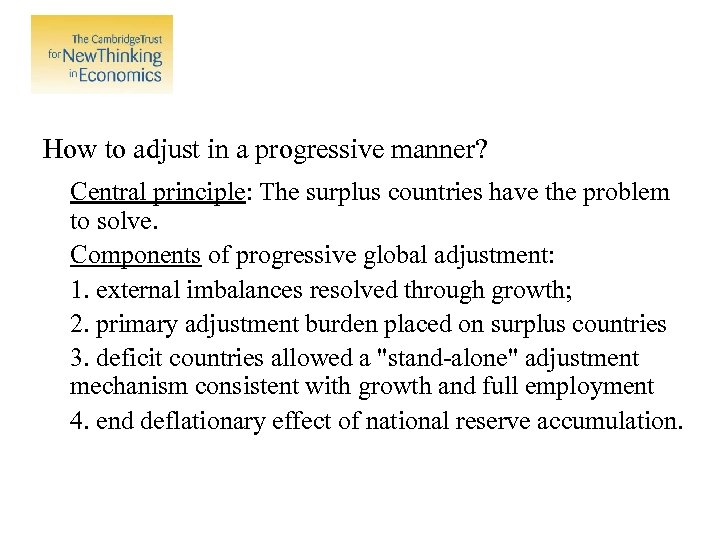 How to adjust in a progressive manner? Central principle: The surplus countries have the problem to solve. Components of progressive global adjustment: 1. external imbalances resolved through growth; 2. primary adjustment burden placed on surplus countries 3. deficit countries allowed a "stand-alone" adjustment mechanism consistent with growth and full employment 4. end deflationary effect of national reserve accumulation.
 Problems & solutions: 1. Nominal exchange rate instability & speculation Global unit of account & store of value, managed by a global financial institution that is lender & currency buyers of last resort (e. g. , Keynes' Bancor plan) 2. Correction of national external imbalances Sanctions for surplus countries, short term internal adjustment mechanisms for deficit countries
 External deficit reduction 1. Critique of Mundell-Fleming inherent instability of adjustment 2. The exchange rate mechanism - under quantity constraint (less than full employment) - supply elasticities
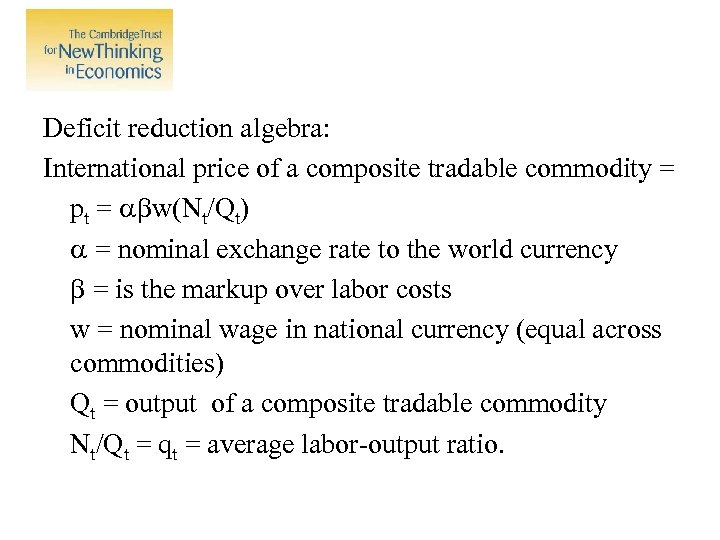 Deficit reduction algebra: International price of a composite tradable commodity = pt = abw(Nt/Qt) a = nominal exchange rate to the world currency b = is the markup over labor costs w = nominal wage in national currency (equal across commodities) Qt = output of a composite tradable commodity Nt/Qt = qt = average labor-output ratio.
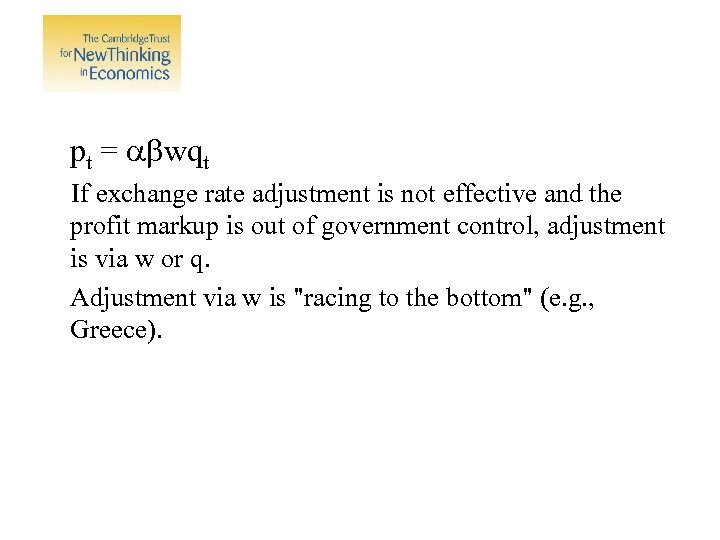 pt = abwqt If exchange rate adjustment is not effective and the profit markup is out of government control, adjustment is via w or q. Adjustment via w is "racing to the bottom" (e. g. , Greece).
 External deficit reduction via q has two components: 1. medium and long term: public investment to lower total unit costs of tradables 2. short term: transitory and targeted import restrictions and export subsidies
 A Progressive Global Monetary System Summarized: 1. Global financial institution (lender & buyer of last resort) 2. Global unit of account & store of value (recycling of surpluses) 3. Penalties for persistent surpluses 4. "Stand alone" mechanisms for short term reduction of external deficits (import restrictions and export subsidies)