


 Скачать презентацию International Dimensions of Monetary and Fiscal Policy Chapter
c93a8976f8e3e7de377f59447561d5b4.ppt
- Количество слайдов: 91
 International Dimensions of Monetary and Fiscal Policy Chapter 17 © 2003 Mc. Graw-Hill Ryerson Limited.
 17 - 2 Ambiguous International Goals of Macroeconomic Policy u Macroeconomics’ international goals are less straightforward than its domestic goals. © 2003 Mc. Graw-Hill Ryerson Limited.
 17 - 3 Ambiguous International Goals of Macroeconomic Policy u There is great debate about how Canada should maintain its position in the world economy. © 2003 Mc. Graw-Hill Ryerson Limited.
 17 - 4 Ambiguous International Goals of Macroeconomic Policy Do we want a high or a low value for our currency? u Do we want a balance of trade surplus or a trade deficit? u Should we even pay attention to the balance of trade? u © 2003 Mc. Graw-Hill Ryerson Limited.
 17 - 5 The Exchange Rate Goal A high value for a currency has advantages and disadvantages. u Depending on the state of the economy, there arguments both for high and low exchange rates. u © 2003 Mc. Graw-Hill Ryerson Limited.
 17 - 6 Advantages of a High Value for the Dollar It makes foreign currencies cheaper. u It lowers the price of imports. u © 2003 Mc. Graw-Hill Ryerson Limited.
 17 - 7 Advantages of a High Value for the Dollar Lower import prices puts competitive pressure on domestic firms and helps to keep down inflation. u Canadian residents’ living standards are enhanced. u © 2003 Mc. Graw-Hill Ryerson Limited.
 17 - 8 Advantages of a High Exchange Rate u A low value for the dollar has the opposite effect. © 2003 Mc. Graw-Hill Ryerson Limited.
 17 - 9 Disadvantages of a High Value for the Dollar A high value for a currency encourages imports and discourages exports. u It can cause a trade deficit that can have a contractionary effect of the economy by decreasing aggregate demand for domestic output. u © 2003 Mc. Graw-Hill Ryerson Limited.
 17 - 10 Disadvantages of a High Value for the Dollar u A low exchange rate has the opposite effect. © 2003 Mc. Graw-Hill Ryerson Limited.
 17 - 11 The Exchange Rate Goal u Because of the divergent views, some economists argue that government should simply accept whatever exchange rate exists and not consider it in its conduct of monetary and fiscal policies. © 2003 Mc. Graw-Hill Ryerson Limited.
 17 - 12 The Trade Balance Goal u A deficit in the trade balance means that, as a country, we are consuming more than we are producing. balance – the difference between imports and exports. l Trade © 2003 Mc. Graw-Hill Ryerson Limited.
 17 - 13 The Trade Balance Goal There is a debate about whether we should worry about a trade deficit or not. u A trade deficit is not without costs. u We pay for a trade deficit by selling off Canadian assets to foreigners. u © 2003 Mc. Graw-Hill Ryerson Limited.
 17 - 14 The Trade Balance Goal u All the future interest and profits on those assets will flow to foreigners, not Canadian citizens. © 2003 Mc. Graw-Hill Ryerson Limited.
 17 - 15 The Trade Balance Goal u Eventually, we will have to produce more than we consume so that we can pay them their profit and interest on their assets. © 2003 Mc. Graw-Hill Ryerson Limited.
 17 - 16 The Trade Balance Goal u In the short-run a trade deficit allows more current consumption, in the long run it presents problems. © 2003 Mc. Graw-Hill Ryerson Limited.
 17 - 17 International versus Domestic Goals Domestic goals generally dominate international goals. u International goals are ambiguous. u © 2003 Mc. Graw-Hill Ryerson Limited.
 17 - 18 International versus Domestic Goals International goals affect a country’s population indirectly. u In politics, indirect effects take a back seat. u © 2003 Mc. Graw-Hill Ryerson Limited.
 17 - 19 International versus Domestic Goals u When a nation is forced to face certain economic facts (threats by other countries that they must limit their imports), international goals can become its primary goals. © 2003 Mc. Graw-Hill Ryerson Limited.
 17 - 20 International versus Domestic Goals u As countries become more economically integrated, these pressures from other countries become more important. © 2003 Mc. Graw-Hill Ryerson Limited.
 17 - 21 Monetary and Fiscal Policy with Fixed Exchange Rates u An economy with fixed exchange rates is much more restricted in its monetary and fiscal policies than one with flexible exchange rates. © 2003 Mc. Graw-Hill Ryerson Limited.
 17 - 22 Monetary and Fiscal Policy with Fixed Exchange Rates u The reason is that the amount of currency stabilization that can be achieved with direct intervention is quite small, since a country's foreign reserves are limited. © 2003 Mc. Graw-Hill Ryerson Limited.
 17 - 23 Monetary and Fiscal Policy with Fixed Exchange Rates u If foreign reserves are limited, a country must adjust its economy to maintain the value of its currency. © 2003 Mc. Graw-Hill Ryerson Limited.
 17 - 24 Raising the Value of the Euro Using Monetary and Fiscal Policy u There are three options for raising the value of the euro: l Increase the private demand for euros via contractionary monetary policy. l Decrease the private supply of euros via contractionary monetary and fiscal policy. l Use some combination of both. © 2003 Mc. Graw-Hill Ryerson Limited.
 17 - 25 Increase the Private Demand for Euros The primary way to increase the demand for euros in the short run is through contractionary monetary policy. u The interest rate will increase which increases the demand for the countries’ interest-bearing assets. u © 2003 Mc. Graw-Hill Ryerson Limited.
 17 - 26 Increase the Private Demand for Euros The problem? u The area can achieve an interest rate target or an exchange rate target, but not both at the same time. u © 2003 Mc. Graw-Hill Ryerson Limited.
 17 - 27 Decrease the Private Supply of Euros u The private supply of euros can be decreased via contractionary monetary and fiscal policy. © 2003 Mc. Graw-Hill Ryerson Limited.
 17 - 28 Decrease the Private Supply of Euros Contractionary monetary and fiscal policy will create a recession. u The demand for imports will decrease, thereby decreasing the private supply of euros. u © 2003 Mc. Graw-Hill Ryerson Limited.
 17 - 29 Decrease the Private Supply of Euros The problem? u A purposely induced recession for political reasons is not a very popular decision. u © 2003 Mc. Graw-Hill Ryerson Limited.
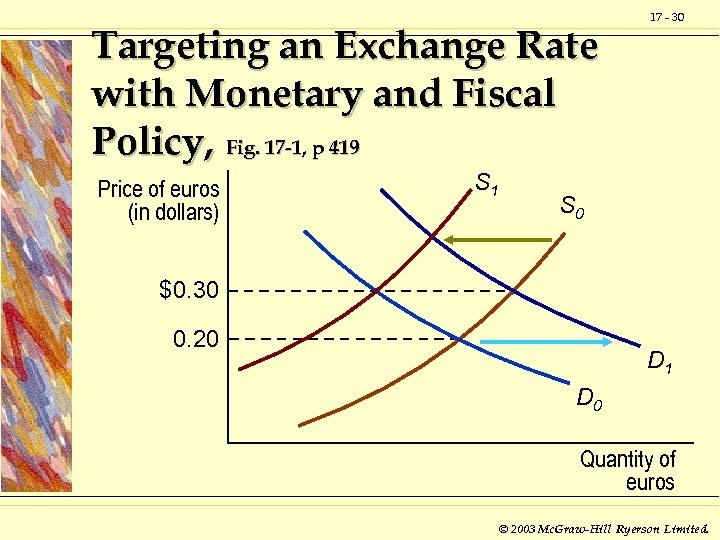 Targeting an Exchange Rate with Monetary and Fiscal Policy, Fig. 17 -1, p 419 Price of euros (in dollars) S 1 17 - 30 S 0 $0. 30 0. 20 D 1 D 0 Quantity of euros © 2003 Mc. Graw-Hill Ryerson Limited.
 17 - 31 Monetary and Fiscal Policy with Flexible or Partially Flexible Exchange Rates u Many countries choose flexible or partially flexible exchange rate regimes to avoid the constraints that a fixed exchange rate regime places on domestic monetary and fiscal policy. © 2003 Mc. Graw-Hill Ryerson Limited.
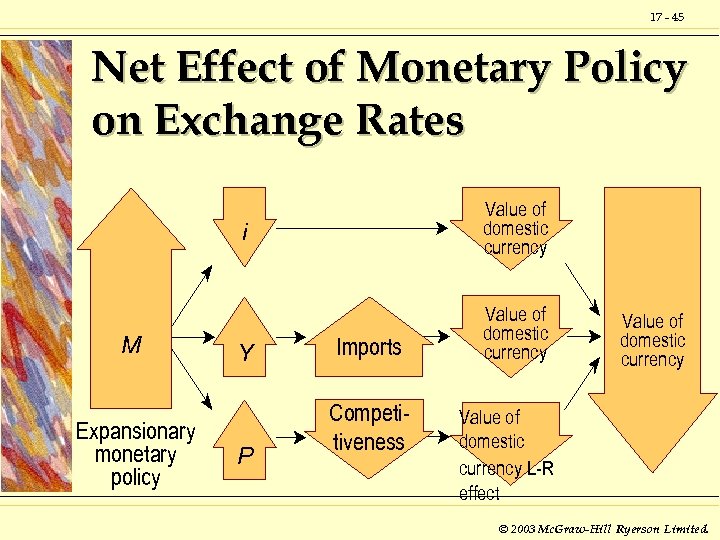
 17 - 32 Monetary Policy’s Effect on Exchange Rates u Monetary policy's effect on exchange rates is felt in three ways: l Through its effect on the interest rate. l Through its effect on income. l Through its effect on price levels and inflation. © 2003 Mc. Graw-Hill Ryerson Limited.
 17 - 33 The Effect on Exchange Rates via Interest Rates An expansionary monetary policy pushes down the Canadian interest rate. u Lower interest rates decrease foreign capital inflow into Canada. u © 2003 Mc. Graw-Hill Ryerson Limited.
 17 - 34 The Effect on Exchange Rates via Interest Rates Less foreign capital inflow decreases the demand for dollars. u Lower demand for Canadian dollars decreases the exchange. u © 2003 Mc. Graw-Hill Ryerson Limited.
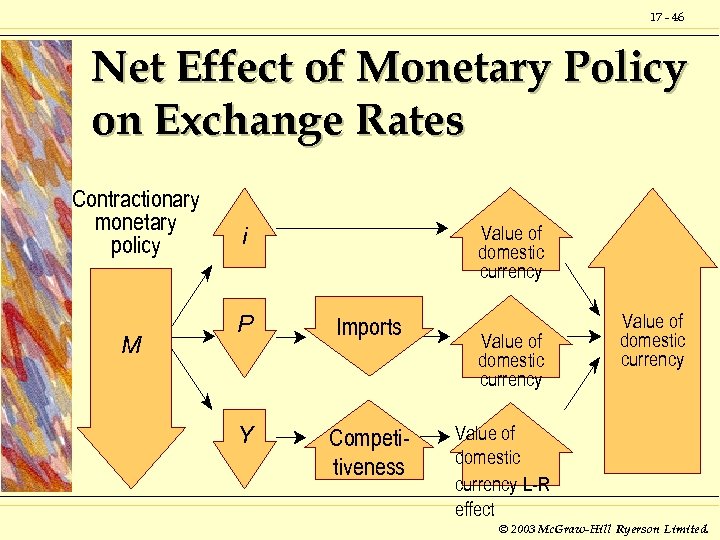
 17 - 35 The Effect on Exchange Rates via Interest Rates A contractionary monetary policy does the opposite. u It raises Canadian interest rate, bringing in the capital from abroad, increasing the demand for dollars and increasing the value of the dollar. u © 2003 Mc. Graw-Hill Ryerson Limited.
 17 - 36 The Effect on Exchange Rates via Income u Monetary policy affects income in a country. l As money supply rises, income expands. l When money supply falls, income contracts. © 2003 Mc. Graw-Hill Ryerson Limited.
 17 - 37 The Effect on Exchange Rates via Income Rising Canada’s income increases the demand for imported goods. u To buy imported goods, Canadian citizens need foreign currency that they must buy with dollars. u © 2003 Mc. Graw-Hill Ryerson Limited.
 17 - 38 The Effect on Exchange Rates via Income u The supply of dollars in the foreign exchange market increases as Canadian citizens sell dollars to buy foreign currencies to pay for the imports. u The increase in the supply of dollars causes its value to decrease. © 2003 Mc. Graw-Hill Ryerson Limited.
 17 - 39 The Effect on Exchange Rates via Price Levels Expansionary monetary policy pushes up the Canadian price level. u As the prices rise relative to foreign prices, Canadian exports become more expensive and goods Canadian imports become cheaper. u © 2003 Mc. Graw-Hill Ryerson Limited.
 17 - 40 The Effect on Exchange Rates via Price Levels u The demand foreign currencies increases and the demand for dollars decreases, pushing the value of the dollar down. © 2003 Mc. Graw-Hill Ryerson Limited.
 17 - 41 The Effect on Exchange Rates via Price Levels u Contractionary monetary policy puts downward pressure on Canadian price level and slows down any existing inflation. © 2003 Mc. Graw-Hill Ryerson Limited.
 17 - 42 The Effect on Exchange Rates via Price Levels u As a result, contractionary monetary policy pushes the value of the dollar up via the price path. © 2003 Mc. Graw-Hill Ryerson Limited.
 17 - 43 The Net Effect of Monetary Policy on Exchange Rates Expansionary monetary policy lowers exchange rates. u It decreases the relative value of a currency. u © 2003 Mc. Graw-Hill Ryerson Limited.
 17 - 44 The Net Effect of Monetary Policy on Exchange Rates Contractionary monetary policy increases exchange rates. u It increases the relative value of a country's currency. u © 2003 Mc. Graw-Hill Ryerson Limited.
 17 - 45 Net Effect of Monetary Policy on Exchange Rates Value of domestic currency i M Expansionary monetary policy Y P Imports Competitiveness Value of domestic currency L-R effect © 2003 Mc. Graw-Hill Ryerson Limited.
 17 - 46 Net Effect of Monetary Policy on Exchange Rates Contractionary monetary policy M Value of domestic currency i P Imports Y Competitiveness Value of domestic currency L-R effect © 2003 Mc. Graw-Hill Ryerson Limited.
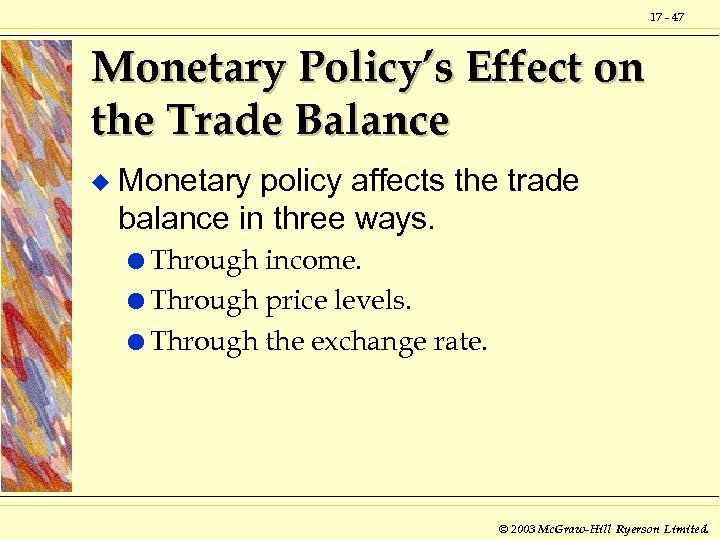 17 - 47 Monetary Policy’s Effect on the Trade Balance u Monetary policy affects the trade balance in three ways. l Through income. l Through price levels. l Through the exchange rate. © 2003 Mc. Graw-Hill Ryerson Limited.
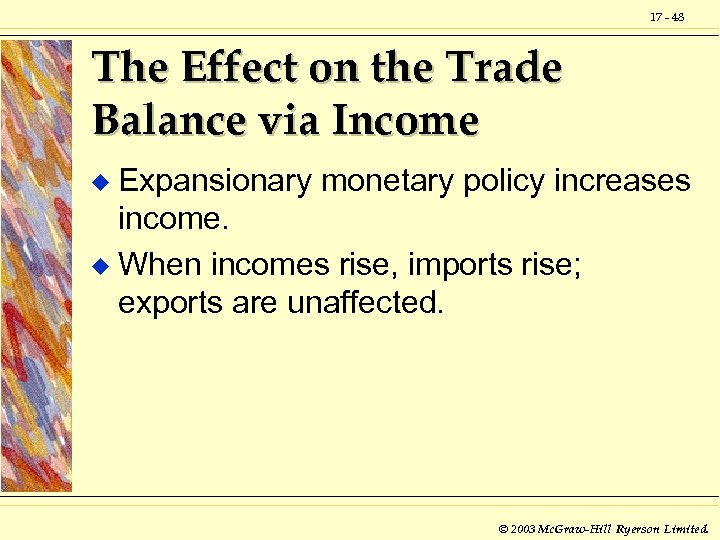 17 - 48 The Effect on the Trade Balance via Income Expansionary monetary policy increases income. u When incomes rise, imports rise; exports are unaffected. u © 2003 Mc. Graw-Hill Ryerson Limited.
 17 - 49 The Effect on the Trade Balance via Income As imports rise, the trade balance shifts in the direction of deficit. u As a result, the trade balance shifts toward a deficit. u © 2003 Mc. Graw-Hill Ryerson Limited.
 17 - 50 The Effect on the Trade Balance via Income Contractionary monetary policy works in the opposite direction. u As a result, the trade balance shifts toward a surplus. u © 2003 Mc. Graw-Hill Ryerson Limited.
 17 - 51 The Effect on the Trade Balance via Price Levels Expansionary monetary policy pushes a country’s price level up. u This decreases it competitiveness. u Trade deficits go up as residents substitute imported for domestic goods. u © 2003 Mc. Graw-Hill Ryerson Limited.
 17 - 52 The Effect on the Trade Balance via Price Levels Contractionary monetary policy works in the opposite direction. u As a result, contractionary monetary policy decreases a trade deficit. u © 2003 Mc. Graw-Hill Ryerson Limited.
 17 - 53 The Effect on the Trade Balance via Price Levels u Monetary policy’s effect on the price level is a long-run effect. © 2003 Mc. Graw-Hill Ryerson Limited.
 17 - 54 The Effect on the Trade Balance via Exchange Rates Expansionary monetary policy decreases the interest rate. u This tends to push the dollar exchange rate down. u This increases Canadian competitiveness which decreases a trade deficit. u © 2003 Mc. Graw-Hill Ryerson Limited.
 17 - 55 The Effect on the Trade Balance via Exchange Rates Contractionary monetary policy works in the opposite direction. u As a result, contractionary monetary policy increases a trade deficit. u © 2003 Mc. Graw-Hill Ryerson Limited.
 17 - 56 The Effect on the Trade Balance via Exchange Rates u Like the price level effect, the effect of the exchange rate on the trade deficit is a long-term effect. © 2003 Mc. Graw-Hill Ryerson Limited.
 17 - 57 The Net Effect of Monetary Policy on the Trade Balance Expansionary monetary policy makes a trade deficit larger. u Contractionary monetary policy makes a trade deficit smaller. u © 2003 Mc. Graw-Hill Ryerson Limited.
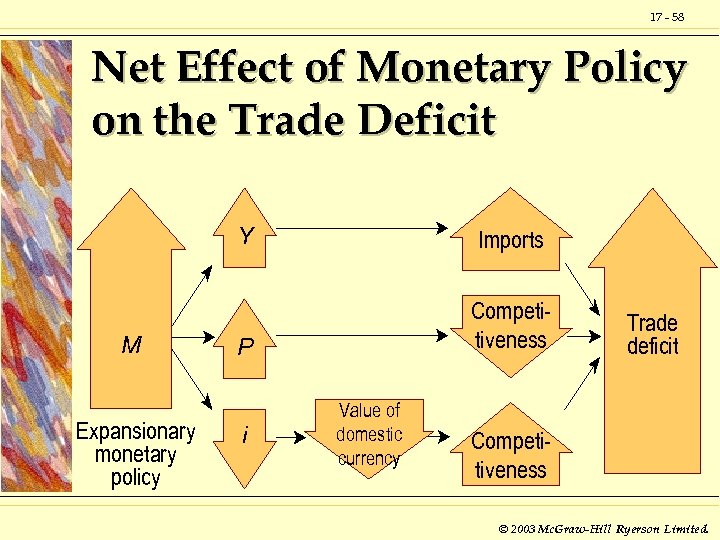 17 - 58 Net Effect of Monetary Policy on the Trade Deficit Y M Expansionary monetary policy Imports P Competitiveness i Value of domestic currency Trade deficit Competitiveness © 2003 Mc. Graw-Hill Ryerson Limited.
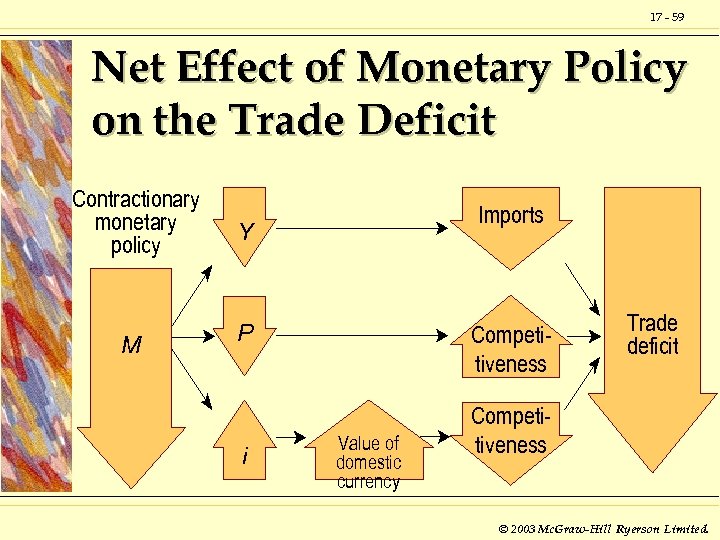 17 - 59 Net Effect of Monetary Policy on the Trade Deficit Contractionary monetary policy Y M P i Imports Competitiveness Value of domestic currency Trade deficit Competitiveness © 2003 Mc. Graw-Hill Ryerson Limited.
 17 - 60 Fiscal Policy’s Effect on Exchange Rates u Fiscal policy affects exchange rates in three ways. l Through income. l Through price. l Through interest rates. © 2003 Mc. Graw-Hill Ryerson Limited.
 17 - 61 The Effect on Exchange Rates via Income Expansionary fiscal policy increases income. u When incomes rise, imports rise; exports are unaffected. u As imports rise, the trade deficit increases and the currency value drops. u © 2003 Mc. Graw-Hill Ryerson Limited.
 17 - 62 The Effect on Exchange Rates via Income Contractionary fiscal policy works in the opposite direction. u Imports decrease and the currency value increases. u © 2003 Mc. Graw-Hill Ryerson Limited.
 17 - 63 The Effect on Exchange Rates via Price Levels Expansionary fiscal policy increases aggregate demand. u The prices of a country’s exports increases. u The competitiveness of a country’s exports decreases and the currency value drops. u © 2003 Mc. Graw-Hill Ryerson Limited.
 17 - 64 The Effect on Exchange Rates via Price Levels Contractionary fiscal policy works in the opposite direction. u The price path is a long-run effect. u © 2003 Mc. Graw-Hill Ryerson Limited.
 17 - 65 The Effect on Exchange Rates via Interest Rates Expansionary fiscal policy increases interest rates because the government sells bonds to finance the deficit. u Higher Canadian interest rates cause foreign capital to flow into Canada. u The dollar value goes up. u © 2003 Mc. Graw-Hill Ryerson Limited.
 17 - 66 The Effect on Exchange Rates via Interest Rates Contractionary fiscal policy works in the opposite direction. u Interest rates decrease, capital flows out of Canada and the value of the dollar decreases. u © 2003 Mc. Graw-Hill Ryerson Limited.
 17 - 67 The Net Effect of Fiscal Policy on Exchange Rates The interest rate effect and the income effect are both short-term effects. u The two work in opposite directions, so the net effect of fiscal policy is ambiguous. u © 2003 Mc. Graw-Hill Ryerson Limited.
 17 - 68 The Net Effect of Fiscal Policy on Exchange Rates u It is unclear what the effect of expansionary or contractionary fiscal policy will be on exchange rates. © 2003 Mc. Graw-Hill Ryerson Limited.
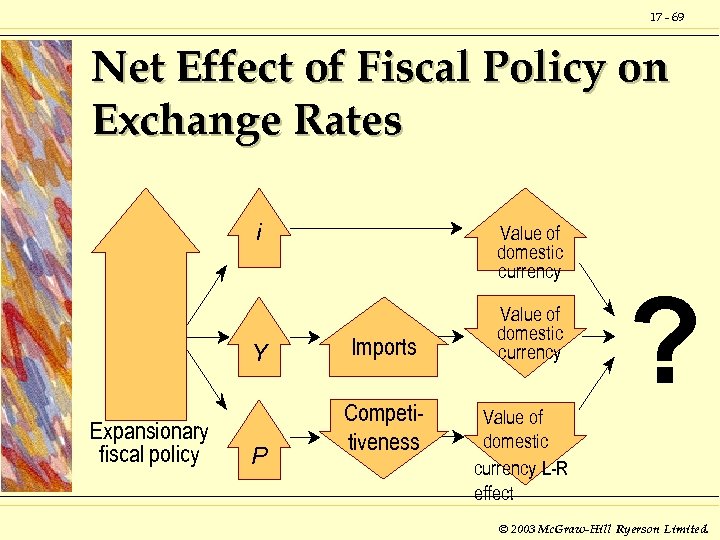 17 - 69 Net Effect of Fiscal Policy on Exchange Rates i Y Expansionary fiscal policy P Value of domestic currency Imports Competitiveness Value of domestic currency L-R effect ? © 2003 Mc. Graw-Hill Ryerson Limited.
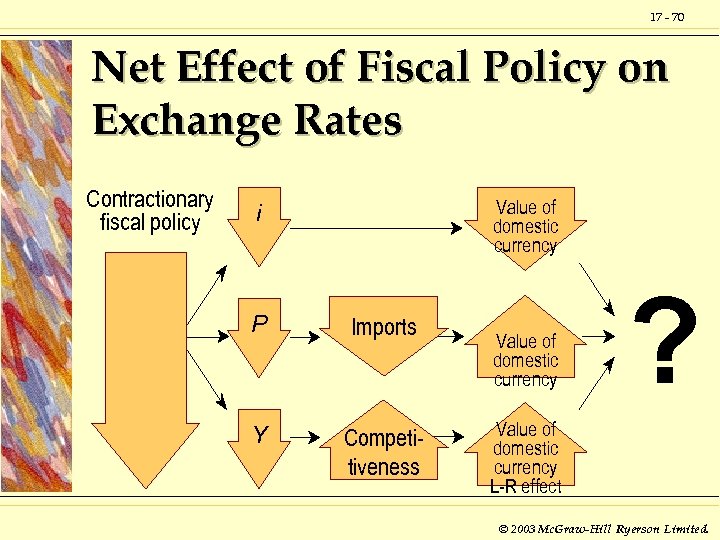 17 - 70 Net Effect of Fiscal Policy on Exchange Rates Contractionary fiscal policy Value of domestic currency i P Imports Y Competitiveness Value of domestic currency ? Value of domestic currency L-R effect © 2003 Mc. Graw-Hill Ryerson Limited.
 17 - 71 Fiscal Policy’s Effect on the Trade Deficit u Fiscal policy works on the trade deficit through its effects on income and prices. © 2003 Mc. Graw-Hill Ryerson Limited.
 17 - 72 The Effect on the Trade Deficit via Income Expansionary fiscal policy increases income. u Imports go up, as does the trade deficit. u © 2003 Mc. Graw-Hill Ryerson Limited.
 17 - 73 The Effect on the Trade Deficit via Income Contractionary fiscal policy works in the opposite direction. u It decreases the size of the trade deficit. u These are the same effects as those of monetary policy. u © 2003 Mc. Graw-Hill Ryerson Limited.
 17 - 74 The Effect on the Trade Deficit via Prices Expansionary fiscal policy increases the price level. u This increases the price of a country’s exports and decreases it competitiveness. u This increases the trade deficit. u © 2003 Mc. Graw-Hill Ryerson Limited.
 17 - 75 The Effect on the Trade Deficit via Prices Contractionary fiscal policy works in the opposite direction. u It decreases the size of the trade deficit. u These are the same effects as those of monetary policy. u © 2003 Mc. Graw-Hill Ryerson Limited.
 17 - 76 The Net Effect of Fiscal Policy on the Trade Deficit Expansionary fiscal policy increases a trade deficit. u Contractionary fiscal policy decreases a trade deficit. u © 2003 Mc. Graw-Hill Ryerson Limited.
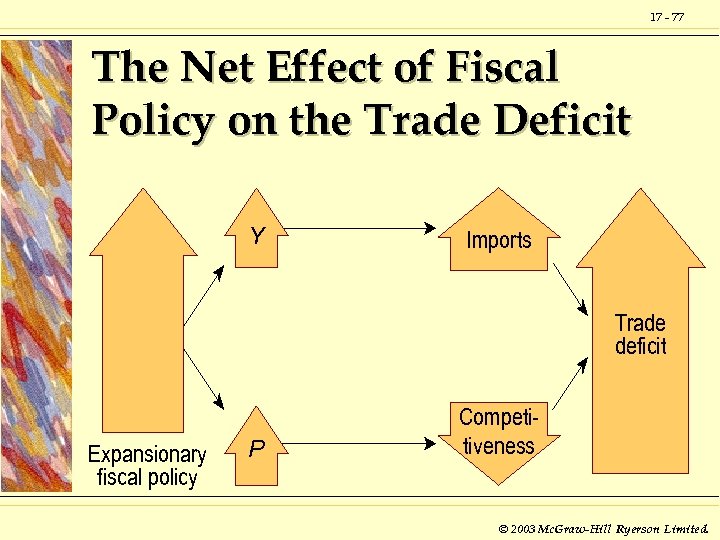 17 - 77 The Net Effect of Fiscal Policy on the Trade Deficit Y Imports Trade deficit Expansionary fiscal policy P Competitiveness © 2003 Mc. Graw-Hill Ryerson Limited.
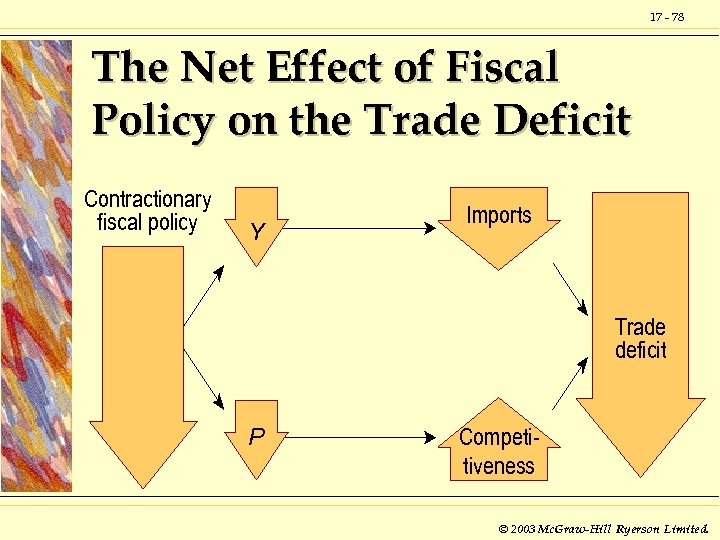 17 - 78 The Net Effect of Fiscal Policy on the Trade Deficit Contractionary fiscal policy Y Imports Trade deficit P Competitiveness © 2003 Mc. Graw-Hill Ryerson Limited.
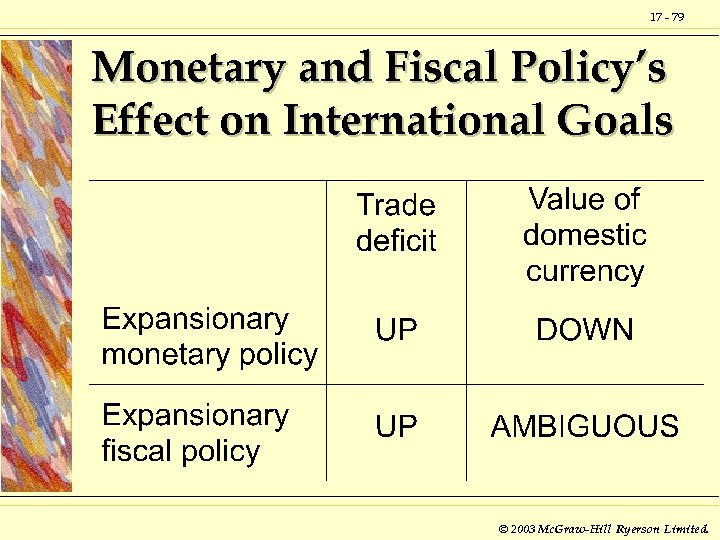 17 - 79 Monetary and Fiscal Policy’s Effect on International Goals © 2003 Mc. Graw-Hill Ryerson Limited.
 17 - 80 International Phenomena and Domestic Goals Monetary and fiscal policy can work the other way around. u The monetary and fiscal policies of other countries can have significant effects on Canadian domestic economy. u © 2003 Mc. Graw-Hill Ryerson Limited.
 17 - 81 International Monetary and Fiscal Coordination u Governments try to coordinate their monetary and fiscal policies because their economies are interdependent. © 2003 Mc. Graw-Hill Ryerson Limited.
 17 - 82 International Monetary and Fiscal Coordination u Because of this interdependence, many economists argue that all countries must work together to coordinate their monetary and fiscal policies. © 2003 Mc. Graw-Hill Ryerson Limited.
 17 - 83 International Monetary and Fiscal Coordination u Because of the fear of retaliatory measures, nations take their trading partners’ desires into account when making their monetary and fiscal policies. © 2003 Mc. Graw-Hill Ryerson Limited.
 17 - 84 Coordination Is a Two-Way Street u If other nations are to take the needs of Canadian economy into account, Canada must take the needs of other countries into account in determining its goals. © 2003 Mc. Graw-Hill Ryerson Limited.
 17 - 85 Coordination Is a Two-Way Street u Each country will likely do what is best for the world economy as long as it is also best for itself. © 2003 Mc. Graw-Hill Ryerson Limited.
 17 - 86 Crowding Out and International Considerations There is another way to avoid crowding out that results from financing the debt. u Foreigners could buy the debt at the existing interest rate. u This is called internationalizing the debt. u © 2003 Mc. Graw-Hill Ryerson Limited.
 17 - 87 Crowding Out and International Considerations u Internationalizing a country’s debt may help in the short run. © 2003 Mc. Graw-Hill Ryerson Limited.
 17 - 88 Crowding Out and International Considerations u In the long run it presents potential problems since foreign ownership of a country’s debts means the country must pay interest to those foreign countries and that debt may come due. © 2003 Mc. Graw-Hill Ryerson Limited.
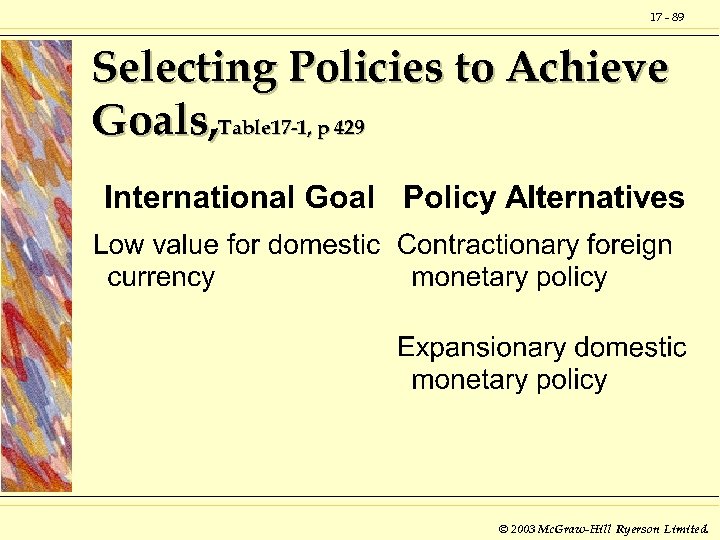 17 - 89 Selecting Policies to Achieve Goals, Table 17 -1, p 429 © 2003 Mc. Graw-Hill Ryerson Limited.
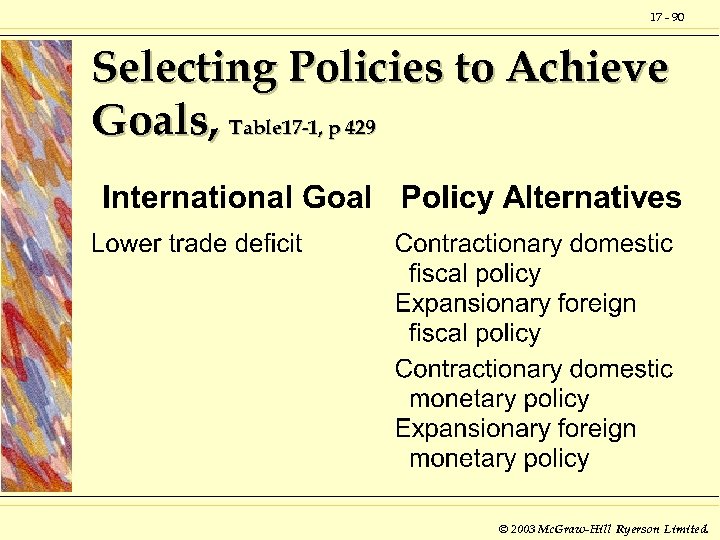 17 - 90 Selecting Policies to Achieve Goals, Table 17 -1, p 429 © 2003 Mc. Graw-Hill Ryerson Limited.
 International Dimensions of Monetary and Fiscal Policy End of Chapter 17 © 2003 Mc. Graw-Hill Ryerson Limited.