


 Скачать презентацию International cooperation in the EU Framework Programmes Health
19a0cade0347aa25df33b70266cfc3d4.ppt
- Количество слайдов: 30
 International cooperation in the EU Framework Programmes Health research Dr. Indridi Benediktsson Health Research DG Research – European Commission Oct 2009
 Aspects covered: l The Health Theme l International cooperation l Outcome of FP 7 Health calls l Next call l Information sources
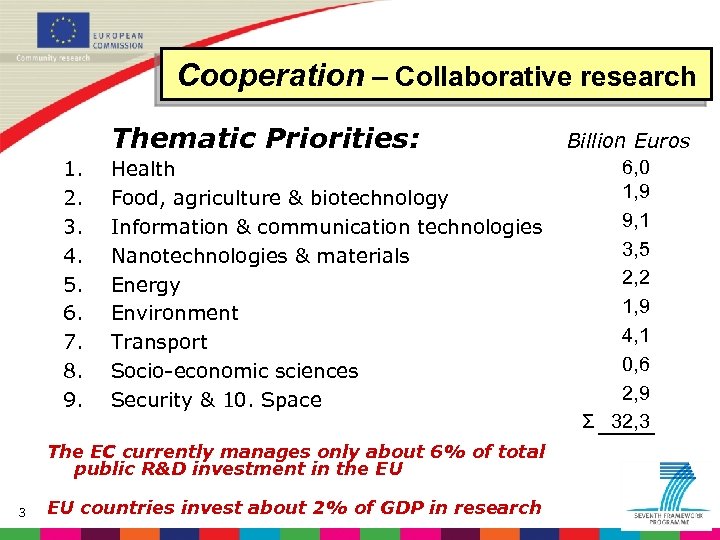 Cooperation – Collaborative research Thematic Priorities: 1. 2. 3. 4. 5. 6. 7. 8. 9. Health Food, agriculture & biotechnology Information & communication technologies Nanotechnologies & materials Energy Environment Transport Socio-economic sciences Security & 10. Space The EC currently manages only about 6% of total public R&D investment in the EU 3 EU countries invest about 2% of GDP in research Billion Euros 6, 0 1, 9 9, 1 3, 5 2, 2 1, 9 4, 1 0, 6 2, 9 Σ 32, 3
 FP 7 Health Main policy drivers: § Improving health of European citizens § Increasing competitiveness of European healthrelated industries and businesses § Addressing global health issues, including emerging epidemics Budget: Ø € 6. 1 billion over 7 years (2007 -2013)
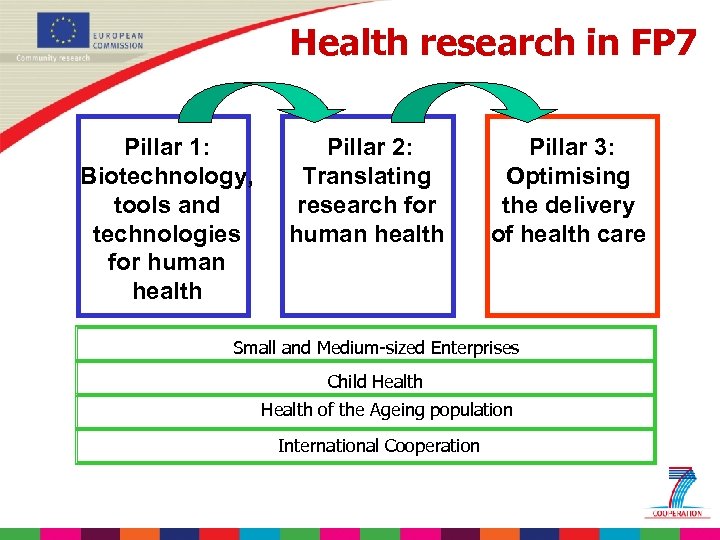 Health research in FP 7 Pillar 1: Biotechnology, tools and technologies for human health Pillar 2: Translating research for human health Pillar 3: Optimising the delivery of health care Small and Medium-sized Enterprises Child Health of the Ageing population International Cooperation
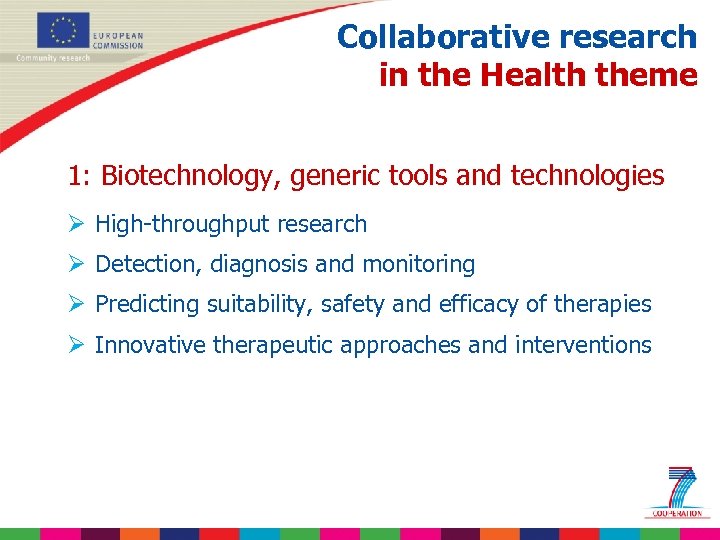 Collaborative research in the Health theme 1: Biotechnology, generic tools and technologies Ø High-throughput research Ø Detection, diagnosis and monitoring Ø Predicting suitability, safety and efficacy of therapies Ø Innovative therapeutic approaches and interventions
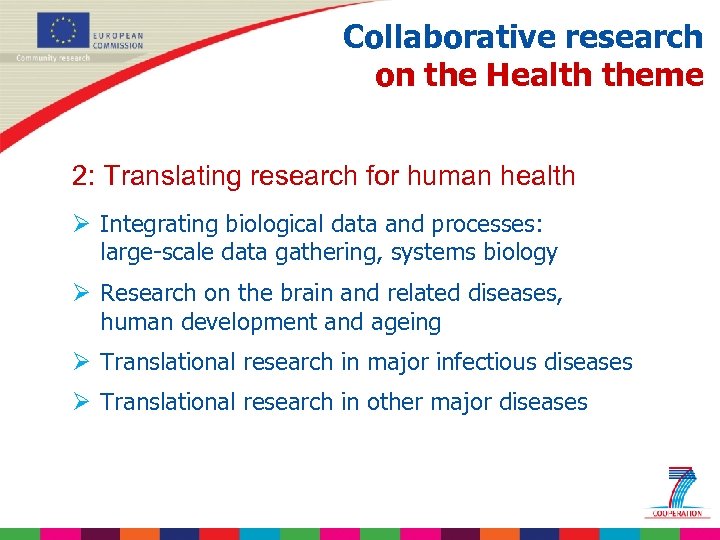 Collaborative research on the Health theme 2: Translating research for human health Ø Integrating biological data and processes: large-scale data gathering, systems biology Ø Research on the brain and related diseases, human development and ageing Ø Translational research in major infectious diseases Ø Translational research in other major diseases
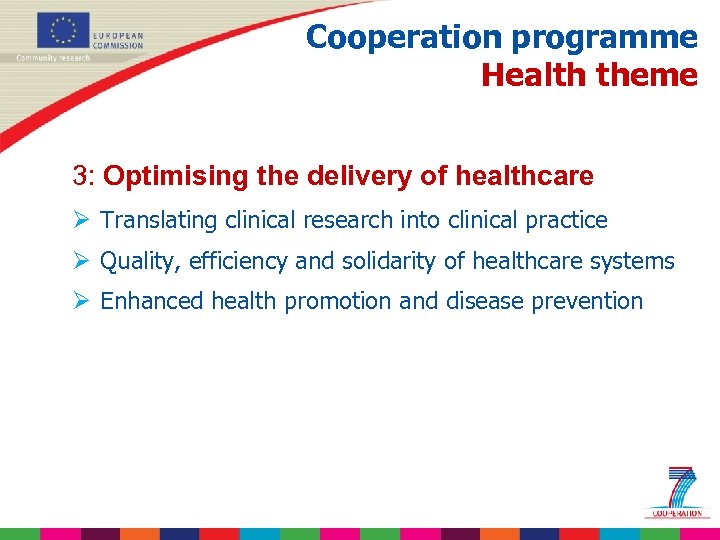 Cooperation programme Health theme 3: Optimising the delivery of healthcare Ø Translating clinical research into clinical practice Ø Quality, efficiency and solidarity of healthcare systems Ø Enhanced health promotion and disease prevention
 Collaborative research on the Health theme 4. Actions across the Theme Ø Coordination & Support Actions across theme Ø Responding to EU policy needs Ø Specific International Cooperation Actions (SICAs)
 Scope of research in the Health Theme • In the Health theme, the Framework programme can support both basic and applied research • This includes discovery activities, translational research and early clinical trials (normally only phase I and II).
 Collaborative research across borders • multinational consortia, at least 3 partners from the 27 EU Member States (MS) and Associated Countries (AC) Albania, Bosnia-Herzegovina, Croatia, Iceland, Israel, Liechtenstein, Macedonia, Montenegro, Norway, Serbia, Switzerland, Turkey • researchers from any country in the world can participate, from industrialised and developing countries eg: Argentina, Australia, Brazil, Canada, China, India, Japan, Korea, New-Zealand, Russia, South-Africa, USA, … … …
 Scientific excellence at European level From policy to funding the best research projects: • The policy for Health research is described in the FP 7 specific programme (available on CORDIS) • Each year, a work programme is prepared by the EC, with the Advisory Group and in consultation with the Programme Committee • Through calls for proposals the EC invites researchers from all Europe and beyond to submit their proposals • The very best projects are selected on the basis of evaluation by independent experts (peer review) • After negotiation of a grant agreement, a project is funded for 2 -5 y.
 Scientific excellence at European level Topics selection: • FP 6 and FP 7 actions are taken into consideration • Workshops and conferences with scientific communitiy and others • Early input from MS & AC (strategic priorities) • Topics are drafted by the Commission services, to implement FP 7. • Not all topics / areas can be opened at any one time: some areas are closed in some call, emphasis placed on others • Trying to have a structuring effect on European research
 International Collaboration in FP 7 - Health The context: why international cooperation? HEALTH is a political priority for most countries in the world; industrialised, emerging economies and low income countries Infectious diseases do not respect borders and can spread worldwide “Rich world” diseases (cancer, diabetes…) also affect the developing countries and vice versa (Aids, TB…) Treatments and cures are universal
 International Collaboration -issues at stake: l Assistance for development è policy objectives, e. g. Millennium Development Goals è targets: low income countries, e. g. ACP l Strengthening competitiveness è competing with industrialised countries (e. g. attracting excellence) è collaboration for mutual gains targets: more developed countries (e. g. BRIC) l Science diplomacy è collaborating w. industrialised countries è “ice breaking” when collaborating w. new partner countries è putting “flesh on the bones” of S+T agreements è a sign of maturity of the FPs (openness) è targets: OECD, all 3 rd countries l All in the context of Excellence
 International Cooperation in FP 7 3 different avenues: 1. All activities open for International Cooperation Partner Countries (ICPCs) can participate in projects and receive EC funding § Industrialised countries may be funded if their participation is seen as essential for the project or if provided for in the call § Minimum number of participants: 3 from MS/AC § 2. Specific International Cooperation Actions § Address specific issues that partner countries face or have a global character, on the basis of mutual interest and benefit § Minimum number of participants: 2+2 (2 from MS/AC + 2 from ICPCs) 3. Bilateral agreements for targeted co-funding § Individual agreements with specific countries e. g. Russia 16
 International Cooperation in FP 7 Health Programme level cooperation In large scale endeavours where tasks can be divided in sub-projects § Funding agencies and scientists design the “Meta”project – agreeing on broad common principles § Each agency issues calls according to own rules § Projects are funded and required to work together § Otherwise no contractual link
 Programme level cooperation - examples • International Knock – out Mouse Consortium (IKMC) (2007) (EU, Canada, USA…) • The Human Microbiome (EU, USA, Canada, China) • International Cancer Genomics Consortium (EC, Genome Canada, NIH. . . ) • Affinity Reagents for the Human Proteome (in preparation) 18
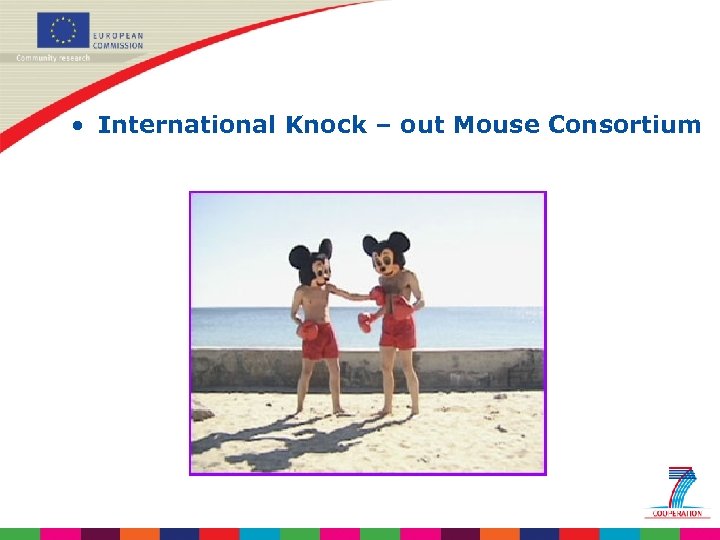 • International Knock – out Mouse Consortium
 International Cooperation Programme Level Cooperation or a priori twinning of projects
 Programme Level Cooperation Ø Discussion at high level on broad areas Ø Workshop to identify priority topics within the areas Ø Issuing of calls in FP and in the cooperating country (-ies) Ø Independent evaluation of proposals Ø Negotiation of complementary proposals Ø Close cooperation of the funded projects on both sides (common meetings, conferences, exchange of staff etc. )
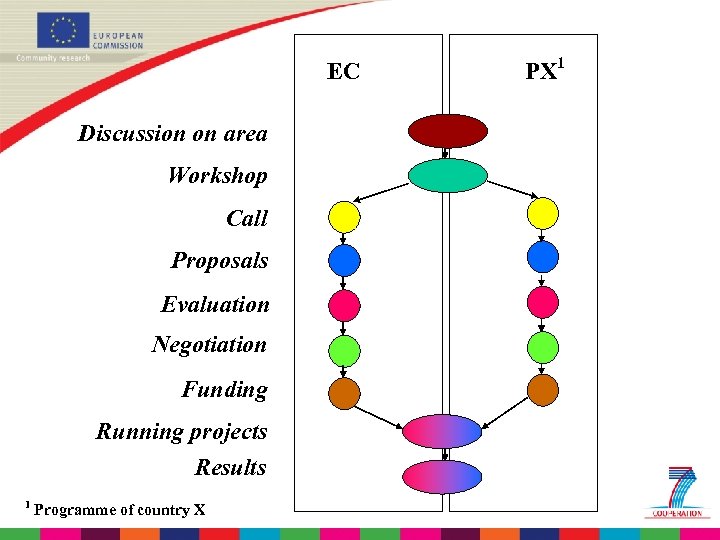 EC Discussion on area Workshop Call Proposals Evaluation Negotiation Funding Running projects Results 1 Programme of country X PX 1
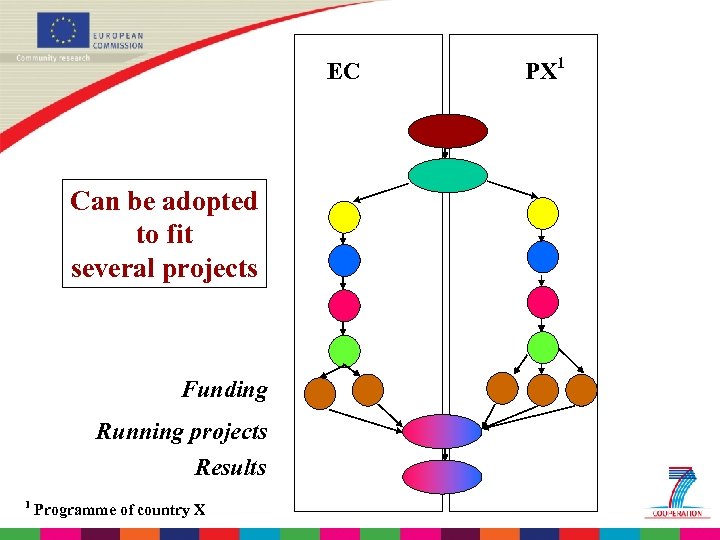 EC Can be adopted to fit several projects Funding Running projects Results 1 Programme of country X PX 1
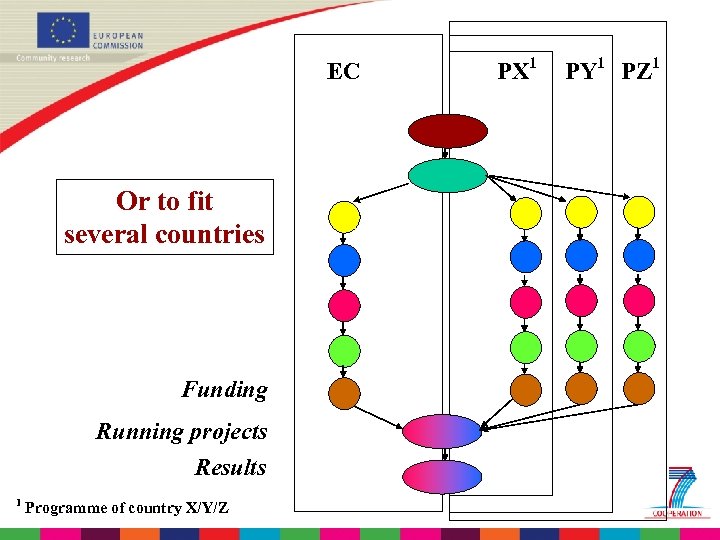 EC Or to fit several countries Funding Running projects Results 1 Programme of country X/Y/Z PX 1 PY 1 PZ 1
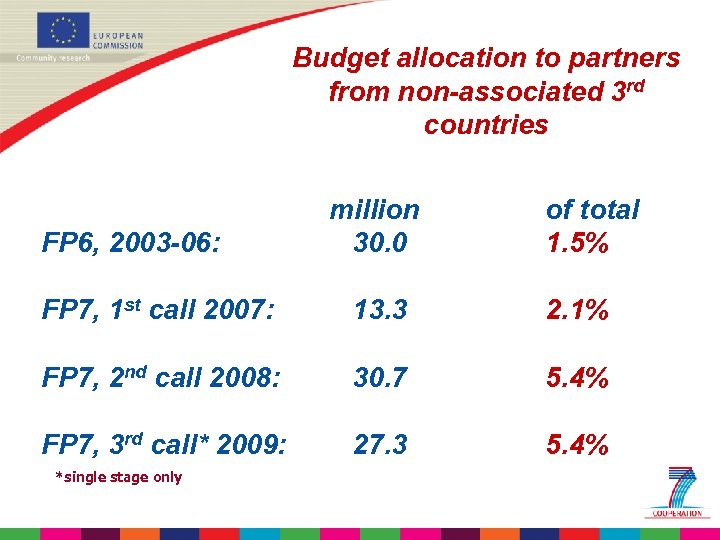 Budget allocation to partners from non-associated 3 rd countries FP 6, 2003 -06: million 30. 0 of total 1. 5% FP 7, 1 st call 2007: 13. 3 2. 1% FP 7, 2 nd call 2008: 30. 7 5. 4% FP 7, 3 rd call* 2009: 27. 3 5. 4% *single stage only
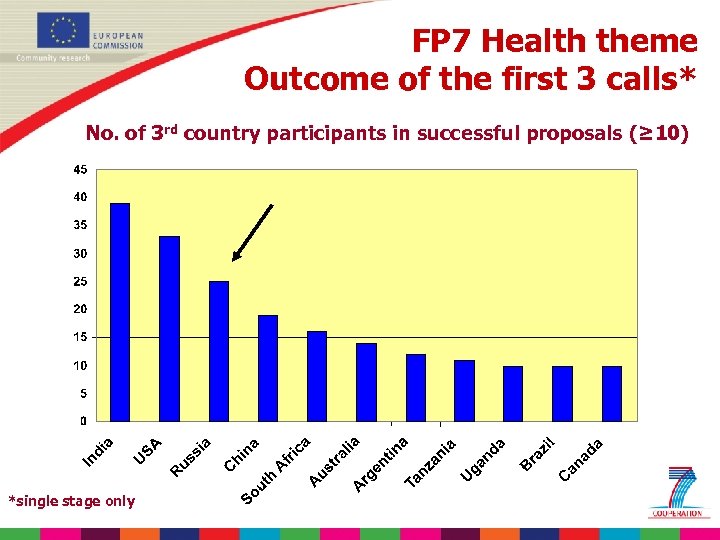 FP 7 Health theme Outcome of the first 3 calls* No. of 3 rd country participants in successful proposals (≥ 10) *single stage only
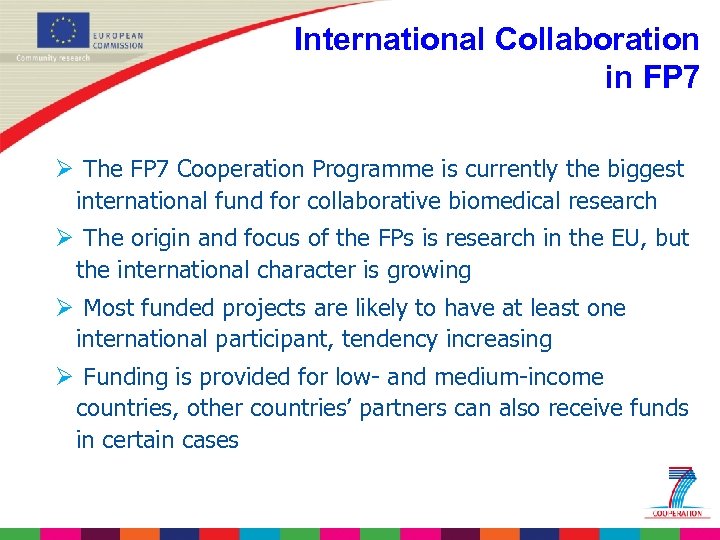 International Collaboration in FP 7 Ø The FP 7 Cooperation Programme is currently the biggest international fund for collaborative biomedical research Ø The origin and focus of the FPs is research in the EU, but the international character is growing Ø Most funded projects are likely to have at least one international participant, tendency increasing Ø Funding is provided for low- and medium-income countries, other countries’ partners can also receive funds in certain cases
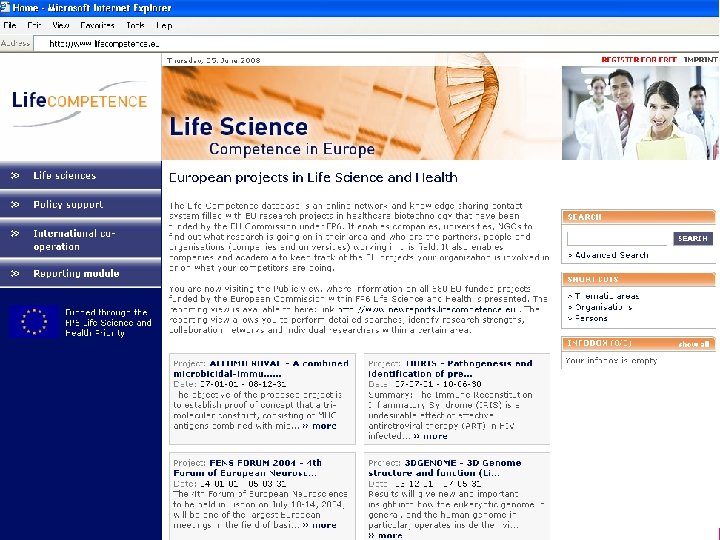
 Information • EU research: http: //ec. europa. eu/research • Seventh Framework Programme: http: //ec. europa. eu/research/fp 7 • Information on research programmes and projects: http: //cordis. europa. eu/ • http: //ec. europa. eu/research-eu/ • Information requests: http: //ec. europa. eu/research/enquiries/ 29
 EC money ≠ Easy money