 Скачать презентацию International Continence Society Tokyo 13 -16 september 2016
4c8afaf3dd5576535bc4ec3bbb436376.ppt
- Количество слайдов: 1



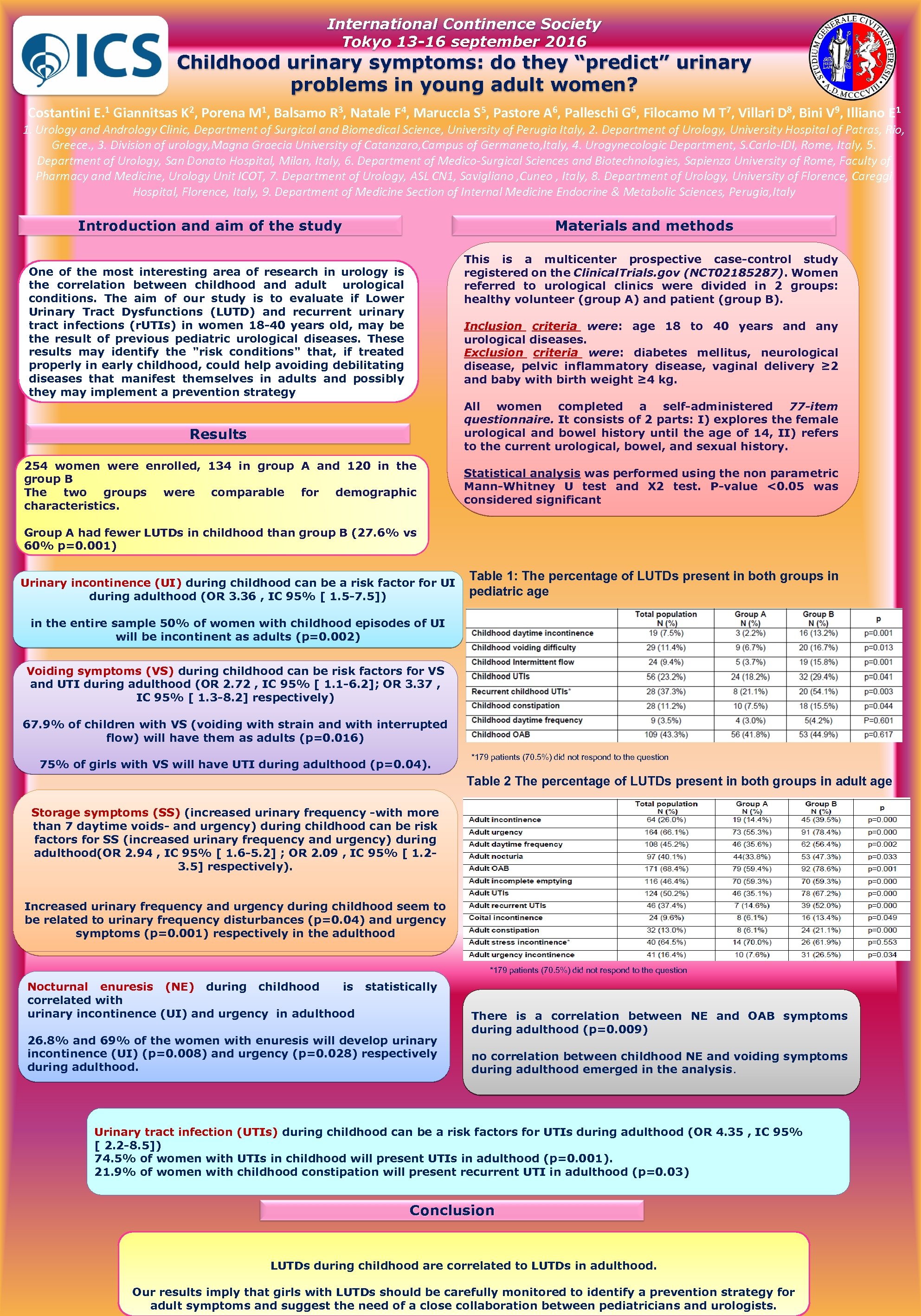
International Continence Society Tokyo 13 -16 september 2016 Childhood urinary symptoms: do they “predict” urinary problems in young adult women? Costantini E. 1 Giannitsas K 2, Porena M 1, Balsamo R 3, Natale F 4, Marucc. Ia S 5, Pastore A 6, Palleschi G 6, Filocamo M T 7, Villari D 8, Bini V 9, Illiano E 1 1. Urology and Andrology Clinic, Department of Surgical and Biomedical Science, University of Perugia Italy, 2. Department of Urology, University Hospital of Patras, Rio, Greece. , 3. Division of urology, Magna Graecia University of Catanzaro, Campus of Germaneto, Italy, 4. Urogynecologic Department, S. Carlo-IDI, Rome, Italy, 5. Department of Urology, San Donato Hospital, Milan, Italy, 6. Department of Medico-Surgical Sciences and Biotechnologies, Sapienza University of Rome, Faculty of Pharmacy and Medicine, Urology Unit ICOT, 7. Department of Urology, ASL CN 1, Savigliano , Cuneo , Italy, 8. Department of Urology, University of Florence, Careggi Hospital, Florence, Italy, 9. Department of Medicine Section of Internal Medicine Endocrine & Metabolic Sciences, Perugia, Italy Introduction and aim of the study Materials and methods This is a multicenter prospective case-control study registered on the Clinical. Trials. gov (NCT 02185287). Women referred to urological clinics were divided in 2 groups: healthy volunteer (group A) and patient (group B). One of the most interesting area of research in urology is the correlation between childhood and adult urological conditions. The aim of our study is to evaluate if Lower Urinary Tract Dysfunctions (LUTD) and recurrent urinary tract infections (r. UTIs) in women 18 -40 years old, may be the result of previous pediatric urological diseases. These results may identify the "risk conditions" that, if treated properly in early childhood, could help avoiding debilitating diseases that manifest themselves in adults and possibly they may implement a prevention strategy Inclusion criteria were: age 18 to 40 years and any urological diseases. Exclusion criteria were: diabetes mellitus, neurological disease, pelvic inflammatory disease, vaginal delivery ≥ 2 and baby with birth weight ≥ 4 kg. All women completed a self-administered 77 -item questionnaire. It consists of 2 parts: I) explores the female urological and bowel history until the age of 14, II) refers to the current urological, bowel, and sexual history. Results 254 women were enrolled, 134 in group A and 120 in the group B The two groups were comparable for demographic characteristics. Statistical analysis was performed using the non parametric Mann-Whitney U test and X 2 test. P-value <0. 05 was considered significant Group A had fewer LUTDs in childhood than group B (27. 6% vs 60% p=0. 001) Urinary incontinence (UI) during childhood can be a risk factor for UI during adulthood (OR 3. 36 , IC 95% [ 1. 5 -7. 5]) Table 1: The percentage of LUTDs present in both groups in pediatric age in the entire sample 50% of women with childhood episodes of UI will be incontinent as adults (p=0. 002) Voiding symptoms (VS) during childhood can be risk factors for VS and UTI during adulthood (OR 2. 72 , IC 95% [ 1. 1 -6. 2]; OR 3. 37 , IC 95% [ 1. 3 -8. 2] respectively) 67. 9% of children with VS (voiding with strain and with interrupted flow) will have them as adults (p=0. 016) 75% of girls with VS will have UTI during adulthood (p=0. 04). *179 patients (70. 5%) did not respond to the question Table 2 The percentage of LUTDs present in both groups in adult age Storage symptoms (SS) (increased urinary frequency -with more than 7 daytime voids- and urgency) during childhood can be risk factors for SS (increased urinary frequency and urgency) during adulthood(OR 2. 94 , IC 95% [ 1. 6 -5. 2] ; OR 2. 09 , IC 95% [ 1. 23. 5] respectively). In group A r. UTIs were present in 5% and 6% in adulthood and childhood respectively while in group B they were present in 29% of adults and 18% of children Increased urinary frequency and urgency during childhood seem to be related to urinary frequency disturbances (p=0. 04) and urgency symptoms (p=0. 001) respectively in the adulthood *179 patients (70. 5%) did not respond to the question Nocturnal enuresis (NE) during childhood is statistically correlated with urinary incontinence (UI) and urgency in adulthood 26. 8% and 69% of the women with enuresis will develop urinary incontinence (UI) (p=0. 008) and urgency (p=0. 028) respectively during adulthood. There is a correlation between NE and OAB symptoms during adulthood (p=0. 009) no correlation between childhood NE and voiding symptoms during adulthood emerged in the analysis. Urinary tract infection (UTIs) during childhood can be a risk factors for UTIs during adulthood (OR 4. 35 , IC 95% [ 2. 2 -8. 5]) 74. 5% of women with UTIs in childhood will present UTIs in adulthood (p=0. 001). 21. 9% of women with childhood constipation will present recurrent UTI in adulthood (p=0. 03) Conclusion LUTDs during childhood are correlated to LUTDs in adulthood. Our results imply that girls with LUTDs should be carefully monitored to identify a prevention strategy for adult symptoms and suggest the need of a close collaboration between pediatricians and urologists.
Скачать презентацию International Continence Society Tokyo 13 -16 september 2016
4c8afaf3dd5576535bc4ec3bbb436376.ppt