


 Скачать презентацию International Conference on Dynamics in Logistics August 28
db01fcc5bbfac22478cda3635ec09f76.ppt
- Количество слайдов: 25
 International Conference on Dynamics in Logistics, August 28 th - 30 th, 2007, Bremen, Germany SFB 637 Dynamic Decision Making on Embedded Platforms in Transport Logistics – A case study Reiner Jedermann, Luis Javier Antûnez Congil, Martin Lorenz, Jan D. Gehrke, Walter Lang and Otthein Herzog Institute for Microsensors, -Actuators and -Systems IMSAS Center for Computing Technologies – TZI
 Outline SFB 637 § Introduction § Decentralized route planning § Agent-based shelf life supervision § Extension for multi package problem § Experimental evaluation § Summary and future work
 Introduction SFB 637 Shifting intelligence from central control to transport containers § Complexity and cost pressure in supply chains forces new approaches § Individual planning for each palette / freight item - Transportation of perishable goods - Setting with high amount of data per cargo for monitoring - Unexpected changes in product quality may force re-planning - (change of vehicle and/or destination) Vision: intelligent cargo Current hardware solution on vehicle/container level § Two points of view - Planning for full truckloads (existing demonstrator) - Combined planning for part loads (simulation of new concept)
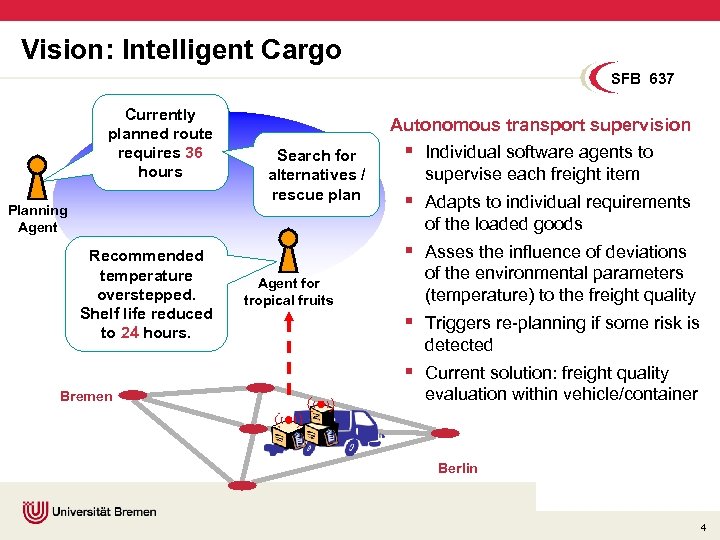 Vision: Intelligent Cargo SFB 637 Currently planned route requires 36 hours Planning Agent Autonomous transport supervision Search for alternatives / rescue plan § Individual software agents to supervise each freight item § Adapts to individual requirements of the loaded goods Recommended temperature overstepped. Shelf life reduced to 24 hours. § Asses the influence of deviations Agent for tropical fruits of the environmental parameters (temperature) to the freight quality § Triggers re-planning if some risk is detected § Current solution: freight quality Bremen evaluation within vehicle/container Berlin 4
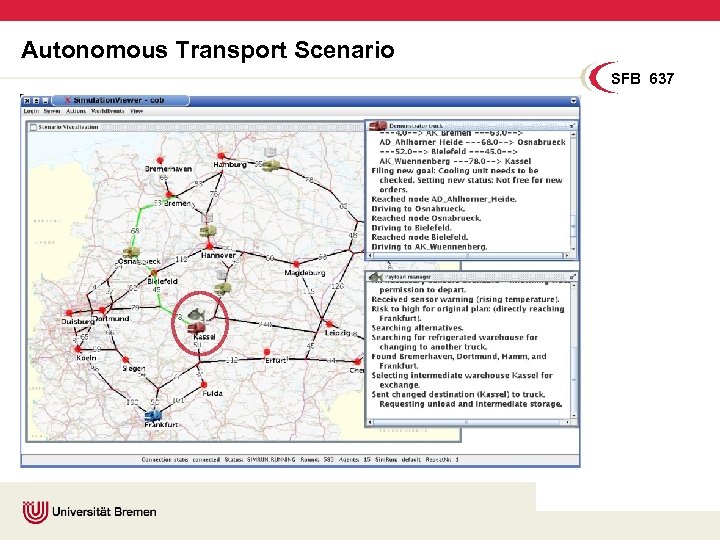 Autonomous Transport Scenario SFB 637
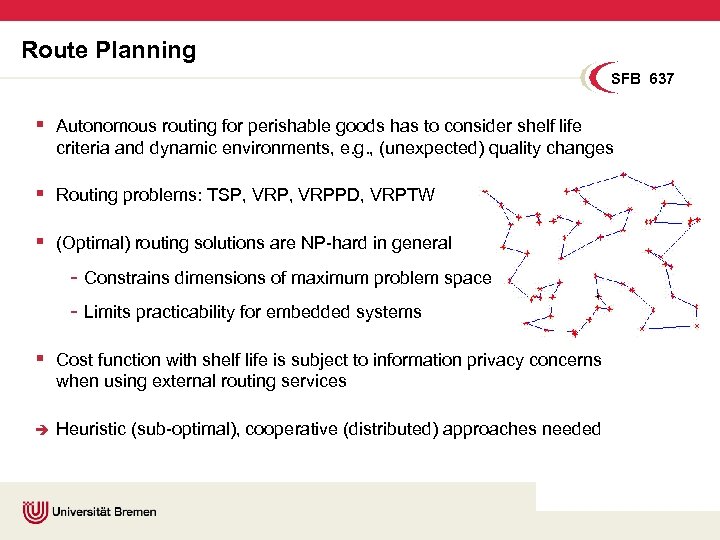 Route Planning SFB 637 § Autonomous routing for perishable goods has to consider shelf life criteria and dynamic environments, e. g. , (unexpected) quality changes § Routing problems: TSP, VRPPD, VRPTW § (Optimal) routing solutions are NP-hard in general - Constrains dimensions of maximum problem space - Limits practicability for embedded systems § Cost function with shelf life is subject to information privacy concerns when using external routing services è Heuristic (sub-optimal), cooperative (distributed) approaches needed
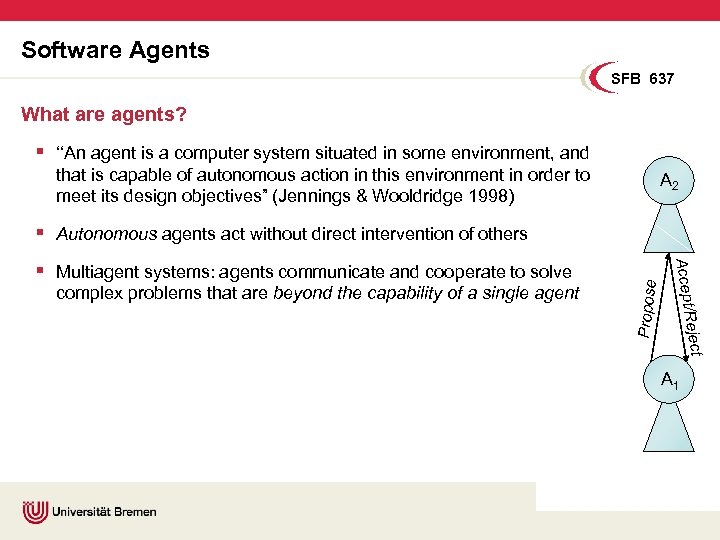 Software Agents SFB 637 What are agents? § ‘‘An agent is a computer system situated in some environment, and that is capable of autonomous action in this environment in order to meet its design objectives” (Jennings & Wooldridge 1998) A 2 complex problems that are beyond the capability of a single agent Reject Accept/ § Multiagent systems: agents communicate and cooperate to solve Propose § Autonomous agents act without direct intervention of others A 1
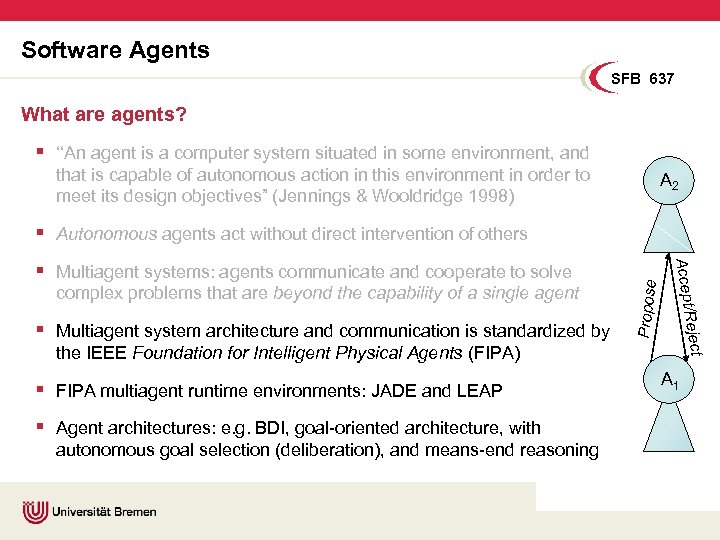 Software Agents SFB 637 What are agents? § ‘‘An agent is a computer system situated in some environment, and that is capable of autonomous action in this environment in order to meet its design objectives” (Jennings & Wooldridge 1998) A 2 complex problems that are beyond the capability of a single agent Reject § Multiagent system architecture and communication is standardized by Accept/ § Multiagent systems: agents communicate and cooperate to solve Propose § Autonomous agents act without direct intervention of others the IEEE Foundation for Intelligent Physical Agents (FIPA) § FIPA multiagent runtime environments: JADE and LEAP § Agent architectures: e. g. BDI, goal-oriented architecture, with autonomous goal selection (deliberation), and means-end reasoning A 1
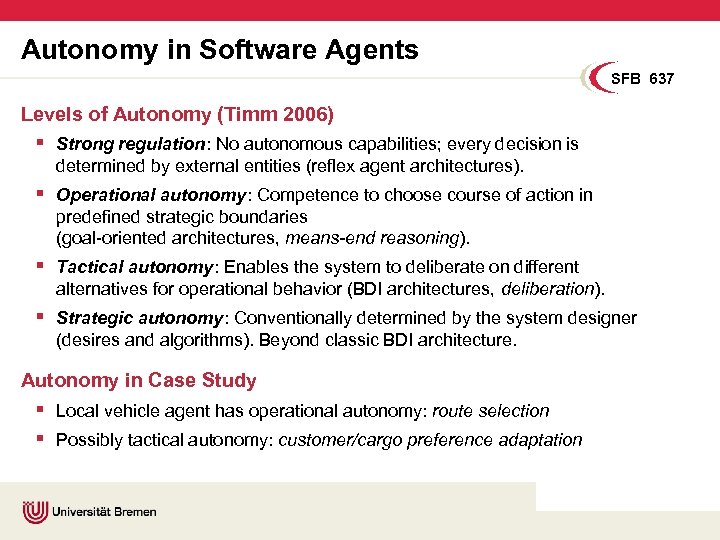 Autonomy in Software Agents SFB 637 Levels of Autonomy (Timm 2006) § Strong regulation: No autonomous capabilities; every decision is determined by external entities (reflex agent architectures). § Operational autonomy: Competence to choose course of action in predefined strategic boundaries (goal-oriented architectures, means-end reasoning). § Tactical autonomy: Enables the system to deliberate on different alternatives for operational behavior (BDI architectures, deliberation). § Strategic autonomy: Conventionally determined by the system designer (desires and algorithms). Beyond classic BDI architecture. Autonomy in Case Study § Local vehicle agent has operational autonomy: route selection § Possibly tactical autonomy: customer/cargo preference adaptation
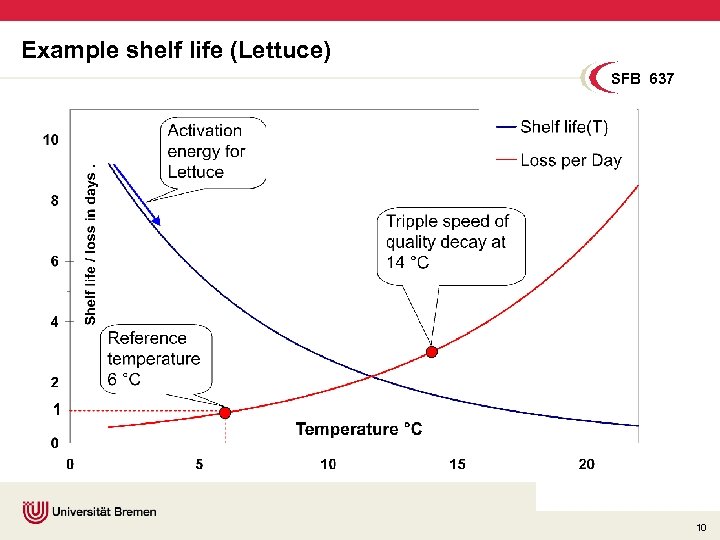 Example shelf life (Lettuce) SFB 637 10
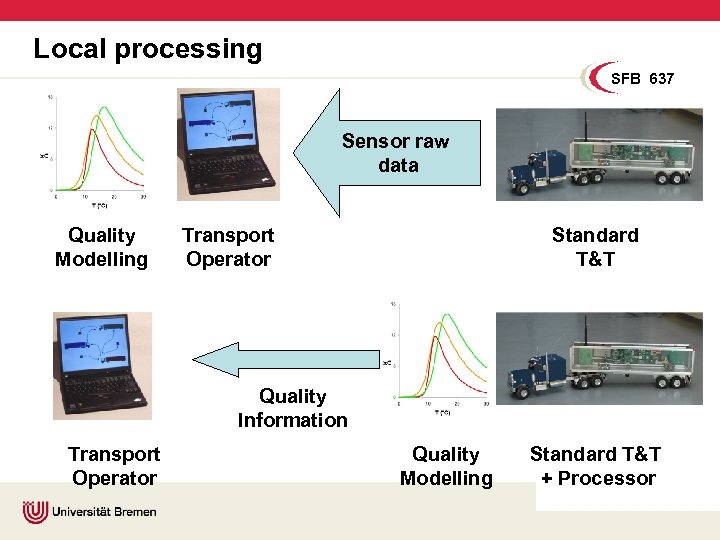 Local processing SFB 637 Sensor raw data Quality Modelling Transport Operator Standard T&T Quality Information Transport Operator Quality Modelling Standard T&T + Processor
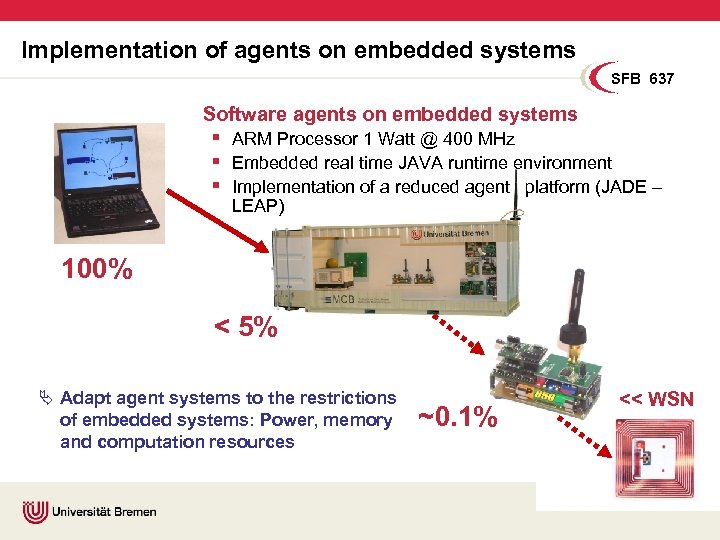 Implementation of agents on embedded systems SFB 637 Software agents on embedded systems § ARM Processor 1 Watt @ 400 MHz § Embedded real time JAVA runtime environment § Implementation of a reduced agent platform (JADE – LEAP) 100% < 5% Ä Adapt agent systems to the restrictions of embedded systems: Power, memory and computation resources ~0. 1% << WSN
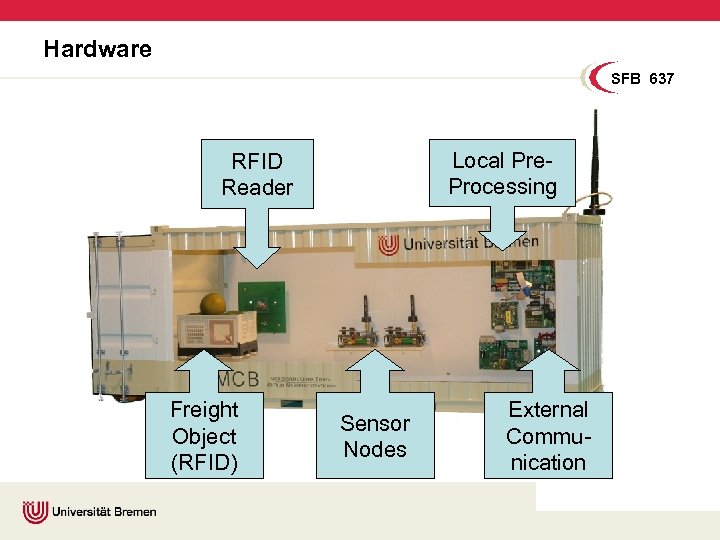 Hardware SFB 637 Local Pre. Processing RFID Reader Freight Object (RFID) Sensor Nodes External Communication
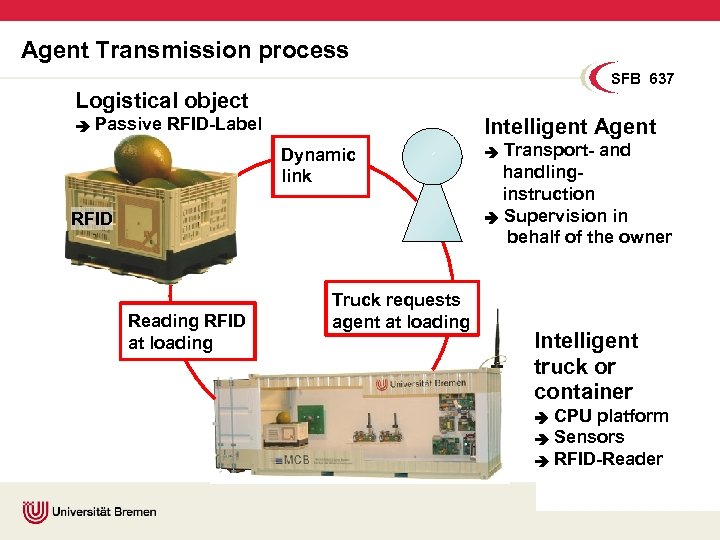 Agent Transmission process SFB 637 Logistical object Passive RFID-Label Intelligent Agent Dynamic link RFID Reading RFID at loading Truck requests agent at loading Transport- and handlinginstruction Supervision in behalf of the owner Intelligent truck or container CPU platform Sensors RFID-Reader
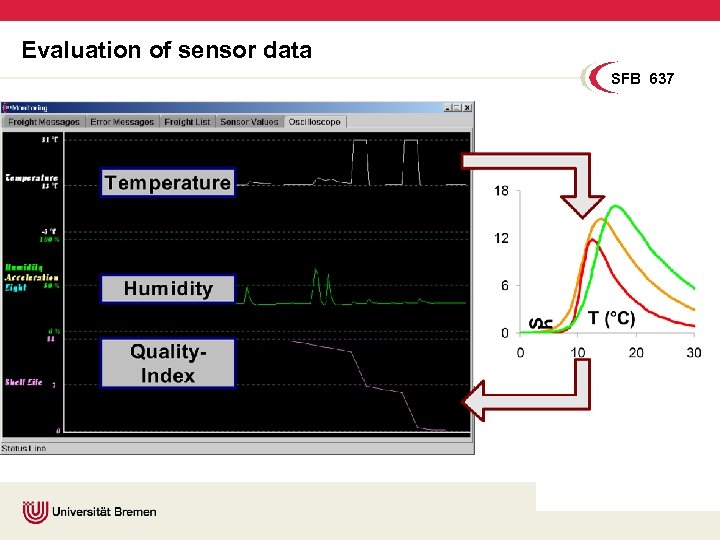 Evaluation of sensor data SFB 637
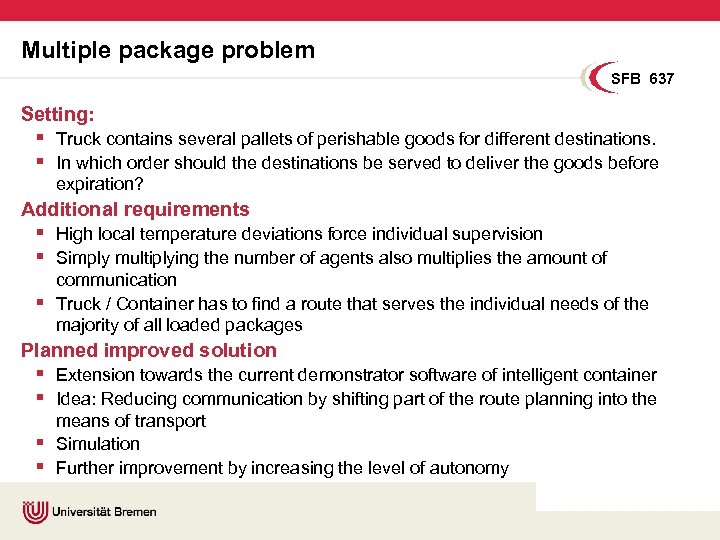 Multiple package problem SFB 637 Setting: § Truck contains several pallets of perishable goods for different destinations. § In which order should the destinations be served to deliver the goods before expiration? Additional requirements § High local temperature deviations force individual supervision § Simply multiplying the number of agents also multiplies the amount of § communication Truck / Container has to find a route that serves the individual needs of the majority of all loaded packages Planned improved solution § Extension towards the current demonstrator software of intelligent container § Idea: Reducing communication by shifting part of the route planning into the § § means of transport Simulation Further improvement by increasing the level of autonomy
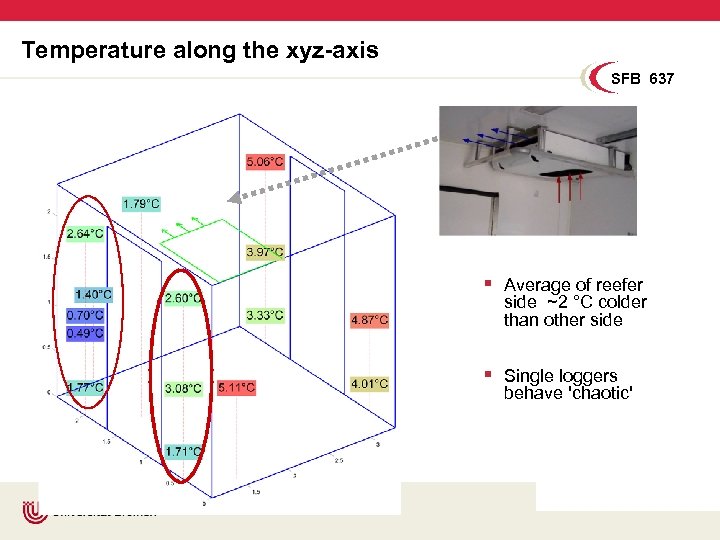 Temperature along the xyz-axis SFB 637 § Average of reefer side ~2 °C colder than other side § Single loggers behave 'chaotic'
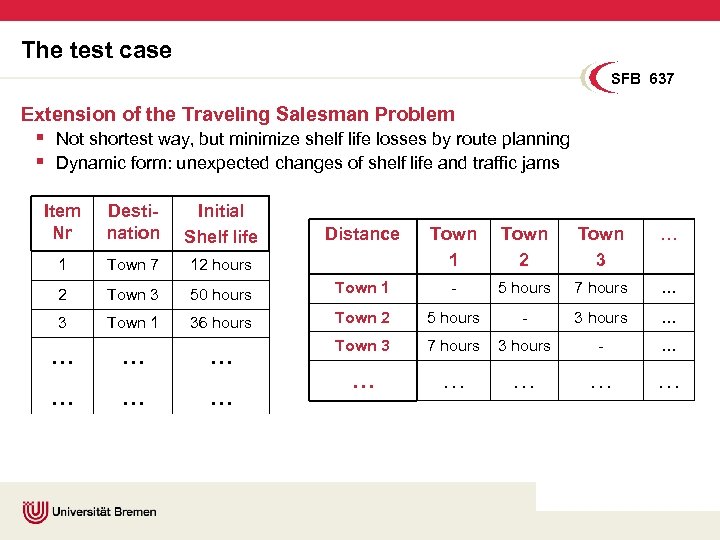 The test case SFB 637 Extension of the Traveling Salesman Problem § Not shortest way, but minimize shelf life losses by route planning § Dynamic form: unexpected changes of shelf life and traffic jams Item Nr Destination Initial Shelf life 1 Town 7 12 hours 2 Town 3 3 Town 1 Distance Town 1 Town 2 Town 3 … 50 hours Town 1 - 5 hours 7 hours … 36 hours Town 2 5 hours - 3 hours … Town 3 7 hours 3 hours - … … …
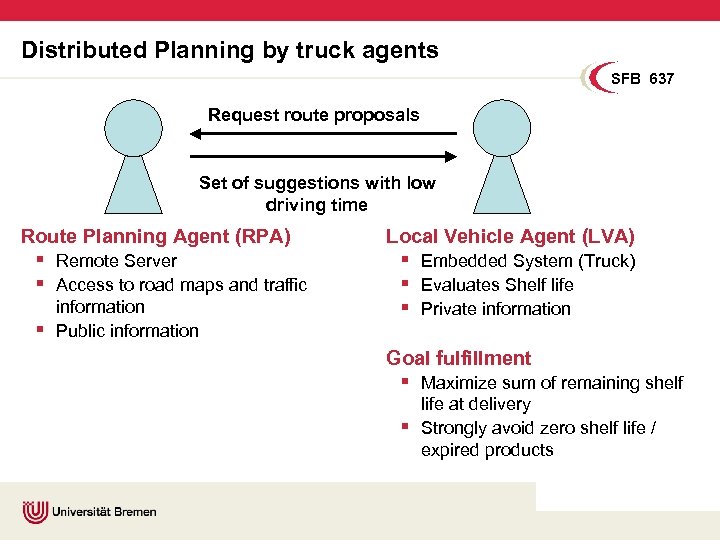 Distributed Planning by truck agents SFB 637 Request route proposals Set of suggestions with low driving time Route Planning Agent (RPA) § Remote Server § Access to road maps and traffic § information Public information Local Vehicle Agent (LVA) § Embedded System (Truck) § Evaluates Shelf life § Private information Goal fulfillment § Maximize sum of remaining shelf § life at delivery Strongly avoid zero shelf life / expired products
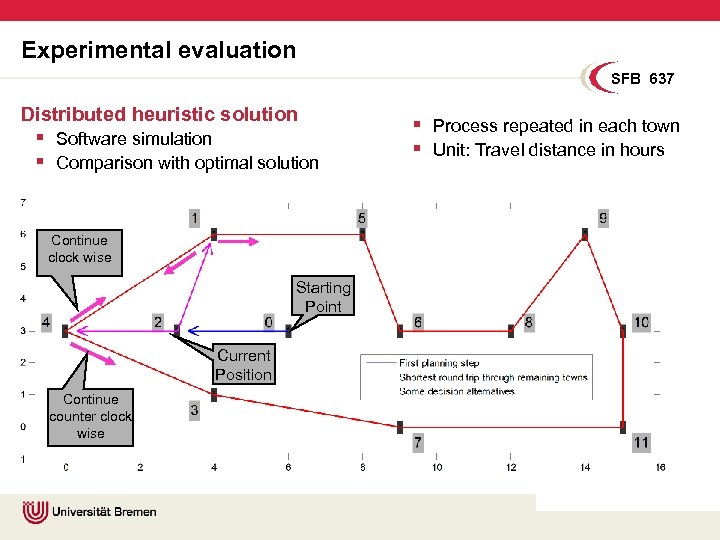 Experimental evaluation SFB 637 Distributed heuristic solution § Software simulation § Comparison with optimal solution Continue clock wise Starting Point Current Position Continue counter clock wise § Process repeated in each town § Unit: Travel distance in hours
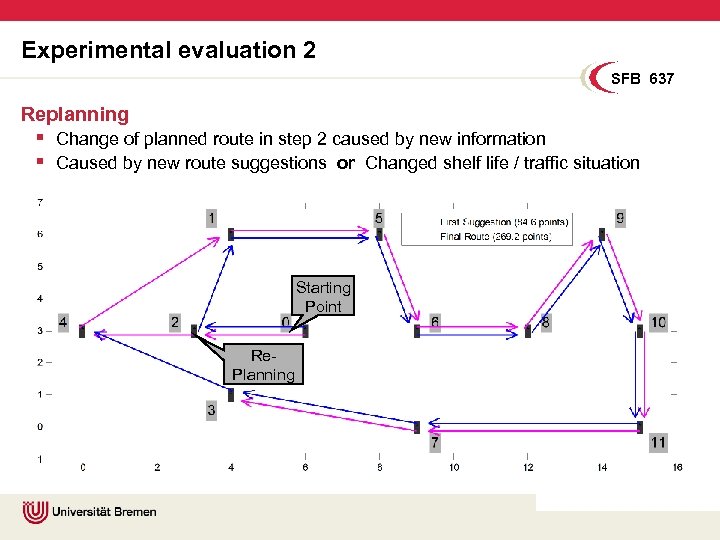 Experimental evaluation 2 SFB 637 Replanning § Change of planned route in step 2 caused by new information § Caused by new route suggestions or Changed shelf life / traffic situation Starting Point Re. Planning
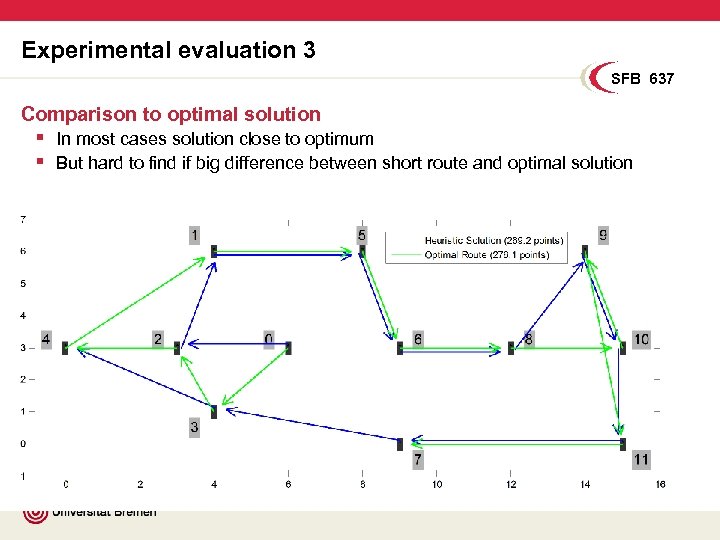 Experimental evaluation 3 SFB 637 Comparison to optimal solution § In most cases solution close to optimum § But hard to find if big difference between short route and optimal solution
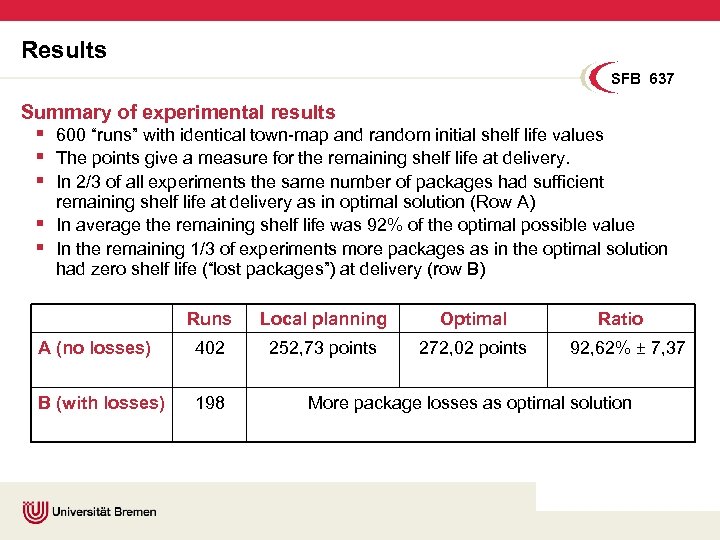 Results SFB 637 Summary of experimental results § 600 “runs” with identical town-map and random initial shelf life values § The points give a measure for the remaining shelf life at delivery. § In 2/3 of all experiments the same number of packages had sufficient § § remaining shelf life at delivery as in optimal solution (Row A) In average the remaining shelf life was 92% of the optimal possible value In the remaining 1/3 of experiments more packages as in the optimal solution had zero shelf life (“lost packages”) at delivery (row B) Runs Local planning Optimal A (no losses) 402 252, 73 points 272, 02 points B (with losses) 198 Ratio 92, 62% ± 7, 37 More package losses as optimal solution
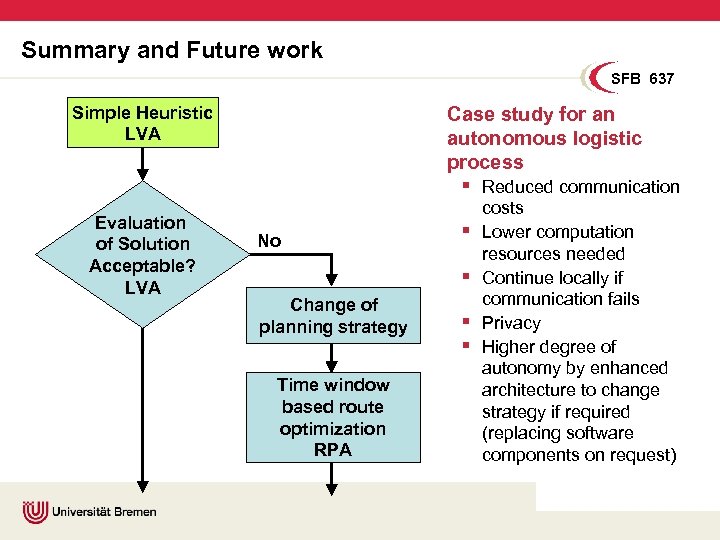 Summary and Future work SFB 637 Simple Heuristic LVA Case study for an autonomous logistic process § Reduced communication Evaluation of Solution Acceptable? LVA No § § Change of planning strategy Time window based route optimization RPA § § costs Lower computation resources needed Continue locally if communication fails Privacy Higher degree of autonomy by enhanced architecture to change strategy if required (replacing software components on request)
 The End SFB 637 Thanks for your attention www. intelligentcontainer. com Contact Dipl. -Ing. Reiner Jedermann Universität Bremen, FB 1 (IMSAS), Otto-Hahn-Allee NW 1, D-28359 Bremen, Germany Phone +49 421 218 4908, Fax +49 421 218 4774 rjedermann@imsas. uni-bremen. de Dipl. -Inf. Jan D. Gehrke Universität Bremen, FB 3 (TZI), Am Fallturm 1 D-28359 Bremen, Germany Phone +49 421 218 8614 , Fax +49 421 218 7196 jgehrke@tzi. de