


 Скачать презентацию International Conference Manufacturing-led Growth for Employment Equality The
d6b9882b4137158bc1ee68a0453e44a5.ppt
- Количество слайдов: 23
 International Conference Manufacturing-led Growth for Employment Equality “The challenges to reversing the decline of the apparel sector in South Africa” Mike Morris, School of Economics, University of Cape Town and Justin Barnes, Development Studies, University of Kwa. Zulu-Natal
 Introduction • • Central focus - is there a labour intensive path for SA? Unpack apparel sector dynamics over the past 15 years Identify domestic industry key drivers Establish fit between these drivers and policy levers Examine previous policy faults Draw on Turkish experience lessons Suggest differentiated policy alternatives to build a sustainable SA apparel industry at both market ends
 Apparel GVC dynamics • Buyer dominated GVCs shaped by Northern Hemisphere retailer, own-brand, and technical market movements • China supply dominance - bifurcation of industry: o Long-lead time, highly price sensitive supply – China, India, Bangladesh, Vietnam, etc. (+ slide) o Short-lead time, less price sensitive supply, driven by OTIF delivery, QA, small batch runs, technology rich supply chain linkages – Turkey, Morocco, Southern Europe, Mauritius (+slide) • SSA marginal but apparel production NB to Mauritius, Madagascar, Lesotho, Swaziland, Kenya (++ slide) • SSA benefits: EPZs, AGOA, EU GSP • Important dynamic: SA market very meaningful (R 30 bn)
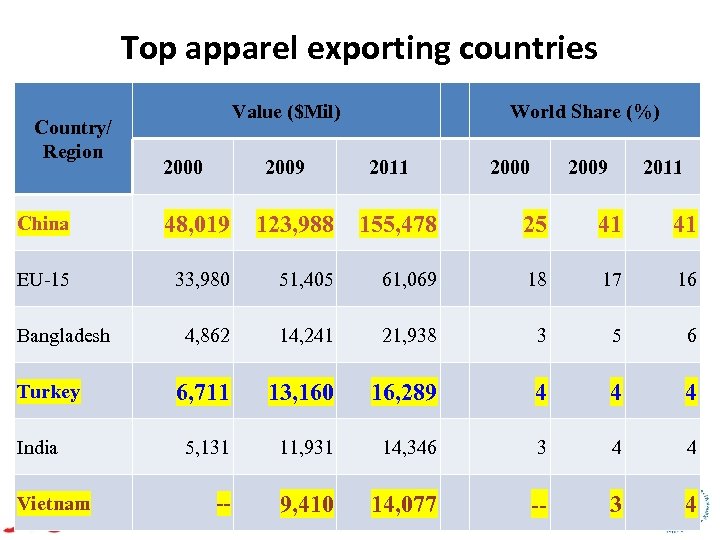 Top apparel exporting countries Country/ Region Value ($Mil) 2000 2009 World Share (%) 2011 2000 2009 2011 China 48, 019 123, 988 155, 478 25 41 41 EU-15 33, 980 51, 405 61, 069 18 17 16 4, 862 14, 241 21, 938 3 5 6 6, 711 13, 160 16, 289 4 4 4 5, 131 11, 931 14, 346 3 4 4 -- 9, 410 14, 077 -- 3 4 Bangladesh Turkey India Vietnam
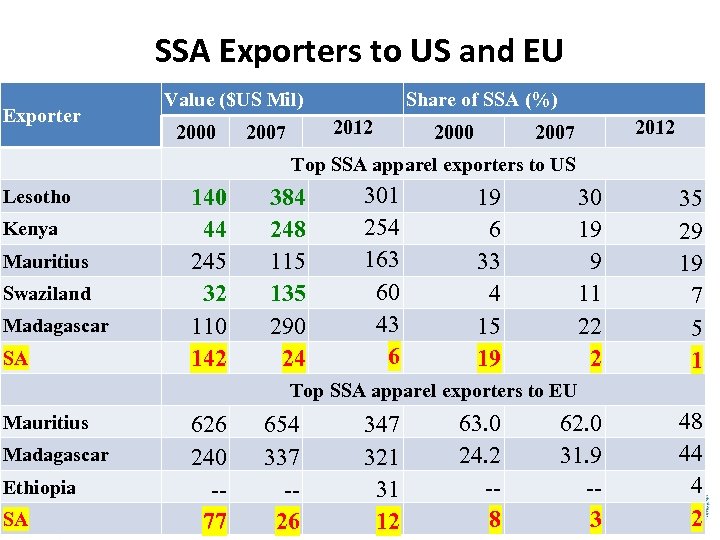 SSA Exporters to US and EU Exporter Value ($US Mil) 2000 Lesotho Kenya Mauritius Swaziland Madagascar SA Madagascar Ethiopia SA 2012 2007 2000 2012 2007 Top SSA apparel exporters to US 140 44 245 32 110 142 Mauritius Share of SSA (%) 384 248 115 135 290 24 301 254 163 60 43 6 19 6 33 4 15 19 30 19 9 11 22 2 35 29 19 7 5 1 62. 0 31. 9 -3 48 44 4 2 Top SSA apparel exporters to EU 626 240 -77 654 337 -26 347 321 31 12 63. 0 24. 2 -8
 SA apparel : 1 st Period ISI driven (+/- 2000 – 2009) • AGOA – Local manufacturers renege domestic retailers • Rand strengthens 2003 – local manufacturers renege US • Retail big imports from China - $95 m (2000) to $558 (2005) to $961 m (2011) so 74% of imports in 2005 • Exacerbated by illegal imports and crime syndicates • Globalisation impacts – labour/production (+ slide) • Policy response contradictory - ISI mindset dominates
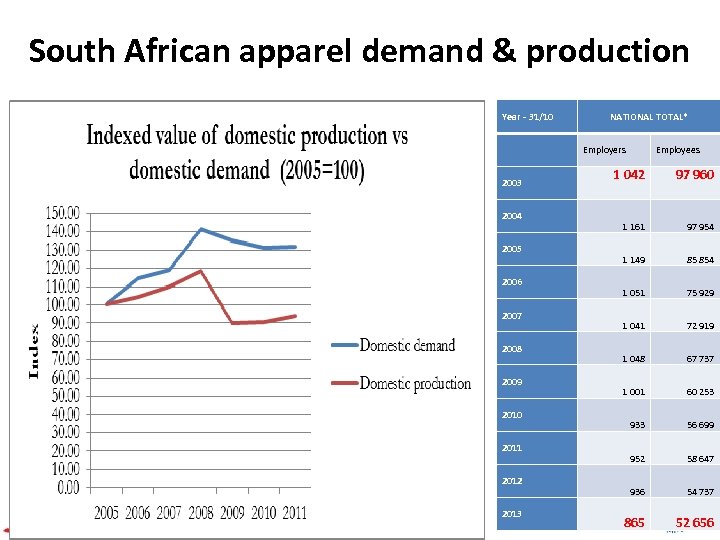 South African apparel demand & production Year - 31/10 NATIONAL TOTAL* Employers 2003 2004 2005 2006 2007 2008 2009 2010 2011 2012 2013 Employees 1 042 97 960 1 161 97 954 1 149 85 854 1 051 75 929 1 041 72 919 1 048 67 737 1 001 60 253 933 56 699 952 58 647 936 54 737 865 52 656
 Policy Response of Industry and Government • Manufacturers – ignored competitiveness issues o Called for increased protection • Union – retailers not globalisation are major cause o Demanded 75% local and quota on Chinese imports o Rigidify labour market: central bargaining, close metro/non metro wage gap, punish non compliant firms • State – Contradictory but supported union o Slashed tariffs/import controls o Imposed Chinese quotas and raised tariff to 45% o Supported union in CSP negotiations
 South African apparel industry response • Industry caught in contradictions between the strategic positions of the past and the requirements of the future • Paralyzed its ability to respond: 1. Lack of firm-level and broader supply chain competitiveness 2. Misplaced government policy 3. Unions as victims of their own ISI-era success • All failed to take account of globalisation • Look at own role and responsibilities in transition • Instead marshalled resources & ideological frameworks from the past to deal with the challenges of the future Result: Substantial decline
 SA apparel : 2 nd Period (2009 – now) Regional market dynamics change fundamentally with PTA opportunities (SACU/SADC) • Huge jump imports from Lesotho/Swaziland (low to middle market segment) (+ slide) • Rising imports Mauritius/Madagascar (middle to top market segment) (++ slide) This is a new major threat to local firms and labour • Cant solve with ISI policy agenda
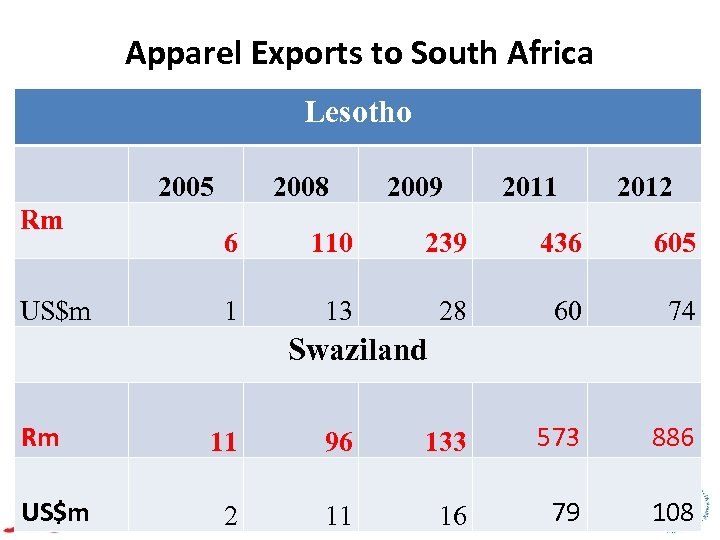 Apparel Exports to South Africa Lesotho 2005 Rm US$m 2008 2009 2011 2012 6 110 239 436 605 1 13 28 60 74 Swaziland Rm US$m 11 96 133 573 886 2 11 16 79 108
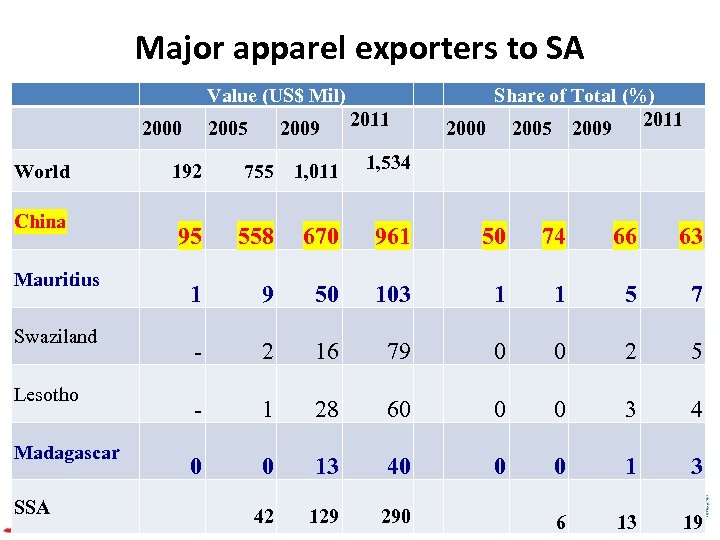 Major apparel exporters to SA Value (US$ Mil) 2005 2009 2011 2000 World China Mauritius Swaziland Lesotho Madagascar SSA Share of Total (%) 2011 2000 2005 2009 192 755 1, 011 1, 534 95 558 670 961 50 74 66 63 1 9 50 103 1 1 5 7 - 2 16 79 0 0 2 5 - 1 28 60 0 0 3 4 0 0 13 40 0 0 1 3 42 129 290 6 13 19
 South African apparel industry response • Apparel manufacturers at lower market end response: o Relocated to Lesotho and Swaziland - generally flourished o Ignored bargaining council, paid a wage workers would accept o Informalised – competing by being “below the radar” • Demonstrated old ISI policy model restricts competitive & employment basis for this low market segment • Their legal status excludes from DTI support • So limits ability to define a competitive advantage, limits ability to upgrade, and create decent employment
 Differential Response of Local Industry Mid to higher market abandoned ISI mindset to focus on firm and systemic competiveness • • Build firm capabilities - clusters (+ slide) Value chain cooperation - retailers joining clusters Industrial policy alliances - strategic industry alignment Supply chain alignment – created retail supplier clusters to build quick response systemic competitiveness
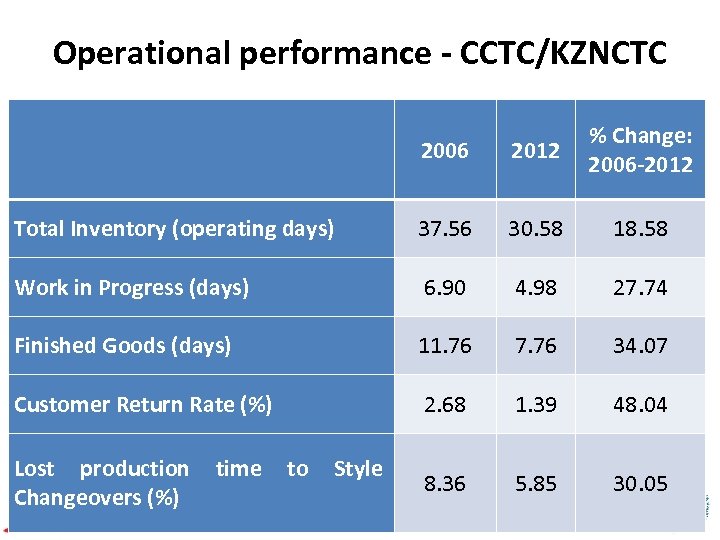 Operational performance - CCTC/KZNCTC 2006 2012 % Change: 2006 -2012 Total Inventory (operating days) 37. 56 30. 58 18. 58 Work in Progress (days) 6. 90 4. 98 27. 74 Finished Goods (days) 11. 76 7. 76 34. 07 Customer Return Rate (%) 2. 68 1. 39 48. 04 Lost production time to Style Changeovers (%) 8. 36 5. 85 30. 05
 What is Quick response (QR)? • Principle - use geographical nearness to provide retailers with speed & flexible supply (follow Turkish model to EU) o QR pilots with retailers key suppliers supply - demonstrated the positive impact of model o Retailers made 14% more relative to Asian long lead time orders WHY? o Because local QR products, with point of sale information took 56 day delivery meeting requirements demanded by customers. o Item sold at full price – retailers higher retained margin than from Asian imports, latter required discounts to be cleared
 South African apparel industry response • QR pilots demonstrated potential for a vibrant domestic industry that provides labour intensive employment. • Industry could potentially sustain 110, 697 formal sector jobs by 2022 on the basis of SA retailers shifting 40% of their total purchases to the QR model • Key is developing the manufacturing performance attributes that align with QR retailing requirements: o Product flexibility - requires product upgrading o Production versatility - requires production upgrading o Supply chain management capabilities - needs retailer upgrading
 South African government response DTI • 2010 incentives (PI and CTCIP) large number of firms upgrading (PI - R 2. 5 bn, CTCIP R 633 m) • Support initiated textiles re-capitalisation • Support QR retail supply clusters – e. g. 1 retailer/7 firms, employment grew 12. 6% • Support clusters – marginal employment growth BUT • Labour influenced institutions still ISI mindset – (Department, Bargaining Council, union)
 General Conclusion • SA apparel sector faces extreme competition: Asia to SSA • Entire sector threatened • Old ISI defensive mindset of protecting insiders & punishing non-compliant is recipe for continued competitive decline, shrinking employment, and industry contraction • Policy must move from ‘one size fits all’, centralised, inflexible mode, and accept have different industry needs • Policy supported compliant firms but narrow focus trapped non compliant firms in downward spiral
 What can we learn from Turkey? • National minimum wage (± $100 per 45 hour week) • Metro firms pay 50 -100% above this level - drives productivity and sweating overheads • Flexible working environment - firms can extend to 54 hours at a 50% premium which allows for sweating overheads, and adjusting production output to variable market demand • Entire industry competes on a differentiated QR model with seamless linkages between high value adding metro firms, design centres and less advanced, lower cost rural firms
 South Africa Policy Conclusion Need a differentiated policy for the sector • On one hand, support more advanced firms to meet the domestic retailer QR demands, (and perhaps export to EU QR retailers) • On other hand, support rather than punish lower end market segment – small firms, nonmetro, long lead time, unsophisticated, “commodity-type” producers
 And manufacturing employment generally? – Industrial policy needs to be “tied up” - upgrading support is required, but treating an ISI-based labour market as sacrosanct, which limits competitiveness, hamstrings resuscitating labour-intensive industries – Manufacturing informalisation has to be reversed – but firms need incentivises to advance their operational capabilities. Competing on low labour productivity, and old capital, can only lead to a “race to the bottom” – “Forcing” demand for SA-made products is short-term, but the underlying uncompetitive basis needs to be dealt with if employment is to be created
 Thank you