 Скачать презентацию International Collaboration for Data Preservation and Long Term
17232cbc618419d0e7e958be0cd5d791.ppt
- Количество слайдов: 25



International Collaboration for Data Preservation and Long Term Analysis in High Energy Physics Long-Term Sustainability A User (Support) View EOSC Pilot: Science Demonstrator Jamie. Shiers@cern. ch
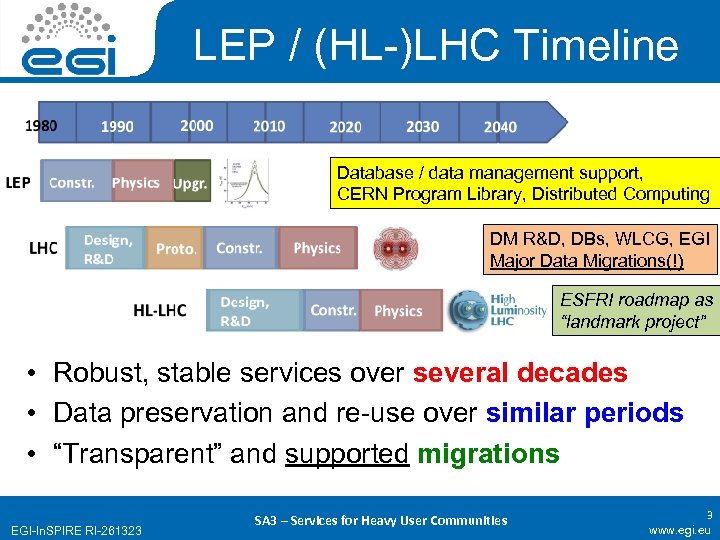
LEP / (HL-)LHC Timeline Database / data management support, CERN Program Library, Distributed Computing DM R&D, DBs, WLCG, EGI Major Data Migrations(!) ESFRI roadmap as “landmark project” • Robust, stable services over several decades • Data preservation and re-use over similar periods • “Transparent” and supported migrations EGI-In. SPIRE RI-261323 SA 3 – Services for Heavy User Communities 3 www. egi. eu
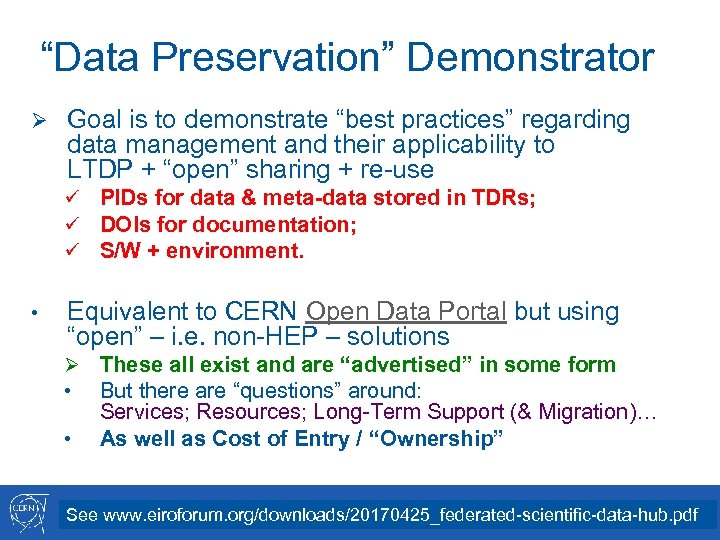
“Data Preservation” Demonstrator Ø Goal is to demonstrate “best practices” regarding data management and their applicability to LTDP + “open” sharing + re-use ü PIDs for data & meta-data stored in TDRs; ü DOIs for documentation; ü S/W + environment. • Equivalent to CERN Open Data Portal but using “open” – i. e. non-HEP – solutions Ø These all exist and are “advertised” in some form • But there are “questions” around: • Services; Resources; Long-Term Support (& Migration)… As well as Cost of Entry / “Ownership” Slide 4 See www. eiroforum. org/downloads/20170425_federated-scientific-data-hub. pdf
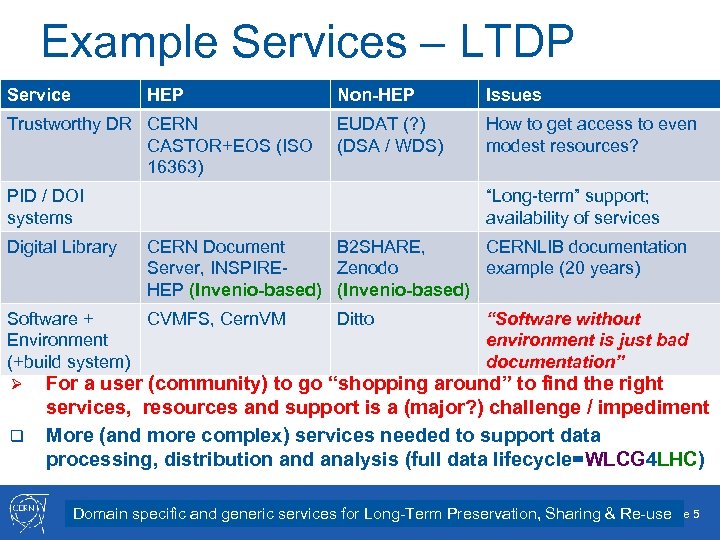
Example Services – LTDP Service HEP Trustworthy DR CERN CASTOR+EOS (ISO 16363) Non-HEP Issues EUDAT (? ) (DSA / WDS) How to get access to even modest resources? PID / DOI systems Digital Library “Long-term” support; availability of services CERN Document B 2 SHARE, CERNLIB documentation Server, INSPIREZenodo example (20 years) HEP (Invenio-based) Software + CVMFS, Cern. VM Environment (+build system) Ø q Ditto “Software without environment is just bad documentation” For a user (community) to go “shopping around” to find the right services, resources and support is a (major? ) challenge / impediment More (and more complex) services needed to support data processing, distribution and analysis (full data lifecycle=WLCG 4 LHC) Slide Domain specific and generic services for Long-Term Preservation, Sharing & Re-use 5
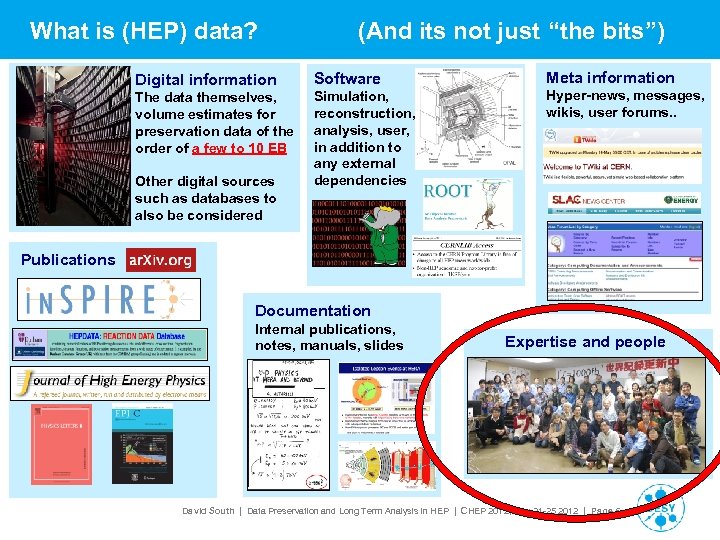
What is (HEP) data? (And its not just “the bits”) Digital information Software Meta information The data themselves, volume estimates for preservation data of the order of a few to 10 EB Simulation, reconstruction, analysis, user, in addition to any external dependencies Hyper-news, messages, wikis, user forums. . Other digital sources such as databases to also be considered Publications Documentation Internal publications, notes, manuals, slides Expertise and people David South | Data Preservation and Long Term Analysis in HEP | CHEP 2012, May 21 -25 2012 | Page 6
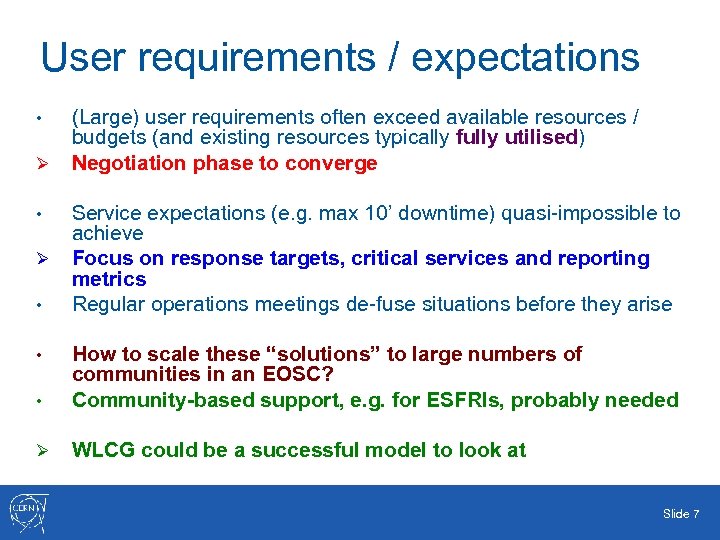
User requirements / expectations • Ø • (Large) user requirements often exceed available resources / budgets (and existing resources typically fully utilised) Negotiation phase to converge Service expectations (e. g. max 10’ downtime) quasi-impossible to achieve Focus on response targets, critical services and reporting metrics Regular operations meetings de-fuse situations before they arise • How to scale these “solutions” to large numbers of communities in an EOSC? Community-based support, e. g. for ESFRIs, probably needed Ø WLCG could be a successful model to look at • Slide 7
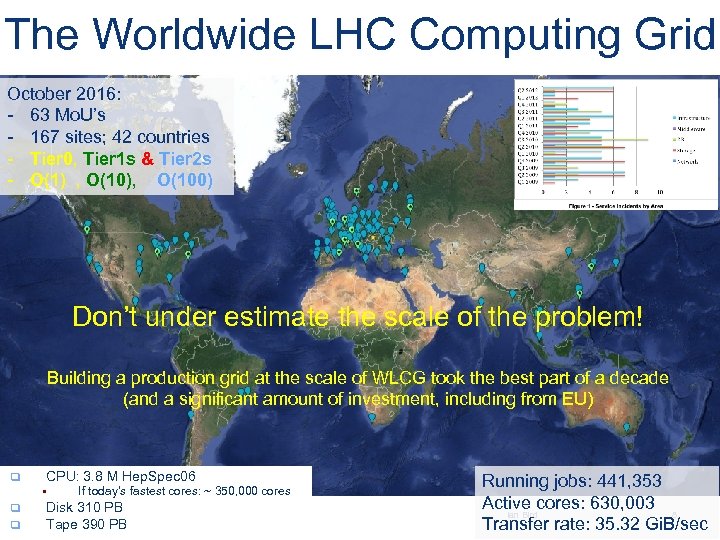
The Worldwide LHC Computing Grid October 2016: - 63 Mo. U’s - 167 sites; 42 countries - Tier 0, Tier 1 s & Tier 2 s - O(1) , O(10), O(100) Don’t under estimate the scale of the problem! Building a production grid at the scale of WLCG took the best part of a decade (and a significant amount of investment, including from EU) q CPU: 3. 8 M Hep. Spec 06 § q q If today’s fastest cores: ~ 350, 000 cores Disk 310 PB Tape 390 PB 2 Dec 2016 Running jobs: 441, 353 Active cores: 630, 003 Ian Bird 8 Transfer rate: 35. 32 Gi. B/sec
WLCG Service Challenges • Ø • • • As much about people and collaboration as about technology Getting people to provide a 24 x 7 service for a machine on the other side of the planet for no clear reason was going to be hard! Regional workshops – both motivational as well as technical – plus daily Operations Calls In a grid, something is broken all of the time! Clear KPIs, “critical services” & response targets: measurable improvement in service quality despite ever increasing demands Targets for response, intervention and resolution based on severity. Monitored regularly – not guarantees! Slide 9
DMPs, the EOSC and ESFRIs Ø An EOSC must support multiple disciplines • Therefore, we need a lingua franca i. e. someway of getting them to talk together • Ø IMHO, DMPs could provide just that! • • And / or to the service providers! Even though guidelines would need to be broadened to cover data acquisition, processing, distribution and analysis in more detail! DMP w/s for ESFRI(-like) projects proposed: to be rescheduled now that EOSC goals / plans more clear Synergies through DMPs: save time, money; better solutions! Slide 10
Benefits of collaboration: LTDP 1. 2. 3. 4. 5. The elaboration of a clear "business case" for long-term data preservation The development of an associated "cost model” A common view of the Use Cases driving the need for data preservation Understanding how to address Funding Agencies requirements for Data Management Plans Preparing for Certification of HEP digital repositories and their long-term future. Collaboration (and not “control”) is key to everything CERN does. Slide 11
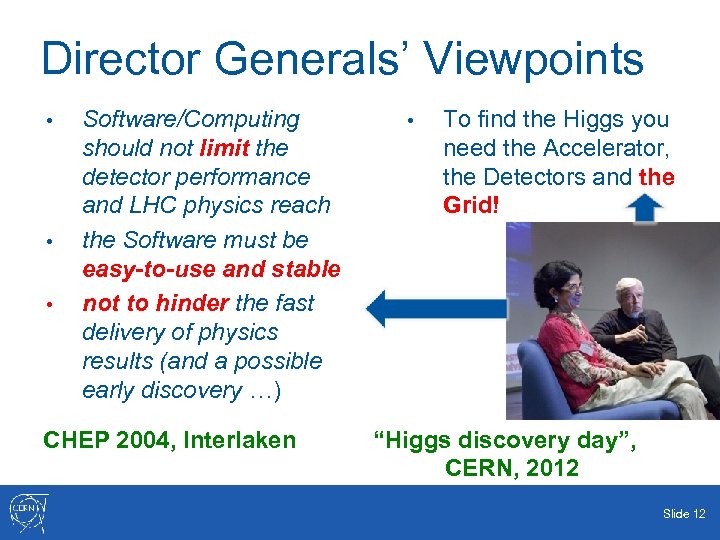
Director Generals’ Viewpoints • • • Software/Computing should not limit the detector performance and LHC physics reach the Software must be easy-to-use and stable not to hinder the fast delivery of physics results (and a possible early discovery …) CHEP 2004, Interlaken • To find the Higgs you need the Accelerator, the Detectors and the Grid! “Higgs discovery day”, CERN, 2012 Slide 12
Services are (just) services • No matter how fantastic our { TDRs, PID services, Digital Library, Software repository } etc is, they are there to support the users Ø Who have to do the really hard work! § • E. g. write the software, documentation, acquire and analyse the data, write the scientific papers Getting the degree of public recognition as at the Higgs discovery day was a target KPI! Slide 13
~30 years of LEP – what does it tell us? ► Major migrations are unavoidable but hard to foresee! ► Data is not just “bits”, but also documentation, software + environment + “knowledge” ► “Collective knowledge” particularly hard to capture ► ► Documentation “refreshed” after 20 years (1995) – now in Digital Library in PDF & PDF/A formats (was Postscript) Today’s “Big Data” may become tomorrow’s “peanuts” ► ► 100 TB per LEP experiment: immensely challenging at the time; now “trivial” for both CPU and storage With time, hardware costs tend to zero ► ► O(CHF 1000) per experiment per year for archive storage Personnel costs tend to O(1 FTE) >> CHF 1000! ► Perhaps as little now as 0. 1 – 0. 2 FTE per LEP experiment to keep data + s/w alive – no new analyses included See DPHEP Workshop on “Full Costs of Curation”, January 2014: https: //indico. cern. ch/event/276820/ 14
ODBMS migration – overview (300 TB) § A triple migration! § Data format and software conversion from Objectivity/DB to Oracle § Physical media migration from Storage. Tek 9940 A to 9940 B tapes § Took ~1 year to prepare; ~1 year to execute § Could never have been achieved without extensive system, database and application support! § Two experiments – many software packages and data sets § COMPASS raw event data (300 TB) § Data taking continued after the migration, using the new Oracle software § HARP raw event data (30 TB), event collections and conditions data § Data taking stopped in 2002, no need to port event writing infrastructure § In both cases, the migration was during the “lifetime” of the experiment § System integration tests validating read-back from the new storage IT-SDC A. Valassi – Objectivity Migration 13 th January 2014 15
Open Science: A 5 -Star Scale? • We have a 5 -star scale for Open Data • Sir Timothy Berners-Lee • We have a proposed 5 -star scale for FAIR data management (+TDRs) • Peter Doorn and Ingrid Dillo Ø How about a 5 -star scale for “Open Science: Open to the World”? • The EOSC “Open to the world” cannot mean no accounting, authorisation, access control etc. Slide 16
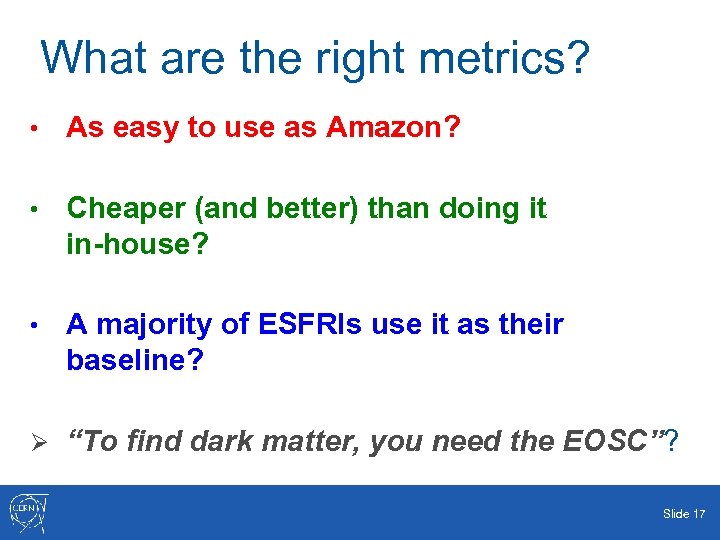
What are the right metrics? • As easy to use as Amazon? • Cheaper (and better) than doing it in-house? • A majority of ESFRIs use it as their baseline? Ø “To find dark matter, you need the EOSC”? Slide 17
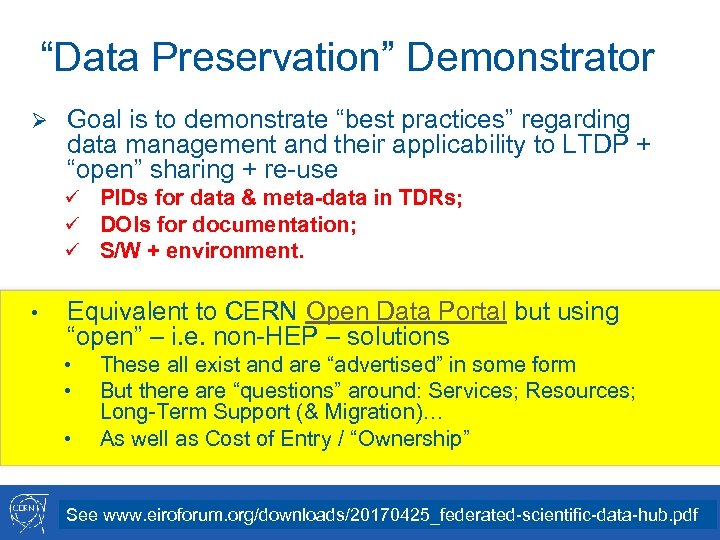
“Data Preservation” Demonstrator Ø Goal is to demonstrate “best practices” regarding data management and their applicability to LTDP + “open” sharing + re-use ü PIDs for data & meta-data in TDRs; ü DOIs for documentation; ü S/W + environment. • Equivalent to CERN Open Data Portal but using “open” – i. e. non-HEP – solutions • • • These all exist and are “advertised” in some form But there are “questions” around: Services; Resources; Long-Term Support (& Migration)… As well as Cost of Entry / “Ownership” Slide 18 See www. eiroforum. org/downloads/20170425_federated-scientific-data-hub. pdf
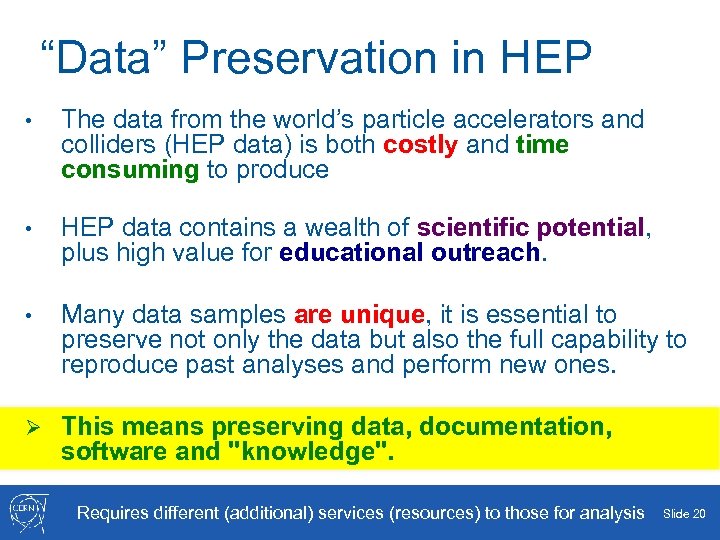
“Data” Preservation in HEP • The data from the world’s particle accelerators and colliders (HEP data) is both costly and time consuming to produce • HEP data contains a wealth of scientific potential, plus high value for educational outreach. • Many data samples are unique, it is essential to preserve not only the data but also the full capability to reproduce past analyses and perform new ones. Ø This means preserving data, documentation, software and "knowledge". Requires different (additional) services (resources) to those for analysis Slide 20
What Makes HEP Different? • • • We throw away most of our data before it is even recorded – “triggers” Our detectors are relatively stable over long periods of time (years) – not “doubling every 6 or 18 months” We make “measurements” – not “observations” Our projects typically last for decades – we need to keep data usable during at least this length of time We have shared “data behind publications” for more than 30 years… (HEPData) Measurements are repeatable: observations are not Slide 21
CERN Services for LTDP 1. 2. 3. 4. 5. 6. Ø State-of-the art "bit preservation", implementing practices that conform to the ISO 16363 standard "Software preservation" - a key challenge in HEP where the software stacks are both large and complex (and dynamic) Analysis capture and preservation, corresponding to a set of agreed Use Cases Access to data behind physics publications - the HEPData portal An Open Data portal for released subsets of the (currently) LHC data A DPHEP portal that links also to data preservation efforts at other HEP institutes worldwide. These run in production at CERN and elsewhere and are being prototyped (in generic equivalents) in the EOSC Pilot Humble pie: services are just services. The real work is in using them! Slide 22
Bit Preservation: Steps Include Ø Controlled media lifecycle • • Regular media verification • • For “smaller” communities, a 2 nd copy can be created: separate library in a different building (e. g. LEP – 3 copies at CERN!) Protecting the physical link • • Reduces media wear-out & increases efficiency Data Redundancy • • When tape written, filled, every 2 years… Reducing tape mounts • • Media kept for 2 max. 2 drive generations Between disk caches and tape servers Protecting the environment • Dust sensors! (Don’t let users touch tapes) Constant improvement: reduction in bit-loss rate: 5 x 10 -16 See “The Lost Picture Show: Hollywood Archivists Can’t Outpace Obsolescence” Slide 23 IEEE Spectrum
LTDP Conclusions • As is well known, Data Preservation is a Journey and not a destination. • Can we capture sufficient “knowledge” to keep the data usable beyond the lifetime of the original collaboration? • Can we prepare for major migrations, similar to those that happened in the past? (Or will x 86 and Linux last “forever”) • For the HL-LHC, we may have neither the storage resources to keep all (intermediate) data, nor the computational resources to re-compute them! Ø You can’t share or re-use data, nor reproduce results, if you haven’t first preserved it (data, software, documentation, knowledge) Data preservation & sharing: required by Science and Funders Slide 24
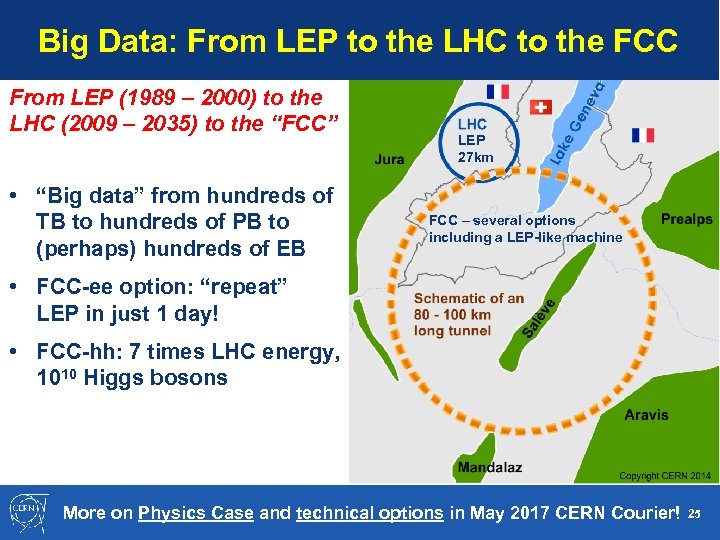
Big Data: From LEP to the LHC to the FCC From LEP (1989 – 2000) to the LHC (2009 – 2035) to the “FCC” • “Big data” from hundreds of TB to hundreds of PB to (perhaps) hundreds of EB LEP 27 km FCC – several options including a LEP-like machine • FCC-ee option: “repeat” LEP in just 1 day! • FCC-hh: 7 times LHC energy, 1010 Higgs bosons More on Physics Case and technical options in May 2017 CERN Courier! 25
Скачать презентацию International Collaboration for Data Preservation and Long Term
17232cbc618419d0e7e958be0cd5d791.ppt