 Скачать презентацию International Civil Aviation Organization SIP ASBU 2012 -WP 18 FF-ICE A
3d22c7276f4b48c8847a89107960d6e9.ppt
- Количество слайдов: 22



International Civil Aviation Organization SIP/ASBU/2012 -WP/18 FF-ICE A CONCEPT TO SUPPORT THE ATM SYSTEM OF THE FUTURE Saulo Da Silva Workshop on preparations for ANConf/12 − ASBU methodology (Bangkok, 14 -18/Nadi, 21 -25 May 2012)
Overview • • • BACKGROUND TO FF-ICE DRIVERS FOR CHANGE SUMMARY OF CONCEPT IMPLICATIONS BENEFITS ICAO SIP 2012 - ASBU workshops 2
Flight plan ‘SPECIFIED INFORMATION PROVIDED TO AIR TRAFFIC SERVICE UNITS, RELATIVE TO AN INTENDED FLIGHT OR PORTION OF A FLIGHT OF AN AIRCRAFT’ (ICAO DEFINITION) ICAO SIP 2012 - ASBU workshops 3
Air Traffic Management (ATM) ‘THE DYNAMIC, INTEGRATED MANAGEMENT OF AIR TRAFFIC AND AIRSPACE INCLUDING AIR TRAFFIC SERVICES, TRAFFIC AIRSPACE FLOW MANAGEMENT AND – AIR SAFELY, ECONOMICALLY AND EFFICIENTLY – THROUGH THE PROVISION OF FACILITIES AND SEAMLESS SERVICES IN COLLABORATION INVOLVING WITH AIRBORNE ALL AND PARTIES GROUND AND BASED FUNCTIONS’ ICAO SIP 2012 - ASBU workshops 4
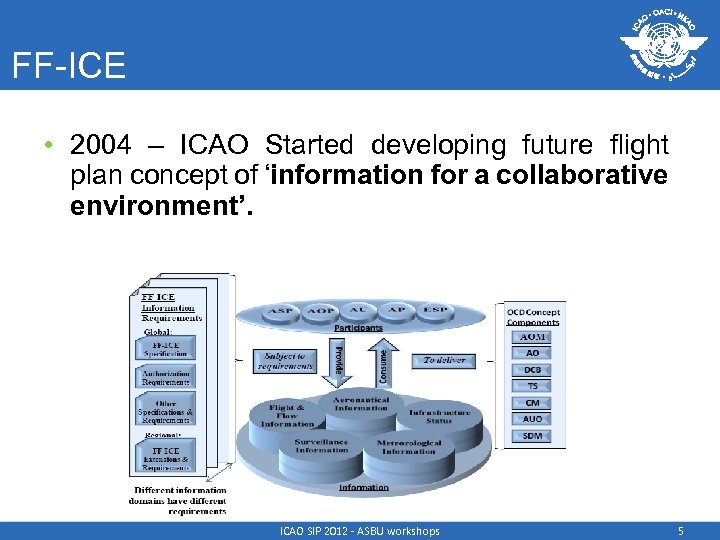
FF-ICE • 2004 – ICAO Started developing future flight plan concept of ‘information for a collaborative environment’. ICAO SIP 2012 - ASBU workshops 5
The need for change • How often is the ICAO paper flight plan form actually used to file a flight plan? • How representative of the capabilities of both airborne and ground based systems is the current form and process? ICAO SIP 2012 - ASBU workshops 6
Limitations of ATM system (1) • Disparate services & procedures • Reliance on voice radio communications • Rigid airspace divisions & route structures • Limited collaborative planning amongst ANSPs, aerodrome & a/c operators • Less than optimum use of resources ICAO SIP 2012 - ASBU workshops 7
Limitations of ATM system (2) • Limited facilities for real-time information exchange • Limited ability to maximise benefits for aircraft with advanced avionics • Long lead times for development and deployment of improved systems. ICAO SIP 2012 - ASBU workshops 8
Consequences • Non optimized departure & arrival procedures • Exclusion of civil traffic from airspace reserved for special use • Indirect fixed routes • Excessive system related delays • Operation of a/c at inefficient FLs, speeds & in unfavourable MET • Insufficient flexibility to properly manage disruptions to airline operations. ICAO SIP 2012 - ASBU workshops 9
ICAO requirements • Global ATM Operational Concept (Doc 9854) • Manual on ATM System Requirements (DOC 9882) • Manual on Global Performance of the Air Navigation System (doc 9883). ICAO SIP 2012 - ASBU workshops 10
FF-ICE concept • Facts and data to support performance based decision making • Data representing results of performance based decision making • Data related to managing the performance of individual flight • Data related to managing overall performance & meeting expectations • Mechanisms for ensuring data consistency and interoperability • Mechanisms for increased flexibility regarding new information. ICAO SIP 2012 - ASBU workshops 11
Addressing limitations • • • Sharing flight information Advance notification Inconsistent information Information distribution Information security Flexible information set. ICAO SIP 2012 - ASBU workshops 12
Principles of FF-ICE(1) • Flexible concept allowing new technologies & procedures to be incorporated as necessary • Detailed indication of a/c performance capabilities • Early indication of intent • Information for increased & more automated CDM • Avoidance of unnecessary limitations on information ICAO SIP 2012 - ASBU workshops 13
Principles of FF-ICE (2) • • • Support for 4 D trajectory management Avoidance of filing unnecessary/ambiguous info Provision of info security requirements Consideration of cost impact Ensures information is machine readable Globally standardised definitions of information elements. ICAO SIP 2012 - ASBU workshops 14
Information elements • • • Flight identifying information Flight SAR information Flight permission information Flight preferences and constraints information Trajectory type Surface segment type Airborne element type Performance information Aircraft intent Flight trajectory information ICAO SIP 2012 - ASBU workshops 15
Technical environment • Data model • System Wide Information Management (SWIM) • Supporting infrastructure ICAO SIP 2012 - ASBU workshops 16
Infrastructure • Communication network • Safety and security features • Data exchange formats – will use XML ICAO SIP 2012 - ASBU workshops 17
Example timeline for info provision • Scheduling and strategic activities • Pre-tactical operational planning • Tactical operational planning • Flight operation ICAO SIP 2012 - ASBU workshops 18
Transition & implementation • Operator flight planning systems - will require changes to extract and process info to facilitate the collaborative process • ASP and AOP systems – modifications to implementing systems to facilitate interaction • Documentation & training – changes to procedures & systems will necessitate new documentation & training. ICAO SIP 2012 - ASBU workshops 19
Benefits • Cost Effectiveness - Standard information will reduce cost of system development • Efficiency - Better knowledge of trajectory information will allow more optimum flight profile • Global Interoperability – Global interoperability is facilitated by easier connection of all stakeholders ICAO SIP 2012 - ASBU workshops 20
Benefits • Participation by the ATM community - Participation of all stakeholders is facilitated through real-time data sharing • Predictability - The sharing of information between aircraft and ground systems will enhance the predictability • Safety - System wide data sharing will allow early detection of inconsistencies and updated information which will improve situation awareness. . ICAO SIP 2012 - ASBU workshops 21

ICAO SIP 2012 - ASBU workshops 22
Скачать презентацию International Civil Aviation Organization SIP ASBU 2012 -WP 18 FF-ICE A
3d22c7276f4b48c8847a89107960d6e9.ppt