 Скачать презентацию International Business Management MS 34 B Balance of
52d289a557e6b2b91d9f05dd4c699fe2.ppt
- Количество слайдов: 23



International Business Management (MS 34 B) Balance of Payments and National Financial Management Facilitator : Densil A. Williams MS 34 B UWI Mona, Department of Management Studies
Contents n n n Definition of Balance of Payments Composition of the Balance of Payment Importance of Balance of Payment Data for Managers and Governments National Financial Management : Barbados National Financial Management: Jamaica Concluding Remarks MS 34 B UWI Mona, Department of Management Studies
Balance of Payments n n The BOP records all financial transactions between residents of a country and residents of the rest of the world during a period of time. In other words, its records a country’s international transactions with the rest of the world. It is a part of a country’s national accounts which records inflows of funds into the country as a credit and is entered with a plus sign in the accounts and outflows of funds is a debit and is entered with a minus sign in the accounts. These are best illustrated as we look at the component of the BOP. MS 34 B UWI Mona, Department of Management Studies
Composition of Balance of Payments Component of the BOP n The BOP is divided into: -Current, -Capital -Reserve. Current Account n The current account comprises financial transactions that provide no opportunity to receive nor obligation to pay out foreign exchange in the future MS 34 B UWI Mona, Department of Management Studies
Composition Payments of Balance of In other words, it records a country’s trade in currently produced goods and services, along with non-reciprocal transfer between countries. n It is divided into three separate components: - net export of goods and services - net income from abroad - net unilateral transfers (e. g. official foreign aid) n MS 34 B UWI Mona, Department of Management Studies
Composition of Balance of Payments n n Adding all the balances on each sub account yields the current account balance. If the balance is positive, the country has a current account surplus and if negative a deficit. MS 34 B UWI Mona, Department of Management Studies
Composition of Balance of Payments Capital Account n The capital account comprises financial transactions that do provide for future foreign exchange receipts or payment obligations. n n In other words, it comprises unilateral transfers of assets between countries such as debt forgiveness or migrant transfers. The account is generally referred to as the Capital and Financial Account. MS 34 B UWI Mona, Department of Management Studies
Composition of Balance of Payments n n n The financial account records the value of financial flows in the country i. e. the buying or selling of assets by residents of a country to or from foreigners. The capital and financial account balance is the sum of the capital account and financial account balance. N. B. The capital account comprises only nonreciprocal transfer of assets while the financial account comprises both buying and selling of assets. MS 34 B UWI Mona, Department of Management Studies
Composition of Balance of Payments Reserves n Reserve accounts reflect changes in the country’s stock of foreign exchange reserves. n Since the BOP must be balanced, if the Current account and the Capital and Financial accounts do not equate to zero, any excess is transferred to the reserves (a negative sign) while, if there is a short fall the amount needed to balance the BOP is taken from the reserves (a positive sign) MS 34 B UWI Mona, Department of Management Studies
Importance of BOP Data Importance to Managers & Governments n Exchange rate forecast. n Business cycle planning n Determine health management of a country’s MS 34 B UWI Mona, Department of Management Studies financial
National Financial Management n Financial Management is important to help a country to enhance its international competitiveness and thus improve the life and well -being of its citizens. n The goal of this process is to accelerate economic growth and development. n Who should spur the growth –Public or Private sector? MS 34 B UWI Mona, Department of Management Studies
National Financial Management The elements of a growth oriented public policy agenda are: -macro economic stability -macro political stability -government consumption -competitive markets and properly regulated MS 34 B UWI Mona, Department of Management Studies domestic
National Financial Management -improvements in terms of trade -enhancement of firm’s international competitiveness -sound governance -embrace social, cultural and environmental realities of a country MS 34 B UWI Mona, Department of Management Studies
National Financial Management Economic Stability : n Low Inflation n Low Interest Rates n Sustainable External Balances n Sustainable Fiscal Balances MS 34 B UWI Mona, Department of Management Studies
National Financial Management Public Policy and Sovereignty n n n The Caribbean experience suggests an inverse relationship between exchange and monetary policy independence and economic performance in small economies. In the Caribbean, fixed exchange rates have been more compatible with economic growth than flexible exchange rates. This does not suggest that fixed exchange rates are ideal, but that Caribbean governments have generally not managed flexible exchange rates well. Trinidad and Tobago is the exception in this regard. Department of MS 34 B UWI Mona, Management Studies
National Financial Management: The Case of Barbados n n n Choice of Nominal Anchor – exchange rate Barbados choose fixed exchange rate – which survived 1981 and 1991 fiscal crises. 1991 crisis led to wage cut, social partnership via protocol on prices/income policy. MS 34 B UWI Mona, Department of Management Studies
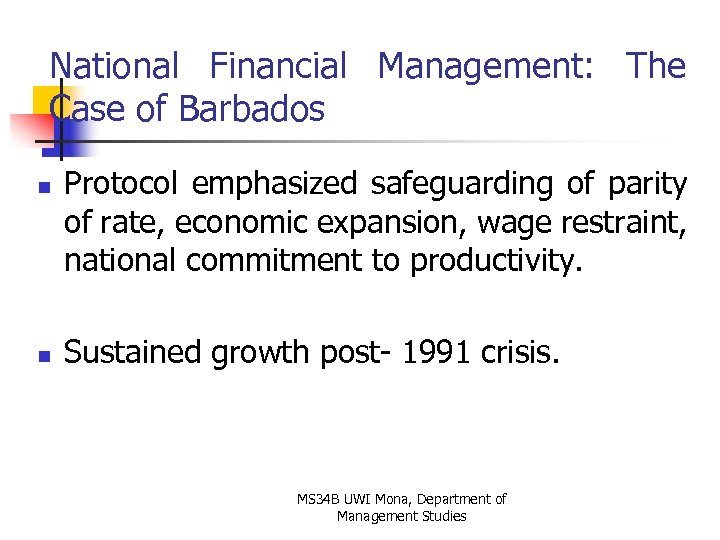
National Financial Management: The Case of Barbados n n Protocol emphasized safeguarding of parity of rate, economic expansion, wage restraint, national commitment to productivity. Sustained growth post- 1991 crisis. MS 34 B UWI Mona, Department of Management Studies
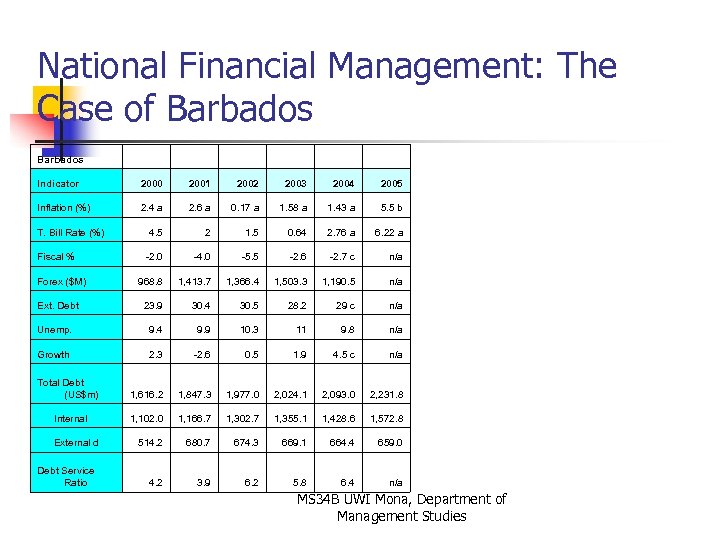
National Financial Management: The Case of Barbados Indicator 2000 2001 2002 2003 2004 2005 Inflation (%) 2. 4 a 2. 6 a 0. 17 a 1. 58 a 1. 43 a 5. 5 b 4. 5 2 1. 5 0. 64 2. 76 a 6. 22 a -2. 0 -4. 0 -5. 5 -2. 6 -2. 7 c n/a 968. 8 1, 413. 7 1, 366. 4 1, 503. 3 1, 190. 5 n/a 23. 9 30. 4 30. 5 28. 2 29 c n/a Unemp. 9. 4 9. 9 10. 3 11 9. 8 n/a Growth 2. 3 -2. 6 0. 5 1. 9 4. 5 c n/a Total Debt (US$m) 1, 616. 2 1, 847. 3 1, 977. 0 2, 024. 1 2, 093. 0 2, 231. 8 Internal 1, 102. 0 1, 166. 7 1, 302. 7 1, 355. 1 1, 428. 6 1, 572. 8 External d 514. 2 680. 7 674. 3 669. 1 664. 4 659. 0 Debt Service Ratio 4. 2 3. 9 6. 2 5. 8 6. 4 n/a T. Bill Rate (%) Fiscal % Forex ($M) Ext. Debt MS 34 B UWI Mona, Department of Management Studies
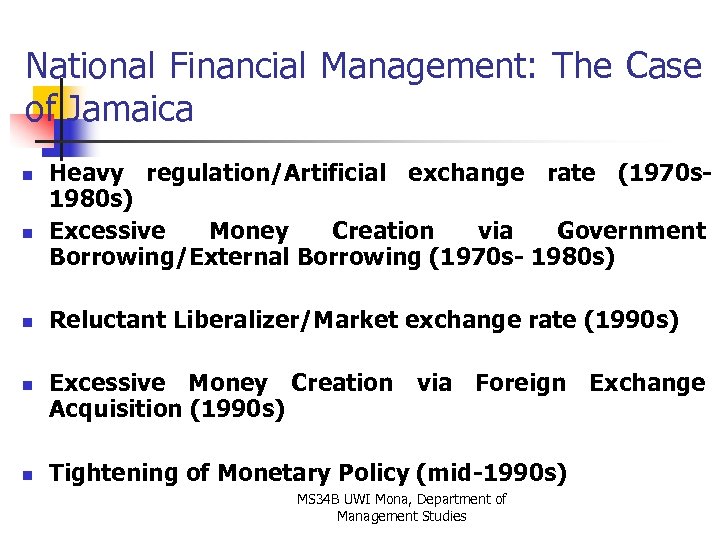
National Financial Management: The Case of Jamaica n n n Heavy regulation/Artificial exchange rate (1970 s 1980 s) Excessive Money Creation via Government Borrowing/External Borrowing (1970 s- 1980 s) Reluctant Liberalizer/Market exchange rate (1990 s) Excessive Money Creation via Foreign Exchange Acquisition (1990 s) Tightening of Monetary Policy (mid-1990 s) MS 34 B UWI Mona, Department of Management Studies
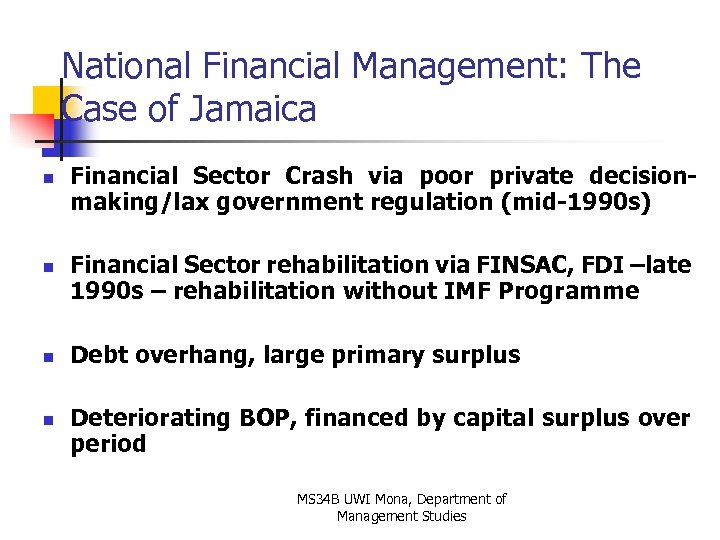
National Financial Management: The Case of Jamaica n n Financial Sector Crash via poor private decisionmaking/lax government regulation (mid-1990 s) Financial Sector rehabilitation via FINSAC, FDI –late 1990 s – rehabilitation without IMF Programme Debt overhang, large primary surplus Deteriorating BOP, financed by capital surplus over period MS 34 B UWI Mona, Department of Management Studies
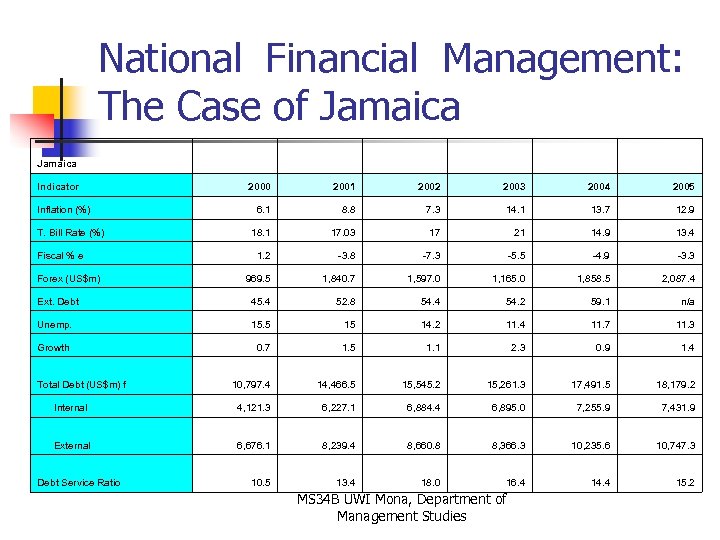
National Financial Management: The Case of Jamaica Indicator 2000 2001 2002 2003 2004 2005 6. 1 8. 8 7. 3 14. 1 13. 7 12. 9 18. 1 17. 03 17 21 14. 9 13. 4 1. 2 -3. 8 -7. 3 -5. 5 -4. 9 -3. 3 969. 5 1, 840. 7 1, 597. 0 1, 165. 0 1, 858. 5 2, 087. 4 Ext. Debt 45. 4 52. 8 54. 4 54. 2 59. 1 n/a Unemp. 15. 5 15 14. 2 11. 4 11. 7 11. 3 Growth 0. 7 1. 5 1. 1 2. 3 0. 9 1. 4 10, 797. 4 14, 466. 5 15, 545. 2 15, 261. 3 17, 491. 5 18, 179. 2 Internal 4, 121. 3 6, 227. 1 6, 884. 4 6, 895. 0 7, 255. 9 7, 431. 9 External 6, 676. 1 8, 239. 4 8, 660. 8 8, 366. 3 10, 235. 6 10, 747. 3 10. 5 13. 4 18. 0 16. 4 14. 4 15. 2 Inflation (%) T. Bill Rate (%) Fiscal % e Forex (US$m) Total Debt (US$m) f Debt Service Ratio MS 34 B UWI Mona, Department of Management Studies
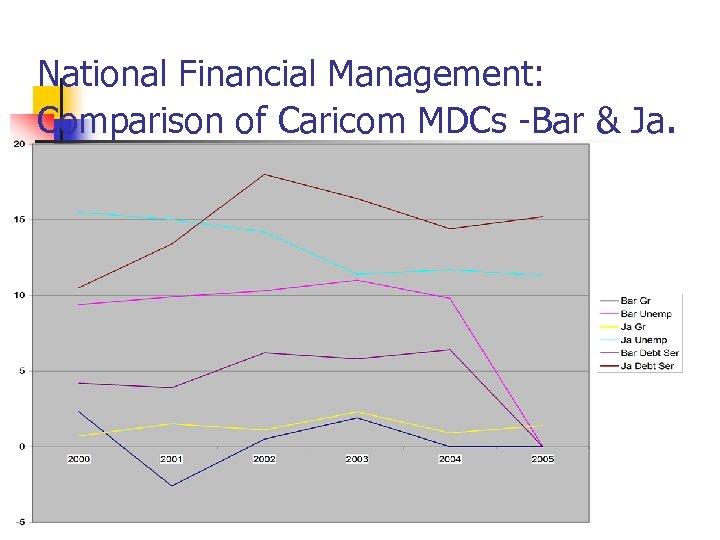
National Financial Management: Comparison of Caricom MDCs -Bar & Ja.
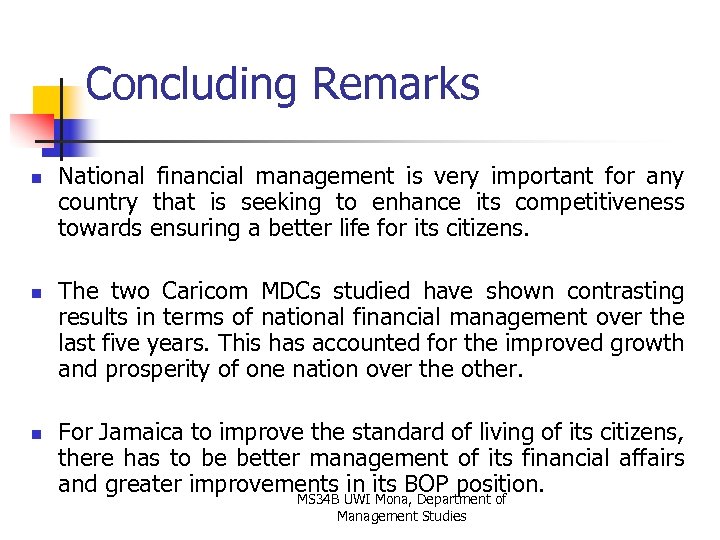
Concluding Remarks n n n National financial management is very important for any country that is seeking to enhance its competitiveness towards ensuring a better life for its citizens. The two Caricom MDCs studied have shown contrasting results in terms of national financial management over the last five years. This has accounted for the improved growth and prosperity of one nation over the other. For Jamaica to improve the standard of living of its citizens, there has to be better management of its financial affairs and greater improvements in its BOP position. MS 34 B UWI Mona, Department of Management Studies
Скачать презентацию International Business Management MS 34 B Balance of
52d289a557e6b2b91d9f05dd4c699fe2.ppt