 Скачать презентацию International Business by Prof Yong-Sik Hwang Sejong University
f3b60660cdb86cb435133d9327a86e95.ppt
- Количество слайдов: 43



International Business by Prof. Yong-Sik Hwang Sejong University
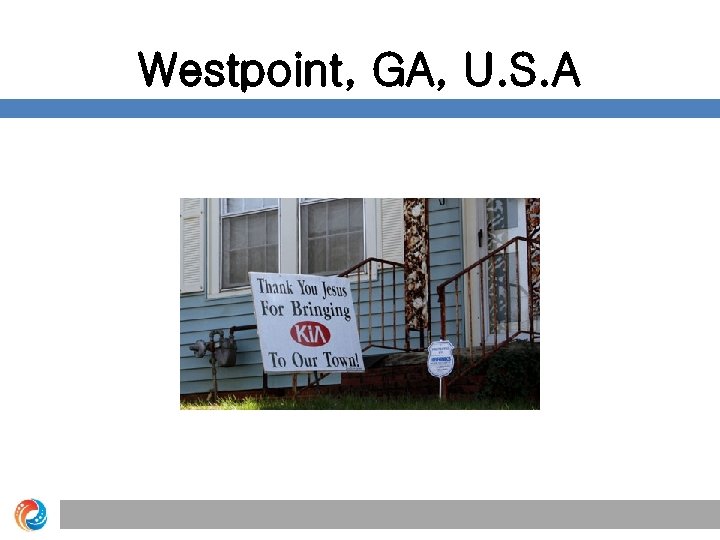
Westpoint, GA, U. S. A
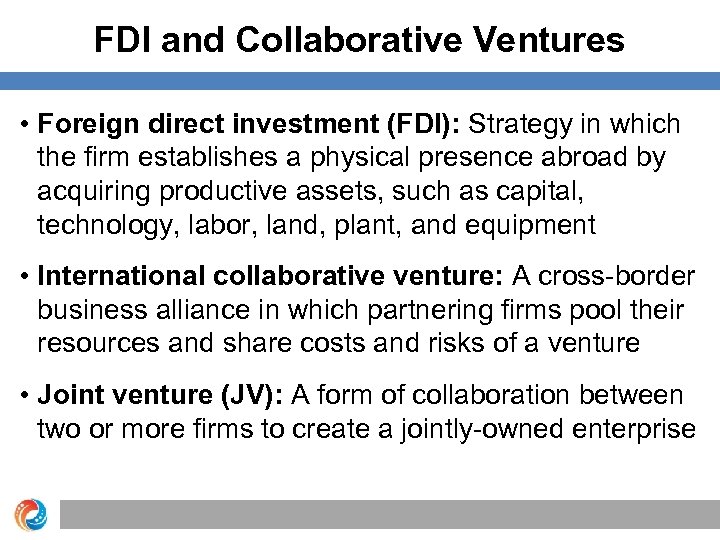
FDI and Collaborative Ventures • Foreign direct investment (FDI): Strategy in which the firm establishes a physical presence abroad by acquiring productive assets, such as capital, technology, labor, land, plant, and equipment • International collaborative venture: A cross-border business alliance in which partnering firms pool their resources and share costs and risks of a venture • Joint venture (JV): A form of collaboration between two or more firms to create a jointly-owned enterprise
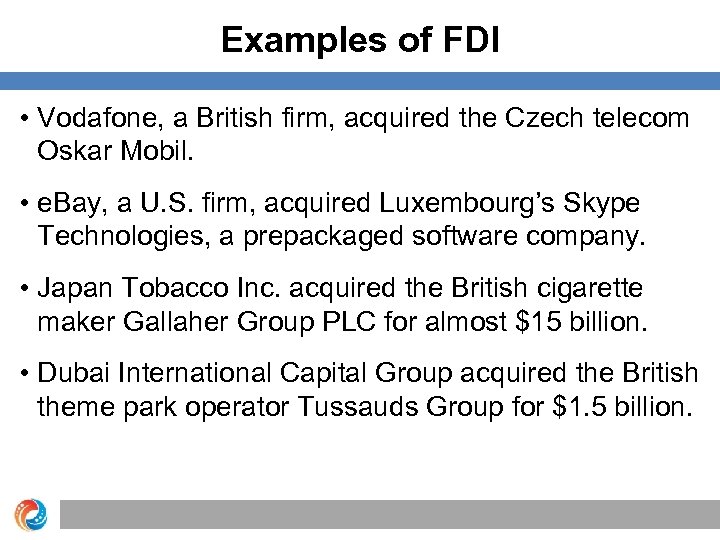
Examples of FDI • Vodafone, a British firm, acquired the Czech telecom Oskar Mobil. • e. Bay, a U. S. firm, acquired Luxembourg’s Skype Technologies, a prepackaged software company. • Japan Tobacco Inc. acquired the British cigarette maker Gallaher Group PLC for almost $15 billion. • Dubai International Capital Group acquired the British theme park operator Tussauds Group for $1. 5 billion.
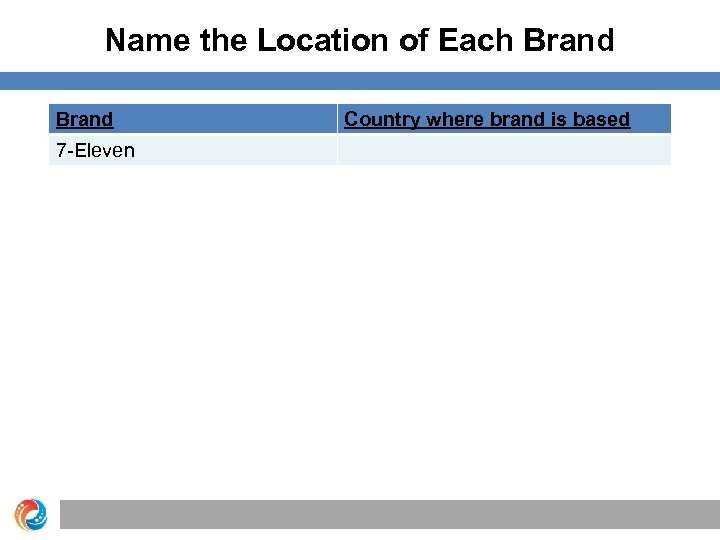
Name the Location of Each Brand 7 -Eleven Country where brand is based
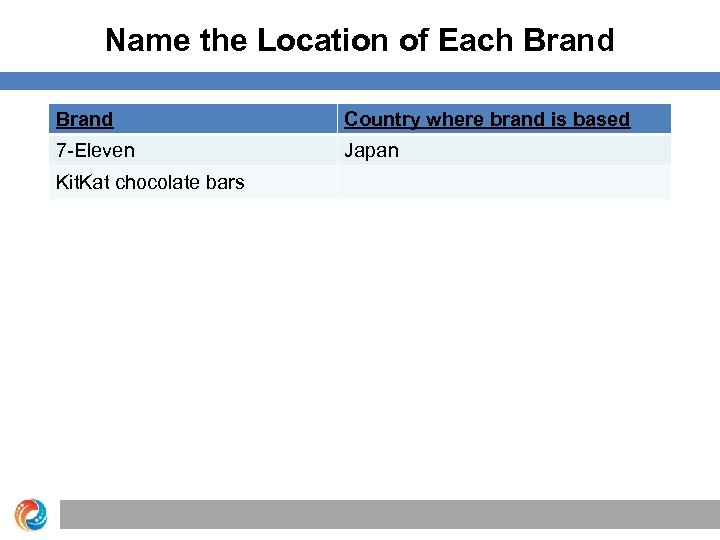
Name the Location of Each Brand Country where brand is based 7 -Eleven Japan Kit. Kat chocolate bars
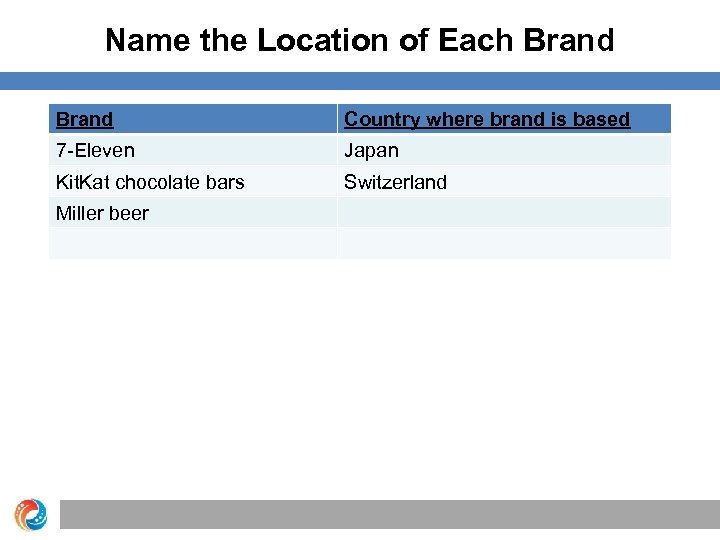
Name the Location of Each Brand Country where brand is based 7 -Eleven Japan Kit. Kat chocolate bars Switzerland Miller beer
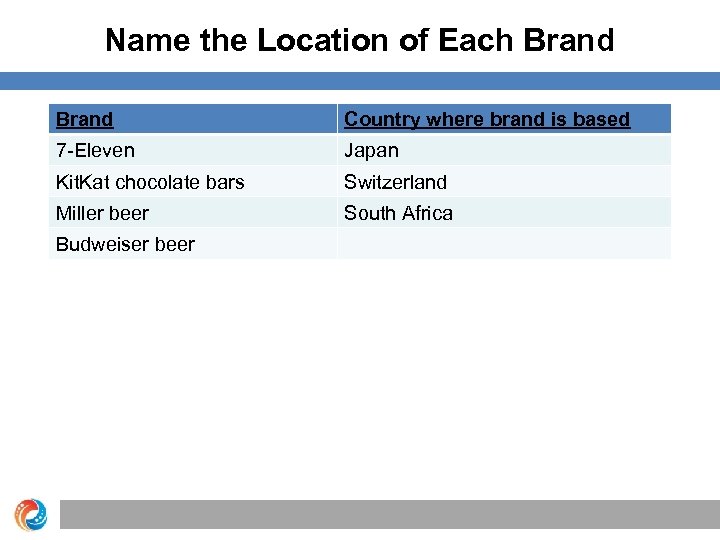
Name the Location of Each Brand Country where brand is based 7 -Eleven Japan Kit. Kat chocolate bars Switzerland Miller beer South Africa Budweiser beer
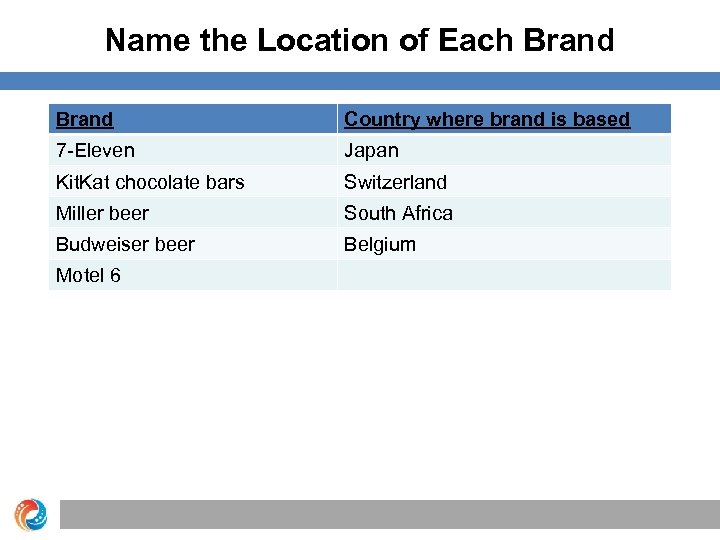
Name the Location of Each Brand Country where brand is based 7 -Eleven Japan Kit. Kat chocolate bars Switzerland Miller beer South Africa Budweiser beer Belgium Motel 6
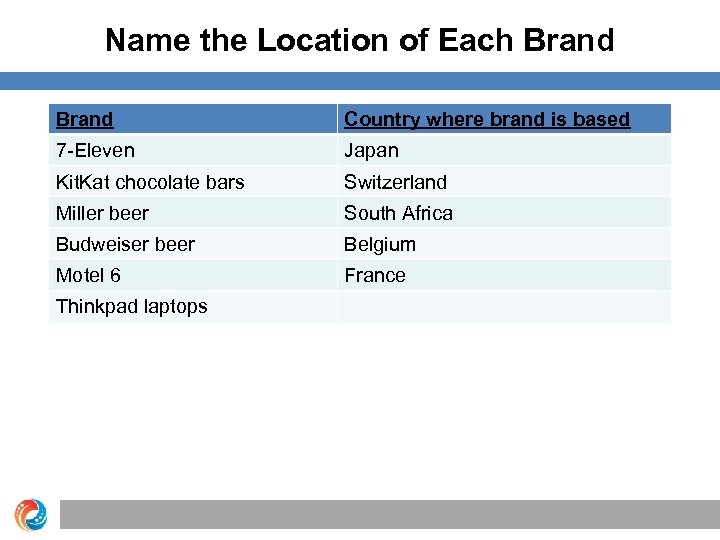
Name the Location of Each Brand Country where brand is based 7 -Eleven Japan Kit. Kat chocolate bars Switzerland Miller beer South Africa Budweiser beer Belgium Motel 6 France Thinkpad laptops
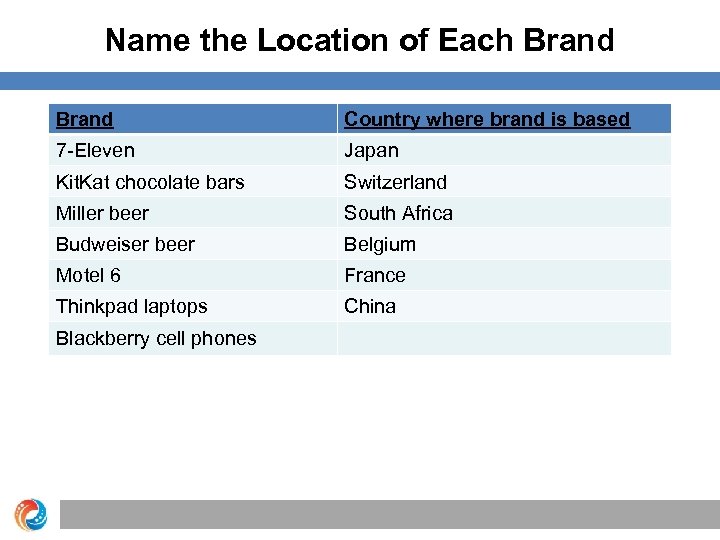
Name the Location of Each Brand Country where brand is based 7 -Eleven Japan Kit. Kat chocolate bars Switzerland Miller beer South Africa Budweiser beer Belgium Motel 6 France Thinkpad laptops China Blackberry cell phones
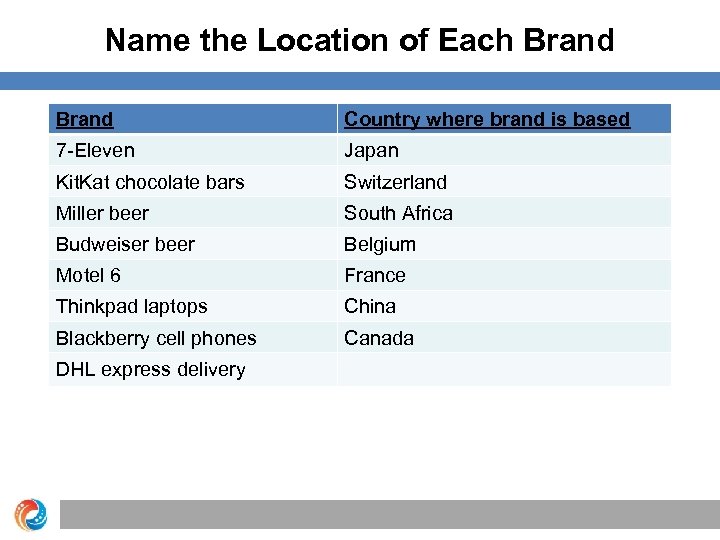
Name the Location of Each Brand Country where brand is based 7 -Eleven Japan Kit. Kat chocolate bars Switzerland Miller beer South Africa Budweiser beer Belgium Motel 6 France Thinkpad laptops China Blackberry cell phones Canada DHL express delivery
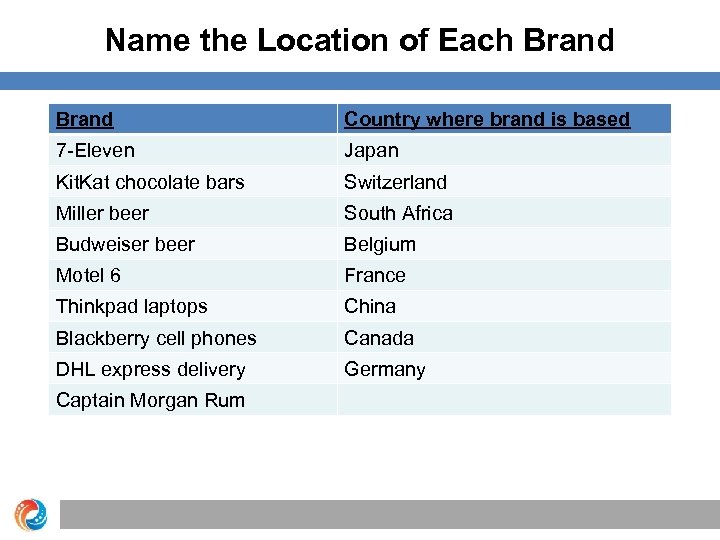
Name the Location of Each Brand Country where brand is based 7 -Eleven Japan Kit. Kat chocolate bars Switzerland Miller beer South Africa Budweiser beer Belgium Motel 6 France Thinkpad laptops China Blackberry cell phones Canada DHL express delivery Germany Captain Morgan Rum
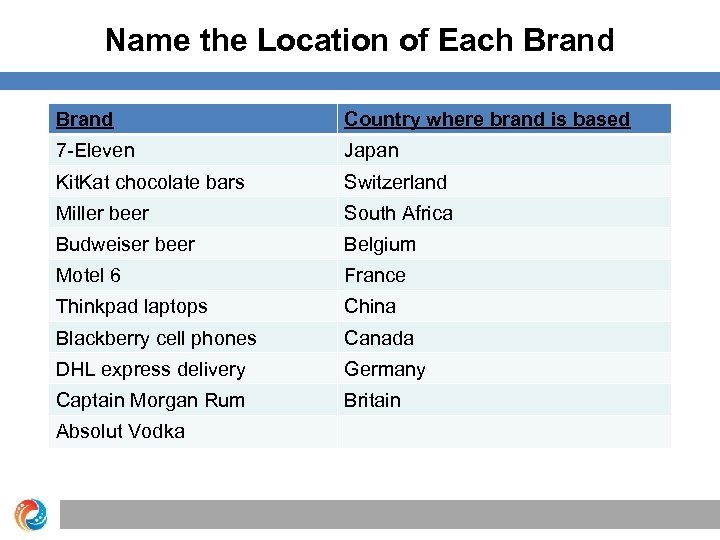
Name the Location of Each Brand Country where brand is based 7 -Eleven Japan Kit. Kat chocolate bars Switzerland Miller beer South Africa Budweiser beer Belgium Motel 6 France Thinkpad laptops China Blackberry cell phones Canada DHL express delivery Germany Captain Morgan Rum Britain Absolut Vodka
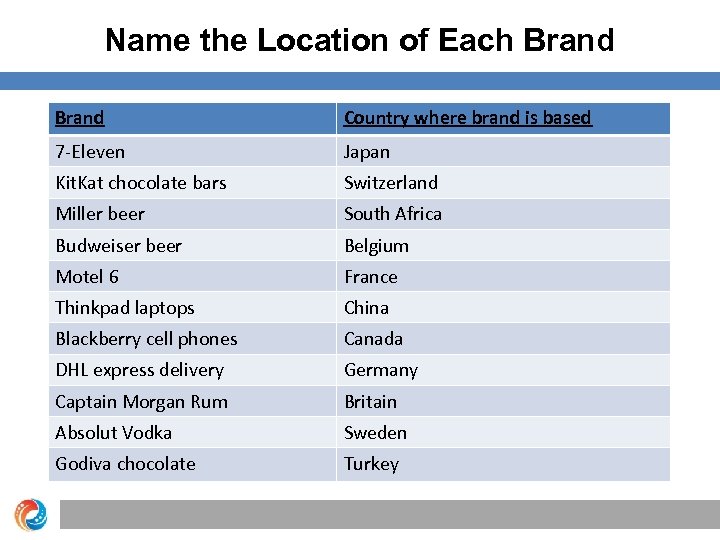
Name the Location of Each Brand Country where brand is based 7 -Eleven Japan Kit. Kat chocolate bars Switzerland Miller beer South Africa Budweiser beer Belgium Motel 6 France Thinkpad laptops China Blackberry cell phones Canada DHL express delivery Germany Captain Morgan Rum Britain Absolut Vodka Sweden Godiva chocolate Turkey
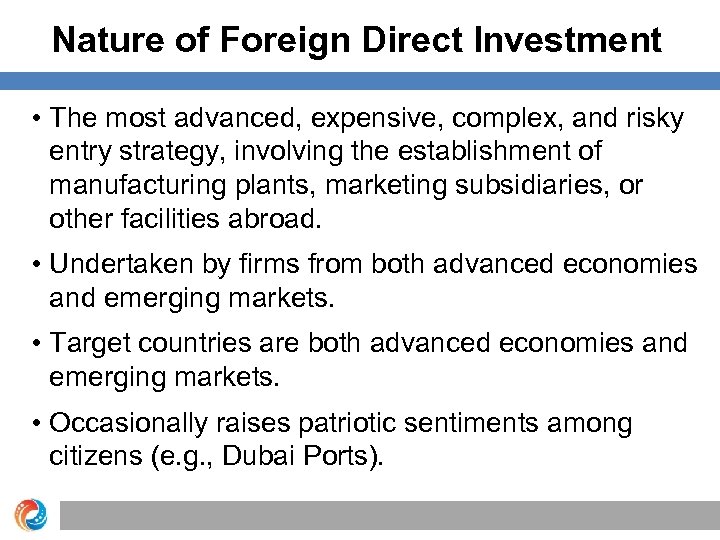
Nature of Foreign Direct Investment • The most advanced, expensive, complex, and risky entry strategy, involving the establishment of manufacturing plants, marketing subsidiaries, or other facilities abroad. • Undertaken by firms from both advanced economies and emerging markets. • Target countries are both advanced economies and emerging markets. • Occasionally raises patriotic sentiments among citizens (e. g. , Dubai Ports).
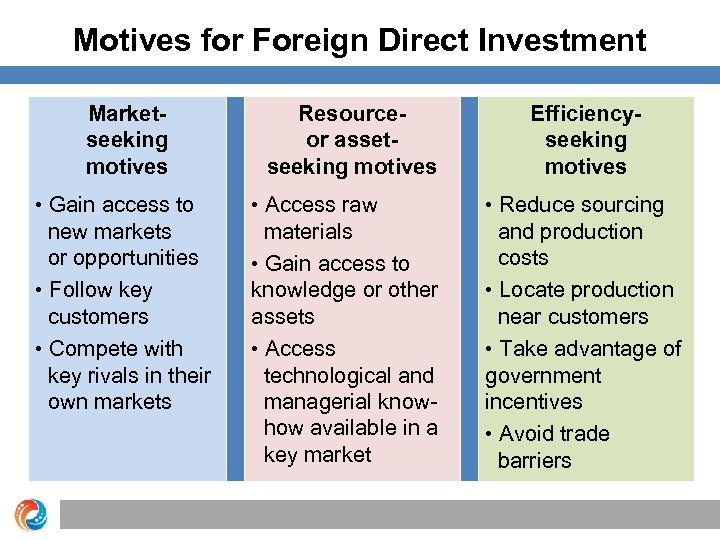
Motives for Foreign Direct Investment Marketseeking motives • Gain access to new markets or opportunities • Follow key customers • Compete with key rivals in their own markets Resourceor assetseeking motives • Access raw materials • Gain access to knowledge or other assets • Access technological and managerial knowhow available in a key market Efficiencyseeking motives • Reduce sourcing and production costs • Locate production near customers • Take advantage of government incentives • Avoid trade barriers
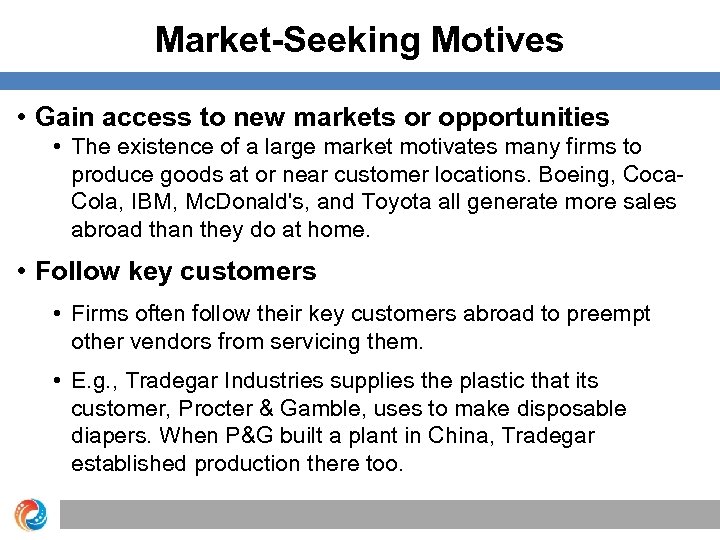
Market-Seeking Motives • Gain access to new markets or opportunities • The existence of a large market motivates many firms to produce goods at or near customer locations. Boeing, Coca. Cola, IBM, Mc. Donald's, and Toyota all generate more sales abroad than they do at home. • Follow key customers • Firms often follow their key customers abroad to preempt other vendors from servicing them. • E. g. , Tradegar Industries supplies the plastic that its customer, Procter & Gamble, uses to make disposable diapers. When P&G built a plant in China, Tradegar established production there too.
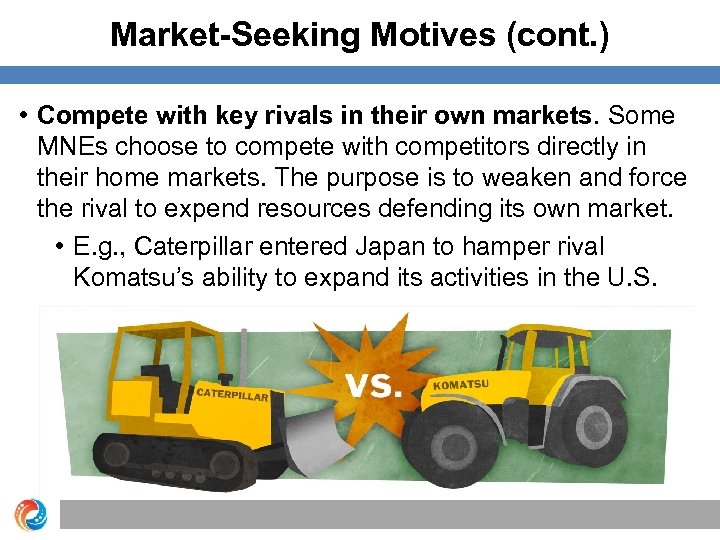
Market-Seeking Motives (cont. ) • Compete with key rivals in their own markets. Some MNEs choose to compete with competitors directly in their home markets. The purpose is to weaken and force the rival to expend resources defending its own market. • E. g. , Caterpillar entered Japan to hamper rival Komatsu’s ability to expand its activities in the U. S.
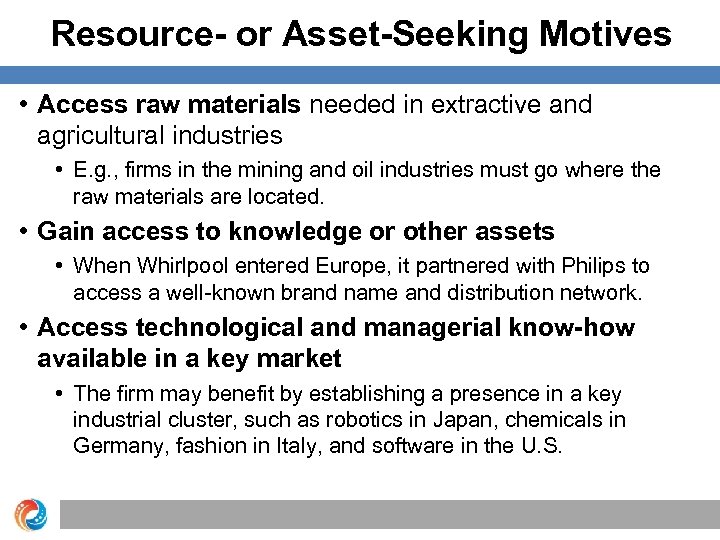
Resource- or Asset-Seeking Motives • Access raw materials needed in extractive and agricultural industries • E. g. , firms in the mining and oil industries must go where the raw materials are located. • Gain access to knowledge or other assets • When Whirlpool entered Europe, it partnered with Philips to access a well-known brand name and distribution network. • Access technological and managerial know-how available in a key market • The firm may benefit by establishing a presence in a key industrial cluster, such as robotics in Japan, chemicals in Germany, fashion in Italy, and software in the U. S.
Efficiency-Seeking Motives • Reduce sourcing and production costs by accessing inexpensive labor and other cheap inputs to the production process • This motive accounts for the massive development of manufacturing facilities in China, Mexico, Eastern Europe, and India. • Locate production near customers • In the fashion industry, Spain’s Zara and Sweden’s H&M locate much of their garment production in key markets such as Spain and Turkey. H&M
Efficiency-Seeking Motives (cont. ) • Take advantage of government incentives • In addition to restricting imports, governments may offer subsidies and tax concessions to foreign firms to encourage them to invest locally. • Avoid trade barriers • By establishing a physical presence within a country, the investor obtains the same advantages as local firms. The desire to avoid trade barriers helps explain why Japanese automakers set up factories in the United States in the 1980 s.
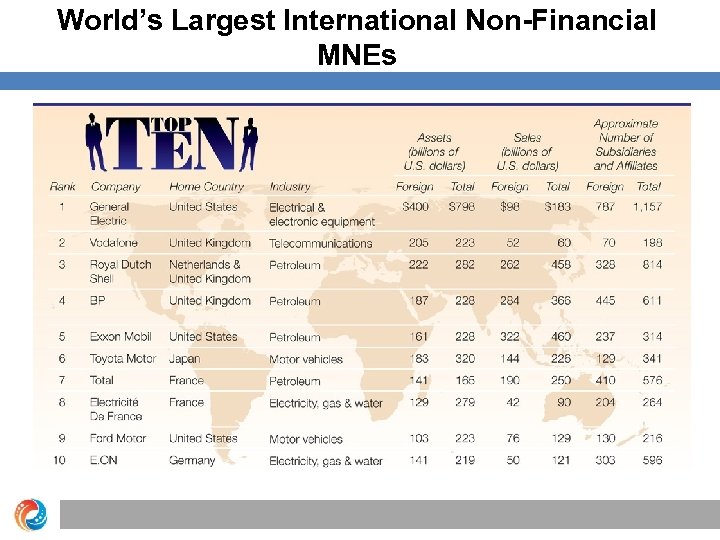
World’s Largest International Non-Financial MNEs
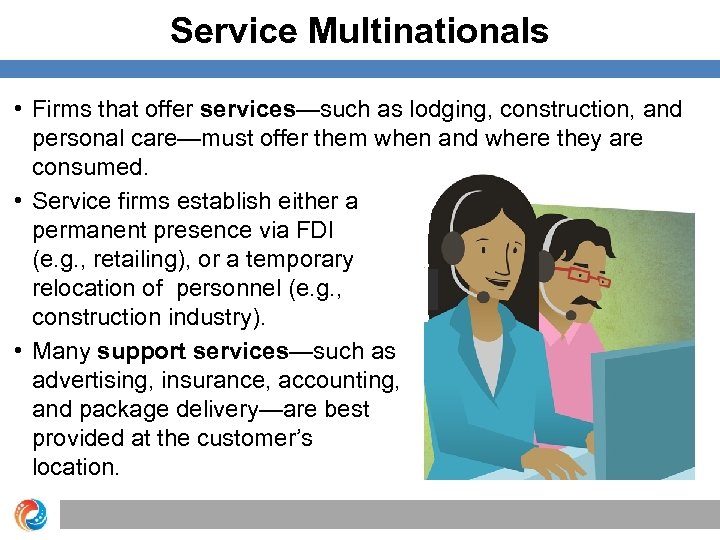
Service Multinationals • Firms that offer services—such as lodging, construction, and personal care—must offer them when and where they are consumed. • Service firms establish either a permanent presence via FDI (e. g. , retailing), or a temporary relocation of personnel (e. g. , construction industry). • Many support services—such as advertising, insurance, accounting, and package delivery—are best provided at the customer’s location.
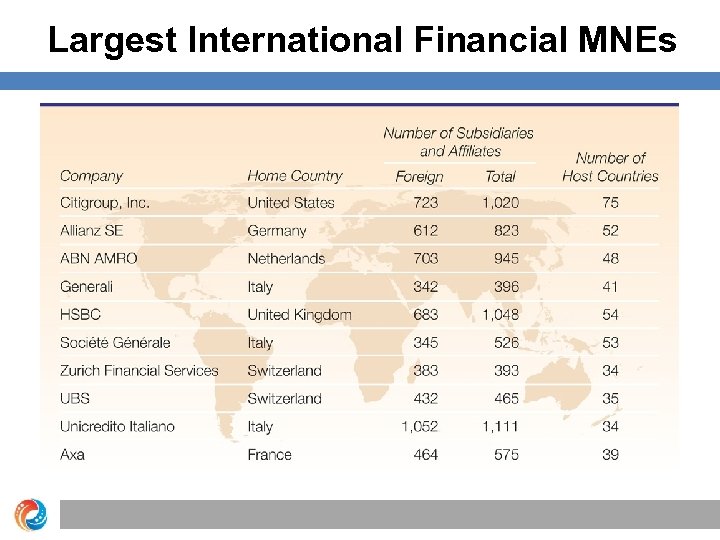
Largest International Financial MNEs
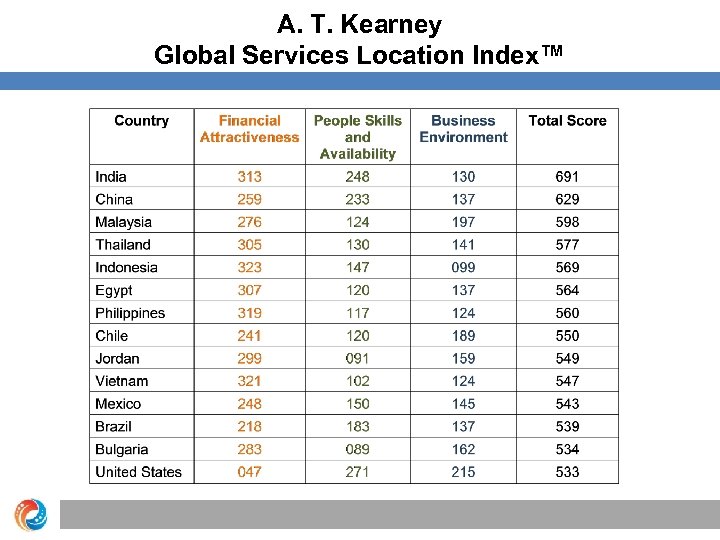
A. T. Kearney Global Services Location Index™
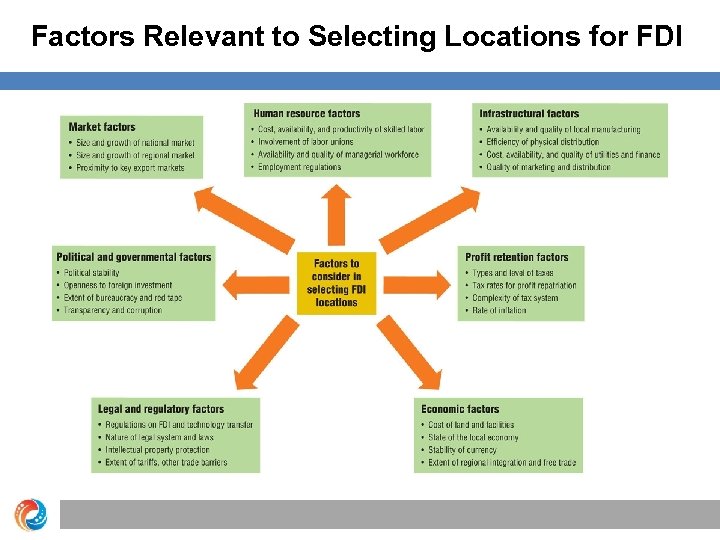
Factors Relevant to Selecting Locations for FDI
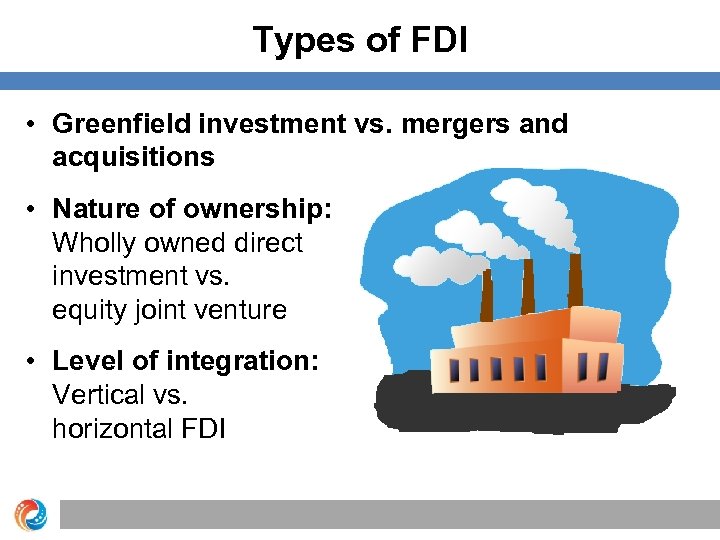
Types of FDI • Greenfield investment vs. mergers and acquisitions • Nature of ownership: Wholly owned direct investment vs. equity joint venture • Level of integration: Vertical vs. horizontal FDI
Greenfield Investment vs. M&As • Greenfield investment: Firm invests to build a new manufacturing, marketing, or administrative facility, as opposed to acquiring existing facilities • Merger: Special type of acquisition in which two firms join to form a new, larger company • Acquisition: Direct investment in or purchase of an existing company or facility
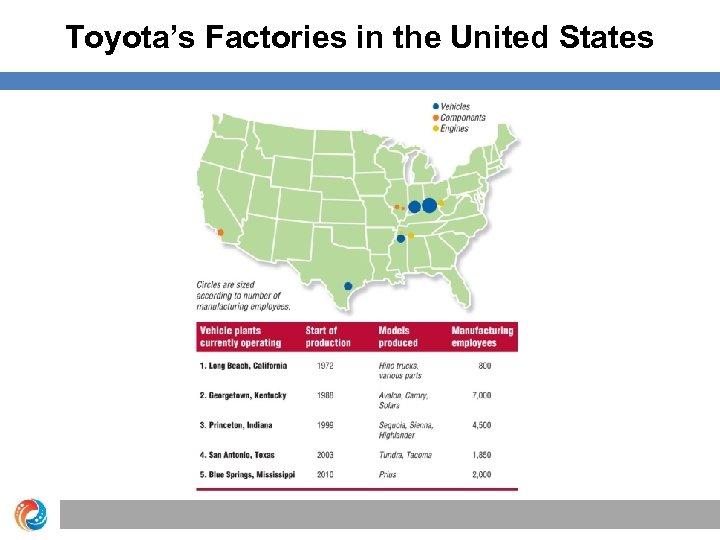
Toyota’s Factories in the United States
The Nature of Ownership • Equity participation: Acquisition of partial ownership in an existing firm • Wholly owned direct investment: Investor fully owns the foreign assets • Equity joint venture: Partnership in which a separate firm is created through the investment of assets by two or more parent firms that gain joint ownership of a new legal entity
Level of Integration • Vertical integration: Firm owns, or seeks to own, multiple stages of a value chain for producing, selling, and delivering a product • E. g. , Toyota owns some Toyota car dealerships around the world. Ford once owned steel mills that produced steel used to make Ford cars. • Horizontal integration: Arrangement whereby the firm owns, or seeks to own, the activities involved in a single stage of its value chain • E. g. , Microsoft acquired a Montreal-based firm that makes software used to create movie animation.
International Collaborative Venture • A partnership between two or more firms • Includes equity joint ventures and nonequity, projectbased ventures • Sometimes called partnerships or strategic alliances • Helps overcome the often substantial risk and high costs of international business • Makes possible the achievement of projects that exceed the capabilities of the individual firm
Equity vs. Project-Based Joint Ventures • Equity Joint Ventures are normally formed when no one party has all the assets needed to exploit an opportunity. Typically, the local partner contributes a factory, market navigation know-how, connections, or low-cost labor. • A project-based joint venture has a narrow scope and limited timetable. No new legal entity is created. Typically, partners collaborate on joint development of new technologies, products, or share other expertise with each other. Such cooperation helps them catch up with rivals in technology development.
Other Types of Collaborative Ventures • Consortium: Project-based, usually nonequity venture with multiple partners fulfilling a large-scale project • E. g. , commercial aircraft manufacturing (Boeing and Airbus) • Cross-licensing agreement: Type of project-based, nonequity venture where each partner agrees to access licensed technology developed by the other on preferential terms
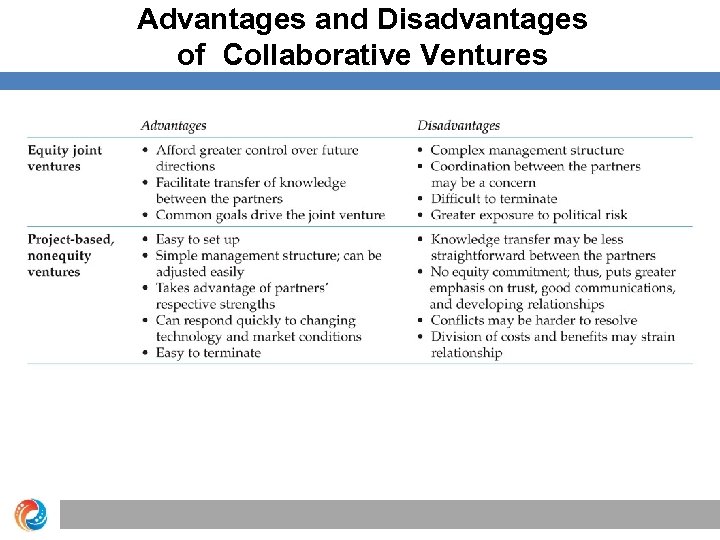
Advantages and Disadvantages of Collaborative Ventures
Managing Collaborative Ventures: Key Questions • How dependent will we be on our partner? • How will responsibilities and competencies be shared with the partner? • Are our assets at risk? How can we protect them? • What other risks do we face by partnering? • Will we close growth opportunities due to this venture? • How will the venture be managed? What burdens will be placed on managerial, financial, or other resources?
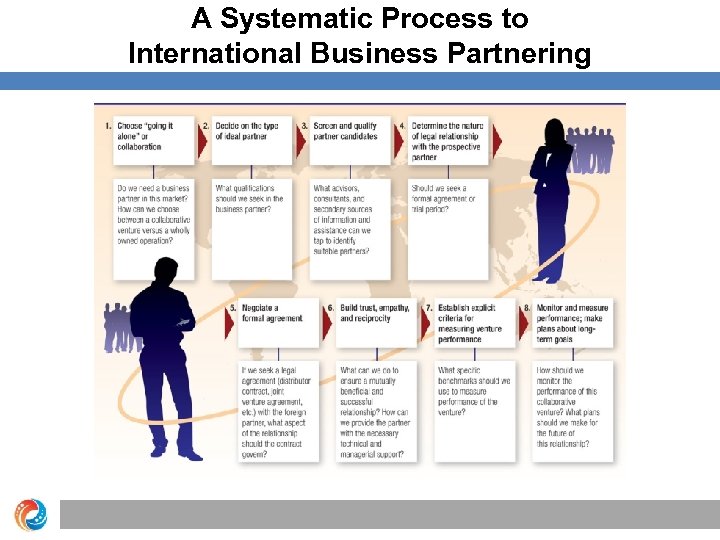
A Systematic Process to International Business Partnering
Success Factors in Collaborative Ventures • Half of all global collaborative ventures fail in the first 5 years of operations due to unresolved disagreements, confusion, and frustration. Thus, partners should: § Be aware of cultural differences § Pursue common goals § Pay attention to planning and management of the venture § Safeguard core competencies § Adjust to shifting environmental circumstances
Retailers: A Special Case of Internationalization Retailers typically internationalize via FDI and collaborative ventures. Retailing takes various forms: • Department stores (Marks & Spencer, Macy's) • Specialty retailers (Body Shop, Gap, Disney Store) • Supermarkets (Sainsbury, Safeway, Sparr) • Convenience stores (Circle K, 7 -Eleven, Tom Thumb) • Discount stores (Zellers, Tati, Target) • “Big box stores” (Home Depot, IKEA, Toys "R" Us) Wal-Mart has over 100 stores and 50, 000 employees in China, sourcing almost all its merchandise locally and providing thousands of local jobs.
Barriers to Retailer Success Abroad 1. Culture and language barriers • E. g. , differing product and service portfolio, store hours, store layout, relations between management and labor 2. Consumer loyalty to indigenous retailers 1. E. g. , Galleries Lafayette in New York and Wal-Mart in Germany failed. 3. Legal and regulatory barriers • Countries have idiosyncratic laws that affect retailing. E. g. , Germany limits store hours and requires recycling. 4. Developing local sources of supply • E. g. , Mc. Donald’s in Russia; KFC in China
Wal-Mart’s Mixed Experience • Germany: Failing to understand the market, Wal-Mart could not compete with local firms, and left the market. • Mexico: Built huge U. S. -style parking lots. But most Mexicans lack cars, and city bus stops were far away, so shoppers could not haul their purchases home. • Brazil: Families do their big shopping on payday. Aisles were too narrow to accommodate the rush. • Argentina: Wal-Mart’s red, white, and blue banners, reminiscent of the U. S. flag, offended local tastes.
Success Factors for Retailers 1. Advance research and planning. French retailer Carrefour spent 12 years building its business in Taiwan to better understand Chinese culture. 2. Establish logistics and purchasing networks in each market. Well-organized sourcing and logistics ensure inventory is always maintained. 3. Assume entrepreneurial, creative approach. Virgin megastore expanded to Asia, Europe, and North America by using creative approaches. 4. Adjust business model to suit local conditions. In Mexico, Home Depot packages merchandise to suit smaller budgets and offers flexible payment plans.
Скачать презентацию International Business by Prof Yong-Sik Hwang Sejong University
f3b60660cdb86cb435133d9327a86e95.ppt