 Скачать презентацию International Business 9 e By Charles W L
7efe519ae28d21765aad0b27663e6d19.ppt
- Количество слайдов: 17



International Business 9 e By Charles W. L. Hill Mc. Graw-Hill/Irwin Copyright © 2013 by The Mc. Graw-Hill Companies, Inc. All rights reserved.
Chapter 12 The Global Capital Market
Why Do We Have Capital Markets? Ø Capital markets bring together investors and borrowers Ø investors - corporations with surplus cash, individuals, and non-bank financial institutions Ø borrowers - individuals, companies, and governments Ø markets makers - the financial service companies that connect investors and borrowers, either directly (investment banks) or indirectly (commercial banks) Ø capital market loans can be equity or debt 12 -3
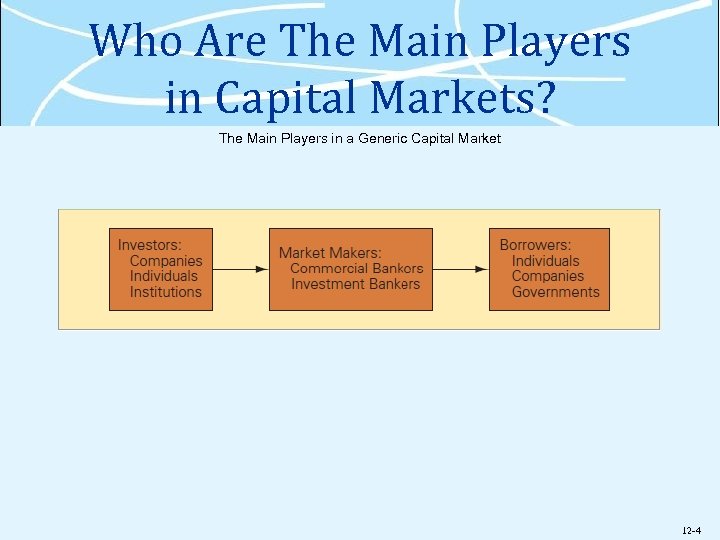
Who Are The Main Players in Capital Markets? The Main Players in a Generic Capital Market 12 -4
What Makes The Global Capital Market Attractive? Ø Today’s capital markets are highly interconnected and facilitate the free flow of money around the world Ø Borrowers benefit from the additional supply of funds global capital markets provide Ø lowers the cost of capital Ø Investors benefit from the wider range of investment opportunities Ø diversify portfolios and lower risk 12 -5
How Have Global Capital Markets Changed Since 1990? Ø Global capital markets have grown rapidly Ø the stock of cross-border bank loans was just $3, 600 billion in 1990, but $32, 430 in 2010 Ø the international bond market has grown from $3, 515 billion in 1997 to $26, 613 in 2010 Ø international equity offerings were just $18 billion in 1990, but grew to $750 billion in 2009 Ø The growth in the markets is a result of 1. Advances in information technology 2. Deregulation by governments 12 -6
What Are The Risks Of The Global Capital Markets? Ø Question: Could deregulation of capital markets and fewer controls on cross-border capital flows make nations more vulnerable to the effects of speculative capital flows? Ø can have a destabilizing effect on economies Ø 2008 -2009 global financial crisis Ø Speculative capital flows may be the result of inaccurate information about investment opportunities Ø if global capital markets continue to grow, better quality information is likely to be available from financial intermediaries 12 -7
What Is A Eurocurrency? Ø A eurocurrency is any currency banked outside its country of origin Ø about two-thirds of all eurocurrencies are Eurodollars Ø It is an important source of low-cost funds for international companies Ø The market began in the 1950 s Ø Eastern bloc countries feared that the U. S. might seize their dollars so, they deposited them in Europe Ø additional dollar deposits came from Western European central banks and companies that exported to the U. S. 12 -8
Why Has The Eurocurrency Market Grown? Ø In 1957, the market surged again after changes in British laws Ø London became the leading center of the market and still hold this position Ø In the 1960 s, the market grew once again Ø Changes in regulations discouraged U. S. banks from lending to non-U. S. residents Ø would-be borrowers of dollars outside the U. S. turned to the euromarket as a source of dollars 12 -9
Why Has The Eurocurrency Market Grown? Ø The next big increase came after the 197374 and 1979 -80 oil price increases Ø Arab members of OPEC accumulated huge amounts of dollars Øavoided potential confiscation of their dollars by the U. S. by depositing them in banks in London 12 -10
What Makes The Eurocurrency Market Attractive? Ø The eurocurrency market is attractive because it is not regulated by the government Ø banks can offer higher interest rates on eurocurrency deposits and charge lower interest rates to eurocurrency borrowers Ø The spread between the eurocurrency deposit and lending rates is less than the spread between the domestic deposit and lending rates Ø gives eurocurrency banks a competitive edge over domestic banks 12 -11
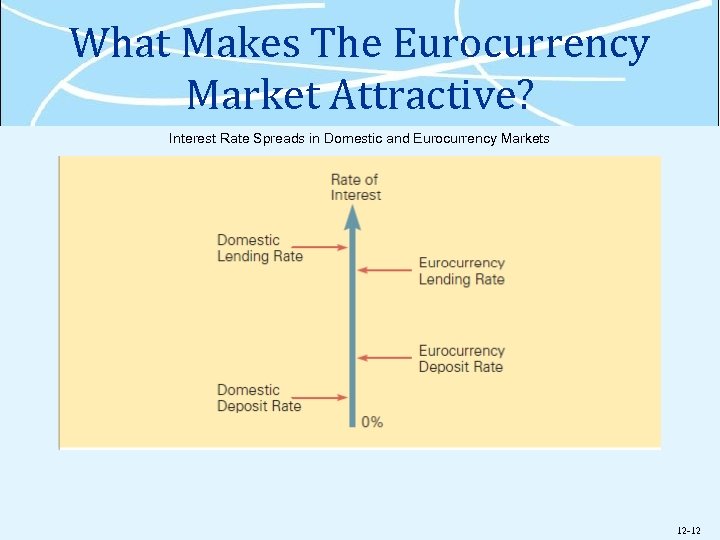
What Makes The Eurocurrency Market Attractive? Interest Rate Spreads in Domestic and Eurocurrency Markets 12 -12
What Makes The Eurocurrency Market Unattractive? Ø The eurocurrency market has two significant drawbacks: 1. Because the eurocurrency market is unregulated, there is a higher risk that bank failure could cause depositors to lose funds Ø can avoid this risk by accepting a lower return on a home-country deposit 2. Companies borrowing eurocurrencies can be exposed to foreign exchange risk Ø can minimize this risk through forward market hedges 12 -13
What Is The Global Bond Market? Ø Bonds are an important means of financing for many companies Ø the most common bond is a fixed rate which gives investors fixed cash payoffs Ø The global bond market grew rapidly during the 1980 s and 1990 s and continues to grow today Ø There are two types of international bonds 1. Foreign bonds 2. Eurobonds 12 -14
What Makes The Eurobond Market Attractive? Ø The eurobond market is attractive because 1. It lacks regulatory interference Ø since companies do not have to adhere to strict regulations, the cost of issuing bonds is lower 2. It has less stringent disclosure requirements than domestic bond markets Ø it can be cheaper and less time consuming to offer eurobonds than dollar-denominated bonds 3. It is more favorable from a tax perspective Ø eurobonds can be sold directly to foreign investors 12 -15
What Is The Global Equity Market? Ø The global equity market allows firms to 1. Attract capital from international investors Ø many investors buy foreign equities to diversify their portfolios 2. List their stock on multiple exchanges Ø this type of trend may result in an internationalization of corporate ownership 3. Raise funds by issuing debt or equity around the world 12 -16
What Do Global Capital Markets Mean For Managers? Ø The growth in global capital markets has created opportunities for firms to borrow or invest internationally Ø can often borrow at a lower cost, but must balance the foreign exchange risk against the costs savings Ø Growth in capital markets offers opportunities for firms, institutions, and individuals to diversify their investments and reduce risk Ø Capital markets are likely to continue to integrate providing more opportunities for business 12 -17
Скачать презентацию International Business 9 e By Charles W L
7efe519ae28d21765aad0b27663e6d19.ppt