 Скачать презентацию International aspect of the Bologna Process BALANCE Project
f9d4d5bf63f5474db5e2e87c1961aa73.ppt
- Количество слайдов: 34



‘International aspect of the Bologna Process’ BALANCE Project Seminar Cambridge, 5 -7 September 2007 Robert Wagenaar Director of Undergraduate and Graduate Studies Chair Dutch team of Bologna Experts Joint co-ordinator TUNING Projects Co-ordinator Erasmus Mundus Master Programme EUROCULTURE University of Groningen (NL)
International aspect of the Bologna Process Title to be understood in two ways: 1. External Dimension of the Bologna Process 2. The impact of the Bologna Process at institutional and subject area level for European and their third country partner institutions and their learners: 3. Paradigm Change in European Higher Education 2 2
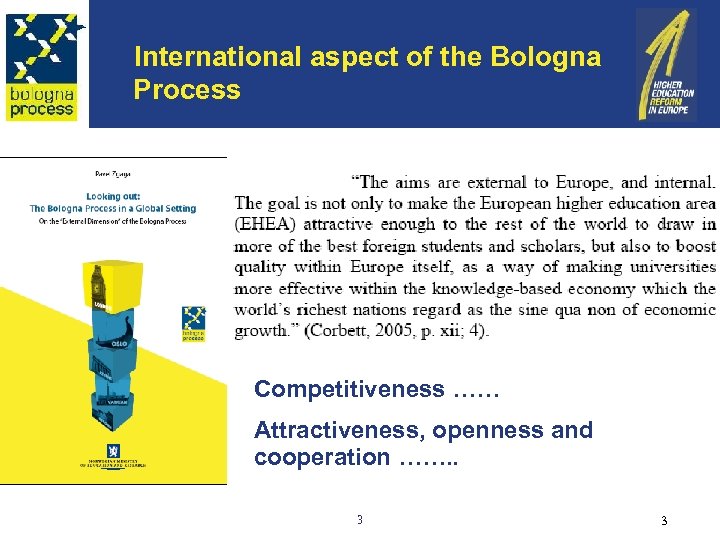
International aspect of the Bologna Process Competitiveness …… Attractiveness, openness and cooperation ……. . 3 3
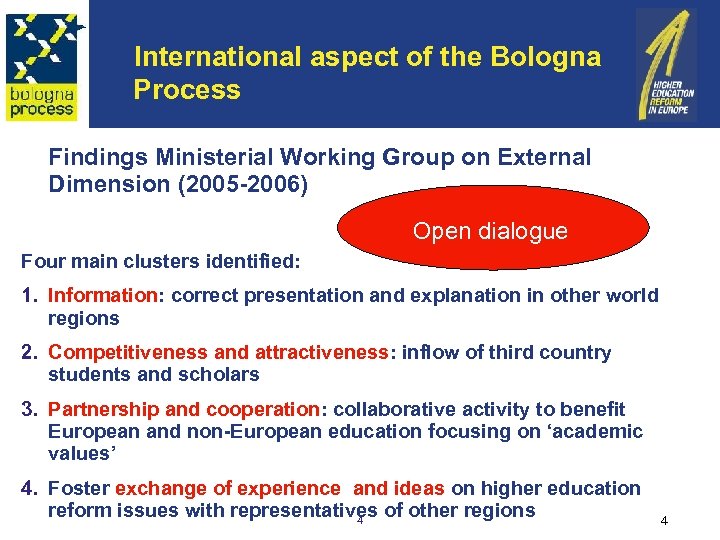
International aspect of the Bologna Process Findings Ministerial Working Group on External Dimension (2005 -2006) Open dialogue Four main clusters identified: 1. Information: correct presentation and explanation in other world regions 2. Competitiveness and attractiveness: inflow of third country students and scholars 3. Partnership and cooperation: collaborative activity to benefit European and non-European education focusing on ‘academic values’ 4. Foster exchange of experience and ideas on higher education reform issues with representatives of other regions 4 4
International aspect of the Bologna Process Main tasks for European Higher Education Institutions • Implementation of a three cycle system with preparation for the labor market at all levels • Provisions for recognition of prior learning • Clear provisions for access at all levels • Effective provisions for student mobility 5 5
International aspect of the Bologna Process More tasks …. . • Degree programmes based on profile, learning outcomes, competences, levels, student workload • Student oriented degree programmes • Learning outcomes in place for the programme as a whole as well as its individual units • ECTS applied as a transfer and accumulation system • Use of ECTS based on learning outcomes and their associated workloads • Feasibility of programmes to be checked regularly 6 6
International aspect of the Bologna Process Even more tasks…. • Degree programmes based on the Bologna cycle (level) descriptors • Quality culture in place at institutional and programme level • Student and staff surveys to evaluate teaching and learning • Curricula evaluation at a regular basis • Diploma Supplement including clear profile and learning outcomes of programme. LO are formulated in such a way 7 7 that they can be used for recognition purposes.
International aspect of the Bologna Process Is there a encompassing methodology available to implement Bologna at institutional and subject area level? • Comparability • Transparency The TUNING • Compatibility approach • Mobility • Recognition • Quality • Employability • Competitiveness • External dimension • Relevance 8 8
International aspect of the Bologna Process Project TUNING EDUCATIONAL STRUCTURES IN EUROPE (and beyond …) § A project for and by universities (strongly supported by the European Commission: financially and morally) § Large scale project focusing on subject area level (Business, Chemistry, Earth Sciences, Education, European Studies, History, Mathematics, Nursing, Physics, etc. ) Tuning Motto 9 9 Tuning of educational structures and programmes
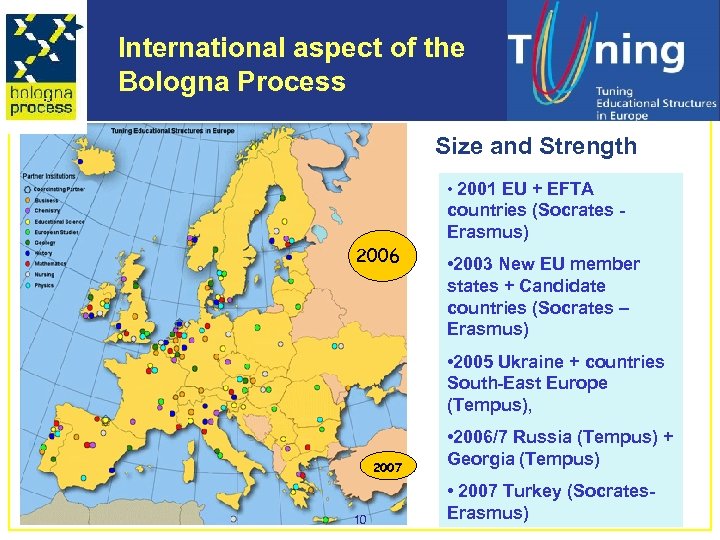
International aspect of the Its strength and size Bologna Process Tuning Europe Size and Strength (2000 -2008): 1. ITS SIZE AND STRENGTH • 2001 EU + EFTA countries (Socrates Erasmus) 2006 • 2003 New EU member states + Candidate countries (Socrates – Erasmus) • 2005 Ukraine + countries South-East Europe (Tempus), 2007 10 • 2006/7 Russia (Tempus) + Georgia (Tempus) • 2007 Turkey (Socrates. Erasmus) 10
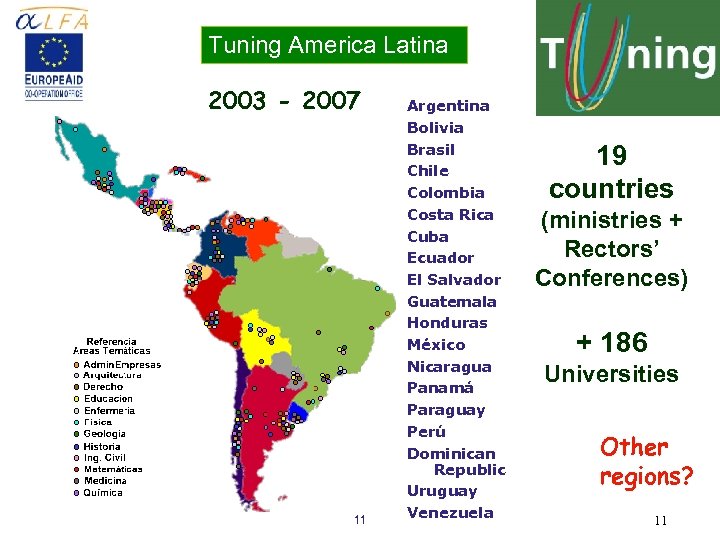
Tuning America Latina 2003 - 2007 subjects 11 Argentina Bolivia Brasil Chile Colombia Costa Rica Cuba Ecuador El Salvador Guatemala Honduras México Nicaragua Panamá Paraguay Perú Dominican Republic Uruguay Venezuela 19 countries (ministries + Rectors’ Conferences) + 186 Universities Other regions? 11
International aspect of the Bologna Process Universities’ contribution to the Bologna Process A PROJECT BY AND FOR UNIVERSITIES • Implementation of the Bologna Process at subject area level • Develop best ways to introduce the two / three cycle system • Promoting transparency in Higher Education • Focus on employability and citizenship • Focus on professional and academic profiles 12 12
Bologna: Make it real ! The Contribution of Tuning (2) • Europe wide introduction of Learning Outcomes and Competences approach • Change of paradigm: from staff centred to learner centred teaching, learning and assessment (input to output based) • Introduction of a common language • Distinction between generic and subject specific competences • Transfer of ECTS from a transfer to a student workload based credit accumulation and transfer 13 13 system
Bologna: Make it real ! The Contribution of Tuning (3) • Raising awareness of the importance of quality in process and delivery • Responds to growing demands of a lifelong learning society which requires more flexibility and differentiation Tuning has identified key issues, has developed a consistent approach on the basis of synthesizing theories and methodologies 14 14
International aspect of the Bologna Process The Contribution of Tuning (3) • Raising awareness of the importance of quality in process and delivery • Responds to growing demands of a lifelong learning society which The work of TUNING is of great importance The work of TUNING is of great for the development of importance European, National and Sectoral Qualification Frameworks European, National and Sectoral • requires more flexibility and differentiation Qualification Frameworks Tuning has identified key issues, has developed a consistent approach on the basis of synthesizing 15 theories and methodologies for purpose 15
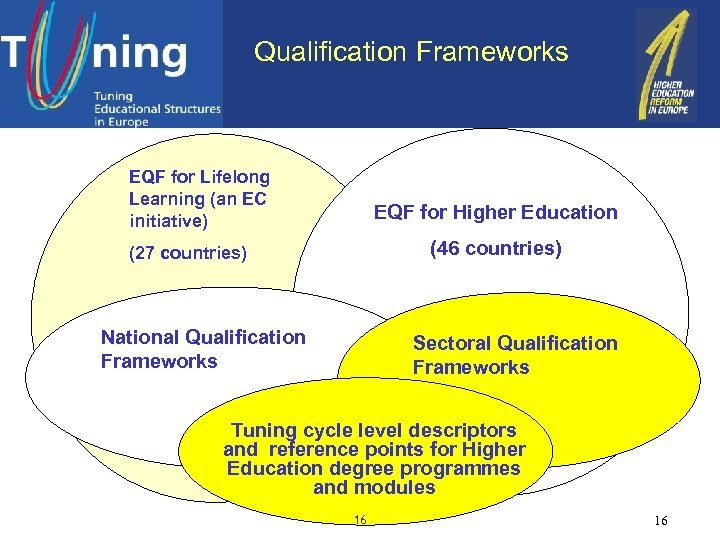
Qualification Frameworks EQF for Lifelong Learning (an EC initiative) EQF for Higher Education (46 countries) (27 countries) National Qualification Frameworks Sectoral Qualification Frameworks Tuning cycle level descriptors and reference points for Higher Education degree programmes and modules 16 16
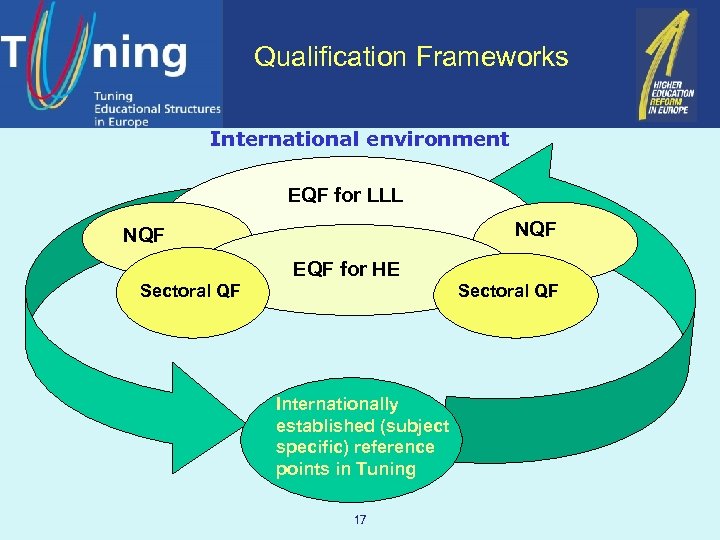
Qualification Frameworks International environment EQF for LLL NQF EQF for HE Sectoral QF Internationally established (subject specific) reference points in Tuning 17 17
International aspect of the Bologna Process Key Tuning contributions to the EHEA • Transparency - Common language understood by all stakeholders • Comparability and compatibility - Programme based on learning outcomes expressed in terms of competences • Recognition – common reference points • Employability and relevance - Consultation of stakeholders • Quality and competitiveness – models for programme design and quality enhancement 18 18 • External dimension – reaching out to other regions
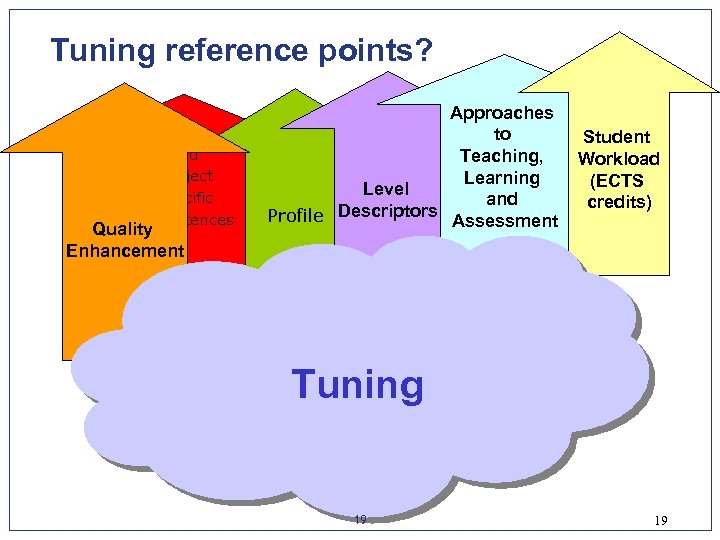
Tuning reference points? Generic and Subject Specific competences Quality Enhancement Approaches to Teaching, Learning Level and Descriptors Profile Assessment Student Workload (ECTS credits) Tuning 19 19
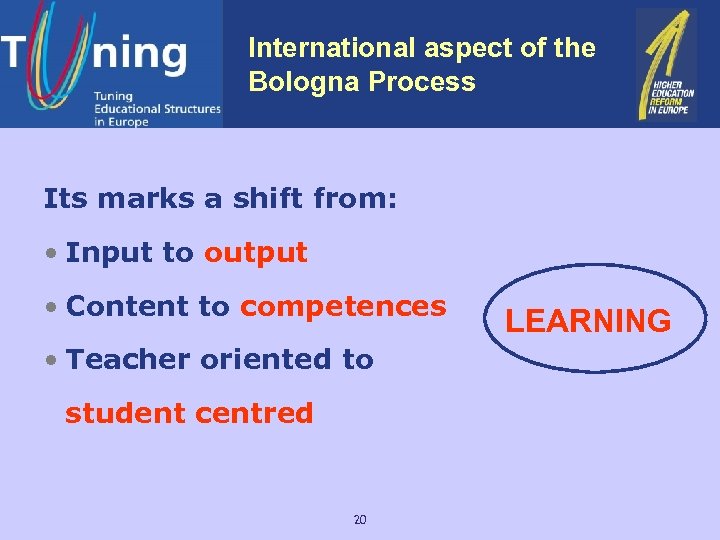
International aspect of the Tuning approach Bologna Process Its marks a shift from: • Input to output • Content to competences LEARNING • Teacher oriented to student centred 20 20
International aspect of the Bologna Process Characteristics of the Tuning reference points • Commonly developed by consensus • Open ended to welcome diversity • Dynamic - subject to development • Reference points, only reference points TUNING has developed cycle level descriptors and reference points for a range of subject areas These are reflected in the Tuning templates of Summary of Subject Area Findings (bench mark papers) 21 21
International aspect of the Bologna Process Profile (of a degree programme) • Developed from awareness of social needs • Outcomes of consultation process of stakeholders • Diversity based on institutional strengths • In dialogue with European reference points • Described in competences and learning outcomes 22 22
International aspect of the Bologna Process What is a competence? Tuning definition of competences • Competences represent a dynamic combination of knowledge, understanding, skills and abilities. • Fostering competences is the object of educational programmes. • Competences are formed in various course units and assessed at different stages. [competences are obtained by the student] 23 23
International aspect of the Bologna Process What is a learning outcome? Level of competence is expressed in terms of Learning outcomes: • Statements of what a learner is expected to know, understand be able to demonstrate after completion of learning. • They can refer to a single course unit or module or else to a period of studies, for example, a first or a second cycle programme. • Learning outcomes specify the requirements for award of credit. [learning outcomes are formulated by academic staff] 24 24
International aspect of the Bologna Process Tuning contribution European Credit Transfer and Accumulation system (ECTS): Student workload and learning outcomes based • Recognition of its importance as a realistic tool • Best use of student time • Description of ranges of variation in time in Europe • Incorporation of learning outcomes First Cycle (Bachelor) 180 -240 ECTS credits ; Second Cycle (Master) ; typically 90 -120, with a minimum of 60 at MA-level One credit corresponds with 25 to 30 hours of student work 25 Student workload ranges from 1500 to 1800 hours per academic year 25
International aspect of the Bologna Process Levels • Relation with QF for the EHEA and EQF (both based on descriptors) • Progression within programme • Own (sub) levels according to subject area 26 26
International aspect of the Bologna Process Other crucial elements: Approaches to Teaching, Learning and Assessment (outcome based) Quality enhancement of degree programme (internal quality culture) 27 27
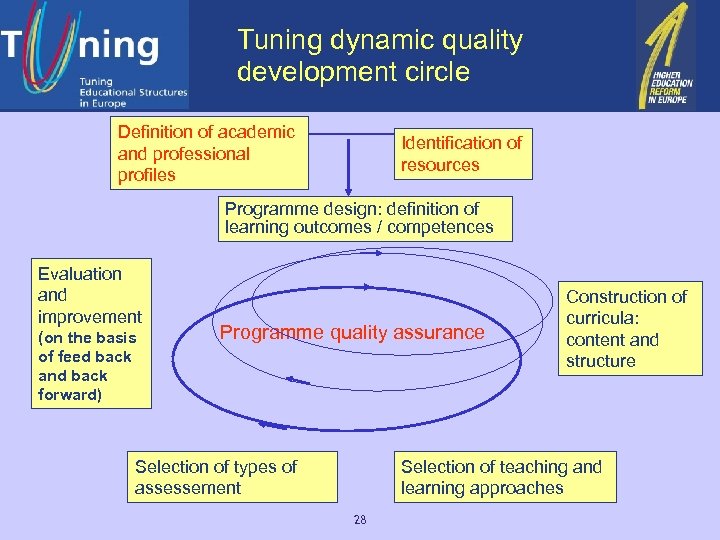
Tuning dynamic quality development circle Definition of academic and professional profiles Identification of resources Programme design: definition of learning outcomes / competences Evaluation and improvement (on the basis of feed back and back forward) Programme quality assurance Selection of types of assessement Construction of curricula: content and structure Selection of teaching and learning approaches 28 28
International aspect of the Bologna Process Where are we today? • Universities have understood the need for change • Tuning has developed a consistent methodology and series of reference points at Subject Area level to assist in the process of change • Process of validation of Tuning approach and Subject Area reference points • Dissemination of the Tuning approach at country, institutional and subject area level as well as in other (non-European) regions and countries 29 29
International aspect of the Bologna Process What has been done? Validation Ø Tuning has organized three validation conferences: • Natural Sciences (23 March 2007) • Health Care sector (22 June 2007) • Humanities and Social Sciences (5 -6 Nov. 2007) Very positive comments by renowned international peers 30 30
International aspect of the Bologna Process What has been done? Dissemination Tuning has published a key publication in English about its methodology which has been translated in: English, Croatian, French, German, Italian, ‘Macedonian’, Portuguese, Russian, Serbian, Spanish, Ukrainian. (Slovenian and Polish in preparation) Tuning will publish in 2007 and 2008 some 20 Subject Area brochures containing Subject Area Findings (including level descriptors and reference points). Others will follow. European contribution to the development of global standards 31 31
International aspect of the Bologna Process Relevance of the Bologna Process as well as the TUNING approach for the international Higher Education Community: • More harmony in European Higher Education • Better international understanding of national educational systems in Europe • International cooperation regarding the development of global reference points for the minimum level / quality of subject areas / degree programmes • One European Higher Education Area based on common reference points reflected in Qualification Frameworks will facilitate mobility of students and graduates. 32 32
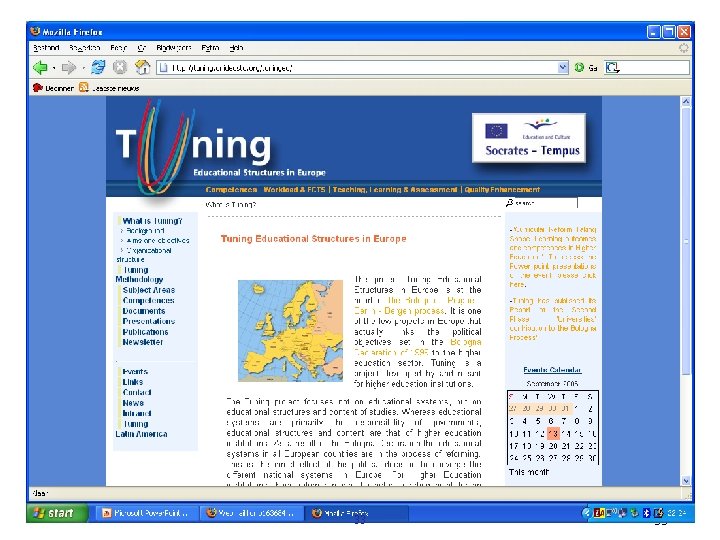
33 33
International aspect of the Bologna Process Web mail addresses for more detailed information: http: //tuning. unideusto. org/tuningeu or www. rug. nl/let/tuningeu 34 http: //tuning. unideusto. org/tuningeu 34
Скачать презентацию International aspect of the Bologna Process BALANCE Project
f9d4d5bf63f5474db5e2e87c1961aa73.ppt