


 Скачать презентацию Internantion Law on Investment ljinglian 163 com Introduction
7ca51f99b916225c808e1abca8240a15.ppt
- Количество слайдов: 72
 Internantion Law on Investment ljinglian@163. com
 Introduction CONTENTS Bilateral Investment Treaty 目 录 Mutilateral Investment Treaty CMS V. Argentina
 01 Part One INTRODUCTION
 1 2 目录 3 4 The definition of Investment The defintion of international investment law The legal resources of international investment law The history of international investment law
 Chapter 1 The definiton of investment the economic definiton the legal definion
 the economic definition of investment According to this view, investment means that individually, as a company or as a county, we forgo the consumption of goods today in order to achieve greater consumption in the future.
 the economic definition of investment The economic approach to investment distinguishes investment in a real assets(such as land or machinery) from investment in a financial instruments such as shares and bonds.
 the legal definition of investment focuses on investment as property and lagel rules associated with ownership of that property.
 the legal definition of investment The legal view of investment is intrinsically liked with the economic view because the objective of the legal rules is to create a link between the forgoing of consumption today and the delivery of greater consumption in the future.
 the legal definition of investment The legal rules must be devised so that investors have confidence in their ability to enforce their claims at some point in the future. This means that the law must make clear the nature of the claim held by the investor and make available enforcement procedures that will provide consistent enforcement of those claims over the long run.
 Questions: 1 2 What is your understanding about investment? Do you have any experience of investing?
 Chapter 2 the definiton of investment law FDI and portfolio investment the definition
 FDI and Portfolio Investment PORTIFOLIO INVESTMENT FDI Foreign direct investment Portfolio investment is means the transfer of tangible normally represented by a or intangible assets from one movement of money for the country into another for the purpose of buying shares in purpose of their use in that a county to generate wealth functioned in another contry. under the total or partial control of the owner of the assets. company formed or
 the distinction between FDI and PI The distinguishing element between foreign direct investment and portfolio investment is that, in portfolio investment, there is a divorce between management and control of the company and the share of ownership in it.
 the distinction between FDI and PI In the case of portfolio investment, it is generally accepted that the investor takes upon himself the risks involved in the making of such investments. He cannot sue the demostic stock exchange or the public entity which runs it, if he were to suffer loss.
 the distinction between FDI and PI Likewise, if he were to suffer loss by buying foreign shares, bonds or other instruments, there would be no basis on which he could seek a remedy. Portfolio investment was not protected by customary international law.
 Questions: 1 2 what is FDI, can you give an exemple what is the meaning of portfolio investment? should portfolio investment be protected?
 the definition of international investment law “ International lnvestment law means law on the protection, promotion and regulation of foreign direct investment(FDI), not only includes public interntioanl law, but also includes national administrative law. ”
 Questions: 1 what is the international trade law? 2 what is the international investment law? 3 what is the distinguish between them?
 Chapter 3 the legal sources of international investment law domestic law bilateral investment treaty multilateral investment treaty
 domestic law Domestic law and regulations in relation to the Administration of FDI can be classified into two types in line with the direction of fund flow, i. e. , law and regulations developed by capital importing countries for the purpose of promoting and regulating FDIs and those developed by capital exproting countries for the purpose of protecting their domestic investors of their overseas investment.
 Homework: Is there any demostic law in your country with the content of protecting foreign Zi m ba bw e investment ? Please find out and write down their main content.
 bilateral investment treaty Bilateral investment treaties(BITs) are the collective term for all bilateral agreements and treaties that captial out-flowing countries conclude with host countries for the purpose of promoting and protecting direct private cross-border investments.
 bilateral investment treaty Given the limited scope of multilateral investment laws, BITs remain the most effective legal system for adjusting the relationship between host state and capital exporting state, and the most important legal authorities of international law on the regulation and protection of international investments.
 Home work: please find the bilateral investment treaty between China and your country, BI T read it.
 multilateral investment treaty gua nt e nte ra l era lat e stm inve y enc ag d t an en ulti estm nt, theck v M Cli al in onme text. s to o on t ur f rt ir ati envdd yo elfco hereof d tern a us i k n d in ent i tmhere tovarrioext. C ecrteoto a r tect t ro ves 85 de ro int. Click madd you pck the 19 you o p r t d al tex as o a n. Cli a thed rde t tion r x h t ti n o t rs In o nterna youunity here venoor te e heae to stmen w u dd i e ick n y tco ick ve re to lacommt. Cl al tcoadd oext. Clm ral Inv MIGA x u ro he na ur te terre o er t te impck atio d yo ltila he. yh td Tou Multila on or Cli rn ad mulick n e ti intere to p r a ext. C vee tto e d tetxte s m a rg h. ven h elo u t r ne n on ev o i n i l i h bli yoiu dadd y atxo. Clack taddsh oul C t Eo terrnte kionre ts ncy(Se u he ino y c l nt Age n Cei xt. v o te C tee aran on) Gu nti nve Co
 multilateral investment treaty gua nt e nte ra l era lat e stm inve y enc ag o as t w ti tion Mul li n. onck en C v ur xt re Con sourete ent, to iny e me t of th on tooadd v. elsctk h add t Ci n r x nt ai e to onte anliizk there oyoulr tie k hersimilaour a c y rg c t n a t n. ain otext. C e ro adid extn. Clicor to addand m o ld ur ic i e te or t The wddr yo Clofk hnr d ypuiratiock here nge on a a ha ap o. Cli s xt. upre to ouriteks ere to xd r r texty exc nd risk e e u e y a s. Clitck h ercial lick hon dd yorrenc dd oa Csk to a cu t. act, t t. i tr em her r t com youasex rk here on ur tex of con c sk yo dc aud h ext. Cli , rio add each s ur t resere t r yo asu k h on b ance. e mext. Clicer, risk sturb t f di rans d civil t n ar a w
 Question: Have you buy any insurance for In su ra nc e yourself in China? What is it? Do you think the insurance is helpful for you?
 multilateral investment treaty ICSID The Washington Convention(Convention on the settlement of investment disputes between States and nationals of other States, ICSID Convention) is a multilateral convention concluded by states under the auspices of the World Bank in 1965, for the purpose of providing a mutually trusted means of solution to investment disputes between the host country government and foreign investors.
 multilateral investment treaty ICSID Before the ICSID came into being, the investor and the host state have different views about the settlement of investment dispute. The host states, always the developing countries, insisted that the foreign investor should settle the dispute by exhausting local remedy. While the investor did not trusted the host state's court, they want to seek their mother countries' protection. The result of the battle is the birth of ICSID, a arbitration centre independent from the host state and the mother one, who is more neutral and impartial.
 Question: Do you have any dispute with others after you came to China? di sp ut e If you encountered any kind of dispute, what will you do? Ask your mother country for political protection or settle the dispute in Chinese court? Do you trust Chinese court? If you are discriminated by the court, what will do then?
 multilateral investment treaty TRIMs Trade-related investment measures are mandatory measures that restrict foreign investment closely related to international trade and constrain or exert negative impacts on international trade. As they distort trade to some extent, these measures attract attention from the GATT/WTO in the first place and were officially incorporated into multilateral trade negotiations as one of the three new topics during the Uruguay Round of Trade Negotiations that started in October 1986. As such, the TRIMs Agreement, as an outcome of the negotiations, came into being, and has become an organic component of the WTO legal framework for multilateral trade.
 multilateral investment treaty TRIMs The core content of the TRIMs is its provisions quantitative on national treatment restrictions. "local and requirement", "export performance requirement" as well as "import over domestic products" and "balance of payment" measures are not consistent with the TRIMs. The TRIMs is the first international agreement that specially regulates the relationship between trade and investment, and therefore plays a critical role in international investment law.
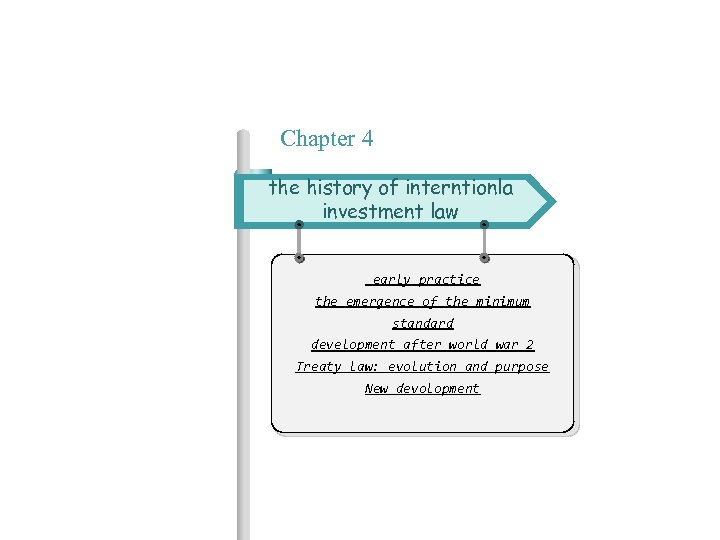 Chapter 4 the history of interntionla investment law early practice the emergence of the minimum standard development after world war 2 Treaty law: evolution and purpose New devolopment
 early practice Before 1917, treaty practice protected alien property not on the basis of an autonomous standards, but by reference to the domestic laws of the host state. for example, the treaty between Switzerland the United States of 1850, article 2(3): In case of…expropriation for purposes of public utility, the citizens of one of the two countries, residing or establishing in the other, shall be placed on an equal footing with the citizens of the country in which they reside in respect to indemnities for damages the may have sustained.
 Question: the similar question: do you think the domestic remedy by the host state is perfect? re loc m al ed y or is it enough? If the host country hurt you, a foreigner, or expropriate your property as their owen citizen, what will you do then?
 early practice But in a famous study, first published in 1868, the Argenine jurist Carlos Calvo for the first time presented a new perspective of this paradigm and asserted that the international rule should in effect be understood as allowing the host state to reduce the protection of alien property when also reducing the guarantees for property held by nationals.
 early practice In 1917, the Soviet Union expropriated national enterprises without compersation and attempted to rely on its empty standard of national treatment for the protection, or lack of protection, of alien property.
 early practice In subsequent decades, a further attack upon the traditional standard of international law was mounted in 1938 by Mexico after the nationalization of US interests in the Mexican agrarian and oil business.
 early practice This dispute led to a frank diplomatic exchange in which US Secretary of State Cordell Hull wrote a famous letter to his Mexican counterpart, spelling out that the rules of international law allowed expropriation of foreign property, but required "prompt, adequate and effective compensation".
 Question: Calvo doctrine and Hull ch oi ce standard, which one do you prefer? why?
 the emergence of the minimum standard The clavo doctrine, the Russian revolution, and the Mexican position not withstanding, what had emerged from the various international disputes about the status of the alien in general (not just in regard to foreign investment) in the nineteenth and twentieth century was a widespread sense that the alien is protected from unaccepted measures of the host state by rules of international law that are independent of those of the host state. The sum of these rules eventually became known as the international minimum standard.
 the emergence of the minimum standard an early leading case(Neer case) on the subject matter, decided in 1926, was concerned with the duty of the host state Mexico to investigate appropriately the circumstances of the unaccounted death of a US national.
 the emergence of the minimum standard When the claim of the widow of the US national for compensation for failure to do so was brought before the Commission in 1926 in regard to the circumstances under which a host state would be liable due to a violation of the minimum standard: The treatment of an alien, in order to constitute an international delinquency, should amount to an outrage, to bad faith, to willful neglect of duty, or to an insufficiency of governmental action so far short of international standards that every reasonable and impartial man would readily recognize its insufficiency.
 Question: What's your opinion about the m st ini an m da um rd minimum standard? is it good for the foreigners? is it enough?
 Development after World War two The period between 1945 and 1990 saw major confrontations between the growing number of newly independent developing countries, on the one hand, and capital-exporting states, on the other, about the status of investment. customary law governing foreign
 Development after World War two These were often prompted by ideological positions by an insistence on strict notions of sovereignty(Permanent Sovereignty over Natural Resources), and by the call for economic decolonization, supported by an economic doctrine calling for independence from centres of colonialism.
 Development after World War two The new battleground chosen by developing states was now the United Nations General Assembly, where they soon held and still hold the majority of votes. In 1962, an early confrontation ended with a compromise, and GA Resolution 1803 stated that in the case of expropriation, 'appropriate compensation' had to be paid, thus neither explicitly confirming the Hull rule nor the calvo doctrine. Remarkably, a consensus existed then that foreign investment agreement conclued by a government must be observed in good faith.
 Development after World War two The developing states decided to take the battle further and brought it to a culmination in 1974, again in the United Nations General Assembly. Encouraged by the success of the oil-producing countries in boycotting Western states and sharp oil price increase, as well as by then prevailing spirit of economic independence in Latin America, several resolutions were passes that call for a 'New International Economic Order'.
 Development after World War two This period of confrontation led to insecurity about the cusomary international rules governing foreign investment. This phase lasted essentially until around 1990. At that time, it became clear that the Socialist view of property had collapsed, together with the end of the Soviet Union, and that the call for economic independence had brought a major financial crisis, rather than more welfare, for the people in Latin America.
 Development after World War two From now on, Latin American States started to conclude bilateral investment treatied whose spirit was opposed to the Calvo Doctrine, and the annual calls for "Permanent Sovereignty " in the UN General Assembly came to an end.
 Development after World War two Within this new climate of international economic relations, the fight of previous decades against customary rules protecting foreign investment had abruptly become anachronistic and obsolete.
 Development after World War two The tide had turned, and the new theme for captial-importing states was not to oppose classical customary law, but instead to grant more protection to foreign investment than traditional customary law did, now on the basis of treaties negotiated to attract additional foreign investment.
 Development after World War two Five decades after it was enunciated, the Hull rule now became a standard element of hundreds of new bilateral investment treaties as well as multilateral agreements, such as the Energy Charter Treaty adopted in 1994, or the North American Free Trade Agreement(NAFTA), in which Mexico decided to join the United States and Canada, also in 1994.
 Development after World War two Developing countries started to conclude investment treaties among themselves, and the characteristics of these treaties did not significantly deviate from those conclued with developed states.
 Treaty law: evolution and purpose bilateral investment treaty The root of modern treaty rules on foreign investment can be traced back to 1778 when the United States and France concluded their first commercial treaty, followed in the nineteenth century by treaties among the United States and its European allies and, subsequently, the new Latin American States. These early treaties mainly addressed trade issues, but also contained rules requiring compensation in case of expropriation.
 Treaty law: evolution and purpose bilateral investment treaty After 1919, the United States negotiated a series of agreements 'on Friendship, Commerce, and Navigation'(FCN), followed by another series of 21 treaties between 1945 and 1966. Rules on investment were never prominent or distinct in these FCN treaties, even though the pre-1945 treaties addressed not just compensation clauses but also provisions on the right to establish certain types of business in the partner state. After 1945, trade matters were regulated in seperate treaties, and FCN treaties contained more details of forein investment.
 Treaty law: evolution and purpose bilateral investment treaty The era of modern investment treaties had begun in 1959 when Germany and Pakistan adoped a bilateral agreement, which entered into force in 1962. Soon after Germany had launched its programme and successfully negotiated its first treaties, other European states followed suit: Switzerland concluded its first such treaty in 1961, France in 1972.
 Treaty law: evolution and purpose bilateral investment treaty In 1977, the US State Department launched an initiative for the United States to join the European practice of the past two decades to conclude agreements that are meant to address issues of foreign investment only, mainly to protect investments of nationals abroad.
 Treaty law: evolution and purpose bilateral investment treaty The most significant trends in the evolution of BIT practice in the past decade concerns the negotiation of BITs by Asian states. China has concluded 117 treaties between 1982 and 2006. India concluded its first BIT in 1994, had already entered into 26 BITs by 1999, and in 2006 was a party to 56 such treaties.
 Treaty law: evolution and purpose bilateral investment treaty Within the past decade, the second key development is the fact that more and more developing states have negotiated BITs among themselves, altogether more than 600. In the period between 2003 and 2006, these treaties outnumbered those between developed and developing states.
 Treaty law: evolution and purpose multilateral investment treaty OECD, the forum of the capital-exporting countries, intended to conluded a mutilateral investment agreement encompass not only specific standards of protection but also a permanent arbitral tribunal charged with the application of the treaty and with the power to lay down economic sanctions against violating states, including non-signatiories. But it failed several times, now there is no such agreement yet.
 Treaty law: evolution and purpose multilateral investment treaty In the World Bank, it was then General Counsel, Aron Broches, who initiated and drove the debates on the possible scope of internaitonal consensus. Given the controversies within the United Nations, Broches properly concluded that for the time being the best contribution of the Bank was to provide for effective procedures for impartial settlement of disputes, without attempting to seek agreement on substantive standards.
 Treaty law: evolution and purpose multilateral investment treaty At first sight, the Broches concept(procedure before substance) seemed to be a limited and modest one. However, he built the design of what was to become, in 1965, the Convention on the Settlement of Investment Disputes between States and Nationals of Other States(ICSID Convention) establishing the International Center for Settlement of Investment Disputes(ICSID).
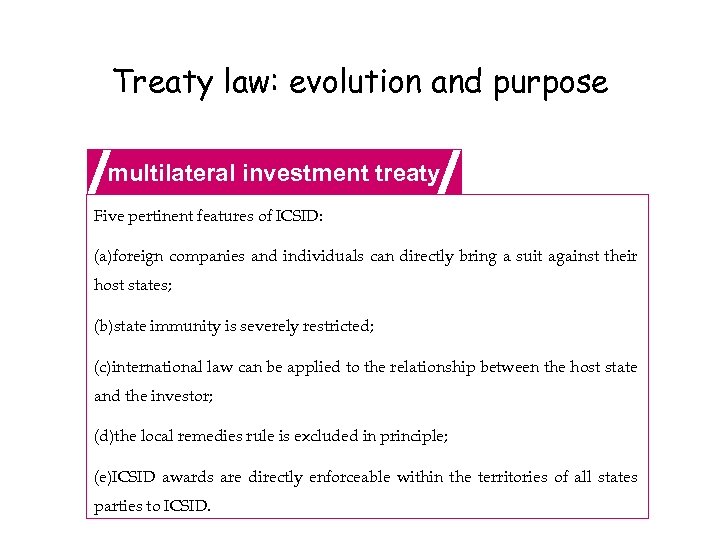 Treaty law: evolution and purpose multilateral investment treaty Five pertinent features of ICSID: (a)foreign companies and individuals can directly bring a suit against their host states; (b)state immunity is severely restricted; (c)international law can be applied to the relationship between the host state and the investor; (d)the local remedies rule is excluded in principle; (e)ICSID awards are directly enforceable within the territories of all states parties to ICSID.
 Treaty law: evolution and purpose multilateral investment treaty In subsequent decades, more and more investment treaties, bilateral and multilateral, referred to ICSID as a forum for dispute settlement. By the 1990 s, ICSID had become the main forum for the settlement of investment disputes, and the vision of Broches had become a reality.
 Treaty law: evolution and purpose multilateral investment treaty From the point of view of member states, one major advantage of the system was that investment disputes would become 'depoliticized' in the sense that it distanced the dispute from the home state of the investor and thus avoided confrontation, at least direct, between home state and host state.
 New development NAFTA North America Free Trade Agteement(NAFTA) was concluded in 1994, among Canada, the United States of America and Mexico. Chapter 11 do with the issue of investment. It is the first investment agreement signed between developed states. The United States and Canada, as the host states, were fistly sued by foreign investors before the international centre for the settlement of investment dispute. Their painful arbitral experience lead them to change the traditional attitude and strategy in the investment treaty negotiation, and finally cause a dramatic change in the international investment arbitration practice.
 New development TPP The Trans-Pacific Partnership (TPP) is a proposed trade agreement between several Pacific Rim countries concerning a variety of matters of economic policy. Among other things, the TPP seeks to lower trade barriers such as tariffs, establish a common framework for intellectual property, enforce standards for labour law and environmental law, and establish an investor-state dispute settlement mechanism. The stated goal of the agreement is to "enhance trade and investment among the TPP partner countries, to promote innovation, economic growth and development, and to support the creation and retention of jobs. " TPP is considered by the United States government as the companion agreement to TTIP (the Transatlantic Trade and Investment Partnership), a broadly similar agreement between the United States and the European Union.
 New development TPP Historically, the TPP is an expansion of the Trans-Pacific Strategic Economic Partnership Agreement (TPSEP or P 4) which was signed by Brunei, Chile, Singapore, and New Zealand in 2006. Beginning in 2008, additional countries joined for a broader agreement: Australia, Canada, Japan, Malaysia, Mexico, Peru, the United States, and Vietnam, bringing the total number of participating countries to twelve. Participating countries set the goal of wrapping up negotiations in 2012, but contentious issues such as agriculture, intellectual property, and services and investments have caused negotiations to continue into the present, with the latest round of negotiations in July 2015. Implementation of the TPP is one of the primary goals of the trade agenda of the Obama administration in the United States of America.
 New development TTIP The Transatlantic Trade and Investment Partnership (TTIP) is a proposed free trade agreement between the European Union and the United States. Proponents say the agreement would result in multilateral economic growth, while critics say it would increase corporate power and make it more difficult for governments to regulate markets for public benefit. The American government considers the TTIP a companion agreement to the Trans-Pacific Partnership. After a proposed draft was leaked in March 2014, the European Commission launched a public consultation on a limited set of clauses and in January 2015 published parts of an overview. If an agreement is to be made, it is not expected to be finalized before 2016.
 THANKS 谢 谢 聆 听