 Скачать презентацию Internal Seminar Groups Arbenz Cellier Gander Hinterberger Alliance for Global Sustainability
27c780b2541bfe1e5005284371972c47.ppt
- Количество слайдов: 57




Internal Seminar: Groups Arbenz/Cellier/Gander/Hinterberger Alliance for Global Sustainability April 3, 2007 © Prof. Dr. François E. Cellier Start Presentation
Internal Seminar: Groups Arbenz/Cellier/Gander/Hinterberger Table of Contents • • • April 3, 2007 Mathis Wackernagel: Global Footprint Network Christian Azar: Turning the Tide Dennis Meadows: Limits to Growth The Spanish Pathway Conclusions © Prof. Dr. François E. Cellier Start Presentation

Internal Seminar: Groups Arbenz/Cellier/Gander/Hinterberger Disclaimer • This report contains some material taken from the proceedings of the AGS Conference. Those slides are interspersed with material produced by me. • Since the proceedings were only published in PDF format, all material taken from the proceedings has been included in pixel graphics, i. e. by capture and paste. • The material pasted from other documents is clearly marked by hyperlinks. • The typeset text is all mine. • Especially, since the material from the Spanish pathway was not included in the proceedings, that material (or rather, the interpretation thereof) is all mine. • Finally and most importantly, the conclusions presented on the last page of this document are not official conclusions reached by the conference, but rather, they are my personal conclusions, for which I carry sole responsibility. April 3, 2007 © Prof. Dr. François E. Cellier Start Presentation
Internal Seminar: Groups Arbenz/Cellier/Gander/Hinterberger Global Footprint Network Mathis Wackernagel April 3, 2007 © Prof. Dr. François E. Cellier Start Presentation
Internal Seminar: Groups Arbenz/Cellier/Gander/Hinterberger April 3, 2007 © Prof. Dr. François E. Cellier Start Presentation
Internal Seminar: Groups Arbenz/Cellier/Gander/Hinterberger Cuba April 3, 2007 © Prof. Dr. François E. Cellier Start Presentation

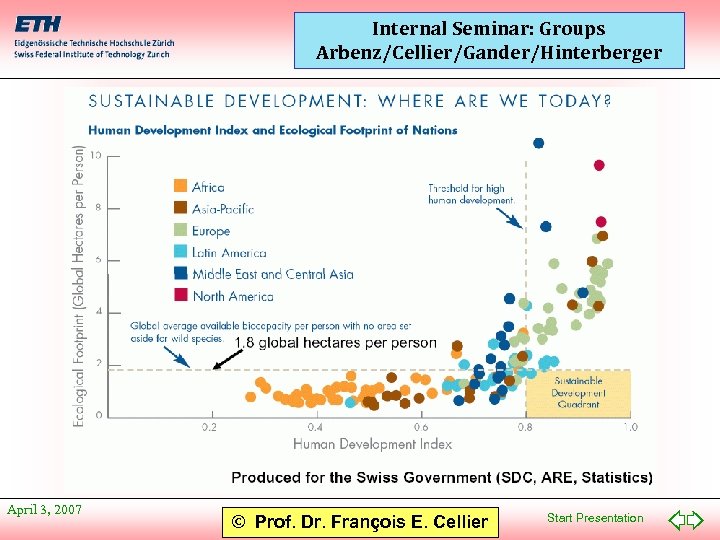
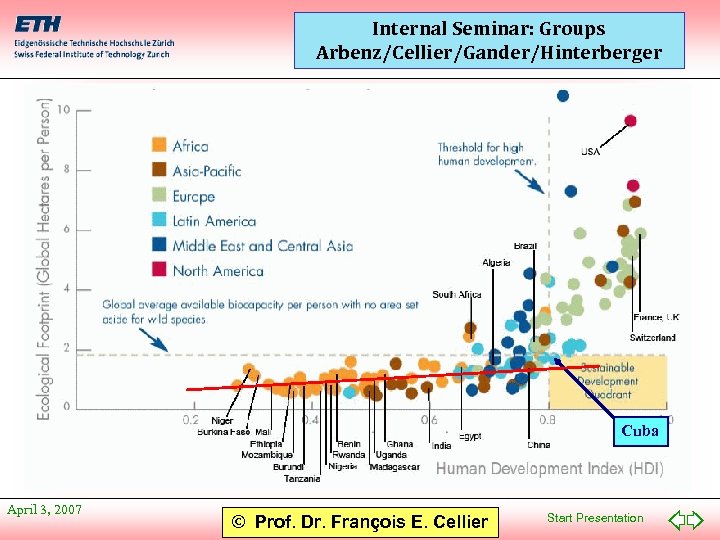
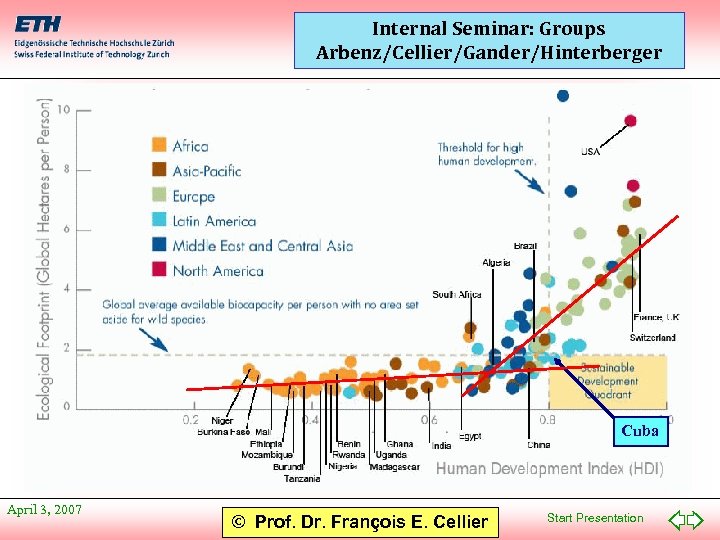
Internal Seminar: Groups Arbenz/Cellier/Gander/Hinterberger The Good News … • It takes relatively little additional resources to dramatically increase the quality of life of the poor nations. April 3, 2007 © Prof. Dr. François E. Cellier Start Presentation
Internal Seminar: Groups Arbenz/Cellier/Gander/Hinterberger Cuba April 3, 2007 © Prof. Dr. François E. Cellier Start Presentation
Internal Seminar: Groups Arbenz/Cellier/Gander/Hinterberger Why is the European Gradient Steeper? • It is steeper, because we live more wastefully. • The poor nations use their few resources in an almost optimal fashion. They cannot afford to waste anything. • We don’t think much about how we might use our resources more efficiently. Ø We heat our houses to high temperature values, while keeping the windows open. Ø We buy food that we don’t need. Ø We maintain secondary homes that we don’t need. Ø … April 3, 2007 © Prof. Dr. François E. Cellier Start Presentation
Internal Seminar: Groups Arbenz/Cellier/Gander/Hinterberger Cuba April 3, 2007 © Prof. Dr. François E. Cellier Start Presentation
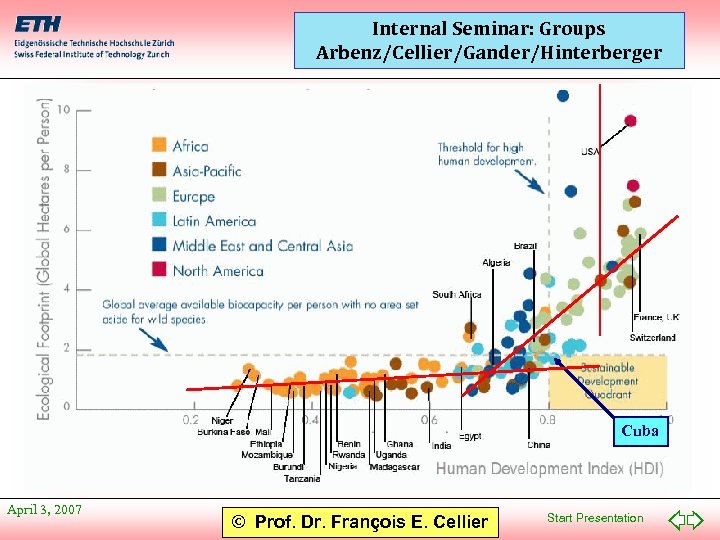
Internal Seminar: Groups Arbenz/Cellier/Gander/Hinterberger No Strings Attached • The U. S. and the United Arab Emirates consume simply because they can, without increasing their quality of life any further. • It is human nature to think first about themselves individually, and only later about the species as a whole. • Humans are constantly in competition with each other. They increase their feeling of “self-worth” by taking something away from another human being. • Example: Easter Islands. • If we want to survive as a species, while keeping up a decent quality of life, we must learn to become … … not “Berliners, ” but “Cubans. ” April 3, 2007 © Prof. Dr. François E. Cellier Start Presentation
Internal Seminar: Groups Arbenz/Cellier/Gander/Hinterberger The Bad News … • Becoming “Cubans” won’t happen on its own. • If the Cubans were given a choice, they would gladly vote to become the 51 st State in the Union … if only they could drive around in these sinfully gorgeous SUVs, heat their homes in the winter to 24 o. C, while cooling them down in the summer to 18 o. C. • We achieve the transition either by regulations … or the planet will achieve it for us, probably in ways that we won’t like a bit. April 3, 2007 © Prof. Dr. François E. Cellier Start Presentation

Internal Seminar: Groups Arbenz/Cellier/Gander/Hinterberger More Bad News … • Every species outgrows its resources over time. • A population of lab rats will stop reproducing only when there is no longer enough food for all of them. • Populations are naturally controlled by hunger and disease, not by living standard. • Whereas humans individually (on a local scale) are capable of behaving in a civilized way and helping each other, there has been no sign so far that humanity, as a species (on a global scale), behaves any differently from lab rats. April 3, 2007 © Prof. Dr. François E. Cellier Start Presentation
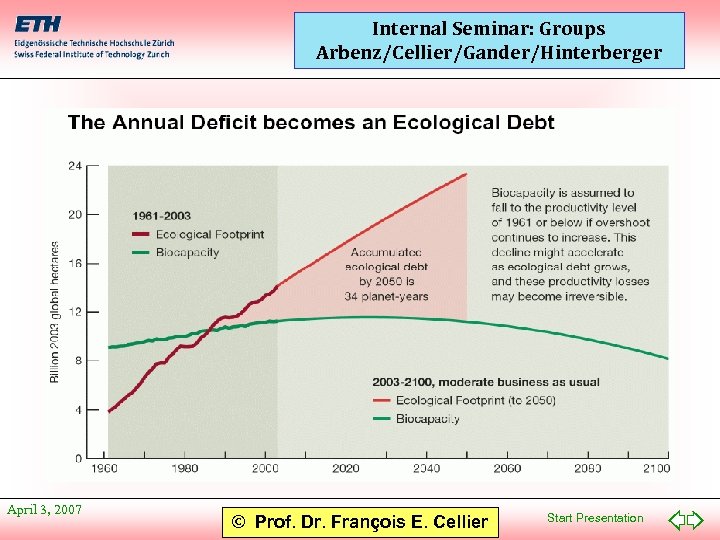
Internal Seminar: Groups Arbenz/Cellier/Gander/Hinterberger Footprint vs. Biocapacity April 3, 2007 © Prof. Dr. François E. Cellier Start Presentation
Internal Seminar: Groups Arbenz/Cellier/Gander/Hinterberger Global Ecological Balance Sheet (in global hectares/person, 2003 data) April 3, 2007 © Prof. Dr. François E. Cellier Start Presentation
Internal Seminar: Groups Arbenz/Cellier/Gander/Hinterberger April 3, 2007 © Prof. Dr. François E. Cellier Start Presentation
Internal Seminar: Groups Arbenz/Cellier/Gander/Hinterberger April 3, 2007 © Prof. Dr. François E. Cellier Start Presentation
Internal Seminar: Groups Arbenz/Cellier/Gander/Hinterberger Turning the Tide Christian Azar April 3, 2007 © Prof. Dr. François E. Cellier Start Presentation
Internal Seminar: Groups Arbenz/Cellier/Gander/Hinterberger April 3, 2007 © Prof. Dr. François E. Cellier Start Presentation
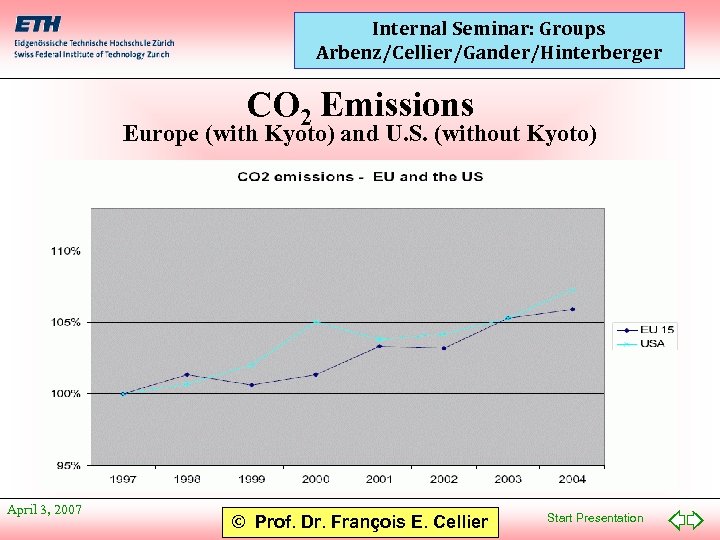
Internal Seminar: Groups Arbenz/Cellier/Gander/Hinterberger CO 2 Emissions Europe (with Kyoto) and U. S. (without Kyoto) April 3, 2007 © Prof. Dr. François E. Cellier Start Presentation
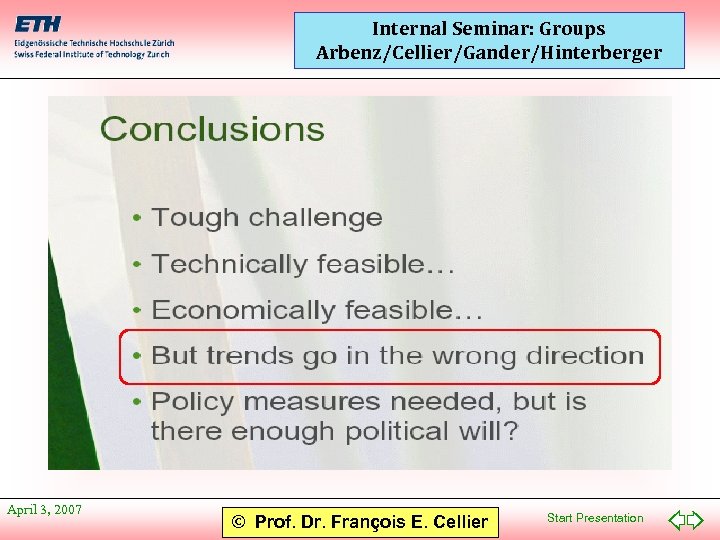
Internal Seminar: Groups Arbenz/Cellier/Gander/Hinterberger Words and Deeds • Although the EU signed the Kyoto agreement whereas the U. S. did not, their increase in CO 2 emissions over time is approximately the same. • Switzerland signed the Kyoto agreement. • What has Switzerland done since then to actually curb CO 2 emissions? • Absolutely nothing. • We talk a lot … but the CO 2 emissions won’t go away by talk alone. • As I shall demonstrate, relying on market forces won’t make them go away either. April 3, 2007 © Prof. Dr. François E. Cellier Start Presentation
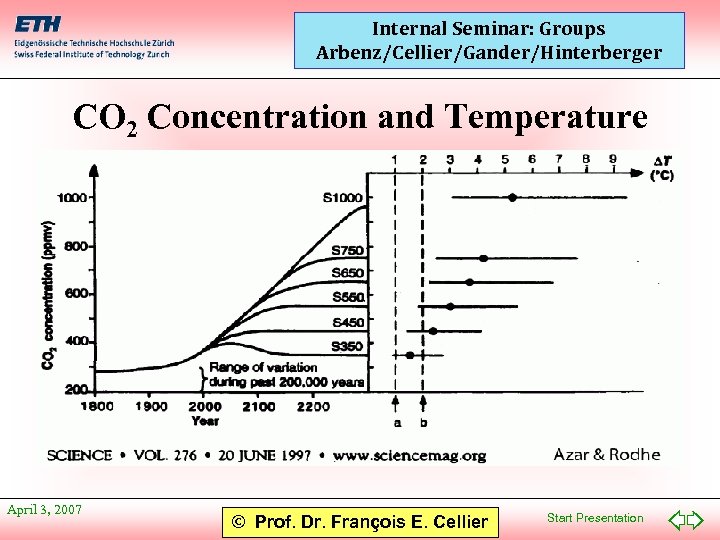
Internal Seminar: Groups Arbenz/Cellier/Gander/Hinterberger CO 2 Concentration and Temperature April 3, 2007 © Prof. Dr. François E. Cellier Start Presentation
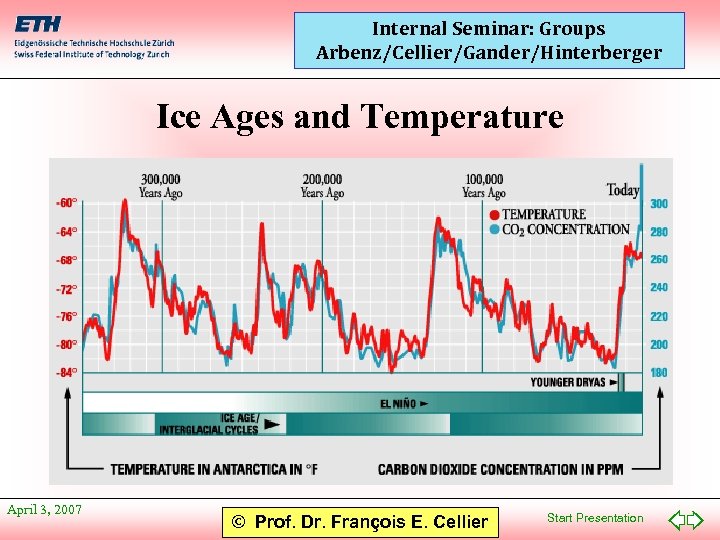
Internal Seminar: Groups Arbenz/Cellier/Gander/Hinterberger Ice Ages and Temperature April 3, 2007 © Prof. Dr. François E. Cellier Start Presentation
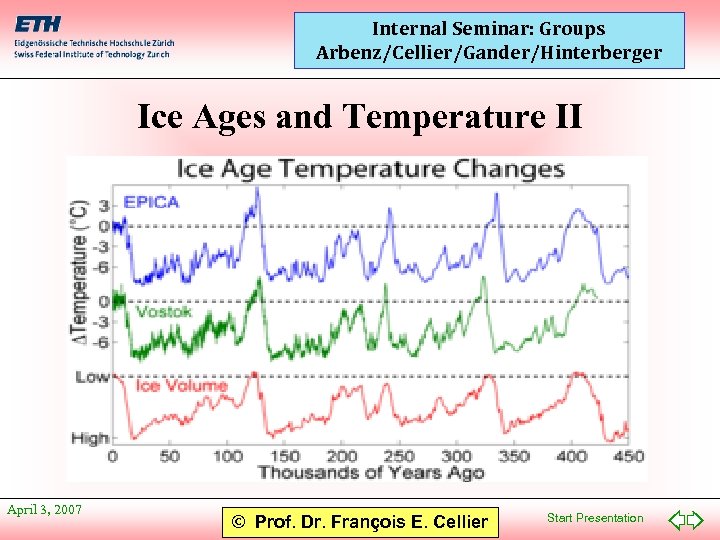
Internal Seminar: Groups Arbenz/Cellier/Gander/Hinterberger Ice Ages and Temperature II April 3, 2007 © Prof. Dr. François E. Cellier Start Presentation
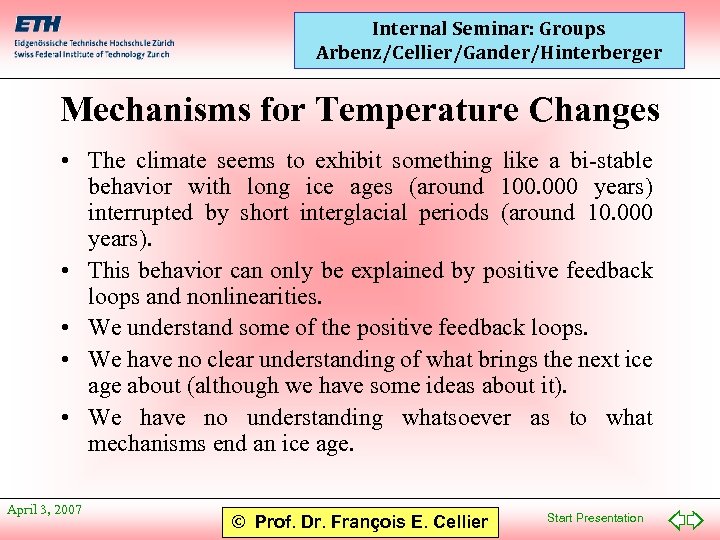
Internal Seminar: Groups Arbenz/Cellier/Gander/Hinterberger Mechanisms for Temperature Changes • The climate seems to exhibit something like a bi-stable behavior with long ice ages (around 100. 000 years) interrupted by short interglacial periods (around 10. 000 years). • This behavior can only be explained by positive feedback loops and nonlinearities. • We understand some of the positive feedback loops. • We have no clear understanding of what brings the next ice age about (although we have some ideas about it). • We have no understanding whatsoever as to what mechanisms end an ice age. April 3, 2007 © Prof. Dr. François E. Cellier Start Presentation
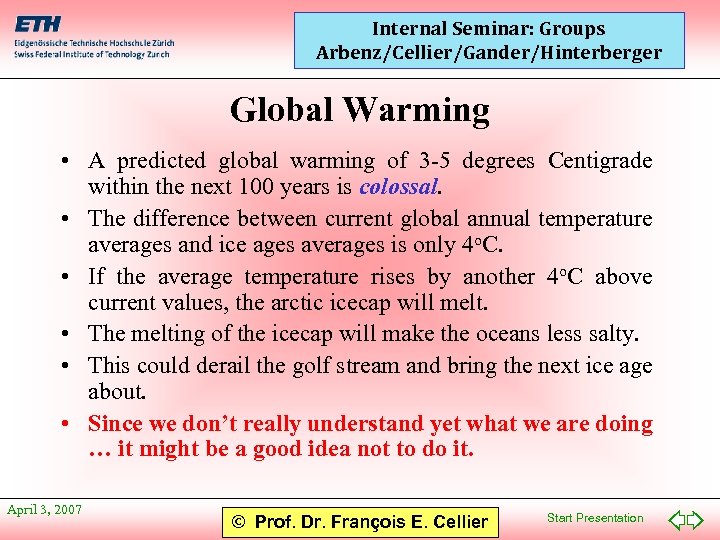
Internal Seminar: Groups Arbenz/Cellier/Gander/Hinterberger Global Warming • A predicted global warming of 3 -5 degrees Centigrade within the next 100 years is colossal. • The difference between current global annual temperature averages and ice ages averages is only 4 o. C. • If the average temperature rises by another 4 o. C above current values, the arctic icecap will melt. • The melting of the icecap will make the oceans less salty. • This could derail the golf stream and bring the next ice age about. • Since we don’t really understand yet what we are doing … it might be a good idea not to do it. April 3, 2007 © Prof. Dr. François E. Cellier Start Presentation
Internal Seminar: Groups Arbenz/Cellier/Gander/Hinterberger April 3, 2007 © Prof. Dr. François E. Cellier Start Presentation
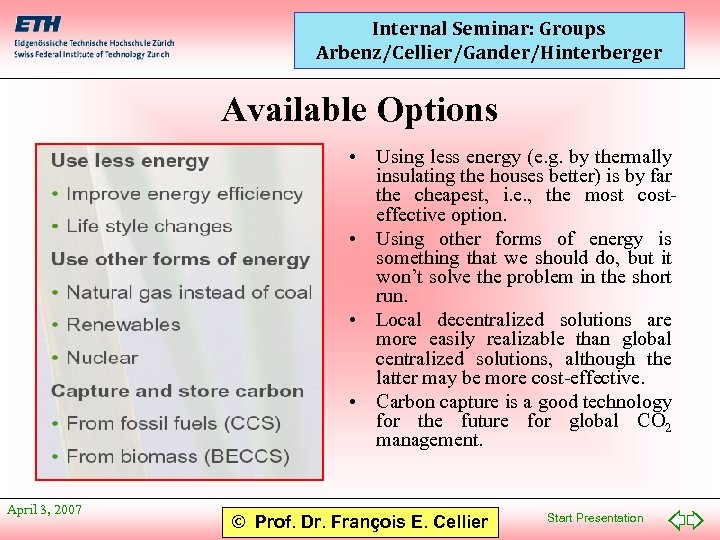
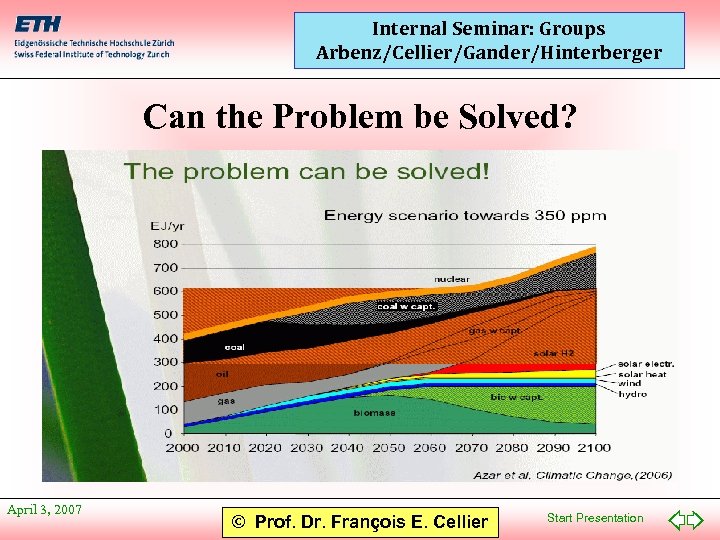
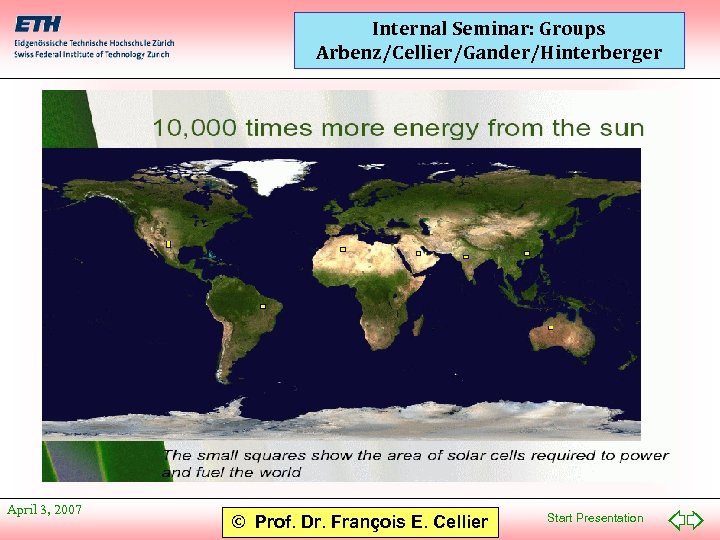
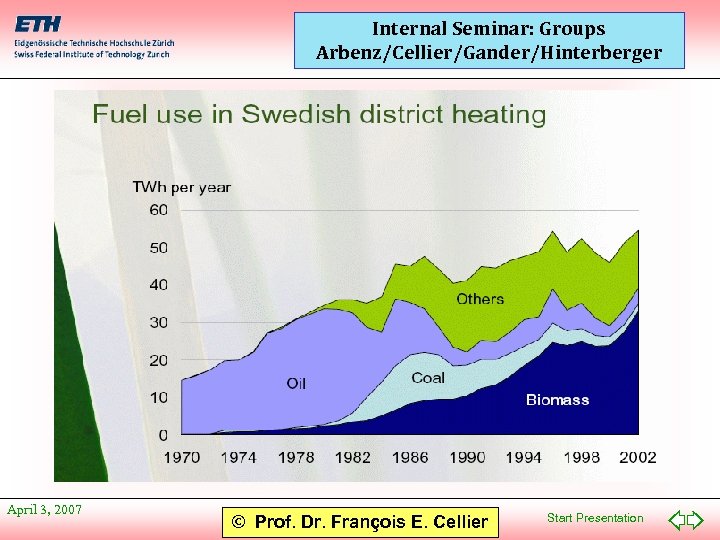
Internal Seminar: Groups Arbenz/Cellier/Gander/Hinterberger Available Options • Using less energy (e. g. by thermally insulating the houses better) is by far the cheapest, i. e. , the most costeffective option. • Using other forms of energy is something that we should do, but it won’t solve the problem in the short run. • Local decentralized solutions are more easily realizable than global centralized solutions, although the latter may be more cost-effective. • Carbon capture is a good technology for the future for global CO 2 management. April 3, 2007 © Prof. Dr. François E. Cellier Start Presentation
Internal Seminar: Groups Arbenz/Cellier/Gander/Hinterberger Can the Problem be Solved? April 3, 2007 © Prof. Dr. François E. Cellier Start Presentation
Internal Seminar: Groups Arbenz/Cellier/Gander/Hinterberger April 3, 2007 © Prof. Dr. François E. Cellier Start Presentation
Internal Seminar: Groups Arbenz/Cellier/Gander/Hinterberger April 3, 2007 © Prof. Dr. François E. Cellier Start Presentation
Internal Seminar: Groups Arbenz/Cellier/Gander/Hinterberger April 3, 2007 © Prof. Dr. François E. Cellier Start Presentation
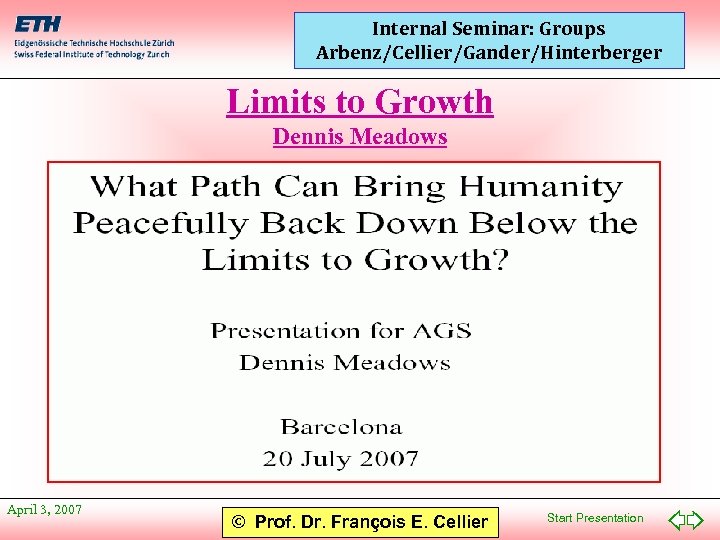
Internal Seminar: Groups Arbenz/Cellier/Gander/Hinterberger Limits to Growth Dennis Meadows April 3, 2007 © Prof. Dr. François E. Cellier Start Presentation
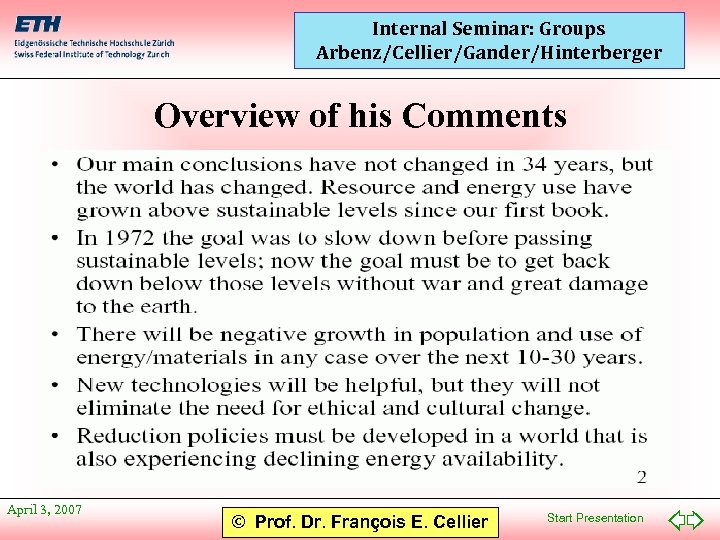
Internal Seminar: Groups Arbenz/Cellier/Gander/Hinterberger Overview of his Comments April 3, 2007 © Prof. Dr. François E. Cellier Start Presentation
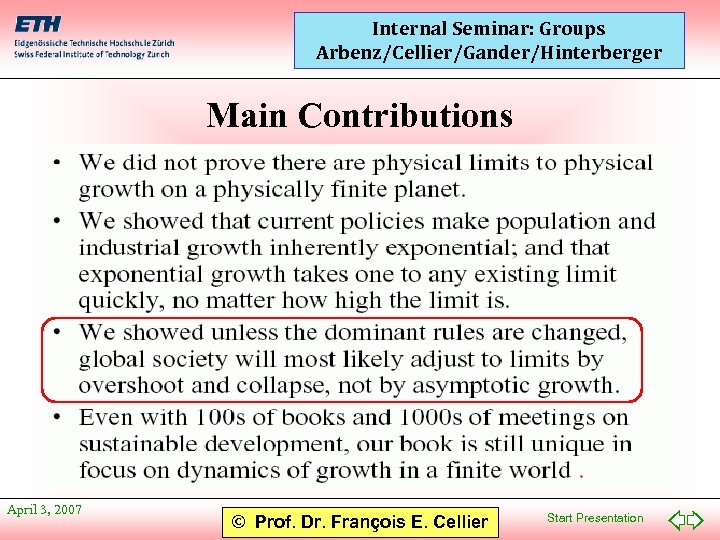
Internal Seminar: Groups Arbenz/Cellier/Gander/Hinterberger Main Contributions April 3, 2007 © Prof. Dr. François E. Cellier Start Presentation
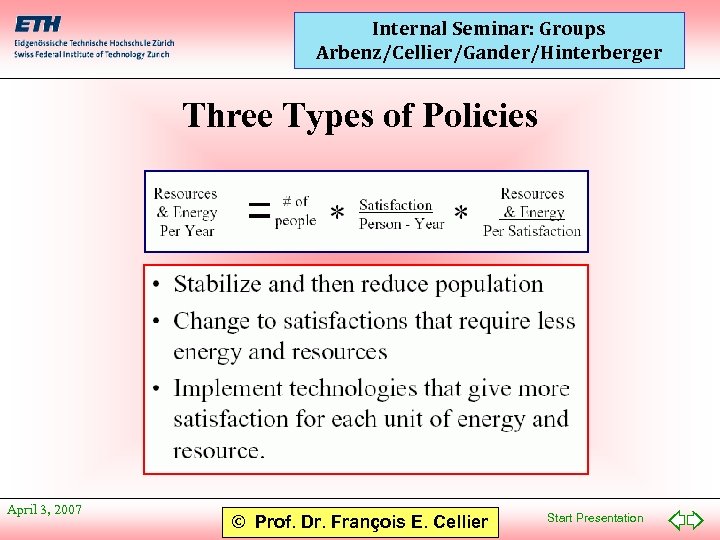
Internal Seminar: Groups Arbenz/Cellier/Gander/Hinterberger Three Types of Policies April 3, 2007 © Prof. Dr. François E. Cellier Start Presentation
Internal Seminar: Groups Arbenz/Cellier/Gander/Hinterberger Energy Gap April 3, 2007 © Prof. Dr. François E. Cellier Start Presentation
Internal Seminar: Groups Arbenz/Cellier/Gander/Hinterberger “Easy” Problems April 3, 2007 © Prof. Dr. François E. Cellier Start Presentation
Internal Seminar: Groups Arbenz/Cellier/Gander/Hinterberger “Difficult” Problems April 3, 2007 © Prof. Dr. François E. Cellier Start Presentation
Internal Seminar: Groups Arbenz/Cellier/Gander/Hinterberger “Difficult” Problems Become “Easy” with Greater Time Horizon April 3, 2007 © Prof. Dr. François E. Cellier Start Presentation
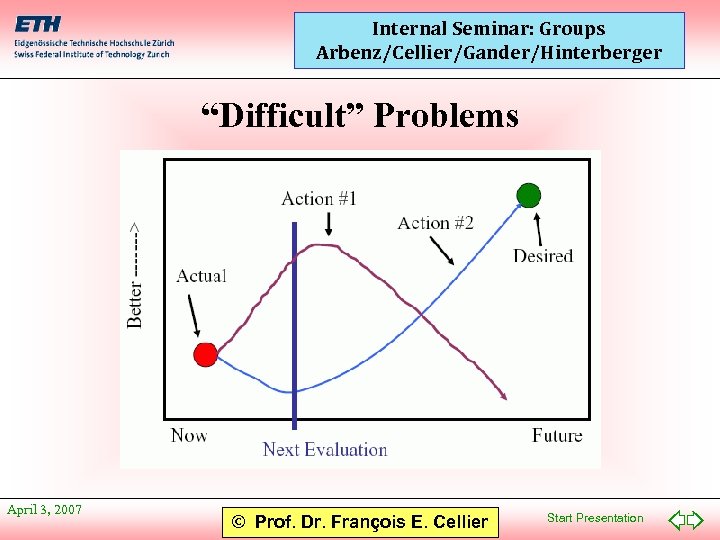
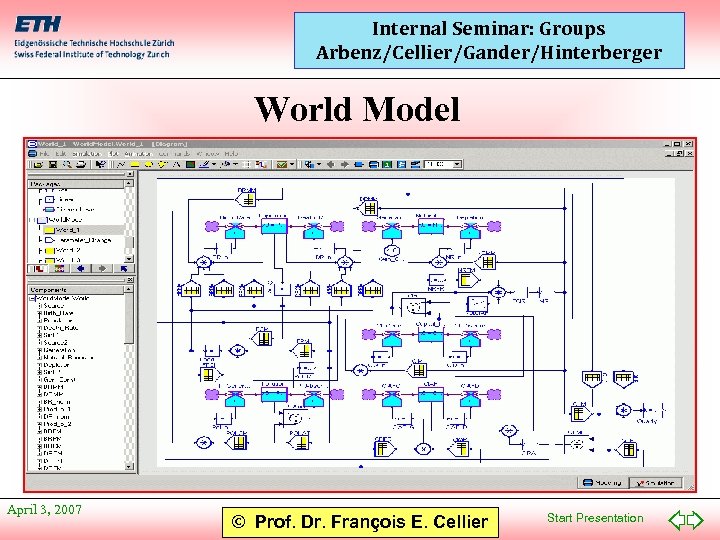
Internal Seminar: Groups Arbenz/Cellier/Gander/Hinterberger Why are Many Problems “Difficult”? • Let me concretize the nature of “difficult” problems by means of a simple optimization study using Forrester’s world model. • I chose that model over Meadows’ newer world model, because Forrester published his full model in his book World Dynamics, whereas Meadows published only the results of his studies in his book Limits to Growth. • The exercise serves to demonstrate why market forces alone are likely to drive us down the path of overshoot and collapse, rather than down the path of a sustainable future. April 3, 2007 © Prof. Dr. François E. Cellier Start Presentation
Internal Seminar: Groups Arbenz/Cellier/Gander/Hinterberger World Model April 3, 2007 © Prof. Dr. François E. Cellier Start Presentation
Internal Seminar: Groups Arbenz/Cellier/Gander/Hinterberger Simulation Results I April 3, 2007 © Prof. Dr. François E. Cellier Start Presentation
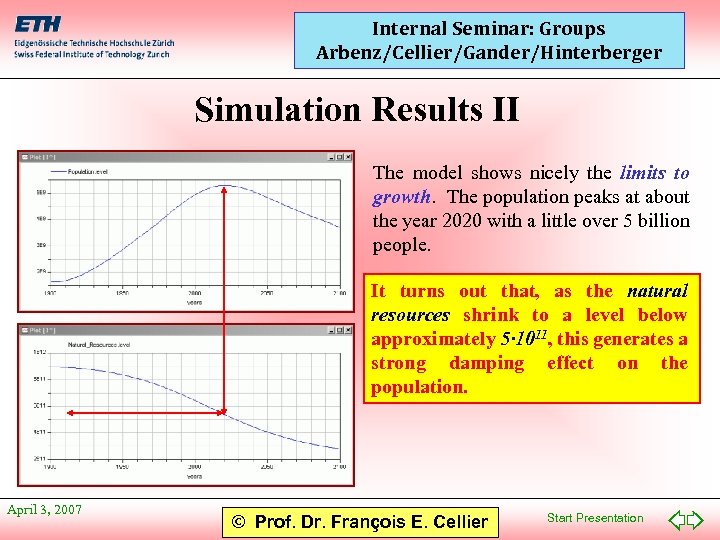
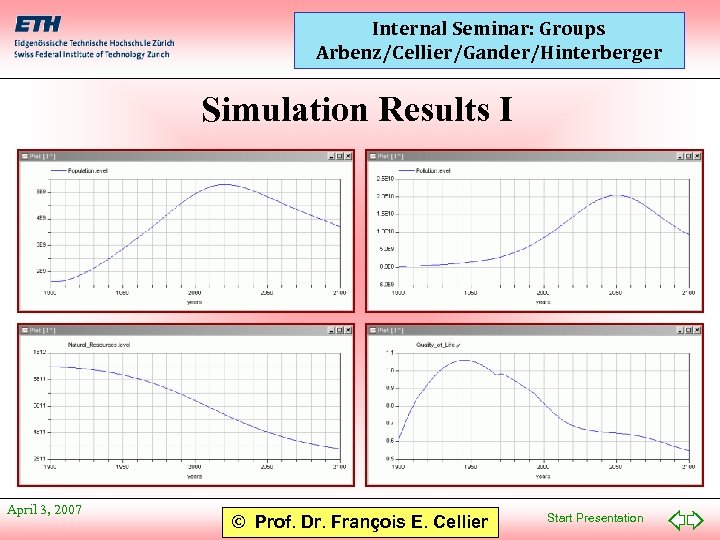
Internal Seminar: Groups Arbenz/Cellier/Gander/Hinterberger Simulation Results II The model shows nicely the limits to growth. The population peaks at about the year 2020 with a little over 5 billion people. It turns out that, as the natural resources shrink to a level below approximately 5· 1011, this generates a strong damping effect on the population. April 3, 2007 © Prof. Dr. François E. Cellier Start Presentation
Internal Seminar: Groups Arbenz/Cellier/Gander/Hinterberger 1 st Modification • Forrester thus proposed to reduce the usage of the natural resources by a factor of 4, starting with the year 1970. • This may be just as well. The effect of this modification is approximately the same as saying that more resources are available than anticipated. This is indeed true. • Now, the resource exhaustion won’t be effective as a damping factor any longer. April 3, 2007 © Prof. Dr. François E. Cellier Start Presentation
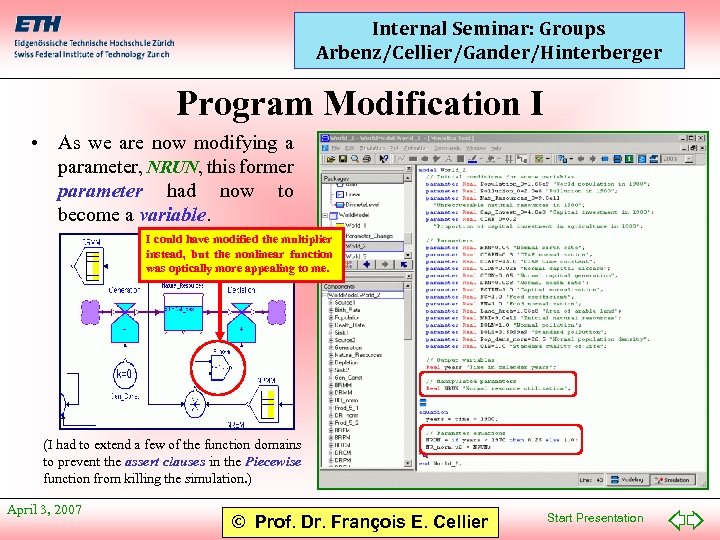
Internal Seminar: Groups Arbenz/Cellier/Gander/Hinterberger Program Modification I • As we are now modifying a parameter, NRUN, this former parameter had now to become a variable. I could have modified the multiplier instead, but the nonlinear function was optically more appealing to me. (I had to extend a few of the function domains to prevent the assert clauses in the Piecewise function from killing the simulation. ) April 3, 2007 © Prof. Dr. François E. Cellier Start Presentation
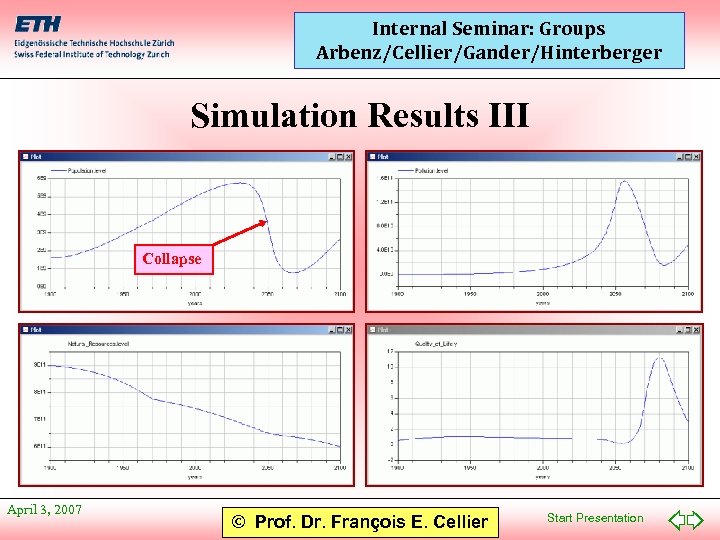
Internal Seminar: Groups Arbenz/Cellier/Gander/Hinterberger Simulation Results III Collapse April 3, 2007 © Prof. Dr. François E. Cellier Start Presentation
Internal Seminar: Groups Arbenz/Cellier/Gander/Hinterberger Optimization • We now want to optimize the consumption of natural resources after the year 1970. • To this end, we shall need a performance index. What is good, is a high value of the minimal quality of life after the year 2000 (optimizing the past doesn’t make much sense). What is bad, is a die-off of the population. • Accordingly, we modify the program once more. This is all done in the equation window. April 3, 2007 © Prof. Dr. François E. Cellier Start Presentation

Internal Seminar: Groups Arbenz/Cellier/Gander/Hinterberger Program Modification II April 3, 2007 © Prof. Dr. François E. Cellier Start Presentation
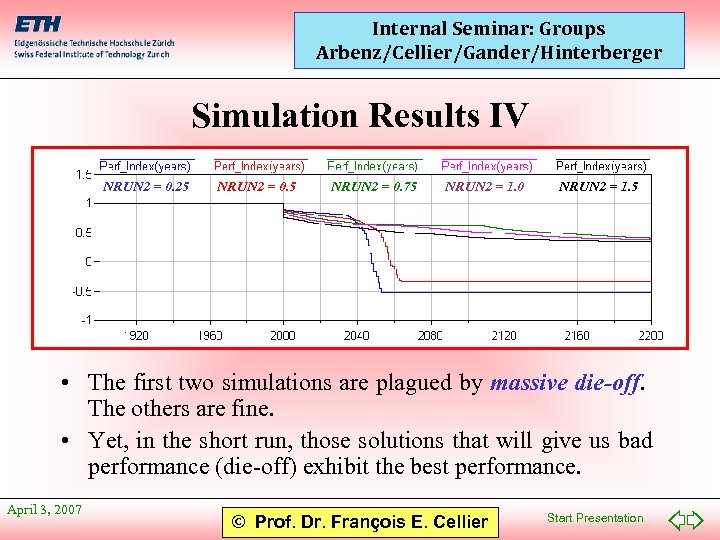
Internal Seminar: Groups Arbenz/Cellier/Gander/Hinterberger Simulation Results IV NRUN 2 = 0. 25 NRUN 2 = 0. 75 NRUN 2 = 1. 0 NRUN 2 = 1. 5 • The first two simulations are plagued by massive die-off. The others are fine. • Yet, in the short run, those solutions that will give us bad performance (die-off) exhibit the best performance. April 3, 2007 © Prof. Dr. François E. Cellier Start Presentation
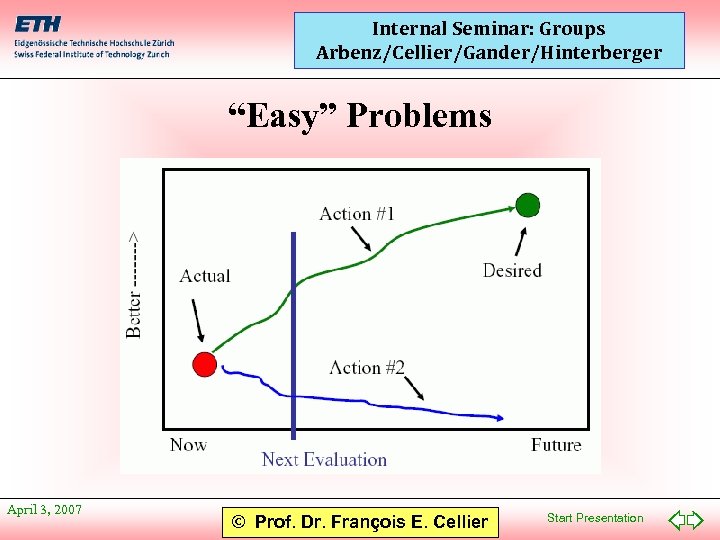
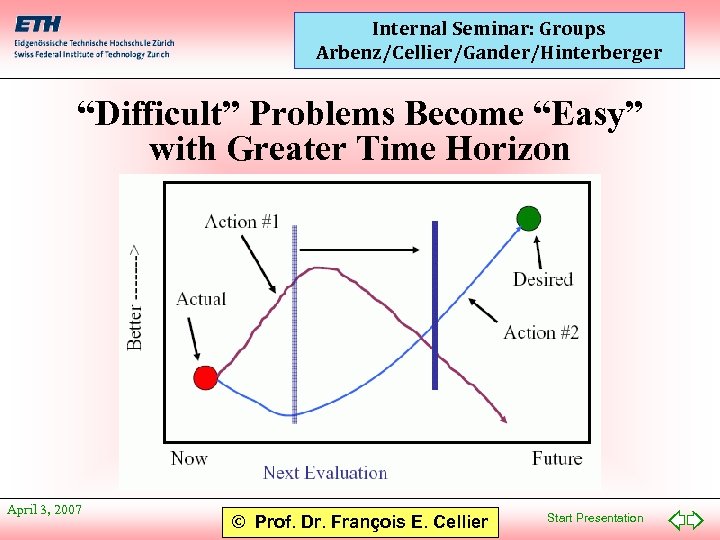
Internal Seminar: Groups Arbenz/Cellier/Gander/Hinterberger Discussion • The example shows what Dennis Meadows calls a “difficult” problem. • Markets forces focus on short-term optimization. Industrial decision makers hardly ever look beyond 2 years. • Consequently, they will most likely favor a solution that will lead to a massive die-off further down the road (après moi le déluge!). • Easter Islands all over again. . . • According to Dennis Meadows, most problems related to sustainability issues are “difficult” problems. April 3, 2007 © Prof. Dr. François E. Cellier Start Presentation
Internal Seminar: Groups Arbenz/Cellier/Gander/Hinterberger The Spanish Pathway • On Wednesday afternoon, after the international AGS meeting had ended, a separate Spanish AGS meeting was held (in Spanish). • I participated in that meeting also, as I was interested in hearing the Spanish viewpoint. April 3, 2007 © Prof. Dr. François E. Cellier Start Presentation
Internal Seminar: Groups Arbenz/Cellier/Gander/Hinterberger The Facts • Between 1990 and 2004, the Spanish CO 2 emissions increased by 46%. • 35% of all Spanish CO 2 emissions are attributed to the building industry. • In the same time frame, the construction of new primary homes grew by 30%. The construction of new secondary homes grew by 52%. • For this reason, the building industry is viewed as the single most important culprit in causing the additional CO 2 emissions. • Assuming a life span of 50 years for a building, the CO 2 emissions produced in constructing that building contribute roughly 50% to the overall CO 2 emissions generated over the entire life span of the building. April 3, 2007 © Prof. Dr. François E. Cellier Start Presentation
Internal Seminar: Groups Arbenz/Cellier/Gander/Hinterberger The Proposed Solution • The Spanish AGS researchers invited CEOs of Spanish companies related to the building industry to a meeting to discuss, how the CO 2 emissions caused by the building industry may be curbed. • If these emissions could be significantly reduced, the overall emissions would decrease as well. At least, that was theory. April 3, 2007 © Prof. Dr. François E. Cellier Start Presentation
Internal Seminar: Groups Arbenz/Cellier/Gander/Hinterberger Problems • The problem with this approach is that the different sectors of the industry are strongly interlinked. • The building industry doesn’t necessarily require much fossil fuels … they require a lot of energy. • If electricity becomes cheaper, they’ll switch over to using electricity, thereby making the building industry look much “cleaner” … while leaving it up to the power companies to decide how they are going to produce the additional electricity that is now being required. • The power companies will most likely meet the requirements … by burning more fossil fuels. April 3, 2007 © Prof. Dr. François E. Cellier Start Presentation
Internal Seminar: Groups Arbenz/Cellier/Gander/Hinterberger Analyzing the Observations • In the time span between 1990 and 2004, the Spanish stock market grew by roughly 46%. • Hence the average person had 46% more money to spend, or rather reinvest. • The people need to reinvest their money somehow. Either they invest it themselves (e. g. by constructing a weekend home), or they give it to a bank to invest it for them (e. g. by lending money to a home builder). • The investment consumes roughly 46% additional energy. • The production of that additional energy is accompanied by roughly 46% additional CO 2 emissions. April 3, 2007 © Prof. Dr. François E. Cellier Start Presentation
Internal Seminar: Groups Arbenz/Cellier/Gander/Hinterberger Conclusions • If we want to reduce the CO 2 emissions, we have no choice but to use less energy, at least in the short run. • The only meaningful way to accomplish this is by adding a massive CO 2 removal tax on the use of fossils fuels. • This tax will slow down the economy. It will make us all poorer in the short run (a “difficult problem” according to Dennis Meadows), but it will accomplish the goal of reducing CO 2 emissions. • The tax will make alternate energy sources (like solar power plants) more attractive, thereby increasing the rate of their introduction. • The tax will also make us more conscious of the indirect cost of burning fossil fuels. Hence each of us is more likely to help our common goal by using less energy. April 3, 2007 © Prof. Dr. François E. Cellier Start Presentation
Скачать презентацию Internal Seminar Groups Arbenz Cellier Gander Hinterberger Alliance for Global Sustainability
27c780b2541bfe1e5005284371972c47.ppt