


 Скачать презентацию Intermunicipal co-operation Finland Juha Myllymäki Legal Counsel The
b295d2408da30dc4539b733188d79f9b.ppt
- Количество слайдов: 7
 Intermunicipal co-operation Finland Juha Myllymäki Legal Counsel The Association of Finnish Local and Regional Authorities
 Local authorities • Population in Finland 5, 3 million • 432 municipalities • Average 12 083 (2003) • Municipalities are self-governing units • Provide basic services relating to social welfare, health care, education, culture, environment and technical infrastructure • Different forms of co-operation widely used
 Legal basis for co-operation Local Government Act 1. Joint authorities - legal public entities established by local authorities - set up by an agreement - no private owners/members - any function on behalf of local authorities (health care, vocational education, social welfare, waste, water, etc. ) - statutory joint authorities (required by law) - Specialist care, care for mentally disabled, land use planning
 Legal basis for co-operation 2. Purchase of services - agreement between authorities 3. Service provision by local authority under supervision of a joint organ - services provided by one local authority on behalf of another local authority (“host”) - no separate, legal person - local authority using the service can participate in decision making by naming a representative to the organ in the “host” responsible for producing/organising services
 Legal basis for co-operation 4. Limited companies - Companies governed by private law - can perform functions other than those involving the use of public power - private shareholders possible
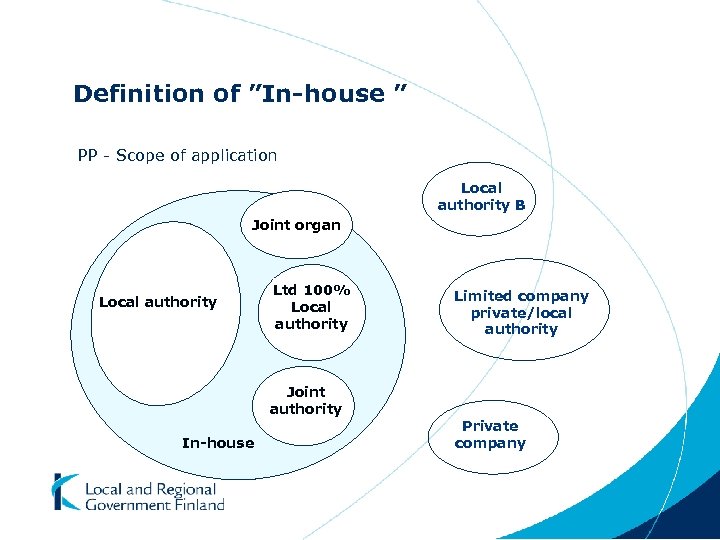 Definition of ”In-house ” PP - Scope of application Local authority B Joint organ Local authority Ltd 100% Local authority Limited company private/local authority Joint authority In-house Private company
 Problems occurred • Public procurement - scope of application • Host local authority model • Other agreements • Limited companies and joint authorities owned by two or more local authorities • Uncertainty development stops