 Скачать презентацию Intermediate English Lessons By Adam Школа английского Understand
Intermediate Class.pptx
- Количество слайдов: 43



Intermediate English Lessons By Adam Школа английского Understand. ru
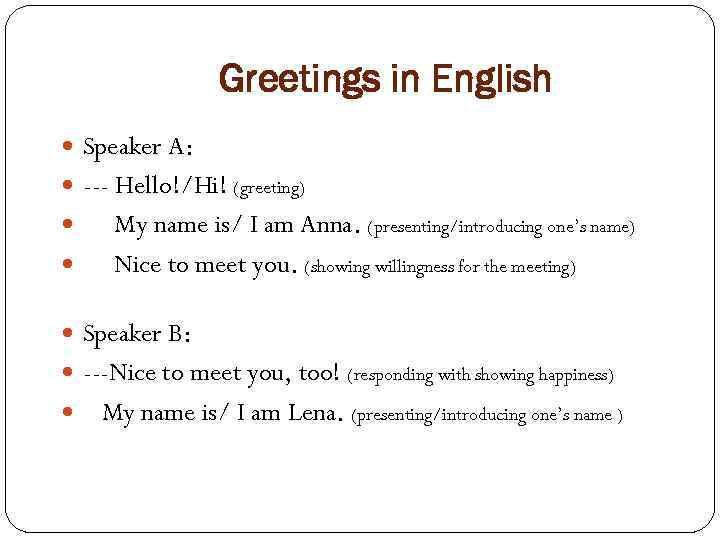
Greetings in English Speaker A: --- Hello!/Hi! (greeting) My name is/ I am Anna. (presenting/introducing one’s name) Nice to meet you. (showing willingness for the meeting) Speaker B: ---Nice to meet you, too! (responding with showing happiness) My name is/ I am Lena. (presenting/introducing one’s name )
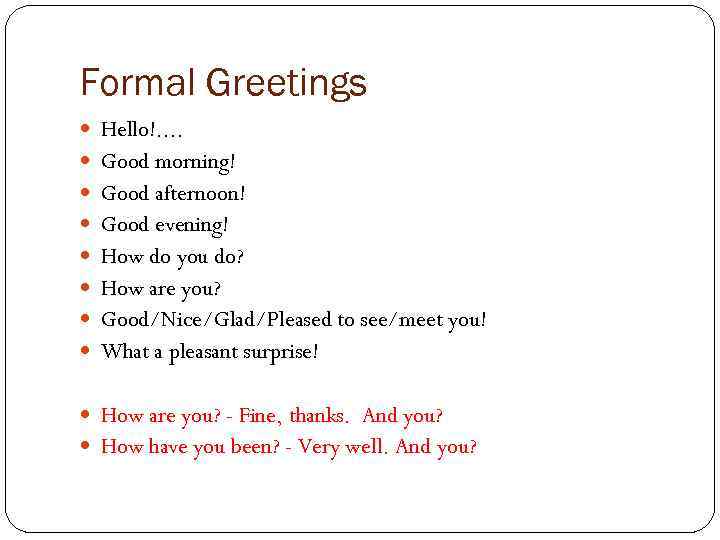
Formal Greetings Hello!. . Good morning! Good afternoon! Good evening! How do you do? How are you? Good/Nice/Glad/Pleased to see/meet you! What a pleasant surprise! How are you? - Fine, thanks. And you? How have you been? - Very well. And you?
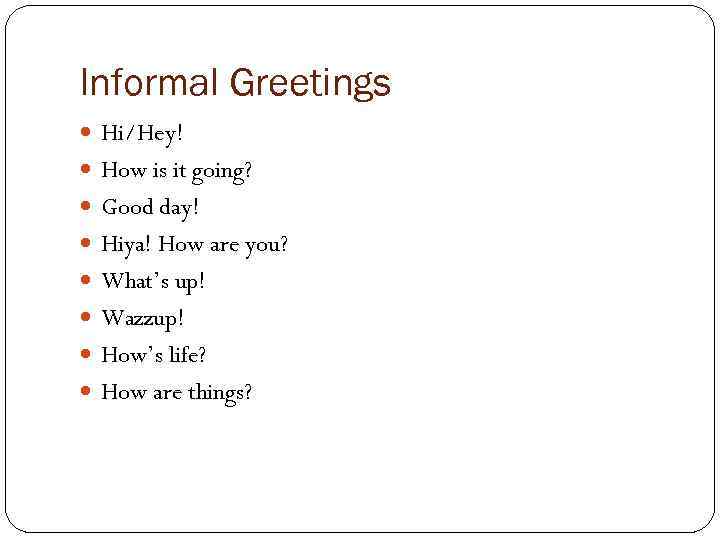
Informal Greetings Hi/Hey! How is it going? Good day! Hiya! How are you? What’s up! Wazzup! How’s life? How are things?
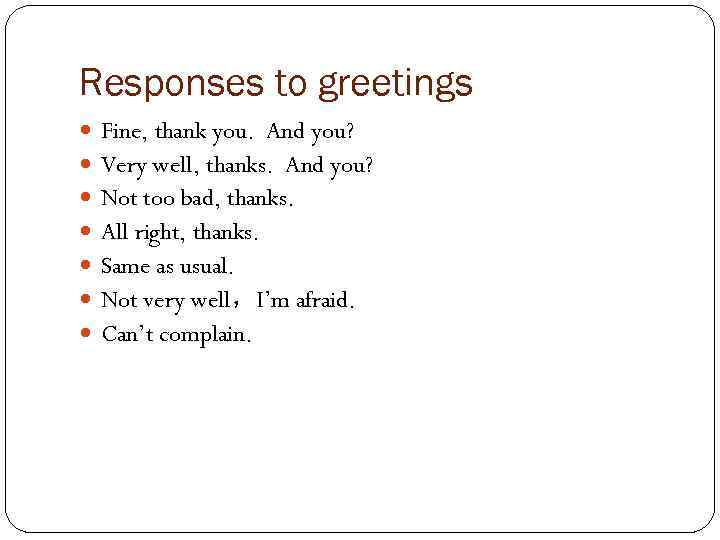
Responses to greetings Fine, thank you. And you? Very well, thanks. And you? Not too bad, thanks. All right, thanks. Same as usual. Not very well,I’m afraid. Can’t complain.
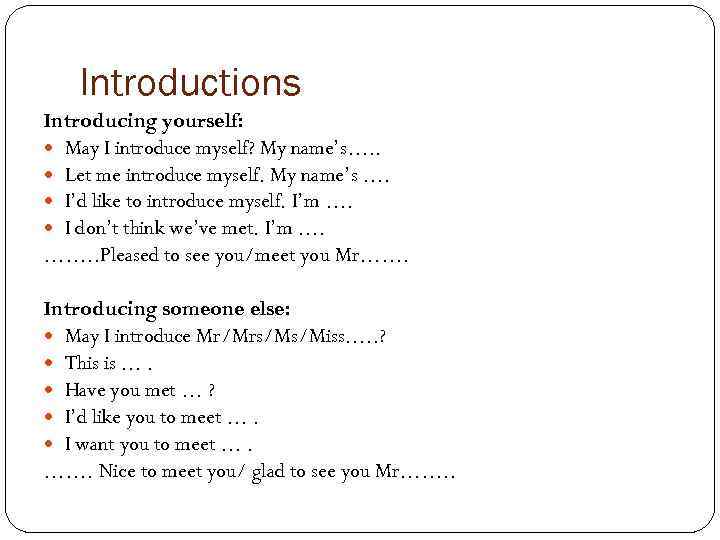
Introductions Introducing yourself: May I introduce myself? My name’s…. . Let me introduce myself. My name’s …. I’d like to introduce myself. I’m …. I don’t think we’ve met. I’m …. ……. . Pleased to see you/meet you Mr……. Introducing someone else: May I introduce Mr/Mrs/Ms/Miss…. . ? This is …. Have you met … ? I’d like you to meet …. I want you to meet …. ……. Nice to meet you/ glad to see you Mr……. .
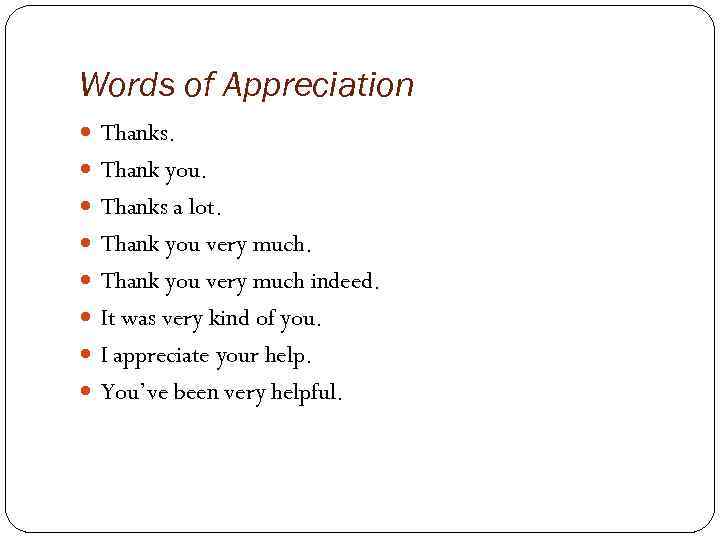
Words of Appreciation Thanks. Thank you. Thanks a lot. Thank you very much indeed. It was very kind of you. I appreciate your help. You’ve been very helpful.

Saying Good-byes Good-bye! Have a nice day. Have a good day. See you soon. See you around. Bye-bye! / Bye! So long! Take care now. Good night -До свидания! -Всего доброго. Всего хорошего. -Пока. Увидимся. -До скорой встречи. -Увидимся. До встречи. -Пока! Всего! -До свидания! До встречи! Пока! -Всего хорошего. -Спокойной ночи. Доброй ночи.
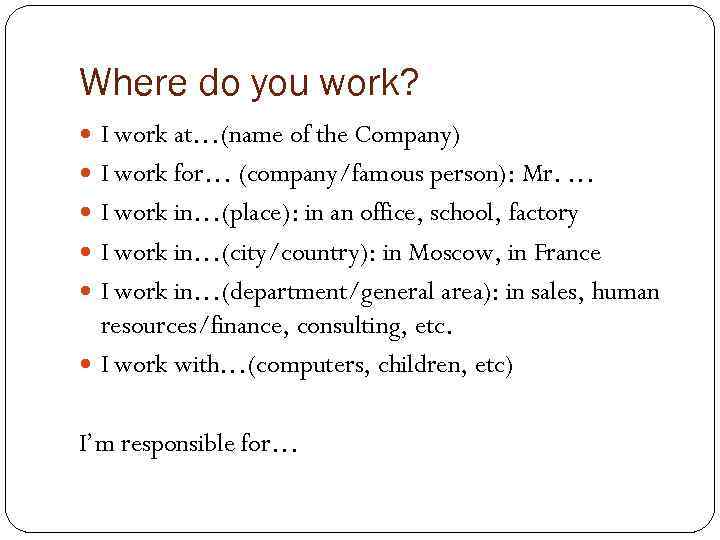
Where do you work? I work at…(name of the Company) I work for… (company/famous person): Mr. … I work in…(place): in an office, school, factory I work in…(city/country): in Moscow, in France I work in…(department/general area): in sales, human resources/finance, consulting, etc. I work with…(computers, children, etc) I’m responsible for…
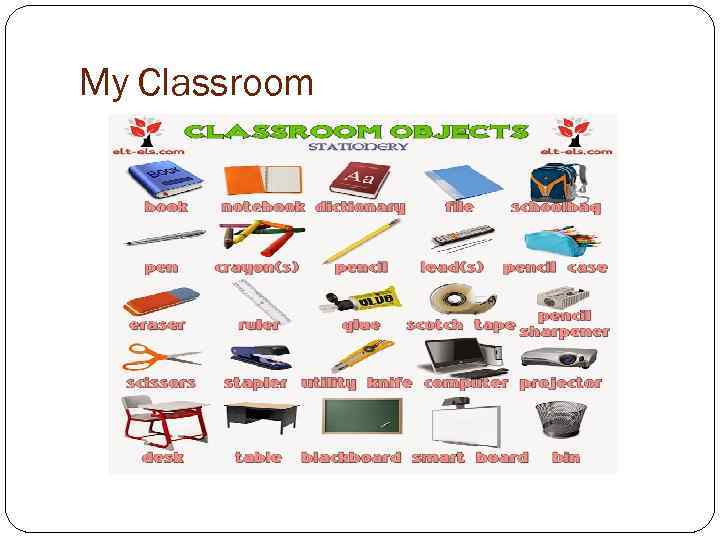
My Classroom
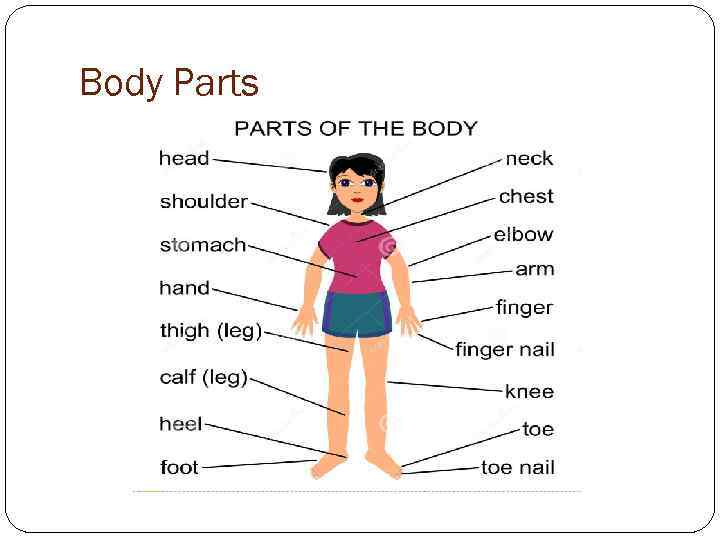
Body Parts
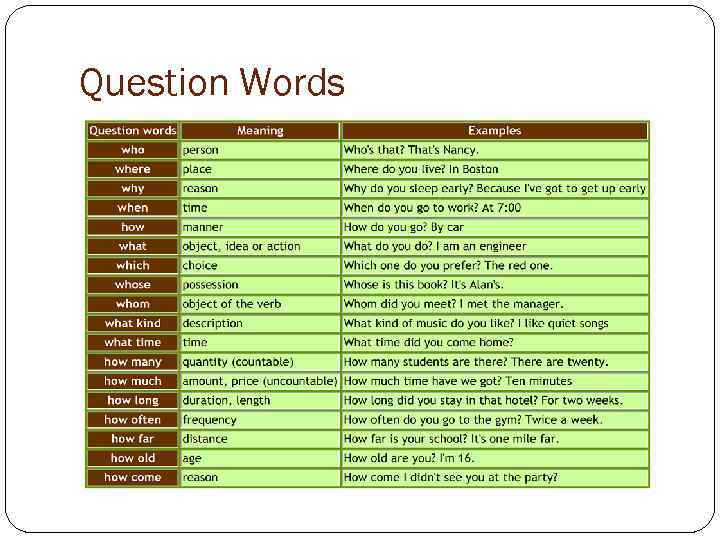
Question Words
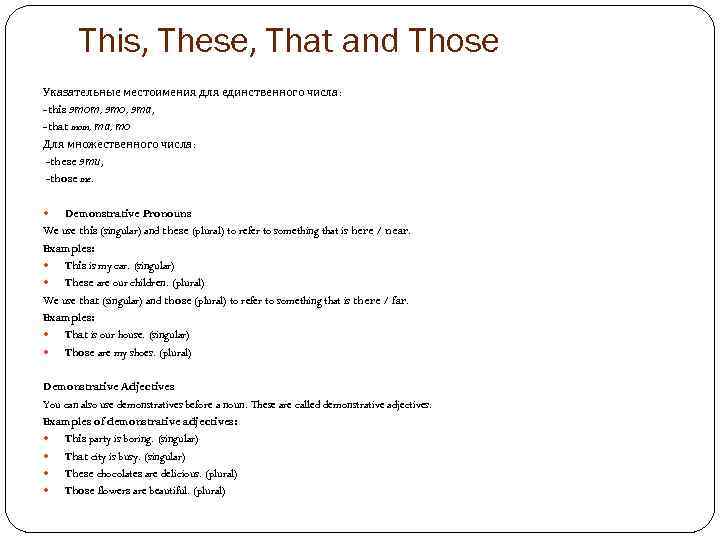
This, These, That and Those Указательные местоимения для единственного числа: -this этот, это, эта, -that mom, та, то Для множественного числа: -these эти, -those me. Demonstrative Pronouns We use this (singular) and these (plural) to refer to something that is here / near. Examples: This is my car. (singular) These are our children. (plural) We use that (singular) and those (plural) to refer to something that is there / far. Examples: That is our house. (singular) Those are my shoes. (plural) Demonstrative Adjectives You can also use demonstratives before a noun. These are called demonstrative adjectives. Examples of demonstrative adjectives: This party is boring. (singular) That city is busy. (singular) These chocolates are delicious. (plural) Those flowers are beautiful. (plural)
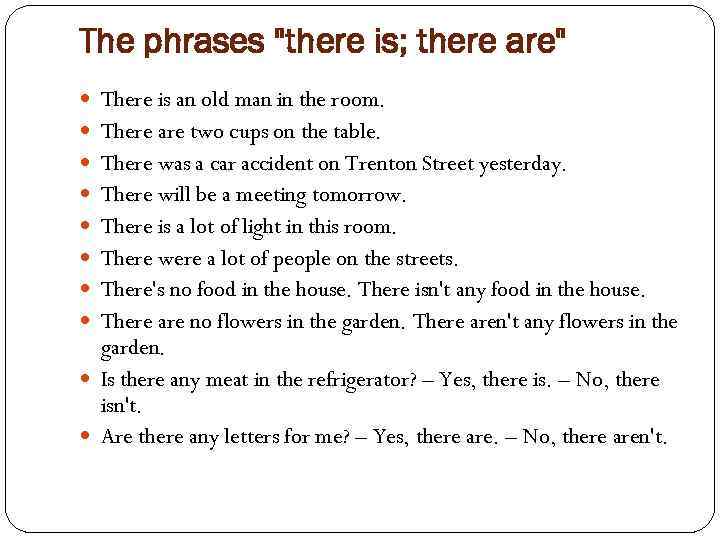
The phrases "there is; there are" There is an old man in the room. There are two cups on the table. There was a car accident on Trenton Street yesterday. There will be a meeting tomorrow. There is a lot of light in this room. There were a lot of people on the streets. There's no food in the house. There isn't any food in the house. There are no flowers in the garden. There aren't any flowers in the garden. Is there any meat in the refrigerator? – Yes, there is. – No, there isn't. Are there any letters for me? – Yes, there are. – No, there aren't.
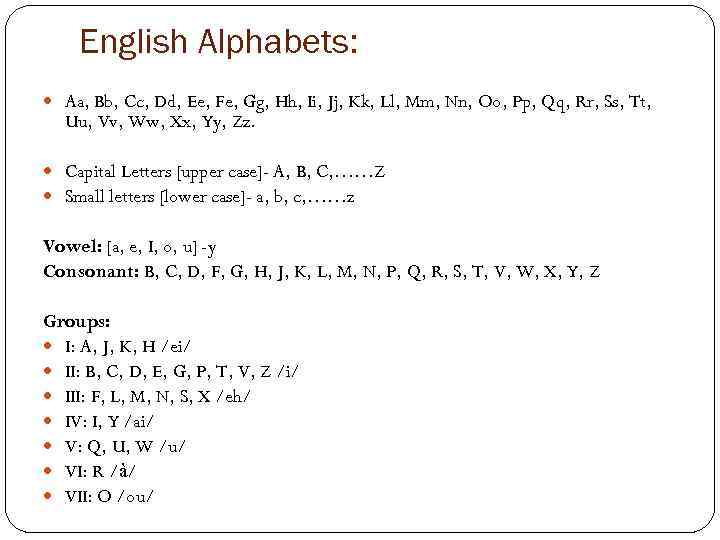
English Alphabets: Aa, Bb, Cc, Dd, Ee, Fe, Gg, Hh, Ii, Jj, Kk, Ll, Mm, Nn, Oo, Pp, Qq, Rr, Ss, Tt, Uu, Vv, Ww, Xx, Yy, Zz. Capital Letters [upper case]- A, B, C, ……Z Small letters [lower case]- a, b, c, ……z Vowel: [a, e, I, o, u] -y Consonant: B, C, D, F, G, H, J, K, L, M, N, P, Q, R, S, T, V, W, X, Y, Z Groups: I: A, J, K, H /ei/ II: B, C, D, E, G, P, T, V, Z /i/ III: F, L, M, N, S, X /eh/ IV: I, Y /ai/ V: Q, U, W /u/ VI: R /à/ VII: O /ou/
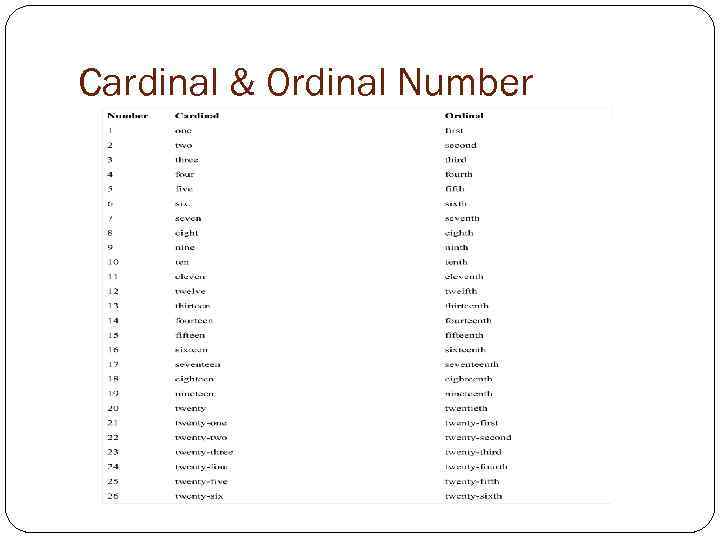
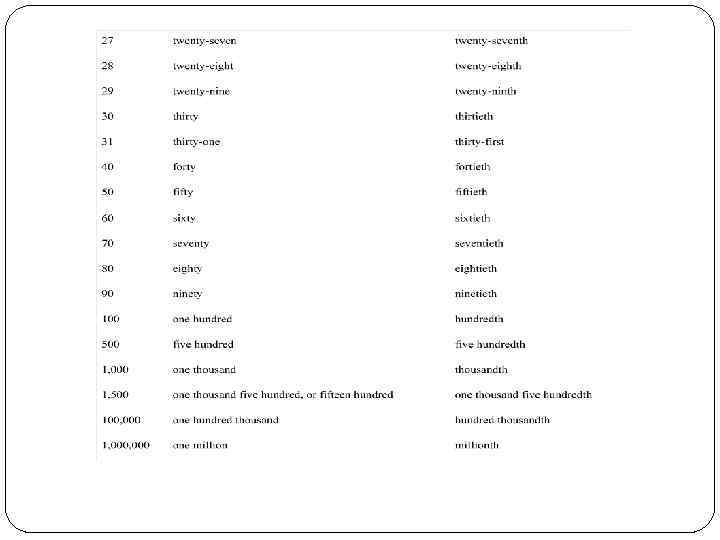
Cardinal & Ordinal Number
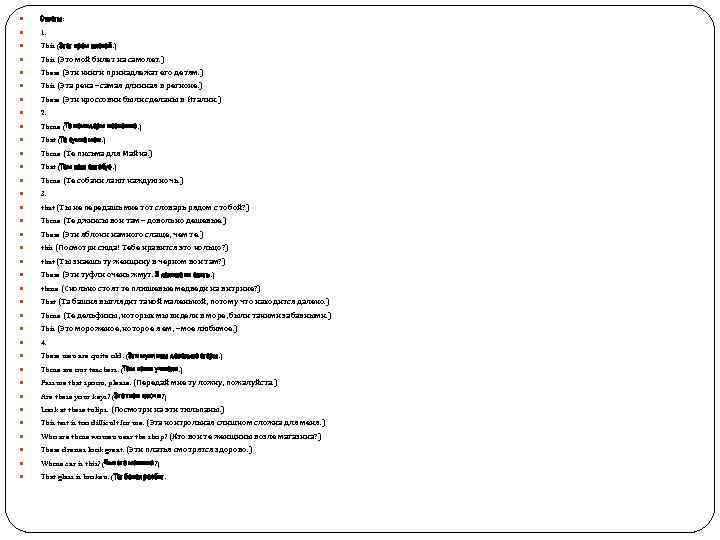
Ответы: 1. This (Этот крем плохой. ) This (Это мой билет на самолет. ) These (Эти книги принадлежат его детям. ) This (Эта река – самая длинная в регионе. ) These (Эти кроссовки были сделаны в Италии. ) 2. Those (Те помидоры несвежие. ) That (Та сумка моя. ) Those (Те письма для Майка. ) That (Там наш автобус. ) Those (Те собаки лают каждую ночь. ) 3. that (Ты не передашь мне тот словарь рядом с тобой? ) Those (Те джинсы вон там – довольно дешевые. ) These (Эти яблоки намного слаще, чем те. ) this (Посмотри сюда! Тебе нравится это кольцо? ) that (Ты знаешь ту женщину в черном вон там? ) These (Эти туфли очень жмут. Я должна их снять. ) those (Сколько стоят те плюшевые медведи на витрине? ) That (Та башня выглядит такой маленькой, потому что находится далеко. ) Those (Те дельфины, которых мы видели в море, были такими забавными. ) This (Это мороженое, которое я ем, – мое любимое. ) 4. These men are quite old. (Эти мужчины довольно стары. ) Those are our teachers. (Там наши учителя. ) Pass me that spoon, please. (Передай мне ту ложку, пожалуйста. ) Are these your keys? (Это твои ключи? ) Look at these tulips. (Посмотри на эти тюльпаны. ) This test is too difficult for me. (Эта контрольная слишком сложна для меня. ) Who are those women near the shop? (Кто вон те женщины возле магазина? ) These dresses look great. (Эти платья смотрятся здорово. ) Whose car is this? (Чья это машина? ) That glass is broken. (Тот бокал разбит.
Lesson 2
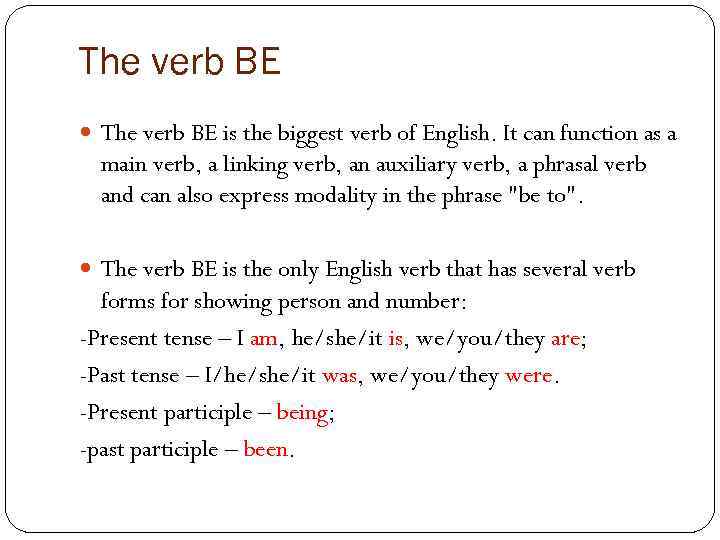
The verb BE is the biggest verb of English. It can function as a main verb, a linking verb, an auxiliary verb, a phrasal verb and can also express modality in the phrase "be to". The verb BE is the only English verb that has several verb forms for showing person and number: -Present tense – I am, he/she/it is, we/you/they are; -Past tense – I/he/she/it was, we/you/they were. -Present participle – being; -past participle – been.
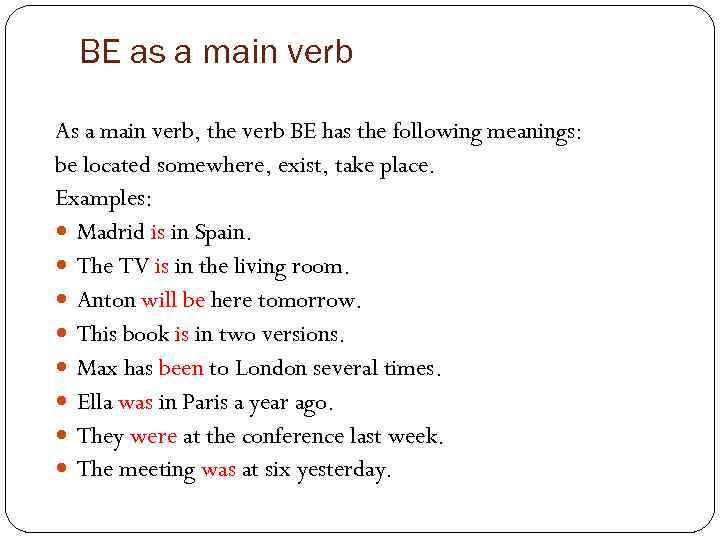
BE as a main verb As a main verb, the verb BE has the following meanings: be located somewhere, exist, take place. Examples: Madrid is in Spain. The TV is in the living room. Anton will be here tomorrow. This book is in two versions. Max has been to London several times. Ella was in Paris a year ago. They were at the conference last week. The meeting was at six yesterday.
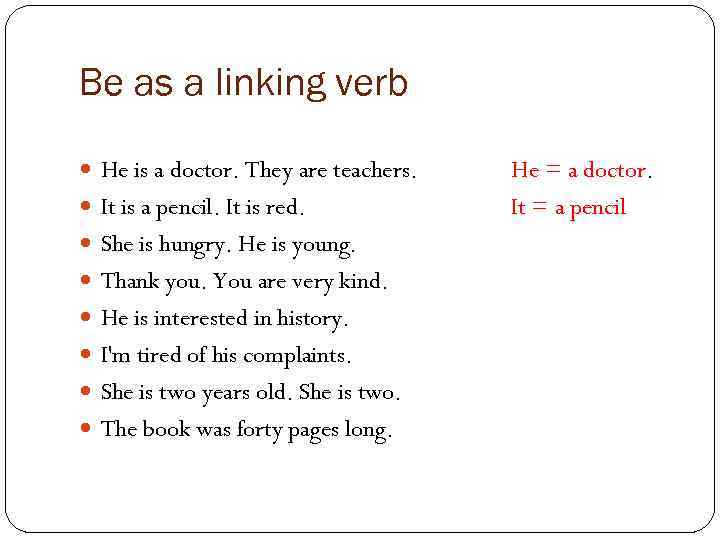
Be as a linking verb He is a doctor. They are teachers. It is a pencil. It is red. She is hungry. He is young. Thank you. You are very kind. He is interested in history. I'm tired of his complaints. She is two years old. She is two. The book was forty pages long. He = a doctor. It = a pencil
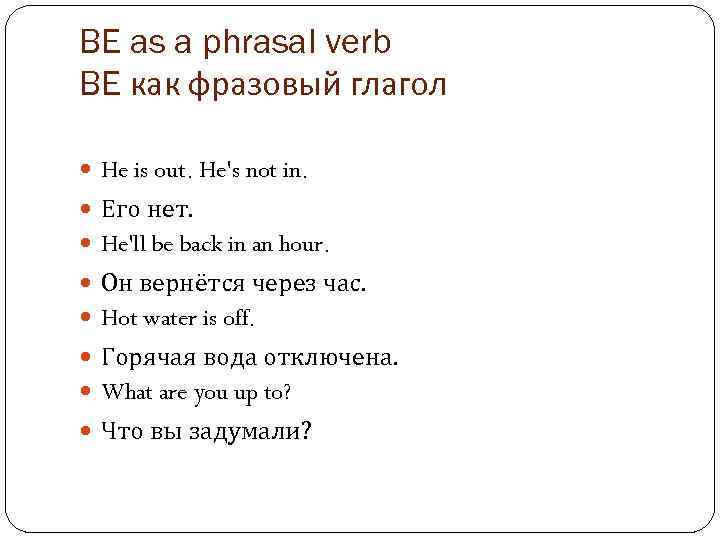
BE as a phrasal verb BE как фразовый глагол He is out. He's not in. Его нет. He'll be back in an hour. Он вернётся через час. Hot water is off. Горячая вода отключена. What are you up to? Что вы задумали?
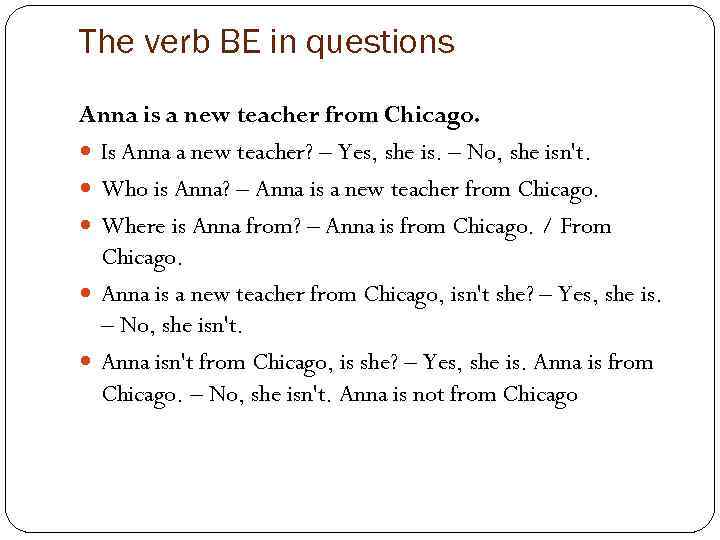
The verb BE in questions Anna is a new teacher from Chicago. Is Anna a new teacher? – Yes, she is. – No, she isn't. Who is Anna? – Anna is a new teacher from Chicago. Where is Anna from? – Anna is from Chicago. / From Chicago. Anna is a new teacher from Chicago, isn't she? – Yes, she is. – No, she isn't. Anna isn't from Chicago, is she? – Yes, she is. Anna is from Chicago. – No, she isn't. Anna is not from Chicago
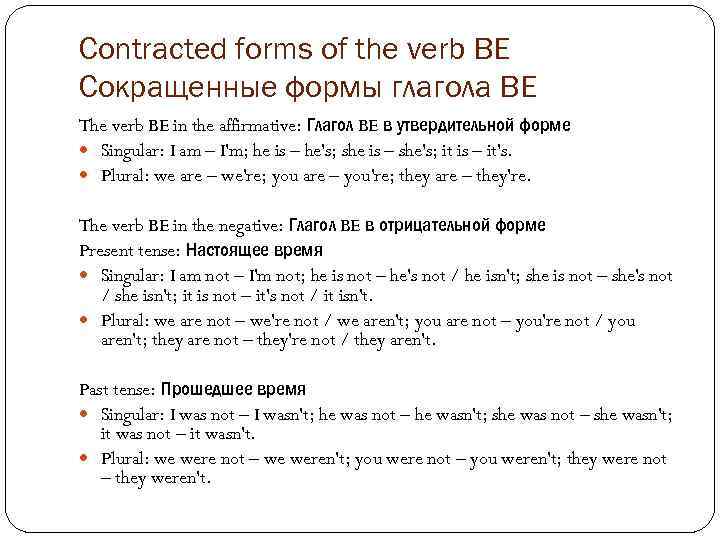
Contracted forms of the verb BE Сокращенные формы глагола BE The verb BE in the affirmative: Глагол BE в утвердительной форме Singular: I am – I'm; he is – he's; she is – she's; it is – it's. Plural: we are – we're; you are – you're; they are – they're. The verb BE in the negative: Глагол BE в отрицательной форме Present tense: Настоящее время Singular: I am not – I'm not; he is not – he's not / he isn't; she is not – she's not / she isn't; it is not – it's not / it isn't. Plural: we are not – we're not / we aren't; you are not – you're not / you aren't; they are not – they're not / they aren't. Past tense: Прошедшее время Singular: I was not – I wasn't; he was not – he wasn't; she was not – she wasn't; it was not – it wasn't. Plural: we were not – we weren't; you were not – you weren't; they were not – they weren't.
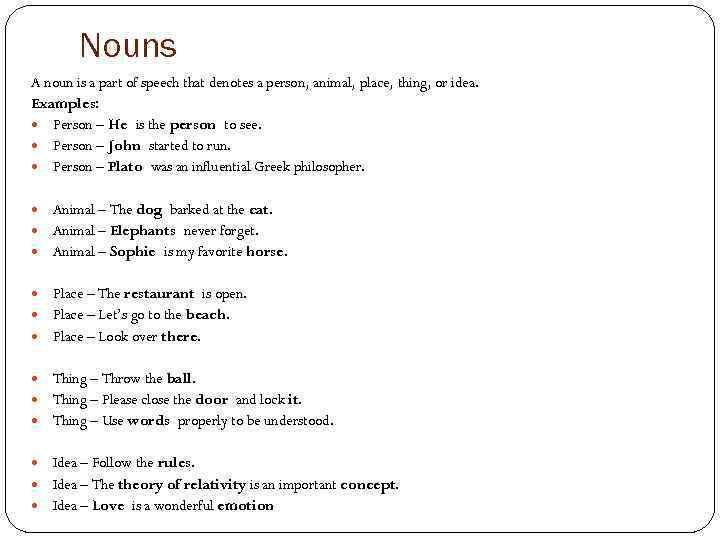
Nouns A noun is a part of speech that denotes a person, animal, place, thing, or idea. Examples: Person – He is the person to see. Person – John started to run. Person – Plato was an influential Greek philosopher. Animal – The dog barked at the cat. Animal – Elephants never forget. Animal – Sophie is my favorite horse. Place – The restaurant is open. Place – Let’s go to the beach. Place – Look over there. Thing – Throw the ball. Thing – Please close the door and lock it. Thing – Use words properly to be understood. Idea – Follow the rules. Idea – The theory of relativity is an important concept. Idea – Love is a wonderful emotion
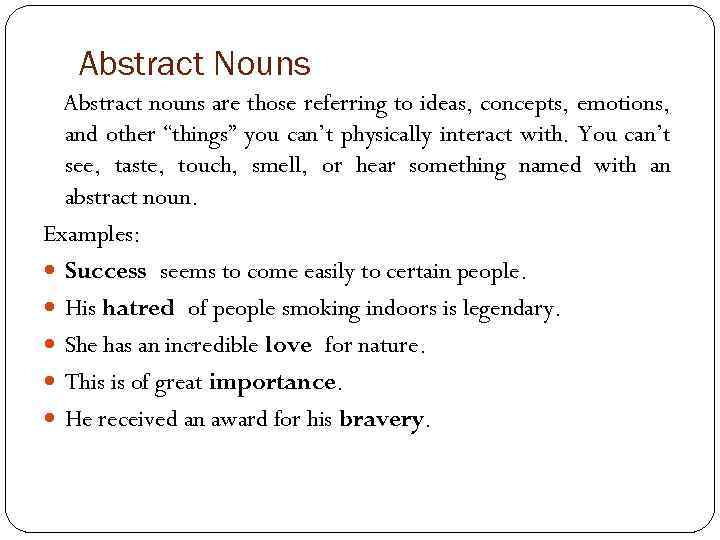
Abstract Nouns Abstract nouns are those referring to ideas, concepts, emotions, and other “things” you can’t physically interact with. You can’t see, taste, touch, smell, or hear something named with an abstract noun. Examples: Success seems to come easily to certain people. His hatred of people smoking indoors is legendary. She has an incredible love for nature. This is of great importance. He received an award for his bravery.
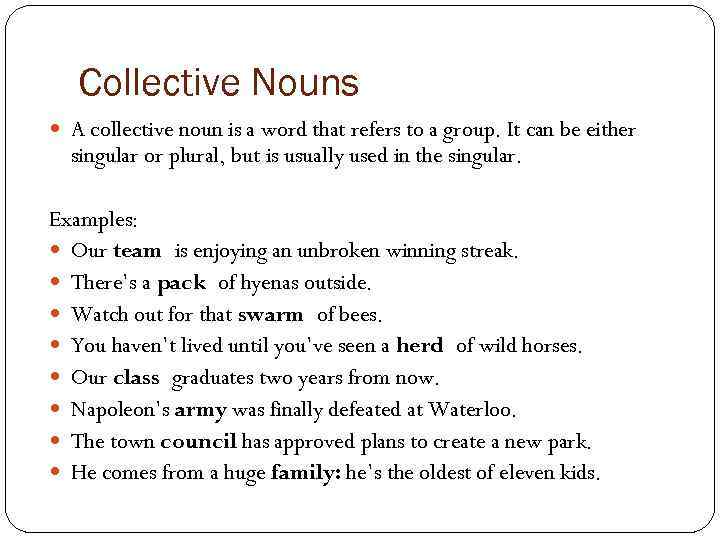
Collective Nouns A collective noun is a word that refers to a group. It can be either singular or plural, but is usually used in the singular. Examples: Our team is enjoying an unbroken winning streak. There’s a pack of hyenas outside. Watch out for that swarm of bees. You haven’t lived until you’ve seen a herd of wild horses. Our class graduates two years from now. Napoleon’s army was finally defeated at Waterloo. The town council has approved plans to create a new park. He comes from a huge family: he’s the oldest of eleven kids.
Common Nouns Common nouns are used to refer to general things rather than specific examples. Common nouns are not normally capitalized unless they are used as part of a proper name or are placed at the beginning of a sentence. Examples: Be sure to pick a top university. Stack those boxes carefully. Would you like a cookie with your coffee? People are strange. My dog won’t stop barking.
Proper Noun Proper nouns have two distinct features: They name specific one-of-akind items, and they begin with capital letters, no matter where they occur within a sentence. Examples: Agatha Christie wrote many books. Cleopatra is the cutest kitten ever. I’m craving Oreos. Let’s go to San Francisco. Mr. Bell seems to understand what students need. I can see Jupiter tonight. He never goes anywhere without Sarah. There are many important documents at The Library of Congress.
Concrete Noun Concrete nouns are words used for actual things you can touch, see, taste, feel, and hear – things you interact with every day. Concrete nouns can also be countable, uncountable, common, proper, and collective nouns. Examples: Please remember to buy oranges. Have a seat in that chair.
Countable Noun Anything that can be counted, whether singular – a dog, a house, a friend, etc. or plural – a few books, lots of oranges, etc. is a countable noun. Examples: There at least twenty Italian restaurants in Little Italy. Megan took a lot of photographs when she went to the Grand Canyon. Your book is on the kitchen table. How many candles are on that birthday cake? You have several paintings to study in art appreciation class. There’s a big brown dog running around the neighborhood
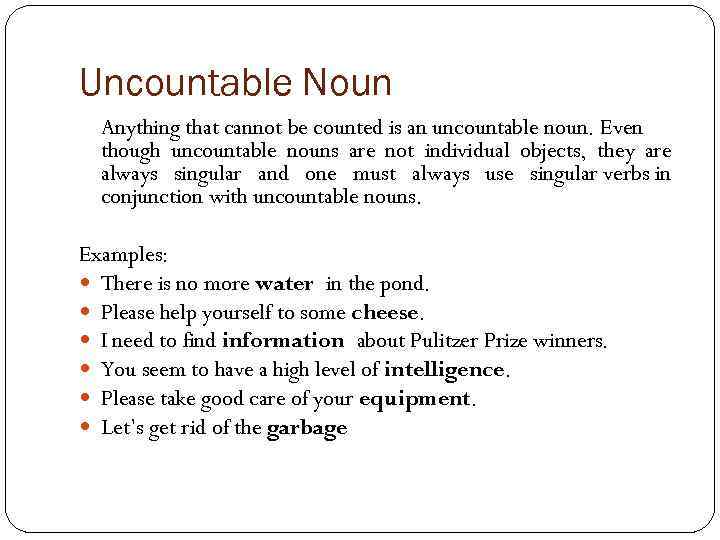
Uncountable Noun Anything that cannot be counted is an uncountable noun. Even though uncountable nouns are not individual objects, they are always singular and one must always use singular verbs in conjunction with uncountable nouns. Examples: There is no more water in the pond. Please help yourself to some cheese. I need to find information about Pulitzer Prize winners. You seem to have a high level of intelligence. Please take good care of your equipment. Let’s get rid of the garbage
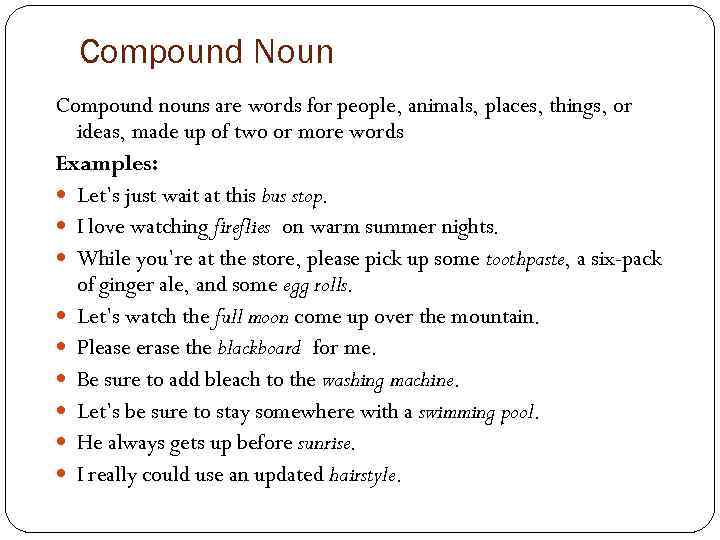
Compound Noun Compound nouns are words for people, animals, places, things, or ideas, made up of two or more words Examples: Let’s just wait at this bus stop. I love watching fireflies on warm summer nights. While you’re at the store, please pick up some toothpaste, a six-pack of ginger ale, and some egg rolls. Let’s watch the full moon come up over the mountain. Please erase the blackboard for me. Be sure to add bleach to the washing machine. Let’s be sure to stay somewhere with a swimming pool. He always gets up before sunrise. I really could use an updated hairstyle.
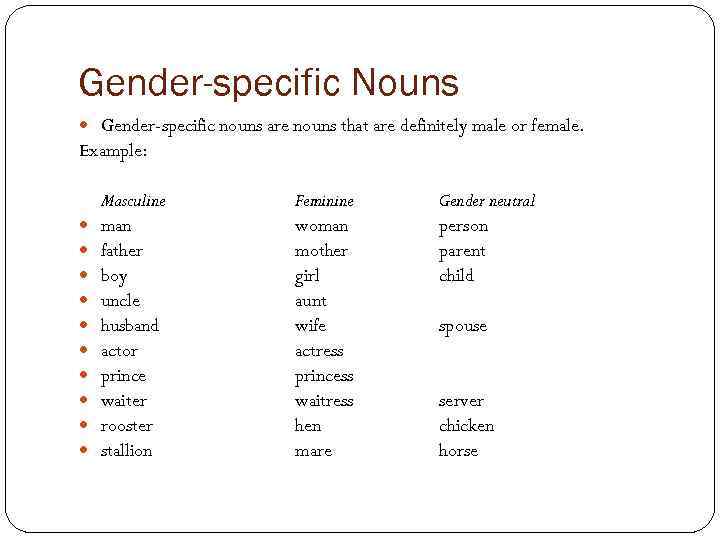
Gender-specific Nouns Gender-specific nouns are nouns that are definitely male or female. Example: Masculine man father boy uncle husband actor prince waiter rooster stallion Feminine woman mother girl aunt wife actress princess waitress hen mare Gender neutral person parent child spouse server chicken horse
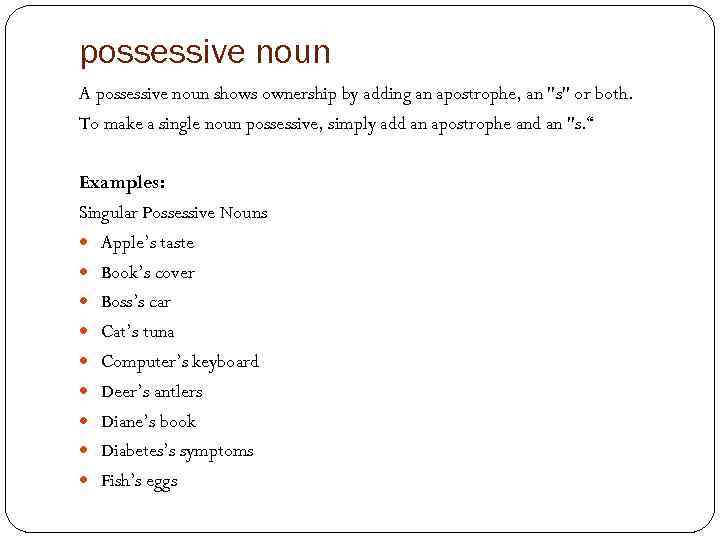
possessive noun A possessive noun shows ownership by adding an apostrophe, an "s" or both. To make a single noun possessive, simply add an apostrophe and an "s. “ Examples: Singular Possessive Nouns Apple’s taste Book’s cover Boss’s car Cat’s tuna Computer’s keyboard Deer’s antlers Diane’s book Diabetes’s symptoms Fish’s eggs
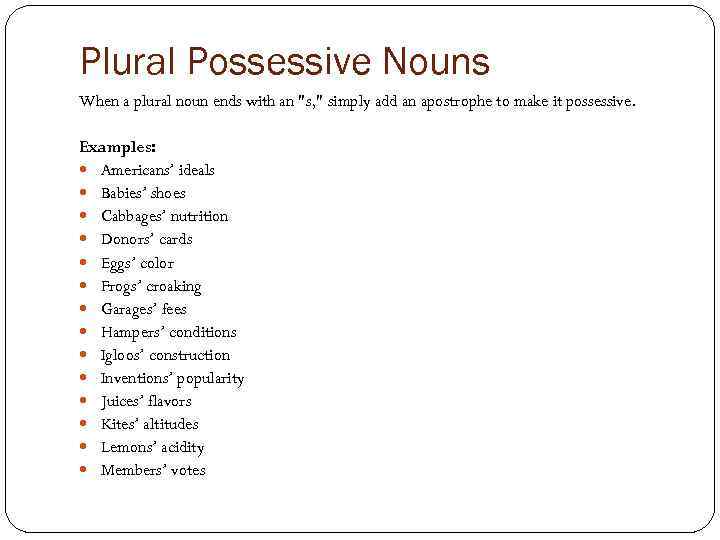
Plural Possessive Nouns When a plural noun ends with an "s, " simply add an apostrophe to make it possessive. Examples: Americans’ ideals Babies’ shoes Cabbages’ nutrition Donors’ cards Eggs’ color Frogs’ croaking Garages’ fees Hampers’ conditions Igloos’ construction Inventions’ popularity Juices’ flavors Kites’ altitudes Lemons’ acidity Members’ votes
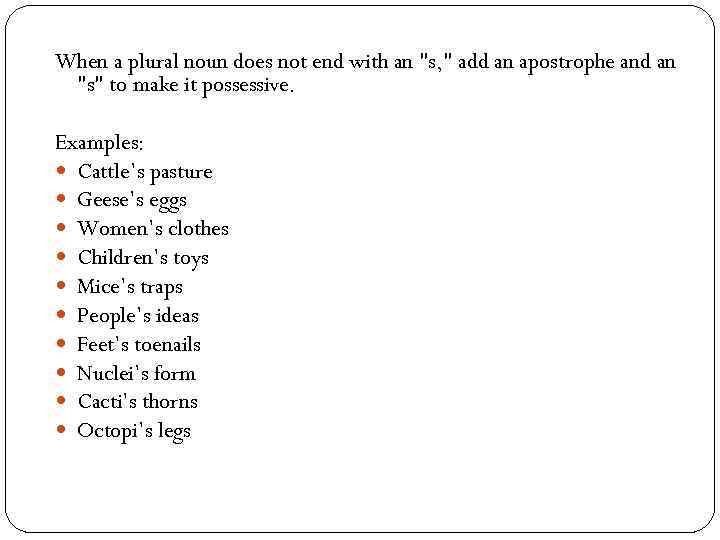
When a plural noun does not end with an "s, " add an apostrophe and an "s" to make it possessive. Examples: Cattle’s pasture Geese’s eggs Women’s clothes Children’s toys Mice’s traps People’s ideas Feet’s toenails Nuclei’s form Cacti’s thorns Octopi’s legs
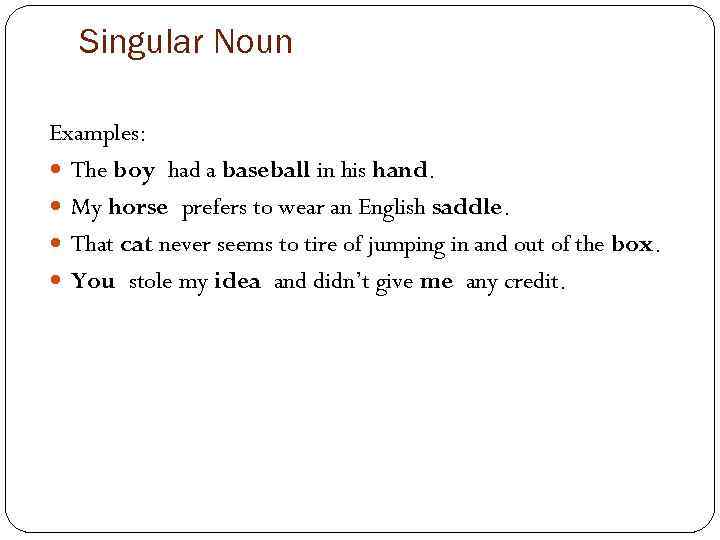
Singular Noun Examples: The boy had a baseball in his hand. My horse prefers to wear an English saddle. That cat never seems to tire of jumping in and out of the box. You stole my idea and didn’t give me any credit.
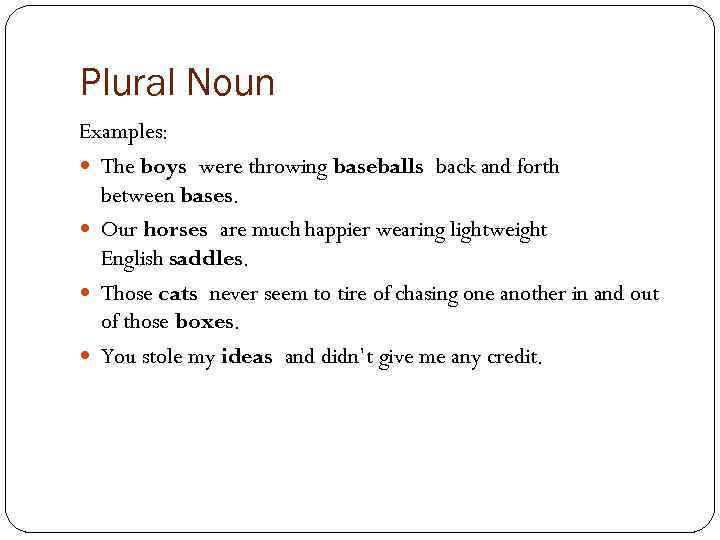
Plural Noun Examples: The boys were throwing baseballs back and forth between bases. Our horses are much happier wearing lightweight English saddles. Those cats never seem to tire of chasing one another in and out of those boxes. You stole my ideas and didn’t give me any credit.
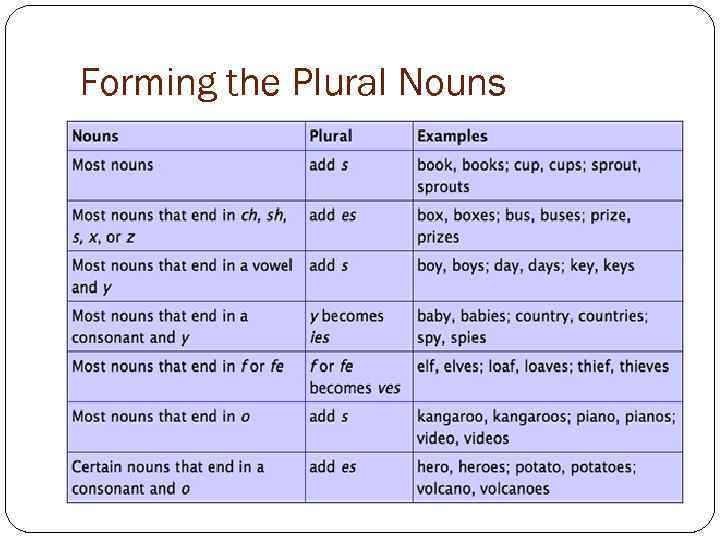
Forming the Plural Nouns
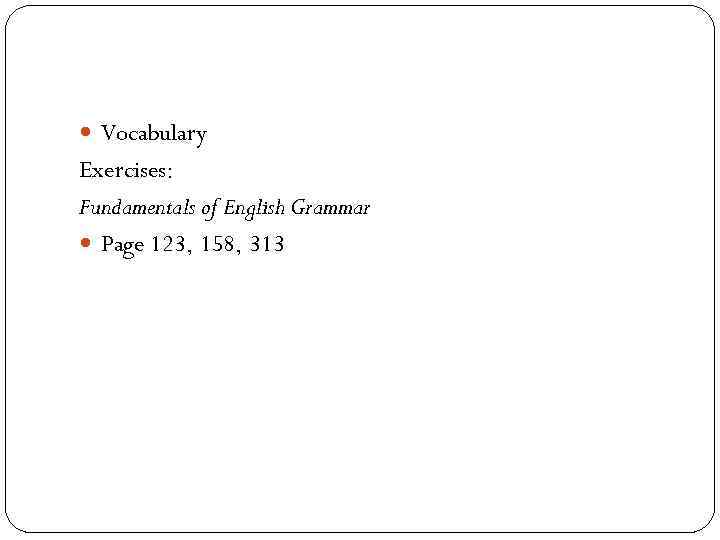
Vocabulary Exercises: Fundamentals of English Grammar Page 123, 158, 313
Скачать презентацию Intermediate English Lessons By Adam Школа английского Understand
Intermediate Class.pptx