


 Скачать презентацию Interlinked Transactions in Cash Cropping Economies The Determinants
ae5bdfb5809421c042ce42d507892dc2.ppt
- Количество слайдов: 12
 Interlinked Transactions in Cash Cropping Economies: The Determinants of Farmer Participation and Benefits in Rural Mozambique Rui M. S. Benfica Maputo, Mozambique September, 2006
 BACKGROUND q Predominance/persistence of Contract farming in cash cropping in Mozambique, due to: § Cash constraints, poor access to inputs and credit § Intensive management and specific production techniques § Difficult to support under spot marketing or plantation arrangements q Processors needing raw materials to achieve scale and recover investments: § Provide inputs on credit and extension assistance § Buy all the output from contract farmers at pre-determined prices (Monopsonic rights under Concession Agreements with the GOM) q Over 100, 000 tobacco farmers engage in these contracts nationwide; over 50, 000 in the study area
 MOTIVATION/CONTRIBUTION q Contract farming institutional arrangements studied at length q However: § Lack of Empirical assessment with household Level data § Failure to appropriately account for selectivity bias § Use of limited data sets and poor specifications q In addition to accounting for possible selection bias, THIS PAPER: § Recognizes heterogeneity among participants themselves § Investigates threshold effects of education and land holdings to identify the types of farmers that benefit § Gives important indications regarding the effects of contract farming on differentiation
 OBJECTIVES 1. To understand the determinants of farmer participation /selection in tobacco growing schemes 2. To estimate the determinants of performance (profits) with the tobacco crop among participants 3. To assess the effects of participation on agricultural and total household incomes, and to explore what kind of participants are most likely to gain
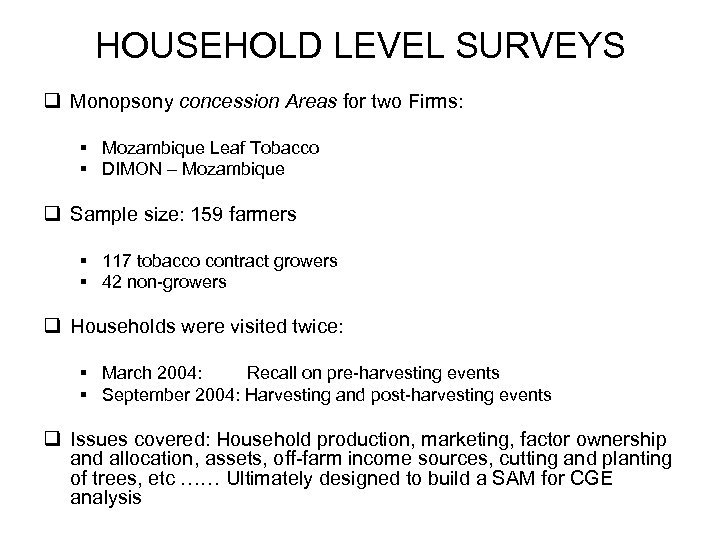 HOUSEHOLD LEVEL SURVEYS q Monopsony concession Areas for two Firms: § Mozambique Leaf Tobacco § DIMON – Mozambique q Sample size: 159 farmers § 117 tobacco contract growers § 42 non-growers q Households were visited twice: § March 2004: Recall on pre-harvesting events § September 2004: Harvesting and post-harvesting events q Issues covered: Household production, marketing, factor ownership and allocation, assets, off-farm income sources, cutting and planting of trees, etc …… Ultimately designed to build a SAM for CGE analysis
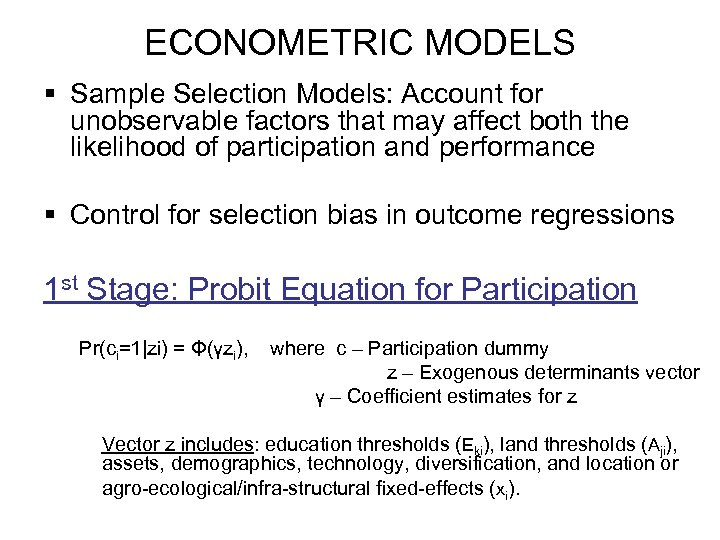 ECONOMETRIC MODELS § Sample Selection Models: Account for unobservable factors that may affect both the likelihood of participation and performance § Control for selection bias in outcome regressions 1 st Stage: Probit Equation for Participation Pr(ci=1|zi) = Φ(γzi), where c – Participation dummy z – Exogenous determinants vector γ – Coefficient estimates for z Vector z includes: education thresholds (Eki), land thresholds (Aji), assets, demographics, technology, diversification, and location or agro-ecological/infra-structural fixed-effects (xi).
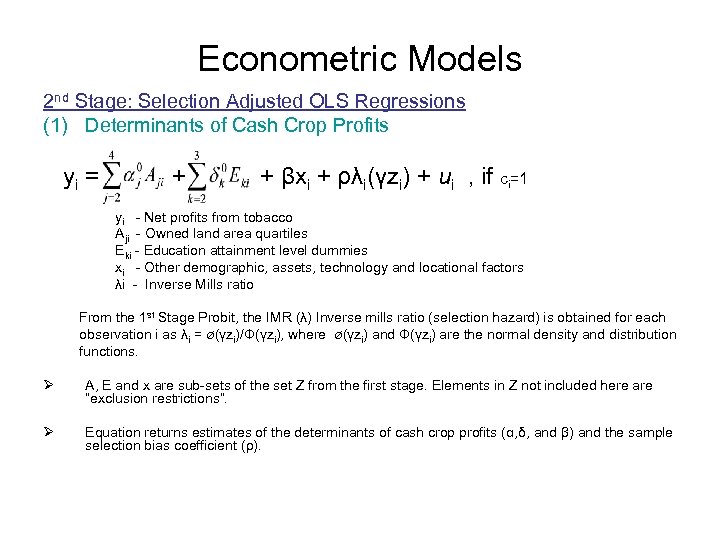 Econometric Models 2 nd Stage: Selection Adjusted OLS Regressions (1) Determinants of Cash Crop Profits yi = + + βxi + ρλi(γzi) + ui , if ci=1 yi - Net profits from tobacco Aji - Owned land area quartiles Eki - Education attainment level dummies xi - Other demographic, assets, technology and locational factors λi - Inverse Mills ratio From the 1 st Stage Probit, the IMR (λ) Inverse mills ratio (selection hazard) is obtained for each observation i as λi = ø(γzi)/Φ(γzi), where ø(γzi) and Φ(γzi) are the normal density and distribution functions. Ø A, E and x are sub-sets of the set Z from the first stage. Elements in Z not included here are “exclusion restrictions”. Ø Equation returns estimates of the determinants of cash crop profits (α, δ, and β) and the sample selection bias coefficient (ρ).
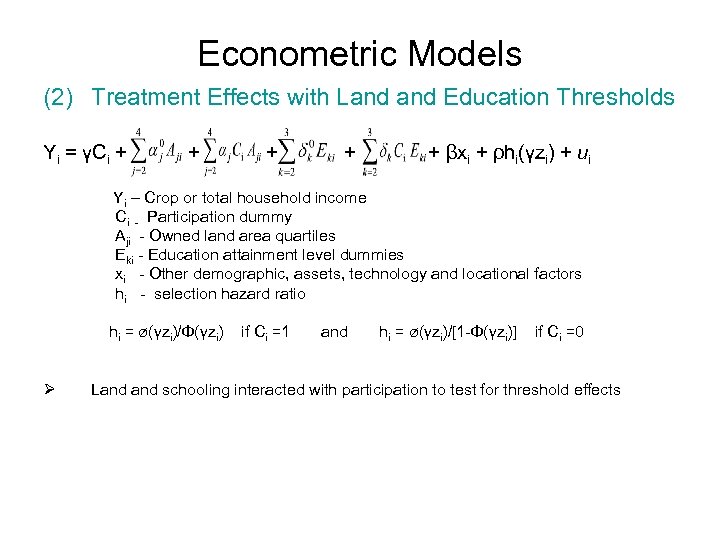 Econometric Models (2) Treatment Effects with Land Education Thresholds Yi = γCi + + + βxi + ρhi(γzi) + ui Yi – Crop or total household income Ci - Participation dummy Aji - Owned land area quartiles Eki - Education attainment level dummies xi - Other demographic, assets, technology and locational factors hi - selection hazard ratio hi = ø(γzi)/Φ(γzi) Ø if Ci =1 and hi = ø(γzi)/[1 -Φ(γzi)] if Ci =0 Land schooling interacted with participation to test for threshold effects
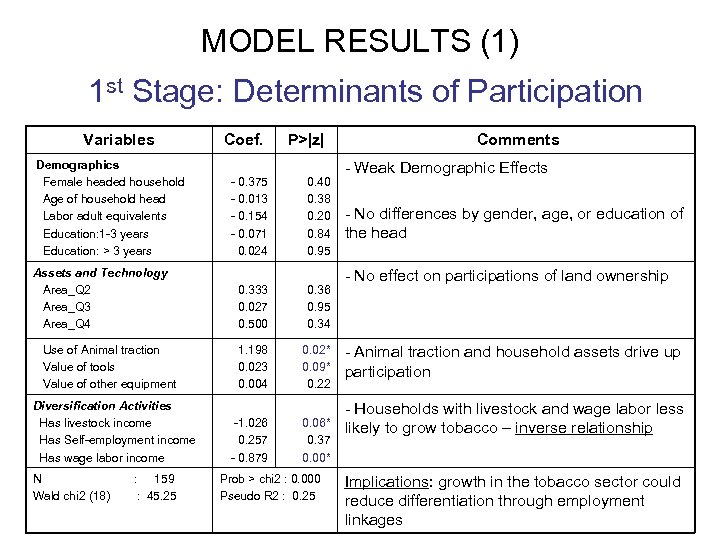 MODEL RESULTS (1) 1 st Stage: Determinants of Participation Variables Demographics Female headed household Age of household head Labor adult equivalents Education: 1 -3 years Education: > 3 years Assets and Technology Area_Q 2 Area_Q 3 Area_Q 4 Use of Animal traction Value of tools Value of other equipment Diversification Activities Has livestock income Has Self-employment income Has wage labor income N Wald chi 2 (18) : 159 : 45. 25 Coef. P>|z| - 0. 375 - 0. 013 - 0. 154 - 0. 071 0. 024 0. 40 0. 38 0. 20 0. 84 0. 95 0. 333 0. 027 0. 500 0. 36 0. 95 0. 34 1. 198 0. 023 0. 004 0. 02* 0. 09* 0. 22 -1. 026 0. 257 - 0. 879 0. 06* 0. 37 0. 00* Prob > chi 2 : 0. 000 Pseudo R 2 : 0. 25 Comments - Weak Demographic Effects - No differences by gender, age, or education of the head - No effect on participations of land ownership - Animal traction and household assets drive up participation - Households with livestock and wage labor less likely to grow tobacco – inverse relationship Implications: growth in the tobacco sector could reduce differentiation through employment linkages
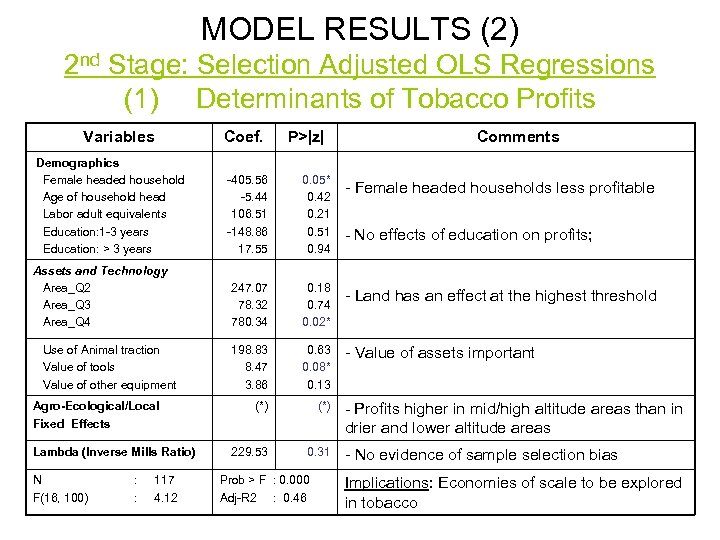 MODEL RESULTS (2) 2 nd Stage: Selection Adjusted OLS Regressions (1) Determinants of Tobacco Profits Variables Demographics Female headed household Age of household head Labor adult equivalents Education: 1 -3 years Education: > 3 years Assets and Technology Area_Q 2 Area_Q 3 Area_Q 4 Use of Animal traction Value of tools Value of other equipment Agro-Ecological/Local Fixed Effects Lambda (Inverse Mills Ratio) N F(16, 100) : : 117 4. 12 Coef. P>|z| Comments -405. 56 -5. 44 106. 51 -148. 86 17. 55 0. 05* 0. 42 0. 21 0. 51 0. 94 - Female headed households less profitable 247. 07 78. 32 780. 34 0. 18 0. 74 0. 02* - Land has an effect at the highest threshold 198. 83 8. 47 3. 86 0. 63 0. 08* 0. 13 - Value of assets important (*) 229. 53 0. 31 Prob > F : 0. 000 Adj-R 2 : 0. 46 - No effects of education on profits; - Profits higher in mid/high altitude areas than in drier and lower altitude areas - No evidence of sample selection bias Implications: Economies of scale to be explored in tobacco
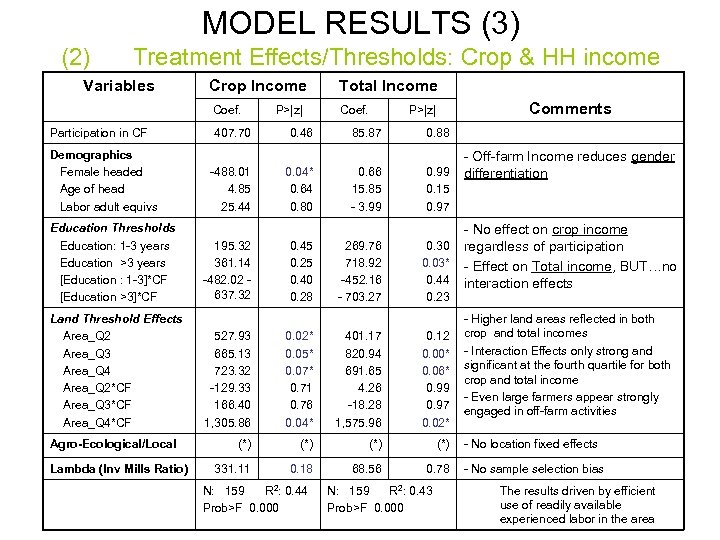 MODEL RESULTS (3) (2) Treatment Effects/Thresholds: Crop & HH income Variables Demographics Female headed Age of head Labor adult equivs Education Thresholds Education: 1 -3 years Education >3 years [Education : 1 -3]*CF [Education >3]*CF Land Threshold Effects Area_Q 2 Area_Q 3 Area_Q 4 Area_Q 2*CF Area_Q 3*CF Area_Q 4*CF Agro-Ecological/Local Lambda (Inv Mills Ratio) Total Income Coef. Participation in CF Crop Income Coef. 407. 70 -488. 01 4. 85 25. 44 195. 32 361. 14 -482. 02 637. 32 P>|z| 0. 46 0. 04* 0. 64 0. 80 0. 45 0. 25 0. 40 0. 28 Comments P>|z| 85. 87 0. 66 15. 85 - 3. 99 269. 76 718. 92 -452. 16 - 703. 27 0. 88 0. 99 0. 15 0. 97 - No effect on crop income 0. 30 regardless of participation 0. 03* - Effect on Total income, BUT…no 0. 44 interaction effects 0. 23 527. 93 665. 13 723. 32 -129. 33 166. 40 1, 305. 86 0. 02* 0. 05* 0. 07* 0. 71 0. 76 0. 04* 401. 17 820. 94 691. 65 4. 26 -18. 28 1, 575. 96 0. 12 0. 00* 0. 06* 0. 99 0. 97 0. 02* (*) (*) 331. 11 0. 18 68. 56 0. 78 N: 159 R 2: 0. 44 Prob>F 0. 000 - Off-farm Income reduces gender differentiation N: 159 R 2: 0. 43 Prob>F 0. 000 - Higher land areas reflected in both crop and total incomes - Interaction Effects only strong and significant at the fourth quartile for both crop and total income - Even large farmers appear strongly engaged in off-farm activities - No location fixed effects - No sample selection bias The results driven by efficient use of readily available experienced labor in the area
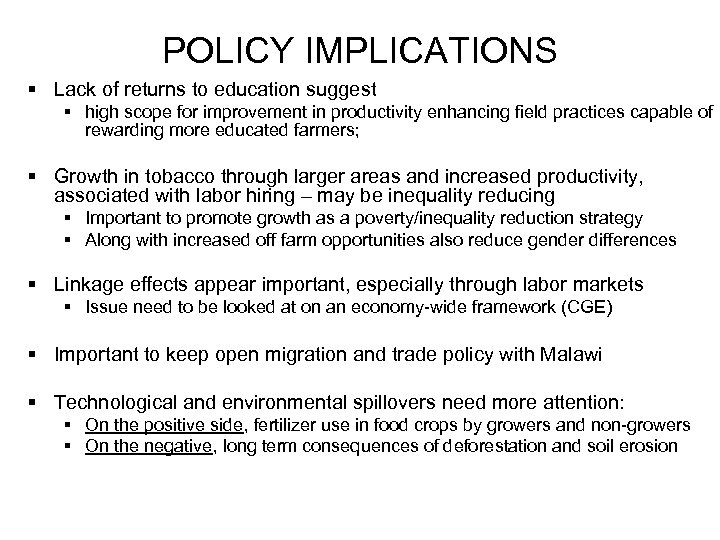 POLICY IMPLICATIONS § Lack of returns to education suggest § high scope for improvement in productivity enhancing field practices capable of rewarding more educated farmers; § Growth in tobacco through larger areas and increased productivity, associated with labor hiring – may be inequality reducing § Important to promote growth as a poverty/inequality reduction strategy § Along with increased off farm opportunities also reduce gender differences § Linkage effects appear important, especially through labor markets § Issue need to be looked at on an economy-wide framework (CGE) § Important to keep open migration and trade policy with Malawi § Technological and environmental spillovers need more attention: § On the positive side, fertilizer use in food crops by growers and non-growers § On the negative, long term consequences of deforestation and soil erosion