 Скачать презентацию Interference Resistant Scalable Video Transmission over DS-CDMA Channels
115bff171c5476038c78b64ff2df3ded.ppt
- Количество слайдов: 41



Interference Resistant Scalable Video Transmission over DS-CDMA Channels John D. Matyjas Air Force Research Laboratory AFRL/IFGC IEEE Rochester Section Seminar Series RIT 22 August 2006 1
Overview • CITE: Research for Tomorrow’s Warfighter - 6. 1 Perspective: Basic research - 6. 2 Perspective: Applied research and development - Signal Detection: Auxiliary-Vector (AV) Algorithm § Results & Demo • Airborne Networking: A Research Perspective - Meeting the Challenges: Establishing priorities - From Concept to Reality: Preparing for take-off 2
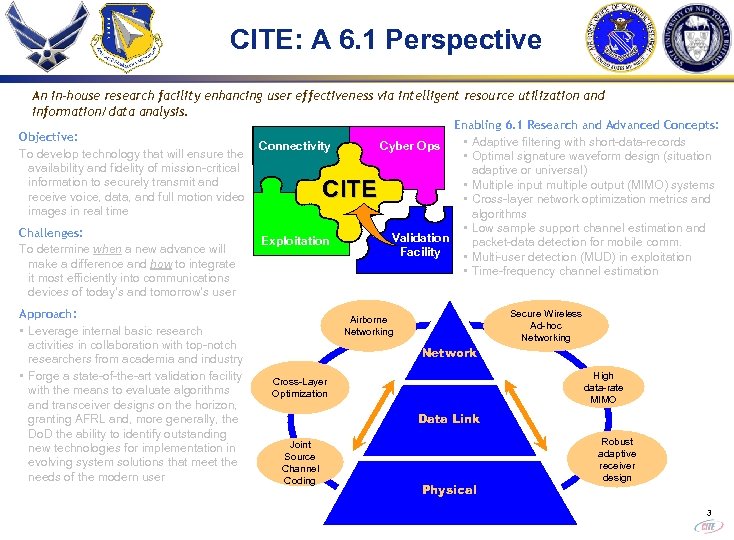
CITE: A 6. 1 Perspective An in-house research facility enhancing user effectiveness via intelligent resource utilization and information/data analysis. Objective: To develop technology that will ensure the availability and fidelity of mission-critical information to securely transmit and receive voice, data, and full motion video images in real time Challenges: To determine when a new advance will make a difference and how to integrate it most efficiently into communications devices of today’s and tomorrow’s user Approach: • Leverage internal basic research activities in collaboration with top-notch researchers from academia and industry • Forge a state-of-the-art validation facility with the means to evaluate algorithms and transceiver designs on the horizon, granting AFRL and, more generally, the Do. D the ability to identify outstanding new technologies for implementation in evolving system solutions that meet the needs of the modern user Connectivity CITE Exploitation Enabling 6. 1 Research and Advanced Concepts: • Adaptive filtering with short-data-records Cyber Ops • Optimal signature waveform design (situation adaptive or universal) • Multiple input multiple output (MIMO) systems • Cross-layer network optimization metrics and algorithms • Low sample support channel estimation and Validation packet-data detection for mobile comm. Facility • Multi-user detection (MUD) in exploitation • Time-frequency channel estimation Secure Wireless Ad-hoc Networking Airborne Networking Network High data-rate MIMO Cross-Layer Optimization Data Link Joint Source Channel Coding Physical Robust adaptive receiver design 3
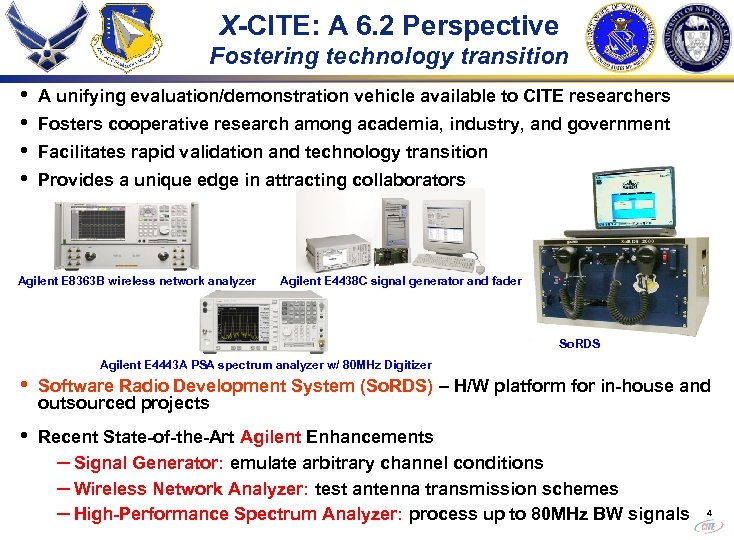
X-CITE: A 6. 2 Perspective Fostering technology transition • • A unifying evaluation/demonstration vehicle available to CITE researchers Fosters cooperative research among academia, industry, and government Facilitates rapid validation and technology transition Provides a unique edge in attracting collaborators Agilent E 8363 B wireless network analyzer Agilent E 4438 C signal generator and fader So. RDS Agilent E 4443 A PSA spectrum analyzer w/ 80 MHz Digitizer • Software Radio Development System (So. RDS) – H/W platform for in-house and outsourced projects • Recent State-of-the-Art Agilent Enhancements – Signal Generator: emulate arbitrary channel conditions – Wireless Network Analyzer: test antenna transmission schemes – High-Performance Spectrum Analyzer: process up to 80 MHz BW signals 4
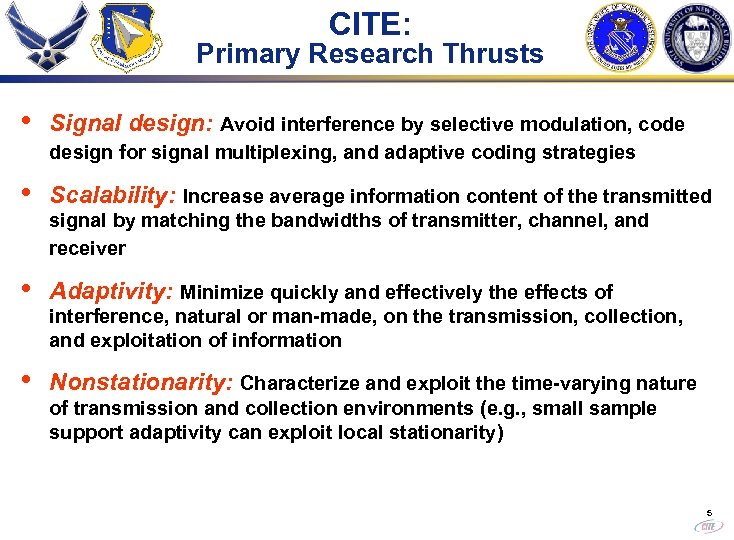
CITE: Primary Research Thrusts • Signal design: Avoid interference by selective modulation, code design for signal multiplexing, and adaptive coding strategies • Scalability: Increase average information content of the transmitted signal by matching the bandwidths of transmitter, channel, and receiver • Adaptivity: Minimize quickly and effectively the effects of interference, natural or man-made, on the transmission, collection, and exploitation of information • Nonstationarity: Characterize and exploit the time-varying nature of transmission and collection environments (e. g. , small sample support adaptivity can exploit local stationarity) 5
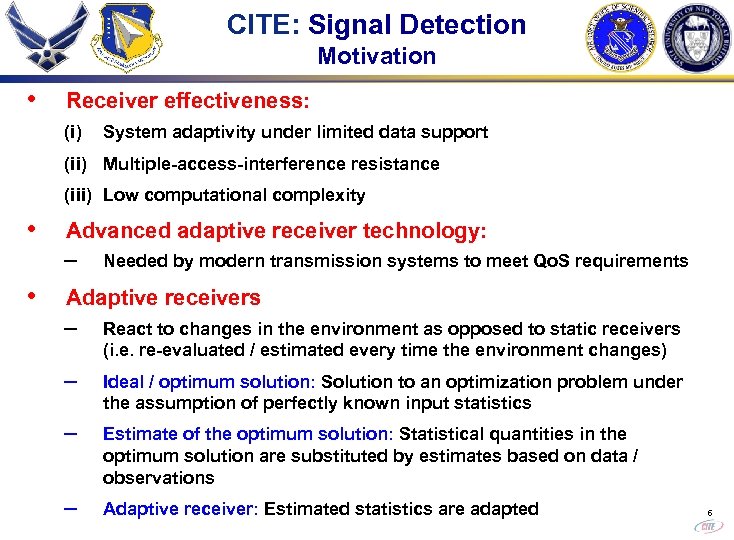
CITE: Signal Detection Motivation • Receiver effectiveness: (i) System adaptivity under limited data support (ii) Multiple-access-interference resistance (iii) Low computational complexity • Advanced adaptive receiver technology: – Needed by modern transmission systems to meet Qo. S requirements • Adaptive receivers – React to changes in the environment as opposed to static receivers (i. e. re-evaluated / estimated every time the environment changes) – Ideal / optimum solution: Solution to an optimization problem under the assumption of perfectly known input statistics – Estimate of the optimum solution: Statistical quantities in the optimum solution are substituted by estimates based on data / observations – Adaptive receiver: Estimated statistics are adapted 6
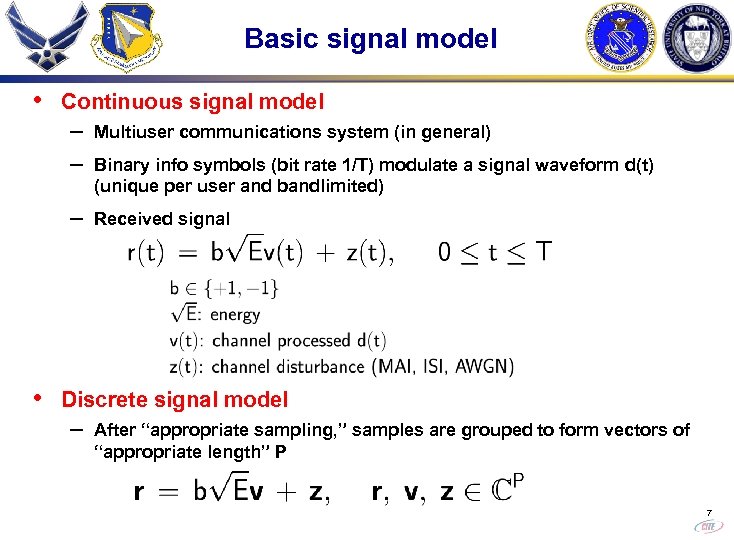
Basic signal model • Continuous signal model – Multiuser communications system (in general) – Binary info symbols (bit rate 1/T) modulate a signal waveform d(t) (unique per user and bandlimited) – • Received signal Discrete signal model – After “appropriate sampling, ” samples are grouped to form vectors of “appropriate length” P 7
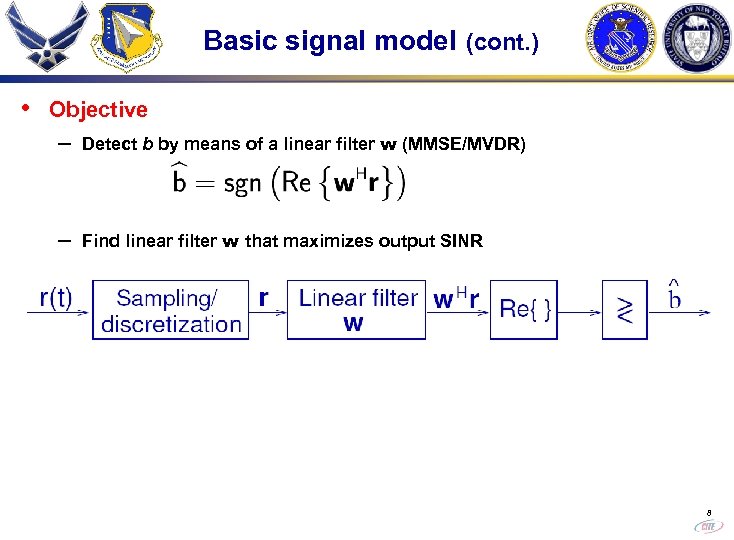
Basic signal model (cont. ) • Objective – Detect b by means of a linear filter w (MMSE/MVDR) – Find linear filter w that maximizes output SINR 8
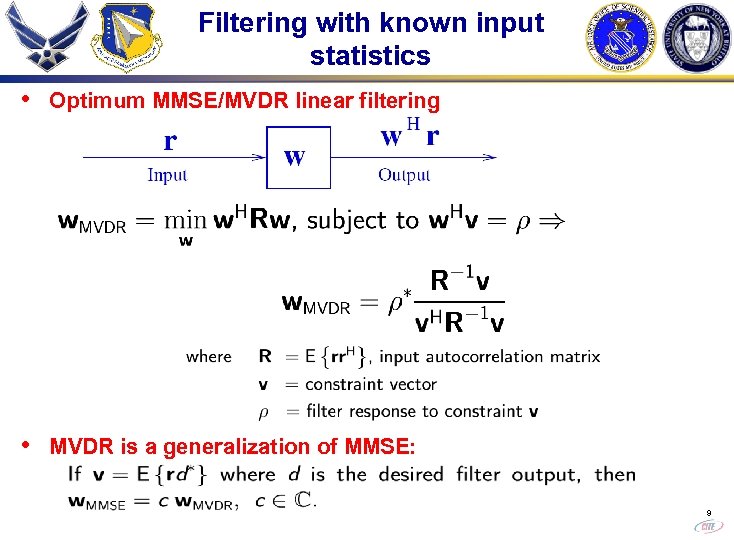
Filtering with known input statistics • Optimum MMSE/MVDR linear filtering • MVDR is a generalization of MMSE: 9
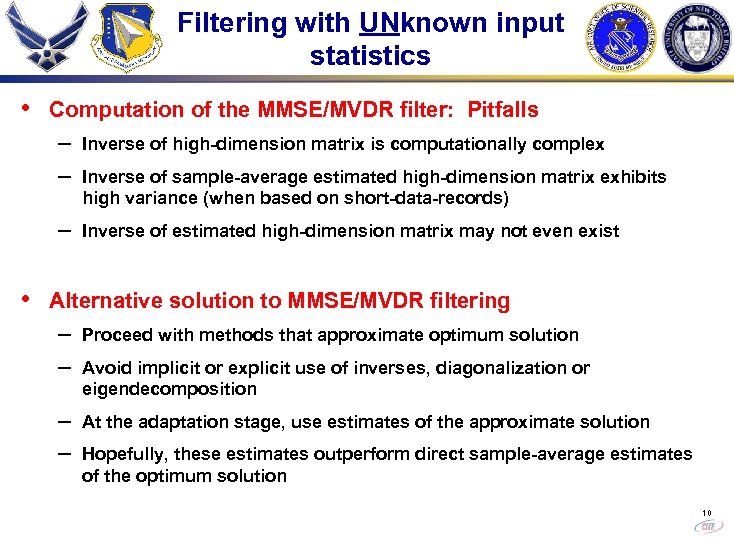
Filtering with UNknown input statistics • Computation of the MMSE/MVDR filter: Pitfalls – – – • Inverse of high-dimension matrix is computationally complex Inverse of estimated high-dimension matrix may not even exist Inverse of sample-average estimated high-dimension matrix exhibits high variance (when based on short-data-records) Alternative solution to MMSE/MVDR filtering – – Proceed with methods that approximate optimum solution – – At the adaptation stage, use estimates of the approximate solution Avoid implicit or explicit use of inverses, diagonalization or eigendecomposition Hopefully, these estimates outperform direct sample-average estimates of the optimum solution 10
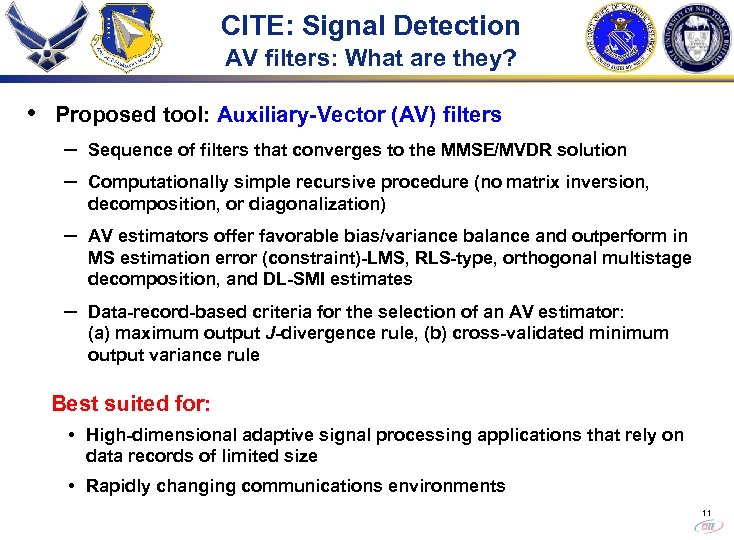
CITE: Signal Detection AV filters: What are they? • Proposed tool: Auxiliary-Vector (AV) filters – – Sequence of filters that converges to the MMSE/MVDR solution – AV estimators offer favorable bias/variance balance and outperform in MS estimation error (constraint)-LMS, RLS-type, orthogonal multistage decomposition, and DL-SMI estimates – Data-record-based criteria for the selection of an AV estimator: (a) maximum output J-divergence rule, (b) cross-validated minimum output variance rule Computationally simple recursive procedure (no matrix inversion, decomposition, or diagonalization) Best suited for: • High-dimensional adaptive signal processing applications that rely on data records of limited size • Rapidly changing communications environments 11
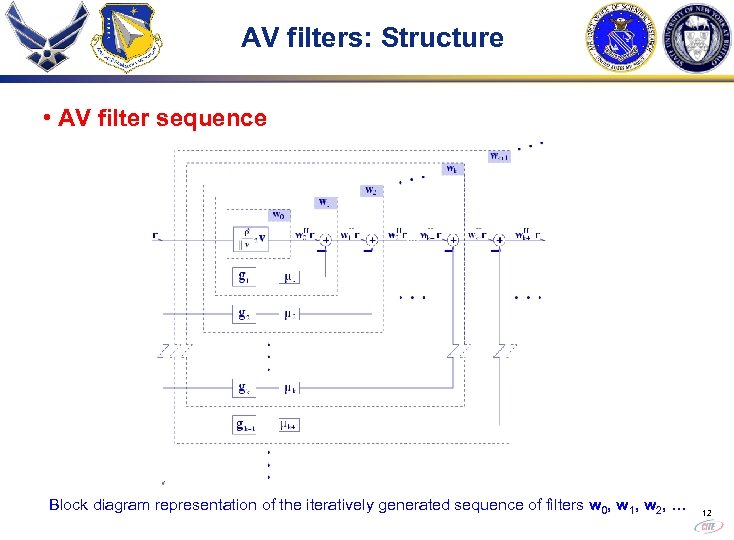
AV filters: Structure • AV filter sequence Block diagram representation of the iteratively generated sequence of filters w 0, w 1, w 2, … 12
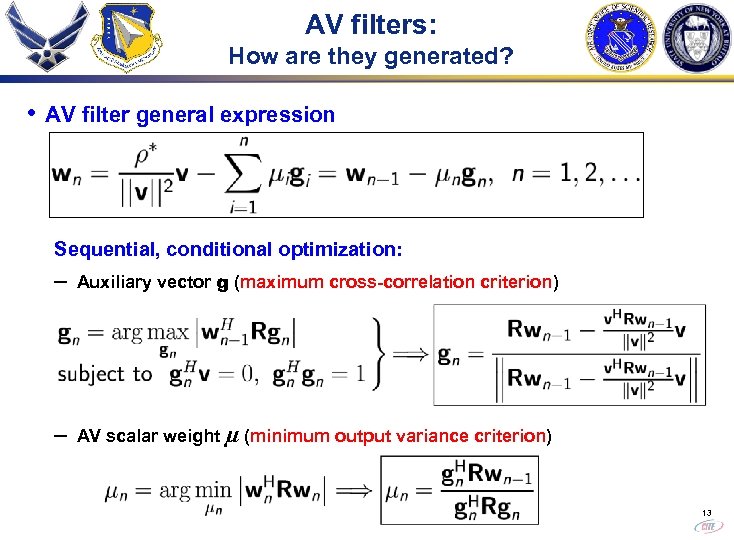
AV filters: How are they generated? • AV filter general expression Sequential, conditional optimization: – Auxiliary vector g (maximum cross-correlation criterion) – AV scalar weight µ (minimum output variance criterion) 13
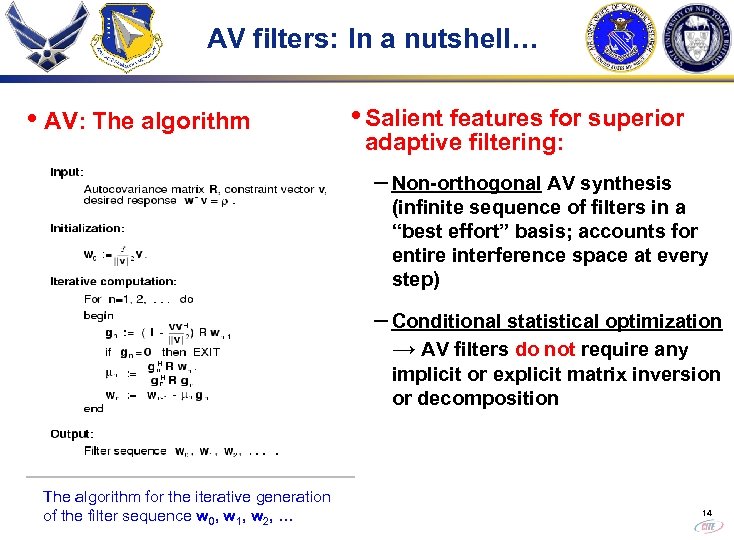
AV filters: In a nutshell… • AV: The algorithm • Salient features for superior adaptive filtering: – Non-orthogonal AV synthesis (infinite sequence of filters in a “best effort” basis; accounts for entire interference space at every step) – Conditional statistical optimization → AV filters do not require any implicit or explicit matrix inversion or decomposition The algorithm for the iterative generation of the filter sequence w 0, w 1, w 2, … 14
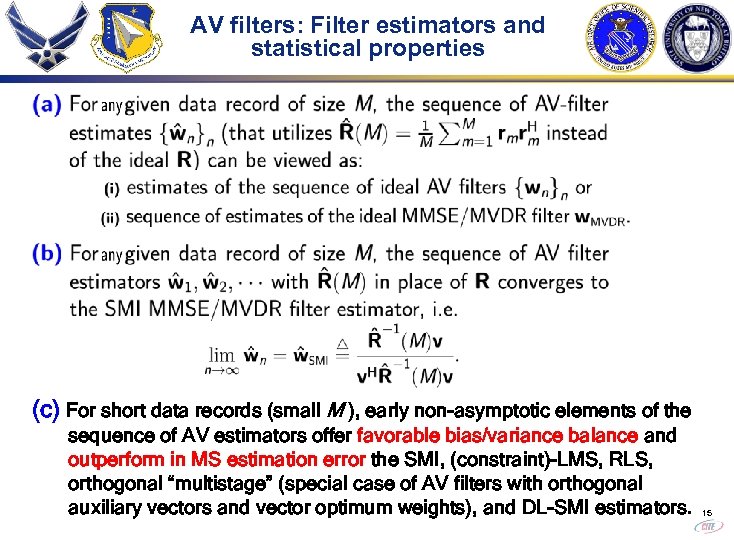
AV filters: Filter estimators and statistical properties (c) For short data records (small M ), early non-asymptotic elements of the sequence of AV estimators offer favorable bias/variance balance and outperform in MS estimation error the SMI, (constraint)-LMS, RLS, orthogonal “multistage” (special case of AV filters with orthogonal auxiliary vectors and vector optimum weights), and DL-SMI estimators. 15
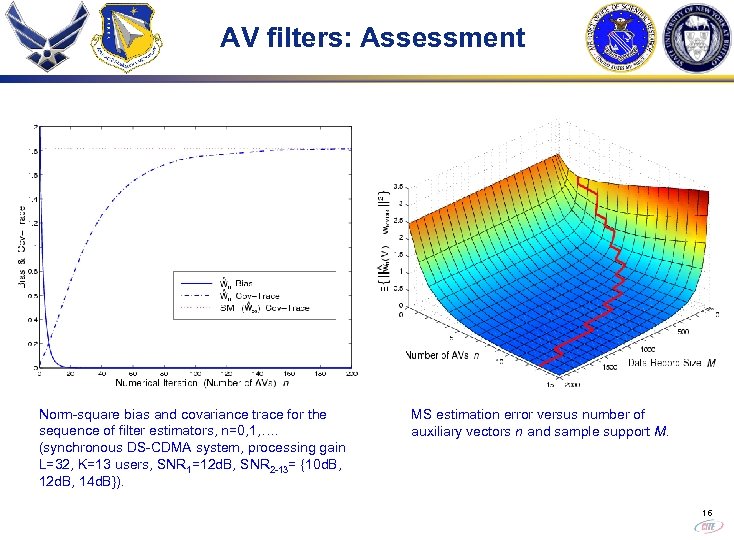
AV filters: Assessment Norm-square bias and covariance trace for the sequence of filter estimators, n=0, 1, …. (synchronous DS-CDMA system, processing gain L=32, K=13 users, SNR 1=12 d. B, SNR 2 -13= {10 d. B, 12 d. B, 14 d. B}). MS estimation error versus number of auxiliary vectors n and sample support M. 16
AV filters: Selection Criteria Problem Statement: Select the best (in some appropriate sense) number of auxiliary vectors n, i. e. select the best MMSE/MVDR filter estimate from the sequence of AV -filter estimates. Remark: The best AV-filter estimate (or the best number of auxiliary vectors n) depends on: – the true signal model, – constraint vector, – data record size, – and the specific data record realization 17

AV filters: Selection Criteria (cont. ) 18
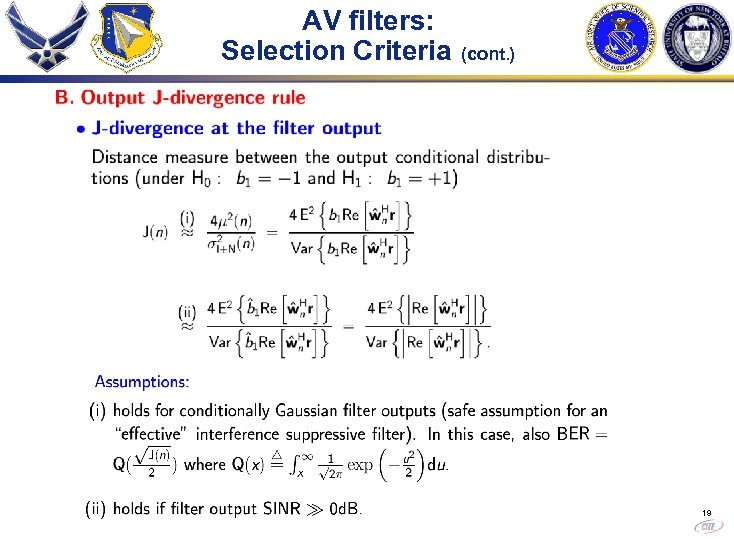
AV filters: Selection Criteria (cont. ) 19
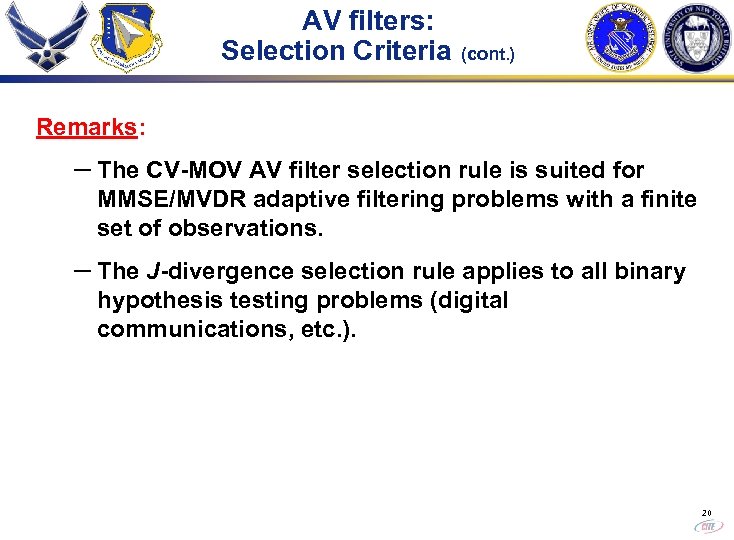
AV filters: Selection Criteria (cont. ) Remarks: – The CV-MOV AV filter selection rule is suited for MMSE/MVDR adaptive filtering problems with a finite set of observations. – The J-divergence selection rule applies to all binary hypothesis testing problems (digital communications, etc. ). 20
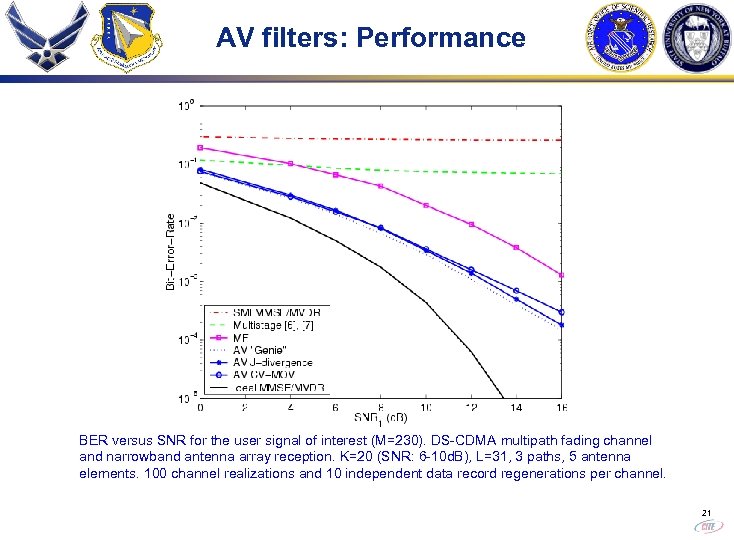
AV filters: Performance BER versus SNR for the user signal of interest (M=230). DS-CDMA multipath fading channel and narrowband antenna array reception. K=20 (SNR: 6 -10 d. B), L=31, 3 paths, 5 antenna elements. 100 channel realizations and 10 independent data record regenerations per channel. 21
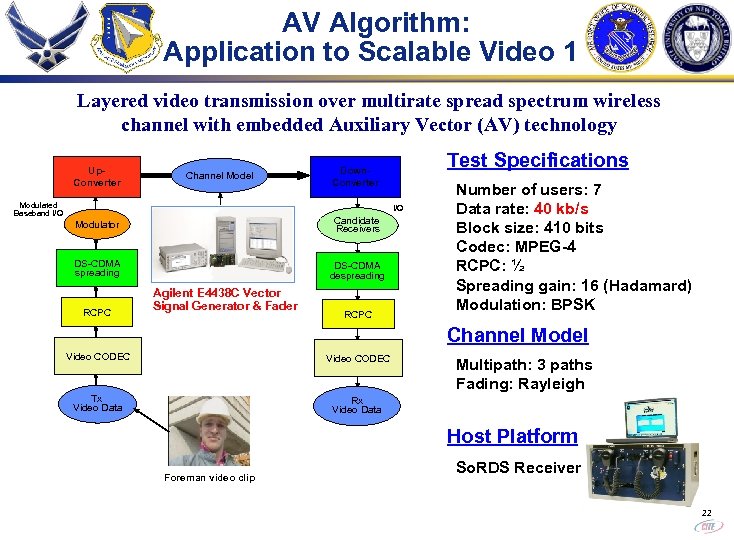
AV Algorithm: Application to Scalable Video 1 Layered video transmission over multirate spread spectrum wireless channel with embedded Auxiliary Vector (AV) technology Up. Converter Channel Modulated Baseband I/Q Test Specifications Down. Converter I/Q Modulator Candidate Receivers DS-CDMA spreading DS-CDMA despreading RCPC Agilent E 4438 C Vector Signal Generator & Fader RCPC Number of users: 7 Data rate: 40 kb/s Block size: 410 bits Codec: MPEG-4 RCPC: ½ Spreading gain: 16 (Hadamard) Modulation: BPSK Channel Model Video CODEC Tx Video Data Rx Video Data Multipath: 3 paths Fading: Rayleigh Host Platform Foreman video clip So. RDS Receiver 22
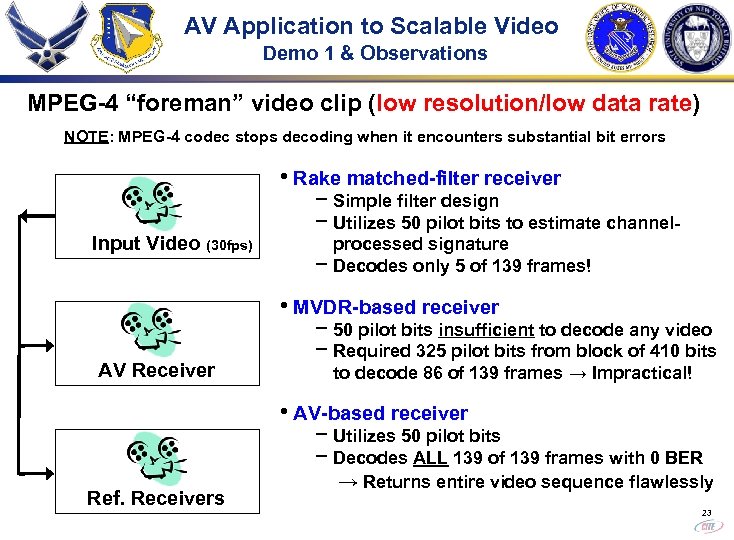
AV Application to Scalable Video Demo 1 & Observations MPEG-4 “foreman” video clip (low resolution/low data rate) NOTE: MPEG-4 codec stops decoding when it encounters substantial bit errors • Rake matched-filter receiver Input Video (30 fps) − Simple filter design − Utilizes 50 pilot bits to estimate channelprocessed signature − Decodes only 5 of 139 frames! • MVDR-based receiver AV Receiver − 50 pilot bits insufficient to decode any video − Required 325 pilot bits from block of 410 bits to decode 86 of 139 frames → Impractical! • AV-based receiver − Utilizes 50 pilot bits − Decodes ALL 139 of 139 frames with 0 BER Ref. Receivers → Returns entire video sequence flawlessly 23
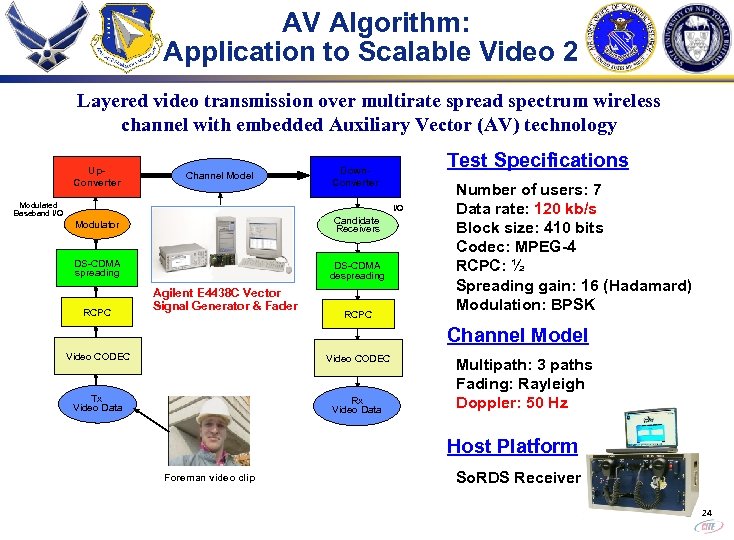
AV Algorithm: Application to Scalable Video 2 Layered video transmission over multirate spread spectrum wireless channel with embedded Auxiliary Vector (AV) technology Up. Converter Channel Modulated Baseband I/Q Test Specifications Down. Converter I/Q Modulator Candidate Receivers DS-CDMA spreading DS-CDMA despreading RCPC Agilent E 4438 C Vector Signal Generator & Fader RCPC Number of users: 7 Data rate: 120 kb/s Block size: 410 bits Codec: MPEG-4 RCPC: ½ Spreading gain: 16 (Hadamard) Modulation: BPSK Channel Model Video CODEC Tx Video Data Rx Video Data Multipath: 3 paths Fading: Rayleigh Doppler: 50 Hz Host Platform Foreman video clip So. RDS Receiver 24
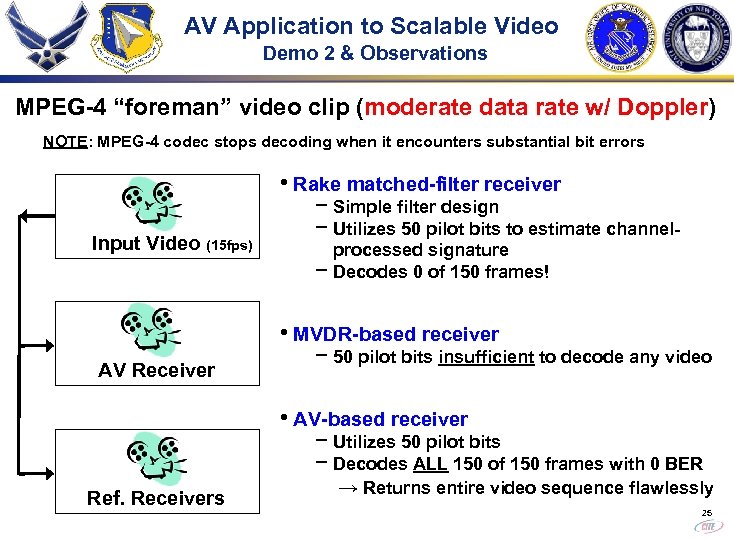
AV Application to Scalable Video Demo 2 & Observations MPEG-4 “foreman” video clip (moderate data rate w/ Doppler) NOTE: MPEG-4 codec stops decoding when it encounters substantial bit errors • Rake matched-filter receiver Input Video (15 fps) − Simple filter design − Utilizes 50 pilot bits to estimate channelprocessed signature − Decodes 0 of 150 frames! • MVDR-based receiver AV Receiver − 50 pilot bits insufficient to decode any video • AV-based receiver − Utilizes 50 pilot bits − Decodes ALL 150 of 150 frames with 0 BER Ref. Receivers → Returns entire video sequence flawlessly 25
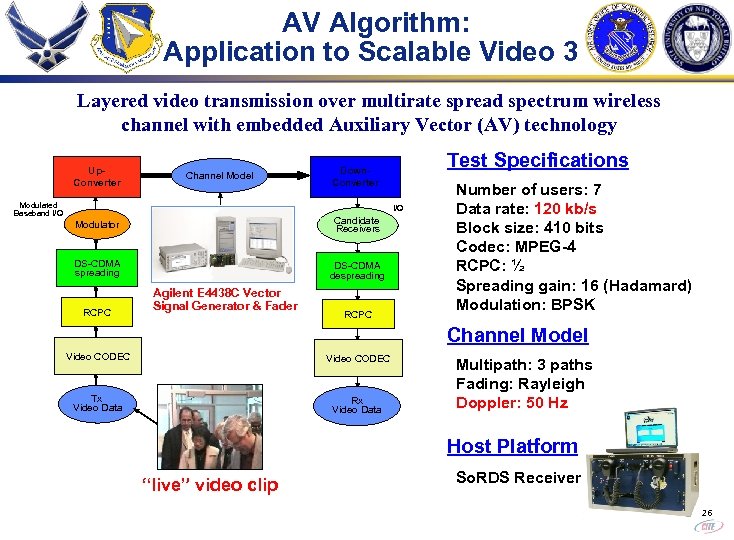
AV Algorithm: Application to Scalable Video 3 Layered video transmission over multirate spread spectrum wireless channel with embedded Auxiliary Vector (AV) technology Up. Converter Channel Modulated Baseband I/Q Test Specifications Down. Converter I/Q Modulator Candidate Receivers DS-CDMA spreading DS-CDMA despreading RCPC Agilent E 4438 C Vector Signal Generator & Fader RCPC Number of users: 7 Data rate: 120 kb/s Block size: 410 bits Codec: MPEG-4 RCPC: ½ Spreading gain: 16 (Hadamard) Modulation: BPSK Channel Model Video CODEC Tx Video Data Rx Video Data Multipath: 3 paths Fading: Rayleigh Doppler: 50 Hz Host Platform “live” video clip So. RDS Receiver 26
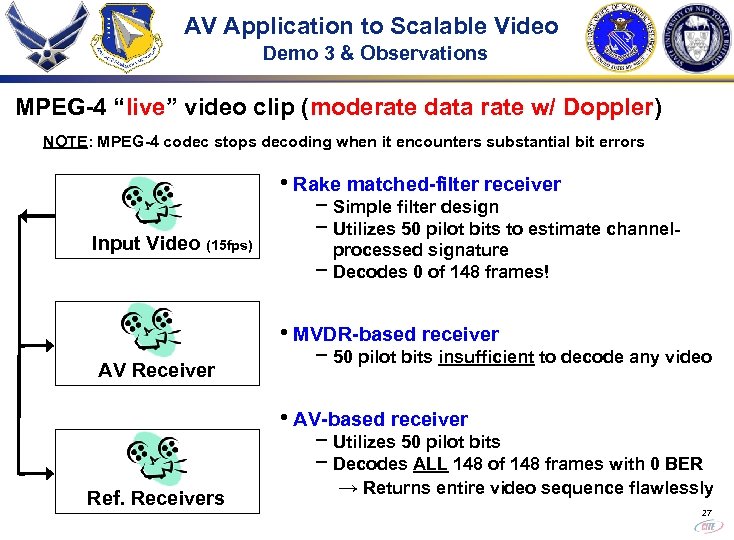
AV Application to Scalable Video Demo 3 & Observations MPEG-4 “live” video clip (moderate data rate w/ Doppler) NOTE: MPEG-4 codec stops decoding when it encounters substantial bit errors • Rake matched-filter receiver Input Video (15 fps) − Simple filter design − Utilizes 50 pilot bits to estimate channelprocessed signature − Decodes 0 of 148 frames! • MVDR-based receiver AV Receiver − 50 pilot bits insufficient to decode any video • AV-based receiver − Utilizes 50 pilot bits − Decodes ALL 148 of 148 frames with 0 BER Ref. Receivers → Returns entire video sequence flawlessly 27
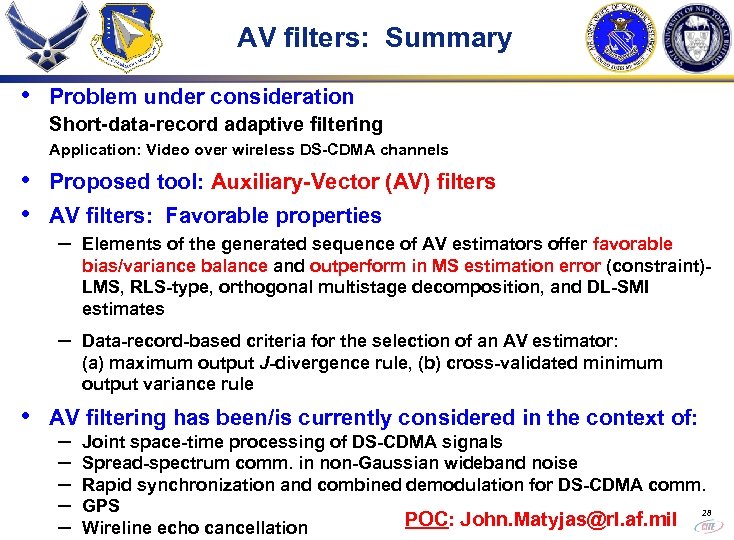
AV filters: Summary • Problem under consideration Short-data-record adaptive filtering Application: Video over wireless DS-CDMA channels • • Proposed tool: Auxiliary-Vector (AV) filters AV filters: Favorable properties – Elements of the generated sequence of AV estimators offer favorable bias/variance balance and outperform in MS estimation error (constraint)LMS, RLS-type, orthogonal multistage decomposition, and DL-SMI estimates – • Data-record-based criteria for the selection of an AV estimator: (a) maximum output J-divergence rule, (b) cross-validated minimum output variance rule AV filtering has been/is currently considered in the context of: – Joint space-time processing of DS-CDMA signals – Spread-spectrum comm. in non-Gaussian wideband noise – Rapid synchronization and combined demodulation for DS-CDMA comm. – GPS POC: John. Matyjas@rl. af. mil 28 – Wireline echo cancellation
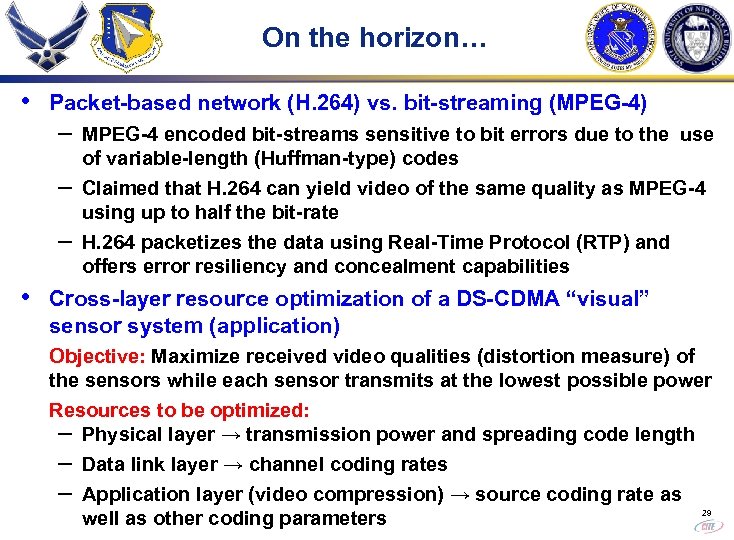
On the horizon… • Packet-based network (H. 264) vs. bit-streaming (MPEG-4) – – – • MPEG-4 encoded bit-streams sensitive to bit errors due to the use of variable-length (Huffman-type) codes Claimed that H. 264 can yield video of the same quality as MPEG-4 using up to half the bit-rate H. 264 packetizes the data using Real-Time Protocol (RTP) and offers error resiliency and concealment capabilities Cross-layer resource optimization of a DS-CDMA “visual” sensor system (application) Objective: Maximize received video qualities (distortion measure) of the sensors while each sensor transmits at the lowest possible power Resources to be optimized: – Physical layer → transmission power and spreading code length – Data link layer → channel coding rates – Application layer (video compression) → source coding rate as 29 well as other coding parameters
Airborne Networking An AF Perspective To enable warfighters - everywhere and anywhere - to employ the same collaborative environment - as they enjoyed terrestrially – in spite of extreme airborne and military [hostile] environments. 30
Airborne Networking Meeting the Challenges “AN begins with the physical layer!” - consensus, AFRL AN Seminar Series (6 Jun 06) Most-promising solution: A cross-layer approach leveraging the best the physical layer has to offer Why? - MACH vs. mph!!! (limited fly-over time, link up status) - Latency (computational complexity/hardware feasibility) Dynamic topologies (rapidly-changing vs. static) Power constraints (UAS and sensor battery life) Bandwidth constraints (disadvantaged links/hostile environments) LPI/LPD considerations (can NOT afford vulnerabilities associated with repeated RF re-transmissions and ACKs) 31
Airborne Networking Meeting the Challenges • Dr. Laurence B. Milstein, Ericsson Chair in Wireless Comm (UCSD) – AN Seminar Series (6 Jun 06) “My general impression was that, while cross-layer interaction was perceived as being desirable, the need to closely incorporate physical layer considerations was not sufficiently appreciated. ” “The most explicit example of this had to do with the idea of attempting a cross-layer optimization that started at the MAC layer, rather than at the physical layer. I believe that this can lead to misleading conclusions at best, and incorrect conclusions at worst. This can be seen by considering the effects of mobility on both the acquisition and the use of channel state information (CSI). As is well known, as mobility increases in a wireless system, the coherence time of the channel decreases due to the increased Doppler spread, and thus the quality of CSI invariably degrades. At the MAC layer, one basic task is that of scheduling, and one popular scheduling technique is that of multiuser diversity. However, if scheduling for multiuser diversity is done without regard for physical layer information, such as the Doppler spread of the channel, the performance of a multiuser diversity system can be poorer than that of a simple round robin scheme. This is due to both the decrease in observation time as the Doppler spread increases, and thus noisier channel estimates, as well as the fact that the channel can be changing so rapidly that the estimates are stale when they are used. ” 32
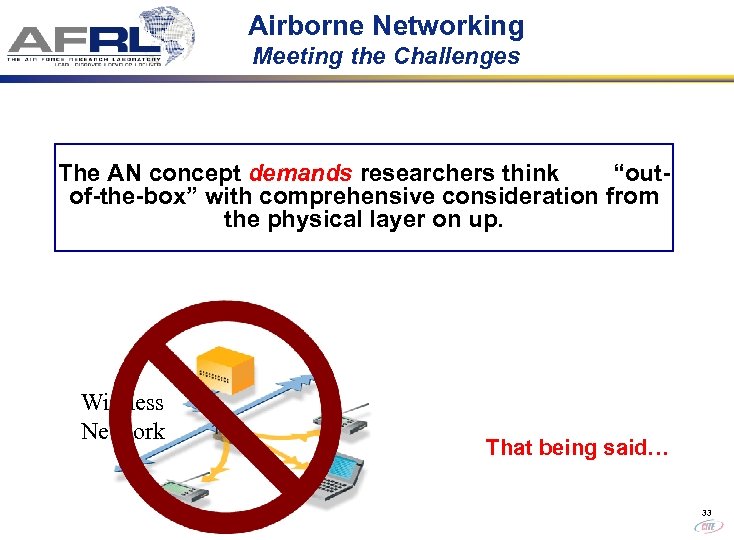
Airborne Networking Meeting the Challenges The AN concept demands researchers think “outof-the-box” with comprehensive consideration from the physical layer on up. Wireless Network That being said… 33
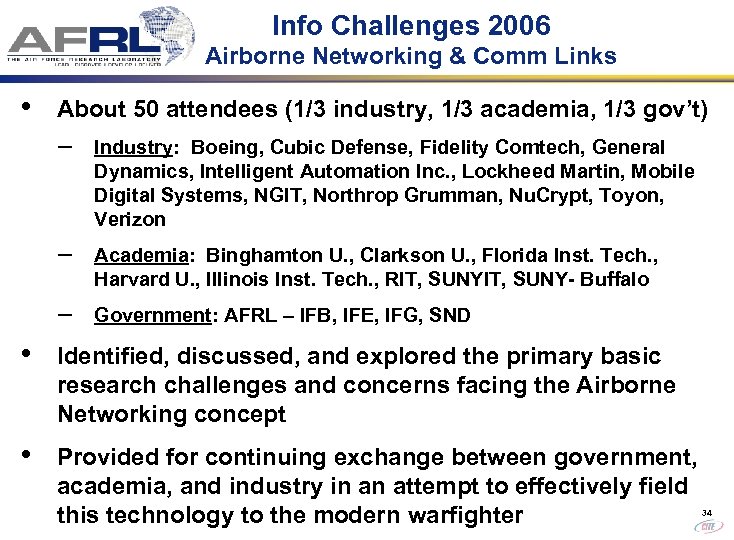
Info Challenges 2006 Airborne Networking & Comm Links • About 50 attendees (1/3 industry, 1/3 academia, 1/3 gov’t) – Industry: Boeing, Cubic Defense, Fidelity Comtech, General Dynamics, Intelligent Automation Inc. , Lockheed Martin, Mobile Digital Systems, NGIT, Northrop Grumman, Nu. Crypt, Toyon, Verizon – Academia: Binghamton U. , Clarkson U. , Florida Inst. Tech. , Harvard U. , Illinois Inst. Tech. , RIT, SUNY- Buffalo – Government: AFRL – IFB, IFE, IFG, SND • Identified, discussed, and explored the primary basic research challenges and concerns facing the Airborne Networking concept • Provided for continuing exchange between government, academia, and industry in an attempt to effectively field this technology to the modern warfighter 34
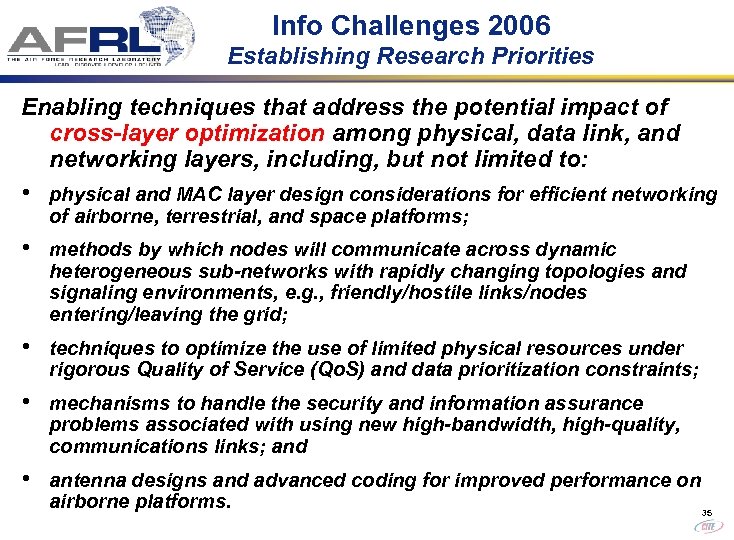
Info Challenges 2006 Establishing Research Priorities Enabling techniques that address the potential impact of cross-layer optimization among physical, data link, and networking layers, including, but not limited to: • physical and MAC layer design considerations for efficient networking of airborne, terrestrial, and space platforms; • methods by which nodes will communicate across dynamic heterogeneous sub-networks with rapidly changing topologies and signaling environments, e. g. , friendly/hostile links/nodes entering/leaving the grid; • techniques to optimize the use of limited physical resources under rigorous Quality of Service (Qo. S) and data prioritization constraints; • mechanisms to handle the security and information assurance problems associated with using new high-bandwidth, high-quality, communications links; and • antenna designs and advanced coding for improved performance on airborne platforms. 35
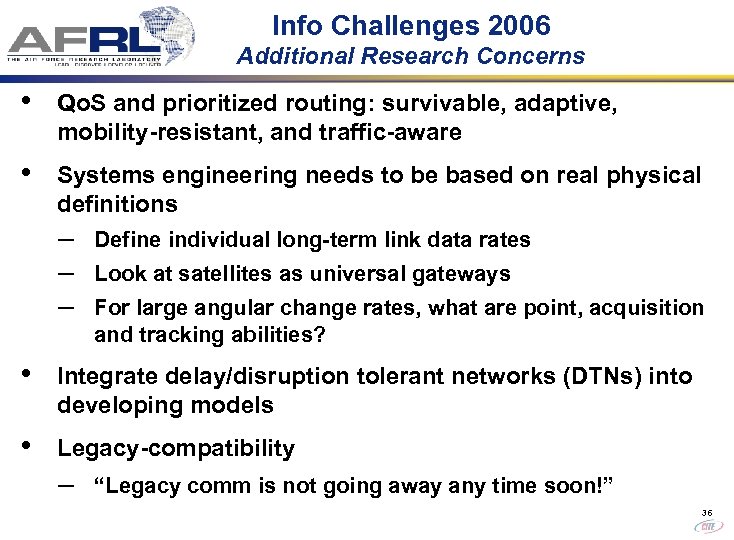
Info Challenges 2006 Additional Research Concerns • Qo. S and prioritized routing: survivable, adaptive, mobility-resistant, and traffic-aware • Systems engineering needs to be based on real physical definitions – – – Define individual long-term link data rates Look at satellites as universal gateways For large angular change rates, what are point, acquisition and tracking abilities? • Integrate delay/disruption tolerant networks (DTNs) into developing models • Legacy-compatibility – “Legacy comm is not going away any time soon!” 36
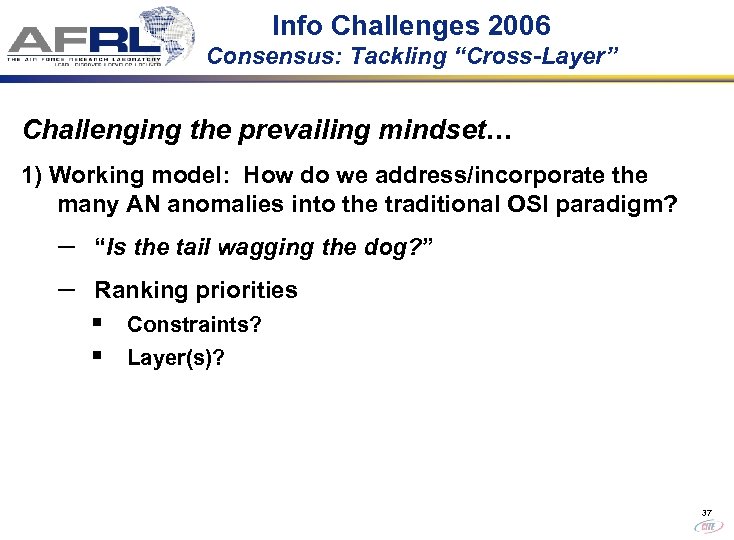
Info Challenges 2006 Consensus: Tackling “Cross-Layer” Challenging the prevailing mindset… 1) Working model: How do we address/incorporate the many AN anomalies into the traditional OSI paradigm? – – “Is the tail wagging the dog? ” Ranking priorities § § Constraints? Layer(s)? 37
Info Challenges 2006 Consensus: Tackling “Cross-Layer” Challenging the prevailing mindset… 2) Is cross-layer optimization a viable option? – – – Pros/Cons: Is it worth it? If so, where do we begin? Principal elements: metrics, parameters, layers? Can we argue/justify the need for a specific “cross-layer” focus between the physical ↔ network layers and identify critical features? 38
Info Challenges 2006 Consensus: Tackling “Cross-Layer” • Traditional networking mindset inadequately addresses Airborne Networking challenges – IP-based solutions are impractical for and unreliable in airborne networking applications due to the high rate of mobility and incidence of disadvantaged wireless interconnections – AFRL should take the initiative/lead in this charge as the commercial industry is too sectorized and no standards exist (varies upon application) – Networking community usually does not fully consider application-aware Qo. S and physical channel characteristics 39
Info Challenges 2006 From Concept to Reality • Physical and MAC layer design considerations for efficient networking of airborne, terrestrial, and space platforms must be considered – – – • Must minimize multiple-access-interference in a highly dynamic environment Requires efficient signal acquisition and tracking schemes Excessive data rates associated with video demand high bandwidth and reliable links Experimentation, modeling and simulation – Development of analytical/simulation models that account for airborne networking operational environments do not exist, especially at ultra-high speeds and high-altitudes 40
Airborne Networking Preparing for Take-off The AN concept demands researchers think “outof-the-box” with comprehensive consideration from the physical layer on up. AFRL is in a prime position to lead the transition of emerging cross-layer research and support the backbone of the Airborne Network. Warfighter Success = AF 2 T 2 EA 4 Anticipate, Find, Fix, Track, Target, Engage, and Assess – Anyone, Anytime, Anywhere 41
Скачать презентацию Interference Resistant Scalable Video Transmission over DS-CDMA Channels
115bff171c5476038c78b64ff2df3ded.ppt