


 Скачать презентацию Interfacing—MEMS energy domains mechanical and fluidic devices Silicon
f6224e68694bd6ba4e8f655834239f26.ppt
- Количество слайдов: 24
 Interfacing--MEMS; energy domains; mechanical and fluidic devices Silicon Programming--Introduction to MEMS 1
 MEMS (Microelectromechanical systems) (Other commonly used terms: Microsystems (Europe); Microfluidics; Mechatronics (Japan) ) All these terms refer to "systems" incorporating electrical elements and elements from other domains into a "chip" or "integrated circuit". Both miniaturization and integration are usually implied. Another term commonly used is "SOC", which stands for "system on a chip". Silicon Programming--Introduction to MEMS 2
 Motivations for MEMS: -----space (area) savings -----power reduction (can we use batteries? ) -----portability (reduced weight / power) -----reliability--because of integration -----economic savings--"mass produce" elements as VLSI chips are currently produced -----application of well-understood VLSI processing techniques to other domains Silicon Programming--Introduction to MEMS 3
 Application areas (a sampling)------automotive systems -----environmental control / monitoring -----health care -----defense systems ----- automated manufacturing Example applications (see, e. g. , Analog Devices website, www. analog. com): : --airbags: change in acceleration (force) is translated into signal to deploy airbag --navigation and stabilization: micro gyroscopes provide a frame of reference in navigation and stabilization systems in cars, planes, etc. --”lab on a chip”: biological / chemical procedures can be carried out on one integrated chip (Lab on a Chip journal: http: //www. rsc. org/is/journals/current/locpub. htm) Silicon Programming--Introduction to MEMS 4
 Area is INHERENTLY MULTIDISCIPLINARY (based on today's "disciplines") How old is this area? (~ 30 years) basic reference: K. Petersen, Silicon as a mechanical material, IEEE Proceedings 70 (5), May 1982, 420 -457. Silicon Programming--Introduction to MEMS 5
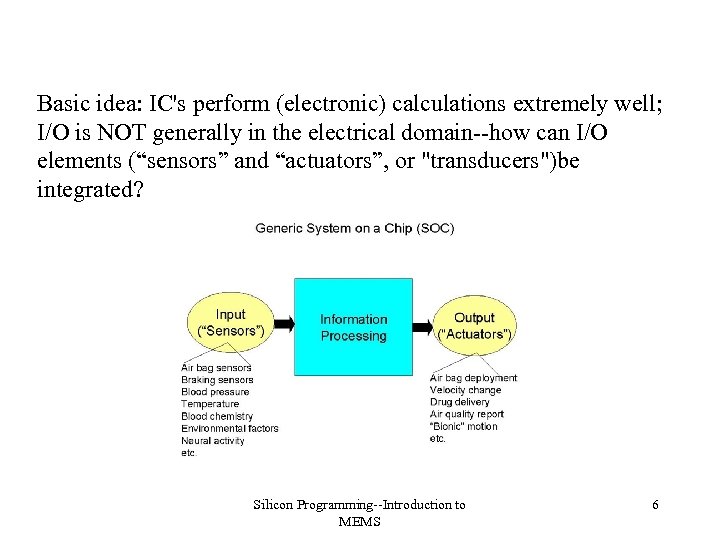 Basic idea: IC's perform (electronic) calculations extremely well; I/O is NOT generally in the electrical domain--how can I/O elements (“sensors” and “actuators”, or "transducers")be integrated? Silicon Programming--Introduction to MEMS 6
 Energy Domains: 1. thermal--temperature, heat flow, etc. 2. mechanical--force, pressure, ve; ocity, acceleration, position, etc. 3. chemical--concentration, material composition, reaction rate, etc. 4. magnetic--magnetic field intensity, flux density, magnetization, etc. 5. radiant--intensity, wavelength, polarizaion, phase, etc. 6. electrical--voltage, current, charge, etc. Silicon Programming--Introduction to MEMS 7
 Relation to IC's: Typical IC is built up of "layers" of material. These layers can be used to make other devices, e. g. , cantilever beams for sensing and actuating Techniques for "machining" are those used in IC fabrication--how can they be used / modified to make devices usable in other domains? Silicon Programming--Introduction to MEMS 8
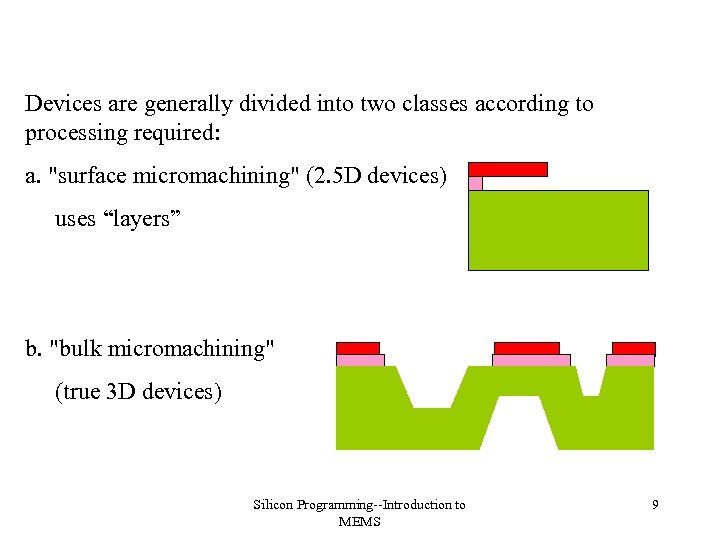 Devices are generally divided into two classes according to processing required: a. "surface micromachining" (2. 5 D devices) uses “layers” b. "bulk micromachining" (true 3 D devices) Silicon Programming--Introduction to MEMS 9
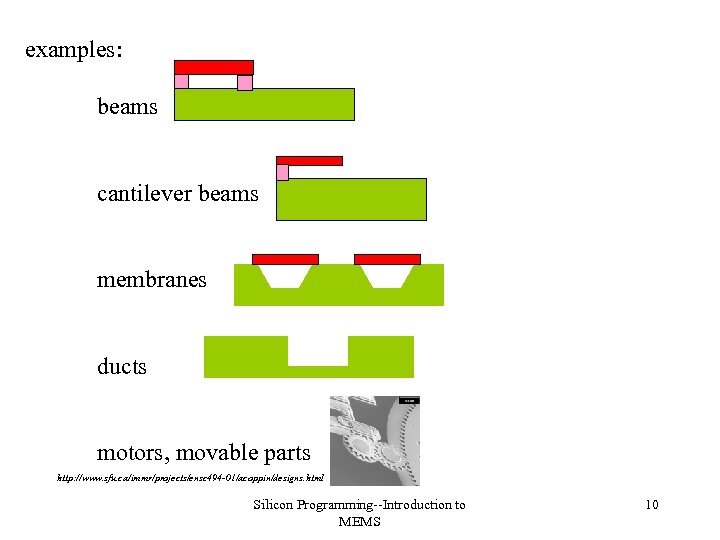 examples: beams cantilever beams membranes ducts motors, movable parts http: //www. sfu. ca/immr/projects/ensc 494 -01/acoppin/designs. html Silicon Programming--Introduction to MEMS 10
 How can MEMS development make use of well-understood IC CAD capabilities? What extensions are needed for CAD for MEMS? Recall: 1. Predicting IC performance requires input from fabrication, design, and environment. 2. Tools for incorporating information from each of these domains are necessary for "rapid prototyping" which make many IC designs economically feasible. Silicon Programming--Introduction to MEMS 11
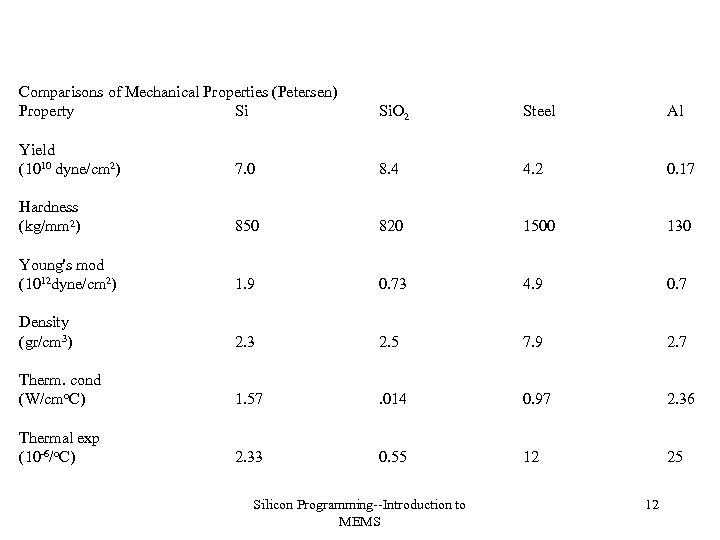 Comparisons of Mechanical Properties (Petersen) Property Si Si. O 2 Steel Al Yield (1010 dyne/cm 2) 7. 0 8. 4 4. 2 0. 17 Hardness (kg/mm 2) 850 820 1500 130 Young's mod (1012 dyne/cm 2) 1. 9 0. 73 4. 9 0. 7 Density (gr/cm 3) 2. 3 2. 5 7. 9 2. 7 Therm. cond (W/cmo. C) 1. 57 . 014 0. 97 2. 36 Thermal exp (10 -6/o. C) 2. 33 0. 55 12 25 Silicon Programming--Introduction to MEMS 12
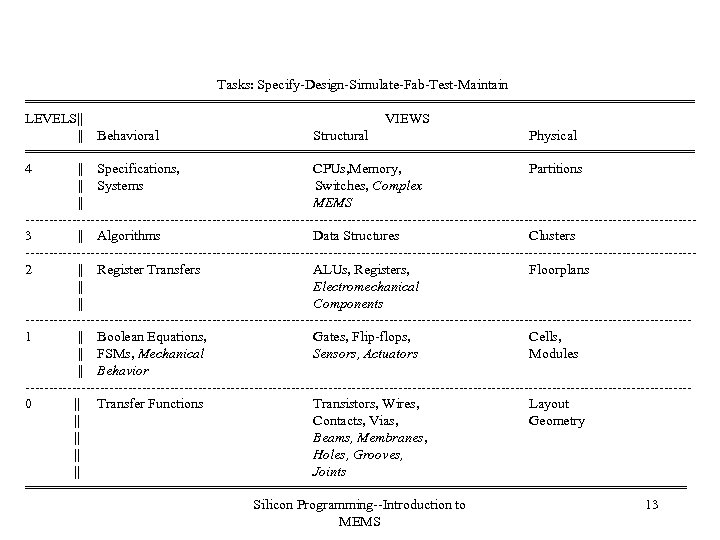 Tasks: Specify-Design-Simulate-Fab-Test-Maintain =========================================== LEVELS|| VIEWS || Behavioral Structural Physical =========================================== 4 || Specifications, CPUs, Memory, Partitions || Systems Switches, Complex || MEMS ------------------------------------------------------------------------3 || Algorithms Data Structures Clusters ------------------------------------------------------------------------2 || Register Transfers ALUs, Registers, Floorplans || Electromechanical || Components -----------------------------------------------------------------------1 || Boolean Equations, Gates, Flip-flops, Cells, || FSMs, Mechanical Sensors, Actuators Modules || Behavior -----------------------------------------------------------------------0 || Transfer Functions Transistors, Wires, Layout || Contacts, Vias, Geometry || Beams, Membranes, || Holes, Grooves, || Joints ========================================== Silicon Programming--Introduction to 13 MEMS
 Cantilever beam--static and dynamic behavior; extending VHDL to other domains (VHDL-AMS) Silicon Programming--Introduction to MEMS 14
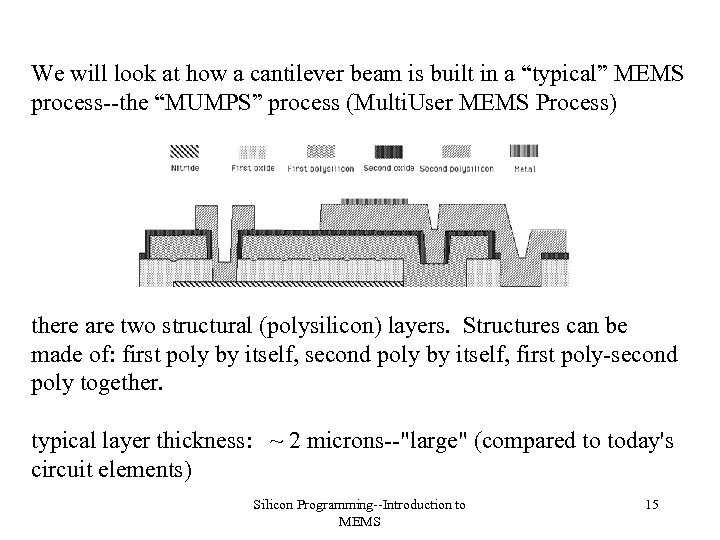 We will look at how a cantilever beam is built in a “typical” MEMS process--the “MUMPS” process (Multi. User MEMS Process) there are two structural (polysilicon) layers. Structures can be made of: first poly by itself, second poly by itself, first poly-second poly together. typical layer thickness: ~ 2 microns--"large" (compared to today's circuit elements) Silicon Programming--Introduction to MEMS 15
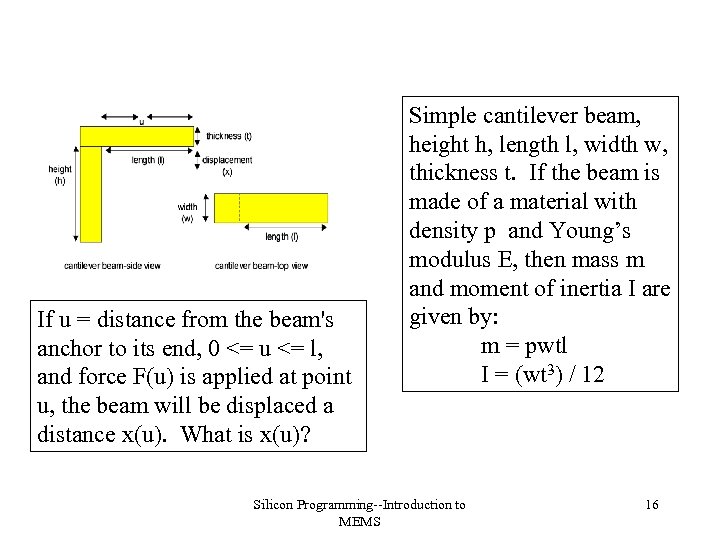 If u = distance from the beam's anchor to its end, 0 <= u <= l, and force F(u) is applied at point u, the beam will be displaced a distance x(u). What is x(u)? Simple cantilever beam, height h, length l, width w, thickness t. If the beam is made of a material with density p and Young’s modulus E, then mass m and moment of inertia I are given by: m = pwtl I = (wt 3) / 12 Silicon Programming--Introduction to MEMS 16
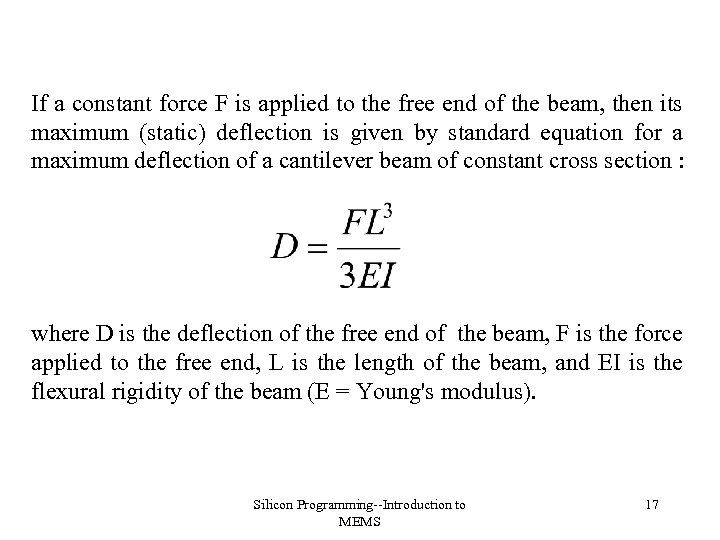 If a constant force F is applied to the free end of the beam, then its maximum (static) deflection is given by standard equation for a maximum deflection of a cantilever beam of constant cross section : where D is the deflection of the free end of the beam, F is the force applied to the free end, L is the length of the beam, and EI is the flexural rigidity of the beam (E = Young's modulus). Silicon Programming--Introduction to MEMS 17
 If F varies with respect to time s, then we actually have F = F( s, u) and we seek the dynamic solution x = x(s, u). Silicon Programming--Introduction to MEMS 18
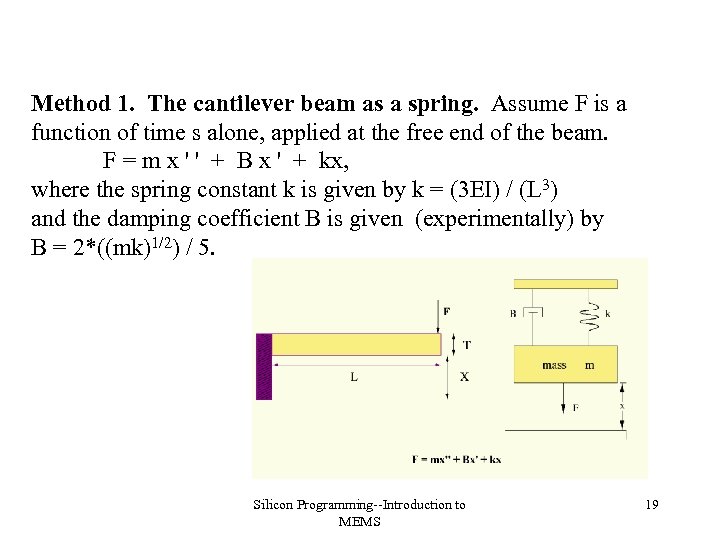 Method 1. The cantilever beam as a spring. Assume F is a function of time s alone, applied at the free end of the beam. F = m x ' ' + B x ' + kx, where the spring constant k is given by k = (3 EI) / (L 3) and the damping coefficient B is given (experimentally) by B = 2*((mk)1/2) / 5. Silicon Programming--Introduction to MEMS 19
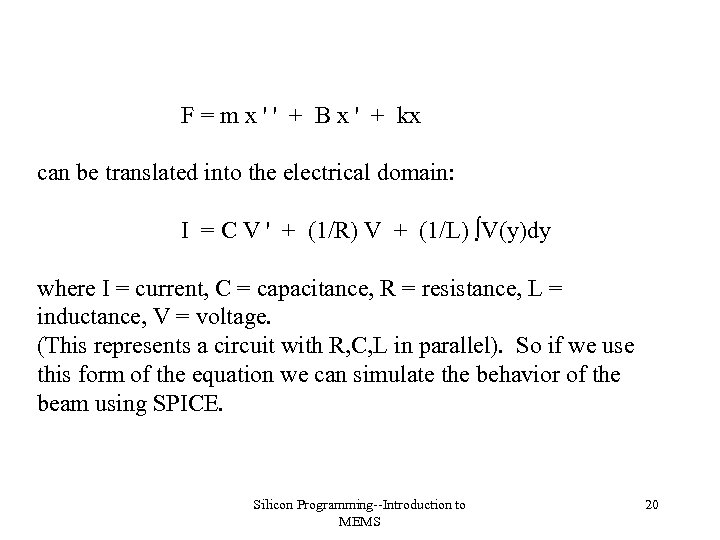 F = m x ' ' + B x ' + kx can be translated into the electrical domain: I = C V ' + (1/R) V + (1/L) V(y)dy where I = current, C = capacitance, R = resistance, L = inductance, V = voltage. (This represents a circuit with R, C, L in parallel). So if we use this form of the equation we can simulate the behavior of the beam using SPICE. Silicon Programming--Introduction to MEMS 20
 Method 2. Finite element analysis. This is a standard method for dealing numerically with complex systems. Here we can break the beam into sections and model the behavior of each section, keeping them "tied" together at the ends. This allows us to deal with a force which varies along the beam length. Silicon Programming--Introduction to MEMS 21
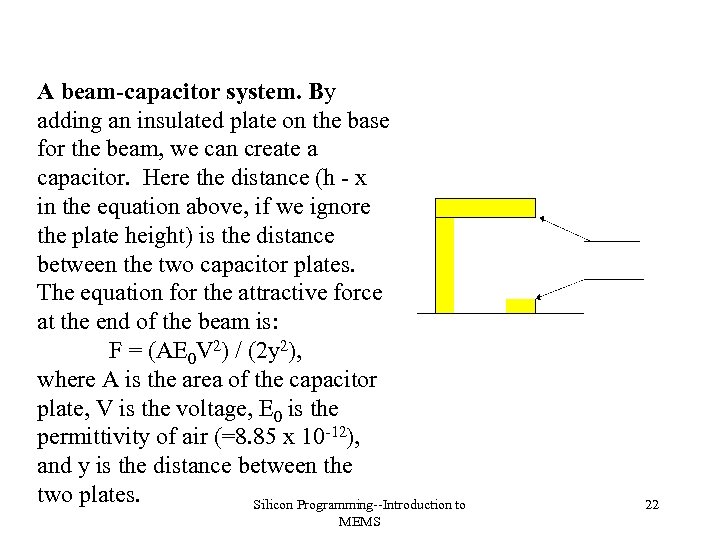 A beam-capacitor system. By adding an insulated plate on the base for the beam, we can create a capacitor. Here the distance (h - x in the equation above, if we ignore the plate height) is the distance between the two capacitor plates. The equation for the attractive force at the end of the beam is: F = (AE 0 V 2) / (2 y 2), where A is the area of the capacitor plate, V is the voltage, E 0 is the permittivity of air (=8. 85 x 10 -12), and y is the distance between the two plates. Silicon Programming--Introduction to MEMS 22
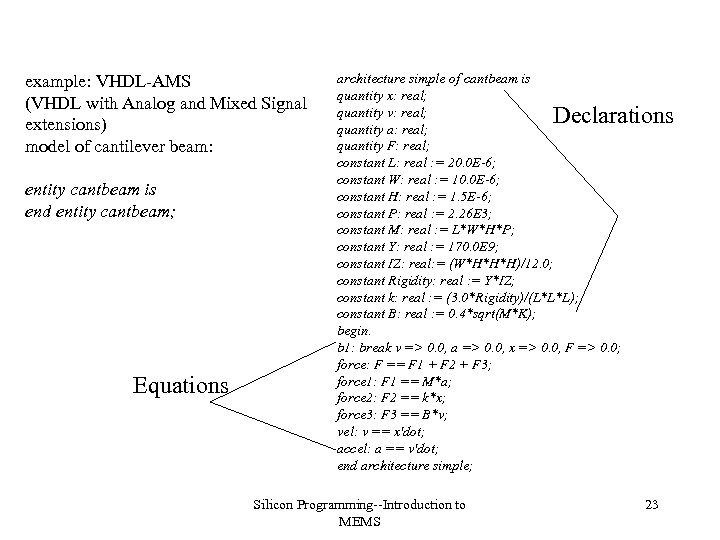 example: VHDL-AMS (VHDL with Analog and Mixed Signal extensions) model of cantilever beam: entity cantbeam is end entity cantbeam; Equations architecture simple of cantbeam is quantity x: real; quantity v: real; quantity a: real; quantity F: real; constant L: real : = 20. 0 E-6; constant W: real : = 10. 0 E-6; constant H: real : = 1. 5 E-6; constant P: real : = 2. 26 E 3; constant M: real : = L*W*H*P; constant Y: real : = 170. 0 E 9; constant IZ: real: = (W*H*H*H)/12. 0; constant Rigidity: real : = Y*IZ; constant k: real : = (3. 0*Rigidity)/(L*L*L); constant B: real : = 0. 4*sqrt(M*K); begin. b 1: break v => 0. 0, a => 0. 0, x => 0. 0, F => 0. 0; force: F == F 1 + F 2 + F 3; force 1: F 1 == M*a; force 2: F 2 == k*x; force 3: F 3 == B*v; vel: v == x'dot; accel: a == v'dot; end architecture simple; Silicon Programming--Introduction to MEMS Declarations 23
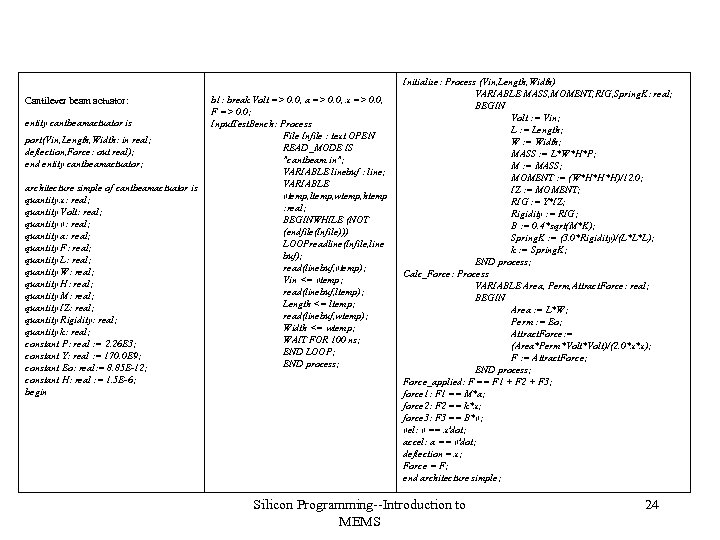 Cantilever beam actuator: entity cantbeamactuator is port(Vin, Length, Width: in real; deflection, Force: out real); end entity cantbeamactuator; architecture simple of cantbeamactuator is quantity x: real; quantity Volt: real; quantity v: real; quantity a: real; quantity F: real; quantity L: real; quantity W: real; quantity H: real; quantity M: real; quantity IZ: real; quantity Rigidity: real; quantity k: real; constant P: real : = 2. 26 E 3; constant Y: real : = 170. 0 E 9; constant Eo: real: = 8. 85 E-12; constant H: real : = 1. 5 E-6; begin b 1: break Volt => 0. 0, a => 0. 0, x => 0. 0, F => 0. 0; Input. Test. Bench: Process File Infile : text OPEN READ_MODE IS "cantbeam. in"; VARIABLE linebuf : line; VARIABLE vtemp, ltemp, wtemp, htemp : real; BEGINWHILE (NOT (endfile(Infile))) LOOPreadline(Infile, line buf); read(linebuf, vtemp); Vin <= vtemp; read(linebuf, ltemp); Length <= ltemp; read(linebuf, wtemp); Width <= wtemp; WAIT FOR 100 ns; END LOOP; END process; Initialize: Process (Vin, Length, Width) VARIABLE MASS, MOMENT, RIG, Spring. K: real; BEGIN Volt : = Vin; L : = Length; W : = Width; MASS : = L*W*H*P; M : = MASS; MOMENT : = (W*H*H*H)/12. 0; IZ : = MOMENT; RIG : = Y*IZ; Rigidity : = RIG; B : = 0. 4*sqrt(M*K); Spring. K : = (3. 0*Rigidity)/(L*L*L); k : = Spring. K; END process; Calc_Force: Process VARIABLE Area, Perm, Attract. Force: real; BEGIN Area : = L*W; Perm : = Eo; Attract. Force: = (Area*Perm*Volt)/(2. 0*x*x); F : = Attract. Force; END process; Force_applied: F == F 1 + F 2 + F 3; force 1: F 1 == M*a; force 2: F 2 == k*x; force 3: F 3 == B*v; vel: v == x'dot; accel: a == v'dot; deflection = x; Force = F; end architecture simple; Silicon Programming--Introduction to MEMS 24