 Скачать презентацию Interfacing External Sensors to Telosb Motes April 06
b70fefc652e7cecbc34623a0f83d8d05.ppt
- Количество слайдов: 8



Interfacing External Sensors to Telosb Motes April 06, 2005 Raghul Gunasekaran
Telosb Motes Low power consuming Capable of operating in large clusters 8 MHz MSP 430 with 10 KB RAM 250 Kbps data rate IEEE 802. 15. 4 Compliant Operating in 2. 4 to 2. 483 GHz Virtual USB programming Serial UART communication Programmable Flash Memory 48 K 1 MB external flash for data logging On board Sensors (Temperature, Humidity and Light Sensor)
Telosb Motes Open source operating System – Tiny. OS Programmed in NESC - a modular programming language - an extension to C Built in 12 -bit ADC Supports 8 channels Capable of interfacing with external Sensors
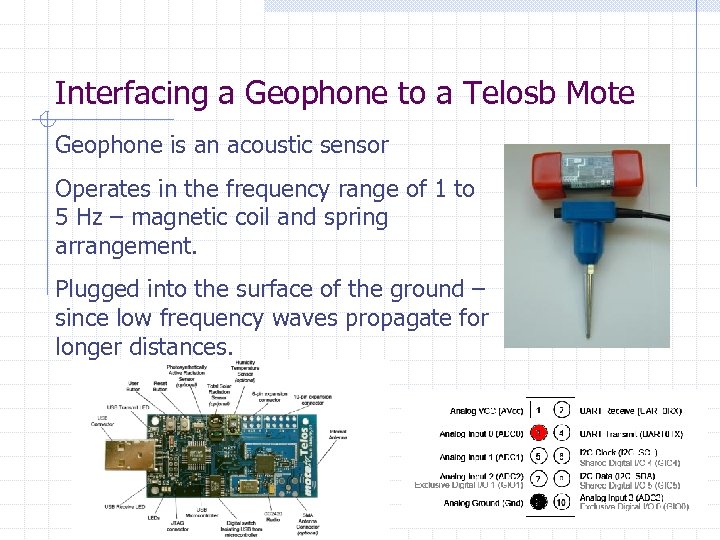
Interfacing a Geophone to a Telosb Mote Geophone is an acoustic sensor Operates in the frequency range of 1 to 5 Hz – magnetic coil and spring arrangement. Plugged into the surface of the ground – since low frequency waves propagate for longer distances.
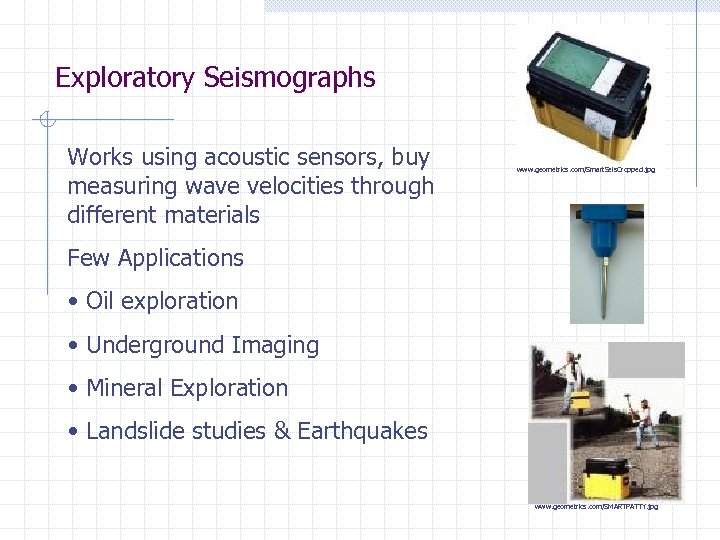
Exploratory Seismographs Works using acoustic sensors, buy measuring wave velocities through different materials www. geometrics. com/Smart. Seis. Cropped. jpg Few Applications • Oil exploration • Underground Imaging • Mineral Exploration • Landslide studies & Earthquakes www. geometrics. com/SMARTPATTY. jpg
Implementation Issues Synchronization - triggered data collection (most important for the application discussed ) Compression of data - Data collected is stored in the flash memory - data sizes would be in the order of 10 k. B + header information. Example: 12 bit ADC (2 byte storage space in the memory) sampled for every 1 ms (or 0. 5 ms) time interval for a period of 2 (or 3) seconds would result in a data size of 6 KB) - Reduced data size results in energy saving over transmitting high data
Implementation Issues Routing – Store and Forward - since the motes have a fixed arrangement - no complex algorithm required - moreover the programming space on the mote needs to be small for we have enough space for data logging.

Thanks
Скачать презентацию Interfacing External Sensors to Telosb Motes April 06
b70fefc652e7cecbc34623a0f83d8d05.ppt