 Скачать презентацию Interesting Choices Maribeth Gandy Jeff Wilson Improving
a86acc27cc0b03f6c9434f25e4841672.ppt
- Количество слайдов: 36



Interesting Choices Maribeth Gandy Jeff Wilson
Improving Player Choices • What makes choice interesting versus uninteresting? • How can you design choices that are interesting?
Consequences • Choices should have consequences. • Or, each choice must alter the course of the game. • Upside and Downside to each choice • Common flaw in existing games: Choices that have no bearing on outcome • Examples of poor choices: too many weapons that are too similar, side quests/mini-games with no real impact • Good examples: Weapons in Legend of Zelda, Fire Emblem (no anonymous grunts)
Types of Decisions • • Hollow Decision: no real consequences Obvious Decision: no real decision Uninformed Decision: an arbitrary choice Informed Decision: where the player has ample information Dramatic Decision: taps into a player’s emotional state Weighted Decision: a balanced decision with consequences on both sides Immediate Decision: has an immediate impact Long-Term Decision: whose impact will be felt down the road
Example: Golden Arrow • Powerful weapon • Use it to slay dragon, or save for the evil mage later in the game? • Informed decision: player knows capabilities of weapon and monsters • Dramatic decision because of emotional attachment to inventory item • Weighted decision: consequences balanced on both sides • Immediate decision – pending battle with dragon • Long-term decision – future battle with mage
Decision Types • Not all decisions have to be as complex as “golden arrow” example • Avoid hollow, obvious, and uniformed decisions • Remove all nondecisions
Dilemmas • Situations where player must weigh the consequences of their choices carefully • In many cases, there is no optimal answer • Often paradoxical or recursive • Von Neumann studied dilemmas, diagrammed showing potential outcomes
Cake-Cutting Dilemma • Divide a piece of cake between two children • Each wants the largest piece • Mother assigns one to be “cutter” the other as “chooser” • Cutter slices the cake, chooser picks their slice
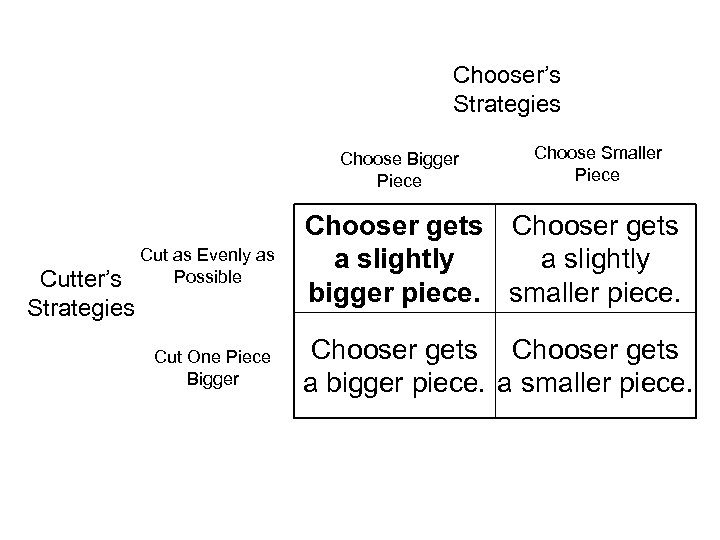
Chooser’s Strategies Choose Bigger Piece Cutter’s Strategies Choose Smaller Piece Cut as Evenly as Possible Chooser gets a slightly bigger piece. smaller piece. Cut One Piece Bigger Chooser gets a bigger piece. a smaller piece.
Zero-Sum Game • Total amount won at the end of the game is exactly equal to the amount lost. • Cake-Cutting Dilemma is an example • Interests of players are diametrically opposed. • What one player loses is gained by the other.
Minimax Theory • Von Neumann discovered that there is an optimal strategy for each player in zerosum games • Optimal strategy is “maximize their minimum potential result”
Problem with Zero-Sum Games • Once players are aware of the optimal strategy, they will always use that strategy • Obvious Decision • How can we create more complex dilemmas?
The Prisoner’s Dilemma • Created by two RAND scientists in the 1950’s • Showed how non zero-sum games can create situations where the optimal strategy for each player can result in suboptimal strategies for both
The Prisoner’s Dilemma • Two criminals commit crime together • Caught by police • Held in separate cells with no means of communication • DA offers each a deal, says that both are getting the same deal: – Rat on partner, he denies it, you go free and partner get 5 years in jail (and vice versa) – Both rat: each gets 3 years – Neither rat: each gets 1 year
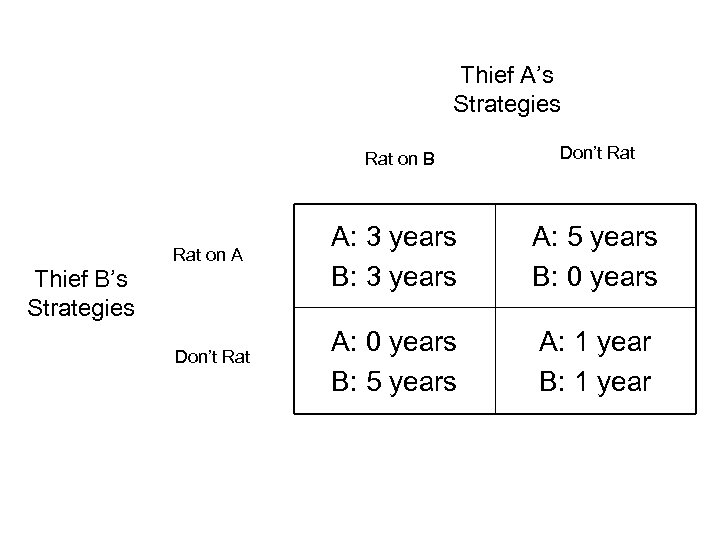
Thief A’s Strategies Rat on B Don’t Rat on A A: 3 years B: 3 years A: 5 years B: 0 years Don’t Rat A: 0 years B: 5 years A: 1 year B: 1 year Thief B’s Strategies
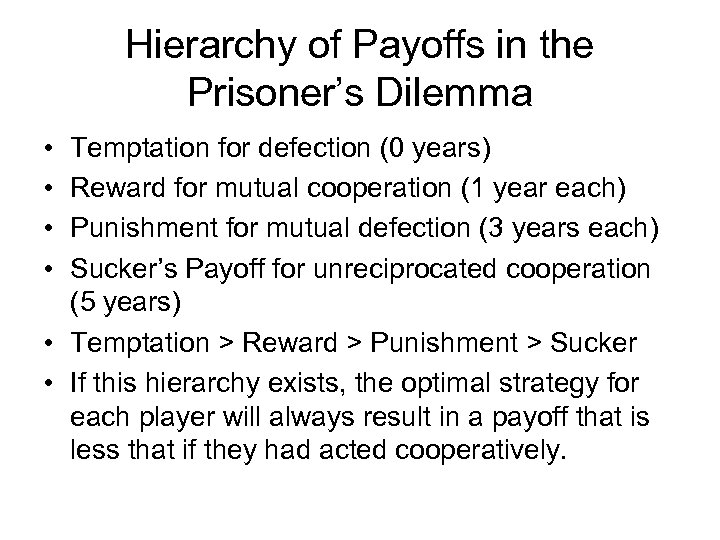
Hierarchy of Payoffs in the Prisoner’s Dilemma • • Temptation for defection (0 years) Reward for mutual cooperation (1 year each) Punishment for mutual defection (3 years each) Sucker’s Payoff for unreciprocated cooperation (5 years) • Temptation > Reward > Punishment > Sucker • If this hierarchy exists, the optimal strategy for each player will always result in a payoff that is less that if they had acted cooperatively.
Hypothetical Game Using Prisoner’s Dilemma • Steve Boscska/Radical Entertainment presented at GDC • Building/Customizing Spacecraft game
Spacecraft Game • Requires bartering and trading of raw materials with budget of $10000, but high transaction cost of $8000 “shipping and handling” • Technology can be purchased ($5000) that allows materials to be transported free of tax but… • …both players must purchase
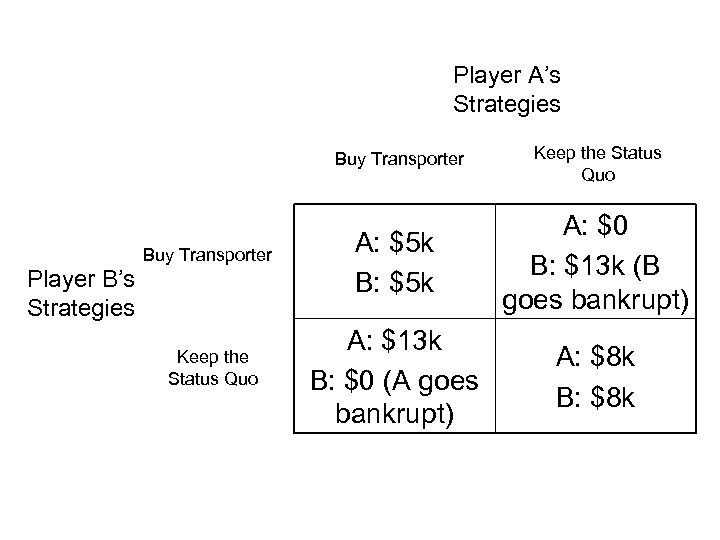
Player A’s Strategies Buy Transporter Player B’s Strategies Keep the Status Quo A: $5 k B: $5 k A: $0 B: $13 k (B goes bankrupt) A: $13 k B: $0 (A goes bankrupt) A: $8 k B: $8 k
Puzzles • Contextualize choices that player makes: moving towards or away from solution? • Key element in creating conflict in almost all single-player games • Innate tension in solving puzzles • Tie to system of rewards for success and punishment for failure => transforms into a dramatic element • Multiplayer games don’t need puzzles, but can certainly be used (especially co-op) • As a game dev, consider yourself a puzzle designer • Make sure puzzle is integrated seamlessly into game – Advance storyline – Enable progress
Rewards and Punishment • Most direct consequences for player choices • Emphasize rewards, while limiting punishments • Threat of punishment, not punishment itself, carries dramatic tension • Rewards should have utility or value
Reward System Guidelines • Rewards that are useful in obtaining future victory carry greater weight • Rewards that have a romantic association, like magic weapons or gold, appear more valuable • Rewards that are tied into the storyline of the game have an added impact • Pay attention to timing and quantity of rewards, otherwise they can become meaningless
Ever. Quest: Addictive Game • Psychologist Nick Yee studied reward/punishment structure in EQ • Believes EQs addictive power lies in a behavior theory advanced by B. F. Skinner: • Operant Conditioning – • The frequency of performing a given behavior is directly linked to whether it is rewarded or punished
Skinner Box • Rat in box with lever and food dispenser • Fixed interval schedule: food comes out on fixed interval • Fixed ratio schedule: food comes out every time rat presses lever fixed number of times • Random ratio schedule: must press lever a randomly determined number of times • Everquest is Random Ratio Schedule • Gambling in Las Vegas?
Recognition • Powerful type of reward • Humans crave acknowledgement for achievements • Examples: high scores, tournaments
Anticipation • Useful for complex choices (random ratio schedule good for simple, repetitive game play) • Closed versus mixed information structures – is all information available to player? • Chess versus Warcraft II with Fog of War
Surprise • • • Feel random to players, but in a good way Example: foot soldier versus ogre Foot soldier: strikes for 1 -5 HP, 10 HP Ogre: strikes for 1 -20 HP, 20 HP Chance that foot soldier will win Trick is to find right balance of surprise versus meaningful decisions
Progress • Advertise milestones to player • Reward after each accomplishment • Providing a path for player gives a sense of achievement • Be creative in finding way to represent progress to player • Plan “mini-arcs” of about one hour of progress after which player encounters “memorable moment”
The End • Play completely resolves (not player death) • Don’t end with fluffy animation with player showered with praise and adulation • Instead build reward ending into story
Fun Killers • • • Micromanagement Stagnation Insurmountable Obstacles Arbitrary Events Predictable Paths

Micromanagement • • Tedious Boring Overwhelming Solutions for RTS – Command queuing – Formations – High-level strategies (defend, attack, patrol, etc. )
Stagnation • Repetition • balance of power (team up against player that is ahead) • endless loop (caught in debt) • no progress being made
Insurmountable Obstacles • Perceived as being such by some percentage of gamers • Adventure games • Halo example
Arbitrary Events • Frustrate user, especially if a negative event • Zombie closets
Predictable Paths • Don’t force user down one path if possible • Create illusion of freedom
Is your game accessible? • Similar to testing for usability • Identify areas that cause confusion, player gets stuck • Refine • Continue until majority of target players can access the most critical areas of your game
Скачать презентацию Interesting Choices Maribeth Gandy Jeff Wilson Improving
a86acc27cc0b03f6c9434f25e4841672.ppt