


 Скачать презентацию Intercultural training Lecture 5 The cross-cultural interactions
Lec 5.3.ppt
- Количество слайдов: 36
 Intercultural training Lecture 5
 The cross-cultural interactions in working places are not always successful. For example, studies have found that between 16 and 40 percent of all expatriate managers who are given foreign assignments end these assignments earlier than expected because of their poor performance or their inability to adjust to the foreign environment (Baker & Ivancevich, 1971; Black, 1988; Dunbar & Ehrlich, 1986; Tung, 1981), and as high as 50 percent of those who do not return early function at a low level of effectiveness (Copeland & Griggs, 1985).
 Unsuccessful cross-cultural interactions become even more important when the costs of failure are high, and they often are. For example, studies have estimated that the cost of a failed expatriate assignment is an amount from $50, 000 to $150, 000 (Copeland & Griggs, 1985; Harris & Moran, 1979; Misa & Fabricatore, 1979).
 For a firm that has hundreds of expatriate employees worldwide, such costs can easily reach into the tens of millions of dollars. In fact, Copeland Griggs (1985) have estimated that the direct costs to U. S. firms of failed expatriate assignments is over $2 billion a year, and this does not include unmeasured losses such as damaged corporate reputations or lost business opportunities.
 Cross-cultural training (CCT) has long been advocated as a means of facilitating effective cross-cultural interactions (Brislin, 1981; Landis & Brislin, 1983; Bochner, 1982; Harris & Moran, 1979; Mendenhall & Oddou, 1986; Tung, 1981).
 Cross-cultural training Brislin and Yoshida (1993) define cross-cultural training as formal efforts to prepare people for more effective interpersonal relations and for job success when they interact extensively with individuals from cultures other than their own (Brislin & Yoshida, 1993). cross-cultural training facilitates more effective cross- cultural interactions.
 Dynamics of adjustment Cross-cultural adjustment ensues from the (1) clarity of the expatriate’s operant frame of reference which functions as an internalized set of relevant norms, and the (2) applicability of personal behaviour in the hostculture. The operant frame of reference is a set of cognitive elements derived from the individual’s world view, which recommend or advise against a certain behaviour in a specific situation. Selmer, J. , Torbiorn, I. , & de Leon, C. T. (1998). Sequential cross-cultural training for expatriate business managers: predeparture and post-arrival. International Journal of Human Resource Management, 9(5), 831 -840.
 Dynamics of adjustment The relationship between applicability and clarity indicates four distinct phases in the cross-cultural adjustment process: (1) Ethnocentric phase (high clarity – low applicability), (2) Culture-shocked phase (low clarity – low applicability), (3) Conformist phase (low clarity – high applicability) and (4) Adjusted phase (high clarity – high applicability). Selmer, J. , Torbiorn, I. , & de Leon, C. T. (1998). Sequential cross-cultural training for expatriate business managers: predeparture and postarrival. International Journal of Human Resource Management, 9(5), 831840
 Pre-departure training During the ethnocentric phase, the psychological predisposition of individuals restricts the in-depth understanding of a particular culture not yet experienced, simply because the cross-cultural context is not a priori of great salience. Trainees are rarely able to grasp in abstraction and recall later in practice the new social skills. Pre-departure programmes could focus instead on essential information on local conditions. Training material should include didactic exposure to the cross-cultural adjustment process, underlining the normal and constructive phases that emerge after the initial strains of culture shock.
 Training in the ethnocentric phase - postarrival training Upon arrival in the host country, expatriates are caught up in hectic familiarization and difficult socialization (Selmer, 1995 b). If encouraged to take time off to participate in post-arrival training, the trainees themselves would suggest many of the concerns to be discussed. Training immediately after arrival should enhance cultural awareness and lower ethnocentrism. Culture-contrast methods would be the ethnocentrism most appropriate to highlight similarities and differences in the fundamental values and characteristics of home and host cultures (cf. cultures Stewart and Bennett, 1991; Althen, 1988). Learning is likely to be most effective when the expatriate’s reliance upon home-culture views has weakened and openness to the new culture has heightened. Based on cultural relativism, the culture-contrast mode of learning introduces the concept of culture and the nature of cultural differences (Brislin et al. , 1983).
 Training in the culture-shocked phase During the culture-shocked phase, cross-cultural training would be most effective. The training during this period should facilitate cognitive restructuring by providing explanations of actual cross-cultural experiences. Exercises should elicit experimentation with new behaviours which could develop into interpersonally effective performance on the job. Culture-shock training should provide the tools for sorting out the many experiences and impressions of the host culture. Since intercultural difficulties are usually due to ignorance of local norms, activities should attempt to supplement the expatriate’s repertoire of social skills.
 Training in the conformist phase The conformist phase is another suitable period for cross-cultural training, but with a different focus. The training at this phase should focus on ‘learning by doing as the host-culture members do’. Culturally sensitive skills would be efficiently learnt by actual practice on the job, which in turn would provide trainees with objective reactions from significant others. The interactional mode of learning occurs through structured or unstructured situations for interaction between trainees and host nationals and/or experienced expatriates. Long-term effects of training at the conformist phase are probable, due to the immediacy of application. The immediate transfer of learning to practice reinforces the behavioural skills, such that cross-cultural competencies are quickly incorporated in the personal repertoire of conduct. Sorcher and Spence’s (1982)
 The effectiveness of multicultural training in general is proven. A good overview of studies and some aspects of the effectiveness of this training can be found in the below presented paper: J. Stewart Black and Mark Mendenhall. «Cross-Cultural Training Effectiveness: A Review and a Theoretical Framework for Future Research» / The Academy of Management Review, Vol. 15, No. 1 (Jan. , 1990), pp. 113 -136.
 What is cultural competency?
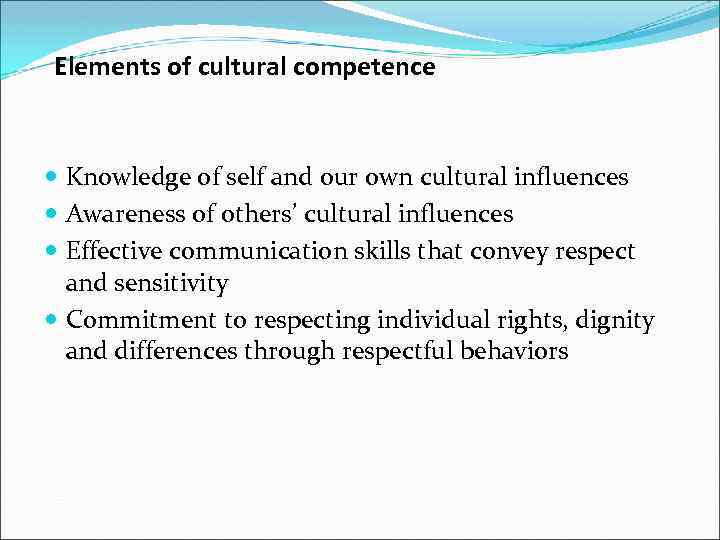 Elements of cultural competence Knowledge of self and our own cultural influences Awareness of others’ cultural influences Effective communication skills that convey respect and sensitivity Commitment to respecting individual rights, dignity and differences through respectful behaviors
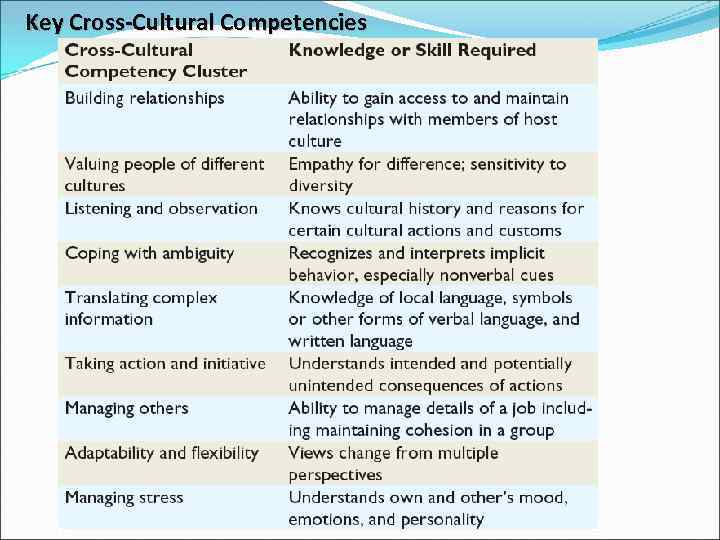 Key Cross-Cultural Competencies
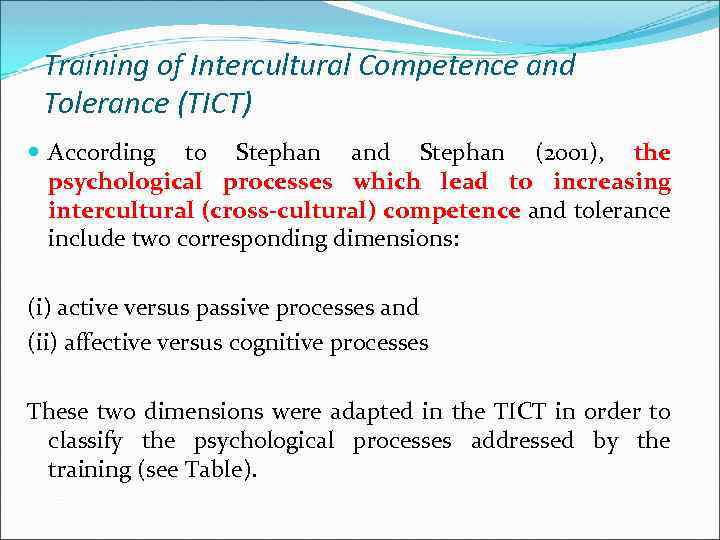 Training of Intercultural Competence and Tolerance (TICT) According to Stephan and Stephan (2001), the psychological processes which lead to increasing intercultural (cross-cultural) competence and tolerance include two corresponding dimensions: (i) active versus passive processes and (ii) affective versus cognitive processes These two dimensions were adapted in the TICT in order to classify the psychological processes addressed by the training (see Table).
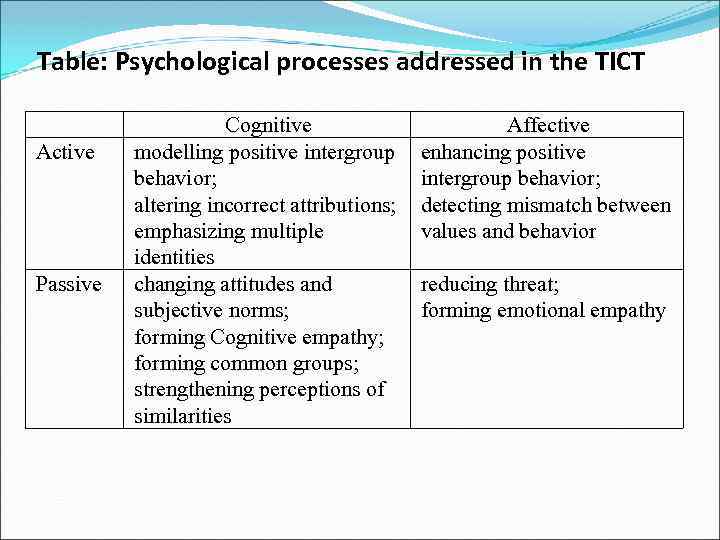 Table: Psychological processes addressed in the TICT Active Passive Cognitive modelling positive intergroup behavior; altering incorrect attributions; emphasizing multiple identities changing attitudes and subjective norms; forming Cognitive empathy; forming common groups; strengthening perceptions of similarities Affective enhancing positive intergroup behavior; detecting mismatch between values and behavior reducing threat; forming emotional empathy
 Experiential Exercises Experiential exercises emerged as a reaction to the traditional university model, and as a result they focus on involving the trainees a great deal. The most popular type of experiential tool is the simulation game in which trainees interact with other people following a set of guidelines provided by the trainer. Usually, trainees are divided into two groups and each represent an imaginary culture with some simple rules.
 Area Simulation Another experiential approach is the area simulation in which the target culture is simulated, usually in a natural setting. For example, Hawaii provides the natural setting for simulating life in the Pacific Islands Trifonovitch (1977) used Hawaii for training Americans who were going to Pacific Islands to emphasize the difference between “land culture” and “sea culture, ” and required the trainees to support themselves by taking care of their food, water, waste disposal, entertainment, and other needs. Among other things, this training provided the opportunity to weaken habitual behaviors such as using clocks and to inculcate new behaviors like using the sun, tide, and the wind direction to think about the time of the day. The strengths of this method are that trainees learn skills that are necessary for living in the target culture on their own, with minimal guidance from the training staff, and doing is stressed over thinking or intellectualizing (Trifonovitch, 1977).
 Cultural Self-Awareness Model Kraemer’s cultural self-awareness model is a training method that was developed in the seventies, and is based on the assumption that one knows one’s culture so well that one really does not think about it, and one needs to be reminded about the assumptions of one’s culture. The training program consists of a set of videotapes that contain 138 episodes covering 21 themes (Kraemer, 1973, 1974). Professional actors play the roles of hosts and sojourners (Americans). The trainees watch the videotape and generate themes for the episodes. Later they compare these themes with those provided by the trainer. A group discussion and a debriefing session follow to clarify any questions or doubts. This method was quite advanced for its time since it used a new technology, i. e. , videotapes, and was also sophisticated theoretically since it used the principles of Social Learning Theory (Bandura, 1977). Theory Bennett (1985) tested the effectiveness of this method by using a sample of exchange students, and found that the treatment group that received this training performed better than the control group. It would be interesting to examine the effectiveness of this method in comparison to other methods, and may give a boost to this method, which deserves to be used more often.
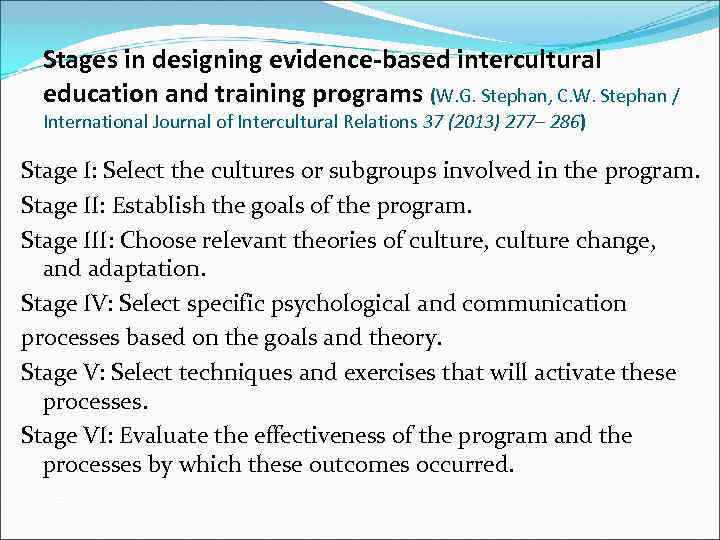 Stages in designing evidence-based intercultural education and training programs (W. G. Stephan, C. W. Stephan / International Journal of Intercultural Relations 37 (2013) 277– 286) Stage I: Select the cultures or subgroups involved in the program. Stage II: Establish the goals of the program. Stage III: Choose relevant theories of culture, culture change, and adaptation. Stage IV: Select specific psychological and communication processes based on the goals and theory. Stage V: Select techniques and exercises that will activate these processes. Stage VI: Evaluate the effectiveness of the program and the processes by which these outcomes occurred.
 Stage I: Select the cultures or subgroups involved in the program. To design effective programs, the program designers must be knowledgeable about the cultures and groups involved, the elements of these cultures, their histories, and the history of relationships between these cultures. Also, the program designers should, if at all possible, include members of all of the cultures involved in the program, even if some of the program designers have extensive experience living in the target cultures.
 Stage II: Establish the goals of the program involved. In the past, the goals of intercultural education and training programs were sometimes stated vaguely, the idea being to improve intercultural relations or increase some combination of knowledge, understanding, and skills. These are fine ideas, but they are too broad to be workable goals. As a field, we are now in a better position to be specific about our goals. This point is exemplified by the types of programs that are currently being developed.
 Stage III: Choose relevant theories of culture, culture change, and adaptation Choose theories of culture and cultural change that are relevant to achieving these goals. Culture is simply too complex to understand without the organizing principles provided by theory. At the broadest level, such theories take a comprehensive view of culture. These theories include the cultural dimensions (Hofstede, 2001; Triandis, 1995), values (Schwartz, 2006), and trait approaches (Church, 2009), as well as activity theory (Cheung, van de Vijver, & Leong, 2011; Ratner, 2008), evolutionary theory (Buss, 2001; Mesoudi, 2009), social representation theories (Moscovici, 1984; Wagner et al. , 1999), and the indigenous culture approach (Kim, 2000), among others. Likewise, there are many theories of intergroup relations that are relevant to intercultural education and training programs. They include social identity theory (Tajfel, 1978), realistic group conflict theory (Jackson, 1993; Le. Vine & Campbell, 1972), contact theory (Pettigrew & Tropp, 2006), intergroup threat theory (Stephan, Ybarra, & Rios Morrison, 2009), and social dominance theory (Pratto, Sidanius, Stallworth, & Malle 1994; Sidanius & Pratto, 2010), among many others.
 Stage IV: Select specific psychological and communication processes based on the goals and theory Based on the goals selected and the relevant theories and empirical research, the next step is to decide how to achieve these goals. In the past, this step goals. would have consisted of the selection of techniques, exercises, simulations, written materials, etc. that were expected to achieve these goals. Now, however, we can add a crucial step. We can use research to specify the psychological and communication processes that will lead to the outcomes we desire from our intercultural education and training programs. For example, we can activate cognitive processes such as analytical thinking, perspective taking, cognitive dissonance, self-regulation, recategorization of group boundaries, or processes to counteract attribution biases. Similarly, affective processes such as emotional empathy, positive intercultural emotions, and reducing intergroup anxiety can be created. With respect to communication, processes such as effective listening skills, openness to others’ views, displaying culturally appropriate non-verbal behaviors, communicating understanding, or responding effectively to intercultural misunderstandings could be set in motion.
 Stage V: Select techniques and exercises that will activate these processes With the chosen psychological and communication processes in mind, select the techniques, exercises, and materials that will activate these processes. For instance, if empathy is the process and reduced prejudice is the prejudice goal, we know that listening to the narratives of members of the other group with empathy – that is, with a mindset to feel their emotions and view the world from their perspective, will lead to valuing members of the other group and increase liking for members of that group (Batson et al. , 1997). Similarly, if reducing intergroup anxiety is the process, we know that anxiety intergroup contact, particularly under the conditions specified by contact Allport (1954), reduces intergroup anxiety, which then leads to more positive attitudes toward the other group (Pettigrew & Tropp, 2008; Turner, Hewstone, Voci, & Vonofakou, 2008).
 Stage VI: Evaluate the effectiveness of the program and the processes by which these outcomes occurred. Evaluate the effectiveness of the program, assessing not only outcomes but also the processes by which these outcomes were achieved. This is an absolutely necessary step, without which knowledge cannot be accumulated and forward progress will not be made.
 Evaluation of the intercultural training effectiveness Intercultural Sensitivity Inventory (ICSI) Bhawuk and Brislin (1992) developed a scale to measure intercultural sensitivity by examining (a) people’s understanding of the different ways they can behave, depending upon whether they are interacting in an individualistic or a collectivist culture, (b) their open-mindedness concerning the differences they encounter in other cultures, and (c) their flexibility concerning behaving in unfamiliar ways that are called upon by the norms of other cultures. The Intercultural Sensitivity Inventory is a 46 -item scale that was developed and tested among participants at the East-West Center in Hawaii and among graduate students in an MBA program who were contemplating careers in international business. The instrument was found to have adequate reliability and validity.
 Reaction Measures Bhawuk used six items, adapted from Harrison (1992), to measure generic reaction to tap participants’ opinions about the training. These included: training “I knew everything that was a part of the training, ” “The training was a waste of time, ” “I think the program was much too short, ” “I enjoyed the training program very much” “I would tell my friends to avoid such a training program, ” and “I enjoyed learning at my own pace. ” These items measure the opinion of the participants about training program. In addition, Bhawuk (1998) used 8 items identified as important goals of cross-cultural training programs in the literature (Underhill, 1990) to measure the relevancy of the material in preparing people for crosscultural interactions. These included items like “I learned from the training program to effectively solve serious problems with people who are culturally different from me” and “The training program helped me to understand the difference between the values of the host culture and those of North American culture. ”
 Learning Measures Bhawuk (1998) used nine difficult critical incidents to measure their skills in making correct attributions in intercultural interactions, and found them to be useful as a measure of learning. Some of the critical incidents were selected from Brislin et al. (1986), which have been used in the past as criterion measures (Broaddus, 1986; Mc. Ilveen-Yarbro, 1988; Cushner, 1989), and others from Bhawuk (1995). Bhawuk (1998) also asked participants to recall five concepts that they had learned from the training program. This method did not distinguish treatment from control groups, but it may be useful in other situations, e. g. , when comparing a culture assimilator to a behavioral training program.
 Behavioral Measures Harrison (1992) developed a cross-cultural interaction task as a measure of behavioral change. In this task, participants are required to interact in the capacity of a manager with a Japanese worker, who was a confederate. The interaction is analyzed by using the five-item criteria recommended by Harrison (1992). These items measure the extent to which a participant would show personal concern, reduce conflict, maintain harmony, emphasize group consensus, and solicit employee input. By examining the audio or video taped interactions, two or more judges can rate each of the participants’ conversation with the confederate on a five-point Likert scale for each of the five criteria of personal concern, reducing conflict, and so forth. It is recommended that the judges discussed their ratings, and to achieve a consensus rating for each of the interactions. This procedure of obtaining a consensual rating for an interaction task has been recommended by Latham and Saari (1979) since it avoids the mechanical calculation of the average of the independent ratings.
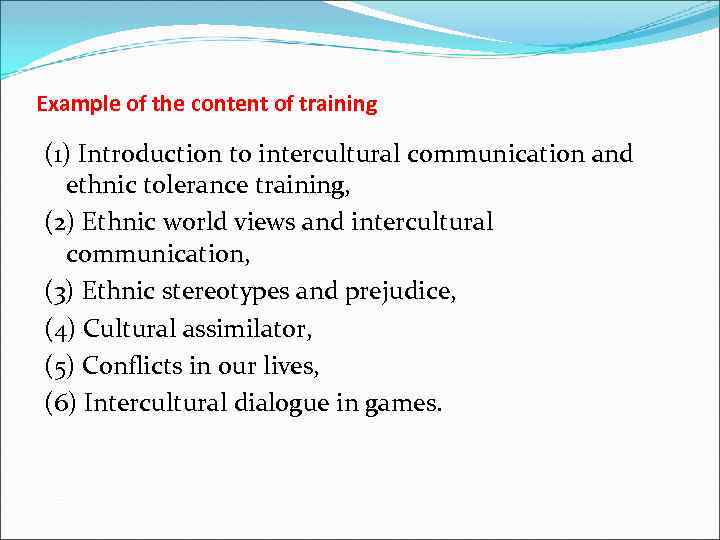 Example of the content of training (1) Introduction to intercultural communication and ethnic tolerance training, (2) Ethnic world views and intercultural communication, (3) Ethnic stereotypes and prejudice, (4) Cultural assimilator, (5) Conflicts in our lives, (6) Intercultural dialogue in games.
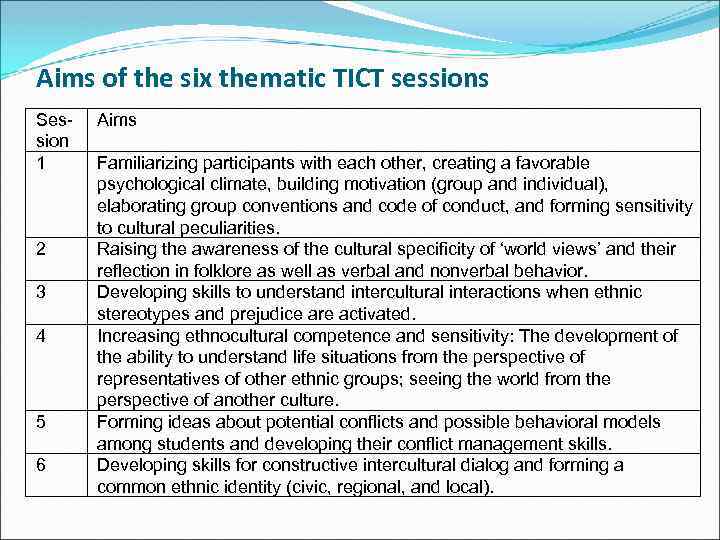 Aims of the six thematic TICT sessions Session 1 2 3 4 5 6 Aims Familiarizing participants with each other, creating a favorable psychological climate, building motivation (group and individual), elaborating group conventions and code of conduct, and forming sensitivity to cultural peculiarities. Raising the awareness of the cultural specificity of ‘world views’ and their reflection in folklore as well as verbal and nonverbal behavior. Developing skills to understand intercultural interactions when ethnic stereotypes and prejudice are activated. Increasing ethnocultural competence and sensitivity: The development of the ability to understand life situations from the perspective of representatives of other ethnic groups; seeing the world from the perspective of another culture. Forming ideas about potential conflicts and possible behavioral models among students and developing their conflict management skills. Developing skills for constructive intercultural dialog and forming a common ethnic identity (civic, regional, and local).
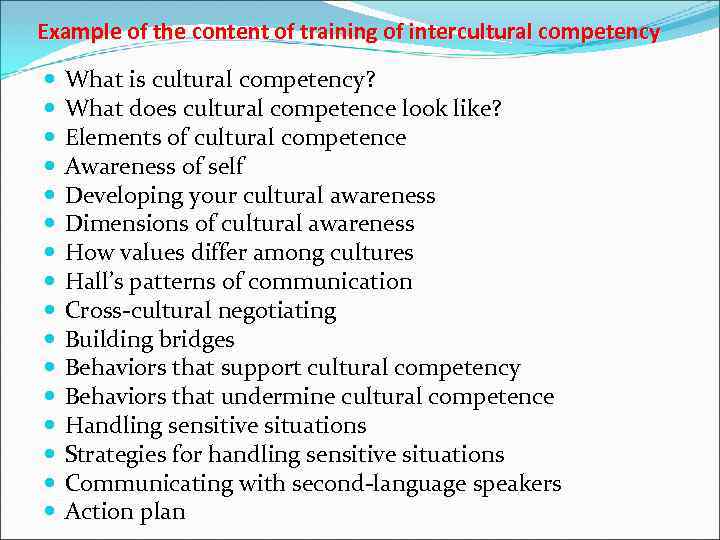 Example of the content of training of intercultural competency What is cultural competency? What does cultural competence look like? Elements of cultural competence Awareness of self Developing your cultural awareness Dimensions of cultural awareness How values differ among cultures Hall’s patterns of communication Cross-cultural negotiating Building bridges Behaviors that support cultural competency Behaviors that undermine cultural competence Handling sensitive situations Strategies for handling sensitive situations Communicating with second-language speakers Action plan
 Barriers to Becoming Interculturally Competent (Mak et al. , 1999) - Limited opportunities for coaching and practice - Interpersonal anxiety in cross-cultural encounters - Social avoidance from hosts and seeking refuge in coethnic “enclaves” - Strong ethnocentrism