


 Скачать презентацию Interconnection among Electronic Academic Journal Platforms Multilateral versus
ae44120fa4a6d4a867640238411437f5.ppt
- Количество слайдов: 37
 Interconnection among Electronic Academic Journal Platforms: Multilateral versus Bilateral Interconnection Doh-Shin Jeon (UPF, IESE (SP-SP), TSE) Domenico Menicucci (Universita di Firenze) IESE lunch seminar 13/11/07 Interconnection among Electronic Academic Journal Platforms 1
 Some background about the market for academic journals Move from print journals to electronic journals raises several fundamental issues: (1) Move from ''no bundling and no discrimination'‘ to ''bundling and discrimination'': Jeon-Menicucci (JEEA, 2006) (2) Open access journals: Jeon-Rochet (2007) (3) Interconnection (=interoperability) : this paper l IESE lunch seminar 13/11/07 Interconnection among Electronic Academic Journal Platforms 2
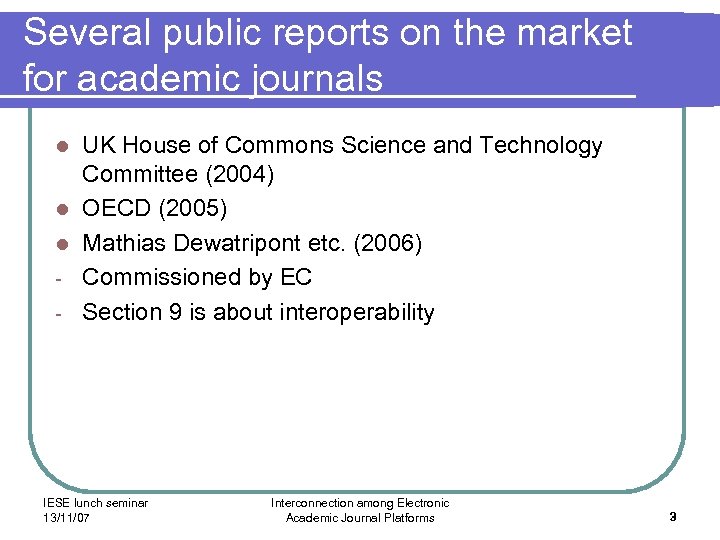 Several public reports on the market for academic journals l l l - UK House of Commons Science and Technology Committee (2004) OECD (2005) Mathias Dewatripont etc. (2006) Commissioned by EC Section 9 is about interoperability IESE lunch seminar 13/11/07 Interconnection among Electronic Academic Journal Platforms 3
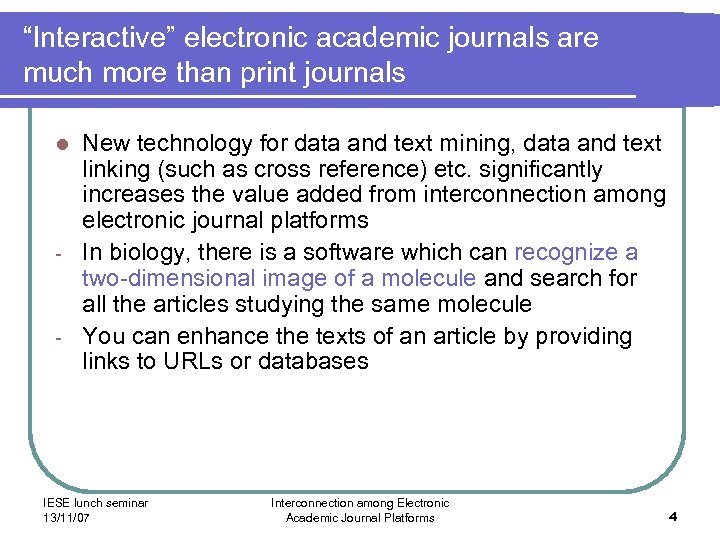 “Interactive” electronic academic journals are much more than print journals New technology for data and text mining, data and text linking (such as cross reference) etc. significantly increases the value added from interconnection among electronic journal platforms - In biology, there is a software which can recognize a two-dimensional image of a molecule and search for all the articles studying the same molecule - You can enhance the texts of an article by providing links to URLs or databases l IESE lunch seminar 13/11/07 Interconnection among Electronic Academic Journal Platforms 4
 Future in biology “One ultimate goal is “automatically generated knowledge layers” which will be overlaid on the electronic text and offer a quick route to connecting a paper with other relevant material – whether it is genes, proteins, metabolic markers etc. ” (Martin Hofmann, Frauhofer Institute of Algorithms and Scientific Computing) IESE lunch seminar 13/11/07 Interconnection among Electronic Academic Journal Platforms 5
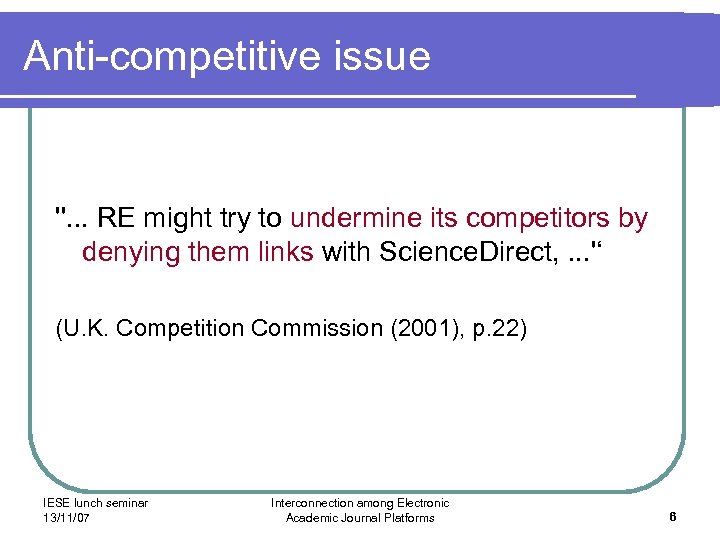 Anti-competitive issue ''. . . RE might try to undermine its competitors by denying them links with Science. Direct, . . . '‘ (U. K. Competition Commission (2001), p. 22) IESE lunch seminar 13/11/07 Interconnection among Electronic Academic Journal Platforms 6
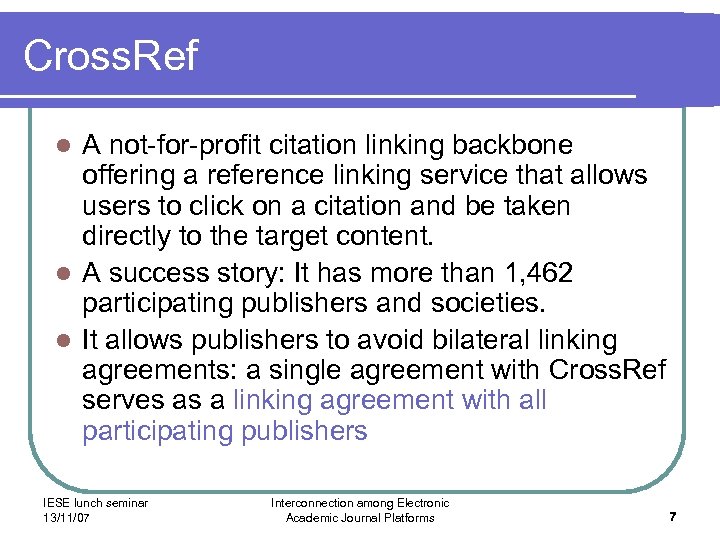 Cross. Ref A not-for-profit citation linking backbone offering a reference linking service that allows users to click on a citation and be taken directly to the target content. l A success story: It has more than 1, 462 participating publishers and societies. l It allows publishers to avoid bilateral linking agreements: a single agreement with Cross. Ref serves as a linking agreement with all participating publishers l IESE lunch seminar 13/11/07 Interconnection among Electronic Academic Journal Platforms 7
 Objective of this paper To compare the multilateral interconnection regime à la Cross. Ref with a bilateral interconnection regime in terms of (1) Incentive to interconnect (2) Profits (3) Welfare l IESE lunch seminar 13/11/07 Interconnection among Electronic Academic Journal Platforms 8
 Main results Publishers are fully interconnected under the multilateral interconnection regime but often partially interconnected under the bilateral one for exclusion or differentiation motives l If partial interconnection occurs for differentiation motive, exclusion of small publisher(s) occurs more often under the multilateral interconnection than under the bilateral one l IESE lunch seminar 13/11/07 Interconnection among Electronic Academic Journal Platforms 9
 Literature review Compatibility among networks: Katz-Shapiro (1985), Farrell and Saloner (1985, 1986) l Interconnection through two-way access pricing among telecommunication networks: Armstrong (1998) and Laffont-Rey-Tirole (1998 a, b) etc l Interconnection among Internet Backbone companies (IBP): Crémer-Rey-Tirole (2000) and Laffont-Marcus. Rey-Tirole (2003) l IESE lunch seminar 13/11/07 Interconnection among Electronic Academic Journal Platforms 10
 Our contribution to the literature To study a multilateral interconnection and to compare it with a bilateral one. l Interconnection among academic journal platforms l Application to Interconnection among Internet Backbone Companies (IBP) l IESE lunch seminar 13/11/07 Interconnection among Electronic Academic Journal Platforms 11
 Model We build on Jeon-Menicucci (JEEA, 2006): Each publisher practices bundling l Players: 3 asymmetric profit-maximizing publishers and one representative library l 3 games (1) m: Multilateral interconnection game à la Cross. Ref (2) b: Billateral interconnection game à la Cross. Ref (3) 0: game without interconnection l IESE lunch seminar 13/11/07 Interconnection among Electronic Academic Journal Platforms 12
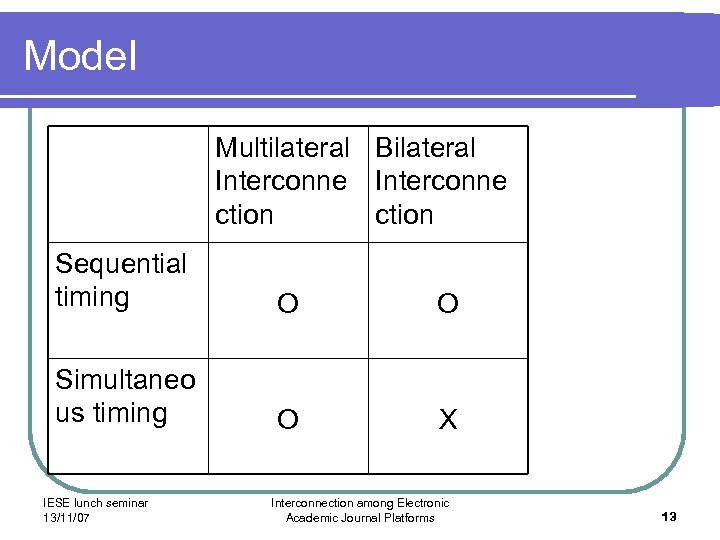 Model Multilateral Bilateral Interconne ction Sequential timing O O Simultaneo us timing O X IESE lunch seminar 13/11/07 Interconnection among Electronic Academic Journal Platforms 13
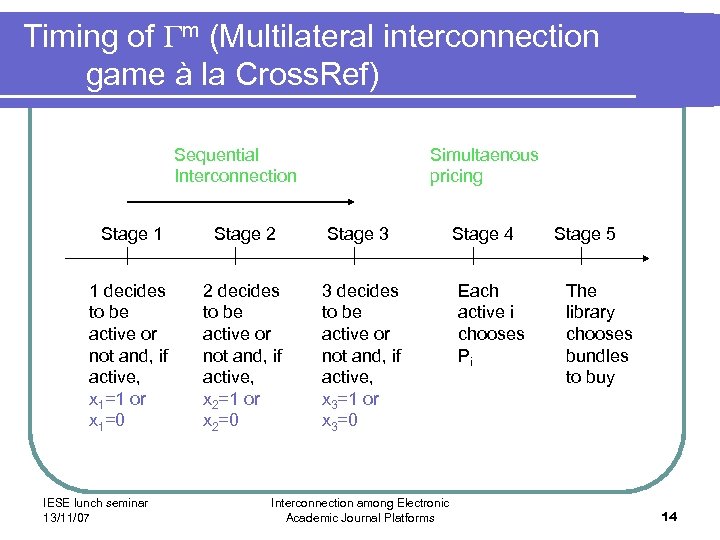 Timing of m (Multilateral interconnection game à la Cross. Ref) Sequential Interconnection Simultaenous pricing Stage 1 Stage 2 Stage 3 1 decides to be active or not and, if active, x 1=1 or x 1=0 2 decides to be active or not and, if active, x 2=1 or x 2=0 3 decides to be active or not and, if active, x 3=1 or x 3=0 IESE lunch seminar 13/11/07 Interconnection among Electronic Academic Journal Platforms Stage 4 Each active i chooses Pi Stage 5 The library chooses bundles to buy 14
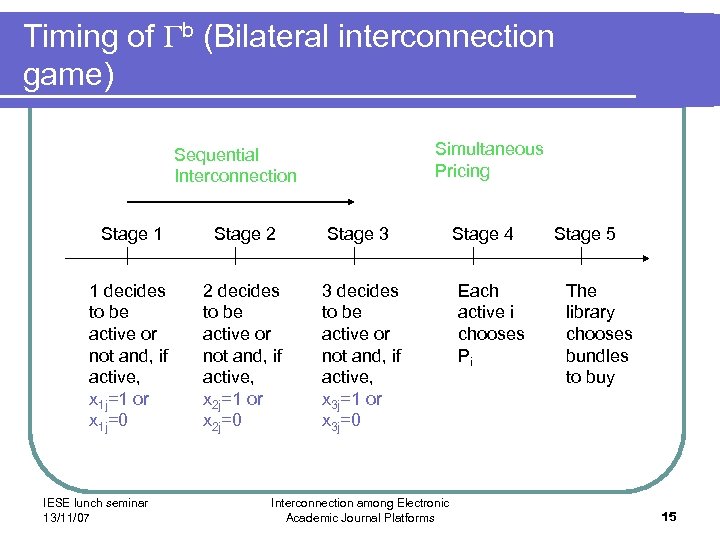 Timing of b (Bilateral interconnection game) Simultaneous Pricing Sequential Interconnection Stage 1 Stage 2 Stage 3 1 decides to be active or not and, if active, x 1 j=1 or x 1 j=0 2 decides to be active or not and, if active, x 2 j=1 or x 2 j=0 3 decides to be active or not and, if active, x 3 j=1 or x 3 j=0 IESE lunch seminar 13/11/07 Interconnection among Electronic Academic Journal Platforms Stage 4 Each active i chooses Pi Stage 5 The library chooses bundles to buy 15
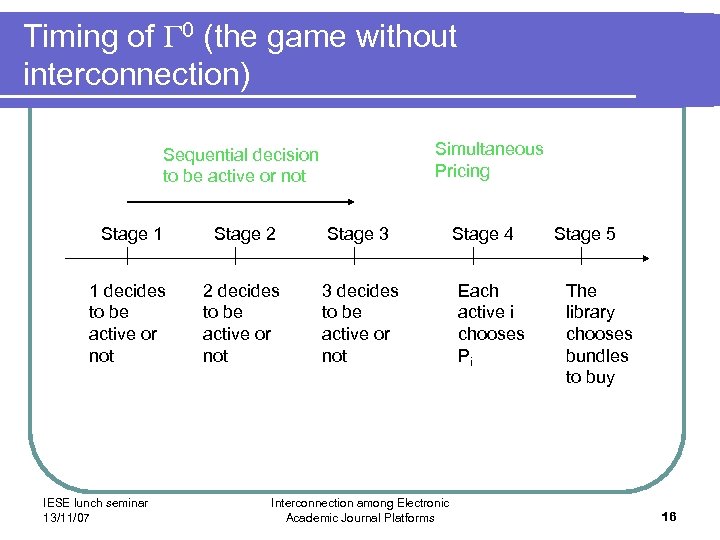 Timing of 0 (the game without interconnection) Simultaneous Pricing Sequential decision to be active or not Stage 1 Stage 2 Stage 3 1 decides to be active or not 2 decides to be active or not 3 decides to be active or not IESE lunch seminar 13/11/07 Interconnection among Electronic Academic Journal Platforms Stage 4 Each active i chooses Pi Stage 5 The library chooses bundles to buy 16
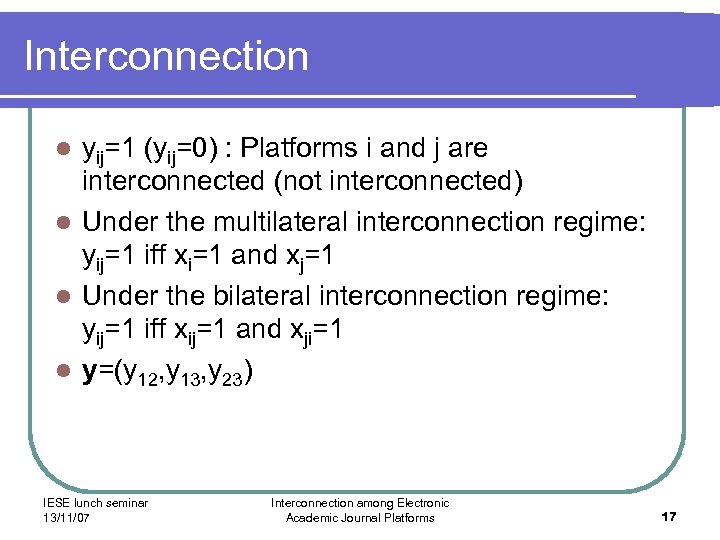 Interconnection yij=1 (yij=0) : Platforms i and j are interconnected (not interconnected) l Under the multilateral interconnection regime: yij=1 iff xi=1 and xj=1 l Under the bilateral interconnection regime: yij=1 iff xij=1 and xji=1 l y=(y 12, y 13, y 23) l IESE lunch seminar 13/11/07 Interconnection among Electronic Academic Journal Platforms 17
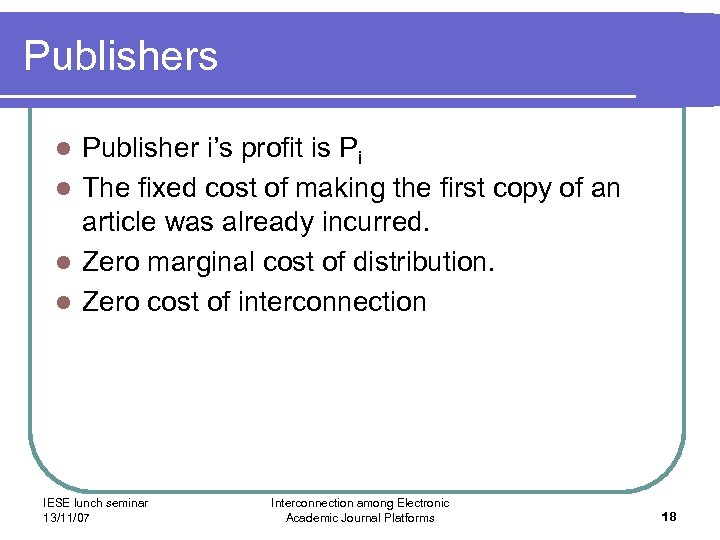 Publishers Publisher i’s profit is Pi l The fixed cost of making the first copy of an article was already incurred. l Zero marginal cost of distribution. l Zero cost of interconnection l IESE lunch seminar 13/11/07 Interconnection among Electronic Academic Journal Platforms 18
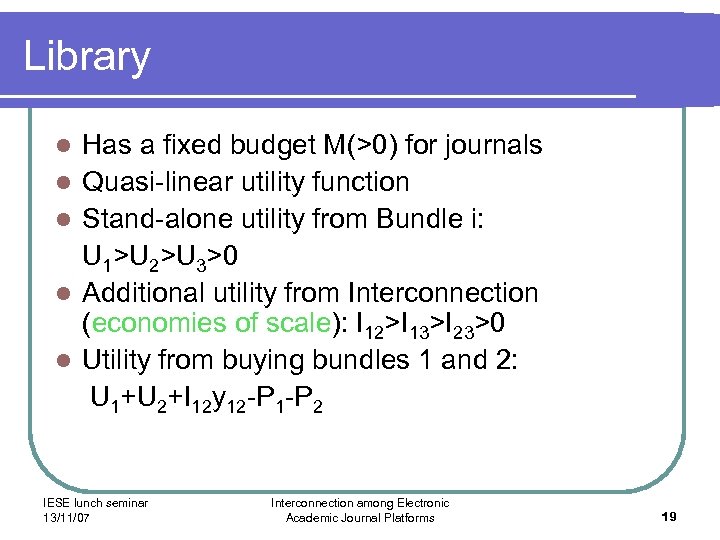 Library l l l Has a fixed budget M(>0) for journals Quasi-linear utility function Stand-alone utility from Bundle i: U 1>U 2>U 3>0 Additional utility from Interconnection (economies of scale): I 12>I 13>I 23>0 Utility from buying bundles 1 and 2: U 1+U 2+I 12 y 12 -P 1 -P 2 IESE lunch seminar 13/11/07 Interconnection among Electronic Academic Journal Platforms 19
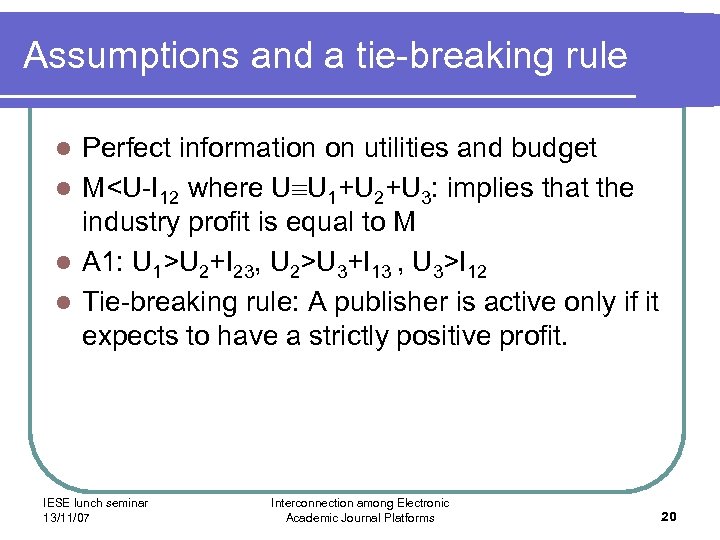 Assumptions and a tie-breaking rule Perfect information on utilities and budget l M
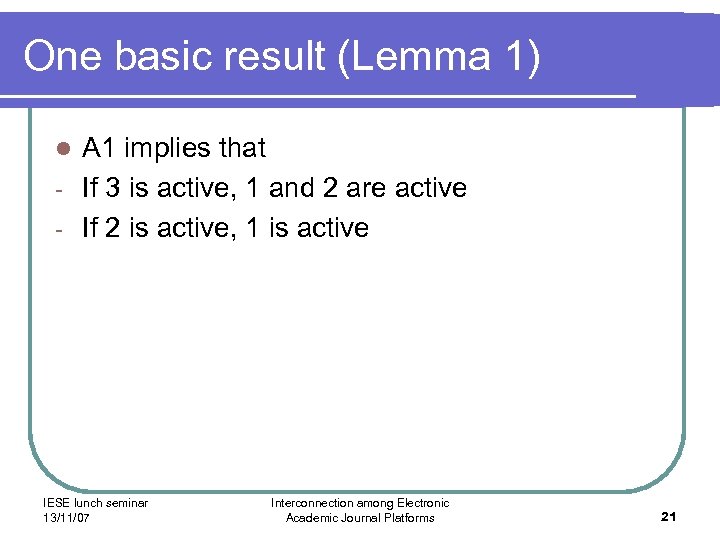 One basic result (Lemma 1) A 1 implies that - If 3 is active, 1 and 2 are active - If 2 is active, 1 is active l IESE lunch seminar 13/11/07 Interconnection among Electronic Academic Journal Platforms 21
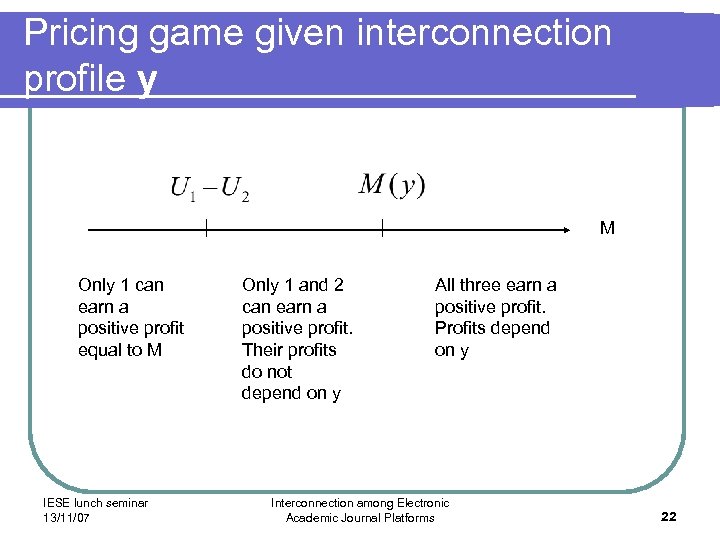 Pricing game given interconnection profile y M Only 1 can earn a positive profit equal to M IESE lunch seminar 13/11/07 Only 1 and 2 can earn a positive profit. Their profits do not depend on y All three earn a positive profit. Profits depend on y Interconnection among Electronic Academic Journal Platforms 22
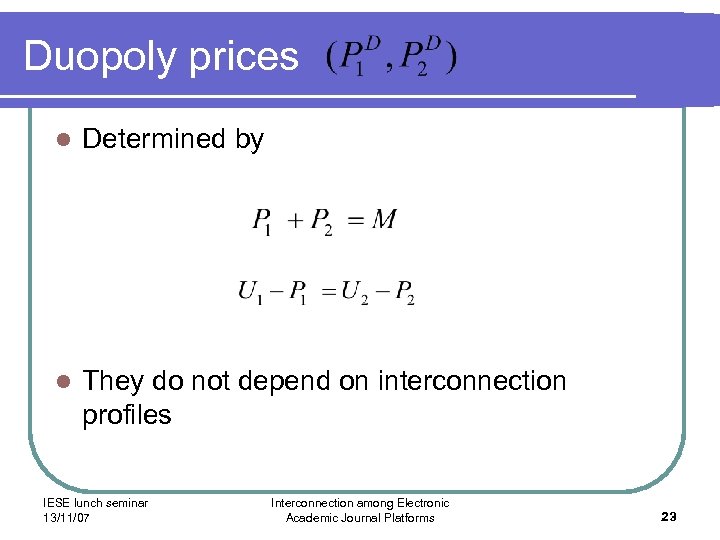 Duopoly prices l Determined by l They do not depend on interconnection profiles IESE lunch seminar 13/11/07 Interconnection among Electronic Academic Journal Platforms 23
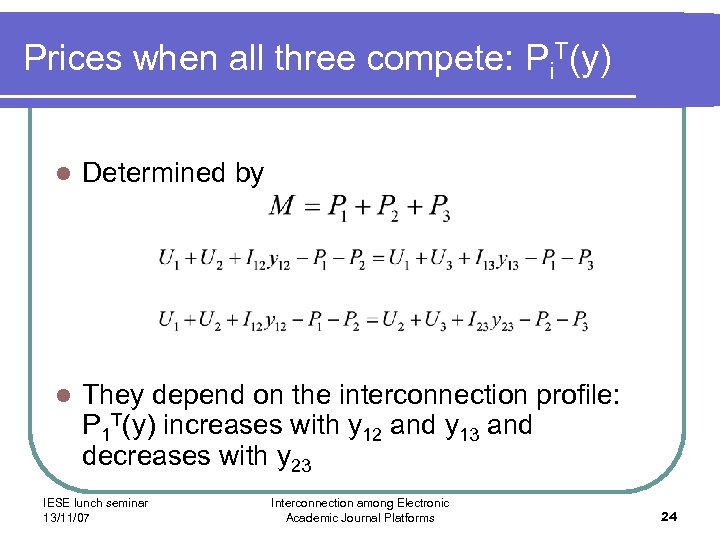 Prices when all three compete: Pi. T(y) l Determined by l They depend on the interconnection profile: P 1 T(y) increases with y 12 and y 13 and decreases with y 23 IESE lunch seminar 13/11/07 Interconnection among Electronic Academic Journal Platforms 24
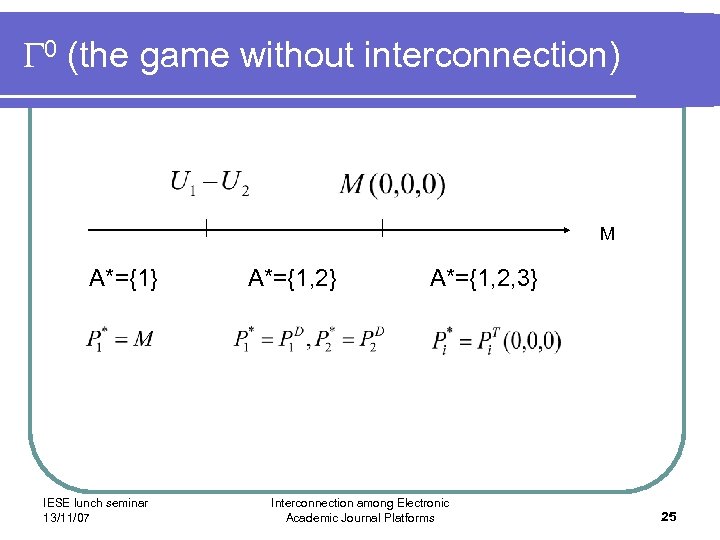 0 (the game without interconnection) M A*={1} IESE lunch seminar 13/11/07 A*={1, 2} A*={1, 2, 3} Interconnection among Electronic Academic Journal Platforms 25
 One basic result regarding incentive to interconnect y=(y 12, y 13, y 23)=(1, 0, 0) is the least favorable for 3. l If M>M(1, 0, 0), 3 makes a positive profit for any interconnection profile l Then, all publishers fully interconnect regardless of the mode of interconnection. l Question: What happens for M M(1, 0, 0)? l IESE lunch seminar 13/11/07 Interconnection among Electronic Academic Journal Platforms 26
 m (Multilateral interconnection game à la Cross. Ref): Incentive to interconnects (0, 1, 0) is the most favorable interconnection profile for 3 under m l If M M(0, 1, 0), 3 cannot make a positive profit for any possible y under m. Hence, we consider M>M(0, 1, 0). l Lemma 3: For each publisher, interconnection is a best response and sometimes the unique one. l IESE lunch seminar 13/11/07 Interconnection among Electronic Academic Journal Platforms 27
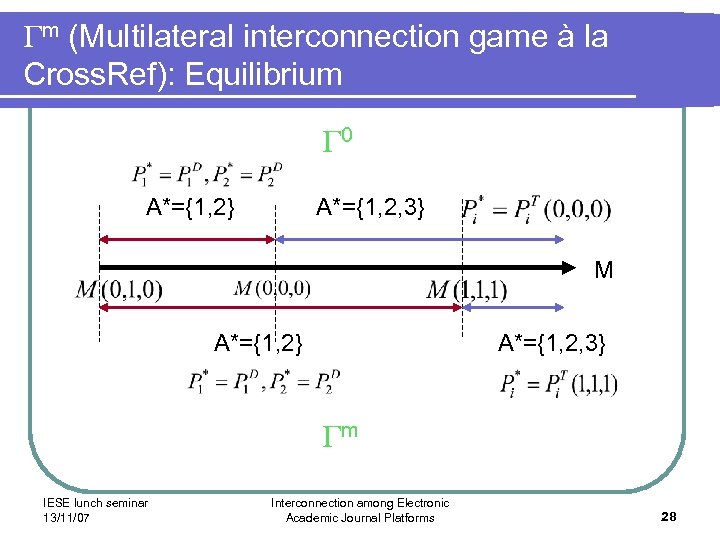 m (Multilateral interconnection game à la Cross. Ref): Equilibrium 0 A*={1, 2} A*={1, 2, 3} M A*={1, 2} A*={1, 2, 3} m IESE lunch seminar 13/11/07 Interconnection among Electronic Academic Journal Platforms 28
 m (Multilateral interconnection game à la Cross. Ref): Intuition More exclusion of 3 under m than under 0 becase of the economies of scale l Exclusion motive does not modify the incentive to interconnect - If 1 chooses x 1=0, 2 and 3 respond by x 2=x 3=1. Hence, x 1=0 only worsens 1’s relative standing. l IESE lunch seminar 13/11/07 Interconnection among Electronic Academic Journal Platforms 29
 b (Bilateral interconnection game): results If M M(0, 1, 1), 3 cannot make a positive profit for any possible y under b. Hence, we consider M>M(0, 1, 1). l Main result: Partial interconnections may arise for two different motives, exclusion or differentiation motive (1) Exclusion motive: If 1 and 2 are similar but 2 is much larger than 3, 1 or 2 excludes 3 by breaking connectivity with 3 (2) Differentiation motive: If 2 and 3 are similar but 1 is much larger than 3, 1 breaks connectivity with 2 but maintains connectivity with 3 in order to differentiate itself with respect to 2. l IESE lunch seminar 13/11/07 Interconnection among Electronic Academic Journal Platforms 30
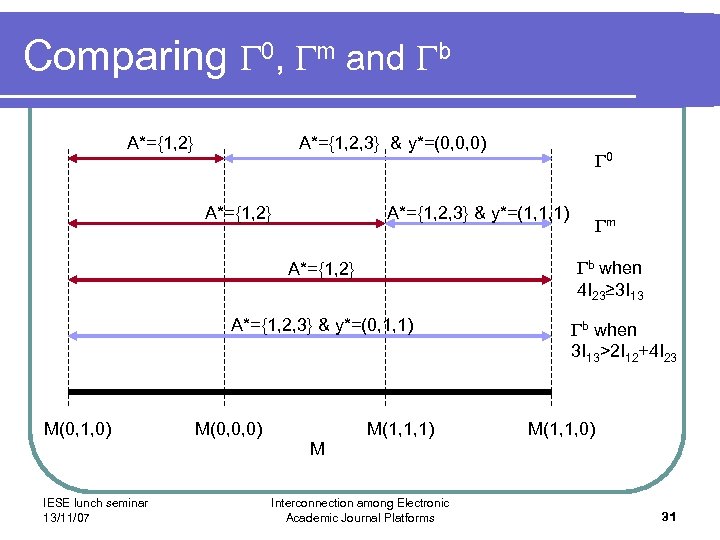 Comparing 0, m and b A*={1, 2} A*={1, 2, 3} & y*=(0, 0, 0) A*={1, 2} A*={1, 2, 3} & y*=(1, 1, 1) A*={1, 2, 3} & y*=(0, 1, 1) M(0, 0, 0) m b when 4 I 23≥ 3 I 13 A*={1, 2} M(0, 1, 0) 0 M(1, 1, 1) b when 3 I 13>2 I 12+4 I 23 M(1, 1, 0) M IESE lunch seminar 13/11/07 Interconnection among Electronic Academic Journal Platforms 31
 Social welfare SW coincides with the library’s payoff. l Under A 1, SW is first determined by the number of active publishers and then by the level of interconnection l As long as A* is the same, the multilateral regime is at least weakly the best. l Otherwise, no interconnection regime or the bilateral regime can be optimal l IESE lunch seminar 13/11/07 Interconnection among Electronic Academic Journal Platforms 32
 Symmetric publishers with sequential interconnection Under the multilateral interconnection regime, all publishers are active and fully interconnected l Under the bilateral regime (1) If M
 Robustness: the multilateral interconnection l The outcome of the sequential interconnection game is equivalent to that of the simultaneous interconnection game l The results of both games extend to the case of any number of heterogeneous libraries IESE lunch seminar 13/11/07 Interconnection among Electronic Academic Journal Platforms 34
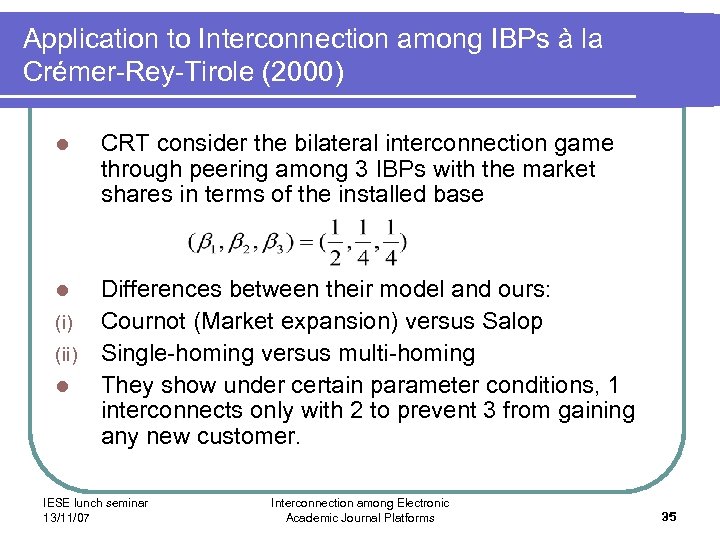 Application to Interconnection among IBPs à la Crémer-Rey-Tirole (2000) l CRT consider the bilateral interconnection game through peering among 3 IBPs with the market shares in terms of the installed base Differences between their model and ours: (i) Cournot (Market expansion) versus Salop (ii) Single-homing versus multi-homing l They show under certain parameter conditions, 1 interconnects only with 2 to prevent 3 from gaining any new customer. l IESE lunch seminar 13/11/07 Interconnection among Electronic Academic Journal Platforms 35
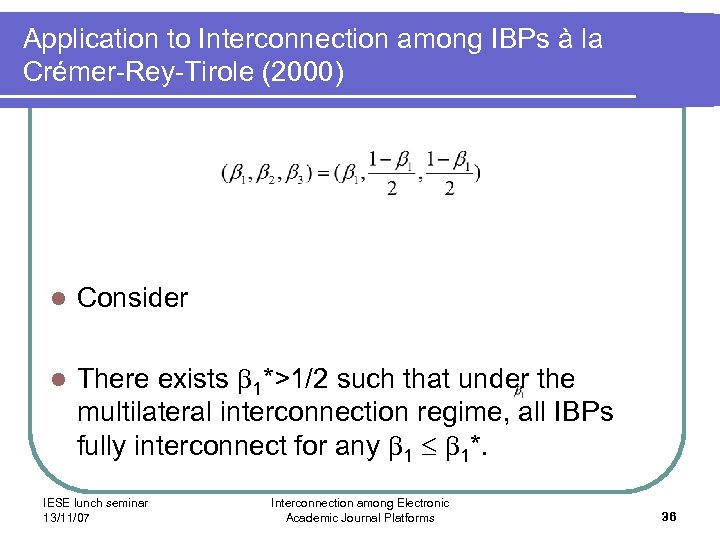 Application to Interconnection among IBPs à la Crémer-Rey-Tirole (2000) l Consider l There exists 1*>1/2 such that under the multilateral interconnection regime, all IBPs fully interconnect for any 1 1*. IESE lunch seminar 13/11/07 Interconnection among Electronic Academic Journal Platforms 36
 Conclusion l l l Interconnection (or interoperability) among different electronic platforms is a very important issue in general and in particular, in the case of academic journals. The multilateral interconnection provides much stronger incentive to interconnect than the bilateral one Our insight can be applied to Interconnection among Internet Backbone companies. A surprising result is that exclusion may occur more often under the multilateral regime than under the bilateral regime and hence SW may be higher under the latter A general message: Allowing firms to have finer instruments to discriminate makes interconnection more difficult than banning the discrimination (Jeon, Laffont, Tirole, RJE, 2005) IESE lunch seminar 13/11/07 Interconnection among Electronic Academic Journal Platforms 37