


 Скачать презентацию Interactive session design cost effectiveness Jan J
e55efb7f9f0b0ccbbd320860d2c6eb98.ppt
- Количество слайдов: 24
 Interactive session design cost effectiveness • Jan J. v. Busschbach, Ph. D. • Erasmus MC – Institute for Medical Psychology and Psychotherapy PO Box 1738 3000 DR Rotterdam +31 10 4087807 J. vanbusschbach@erasmusmc. nl • Psychotherapeutic centre 'De Viersprong’ – PO Box 7 4660 AA Halsteren + 31 164 632200 Jan. Busschbach@deviersprong. nl • Presentations can be found at – http: //www. xs 4 all. nl/~jannetvb/busschbach/ 1
 Questions to be solved; • Who is the audience? – Who’s perspective? • • Should we evaluated at all? What are the costs? What are the effects? How do effects relate to the costs in practice? – Model • Who to interpret the cost effectiveness ratio? 2
 The societal perspective • Standard in health economics • Determine cost (and effects) from the societal viewpoint – Resource used by all parties concerned – The cost for society as a whole • No matter who paying • Other perspectives are possible – Insurance, government, hospital, patient, industry, doctor
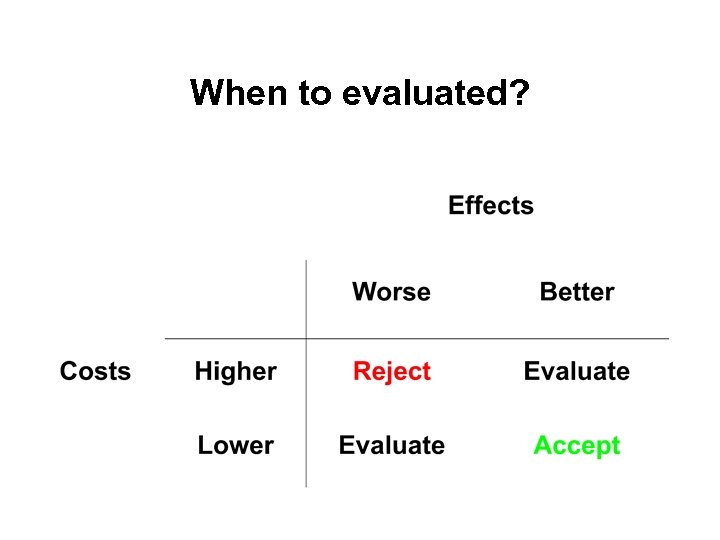 When to evaluated?
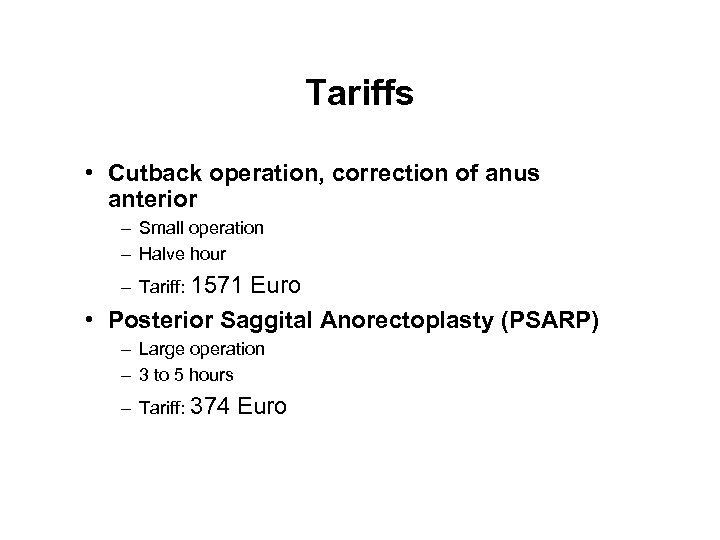 Tariffs • Cutback operation, correction of anus anterior – Small operation – Halve hour – Tariff: 1571 Euro • Posterior Saggital Anorectoplasty (PSARP) – Large operation – 3 to 5 hours – Tariff: 374 Euro
 Cost price investigations • Measure only volumes of major costs drivers • Estimated “real market prices” – One should include all resources used » The societal perspective – Shadow pricing • Tariffs are only used in health economics – If they are a reasonable accurate indication of the resources used – If they are a small proportion of the total costs – If they volumes do not contribute to the incremental costs » (the difference between to alternative programs)
 We are in need of uni-dimensional effects • For instance: – $ 10, 000. 1 hip transplantation – $ 15, 000 , 1 wheelchair • Costs can be compared – Are uni-dimensionaal • Effects are less easy to compare – Effects are multi-dimensional • How to make the effects also uni-dimensional? 7
 How to make the effects unidimensional? • Three methods – Cost Benefit Analysis » Express effects in money – Cost Effectiveness Analysis » Focus on one effect – Cost per QALY Analysis (Utility) » QALY 8
 QALY league table 9
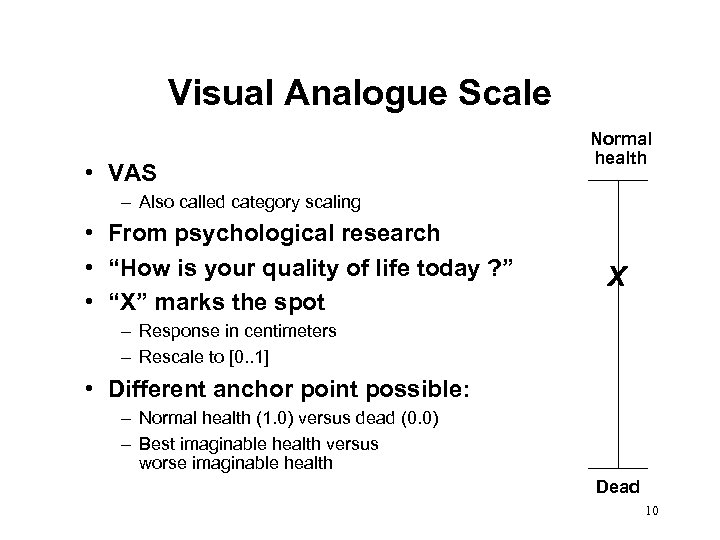 Visual Analogue Scale • VAS Normal health – Also called category scaling • From psychological research • “How is your quality of life today ? ” • “X” marks the spot X – Response in centimeters – Rescale to [0. . 1] • Different anchor point possible: – Normal health (1. 0) versus dead (0. 0) – Best imaginable health versus worse imaginable health Dead 10
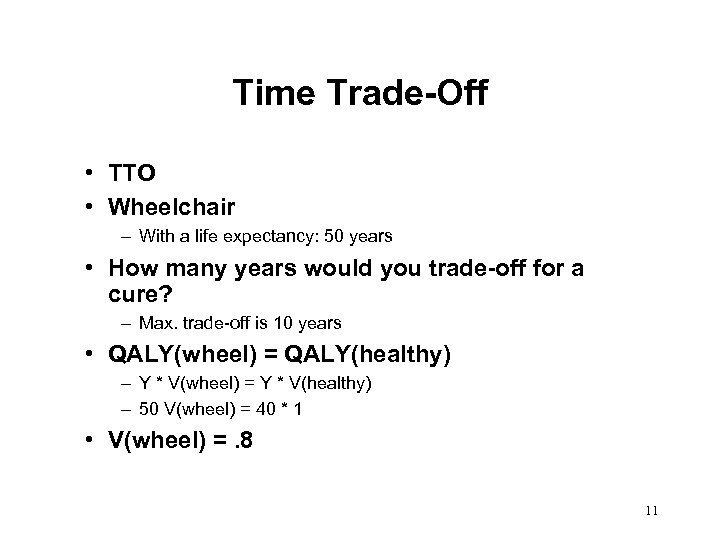 Time Trade-Off • TTO • Wheelchair – With a life expectancy: 50 years • How many years would you trade-off for a cure? – Max. trade-off is 10 years • QALY(wheel) = QALY(healthy) – Y * V(wheel) = Y * V(healthy) – 50 V(wheel) = 40 * 1 • V(wheel) =. 8 11
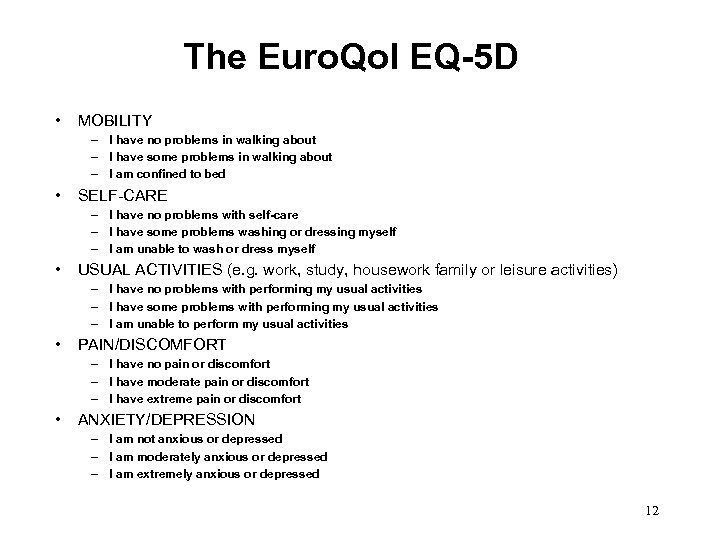 The Euro. Qol EQ-5 D • MOBILITY – I have no problems in walking about – I have some problems in walking about – I am confined to bed • SELF-CARE – I have no problems with self-care – I have some problems washing or dressing myself – I am unable to wash or dress myself • USUAL ACTIVITIES (e. g. work, study, housework family or leisure activities) – I have no problems with performing my usual activities – I have some problems with performing my usual activities – I am unable to perform my usual activities • PAIN/DISCOMFORT – I have no pain or discomfort – I have moderate pain or discomfort – I have extreme pain or discomfort • ANXIETY/DEPRESSION – I am not anxious or depressed – I am moderately anxious or depressed – I am extremely anxious or depressed 12
 Validated Questionnaires • Describe health states • Have values from the general public – – – Rosser QWB 15 D HUI Mark 2 HUI Mark 3 Euro. Qol EQ-5 D 13
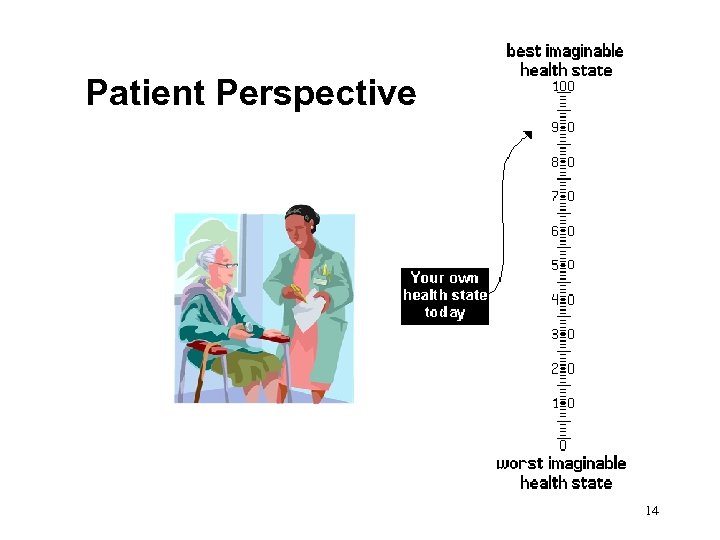 Patient Perspective 14
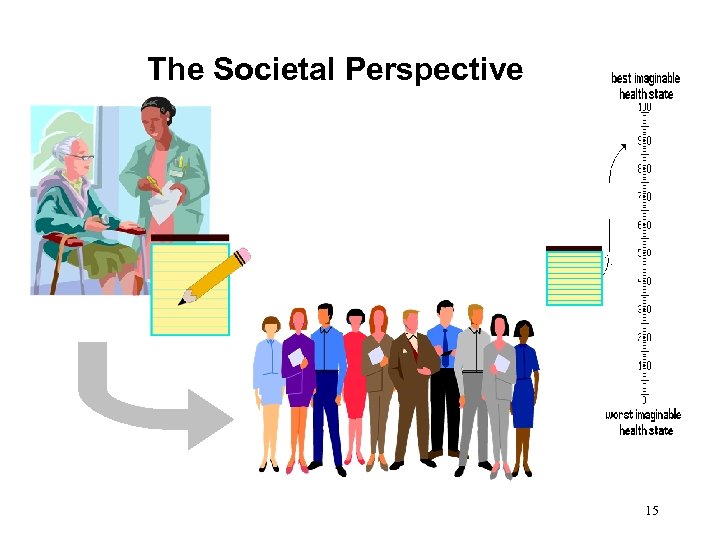 The Societal Perspective 15
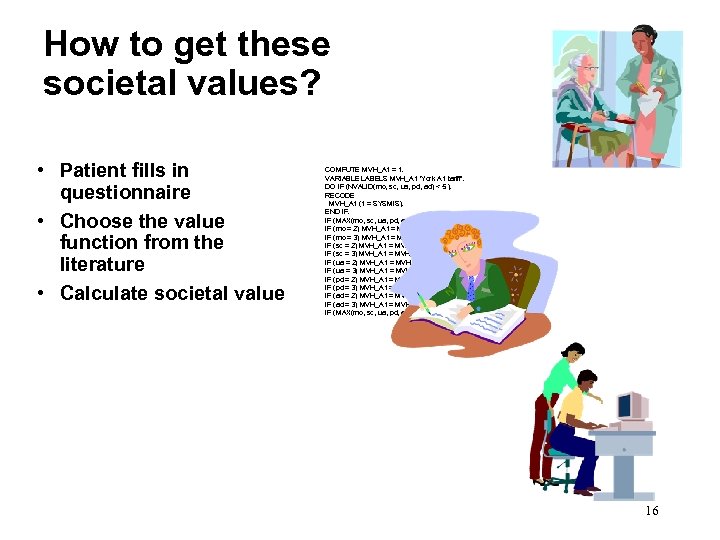 How to get these societal values? • Patient fills in questionnaire • Choose the value function from the literature • Calculate societal value COMPUTE MVH_A 1 = 1. VARIABLE LABELS MVH_A 1 'York A 1 tariff'. DO IF (NVALID(mo, sc, ua, pd, ad) < 5 ). RECODE MVH_A 1 (1 = SYSMIS). END IF. IF (MAX(mo, sc, ua, pd, ad) > 1) MVH_A 1 = MVH_A 1 -. 081. IF (mo = 2) MVH_A 1 = MVH_A 1 -. 069. IF (mo = 3) MVH_A 1 = MVH_A 1 -. 314. IF (sc = 2) MVH_A 1 = MVH_A 1 -. 104. IF (sc = 3) MVH_A 1 = MVH_A 1 -. 214. IF (ua = 2) MVH_A 1 = MVH_A 1 -. 036. IF (ua = 3) MVH_A 1 = MVH_A 1 -. 094. IF (pd = 2) MVH_A 1 = MVH_A 1 -. 123. IF (pd = 3) MVH_A 1 = MVH_A 1 -. 386. IF (ad = 2) MVH_A 1 = MVH_A 1 -. 071. IF (ad = 3) MVH_A 1 = MVH_A 1 -. 236. IF (MAX(mo, sc, ua, pd, ad) > 2) MVH_A 1 = MVH_A 1 -. 269. 16
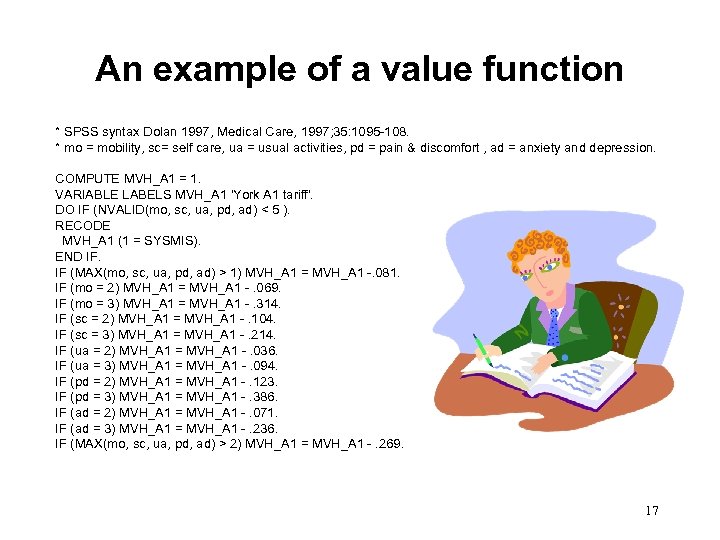 An example of a value function * SPSS syntax Dolan 1997, Medical Care, 1997; 35: 1095 -108. * mo = mobility, sc= self care, ua = usual activities, pd = pain & discomfort , ad = anxiety and depression. COMPUTE MVH_A 1 = 1. VARIABLE LABELS MVH_A 1 'York A 1 tariff'. DO IF (NVALID(mo, sc, ua, pd, ad) < 5 ). RECODE MVH_A 1 (1 = SYSMIS). END IF. IF (MAX(mo, sc, ua, pd, ad) > 1) MVH_A 1 = MVH_A 1 -. 081. IF (mo = 2) MVH_A 1 = MVH_A 1 -. 069. IF (mo = 3) MVH_A 1 = MVH_A 1 -. 314. IF (sc = 2) MVH_A 1 = MVH_A 1 -. 104. IF (sc = 3) MVH_A 1 = MVH_A 1 -. 214. IF (ua = 2) MVH_A 1 = MVH_A 1 -. 036. IF (ua = 3) MVH_A 1 = MVH_A 1 -. 094. IF (pd = 2) MVH_A 1 = MVH_A 1 -. 123. IF (pd = 3) MVH_A 1 = MVH_A 1 -. 386. IF (ad = 2) MVH_A 1 = MVH_A 1 -. 071. IF (ad = 3) MVH_A 1 = MVH_A 1 -. 236. IF (MAX(mo, sc, ua, pd, ad) > 2) MVH_A 1 = MVH_A 1 -. 269. 17
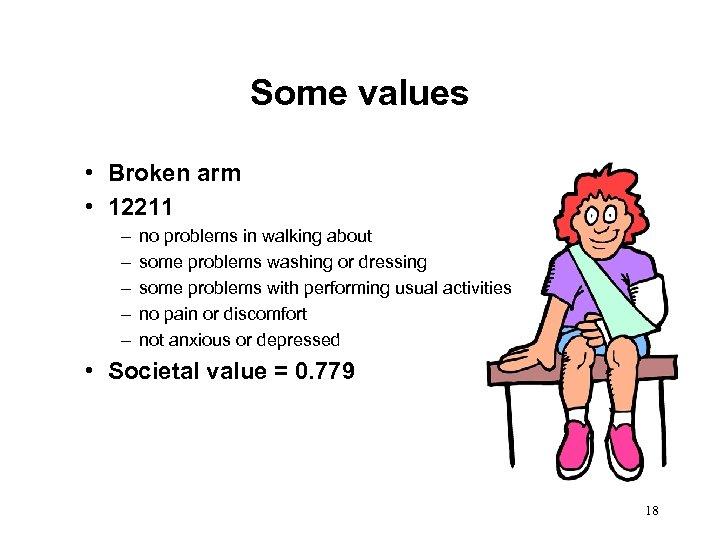 Some values • Broken arm • 12211 – – – no problems in walking about some problems washing or dressing some problems with performing usual activities no pain or discomfort not anxious or depressed • Societal value = 0. 779 18
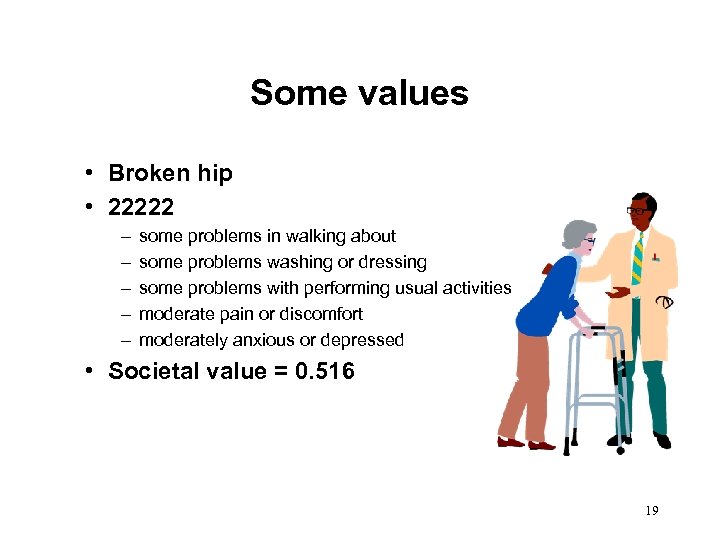 Some values • Broken hip • 22222 – – – some problems in walking about some problems washing or dressing some problems with performing usual activities moderate pain or discomfort moderately anxious or depressed • Societal value = 0. 516 19
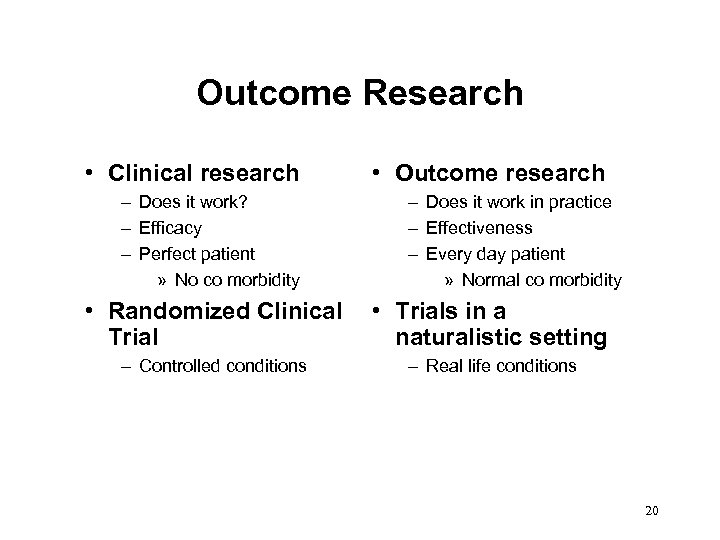 Outcome Research • Clinical research – Does it work? – Efficacy – Perfect patient » No co morbidity • Outcome research – Does it work in practice – Effectiveness – Every day patient » Normal co morbidity • Randomized Clinical Trial • Trials in a naturalistic setting – Controlled conditions – Real life conditions 20
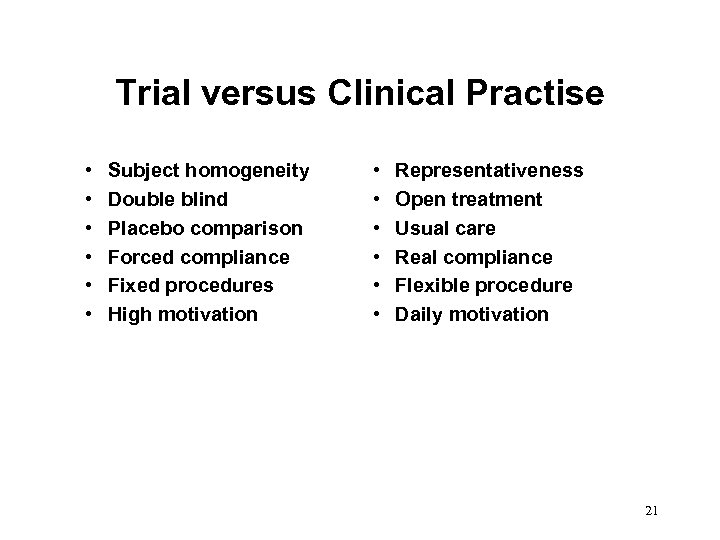 Trial versus Clinical Practise • • • Subject homogeneity Double blind Placebo comparison Forced compliance Fixed procedures High motivation • • • Representativeness Open treatment Usual care Real compliance Flexible procedure Daily motivation 21
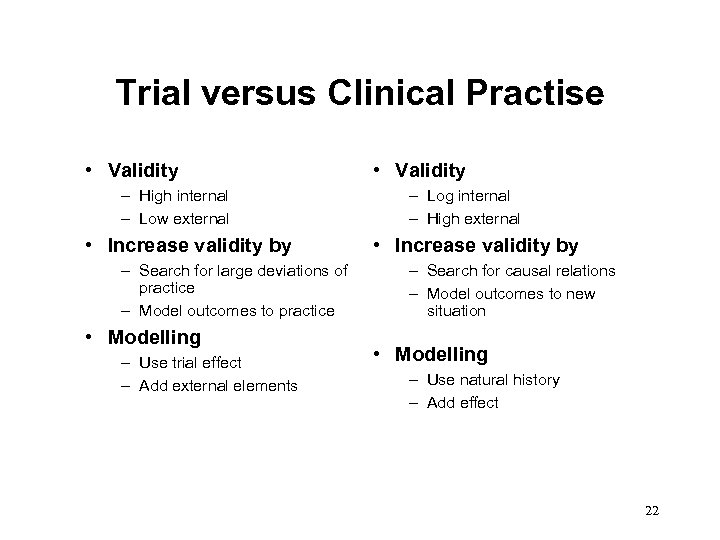 Trial versus Clinical Practise • Validity – High internal – Low external • Increase validity by – Search for large deviations of practice – Model outcomes to practice • Modelling – Use trial effect – Add external elements • Validity – Log internal – High external • Increase validity by – Search for causal relations – Model outcomes to new situation • Modelling – Use natural history – Add effect 22
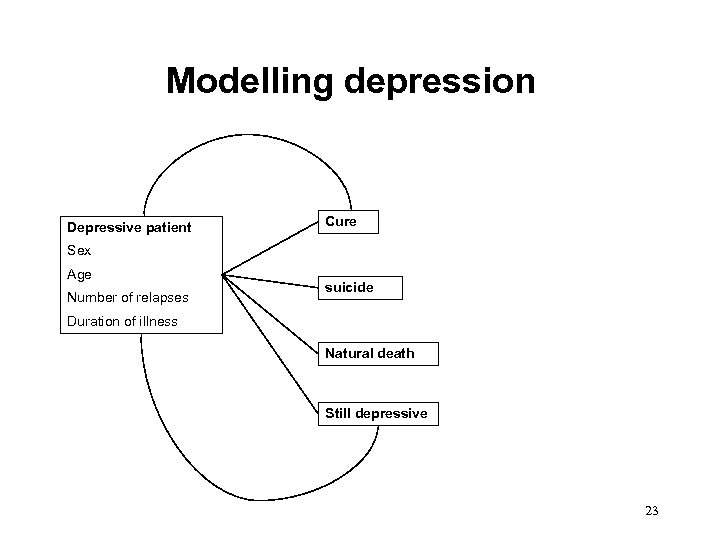 Modelling depression Depressive patient Cure Sex Age Number of relapses suicide Duration of illness Natural death Still depressive 23
 Books • Oostenbrink, J. B. , M. A. Koopmanschap, et al. – "Handleiding voor Kostenonderzoek. Methoden en Richtlijnprijzen voor Economische Evaluaties in de Gezondheidszorg. ” 2000, College voor Zorgverzekeringen • Rutten-van Mölken MPMH, Busschbach JJV, Rutten FFH. – Van Kosten tot Effecten: Een Handleiding voor Evaluatiesstudies in de Gezondheidszorg. Elsevier Gezondheidszorg, Maassen, ISBN: 90 352 2281 4. Zomer 2000 24