


 Скачать презентацию Interactive Science Journals Middle Level through High School
1e3d14c7044715c13e79078ca83341b1.ppt
- Количество слайдов: 35
 Interactive Science Journals Middle Level through High School
 “Compared to higher-scoring nations, U. S. science education is unfocused, fragmented, and more concerned with facts than the concepts that give them meaning. “ Third International Mathematics & Science Study (TIMSS) “(Science Education in America) is a ‘layer-cake curriculum’-- each course a mile wide and an inch deep. By contrast, students in Japan and other high-scoring nations focus on fewer topics and spend more time studying them. ” Senta Raizen, Dir. , National Center for Improving Science Education
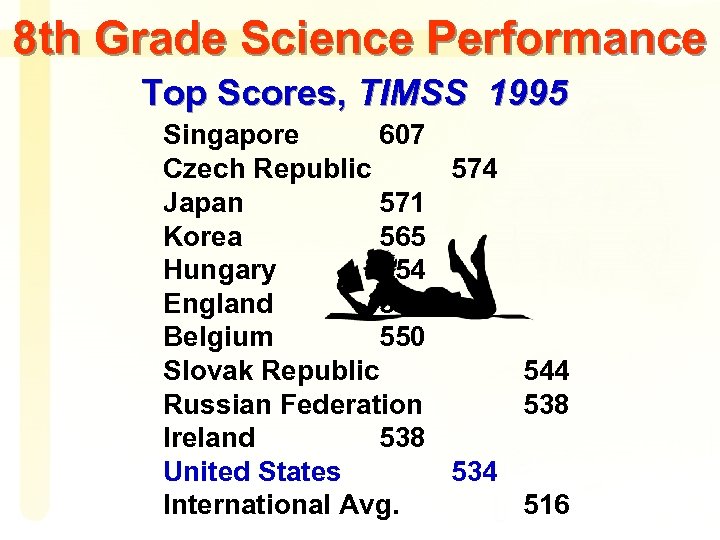 8 th Grade Science Performance Top Scores, TIMSS 1995 Singapore 607 Czech Republic 574 Japan 571 Korea 565 Hungary 554 England 552 Belgium 550 Slovak Republic 544 Russian Federation 538 Ireland 538 United States 534 International Avg. 516
 TIMSS Recommendations • Through Vertical Teaming, create a coherent, logical course sequence that is VISIBLE to teachers and students. • Do lab work that allows students to create their own experimental design comparing their analysis with others in the class. • Teach students to comprehend science as a process
 TIMSS Recommendations • Provide opportunities to obtain novel, unexpected data that either conflict with predicted results or cannot be accounted for the current hypothesis. • Use lab problems that require students to use their creativity and imagination.
 TIMSS Recommendations • Focus on fewer topics per grade • Study each topic more deeply • Give frequent feedback on student progress and quality of work • Give opportunities for independent learning • Design assessments that stress deep learning
 Interactive Science Journals • An innovative strategy for students and teachers, incorporating the independent learning, creativity and accountability and feedback stressed in the TIMSS Study
 What Is It? • Interactive Science Journals are a tool to strengthen student learning of curriculum (the input) through increased student participation (the output). • Simply put: more bang for the buck !
 Why Use Them? The Student Perspective • • • Claims ownership & responsibility Chooses ways to process information and gets to reflect on what’s been learned Includes more learning styles Develops higher-level thinking skills Organizes learning over time Work doesn’t get lost!
 Why Use Them? The Teacher Perspective • • • Make learning more democratic & inclusive Motivate participation Self-evaluate curriculum critically Monitor student progress easily Reduce time spent evaluating work Get ‘real’ student feedback on units • Parent-teacher communication tool
 Interactive Journal Summary • Spiral-bound ONLY - always with you • Right side - INPUT – Cornell notes (input, questions) – Lab data, log research projects • Left-side - OUTPUT – Concept maps, diagrams, lab flow-charts & procedures, photos, graphics • Summary - SELF-REFLECTION – Added at the end of a unit – Feedback on progress, enjoyment, goals
 Materials • 8 1/2 x 11 Spiral Notebook (80+ pgs) • • • Pen and pencil with eraser Glue sticks/tape/rubber cement Colored pencils or pens Highlighters Scissors
 Journal Fundamentals • Page Numbers • • Title Pages Tables of Contents Unit Introduction or Cover page Input: Right side Output: Left side Evaluation using a holistic rubric Regular student & parent feedback.
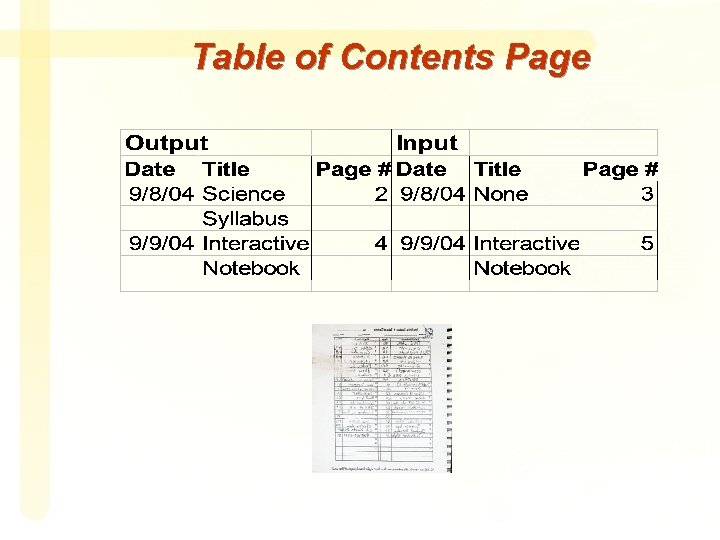 Table of Contents Page
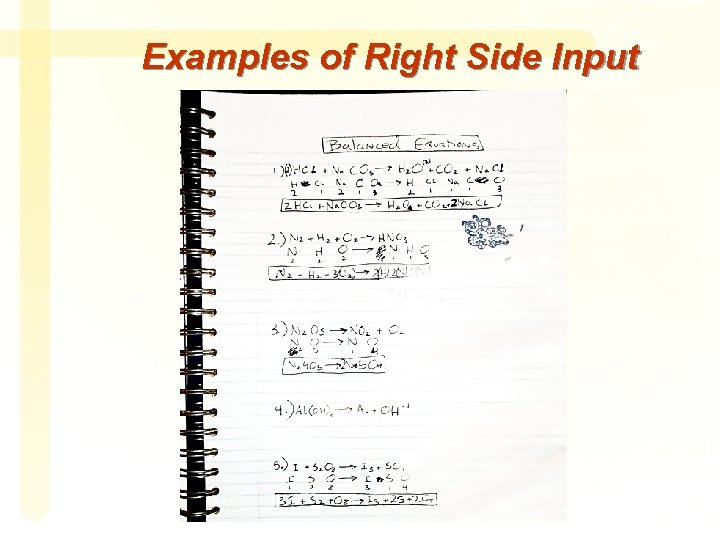 Examples of Right Side Input
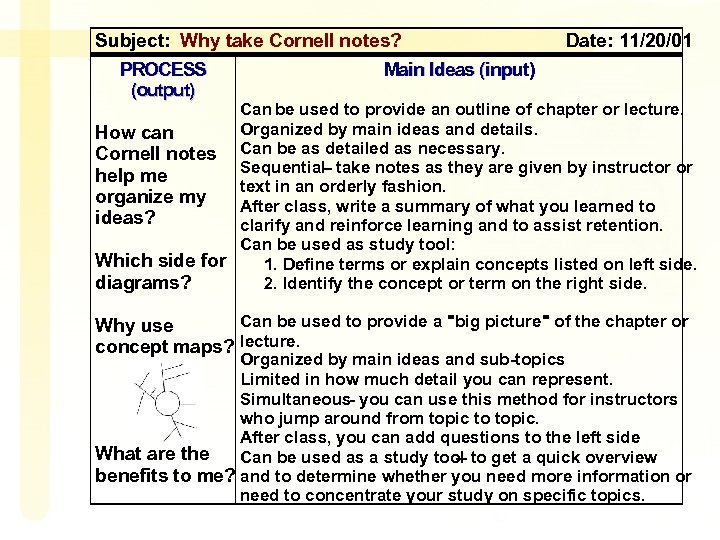 Subject: Why take Cornell notes? PROCESS (output) Date: 11/20/01 Main Ideas (input) Can be used to provide an outline of chapter or lecture. Organized by main ideas and details. How can Cornell notes Can be as detailed as necessary. Sequential- take notes as they are given by instructor or help me text in an orderly fashion. organize my After class, write a summary of what you learned to ideas? clarify and reinforce learning and to assist retention. Can be used as study tool: Which side for 1. Define terms or explain concepts listed on left side. diagrams? 2. Identify the concept or term on the right side. Can be used to provide a "big picture" of the chapter or Why use concept maps? lecture. Organized by main ideas and sub-topics Limited in how much detail you can represent. Simultaneous- you can use this method for instructors who jump around from topic to topic. After class, you can add questions to the left side What are the Can be used as a study tool to get a quick overview -benefits to me? and to determine whether you need more information or need to concentrate your study on specific topics.
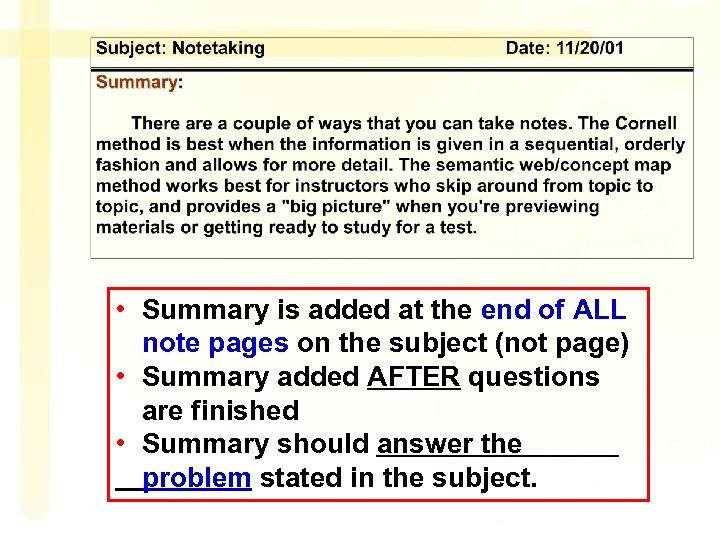 • Summary is added at the end of ALL note pages on the subject (not page) • Summary added AFTER questions are finished • Summary should answer the problem stated in the subject.
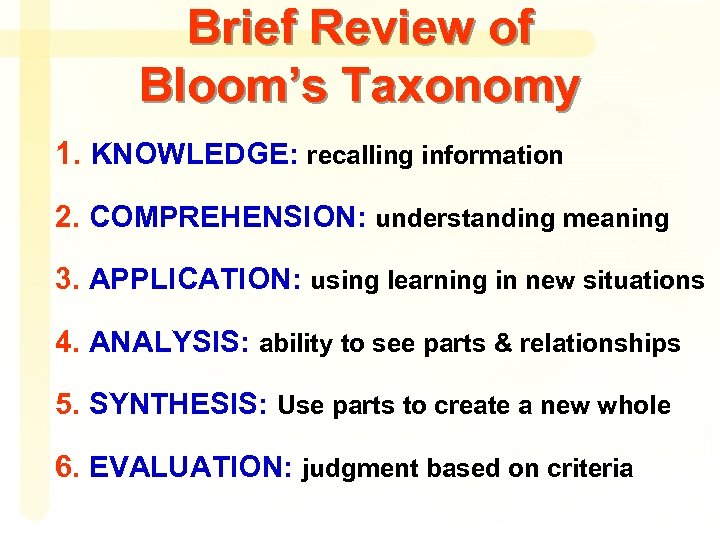 Brief Review of Bloom’s Taxonomy 1. KNOWLEDGE: recalling information 2. COMPREHENSION: understanding meaning 3. APPLICATION: using learning in new situations 4. ANALYSIS: ability to see parts & relationships 5. SYNTHESIS: Use parts to create a new whole 6. EVALUATION: judgment based on criteria
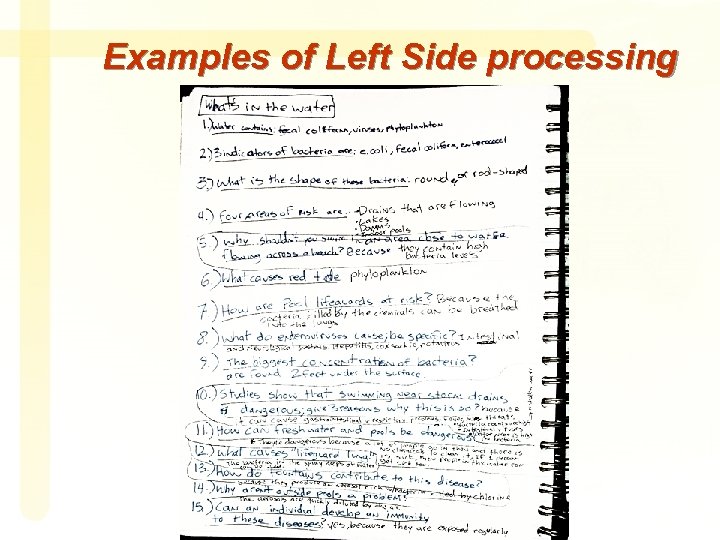 Examples of Left Side processing
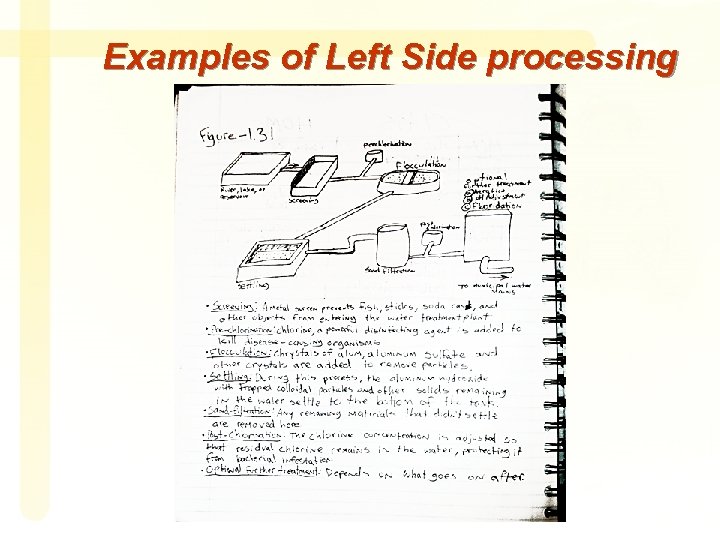 Examples of Left Side processing
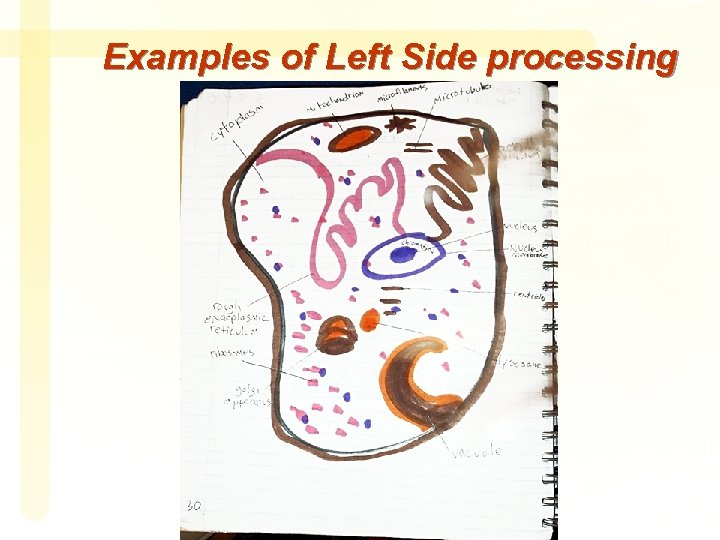 Examples of Left Side processing
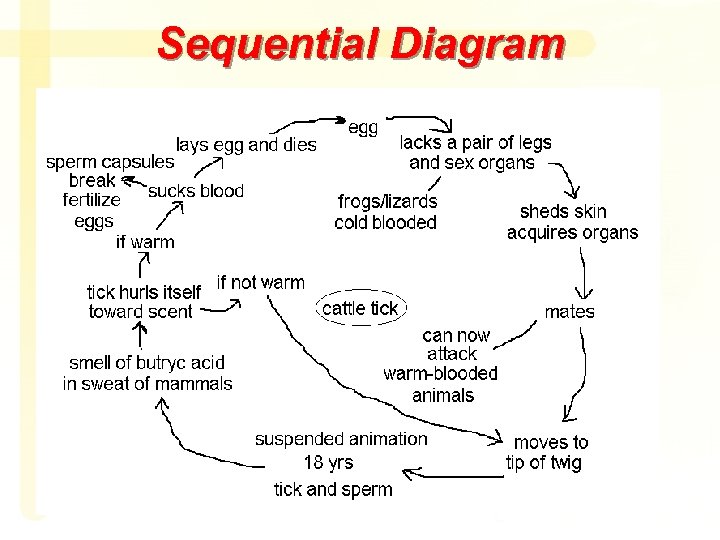 Sequential Diagram
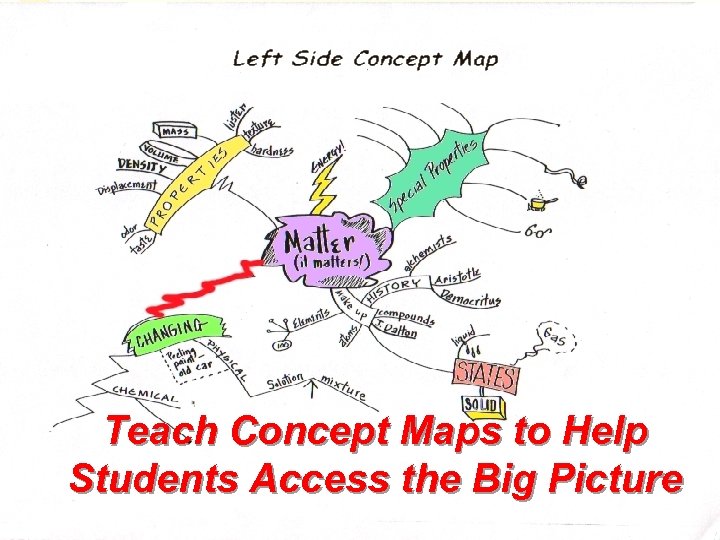 Teach Concept Maps to Help Students Access the Big Picture
 Self-Reflection • At the end of each day reflect on how you learned • At the end of each UNIT, have students add a special page for selfreflection on the topic • A way to give teachers critical feedback
 Reflective Paragraphs Begin your responses on the last left-hand page & continue on the right-hand 1. Choose 6 items, which represent your best interesting work - 3 from left side and 3 from the right side… 2. In several REFLECTIVE paragraphs, write specific reasons why you chose the items, why they are your best work, and what these assignments reflect about your skills as a student
 Reflective Paragraphs • Indicate your overall rating of your notebook based on the 6, 5, 4, 3, 2, 1 rubric. – What do you think this notebook deserves on an A‑F scale? – Include several sentences on WHY, using specific details, you've chosen this rating.
 Reflective Paragraphs • Using sentences and specifics, respond to the following: – What information was new to you? – Did the notebook help you this term? – What would improve the notebook ? – What are your goals for your next unit? – What improvements or areas to change would you like to see in class?
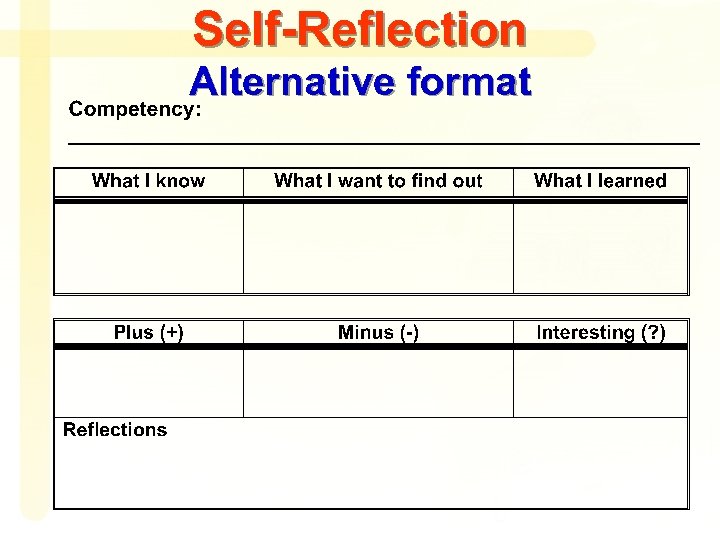 Self-Reflection Alternative format
 Scoring Rubric 6 Excellent • Notebook contents complete, dated & labeled • Pages are numbered (odd: RIGHT‑side even: LEFT‑side) • Right-side/Left-side topics correct & organized • Textbook notes/ writing goes beyond basic requirements • Uses color and effective diagrams • Notebook is neat and shows attention to detail. • Shows impressive, in-depth self-reflection about the work.
 Scoring Rubric 5 Above Average • Contents complete, dated & labeled • Pages correctly numbered • Right-side/Left-side topics correct & organized • Uses color and effective diagrams • Most areas meet requirements, but don't go beyond • Includes most of the traits of a "6", but lacks excellence in all areas. • Shows in-depth self-reflection
 Scoring Rubric 4 Average • Notebook contents are complete (at least 90%) dated & labeled • Pages correctly numbered • Right‑side/Left‑side topics are correct & contents organized • Uses color and some diagrams • Information shows a basic understanding • Some areas meet requirements, but don't go beyond • Shows limited, but real, self-reflection
 Scoring Rubric 3 Below Average • Contents complete (at least 80%) dated & labeled • Pages correctly numbered • Right/Left topics somewhat organized • Uses minimal color, few diagrams • Shows limited understanding • Few areas meet all requirements • Shows some real self-reflection
 Scoring Rubric 2 Inadaquate • Notebook contents are incomplete. • Some attempt at dating & labeling • Right-side/left-side inconsistent & contents unorganized • Information & concepts show only a superficial understanding and/or show serious inaccuracies • Notebook is not neatly written, sloppy • Shows little real self-reflection
 Scoring Rubric 1 Incomplete • Notebook turned in, but too incomplete to evaluate.
 Modified from Power. Point Developed by Anne Maben AVID AP Science Coach © 2001 LACOE All rights reserved