 Скачать презентацию Interac Association Chip readiness program Global Platform August
f9c738038f7eac042278da514278eed0.ppt
- Количество слайдов: 14



Interac Association Chip readiness program Global Platform August 21, 2002
Coverage • • • An introduction to Interac Association Business context for the chip initiative Objectives Scope & timeframes Draft requirements identified to date Approach being considered for technology acquisition • Near term implications 2
Interac: A Canadian Success Story • Resources & cooperation = national network infrastructure • 124 members • Two core services: – 1986 - Shared Cash Dispensing (SCD) – 1992 - Interac Direct Payment (IDP) • 325, 000 Merchants – with over 460, 000 POS terminals • 35, 000 ABMs • In 2001, Interac Direct Payment logged 2. 2 billion transactions, a 1000% increase since it was nationally available in 1994. 3
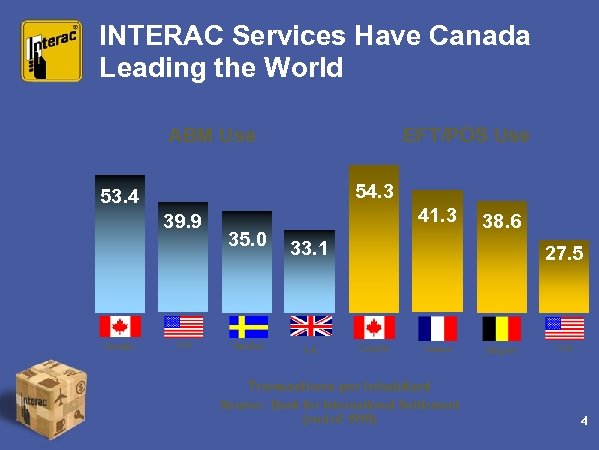
INTERAC Services Have Canada Leading the World ABM Use EFT/POS Use 54. 3 53. 4 39. 9 Canada U. S. 41. 3 35. 0 Sweden 38. 6 33. 1 U. K. 27. 5 Canada France Belgium U. S. Transactions per Inhabitant Source: Bank for International Settlement (end of 1999) 4
Business context for the chip initiative • The Canadian Chip Migration Project (CCMP) has been underway for 18 months, and is intended to enable the successful delivery of EMV-based chip payments infrastructure within Canada • To properly support CCMP the Association is defining the common business rules and infrastructure requirements needed to implement Interac Shared Services on chip • Chip specifications from the previous chip program (IMVCCP) are no longer current and need updating 5
Objectives • The objective of the chip program is to make Interac chip-ready ‘on paper’ if/when a Member decides it would like to move to chip. • Deliverables will include: – Business requirements – Operating rules and regulations – Project plans for changes to the Inter-Member Network – Project plans for the implementation of a Certification Authority – Plans for the implementation of a chip certification process – Test plans…. 6
Objectives • Deliverables will not include: – Development of plans for trials and roll-out – Implementation of changes to Inter-Member Network to accommodate chip – Implementation of a certification process – Implementation of a Certification Authority 7
Scope & timeframes • Scope includes: – Creation of technical specifications covering the Interac Shared Services – Stakeholder communications strategy – Opportunities to leverage, where feasible, the chip technologies developed by other card associations • Timeframe – Chip ready ‘on paper’ by mid-late 2003 – Implementation decision is separate and involves commitment of resources. 8
Draft requirements identified to date • Basic requirement – Replicate existing service functionality (… requires a multi-application chip card in order to address both domestic and international utility) • Possible Enhanced features to be included in the specification: – Provide cardholders with access to multiple accounts, and customize account availability for each Interac service – For off-line operations, differentiate risk parameters by account, by Interac service …… or share parameters where it makes sense to do so – Candidate lists presented for selection should be tailored to the specific circumstances of each cardholder – Position Members to offer multi-application (credit/debit) cards, should they so wish 9
Approach being considered for chip technology • Interac Association’s intention is to leverage existing chip infrastructures to the extent possible – reduce cost & complexity – shorten development time frames – minimize technology risk • Preliminary discussions already held with Visa, Master. Card, and AMEX, …. and with the major card manufacturers 10
Leveraging existing chip technology - evaluation criteria • What options are available, and how effective are they • What are the operational implications (risk, branding, cost, …) • What are the rules and conditions to be imposed • Do any of the options present opportunity to enhance existing services 11
Leveraging existing chip technology - ideal capabilities • For debit cards – use the application, the data structures, and any expected data values – use selected parts of the application, but allow for additional Interac specific processing routines, data structures, and data values, if required • For multi-application cards – use common application, common data structures, common data values – share particular aspects of the application, and perhaps some of its data, but utilise also Interac specific data and processing routines, if required 12
Leveraging existing technologies - preliminary conclusions • Basic requirements seem able to be met using existing masks (M-Chip, VSDC) • Enhanced features require either multiple instances of the application to be replicated within EEPROM, or development of an Interac-specific mask 13
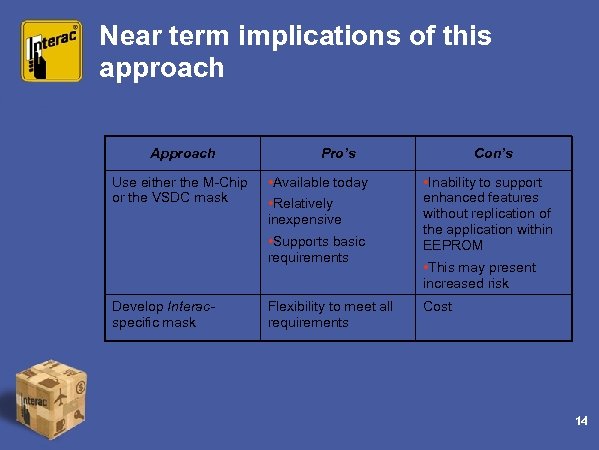
Near term implications of this approach Approach Use either the M-Chip or the VSDC mask Pro’s • Available today • Relatively inexpensive • Supports basic requirements Develop Interacspecific mask Flexibility to meet all requirements Con’s • Inability to support enhanced features without replication of the application within EEPROM • This may present increased risk Cost 14
Скачать презентацию Interac Association Chip readiness program Global Platform August
f9c738038f7eac042278da514278eed0.ppt