 Скачать презентацию Inter Connectivity Issues in Nigeria Some Perspectives Mobolaji E
c9e2af5319d56a78b6c6cbb75f0e967a.ppt
- Количество слайдов: 41



(Inter)Connectivity Issues in Nigeria: Some Perspectives Mobolaji E. Aluko, Ph. D Professor of Chemical Engineering Howard University, Washington DC; President/CEO Alondex Applied Technologies, LLC; Vice-President, NITPA (Nigerian Information Technology Professionals in the Americas)
A talk delivered at the 3 rd Annual International Nigerian Telecommunications Summit [‘Realising Opportunities in Nigerian Telecommunications”] September 20 -21, 2004 London, England 2
Outline of Talk 1. NCC & Interconnection 2. The Need for Interconnectivity 3. The Physical Structure 4. The Logical Structure 5. Nigerian Policy – Guided or Fully liberalized? 6. Some International Examples 7. SAT-3 Issues (International, Local) 8. Some suggestions 9. A few closing thoughts 10. Acknowledgements Bolaji Aluko; Nigeria Telcom Summit, London September 2004 3
![Working Definition of Interconnection NCC Act 1992 [Guidelines on Interconnection of Telecommunications Networks]: “](https://present5.com/presentation/c9e2af5319d56a78b6c6cbb75f0e967a/image-4.jpg "Working Definition of Interconnection NCC Act 1992 [Guidelines on Interconnection of Telecommunications Networks]: “")
Working Definition of Interconnection NCC Act 1992 [Guidelines on Interconnection of Telecommunications Networks]: “ 5. (1) Interconnection means the physical and logical linking of telecommunications networks used by the same or a different operator in order to allow the users of one telecommunications network to communicate with the users of the same or another telecommunications network or to access services provided by a telecommunications network. The services may be provided by the parties involved or other parties 4 who have access to the network. “
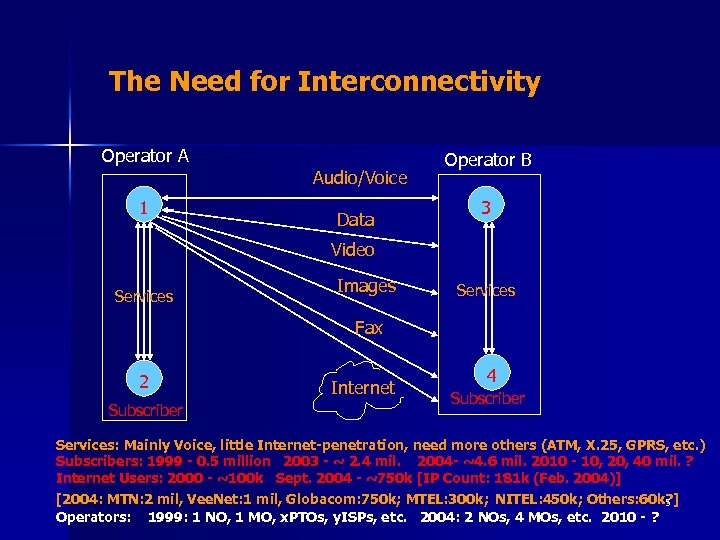
The Need for Interconnectivity Operator A 1 Audio/Voice Data Operator B 3 Video Services Images Services Fax 2 Subscriber Internet 4 Subscriber Services: Mainly Voice, little Internet-penetration, need more others (ATM, X. 25, GPRS, etc. ) Subscribers: 1999 - 0. 5 million 2003 - ~ 2. 4 mil. 2004 - ~4. 6 mil. 2010 - 10, 20, 40 mil. ? Internet Users: 2000 - ~100 k Sept. 2004 - ~750 k [IP Count: 181 k (Feb. 2004)] [2004: MTN: 2 mil, Vee. Net: 1 mil, Globacom: 750 k; MTEL: 300 k; NITEL: 450 k; Others: 60 k? ] 5 Operators: 1999: 1 NO, 1 MO, x. PTOs, y. ISPs, etc. 2004: 2 NOs, 4 MOs, etc. 2010 - ?
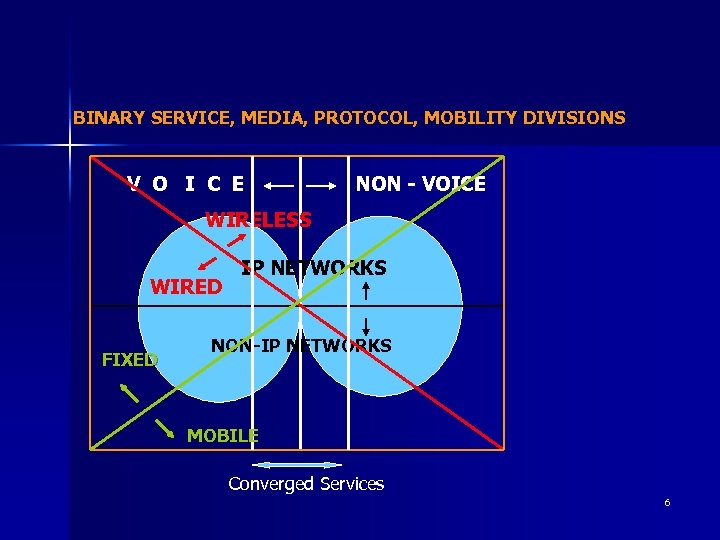
BINARY SERVICE, MEDIA, PROTOCOL, MOBILITY DIVISIONS V O I C E NON - VOICE WIRELESS WIRED FIXED IP NETWORKS NON-IP NETWORKS MOBILE Converged Services 6
Each of the services: * different rates of transmission * different formats * different protocols * different priorities for delivery Convergence Issues XOIP – Services over Internet ! Physical Media; Logical Structure important for efficient connectivity 7
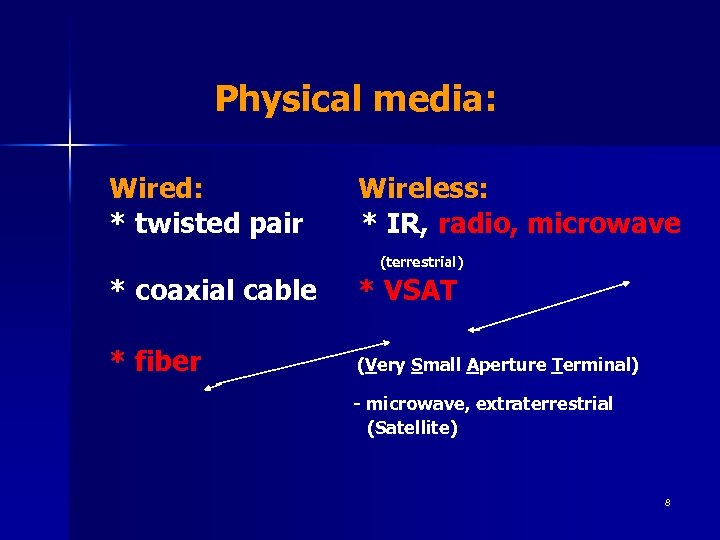
Physical media: Wired: * twisted pair Wireless: * IR, radio, microwave (terrestrial) * coaxial cable * VSAT * fiber (Very Small Aperture Terminal) - microwave, extraterrestrial (Satellite) 8
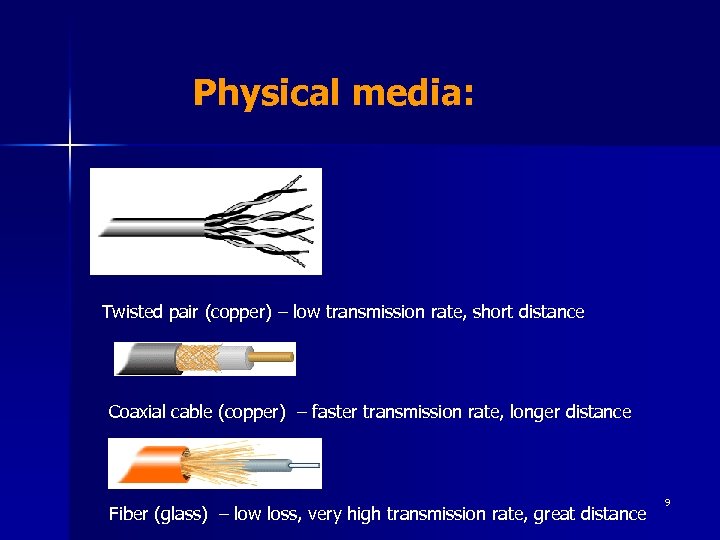
Physical media: Twisted pair (copper) – low transmission rate, short distance Coaxial cable (copper) – faster transmission rate, longer distance Fiber (glass) – low loss, very high transmission rate, great distance 9
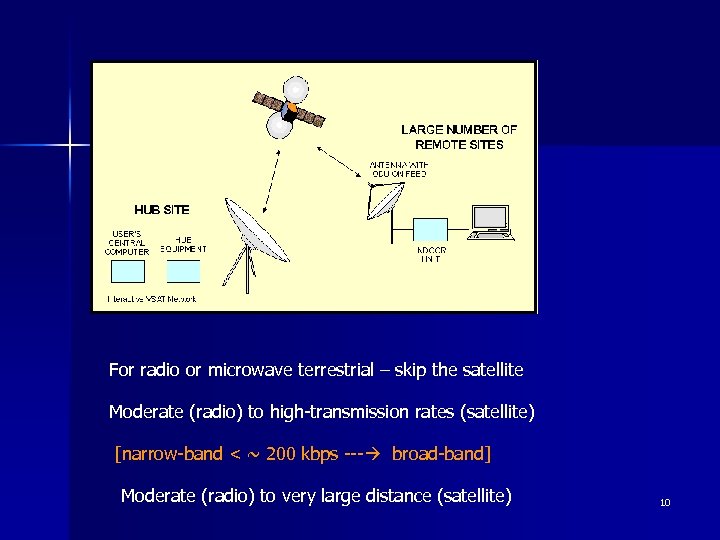
For radio or microwave terrestrial – skip the satellite Moderate (radio) to high-transmission rates (satellite) [narrow-band < ~ 200 kbps --- broad-band] Moderate (radio) to very large distance (satellite) 10
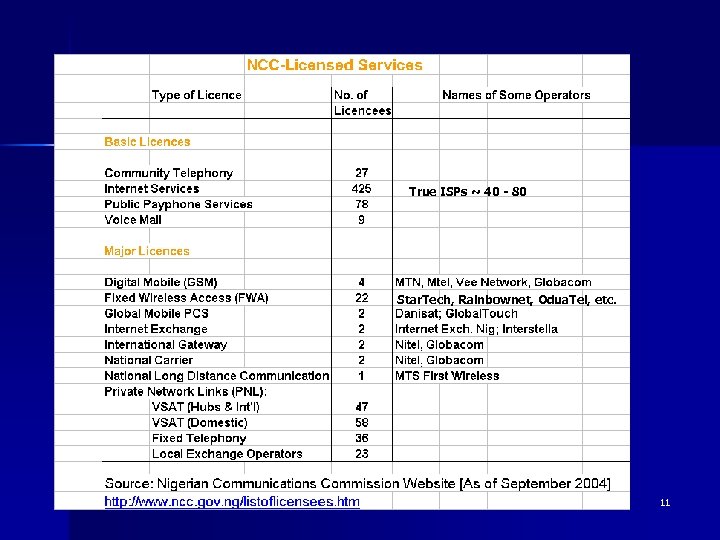
True ISPs ~ 40 - 80 Star. Tech, Rainbownet, Odua. Tel, etc. 11
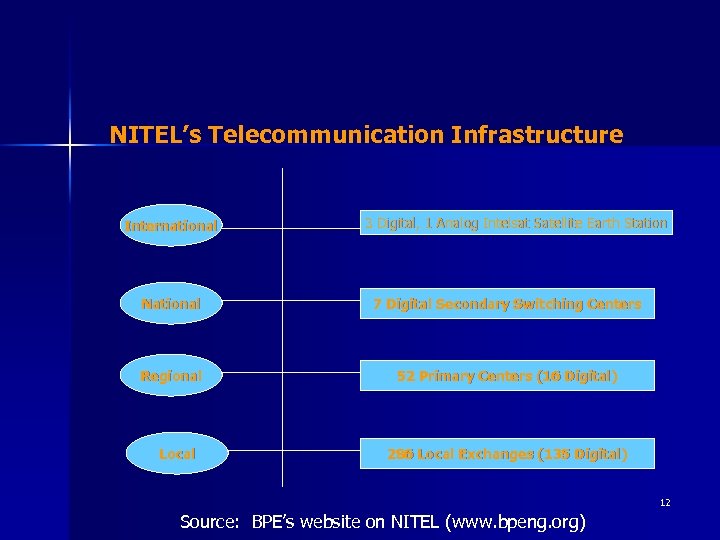
NITEL’s Telecommunication Infrastructure International 3 Digital, 1 Analog Intelsat Satellite Earth Station National 7 Digital Secondary Switching Centers Regional 52 Primary Centers (16 Digital) Local 286 Local Exchanges (135 Digital) 12 Source: BPE’s website on NITEL (www. bpeng. org)
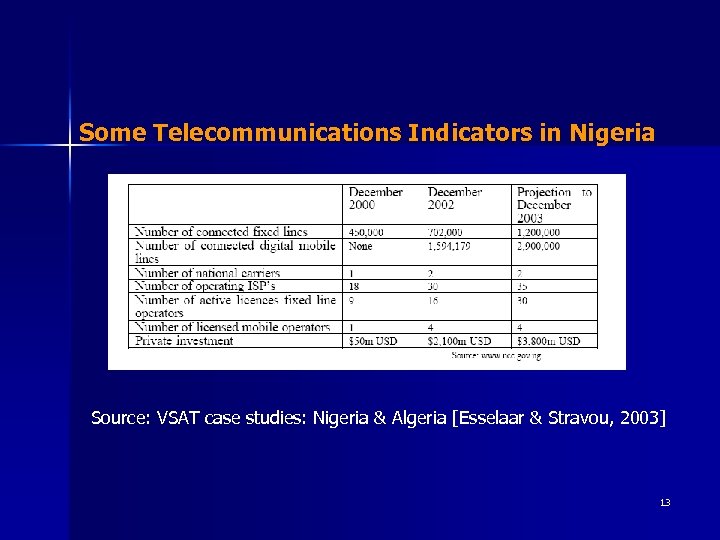
Some Telecommunications Indicators in Nigeria Source: VSAT case studies: Nigeria & Algeria [Esselaar & Stravou, 2003] 13
Questions for Nigeria What is our proposed and/or preferred transmission backbone - fiber and/or wireless? How should it evolve – completely private-driven or government-guided? Needed – a National Fiber Transmission Backbone 14
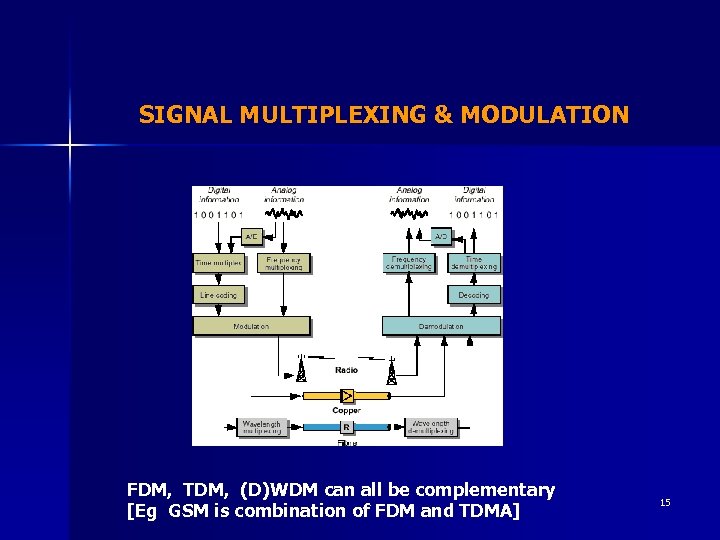
SIGNAL MULTIPLEXING & MODULATION FDM, TDM, (D)WDM can all be complementary [Eg GSM is combination of FDM and TDMA] 15
What Logical Structure ? * hubs * routers (for destination mapping) * bridges (to link networks) * switches (multiport bridges) * gateways * exchanges (eg IXP) Needed: A National Digital Interconnectivity Matrix coordinated Between Operators 16
NCC’s Five-Year Strategic Management Plan (2003 -2007) “Target 1 G 1: To provide the regulatory stimulus and, where appropriate, the incentives to encourage the rollout of fibre optic links nationwide. Minimum coverage targets will be 30% by end Q 4 2004, 40% by end Q 4 2006 and 50% by end Q 4 2007 (by state and nationally, as appropriate)” Are we on track? 17
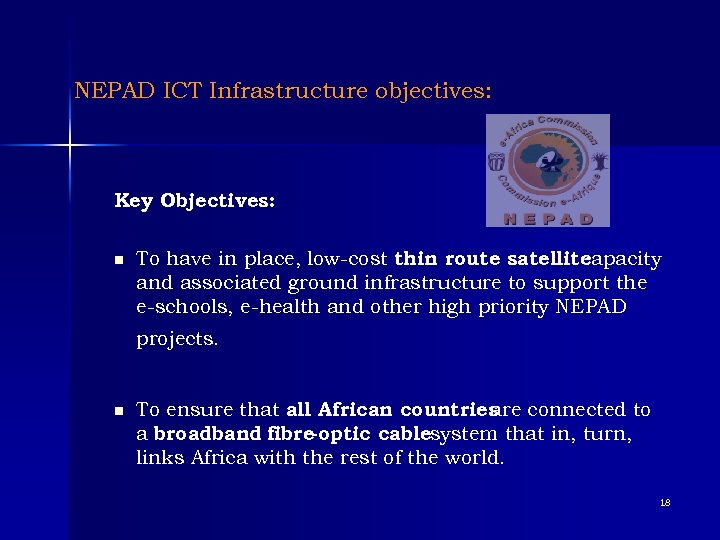
NEPAD ICT Infrastructure objectives: Key Objectives: n To have in place, low-cost thin route satellite capacity and associated ground infrastructure to support the e-schools, e-health and other high priority NEPAD projects. n To ensure that all African countries connected to are a broadband fibre-optic cablesystem that in, turn, links Africa with the rest of the world. 18
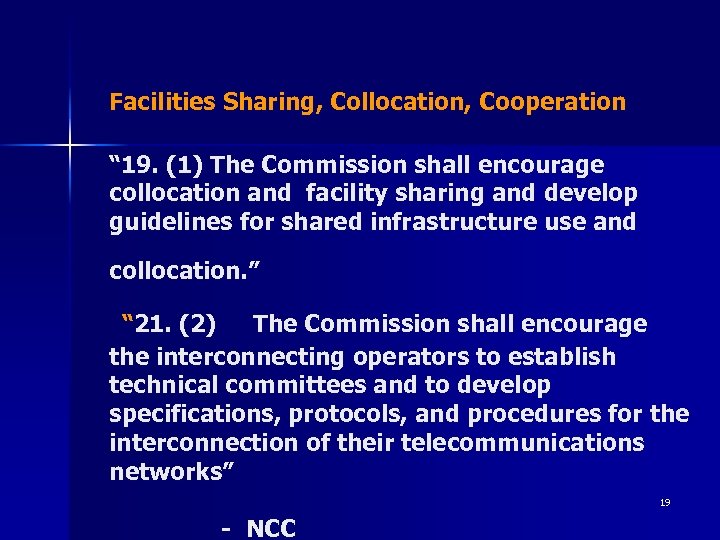
Facilities Sharing, Collocation, Cooperation “ 19. (1) The Commission shall encourage collocation and facility sharing and develop guidelines for shared infrastructure use and collocation. ” “ 21. (2) The Commission shall encourage the interconnecting operators to establish technical committees and to develop specifications, protocols, and procedures for the interconnection of their telecommunications networks” 19 - NCC
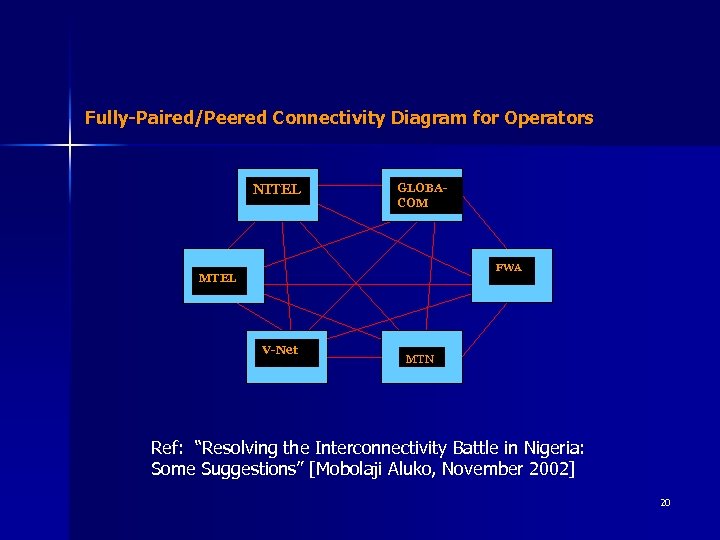
Fully-Paired/Peered Connectivity Diagram for Operators NITEL GLOBACOM FWA MTEL V-Net MTN Ref: “Resolving the Interconnectivity Battle in Nigeria: Some Suggestions” [Mobolaji Aluko, November 2002] 20
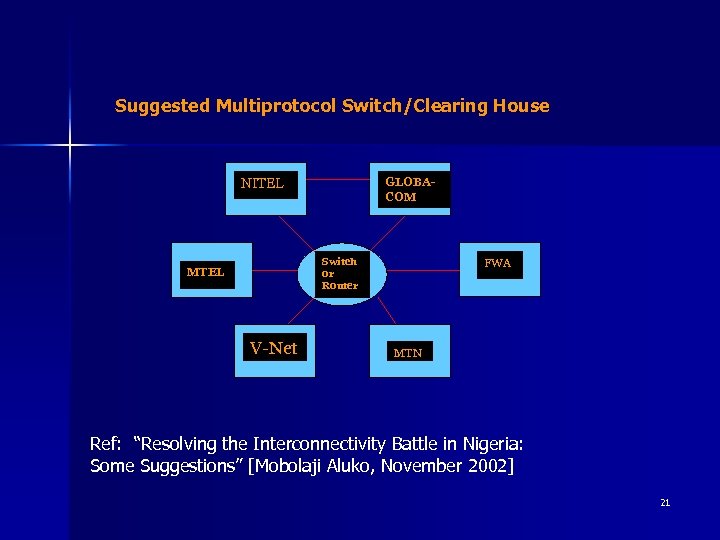
Suggested Multiprotocol Switch/Clearing House GLOBACOM NITEL Switch or Router MTEL V-Net FWA MTN Ref: “Resolving the Interconnectivity Battle in Nigeria: Some Suggestions” [Mobolaji Aluko, November 2002] 21
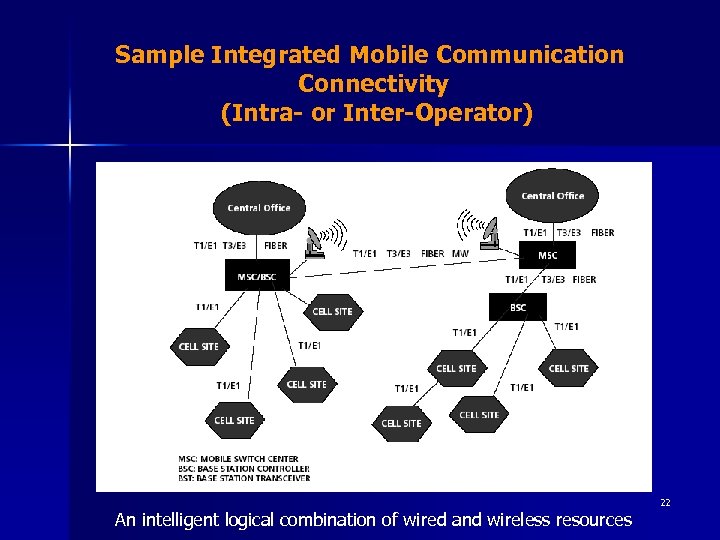
Sample Integrated Mobile Communication Connectivity (Intra- or Inter-Operator) An intelligent logical combination of wired and wireless resources 22
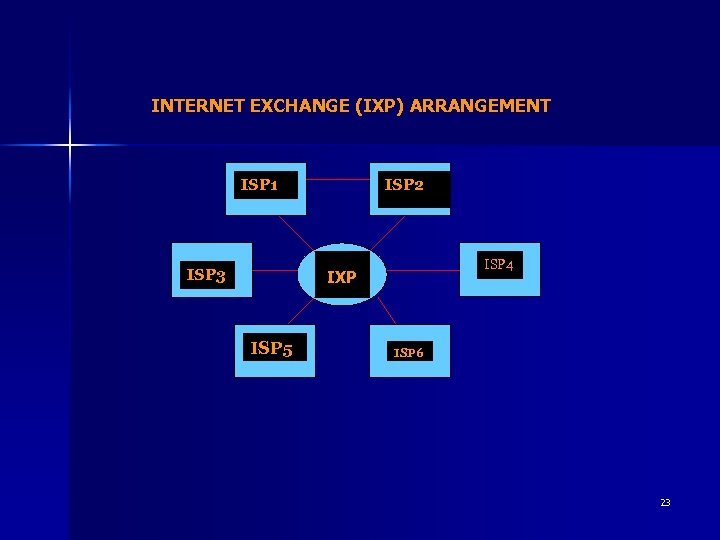
INTERNET EXCHANGE (IXP) ARRANGEMENT ISP 2 ISP 1 ISP 3 ISP 4 IXP ISP 5 ISP 6 23
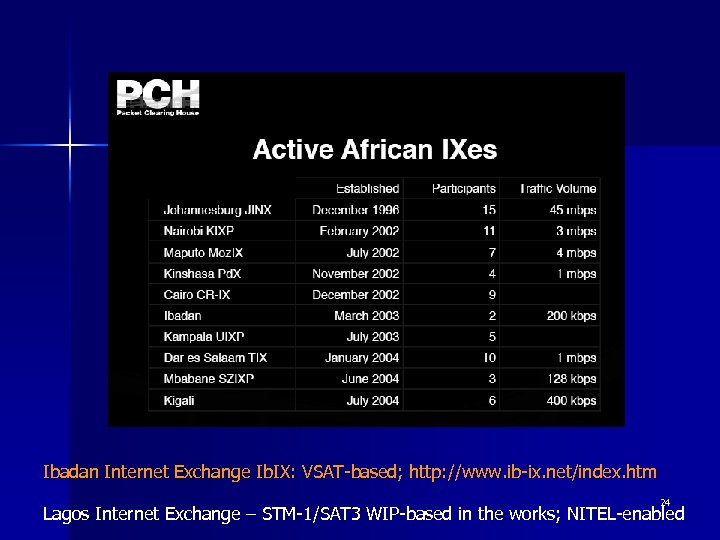
Ibadan Internet Exchange Ib. IX: VSAT-based; http: //www. ib-ix. net/index. htm 24 Lagos Internet Exchange – STM-1/SAT 3 WIP-based in the works; NITEL-enabled
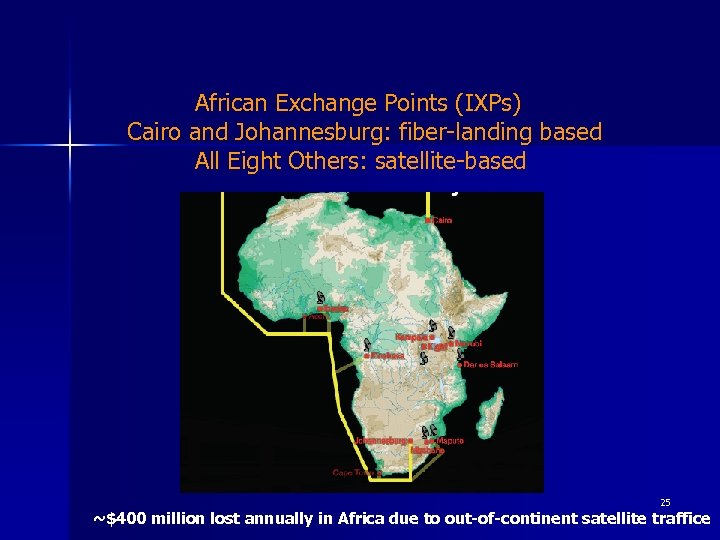
African Exchange Points (IXPs) Cairo and Johannesburg: fiber-landing based All Eight Others: satellite-based 25 ~$400 million lost annually in Africa due to out-of-continent satellite traffice
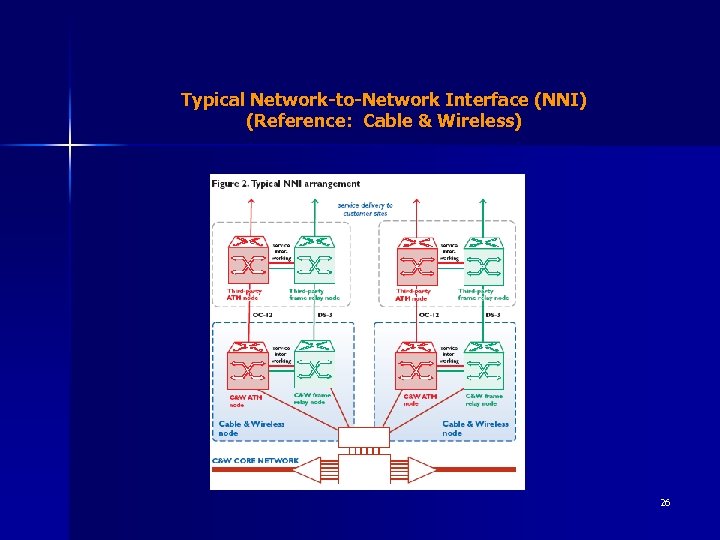
Typical Network-to-Network Interface (NNI) (Reference: Cable & Wireless) 26
![Some IP-VPN Access Options [Cable & Wireless] Desirable to have some similar diagrams from](https://present5.com/presentation/c9e2af5319d56a78b6c6cbb75f0e967a/image-27.jpg "Some IP-VPN Access Options [Cable & Wireless] Desirable to have some similar diagrams from")
Some IP-VPN Access Options [Cable & Wireless] Desirable to have some similar diagrams from Nigerian operators 27
![FIBER-OPTICS INFRASTRUCTURE NITEL Fiber [? STM-4 (622 Mbps) cables] GLOBACOM Fiber [32 STM-64 (~10](https://present5.com/presentation/c9e2af5319d56a78b6c6cbb75f0e967a/image-28.jpg "FIBER-OPTICS INFRASTRUCTURE NITEL Fiber [? STM-4 (622 Mbps) cables] GLOBACOM Fiber [32 STM-64 (~10")
FIBER-OPTICS INFRASTRUCTURE NITEL Fiber [? STM-4 (622 Mbps) cables] GLOBACOM Fiber [32 STM-64 (~10 Gbps) cables] SAT 3 NITEL Fiber Rings (capacities? ) 28
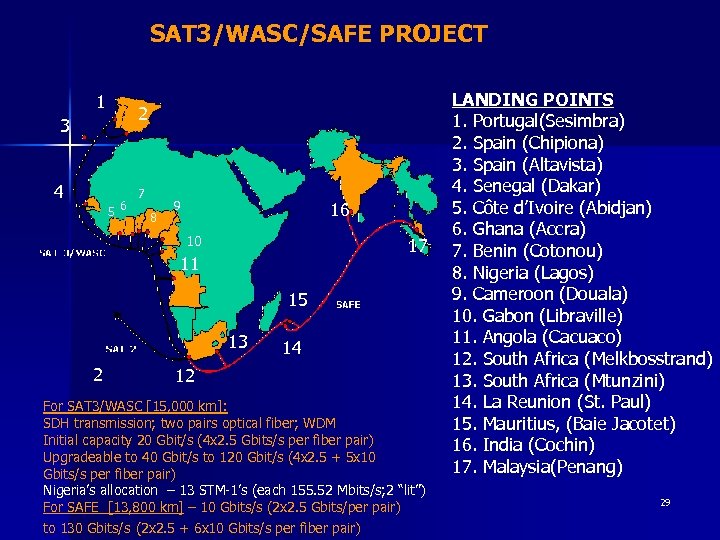
SAT 3/WASC/SAFE PROJECT 1 2 3 4 5 6 7 8 16 9 10 17 11 15 13 2 14 12 For SAT 3/WASC [15, 000 km]: SDH transmission; two pairs optical fiber; WDM Initial capacity 20 Gbit/s (4 x 2. 5 Gbits/s per fiber pair) Upgradeable to 40 Gbit/s to 120 Gbit/s (4 x 2. 5 + 5 x 10 Gbits/s per fiber pair) Nigeria’s allocation – 13 STM-1’s (each 155. 52 Mbits/s; 2 “lit”) For SAFE [13, 800 km] – 10 Gbits/s (2 x 2. 5 Gbits/per pair) to 130 Gbits/s (2 x 2. 5 + 6 x 10 Gbits/s per fiber pair) LANDING POINTS 1. Portugal(Sesimbra) 2. Spain (Chipiona) 3. Spain (Altavista) 4. Senegal (Dakar) 5. Côte d’Ivoire (Abidjan) 6. Ghana (Accra) 7. Benin (Cotonou) 8. Nigeria (Lagos) 9. Cameroon (Douala) 10. Gabon (Libraville) 11. Angola (Cacuaco) 12. South Africa (Melkbosstrand) 13. South Africa (Mtunzini) 14. La Reunion (St. Paul) 15. Mauritius, (Baie Jacotet) 16. India (Cochin) 17. Malaysia(Penang) 29
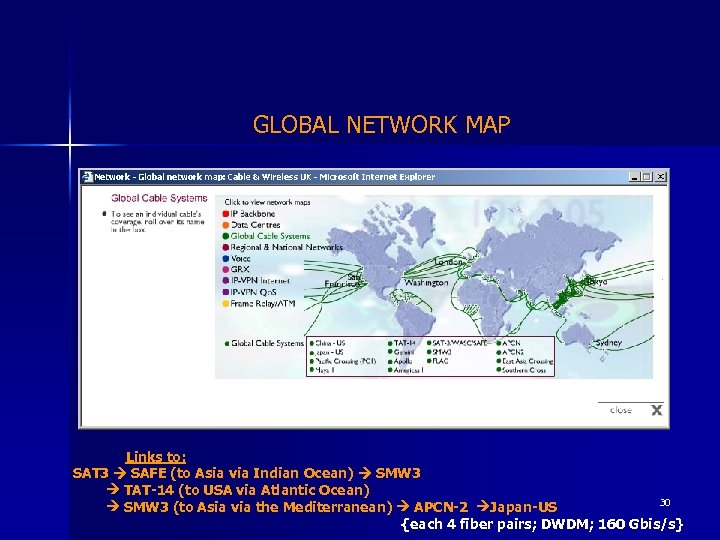
GLOBAL NETWORK MAP Links to: SAT 3 SAFE (to Asia via Indian Ocean) SMW 3 TAT-14 (to USA via Atlantic Ocean) 30 SMW 3 (to Asia via the Mediterranean) APCN-2 Japan-US {each 4 fiber pairs; DWDM; 160 Gbis/s}
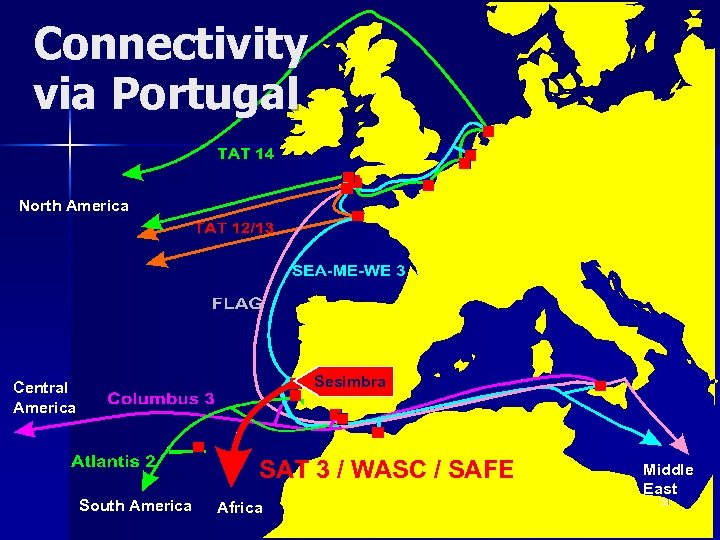
Connectivity via Portugal North America Sesimbra Central America SAT 3 / WASC / SAFE South America Africa Middle East 31
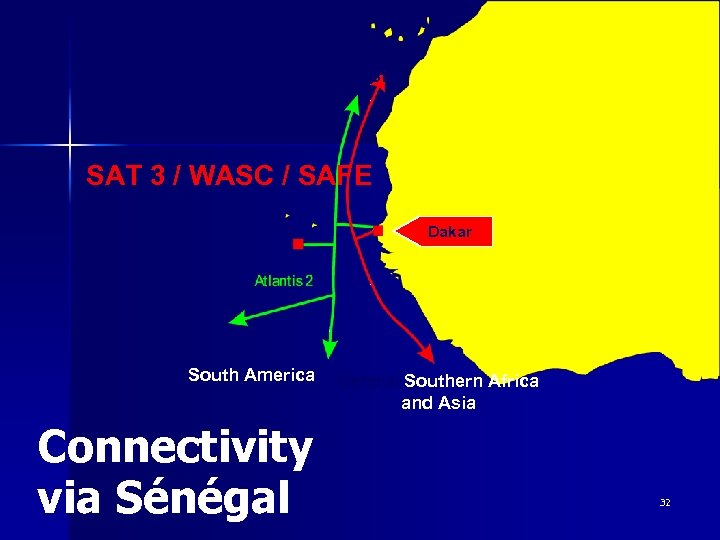
Western Europe Middle East SAT 3 / WASC / SAFE Dakar South America Connectivity via Sénégal Central Southern Africa and Asia 32
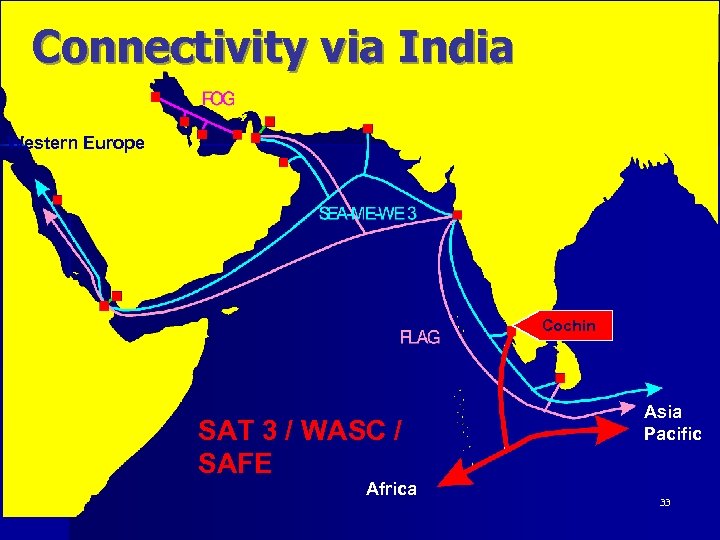
Connectivity via India Western Europe Cochin SAT 3 / WASC / SAFE Africa Asia Pacific 33
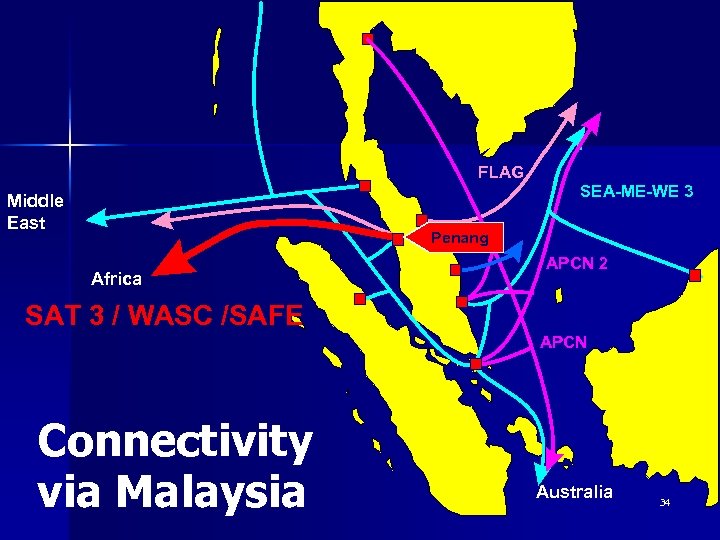
Asia Pacific FLAG Middle East SEA-ME-WE 3 Penang Africa APCN 2 SAT 3 / WASC /SAFE APCN Connectivity via Malaysia Australia 34
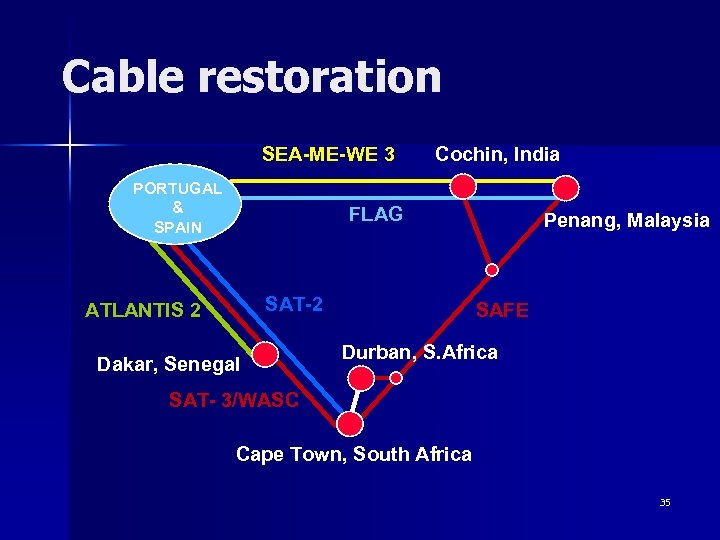
Cable restoration SEA-ME-WE 3 PORTUGAL & SPAIN Cochin, India FLAG SAT-2 ATLANTIS 2 Dakar, Senegal Penang, Malaysia SAFE Durban, S. Africa SAT- 3/WASC Cape Town, South Africa 35
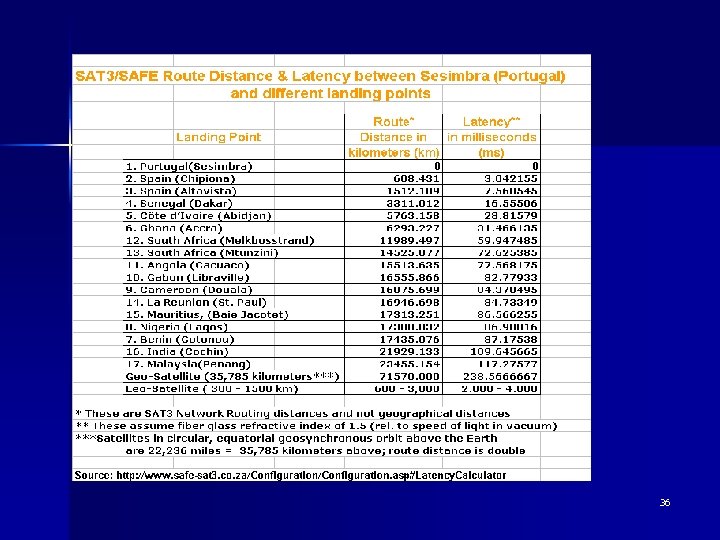
36
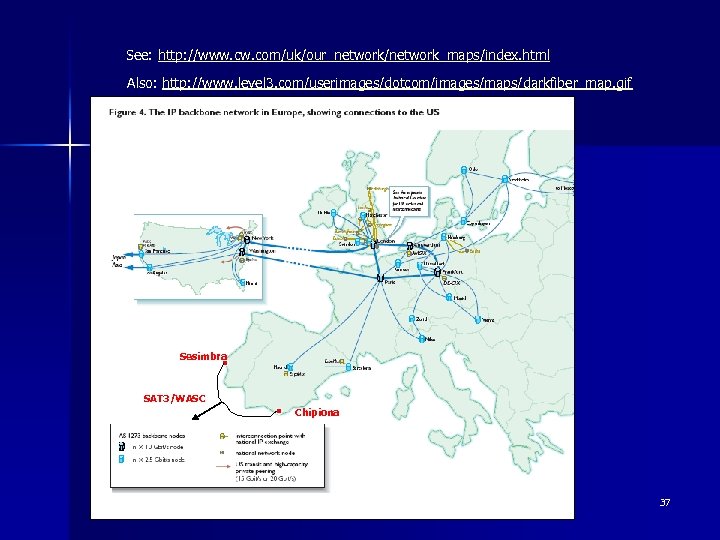
See: http: //www. com/uk/our_network/network_maps/index. html Also: http: //www. level 3. com/userimages/dotcom/images/maps/darkfiber_map. gif Sesimbra SAT 3/WASC Chipiona 37
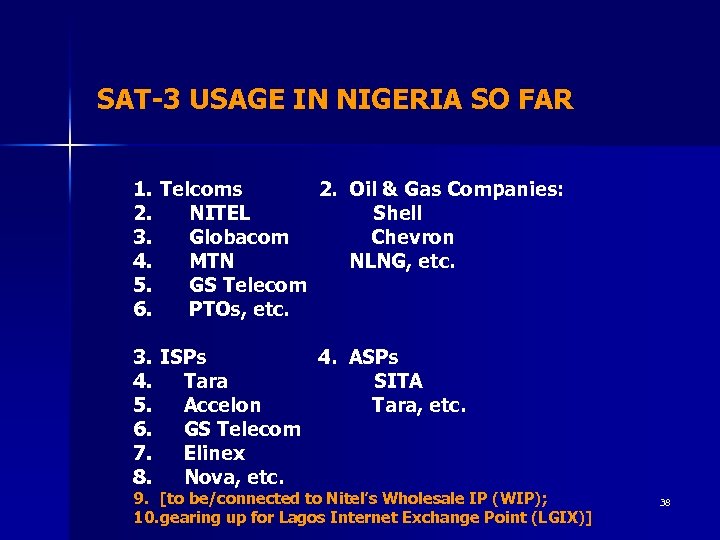
SAT-3 USAGE IN NIGERIA SO FAR 1. Telcoms 2. Oil & Gas Companies: 2. NITEL Shell 3. Globacom Chevron 4. MTN NLNG, etc. 5. GS Telecom 6. PTOs, etc. 3. ISPs 4. ASPs 4. Tara SITA 5. Accelon Tara, etc. 6. GS Telecom 7. Elinex 8. Nova, etc. 9. [to be/connected to Nitel’s Wholesale IP (WIP); 10. gearing up for Lagos Internet Exchange Point (LGIX)] 38
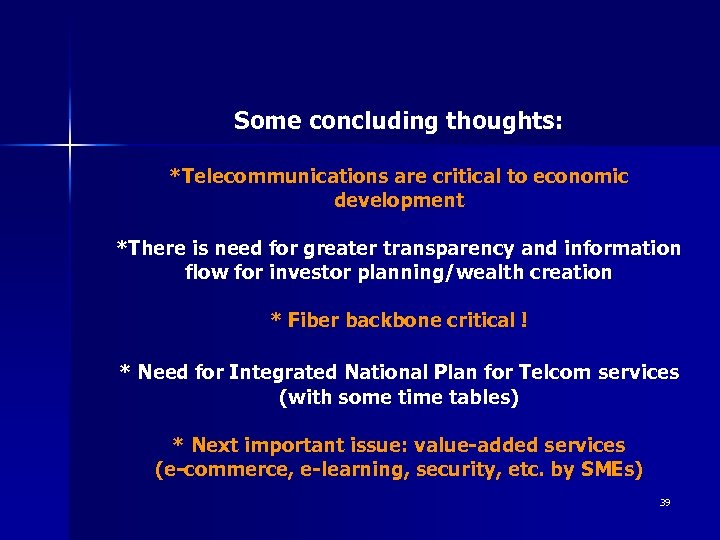
Some concluding thoughts: *Telecommunications are critical to economic development *There is need for greater transparency and information flow for investor planning/wealth creation * Fiber backbone critical ! * Need for Integrated National Plan for Telcom services (with some time tables) * Next important issue: value-added services (e-commerce, e-learning, security, etc. by SMEs) 39
Final Acknowledgements * To CWC * To NCC/Ministry of Communications * To the listening audience Bolaji Aluko; Nigeria Telcom Summit, London September 2004 40
I will be happy to take questions! End Bolaji Aluko; Nigeria Telcom Summit, London September 2004 41
Скачать презентацию Inter Connectivity Issues in Nigeria Some Perspectives Mobolaji E
c9e2af5319d56a78b6c6cbb75f0e967a.ppt