


 Скачать презентацию INTENTIONAL COMMUNITIES JIŘÍ NOSEK SYLWIA ZUKOWSKA IPEK KOSOVA
6c6fadb4461313be0fc49f53b83ae642.ppt
- Количество слайдов: 20
 INTENTIONAL COMMUNITIES JIŘÍ NOSEK, SYLWIA ZUKOWSKA, IPEK KOSOVA, MAI LAN CHI
 BASIC INFORMATIONS planned residential community designed to have a much higher degree of teamwork than other communities the members hold a common social, political or spiritual vision they also share responsibilities and resources Intentional communities include cohousing communities, residential land trusts, ecovillages, communes, kibbutzim, ashrams and housing cooperatives survey in the 1995 reported that 54% of the communities were rural, 28% were urban, 10% had both rural and urban sites, and 8% didn't specify
 TYPE OF GOVERNANCE democratic (64%), with decisions made by some form of consensus decision-making or voting 9% have a hierarchical or authoritarian structure 11% are a combination of democratic and hierarchical structure 16% don't specify Many communities which were led by individual or small group have changed to a more democratic form of governance.
 TYPES OF INTENTIONAL COMMUNITIES
 1)COMMUNITY LAND TRUST villages held property in the community interest European and North American land banks invest in land to help build family farms or to encourage economic development Reverse increasing poverty MAIN IDEAS Reach control over local land increase ownership Provide affordable housing for lower income people in the community Keep housing affordable for future residents Capture the value of public investment for long-term community benefit Build a strong base for community action
 2)COMMUNE community of people living together, sharing common interests, property, possessions, resources, work and income For communes is important communal economy, consensus decision-making, nonhierarchical structures, ecological living, core principles Some communes formed around spiritual leaders some from political ideologies For others, the "glue" is the desire for a more shared, sociable lifestyle. Moreover, some people find it is more economical to live communally. Three main characteristics: 1. egalitarianism (equality) 2. human scale - members of communes saw the scale of society as it was then organised as being too large 3. communes were consciously anti-bureaucratic
 DEFINITIONS OF COMMUNES Dr. Bill Metcalf, defined communes as: the importance of the group, a "common purse„ collective household group decision making in general and intimate affairs Sharing everyday life and facilities commune is an idealised form of family commune members have emotional bonds to the whole group Elisabeth Vob (Germany): live and work together communal economy, common finances and common property (land, buildings, means of production), have communal decision making - usually consensus decision making try to reduce hierarchy and hierarchical structures have communalisation of housework, childcare and other communal tasks have equality between women and men have low ecological footprints through sharing and saving resources
 3)KIBBUTZ kibbutz = "gathering, clustering” collective community in Israel based on agriculture Communal living that combines socialism and Zionism Today, farming has been partly supplanted by other economic branches, including industrial plants and high-tech enterprises firma. There are three types of kibbutzim: Kibbutz Shitufi: preserves a cooperative system. Kibbutz Mitchadesh: number of cooperative systems in its intentions Urban kibbutz: exist within an existing settlement (city). Since the 1970 s around 100 urban kibbutzim have been founded within existing Israeli cities. They have no enterprises of their own and all of their members work in the non-kibbutz sector.
 4)ASHRAM The word ashram is derived from the term āśraya, which means "protection" intentional community formed primarily for spiritual upliftment of its members, often headed by a religious leader or mystic located far from human habitation, in forests or mountainous regions, conducive to spiritual instruction and meditation residents performed spiritual and physical exercises, such as Yoga, sacrifices and penances Ashrams also have residential schools for children
 5)HOUSING COOPERATIVE usually a corporation—that owns real estate, consisting of one or more residential buildings. Each householder is granted the right to occupy one housing unit, sometimes it is a lease fee-paying members obtain the right to occupy a bedroom, share the communal resources of a house that is owned by a cooperative organization student cooperatives in some college neighborhoods in the United States
 6)COHOUSING composed of private homes with full kitchens, supplemented by extensive common facilities is planned, owned and managed by the residents, groups of people who want more interaction with their neighbours common large kitchen and dining room where residents can take turns cooking for the community other facilities may include a laundry, pool, child care facilities, offices, internet access, game room, TV room, tool room or a gym thanks spatial design and shared activities, community enable intergenerational interaction among neighbours also economic and environmental benefits to sharing resources, space and items
 7)ECOVILLAGE intended to be socially, economically and ecologically sustainable intentional community aim for a population of 50 -150 individuals members are united by shared ecological, social-economic and cultural-spiritual values is composed of people who have chosen an alternative to centralized electrical, water, and sewage systems Definition by Robert Gilman : human-scale full-featured settlement plan human activities are harmlessly integrated into the natural world supporting healthy human development can be successfully continued into the indefinite future
 CHARACTERISTIC OF ECOVILLAGE principles can be applied to urban and rural settings, as well as to developing and developed countries followers seek a sustainable lifestyle for inhabitants minimum of trade outside the local area independence from existing infrastructures / more urban settings - integration with existing infrastructure rural ecovillages are based on organic farming, permaculture and other approaches promoting ecosystem function USUALLY RELIES ON: autonomous building or clustered housing, to minimize ecological footprint; renewable energy Permaculture
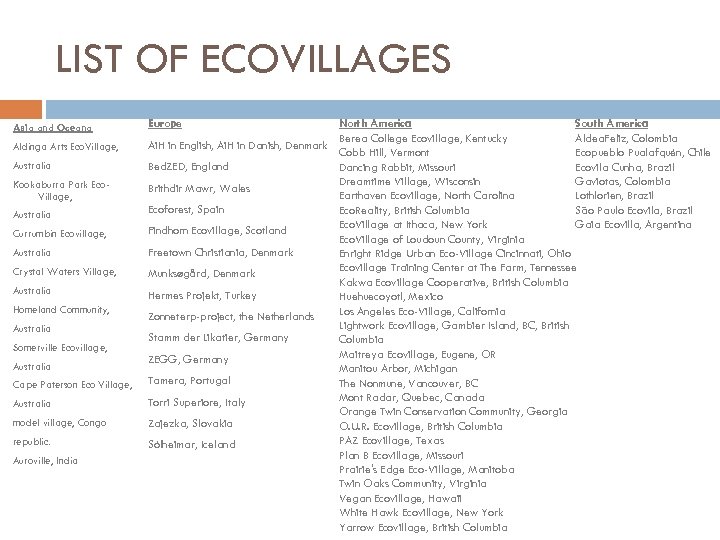 LIST OF ECOVILLAGES Asia and Oceana Aldinga Arts Eco. Village, Australia Kookaburra Park Eco. Village, Australia Currumbin Ecovillage, Australia Crystal Waters Village, Australia Homeland Community, Australia Somerville Ecovillage, Australia Cape Paterson Eco Village, Australia model village, Congo republic. Auroville, India South America North America Aldea. Feliz, Colombia Berea College Ecovillage, Kentucky Ai. H in English, Ai. H in Danish, Denmark Ecopueblo Pualafquén, Chile Cobb Hill, Vermont Bed. ZED, England Ecovila Cunha, Brazil Dancing Rabbit, Missouri Gaviotas, Colombia Dreamtime Village, Wisconsin Brithdir Mawr, Wales Lothlorien, Brazil Earthaven Ecovillage, North Carolina Ecoforest, Spain São Paulo Ecovila, Brazil Eco. Reality, British Columbia Gaia Ecovilla, Argentina Eco. Village at Ithaca, New York Findhorn Ecovillage, Scotland Eco. Village of Loudoun County, Virginia Freetown Christiania, Denmark Enright Ridge Urban Eco-Village Cincinnati, Ohio Ecovillage Training Center at The Farm, Tennessee Munksøgård, Denmark Kakwa Ecovillage Cooperative, British Columbia Hermes Projekt, Turkey Huehuecoyotl, Mexico Los Angeles Eco-Village, California Zonneterp-project, the Netherlands Lightwork Ecovillage, Gambier Island, BC, British Stamm der Likatier, Germany Columbia Maitreya Ecovillage, Eugene, OR ZEGG, Germany Manitou Arbor, Michigan Tamera, Portugal The Nonmune, Vancouver, BC Mont Radar, Quebec, Canada Torri Superiore, Italy Orange Twin Conservation Community, Georgia Zajezka, Slovakia O. U. R. Ecovillage, British Columbia PAZ Ecovillage, Texas Sólheimar, Iceland Plan B Ecovillage, Missouri Prairie's Edge Eco-Village, Manitoba Twin Oaks Community, Virginia Vegan Ecovillage, Hawaii White Hawk Ecovillage, New York Yarrow Ecovillage, British Columbia Europe
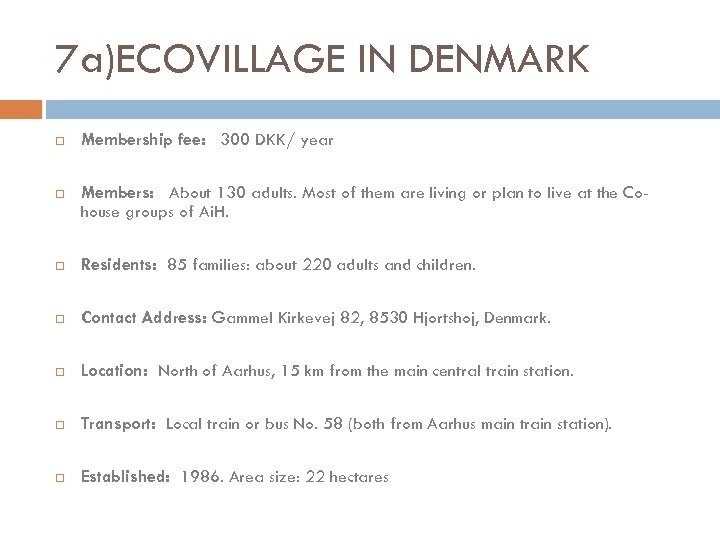 7 a)ECOVILLAGE IN DENMARK Membership fee: 300 DKK/ year Members: About 130 adults. Most of them are living or plan to live at the Cohouse groups of Ai. H. Residents: 85 families: about 220 adults and children. Contact Address: Gammel Kirkevej 82, 8530 Hjortshoj, Denmark. Location: North of Aarhus, 15 km from the main central train station. Transport: Local train or bus No. 58 (both from Aarhus main train station). Established: 1986. Area size: 22 hectares
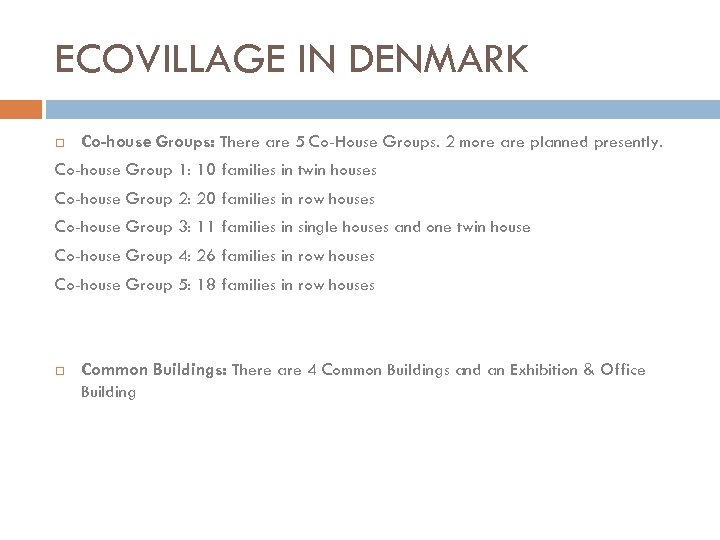 ECOVILLAGE IN DENMARK Co-house Groups: There are 5 Co-House Groups. 2 more are planned presently. Co-house Group 1: 10 families in twin houses Co-house Group 2: 20 families in row houses Co-house Group 3: 11 families in single houses and one twin house Co-house Group 4: 26 families in row houses Co-house Group 5: 18 families in row houses Common Buildings: There are 4 Common Buildings and an Exhibition & Office Building
 LIFESTYLE Ai. H aims to be an example of living with sustainability as a keyword This approach is visible in many ways in their daily life, examples are: Houses are built to be environmentally sustainable (e. g. , rammed clay, earth blocks, wood, paper insulation, solar collectors, ovens, paint from linen oil etc) Using compost or separation toilets rainwater is used in the common washing machines urine is to be irrigated to plants after 9 months of storage farming, with animals like chicken, cows, and goats car-sharing Association (two cars) common dinner three days a week less number people have cars and more people use bicycles and bicycle trailers, against highways Energy Association providing hot water from a wood-pillet and a wood chip burning boiler Common social events and arrangements (New Year, harvest celebration, art workshops etc. ) Cultural evenings and days with music, dance, story telling both for adults and children Michels's Eco-green, which is a commercial organic vegetable farming and organic ice cream production. Open two times a week. Biodiversity care: Re-establishment of a lake in August 2001. Gymnastic for different age groups, dancing for children, yoga
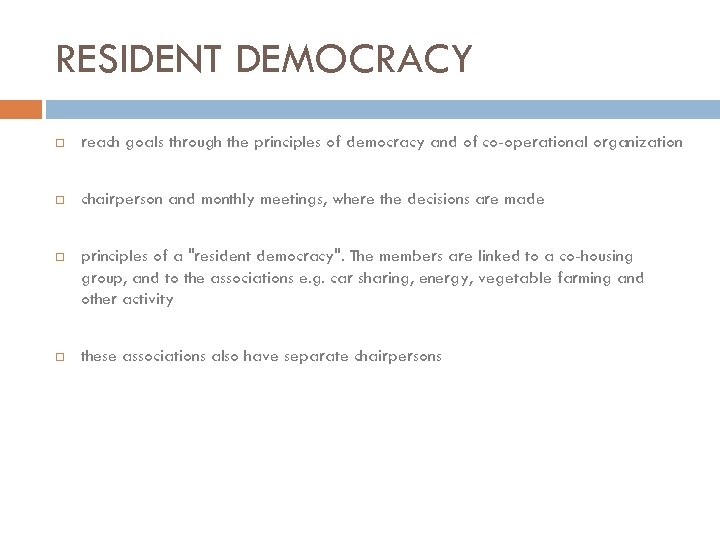 RESIDENT DEMOCRACY reach goals through the principles of democracy and of co-operational organization chairperson and monthly meetings, where the decisions are made principles of a "resident democracy". The members are linked to a co-housing group, and to the associations e. g. car sharing, energy, vegetable farming and other activity these associations also have separate chairpersons
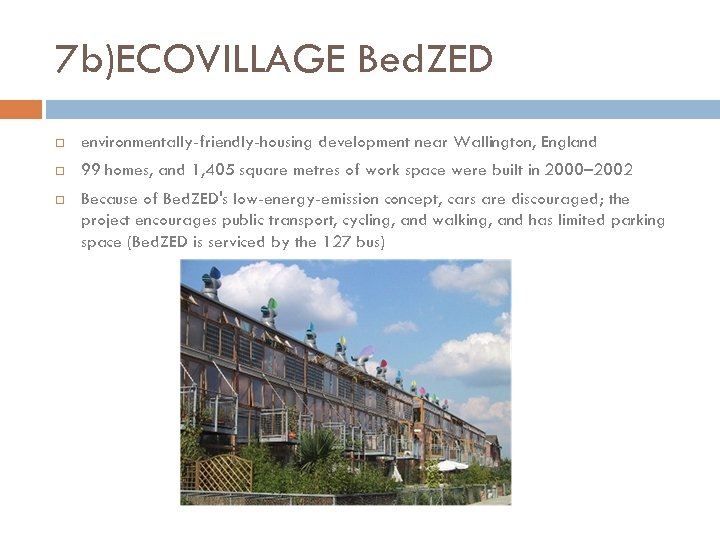 7 b)ECOVILLAGE Bed. ZED environmentally-friendly-housing development near Wallington, England 99 homes, and 1, 405 square metres of work space were built in 2000– 2002 Because of Bed. ZED's low-energy-emission concept, cars are discouraged; the project encourages public transport, cycling, and walking, and has limited parking space (Bed. ZED is serviced by the 127 bus)
 DESIGN PRINCIPLES of Bed. ZED Zero energy—using only energy from renewable sources generated on site; 777 m² of solar panels; tree waste fuels the development's cogeneration plant to provide district heating and elektricity Energy efficient—The houses face south to take advantage of solar gain, are triple glazed, and have high thermal insulation Water efficient—rain water is collected and rezed Low-impact materials—Building materials were selected from renewable or recycled sources within 35 miles of the site, to minimize the energy required for transportation Waste recycling—Refuse-collection facilities are designed to support recycling. Transport—car-sharing system, electric and liquefied-petroleum-gas cars have priority over cars that burn petrol and diesel, electricity is provided in parking spaces for charging electric cars.