


 Скачать презентацию Intensification and weakening Formation of eye and evolution
60e3a5bb1a5b7645366659700abde33e.ppt
- Количество слайдов: 28
 Intensification and weakening; Formation of eye and evolution of inner core
 TC Intensification Rapid Intensification Factors: • High SST/OHC, Moist troposphere- esp. low and mid levels, Cold UL temps • Low VWS, Relative Eddy Flux Convergence (REFC) supportive of UL Div, cyclonic mid and UL PV, mod- fast forward speed of storm • Far from MPI? , Julian Day- near peak
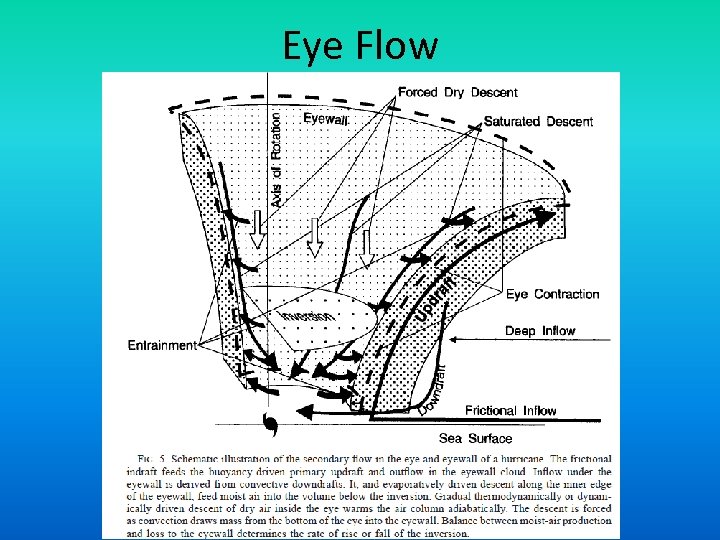
 Eye Formation • Inner core = eye and eyewall region • Tropical depressions and weak tropical storms may exhibit strong convection near the center of the storm that has warm air rising upwards (direct thermal circulation, or DTC) that will induce subsidence away from the heat source. • The horizontal length scale required for the subsidence is relatively large for low wind speeds. Even for a vortex wind profile, subsidence will not be effective at the center, as it’s too close to eyewall convection.
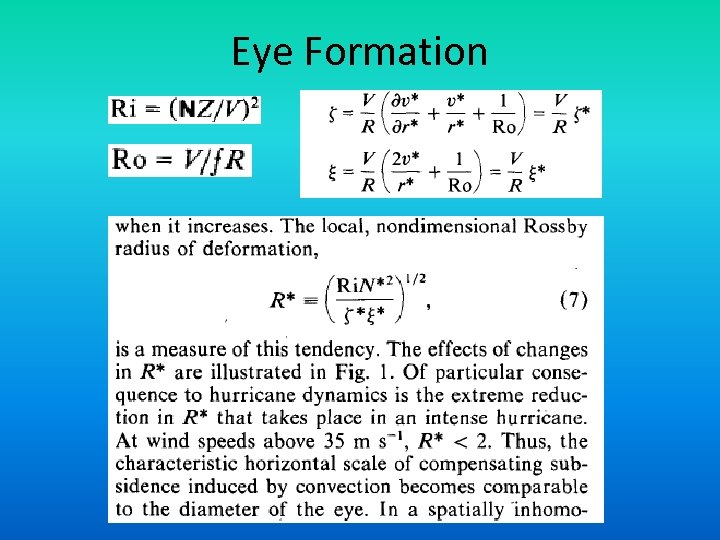 Eye Formation
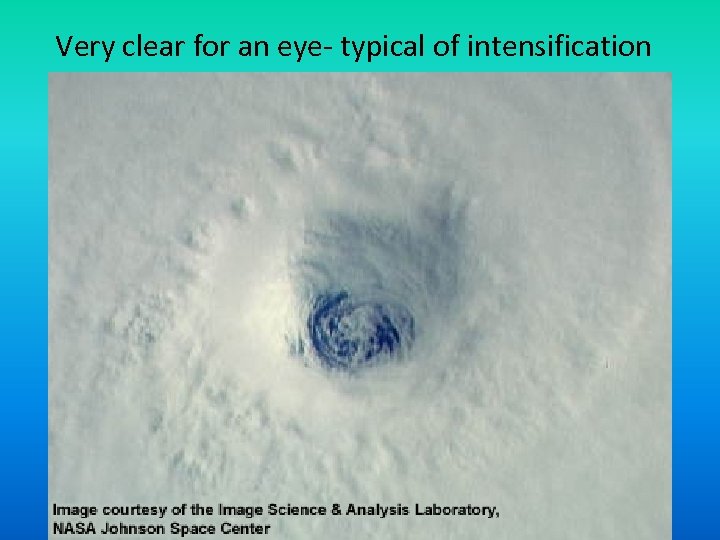
 Eye Formation • As you increase wind speeds in area of latent heating, scale needed for sinking motion decreases. An eye will eventually form. • The eye features warm air sinking, an indirect thermal circulation (ITC) imposed by eyewall convection (DTC). This further lowers the pressure of the hurricane, increases the pressure gradient just inside the radius of maximum winds (contributors to SLP min in eye: ~70% from eyewall LH release, ~30% from warming due to dry subsidence in eye). • The wind speed increases, especially just inside the RMW. Intensification and contraction of the eyewall.
 Eye Flow
 Very clear for an eye- typical of intensification
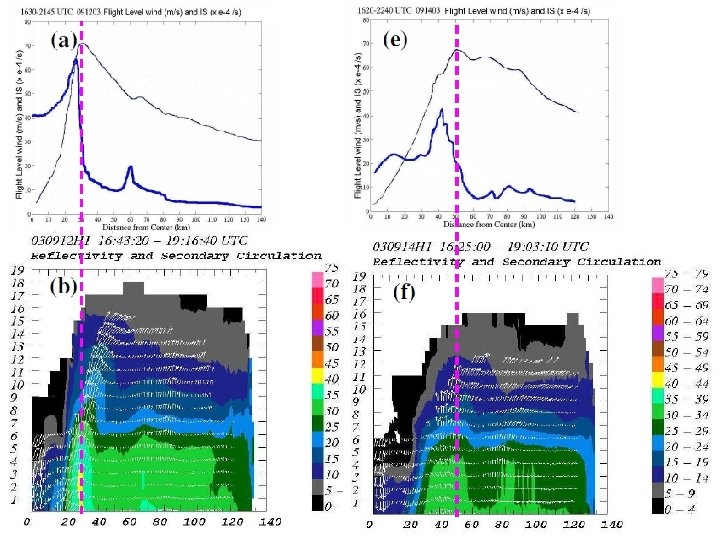
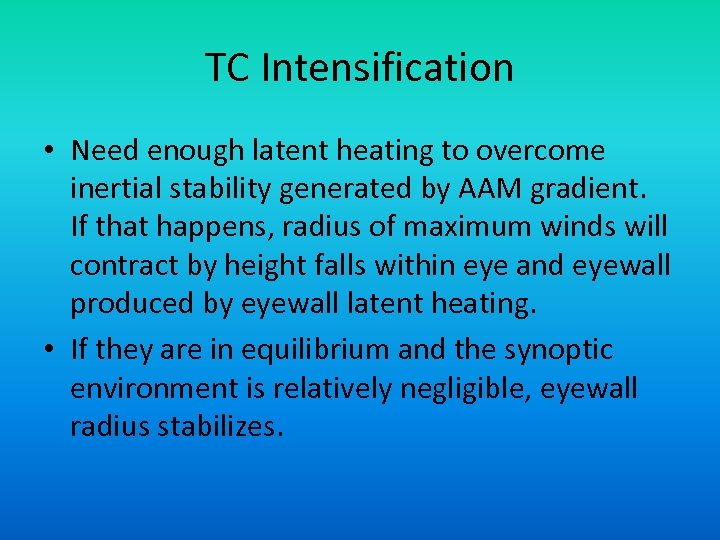 TC Intensification • Need enough latent heating to overcome inertial stability generated by AAM gradient. If that happens, radius of maximum winds will contract by height falls within eye and eyewall produced by eyewall latent heating. • If they are in equilibrium and the synoptic environment is relatively negligible, eyewall radius stabilizes.
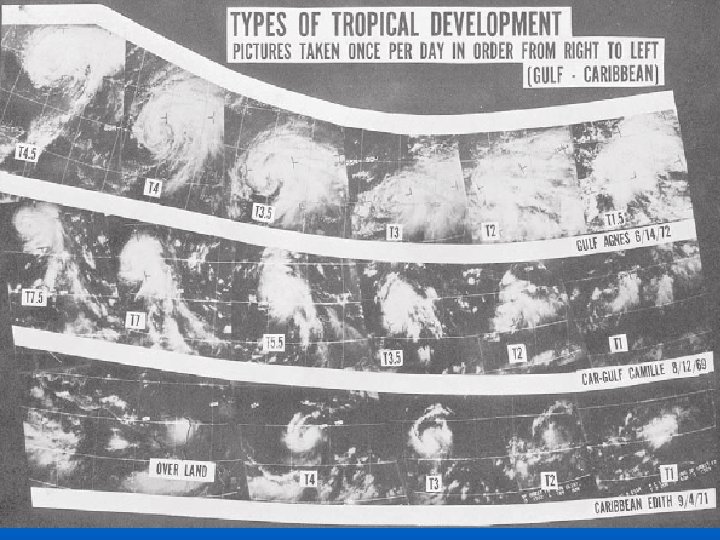
 Dvorak Technique (DT) • Dvorak Technique (DT): An attempt to estimate tropical cyclone intensity objectively via IR satellite imagery. • Hurricane appearance on IR imagery correlated with intensity. • Accurate to within 20 kt roughly 90% of the time, probably more so for meteorologists who have much practice using DT. • T-number assigned, where higher number correlates with higher sustained wind speed value.
 DT • Dvorak Technique (DT): Increased symmetry and increased cold convective cloudtops around center indicative of intensification. • Increase in temperature difference between eye and eyewall indicative of intensification. • Ability for automated estimates, without use of humans to determine a value. • Trends important. • Climatologies from different basins have been and are being created and updated.
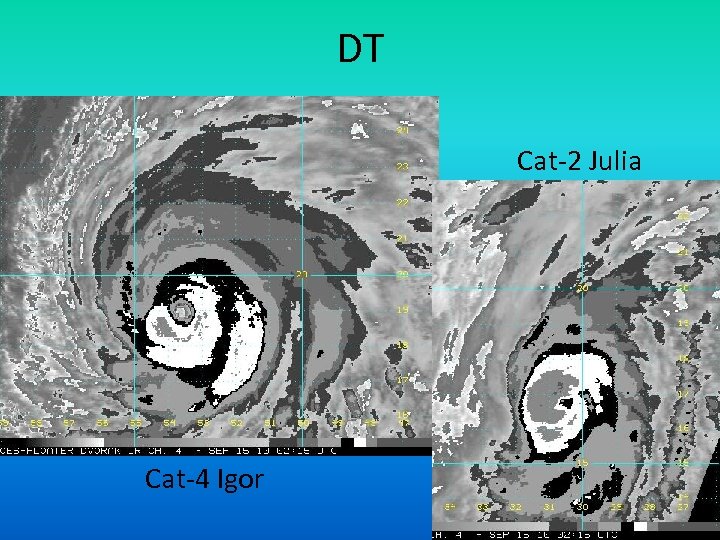 DT Cat-2 Julia Cat-4 Igor
![Dvorak T-Number and Corresponding Intensity[2] • T-Number Winds Category (SSHS) Min. Pressure (millibars) (knots)](https://present5.com/presentation/60e3a5bb1a5b7645366659700abde33e/image-13.jpg "Dvorak T-Number and Corresponding Intensity[2] • T-Number Winds Category (SSHS) Min. Pressure (millibars) (knots)") Dvorak T-Number and Corresponding Intensity[2] • T-Number Winds Category (SSHS) Min. Pressure (millibars) (knots) (mph) (km/h) Atlantic NW Pacific • 1. 0 - 1. 5 25 29 46 TD • 2. 0 30 35 56 TD 1009 1000 Rapid intensification (30 kt/day or • 2. 5 35 40 65 TS 1005 997 greater). Most intense hurricanes • 3. 0 45 52 83 TS 1000 991 undergo rapid intensification during their life. The DT does well, • 3. 5 55 63 102 TS 994 984 especially if the user is • 4. 0 65 75 120 Cat 1 987 976 knowledgeable and perceptive of • 4. 5 77 89 143 Cat 1– 2 979 966 changes in the vortex as well as environmental conditions. Extreme • 5. 0 90 104 167 Cat 2– 3 970 954 rapid intensification of around 80 -100 • 5. 5 102 117 189 Cat 3 960 941 kt/day can be difficult, though highly • 6. 0 115 132 213 Cat 4 948 927 rare. • 6. 5 127 146 235 Cat 4 935 914 • 7. 0 140 161 260 Cat 5 921 898 • 7. 5 155 178 287 Cat 5 906 879 • 8. 0 170 196 315 Cat 5 890 858
Dvorak T-Number and Corresponding Intensity[2] • T-Number Winds Category (SSHS) Min. Pressure (millibars) (knots) (mph) (km/h) Atlantic NW Pacific • 1. 0 - 1. 5 25 29 46 TD • 2. 0 30 35 56 TD 1009 1000 Rapid intensification (30 kt/day or • 2. 5 35 40 65 TS 1005 997 greater). Most intense hurricanes • 3. 0 45 52 83 TS 1000 991 undergo rapid intensification during their life. The DT does well, • 3. 5 55 63 102 TS 994 984 especially if the user is • 4. 0 65 75 120 Cat 1 987 976 knowledgeable and perceptive of • 4. 5 77 89 143 Cat 1– 2 979 966 changes in the vortex as well as environmental conditions. Extreme • 5. 0 90 104 167 Cat 2– 3 970 954 rapid intensification of around 80 -100 • 5. 5 102 117 189 Cat 3 960 941 kt/day can be difficult, though highly • 6. 0 115 132 213 Cat 4 948 927 rare. • 6. 5 127 146 235 Cat 4 935 914 • 7. 0 140 161 260 Cat 5 921 898 • 7. 5 155 178 287 Cat 5 906 879 • 8. 0 170 196 315 Cat 5 890 858
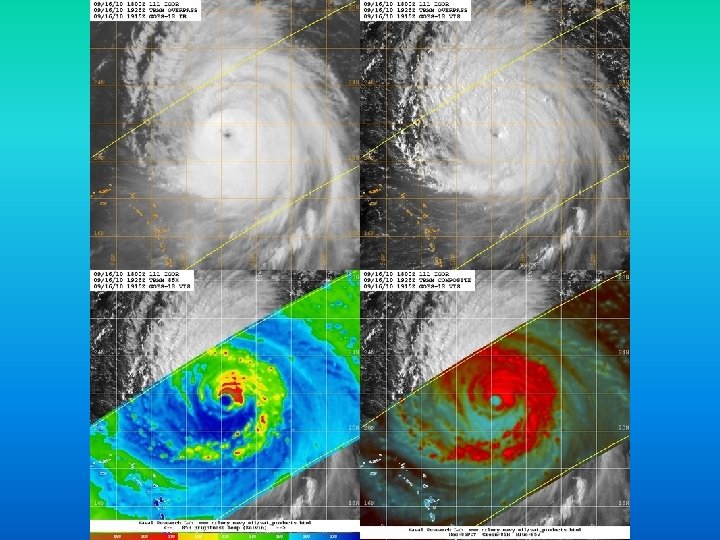
 Microwave Sensing Satellites • Microwave satellites can better pierce clouds (not only see cloudtops) to more accurately portray precipitation fields. • Give a better portrayal of 3 -D structure, latent heat release and lack thereof. • Better resolve secondary eyewall structures. • Microwave satellites can give more detailed views of circulation field and radius of 34 -kt winds, correlated with intensity and area of high seas.
 Secondary Eyewalls • Secondary eyewall formation. • AAM loss to sea surface via friction. Inward radial winds, though still a greater cyclonic component. Convective bands form away from center; cut off warm, moist inflow. Reduce heating of inner eyewall, induce pressure falls outside of inner eyewall. • Intensify at expense of inner eyewall and contract to replace old eyewall.
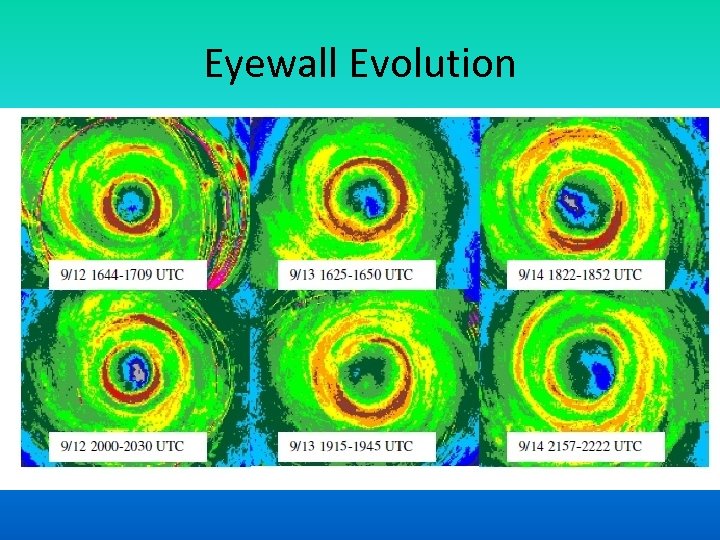 Eyewall Evolution
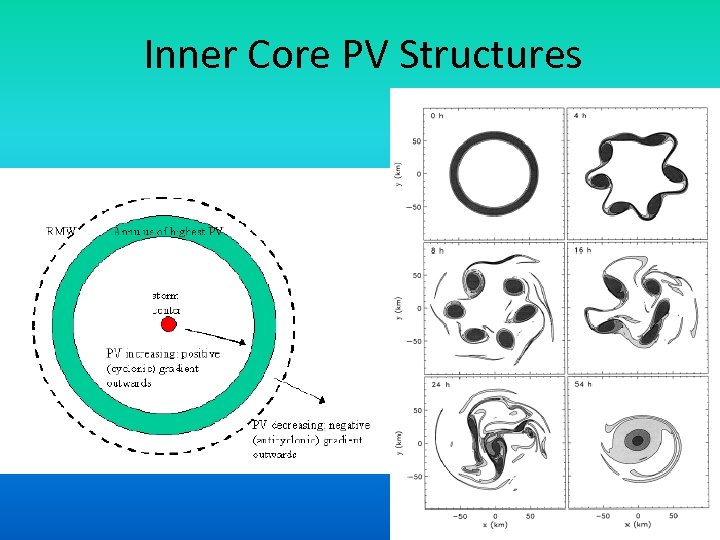
 Energy for Waves via PV Gradients • Polygonal eyewalls and mesovortices. • Energy from vorticity gradient. Above features end up mixing the gradient, spinning up the eye at expense of the eyewall. This reduces the vorticity gradient, killing off vortex Rossby waves and mesovortices. Vortex may re-intensify, creating a new, strong PV gradient maximized at the inner edge of the eyewall once again if synoptic conditions are favorable. • Usually result in weaker IS due to increased eye-eyewall mixing. Generates weaker subsidence-> reduces warming and SLPs will increase, and inversion in eye will ascend. • Generally, vortex expands with time, as gets older and moves to higher latitudes (larger f). Also, annulus of high PV around center is an unstable configuration- usually results in mixing.
 Inner Core PV Structures
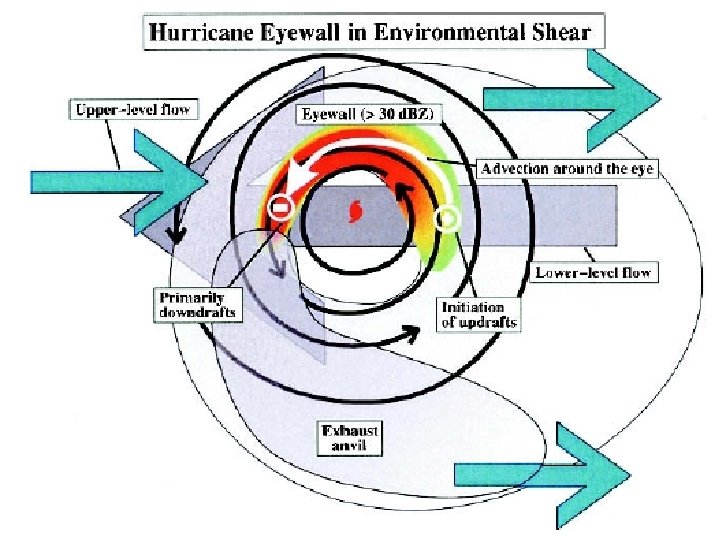
 Vertical Wind Shear • Wavenumber-1 asymmetry from vertical wind shear. • Increases ventilation of system to the point that it reduces available heating-> generally results in weakening. • Deepest convection typically on downshear left side.
 Midlatitude Troughing Troughs, especially at upper levels: • Can intensify storm if UL Div and cyclonic vort enhancement dominates over increased VWS • Weaker values of inertial stability at upper levels in hurricanes makes them sensitive to wind shear aloft; VWS with high AAM values from large scale of trof or outer environment can destroy heat (too much ventilation) and momentum fields at upper levels first.
 TC Death • Decay as move to higher latitude… cooler water and higher VWS most of time. • R# = U/fo. L -> decreases with greater latitude… size of storm increases. Latent heating also decreases. Pressure gradient and tangential winds decrease. • Extratropical transition possible in N Atlantic and NW Pacific. • Die over land due to loss of LH flux, often also SH flux. Increased friction reduces wind speed and may cause too much of a rapid increase in LL mass convergence for adequate evacuation via UL Div.
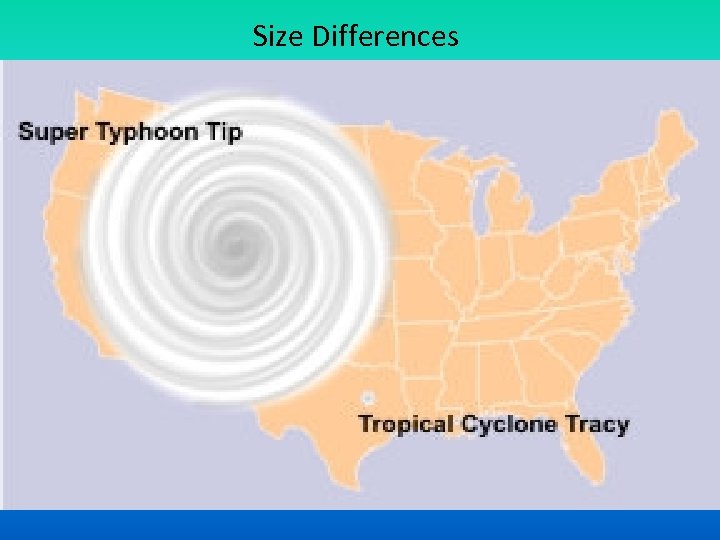 Size Differences
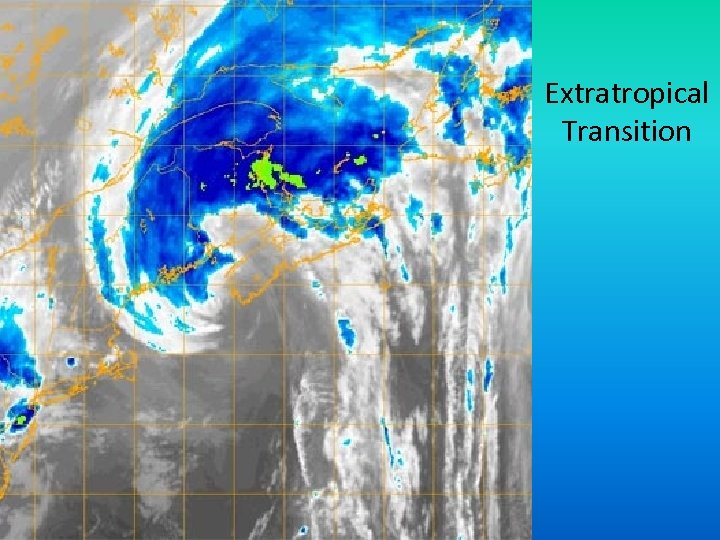
 Extratropical Transition • PV and UL Div from upper trough may enhance TC. • Typically occur in September and October. • Winds increase aloft due to colder mid and upper levels reducing the warm core of the TC. • Precipitation shield on left and poleward side, winds on equatorward side. • Fast forward speed and large, broad wind field may produce very large waves. • Generally becomes increasingly baroclinic and cold core.
 Extratropical Transition
 • End presentation.