


 Скачать презентацию Intended Majors and Career Interests Men and Women
371c59ae5d44c6fd5fbce1a820c1761e.ppt
- Количество слайдов: 43
 Intended Majors and Career Interests: Men and Women Really Are from Different Planets Debra Fitz. Gerald Senior Consultant, Client Outreach ACT Midwest Region Tim Osborn Senior Consultant, Program Solutions ACT Midwest Region
 Expressed and Measured Interests • • • With respect to intended majors and careers, ACT collects two types of information: Expressed Interests: – When students register for the ACT they are asked to specify an intended major (from a choice of 295) and an occupational choice (from the same list of 295). Measured Interests: – When students register for the ACT they are asked to complete a 72 item Interest Inventory that diagnoses their career interest and places the student’s interests on the ACT World of Work Map.
 Goals of the Presentation • • During the presentation we will look at differences in expressed and measured major and career interests between men and women We will also look at how the gender differences correlate to student preferences for 4 -year public and 4 -year private institutions
 Intended Majors by Male/Female Ratio and ACT Composite Score Bands • The first table shows majors where male and female interest is strongest - Red: females more than 50% more likely to have this intended major - Green: males more than 50% more likely to have this intended major • For convenience of reporting, the 295 individual majors are “rolled up” into 18 groupings of similar majors
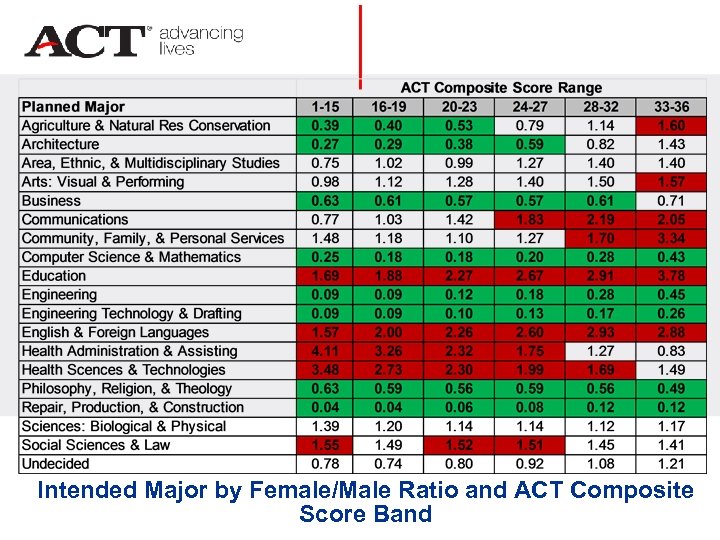 Intended Major by Female/Male Ratio and ACT Composite Score Band
 Intended Majors by Frequency • The next two tables show intended majors by frequency and ACT Composite Score bands – The percents are the comparative frequency within each score band (total N = 1, 540, 876) • The second table also shows majors where male and female interest is strongest – Light Red: females more than 50% more likely to have this intended major – Light Green: males more than 50% more likely to have this intended major
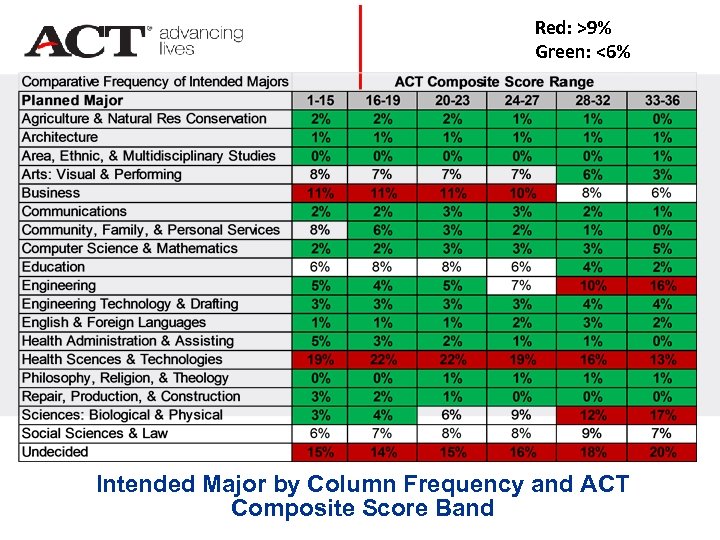 Red: >9% Green: <6% Intended Major by Column Frequency and ACT Composite Score Band
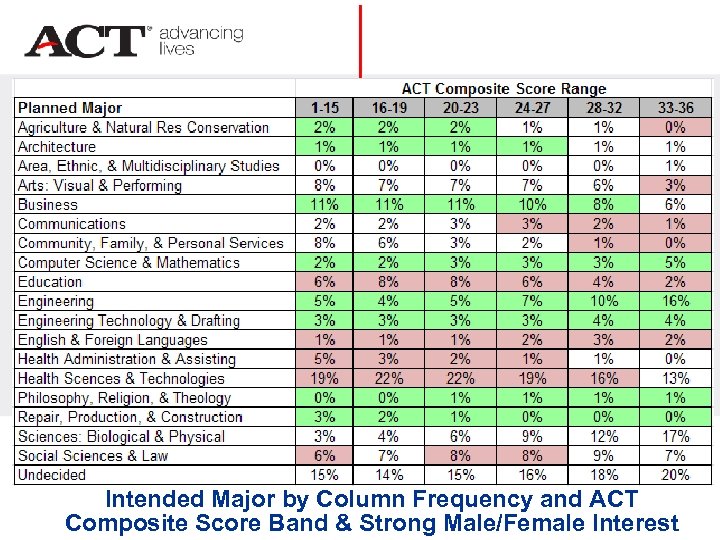 Intended Major by Column Frequency and ACT Composite Score Band & Strong Male/Female Interest
 ACT Composite Scores by Gender • The next chart shows the percentage of men and women whose ACT Composite score falls in particular ability bands – More women than men test in total – Men are over-represented at the highest and lowest score bands – Women are over-represented at the middle ability levels • Thus, the ability bands with the most total tested students (ACT 16 -24) have the largest gap between male and female testers: 10 -13%.
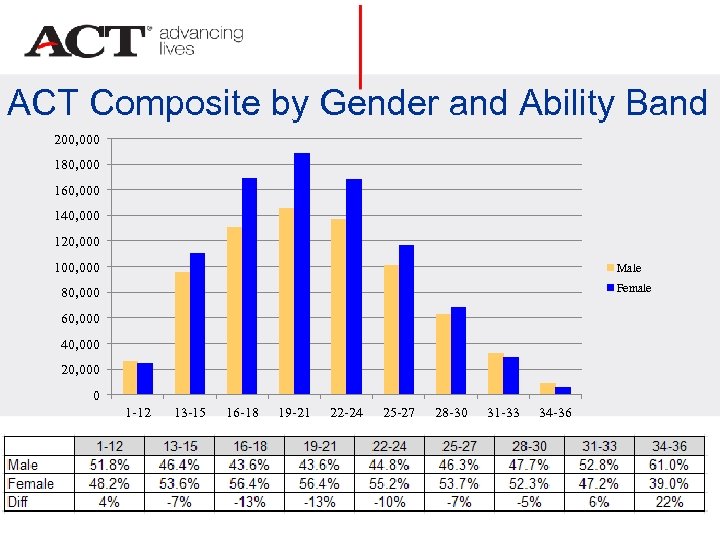 ACT Composite by Gender and Ability Band 200, 000 180, 000 160, 000 140, 000 120, 000 100, 000 Male Female 80, 000 60, 000 40, 000 20, 000 0 1 -12 13 -15 16 -18 19 -21 22 -24 25 -27 28 -30 31 -33 34 -36
 Intended Majors by 4 -yr Public/Private Ratio and ACT Composite Score Bands • The next table shows majors by preferred institution type − Red: greater than a ratio of 1, 4 -yr private more likely to have this intended major − Green: less than a ratio of 1, 4 -yr public more likely to have this intended major
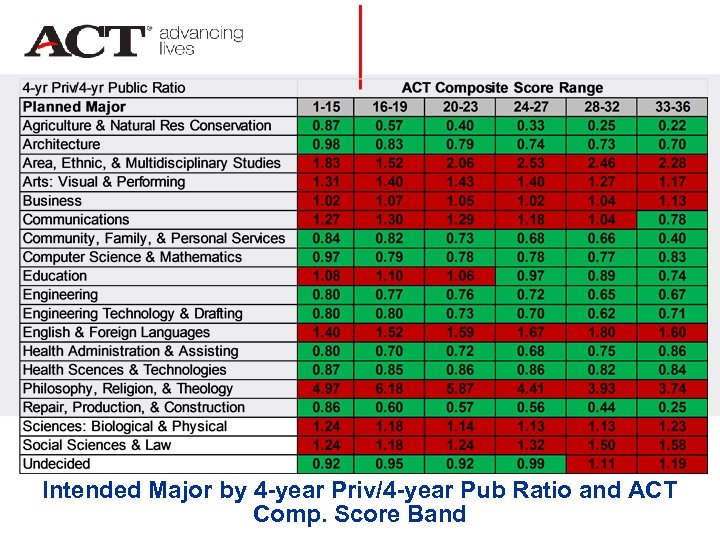 Intended Major by 4 -year Priv/4 -year Pub Ratio and ACT Comp. Score Band
 Correlations by Gender and Institution Type Preference • Majority Male and 4 -yr Public − Agric. & Natural Res Conservation (ACT 1 -27) − Architecture (ACT 1 -32) − Computer Science & Math − Engineering Technology & Drafting − Repair, Production & Construction − Undecided (ACT 1 -27)
 Correlations by Gender and Institution Type Preference • Majority Female and 4 -yr Public ‒ Agric. & Natural Res Conservation (ACT 28 -36) ‒ Architecture (ACT 33 -36) ‒ Communications (ACT 33 -36) ‒ Community, Family & Personal Services ‒ Education (ACT 24 -26) ‒ Health Administration & Assisting (ACT 1 -32) ‒ Health Sciences & Technologies
 Correlations by Gender and Institution Type Preference • Majority Male and 4 -yr Private ‒ Area, Ethnic & Multidisciplinary (ACT 1 -15; 20 -23) ‒ Arts: Visual & Performing (ACT 1 -15) ‒ Business (strong male; slightly more private) ‒ Communications (ACT 1 -15) ‒ Philosophy, Religion & Theology
 Correlations by Gender and Institution Type Preference • Majority Female and 4 -yr Private – Area, Ethnic & Multidisciplinary (ACT 1619; 24 -36) – Arts: Visual and Performing (ACT 16 -36) – Communications (ACT 16 -32) – Education (ACT 1 -23) – English & Foreign Languages – Sciences: Biological & Physical – Social Sciences & Law – Undecided (ACT 28 -36)
 Intended Major by Frequency and ACT Composite Score Band • The table on the next slide shows how student interest in intended major changes as ability level rises. – The columns labeled “ 1 -15” and “ 33 -36” show the relative rank from 1 to 18 of student interest in the majors in that grouping – The column labeled “Trend 1 -36” shows how the ranks change from 1 -15 to 33 -36 and are sorted to show the groups that gain the most in frequency rank – You will note that the groups of majors that gain the most are the most math-intensive and reading-intensive
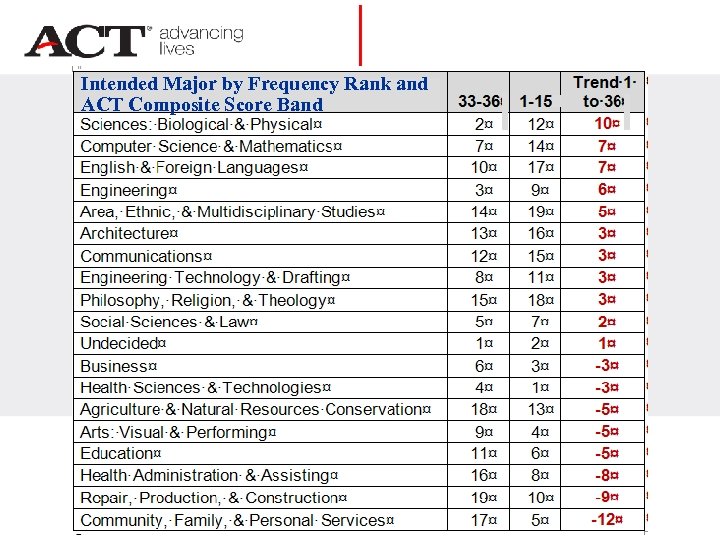 Intended Major by Frequency Rank and ACT Composite Score Band
 ACT Interest Inventory and World of Work Map • The next part of the presentation shows data for the ACT Interest Inventory and World of Work Map Regions ‒ Gender differences are highlighted as are differences among students preferring to attend 4 -year public and 4 -year private institutions
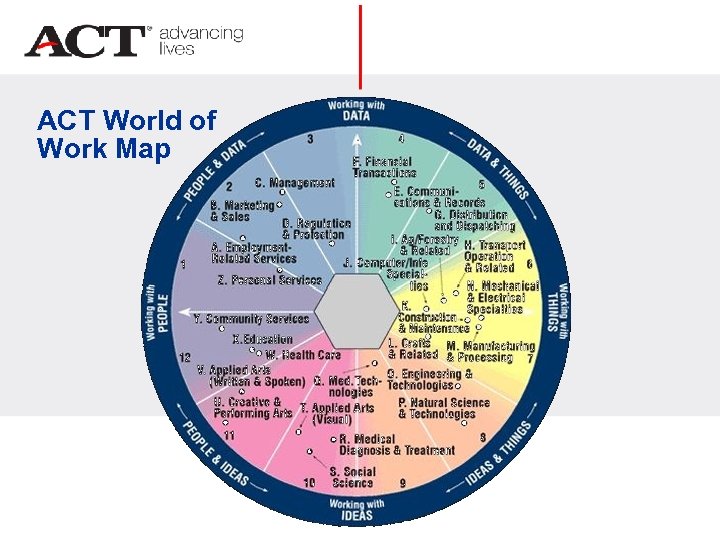 ACT World of Work Map
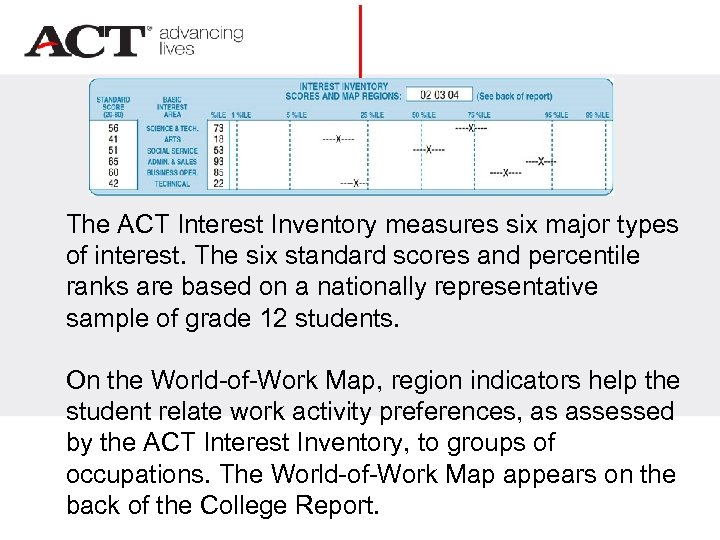 The ACT Interest Inventory measures six major types of interest. The six standard scores and percentile ranks are based on a nationally representative sample of grade 12 students. On the World-of-Work Map, region indicators help the student relate work activity preferences, as assessed by the ACT Interest Inventory, to groups of occupations. The World-of-Work Map appears on the back of the College Report.
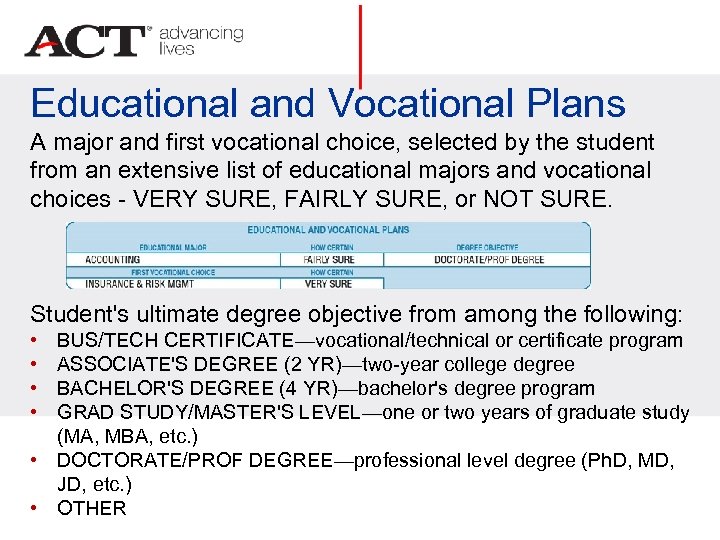 Educational and Vocational Plans A major and first vocational choice, selected by the student from an extensive list of educational majors and vocational choices - VERY SURE, FAIRLY SURE, or NOT SURE. Student's ultimate degree objective from among the following: • • BUS/TECH CERTIFICATE—vocational/technical or certificate program ASSOCIATE'S DEGREE (2 YR)—two-year college degree BACHELOR'S DEGREE (4 YR)—bachelor's degree program GRAD STUDY/MASTER'S LEVEL—one or two years of graduate study (MA, MBA, etc. ) • DOCTORATE/PROF DEGREE—professional level degree (Ph. D, MD, JD, etc. ) • OTHER
 Interest Inventory by Male/Female Ratio and ACT Comp. Score Bands • The next table shows Map Regions where male and female interest is strongest ‒ Red: females more than 50% more likely to be in this Map Region ‒ Green: males more than 50% more likely to be in this Map Region
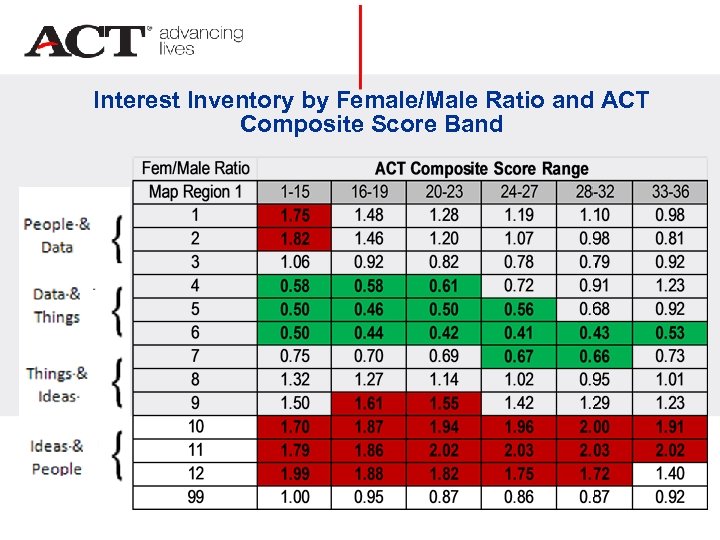 Interest Inventory by Female/Male Ratio and ACT Composite Score Band
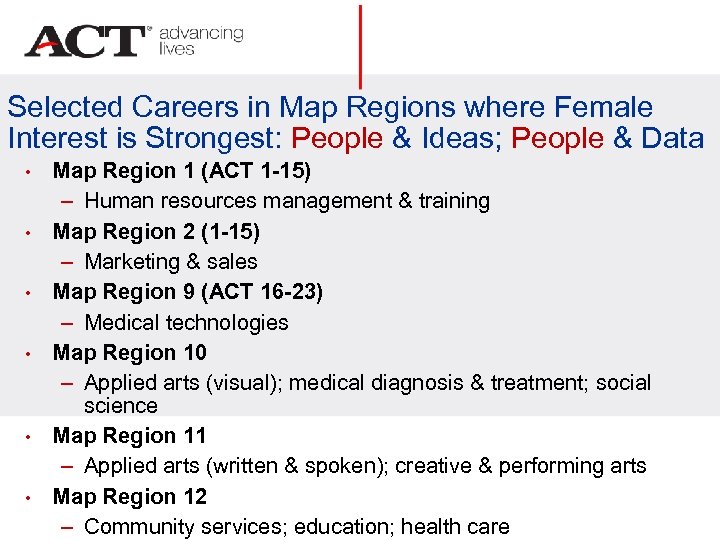 Selected Careers in Map Regions where Female Interest is Strongest: People & Ideas; People & Data • • • Map Region 1 (ACT 1 -15) – Human resources management & training Map Region 2 (1 -15) – Marketing & sales Map Region 9 (ACT 16 -23) – Medical technologies Map Region 10 – Applied arts (visual); medical diagnosis & treatment; social science Map Region 11 – Applied arts (written & spoken); creative & performing arts Map Region 12 – Community services; education; health care
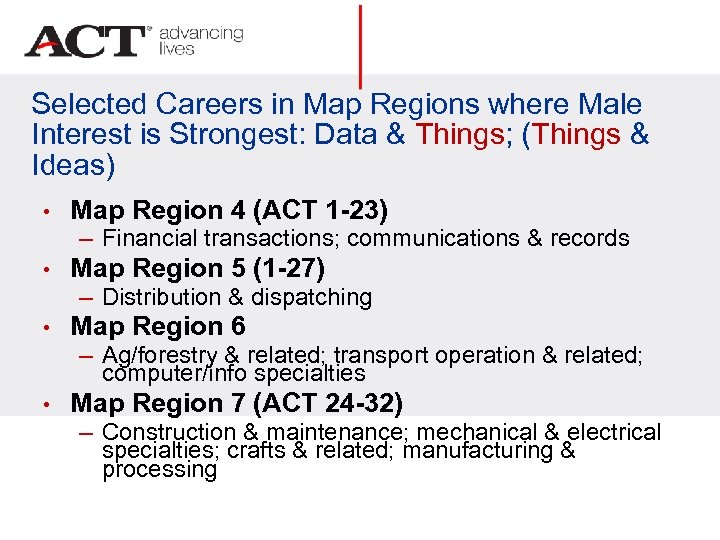 Selected Careers in Map Regions where Male Interest is Strongest: Data & Things; (Things & Ideas) • Map Region 4 (ACT 1 -23) – Financial transactions; communications & records • Map Region 5 (1 -27) – Distribution & dispatching • Map Region 6 – Ag/forestry & related; transport operation & related; computer/info specialties • Map Region 7 (ACT 24 -32) – Construction & maintenance; mechanical & electrical specialties; crafts & related; manufacturing & processing
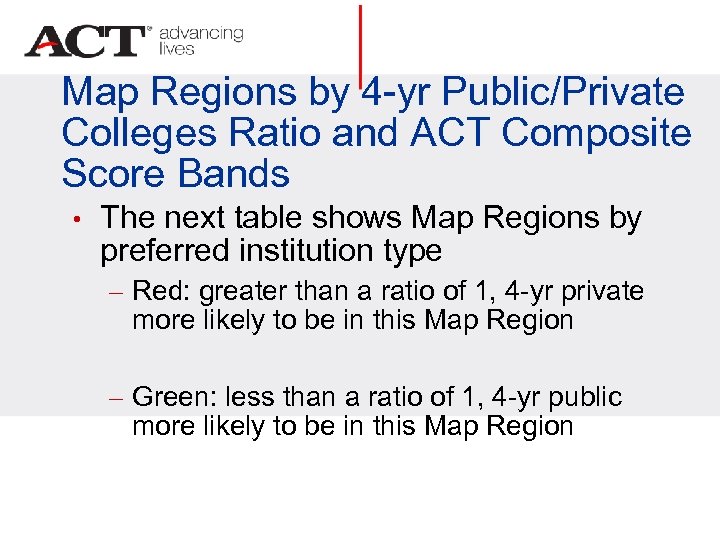 Map Regions by 4 -yr Public/Private Colleges Ratio and ACT Composite Score Bands • The next table shows Map Regions by preferred institution type ‒ Red: greater than a ratio of 1, 4 -yr private more likely to be in this Map Region ‒ Green: less than a ratio of 1, 4 -yr public more likely to be in this Map Region
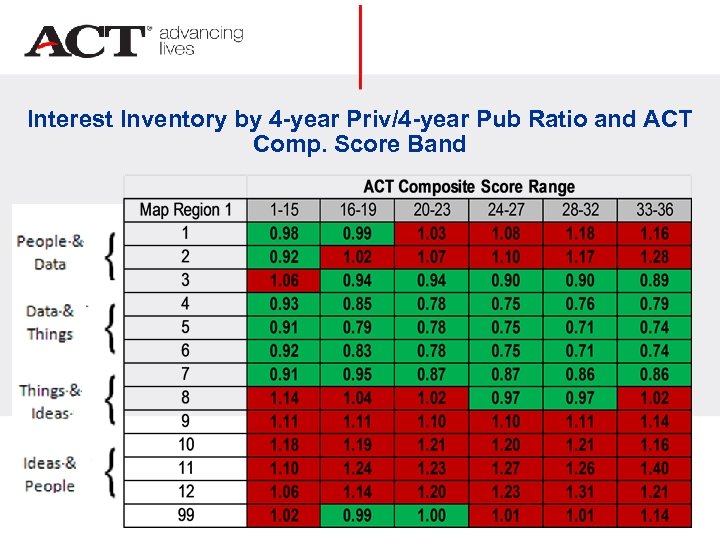 Interest Inventory by 4 -year Priv/4 -year Pub Ratio and ACT Comp. Score Band
 Map Regions by Frequency • The next three tables shows Map Regions by frequency and ACT Composite Score bands ‒ The percents listed are the comparative frequency within each score band (total N = 1, 375, 273) The tables also show Map Regions where male and female interest is strongest (also 2 -yr) • ‒ Red: >9% of students in an ability band ‒ Green: <6% of students in an ability band
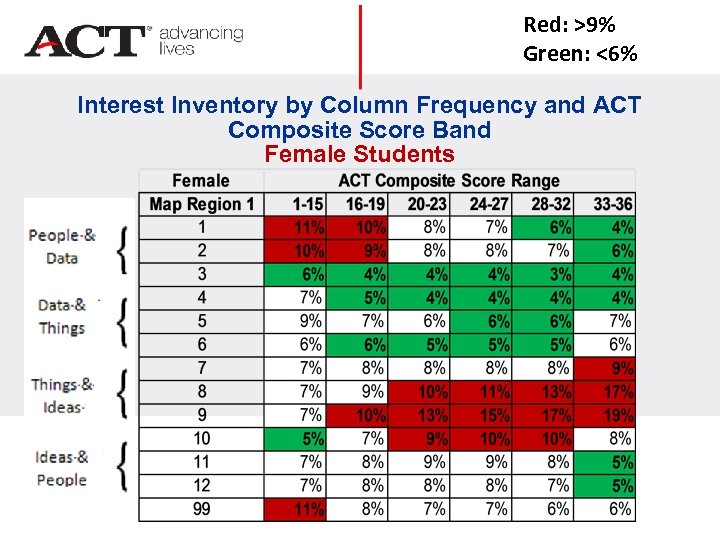 Red: >9% Green: <6% Interest Inventory by Column Frequency and ACT Composite Score Band Female Students
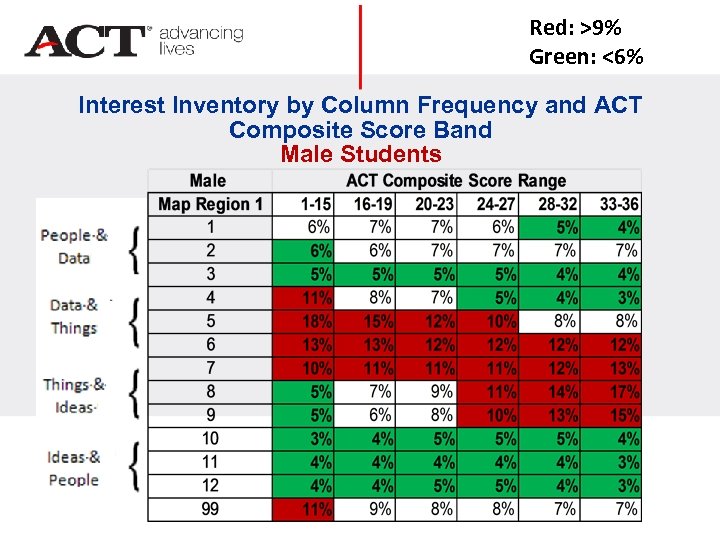 Red: >9% Green: <6% Interest Inventory by Column Frequency and ACT Composite Score Band Male Students
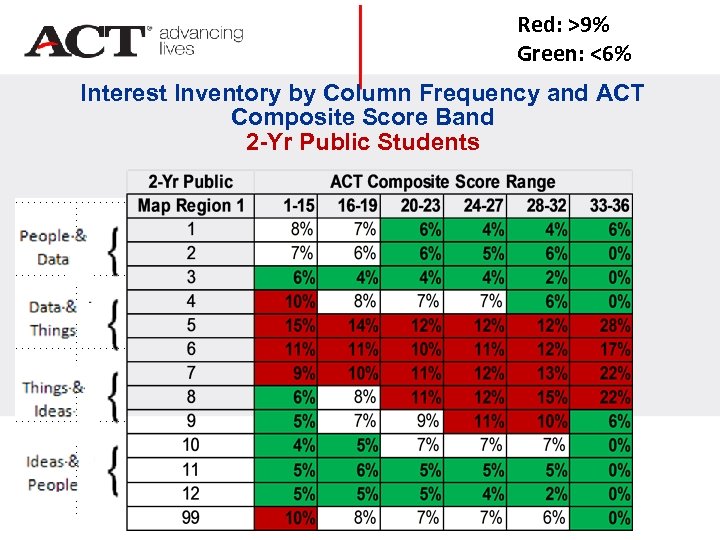 Red: >9% Green: <6% Interest Inventory by Column Frequency and ACT Composite Score Band 2 -Yr Public Students
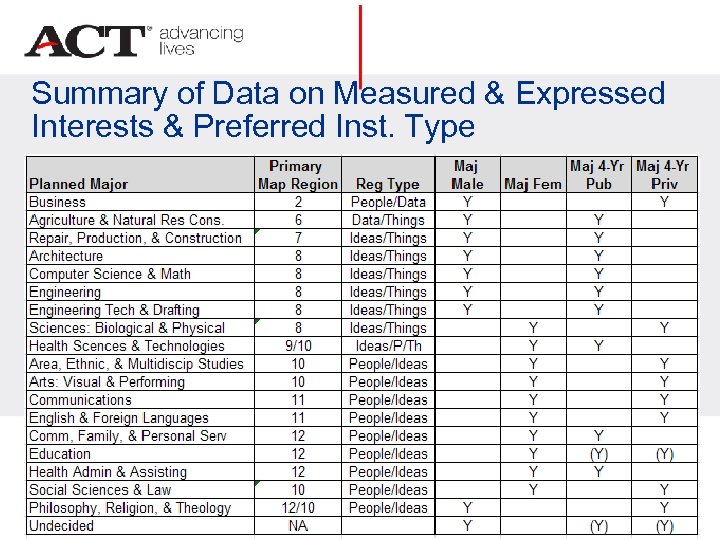 Summary of Data on Measured & Expressed Interests & Preferred Inst. Type
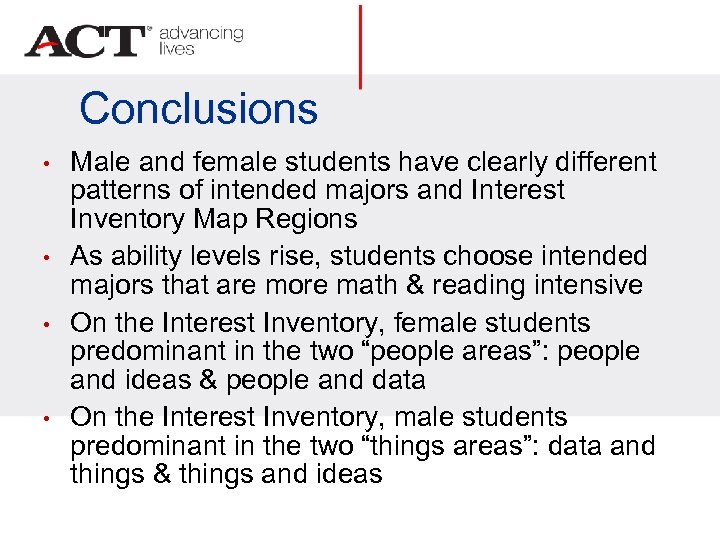 Conclusions • • Male and female students have clearly different patterns of intended majors and Interest Inventory Map Regions As ability levels rise, students choose intended majors that are more math & reading intensive On the Interest Inventory, female students predominant in the two “people areas”: people and ideas & people and data On the Interest Inventory, male students predominant in the two “things areas”: data and things & things and ideas
 Conclusions (continued) • • • Students preferring 4 -yr publics are predominant in Map Regions 3 -7 (data and things) Students preferring 4 -yr privates are predominant in Map Regions 8 -2 (ideas and people) The differences between 4 -yr public and private not as strong as differences between male and female
 Implications • Students choosing selective public and private universities seem to have intended majors and interests that fit mission of those schools • Students choosing regional publics and 2 -yr publics seem to have intended majors and interests that fit mission of those schools
 Implications (continued) • What about non-selective liberal arts colleges, especially those looking for more men? – There may be potential mismatches between ability level of enrolled students and interest in liberal arts areas – Male students at middle and lower ability levels more tuned to 4 -yr public and less tuned to liberal arts majors – Non-selective privates may enroll more students primarily choosing institution for non-academic reasons: involvement in athletics, other activities, environment, small classes, academic support, etc.
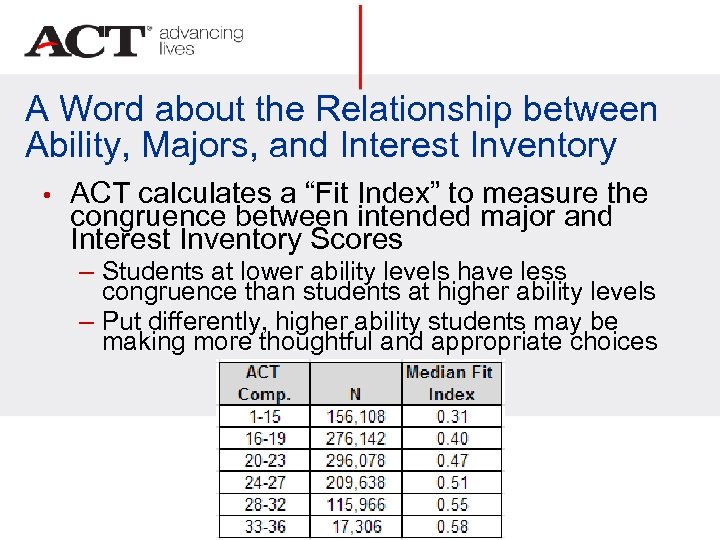 A Word about the Relationship between Ability, Majors, and Interest Inventory • ACT calculates a “Fit Index” to measure the congruence between intended major and Interest Inventory Scores – Students at lower ability levels have less congruence than students at higher ability levels – Put differently, higher ability students may be making more thoughtful and appropriate choices
 Major Enhancement to the ACT Electronic Record • Beginning in September 2012, ACT will begin appending 5 new data elements to the ACT Score Report: − Interest-Major Fit score − Four predictive modeling indexes
 The Interest-Major Fit Index − − The Fit score shows the strength of the relationship between a student’s profile of interests and the profile of interests of students in a given major. Interest-major fit clearly benefits both students and the college they attend: students in “good-fit majors” are more likely to stay in college, stay in their major and finish sooner.
 Predicting Enrollment Behavior with Four Indexes − − The Mobility Index predicts the likelihood of a student enrolling at an out-of-state institution The Institution Type Index predicts the likelihood of a student enrolling at a private institution The Selectivity Index predicts the selectivity of the institution at which the student is likely to enroll The Institution Size Index predicts the size of the institution at which the student is likely to enroll
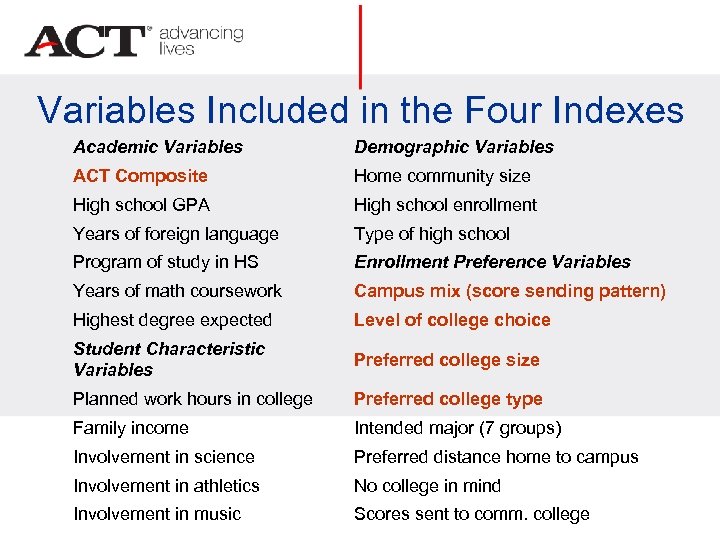 Variables Included in the Four Indexes Academic Variables Demographic Variables ACT Composite Home community size High school GPA High school enrollment Years of foreign language Type of high school Program of study in HS Enrollment Preference Variables Years of math coursework Campus mix (score sending pattern) Highest degree expected Level of college choice Student Characteristic Variables Preferred college size Planned work hours in college Preferred college type Family income Intended major (7 groups) Involvement in science Preferred distance home to campus Involvement in athletics No college in mind Involvement in music Scores sent to comm. college
 Debra Fitz. Gerald Tim Osborn Senior Consultant, Client Outreach Senior Consultant, Program Solutions ACT Midwest Region Lincolnshire, IL 847 -634 -2560 debra. fitzgerald@act. org tim. osborn@act. org