


 Скачать презентацию Intelligent Software Agent Technology Thomas E Potok Ph
4277f908cf4b8f7e2f5354fcd0185427.ppt
- Количество слайдов: 22
 Intelligent Software Agent Technology Thomas E. Potok, Ph. D. Applied Software Engineering Research Group Leader Computational Sciences and Engineering Division Oak Ridge National Laboratory
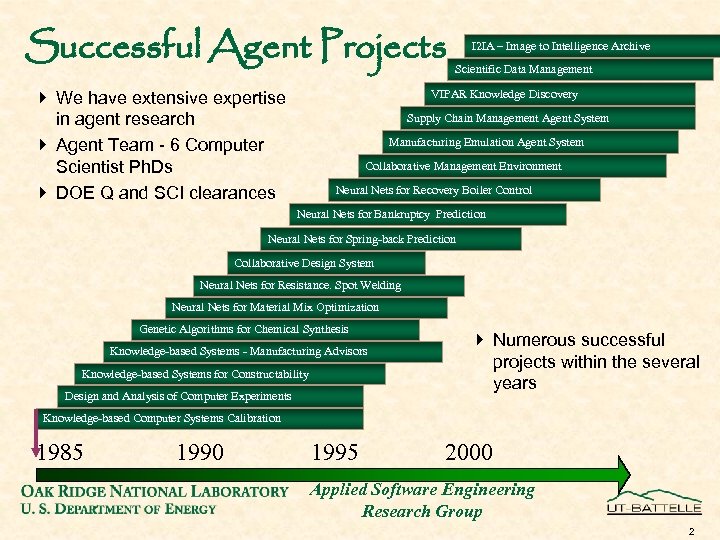 Successful Agent Projects } We have extensive expertise in agent research } Agent Team - 6 Computer Scientist Ph. Ds } DOE Q and SCI clearances I 2 IA – Image to Intelligence Archive Scientific Data Management VIPAR Knowledge Discovery Supply Chain Management Agent System Manufacturing Emulation Agent System Collaborative Management Environment Neural Nets for Recovery Boiler Control Neural Nets for Bankruptcy Prediction Neural Nets for Spring-back Prediction Collaborative Design System Neural Nets for Resistance. Spot Welding Neural Nets for Material Mix Optimization Genetic Algorithms for Chemical Synthesis Knowledge-based Systems - Manufacturing Advisors Knowledge-based Systems for Constructability Design and Analysis of Computer Experiments } Numerous successful projects within the several years Knowledge-based Computer Systems Calibration 1985 1990 1995 2000 Applied Software Engineering Research Group 2
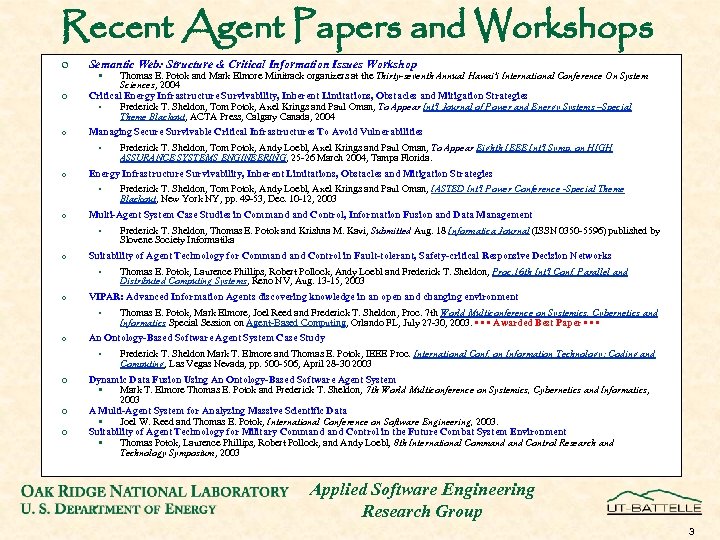 Recent Agent Papers and Workshops o Semantic Web: Structure & Critical Information Issues Workshop § o Thomas E. Potok and Mark Elmore Minitrack organizers at the Thirty-seventh Annual Hawai'i International Conference On System Sciences, 2004 Critical Energy Infrastructure Survivability, Inherent Limitations, Obstacles and Mitigation Strategies § Frederick T. Sheldon, Tom Potok, Axel Krings and Paul Oman, To Appear Int'l Journal of Power and Energy Systems –Special Theme Blackout, ACTA Press, Calgary Canada, 2004 o Managing Secure Survivable Critical Infrastructures To Avoid Vulnerabilities § o Energy Infrastructure Survivability, Inherent Limitations, Obstacles and Mitigation Strategies § o o o Thomas E. Potok, Mark Elmore, Joel Reed and Frederick T. Sheldon, Proc. 7 th World Multiconference on Systemics, Cybernetics and Informatics Special Session on Agent-Based Computing, Orlando FL, July 27 -30, 2003. • • • Awarded Best Paper • • • An Ontology-Based Software Agent System Case Study § o Thomas E. Potok, Laurence Phillips, Robert Pollock, Andy Loebl and Frederick T. Sheldon, Proc. 16 th Int'l Conf. Parallel and Distributed Computing Systems, Reno NV, Aug. 13 -15, 2003 VIPAR: Advanced Information Agents discovering knowledge in an open and changing environment § o Frederick T. Sheldon, Thomas E. Potok and Krishna M. Kavi, Submitted Aug. 18 Informatica Journal (ISSN 0350 -5596) published by Slovene Society Informatika Suitability of Agent Technology for Command Control in Fault-tolerant, Safety-critical Responsive Decision Networks § o Frederick T. Sheldon, Tom Potok, Andy Loebl, Axel Krings and Paul Oman, IASTED Int'l Power Conference -Special Theme Blackout, New York NY, pp. 49 -53, Dec. 10 -12, 2003 Multi-Agent System Case Studies in Command Control, Information Fusion and Data Management § o Frederick T. Sheldon, Tom Potok, Andy Loebl, Axel Krings and Paul Oman, To Appear Eighth IEEE Int'l Symp. on HIGH ASSURANCE SYSTEMS ENGINEERING, 25 -26 March 2004, Tampa Florida. Frederick T. Sheldon Mark T. Elmore and Thomas E. Potok, IEEE Proc. International Conf. on Information Technology: Coding and Computing, Las Vegas Nevada, pp. 500 -506, April 28 -30 2003 Dynamic Data Fusion Using An Ontology-Based Software Agent System § Mark T. Elmore Thomas E. Potok and Frederick T. Sheldon, 7 th World Multiconference on Systemics, Cybernetics and Informatics, 2003 A Multi-Agent System for Analyzing Massive Scientific Data § Joel W. Reed and Thomas E. Potok, International Conference on Software Engineering, 2003. Suitability of Agent Technology for Military Command Control in the Future Combat System Environment § Thomas Potok, Laurence Phillips, Robert Pollock, and Andy Loebl, 8 th International Command Control Research and Technology Symposium, 2003 Applied Software Engineering Research Group 3
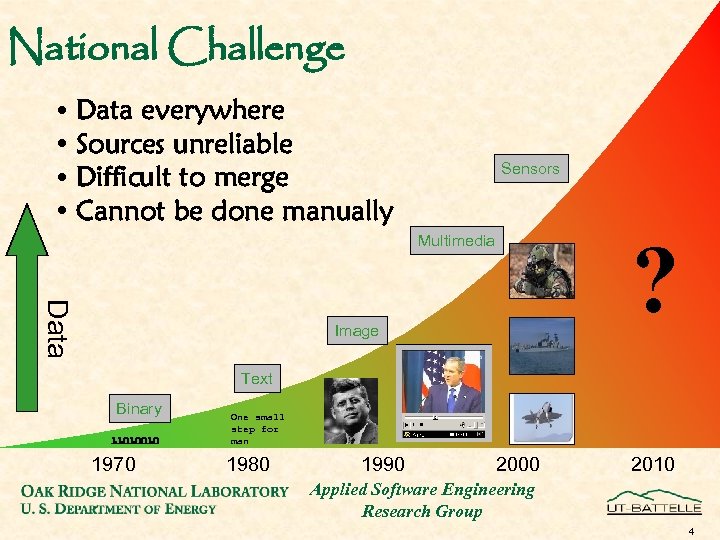 National Challenge • Data everywhere • Sources unreliable • Difficult to merge • Cannot be done manually Sensors ? Multimedia Data Image Text Binary 11010010 1970 One small step for man 1980 1990 2000 2010 Applied Software Engineering Research Group 4
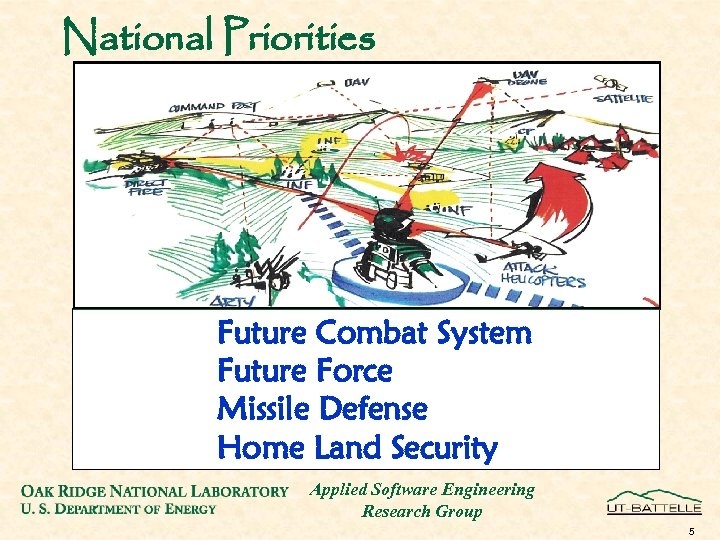 National Priorities Future Combat System Future Force Missile Defense Home Land Security Applied Software Engineering Research Group 5
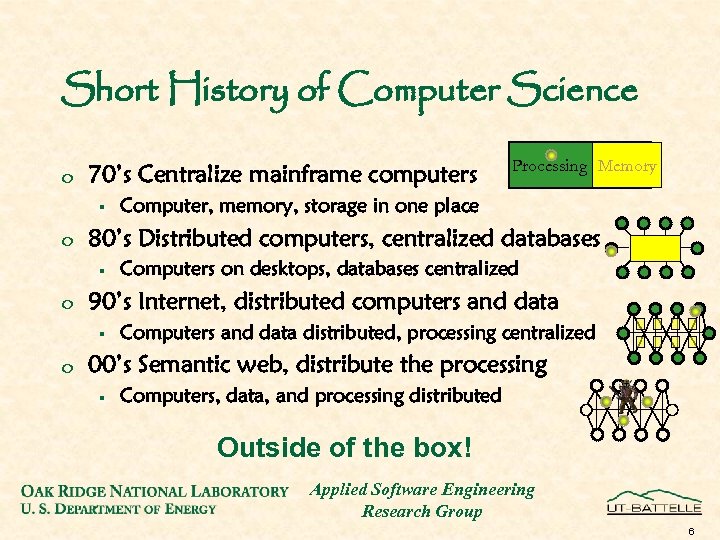 Short History of Computer Science o 70’s Centralize mainframe computers § o Computers on desktops, databases centralized 90’s Internet, distributed computers and data § o Computer, memory, storage in one place 80’s Distributed computers, centralized databases § o Processing Memory Computers and data distributed, processing centralized 00’s Semantic web, distribute the processing § Computers, data, and processing distributed Outside of the box! Applied Software Engineering Research Group 6
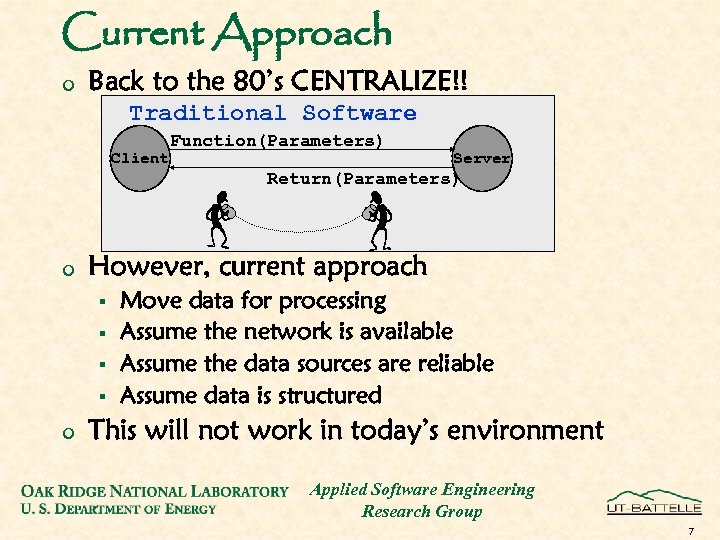 Current Approach o Back to the 80’s CENTRALIZE!! Traditional Software Client Function(Parameters) Server Return(Parameters) o However, current approach § § o Move data for processing Assume the network is available Assume the data sources are reliable Assume data is structured This will not work in today’s environment Applied Software Engineering Research Group 7
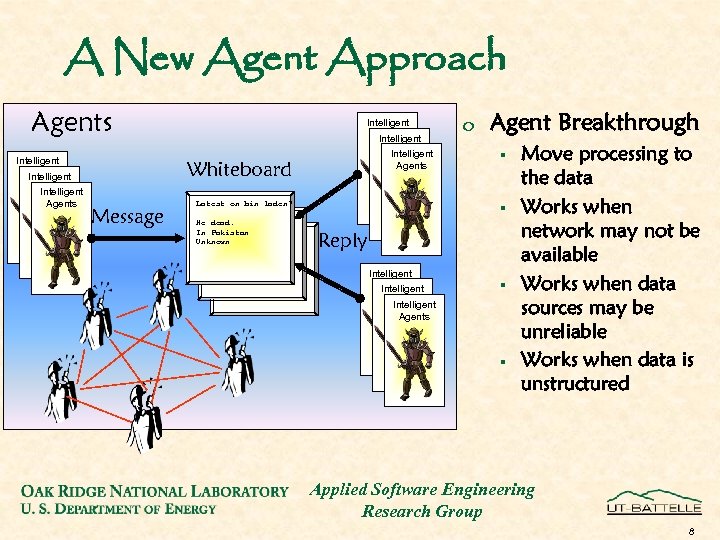 A New Agent Approach Agents Intelligent Agents Intelligent Agents Whiteboard Message Latest on bin laden? He dead. In Pakistan Unknown o Agent Breakthrough § § Reply Intelligent Agents Intelligent § Agents Intelligent Agents § Move processing to the data Works when network may not be available Works when data sources may be unreliable Works when data is unstructured Applied Software Engineering Research Group 8
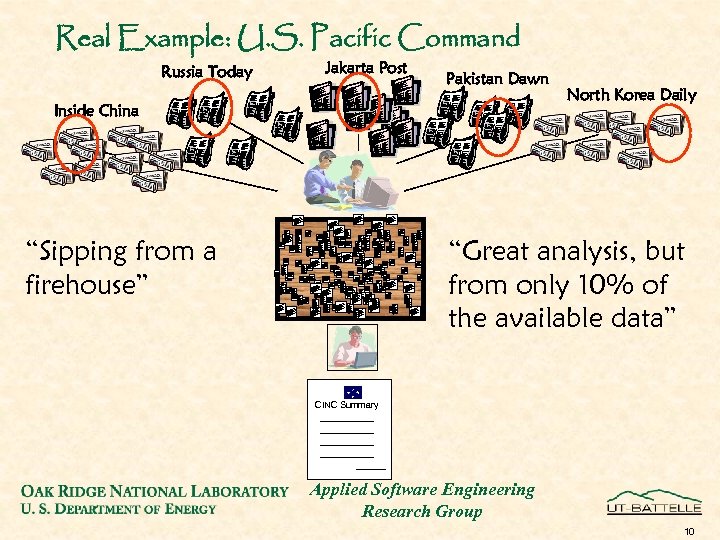 Real Example: U. S. Pacific Command Russia Today Jakarta Post Pakistan Dawn Inside China “Sipping from a firehouse” North Korea Daily “Great analysis, but from only 10% of the available data” CINC Summary Applied Software Engineering Research Group 10
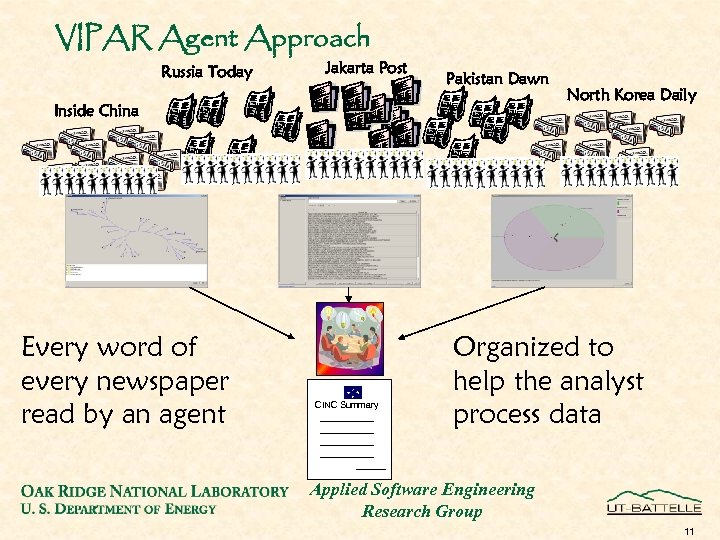 VIPAR Agent Approach Russia Today Jakarta Post Pakistan Dawn Inside China Every word of every newspaper read by an agent CINC Summary North Korea Daily Organized to help the analyst process data Applied Software Engineering Research Group 11
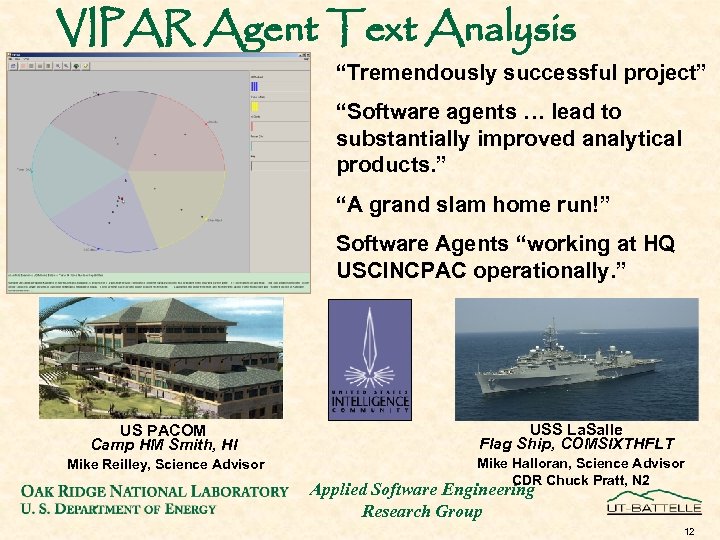 VIPAR Agent Text Analysis “Tremendously successful project” “Software agents … lead to substantially improved analytical products. ” “A grand slam home run!” Software Agents “working at HQ USCINCPAC operationally. ” US PACOM Camp HM Smith, HI Mike Reilley, Science Advisor USS La. Salle Flag Ship, COMSIXTHFLT Mike Halloran, Science Advisor CDR Chuck Pratt, N 2 Applied Software Engineering Research Group 12
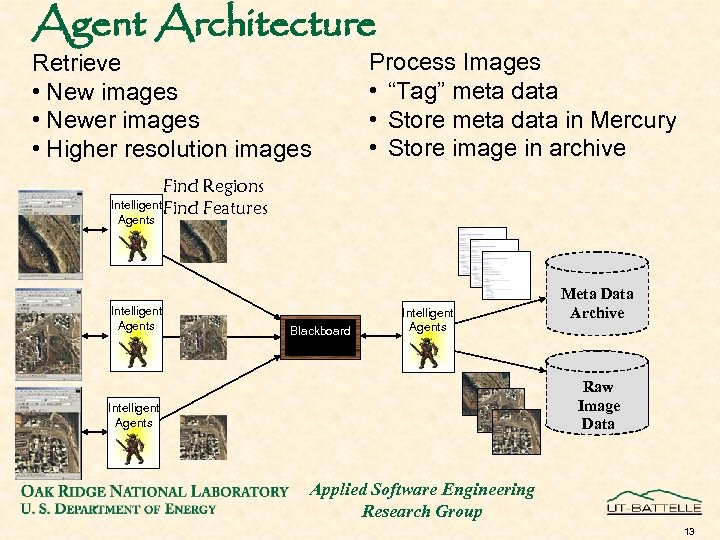 Agent Architecture Retrieve • New images • Newer images • Higher resolution images Process Images • “Tag” meta data • Store meta data in Mercury • Store image in archive Find Regions Intelligent Find Features Agents Intelligent Agents Blackboard Intelligent Agents Meta Data Archive Raw Image Data Intelligent Agents Applied Software Engineering Research Group 13
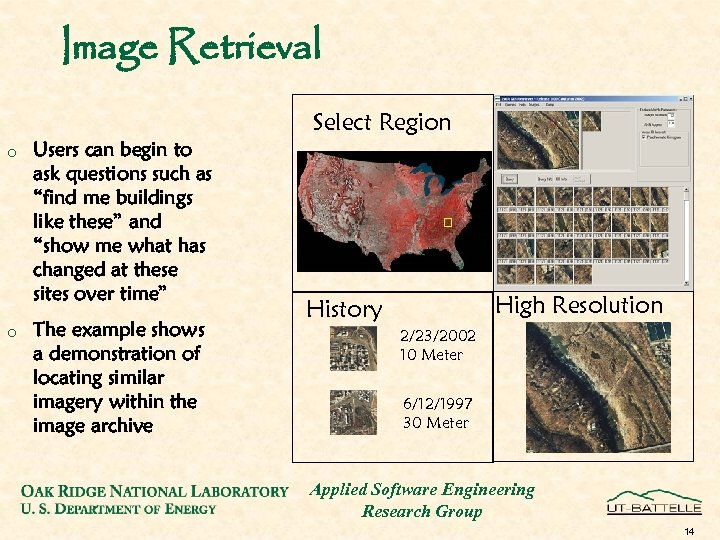 Image Retrieval Select Region o o Users can begin to ask questions such as “find me buildings like these” and “show me what has changed at these sites over time” The example shows a demonstration of locating similar imagery within the image archive High Resolution History 2/23/2002 10 Meter 6/12/1997 30 Meter Applied Software Engineering Research Group 14
 Related Projects o o o Partnering with US Army RDECOM and Sandia to form Agent Center of Excellence Partnering with Sandia to build Advanced Decision Support System for the US Army Partnering with PNNL to bridge INSPIRE and VIPAR software tools Applied Software Engineering Research Group 15
 Piranha Preliminary Work o Two key text clustering problems § § o Lack of a standard reference corpus Computationally expensive ~ O(n 3) Base process § § § Create a vector space model relating terms to documents Create a similarity matrix relating documents to documents Create a cluster ranking tree (dendrogram) that shows the similar documents to each other Applied Software Engineering Research Group 16
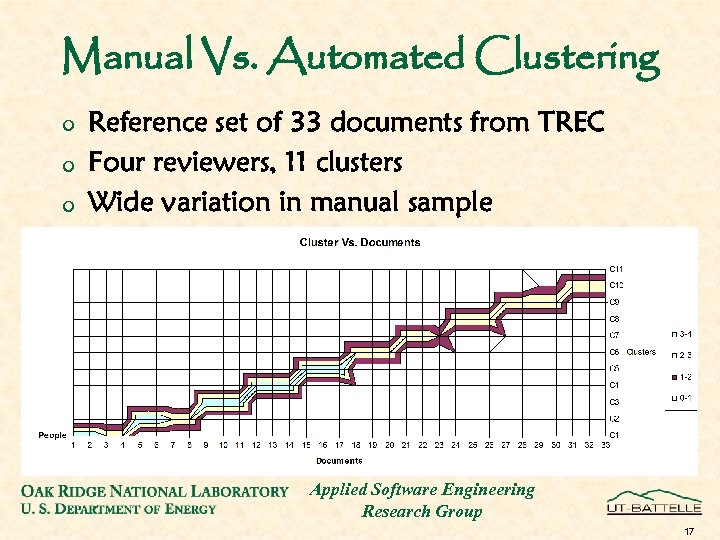 Manual Vs. Automated Clustering o o o Reference set of 33 documents from TREC Four reviewers, 11 clusters Wide variation in manual sample Applied Software Engineering Research Group 17
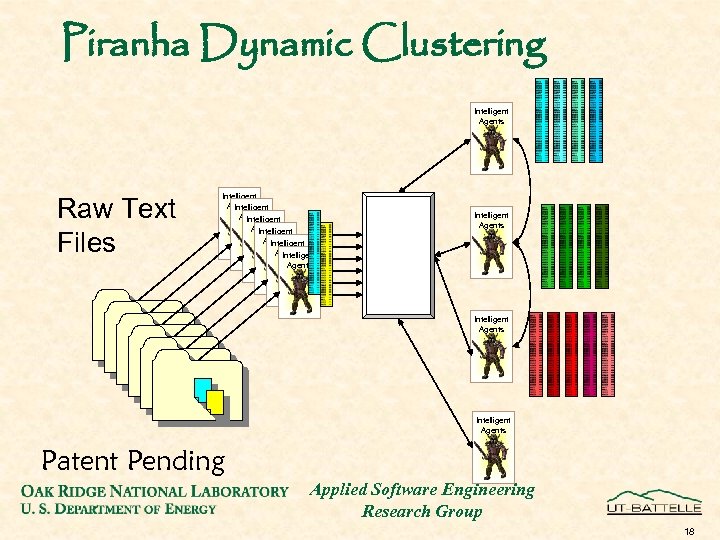 Piranha Dynamic Clustering Intelligent Agents Raw Text Files Intelligent Agents Intelligent Agents Intelligent Agents Patent Pending Applied Software Engineering Research Group 18
 Preliminary Results o o Agent approach much faster More scalable Appears as accurate as traditional approaches Comparison Percentage Difference Manual vs TFIDF 13% Manual vs Agent 9% TFIDF vs Agent o 14% Based on “A Multi-Agent System for Distributed Cluster Analysis” submitted to Software Engineering for Large-Scale Multi-Agent Systems (SELMAS'04) Applied Software Engineering Research Group 19
 Significant Scale Improvement o o o Provides the capability to analyze enormous volumes of data, not available today Allows for a massively distributed or parallel platforms for analysis Allows for multi-agent systems to steer the analysis based on desired outcome Applied Software Engineering Research Group 20
 Next Steps o Experiment with Piranha system on ORNL and LLNL supercomputers § o o Using TREC corpus determine where bottlenecks arise in agent architecture Explore the use of agents to traverse semantic graphs Connect textual analysis to semantic graph relationships Applied Software Engineering Research Group 21
 Summary o o Current technology cannot solve emerging national challenges Intelligent software agents are a significant breakthrough technology Results indicate high-potential to help solve these national challenges We have a progression of significantly successfully deployed agent systems and research to our credit Applied Software Engineering Research Group 22
 Contact Information o Contact Information Thomas E. Potok, Ph. D. Potokte@ornl. gov 865 -574 -0834 Applied Software Engineering Research Group 23