 Скачать презентацию Intelligent IR on the World Wide Web CSC
f3b07d271353a3ed790e5307940cadf7.ppt
- Количество слайдов: 61



Intelligent IR on the World Wide Web CSC 575 Intelligent Information Retrieval
Intelligent IR on the World Wide Web i Web IR versus Classic IR i Web Spiders and Crawlers i Citation/hyperlink Indexing and Analysis i Intelligent Agents for the Web Intelligent Information Retrieval 2
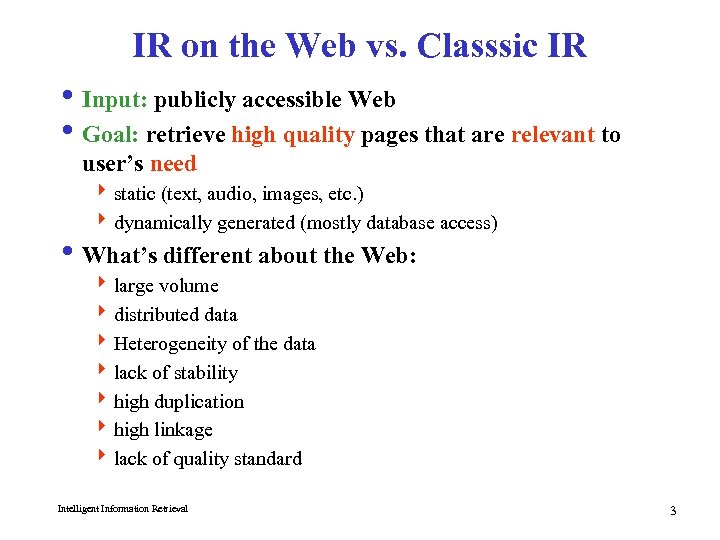
IR on the Web vs. Classsic IR i Input: publicly accessible Web i Goal: retrieve high quality pages that are relevant to user’s need 4 static (text, audio, images, etc. ) 4 dynamically generated (mostly database access) i What’s different about the Web: 4 large volume 4 distributed data 4 Heterogeneity of the data 4 lack of stability 4 high duplication 4 high linkage 4 lack of quality standard Intelligent Information Retrieval 3
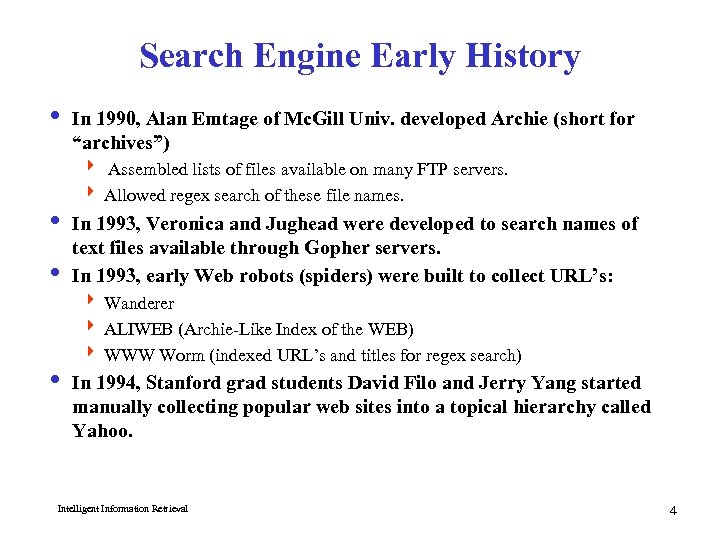
Search Engine Early History i In 1990, Alan Emtage of Mc. Gill Univ. developed Archie (short for “archives”) 4 Assembled lists of files available on many FTP servers. 4 Allowed regex search of these file names. i In 1993, Veronica and Jughead were developed to search names of text files available through Gopher servers. i In 1993, early Web robots (spiders) were built to collect URL’s: 4 Wanderer 4 ALIWEB (Archie-Like Index of the WEB) 4 WWW Worm (indexed URL’s and titles for regex search) i In 1994, Stanford grad students David Filo and Jerry Yang started manually collecting popular web sites into a topical hierarchy called Yahoo. Intelligent Information Retrieval 4
Search Engine Early History i In early 1994, Brian Pinkerton developed Web. Crawler as a class project at U Wash. 4 Eventually became part of Excite and AOL i A few months later, Fuzzy Maudlin, a grad student at CMU developed Lycos 4 First to use a standard IR system 4 First to index a large set of pages i In late 1995, DEC developed Altavista 4 Used a large farm of Alpha machines to quickly process large numbers of queries 4 Supported Boolean operators, phrases in queries. i In 1998, Larry Page and Sergey Brin, Ph. D. students at Stanford, started Google 4 Main advance was use of link analysis to rank results partially based on authority. Intelligent Information Retrieval 5
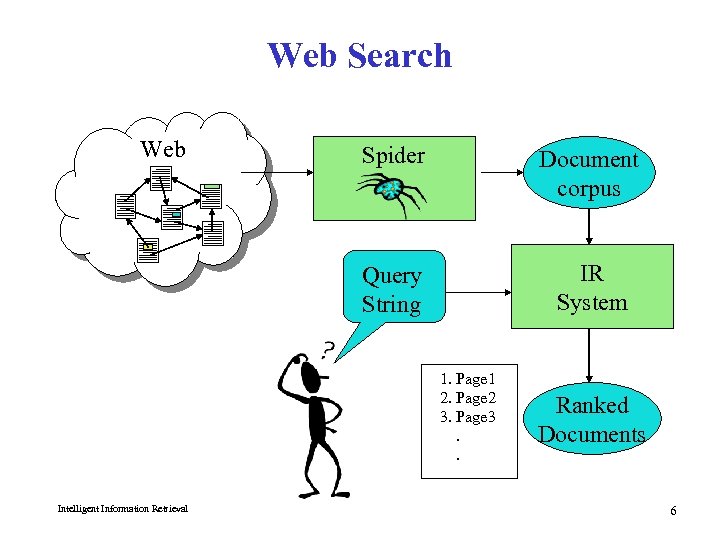
Web Search Web Spider Document corpus Query String IR System 1. Page 1 2. Page 2 3. Page 3. . Intelligent Information Retrieval Ranked Documents 6
Spiders (Robots/Bots/Crawlers) i Start with a comprehensive set of root URL’s from which to start the search. i Follow all links on these pages recursively to find additional pages. i Index all novel found pages in an inverted index as they are encountered. i May allow users to directly submit pages to be indexed (and crawled from). Intelligent Information Retrieval 7
Search Strategy Trade-Off’s i Breadth-first search strategy explores uniformly outward from the root page but requires memory of all nodes on the previous level (exponential in depth). Standard spidering method. i Depth-first search requires memory of only depth times branching-factor (linear in depth) but gets “lost” pursuing a single thread. i Both strategies implementable using a queue of links (URL’s). Intelligent Information Retrieval 8
Avoiding Page Duplication i Must detect when revisiting a page that has already been spidered (web is a graph not a tree). i Must efficiently index visited pages to allow rapid recognition test. 4 Tree indexing (e. g. trie) 4 Hashtable i Index page using URL as a key. 4 Must canonicalize URL’s (e. g. delete ending “/”) 4 Not detect duplicated or mirrored pages. i Index page using textual content as a key. 4 Requires first downloading page. Intelligent Information Retrieval 9
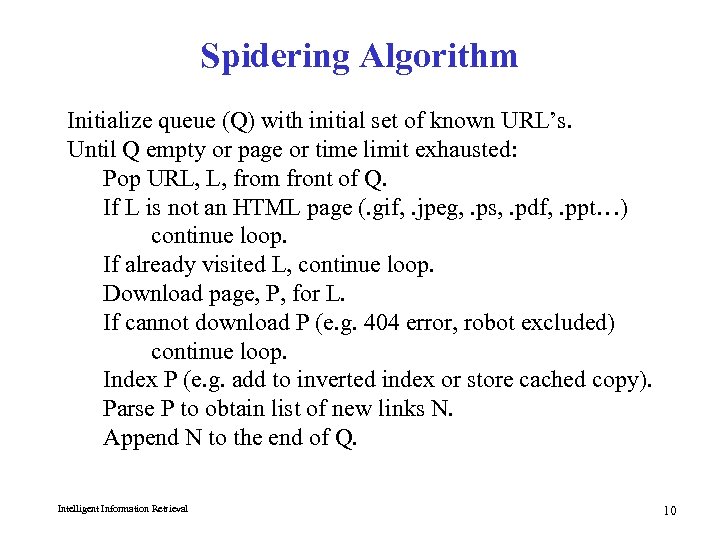
Spidering Algorithm Initialize queue (Q) with initial set of known URL’s. Until Q empty or page or time limit exhausted: Pop URL, L, from front of Q. If L is not an HTML page (. gif, . jpeg, . ps, . pdf, . ppt…) continue loop. If already visited L, continue loop. Download page, P, for L. If cannot download P (e. g. 404 error, robot excluded) continue loop. Index P (e. g. add to inverted index or store cached copy). Parse P to obtain list of new links N. Append N to the end of Q. Intelligent Information Retrieval 10
Queueing Strategy i How new links added to the queue determines search strategy. i FIFO (append to end of Q) 4 gives breadth-first search. i LIFO (add to front of Q) 4 gives depth-first search. i Heuristically ordering the Q gives a “focused crawler” that directs its search towards “interesting” pages. 4 May be able to use standard AI search algorithms such as Best-first search, A*, etc. Intelligent Information Retrieval 11
Restricting Spidering i Restrict spider to a particular site. 4 Remove links to other sites from Q. i Restrict spider to a particular directory. 4 Remove links not in the specified directory. i Obey page-owner restrictions 4 robot exclusion protocol Intelligent Information Retrieval 12
Multi-Threaded Spidering i Bottleneck is network delay in downloading individual pages. i Best to have multiple threads running in parallel each requesting a page from a different host. i Distribute URL’s to threads to guarantee equitable distribution of requests across different hosts to maximize through-put and avoid overloading any single server. i Early Google spider had multiple coordinated crawlers with about 300 threads each, together able to download over 100 pages per second. Intelligent Information Retrieval 13
Directed/Focused Spidering i Sort queue to explore more “interesting” pages first. i Two styles of focus: 4 Topic-Directed 4 Link-Directed Intelligent Information Retrieval 14
Topic-Directed Spidering i Assume desired topic description or sample pages of interest are given. i Sort queue of links by the similarity (e. g. cosine metric) of their source pages and/or anchor text to this topic description. i Preferentially explores pages related to a specific topic. Intelligent Information Retrieval 15
Link-Directed Spidering i Monitor links and keep track of in-degree and outdegree of each page encountered. i Sort queue to prefer popular pages with many incoming links (authorities). i Sort queue to prefer summary pages with many outgoing links (hubs). Intelligent Information Retrieval 16
Keeping Spidered Pages Up to Date i Web is very dynamic: many new pages, updated pages, deleted pages, etc. i Periodically check spidered pages for updates and deletions: 4 Just look at header info (e. g. META tags on last update) to determine if page has changed, only reload entire page if needed. i Track how often each page is updated and preferentially return to pages which are historically more dynamic. i Preferentially update pages that are accessed more often to optimize freshness of more popular pages. Intelligent Information Retrieval 17
Quality and the WWW The Case for Connectivity Analysis i Basic Idea: mine hyperlink information on the Web i Assumptions: 4 links often connect related pages 4 a link between pages is a “recommendation” i Approaches 4 classic IR: co-citation analysis (a. k. a. “bibliometrics”) 4 connectivity-based ranking (e. g. , GOOGLE) 4 HITS - hypertext induced topic search Intelligent Information Retrieval 18
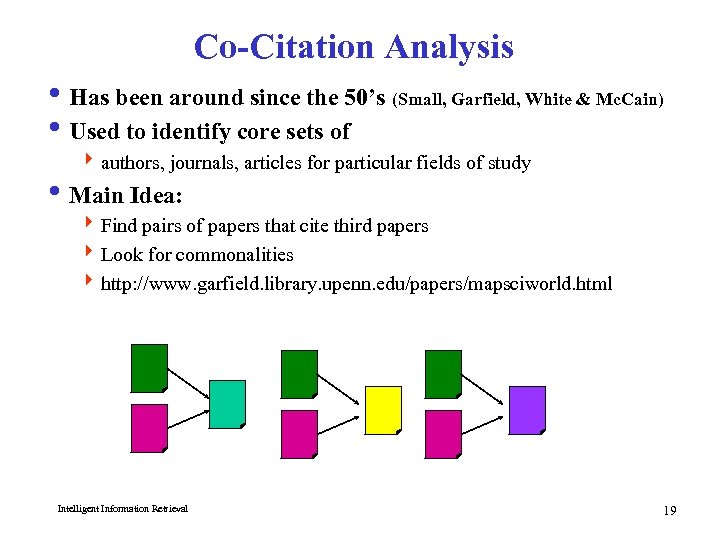
Co-Citation Analysis i Has been around since the 50’s (Small, Garfield, White & Mc. Cain) i Used to identify core sets of 4 authors, journals, articles for particular fields of study i Main Idea: 4 Find pairs of papers that cite third papers 4 Look for commonalities 4 http: //www. garfield. library. upenn. edu/papers/mapsciworld. html Intelligent Information Retrieval 19
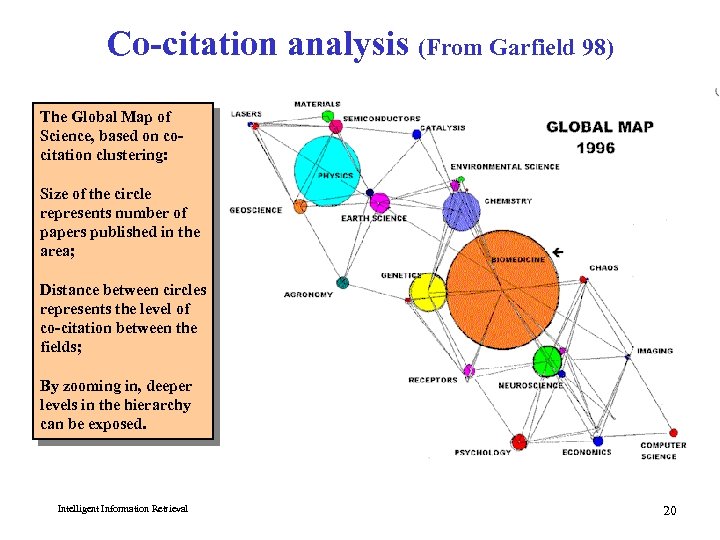
Co-citation analysis (From Garfield 98) The Global Map of Science, based on cocitation clustering: Size of the circle represents number of papers published in the area; Distance between circles represents the level of co-citation between the fields; By zooming in, deeper levels in the hierarchy can be exposed. Intelligent Information Retrieval 20
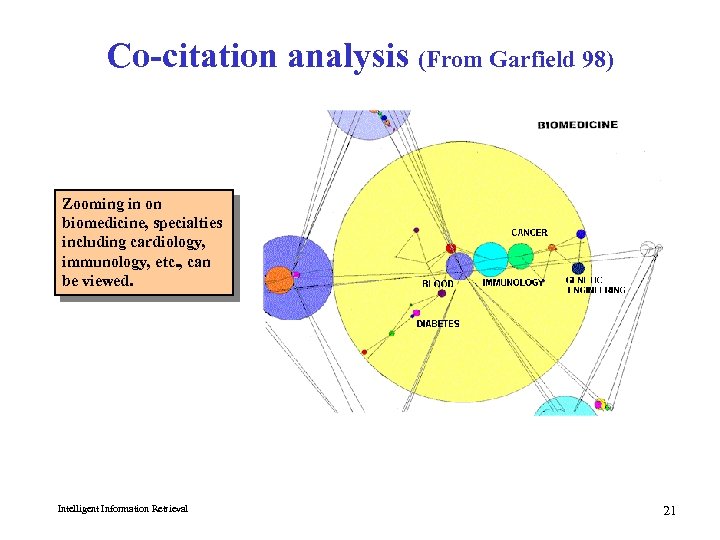
Co-citation analysis (From Garfield 98) Zooming in on biomedicine, specialties including cardiology, immunology, etc. , can be viewed. Intelligent Information Retrieval 21
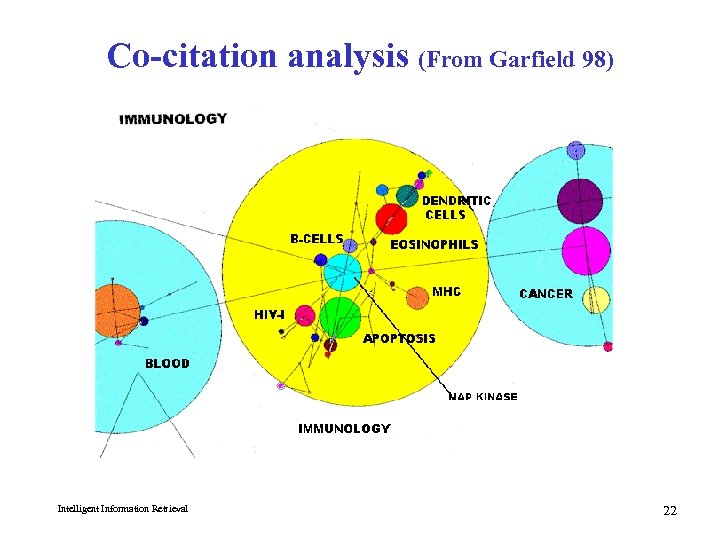
Co-citation analysis (From Garfield 98) Intelligent Information Retrieval 22
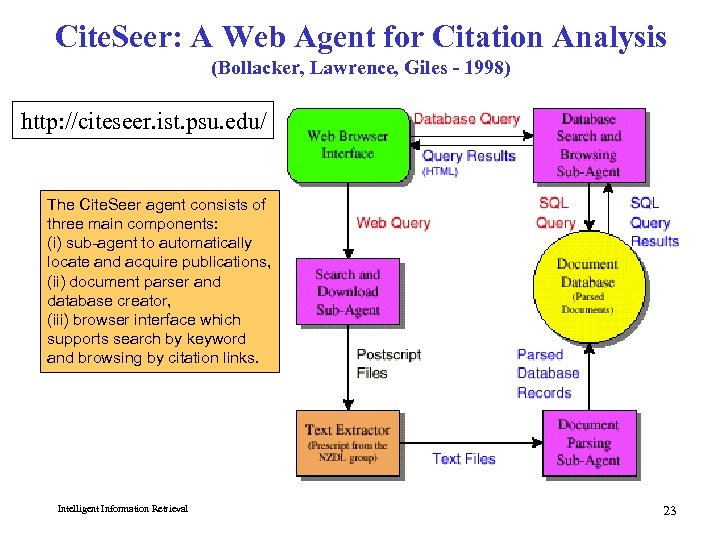
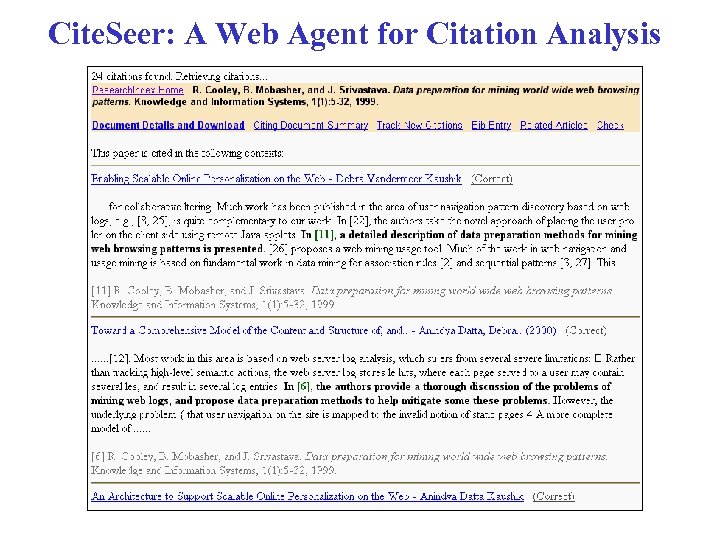
Cite. Seer: A Web Agent for Citation Analysis (Bollacker, Lawrence, Giles - 1998) http: //citeseer. ist. psu. edu/ The Cite. Seer agent consists of three main components: (i) sub-agent to automatically locate and acquire publications, (ii) document parser and database creator, (iii) browser interface which supports search by keyword and browsing by citation links. Intelligent Information Retrieval 23
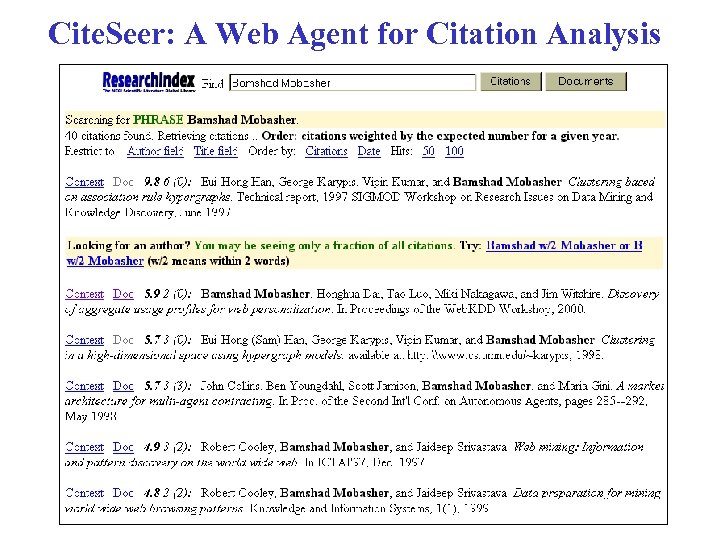
Cite. Seer: A Web Agent for Citation Analysis
Cite. Seer: A Web Agent for Citation Analysis
Citations vs. Links i Web links are a bit different than citations: 4 Many links are navigational. 4 Many pages with high in-degree are portals not content providers. 4 Not all links are endorsements. 4 Company websites don’t point to their competitors. 4 Citations to relevant literature is enforced by peer-review. i Authorities 4 pages that are recognized as providing significant, trustworthy, and useful information on a topic. 4 In-degree (number of pointers to a page) is one simple measure of authority. 4 However in-degree treats all links as equal. Should links from pages that are themselves authoritative count more? i Hubs 4 index pages that provide lots of useful links to relevant content pages (topic authorities). Intelligent Information Retrieval 26
Hypertext Induced Topic Search i Basic Idea: look for “authority” and “hub” web pages (Kleinberg 98) 4 authority: definitive content for a topic 4 hub: index links to good content 4 The two distinctions tend to blend i Procedure: 4 Issue a query on a term, e. g. “java” 4 Get back a set of documents 4 Look at the inlink and outlink patterns for the set of retrieved documents 4 Perform statistical analysis to see which patterns are the most dominant ones i Technique was initially used in IBM’s CLEVER system 4 can find some good starting points for some topics 4 doesn’t solve the whole search problem! 4 doesn’t make explicit use of content (so may result in “topic drift” from original query) Intelligent Information Retrieval 27
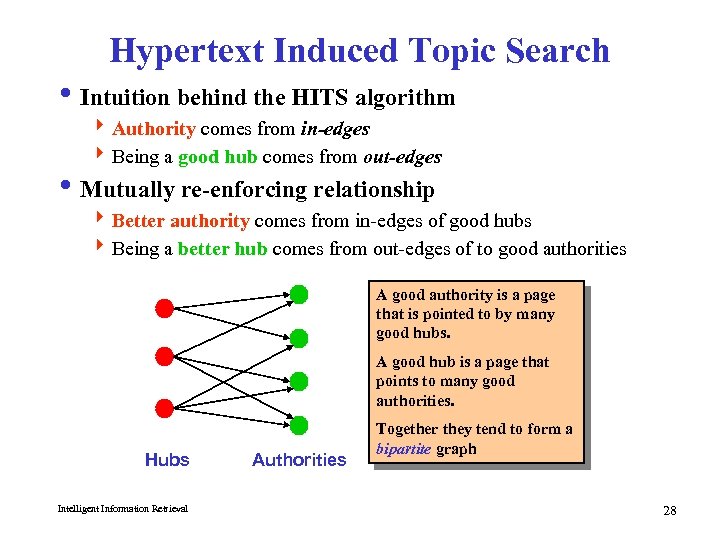
Hypertext Induced Topic Search i Intuition behind the HITS algorithm 4 Authority comes from in-edges 4 Being a good hub comes from out-edges i Mutually re-enforcing relationship 4 Better authority comes from in-edges of good hubs 4 Being a better hub comes from out-edges of to good authorities A good authority is a page that is pointed to by many good hubs. A good hub is a page that points to many good authorities. Hubs Intelligent Information Retrieval Authorities Together they tend to form a bipartite graph 28
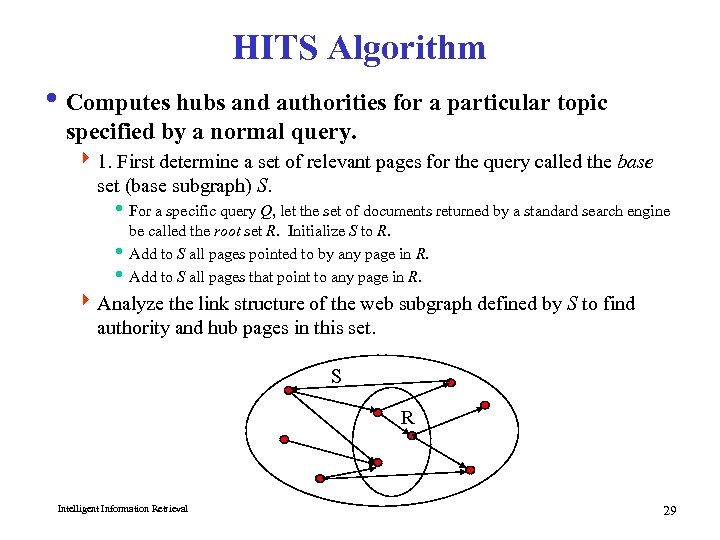
HITS Algorithm i Computes hubs and authorities for a particular topic specified by a normal query. 4 1. First determine a set of relevant pages for the query called the base set (base subgraph) S. i For a specific query Q, let the set of documents returned by a standard search engine be called the root set R. Initialize S to R. i Add to S all pages pointed to by any page in R. i Add to S all pages that point to any page in R. 4 Analyze the link structure of the web subgraph defined by S to find authority and hub pages in this set. S R Intelligent Information Retrieval 29
HITS – Some Considerations i Base Limitations 4 To limit computational expense: i Limit number of root pages to the top 200 pages retrieved for the query. i Limit number of “back-pointer” pages to a random set of at most 50 pages returned by a “reverse link” query. 4 To eliminate purely navigational links: i Eliminate links between two pages on the same host. 4 To eliminate “non-authority-conveying” links: i Allow only m (m 4 8) pages from a given host as pointers to any individual page. i Authorities and In-Degree 4 Even within the base set S for a given query, the nodes with highest indegree are not necessarily authorities (may just be generally popular pages like Yahoo or Amazon). 4 True authority pages are pointed to by a number of hubs (i. e. pages that point to lots of authorities). Intelligent Information Retrieval 30
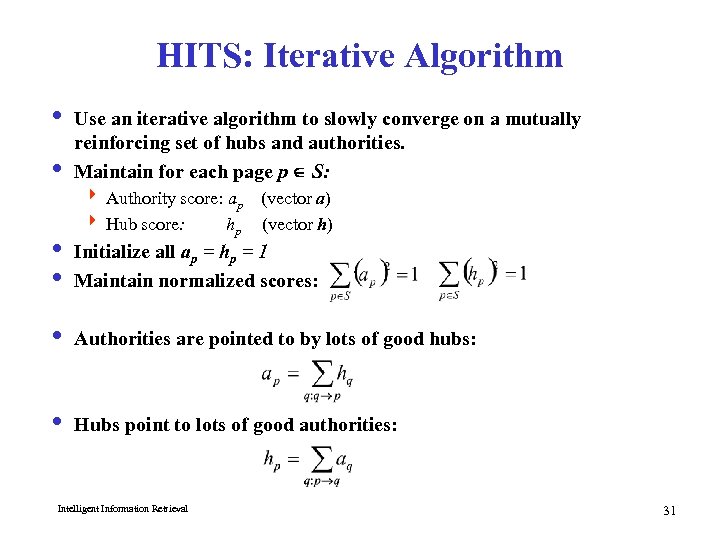
HITS: Iterative Algorithm i Use an iterative algorithm to slowly converge on a mutually reinforcing set of hubs and authorities. i Maintain for each page p S: 4 Authority score: ap (vector a) 4 Hub score: hp (vector h) i Initialize all ap = hp = 1 i Maintain normalized scores: i Authorities are pointed to by lots of good hubs: i Hubs point to lots of good authorities: Intelligent Information Retrieval 31
![HITS Algorithm i Let HUB[v] and AUTH[v] represent the hub and authority values associated](https://present5.com/presentation/f3b07d271353a3ed790e5307940cadf7/image-32.jpg "HITS Algorithm i Let HUB[v] and AUTH[v] represent the hub and authority values associated")
HITS Algorithm i Let HUB[v] and AUTH[v] represent the hub and authority values associated with a vertex v i Repeat until HUB and AUTH vectors converge 4 Normalize HUB and AUTH 4 HUB[v] : = S AUTH[ui] for all ui with Edge(v, ui) 4 AUTH[v] : = S HUB[wi] for all ui with Edge(wi, v) w 1 w 2 . . . wk Intelligent Information Retrieval u 1 v A H u 2 . . . uk 32
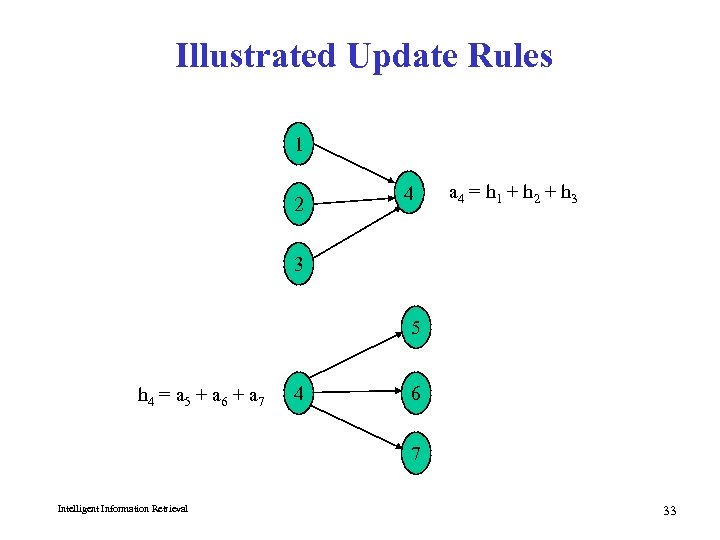
Illustrated Update Rules 1 2 4 a 4 = h 1 + h 2 + h 3 3 5 h 4 = a 5 + a 6 + a 7 4 6 7 Intelligent Information Retrieval 33
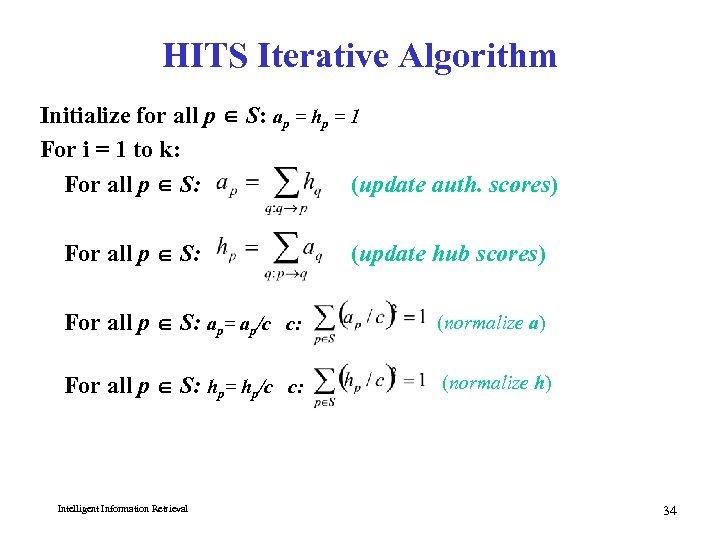
HITS Iterative Algorithm Initialize for all p S: ap = hp = 1 For i = 1 to k: For all p S: (update auth. scores) For all p S: (update hub scores) For all p S: ap= ap/c c: (normalize a) For all p S: hp= hp/c c: (normalize h) Intelligent Information Retrieval 34
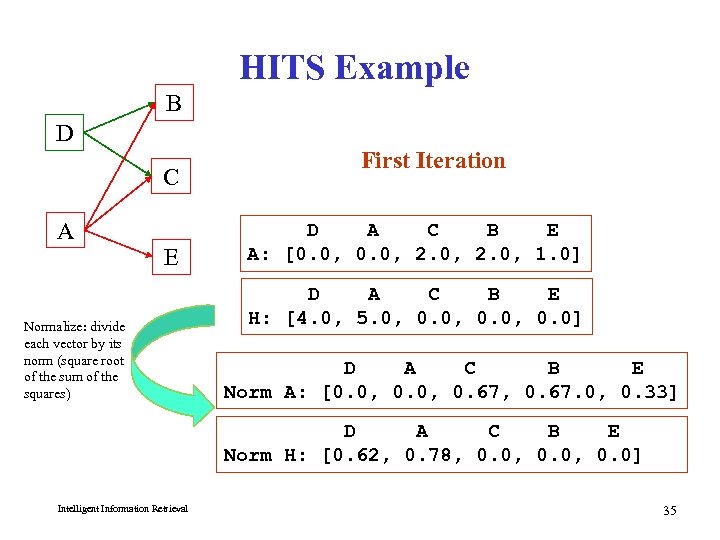
HITS Example B D C A E Normalize: divide each vector by its norm (square root of the sum of the squares) First Iteration D A C B E A: [0. 0, 2. 0, 1. 0] D A C B E H: [4. 0, 5. 0, 0. 0] D A C B E Norm A: [0. 0, 0. 67, 0. 67. 0, 0. 33] D A C B E Norm H: [0. 62, 0. 78, 0. 0, 0. 0] Intelligent Information Retrieval 35
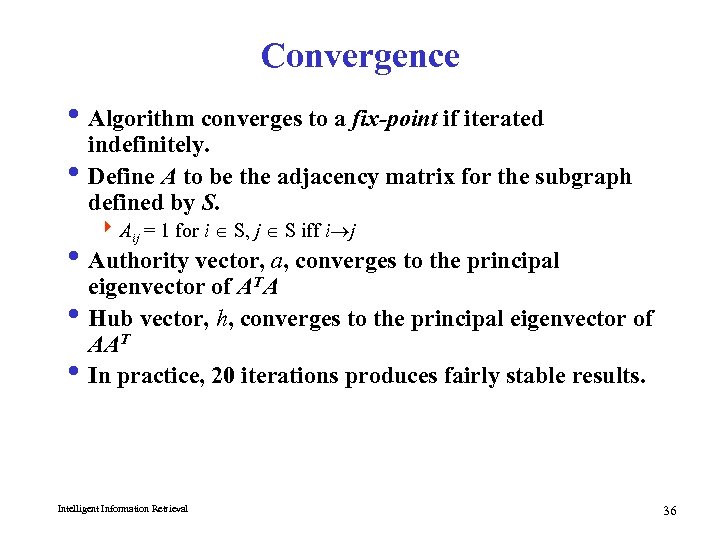
Convergence i Algorithm converges to a fix-point if iterated indefinitely. i Define A to be the adjacency matrix for the subgraph defined by S. 4 Aij = 1 for i S, j S iff i j i Authority vector, a, converges to the principal eigenvector of ATA i Hub vector, h, converges to the principal eigenvector of AAT i In practice, 20 iterations produces fairly stable results. Intelligent Information Retrieval 36
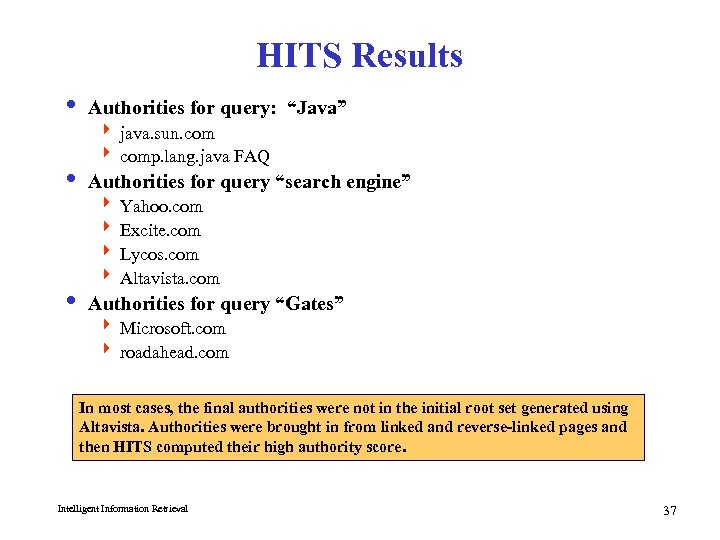
HITS Results i Authorities for query: “Java” 4 java. sun. com 4 comp. lang. java FAQ i Authorities for query “search engine” 4 Yahoo. com 4 Excite. com 4 Lycos. com 4 Altavista. com i Authorities for query “Gates” 4 Microsoft. com 4 roadahead. com In most cases, the final authorities were not in the initial root set generated using Altavista. Authorities were brought in from linked and reverse-linked pages and then HITS computed their high authority score. Intelligent Information Retrieval 37
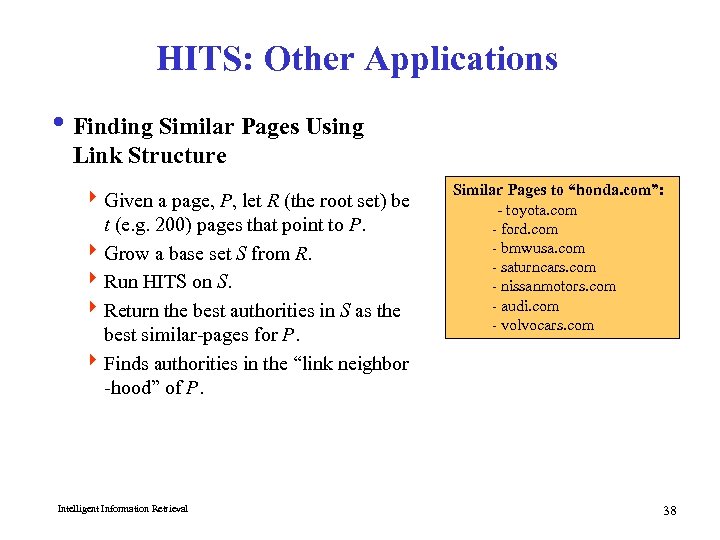
HITS: Other Applications i Finding Similar Pages Using Link Structure 4 Given a page, P, let R (the root set) be t (e. g. 200) pages that point to P. 4 Grow a base set S from R. 4 Run HITS on S. 4 Return the best authorities in S as the best similar-pages for P. 4 Finds authorities in the “link neighbor -hood” of P. Intelligent Information Retrieval Similar Pages to “honda. com”: - toyota. com - ford. com - bmwusa. com - saturncars. com - nissanmotors. com - audi. com - volvocars. com 38
HITS: Other Applications i HITS for Clustering 4 An ambiguous query can result in the principal eigenvector only covering one of the possible meanings. 4 Non-principal eigenvectors may contain hubs & authorities for other meanings. 4 Example: “jaguar”: i. Atari video game (principal eigenvector) i. NFL Football team (2 nd non-princ. eigenvector) i. Automobile (3 rd non-princ. eigenvector) 4 An application of Principle Component Analysis (PCA) Intelligent Information Retrieval 39
HITS: Problems and Solutions i Some edges are wrong (not “recommendations”) 4 multiple edges from the same author 4 automatically generated 4 spam Solution: weight edges to limit influence i Topic Drift 4 Query: jaguar AND cars 4 Result: pages about cars in general Solution: analyze content and assign topic scores to nodes Intelligent Information Retrieval 40
![Modified HITS Algorithm i Let HUB[v] and AUTH[v] represent the hub and authority values](https://present5.com/presentation/f3b07d271353a3ed790e5307940cadf7/image-41.jpg "Modified HITS Algorithm i Let HUB[v] and AUTH[v] represent the hub and authority values")
Modified HITS Algorithm i Let HUB[v] and AUTH[v] represent the hub and authority values associated with a vertex v i Repeat until HUB and AUTH vectors converge 4 Normalize HUB and AUTH 4 HUB[v] : = S AUTH[ui]. Topic. Score[ui]. Weight(v, ui) for all ui with Edge(v, ui) 4 AUTH[v] : = S HUB[wi]. Topic. Score[wi]. Weight(wi, v) for all ui with Edge(wi, v) i Topic score is determined based on similarity measure between the query and the documents Intelligent Information Retrieval 41
Page. Rank i Alternative link-analysis method used by Google (Brin & Page, 1998). i Does not attempt to capture the distinction between hubs and authorities. i Ranks pages just by authority. i Applied to the entire Web rather than a local neighborhood of pages surrounding the results of a query. Intelligent Information Retrieval 42
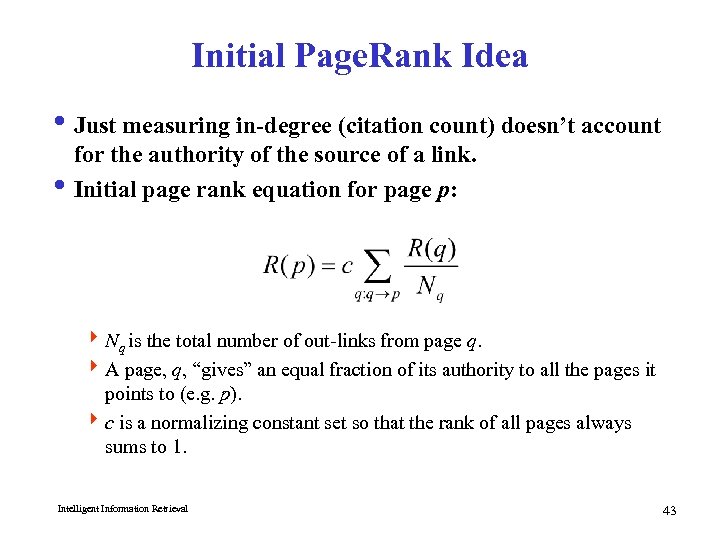
Initial Page. Rank Idea i Just measuring in-degree (citation count) doesn’t account for the authority of the source of a link. i Initial page rank equation for page p: 4 Nq is the total number of out-links from page q. 4 A page, q, “gives” an equal fraction of its authority to all the pages it points to (e. g. p). 4 c is a normalizing constant set so that the rank of all pages always sums to 1. Intelligent Information Retrieval 43
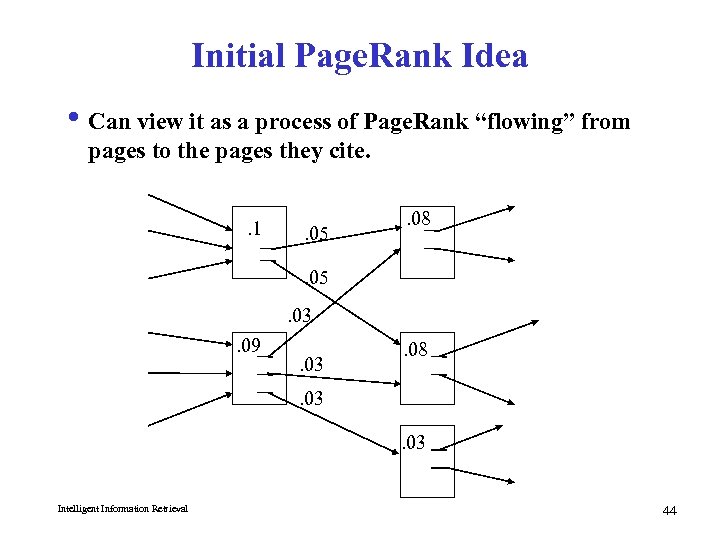
Initial Page. Rank Idea i Can view it as a process of Page. Rank “flowing” from pages to the pages they cite. . 1 . 05 . 08 . 05. 03. 09 . 03 . 08 . 03 Intelligent Information Retrieval 44
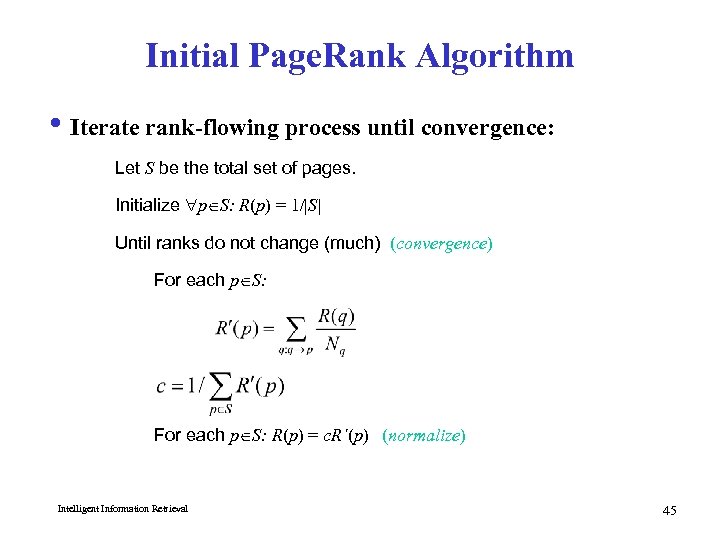
Initial Page. Rank Algorithm i Iterate rank-flowing process until convergence: Let S be the total set of pages. Initialize p S: R(p) = 1/|S| Until ranks do not change (much) (convergence) For each p S: R(p) = c. R´(p) (normalize) Intelligent Information Retrieval 45
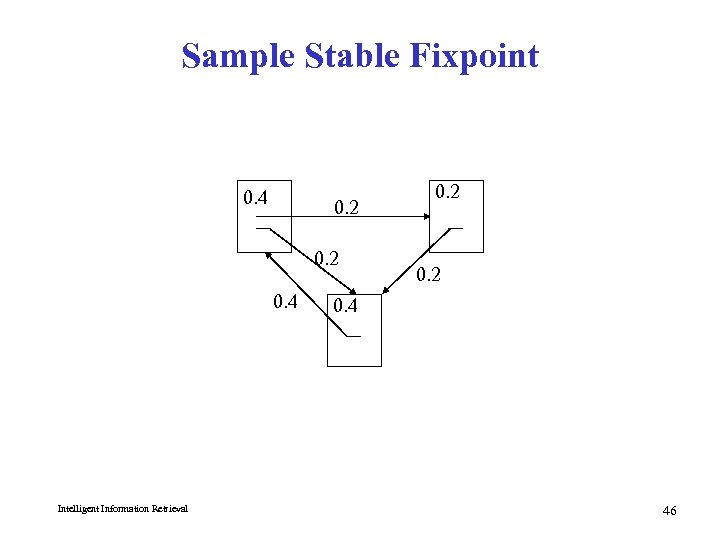
Sample Stable Fixpoint 0. 4 0. 2 0. 4 Intelligent Information Retrieval 0. 2 0. 4 46
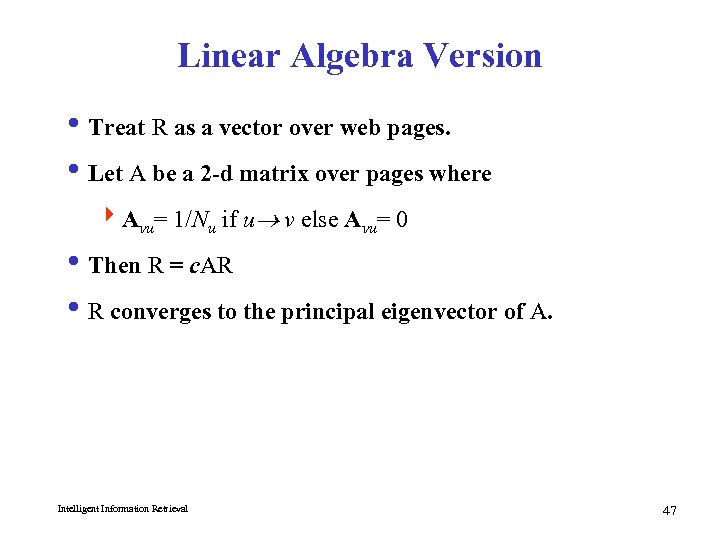
Linear Algebra Version i Treat R as a vector over web pages. i Let A be a 2 -d matrix over pages where 4 Avu= 1/Nu if u v else Avu= 0 i Then R = c. AR i R converges to the principal eigenvector of A. Intelligent Information Retrieval 47
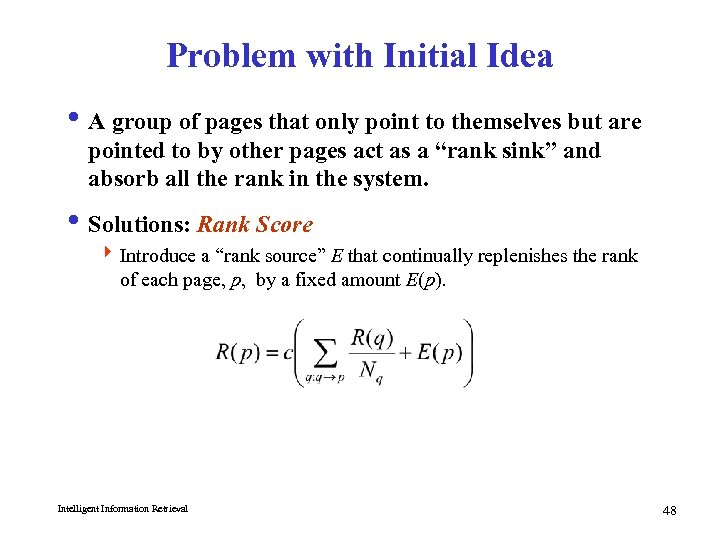
Problem with Initial Idea i A group of pages that only point to themselves but are pointed to by other pages act as a “rank sink” and absorb all the rank in the system. i Solutions: Rank Score 4 Introduce a “rank source” E that continually replenishes the rank of each page, p, by a fixed amount E(p). Intelligent Information Retrieval 48
Random Surfer Model i Page. Rank can be seen as modeling a “random surfer” that starts on a random page and then at each point: 4 With probability E(p) randomly jumps to page p. 4 Otherwise, randomly follows a link on the current page. i R(p) models the probability that this random surfer will be on page p at any given time. i “E jumps” are needed to prevent the random surfer from getting “trapped” in web sinks with no outgoing links. Intelligent Information Retrieval 49
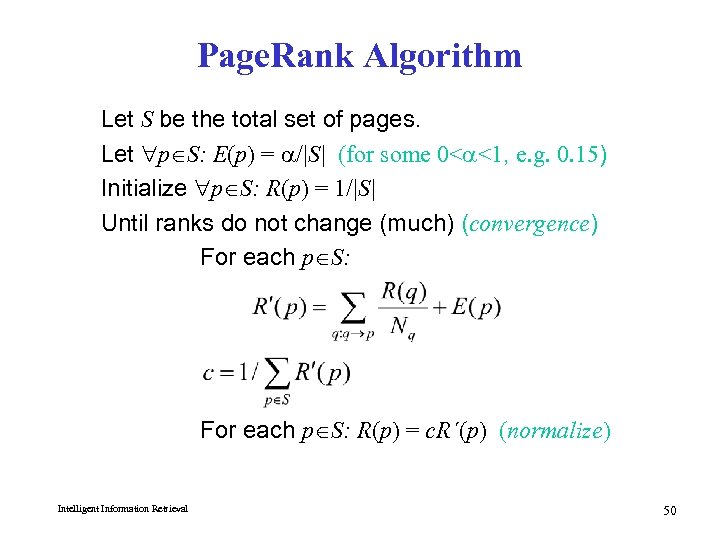
Page. Rank Algorithm Let S be the total set of pages. Let p S: E(p) = /|S| (for some 0< <1, e. g. 0. 15) Initialize p S: R(p) = 1/|S| Until ranks do not change (much) (convergence) For each p S: R(p) = c. R´(p) (normalize) Intelligent Information Retrieval 50
![Page. Rank Example B A A C B Initial R: [0. 33, 0. 33]](https://present5.com/presentation/f3b07d271353a3ed790e5307940cadf7/image-51.jpg "Page. Rank Example B A A C B Initial R: [0. 33, 0. 33]")
Page. Rank Example B A A C B Initial R: [0. 33, 0. 33] = 0. 3 C before normalization: First Iteration Only: R’(C): R(A)/2 + R(B)/1 + 0. 3/3 R’(B): R(A)/2 + 0. 3/3 R’(A): 0. 3/3 A C B R’: [0. 1, 0. 595, 0. 27] Normalization factor: 1/[R’(A)+R’(B)+R’(C)] = 1/0. 965 after normalization: Intelligent Information Retrieval R: A C B [0. 104, 0. 617, 0. 28]
Speed of Convergence i Early experiments on Google used 322 million links. i Page. Rank algorithm converged (within small tolerance) in about 52 iterations. i Number of iterations required for convergence is empirically O(log n) (where n is the number of links). i Therefore calculation is quite efficient. Intelligent Information Retrieval 52
Google Ranking i Complete Google ranking includes (based on university publications prior to commercialization). 4 Vector-space similarity component. 4 Keyword proximity component. 4 HTML-tag weight component (e. g. title preference). 4 Page. Rank component. i Details of current commercial ranking functions are trade secrets. Intelligent Information Retrieval 53
Personalized Page. Rank i Page. Rank can be biased (personalized) by changing E to a non-uniform distribution. i Restrict “random jumps” to a set of specified relevant pages. i For example, let E(p) = 0 except for one’s own home page, for which E(p) = i This results in a bias towards pages that are closer in the web graph to your own homepage. i Similar personalization can be achieved by setting E(p) for only pages p that are part of the user’s profile. Intelligent Information Retrieval 54
Page. Rank-Biased Spidering i Use Page. Rank to direct (focus) a spider on “important” pages. i Compute page-rank using the current set of crawled pages. i Order the spider’s search queue based on current estimated Page. Rank. Intelligent Information Retrieval 55
Link Analysis Conclusions i Link analysis uses information about the structure of the web graph to aid search. i It is one of the major innovations in web search. i It is the primary reason for Google’s success. Intelligent Information Retrieval 56
Anchor Text Indexing i Extract anchor text (between <a> and </a>) of each link: 4 Anchor text is usually descriptive of the document to which it points. 4 Add anchor text to the content of the destination page to provide additional relevant keyword indices. 4 Used by Google: i <a href=“http: //www. microsoft. com”>Evil Empire</a> i <a href=“http: //www. ibm. com”>IBM</a> i Helps when descriptive text in destination page is embedded in image logos rather than in accessible text. i Many times anchor text is not useful: 4 “click here” i Increases content more for popular pages with many incoming links, increasing recall of these pages. i May even give higher weights to tokens from anchor text. Intelligent Information Retrieval 57
Behavior-Based Ranking i Emergence of large-scale search engines allow for mining aggregate user behavior to improving ranking. i Basic Idea: 4 For each query Q, keep track of which docs in the results are clicked on 4 On subsequent requests for Q, re-order docs in results based on click-throughs. 4 Relevance assessment based on i. Behavior/usage ivs. content Intelligent Information Retrieval 58
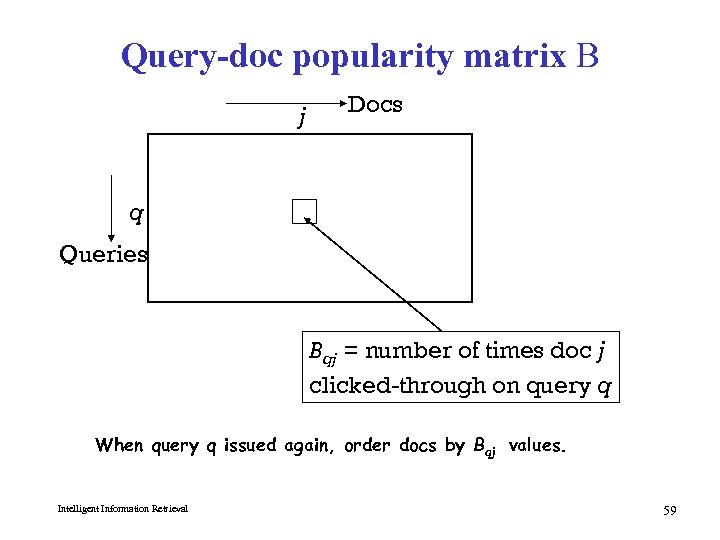
Query-doc popularity matrix B j Docs q Queries Bqj = number of times doc j clicked-through on query q When query q issued again, order docs by Bqj values. Intelligent Information Retrieval 59
Vector space implementation i Maintain a term-doc popularity matrix C 4 as opposed to query-doc popularity 4 initialized to all zeros i Each column represents a doc j 4 If doc j clicked on for query q, update Cj Cj + q (here q is viewed as a vector). i On a query q’, compute its cosine proximity to Cj for all j. i Combine this with the regular text score. Intelligent Information Retrieval 60
Issues i Normalization of Cj after updating i Assumption of query compositionality 4 “white house” document popularity derived from “white” and “house” i Updating - live or batch? i Basic assumption: 4 Relevance can be directly measured by number of click throughs 4 Valid? Intelligent Information Retrieval 61
Скачать презентацию Intelligent IR on the World Wide Web CSC
f3b07d271353a3ed790e5307940cadf7.ppt