 Скачать презентацию Intelligent Design Detector Norman Graf SLAC Super B
97bd3f1bc3a95431ec63c6fa1e8df640.ppt
- Количество слайдов: 37



Intelligent Design Detector Norman Graf (SLAC) Super. B computing mini-Workshop Pearl Harbor Day, 2007 Maryland Physics Department Colloquium
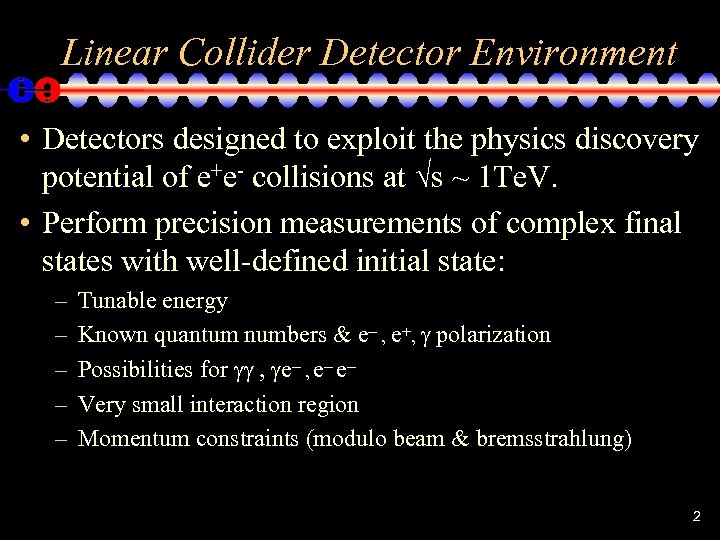
Linear Collider Detector Environment • Detectors designed to exploit the physics discovery potential of e+e- collisions at s ~ 1 Te. V. • Perform precision measurements of complex final states with well-defined initial state: – – – Tunable energy Known quantum numbers & e─ , e+, polarization Possibilities for , e─ , e─ e─ Very small interaction region Momentum constraints (modulo beam & bremsstrahlung) 2
LCD Simulation Mission Statement • Provide full simulation capabilities for Linear Collider physics program: – Physics simulations – Detector designs – Reconstruction and analysis • Need flexibility for: – New detector geometries/technologies – Different reconstruction algorithms • Limited resources demand efficient solutions, focused effort. 3
Overview: Goals • Facilitate contribution from physicists in different locations with various amounts of time available. • Use standard data formats, when possible. • Provide a general-purpose framework for physics software development. • Develop a suite of reconstruction and analysis algorithms and sample codes. • Simulate benchmark physics processes on different full detector designs. 4
Fast Detector Response Simulation • Covariantly smear tracks with matrices derived from geometry, materials and point resolution using Billoir’s formulation. http: //www. slac. stanford. edu/~schumm/lcdtrk • Derivative of TRKERR. • Provides smeared tracks with full covariance matrix. 5
lelaps • Fast detector response package. • Handles decays in flight, multiple scattering and energy loss in trackers. • Parameterizes particle showers in calorimeters. • Produces lcio data at the hit level. • Uses runtime geometry (compact. xml godl). • An excellent tool for designing tracking detectors! http: //lelaps. freehep. org/index. html 6
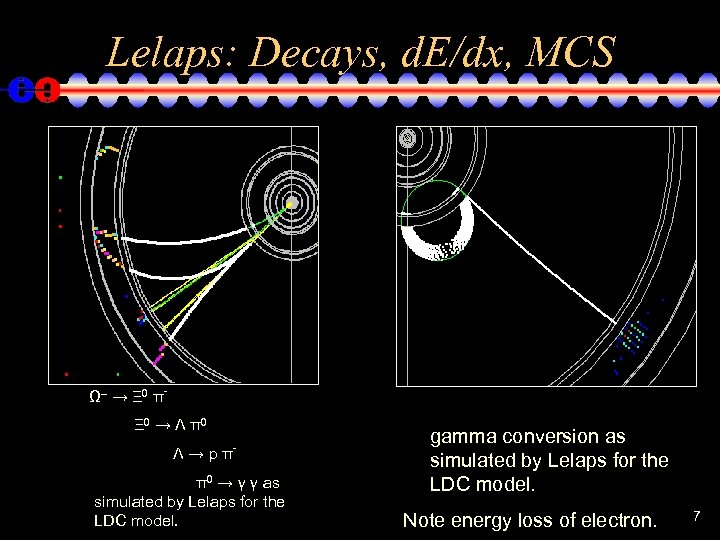
Lelaps: Decays, d. E/dx, MCS Ω- → Ξ 0 π Ξ 0 → Λ π0 Λ→pπ - π0 → γ γ as simulated by Lelaps for the LDC model. gamma conversion as simulated by Lelaps for the LDC model. Note energy loss of electron. 7
Detector Design (GEANT 4) • Need to be able to flexibly, but believably simulate the detector response for various designs. • GEANT is the de facto standard for HEP physics simulations. • Use runtime configurable detector geometries • Write out “generic” hits to digitize later. 8
Full Detector Response Simulation • Use Geant 4 toolkit to describe interaction of particles with matter. • Thin layer of LC-specific C++ provides access to: – Event Generator input ( binary stdhep format ) – Detector Geometry description ( XML ) – Detector Hits ( LCIO ) • Geometries fully described at run-time! – In principle, as fully detailed as desired. – In practice, will explore detector variations with simplified approximations. 9
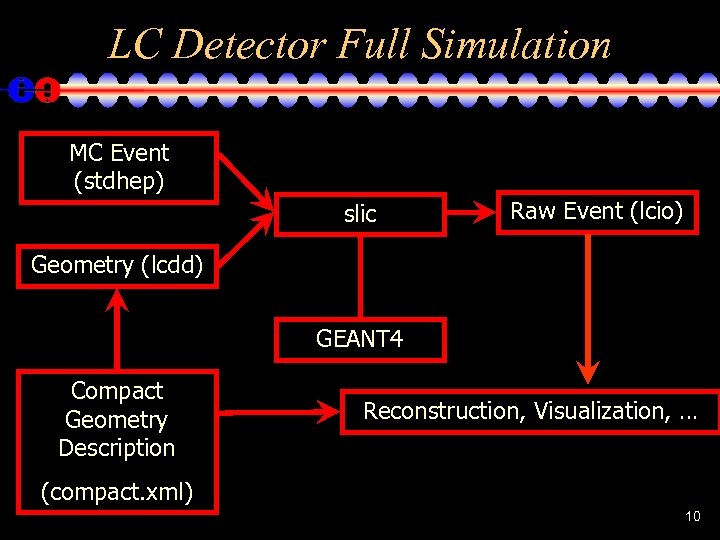
LC Detector Full Simulation MC Event (stdhep) slic Raw Event (lcio) Geometry (lcdd) GEANT 4 Compact Geometry Description Reconstruction, Visualization, … (compact. xml) 10
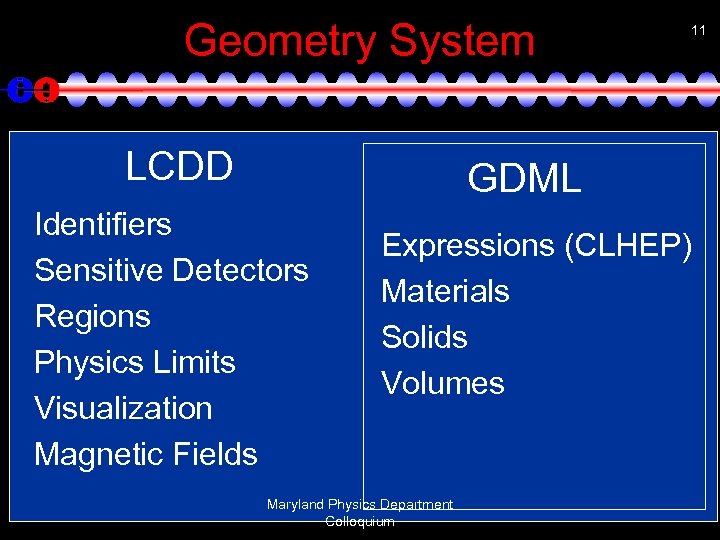
Geometry System LCDD 11 GDML Identifiers Sensitive Detectors Regions Physics Limits Visualization Magnetic Fields Expressions (CLHEP) Materials Solids Volumes Maryland Physics Department Colloquium
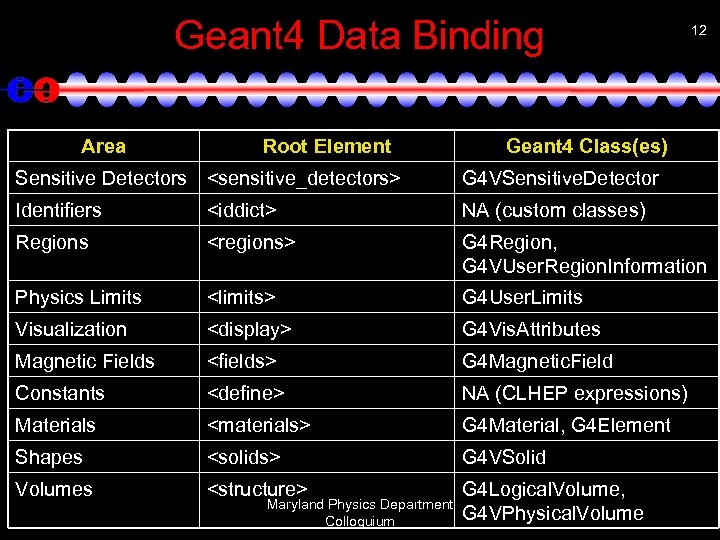
Geant 4 Data Binding Area Root Element 12 Geant 4 Class(es) Sensitive Detectors <sensitive_detectors> G 4 VSensitive. Detector Identifiers <iddict> NA (custom classes) Regions <regions> G 4 Region, G 4 VUser. Region. Information Physics Limits <limits> G 4 User. Limits Visualization <display> G 4 Vis. Attributes Magnetic Fields <fields> G 4 Magnetic. Field Constants <define> NA (CLHEP expressions) Materials <materials> G 4 Material, G 4 Element Shapes <solids> G 4 VSolid Volumes <structure> G 4 Logical. Volume, G 4 VPhysical. Volume Maryland Physics Department Colloquium
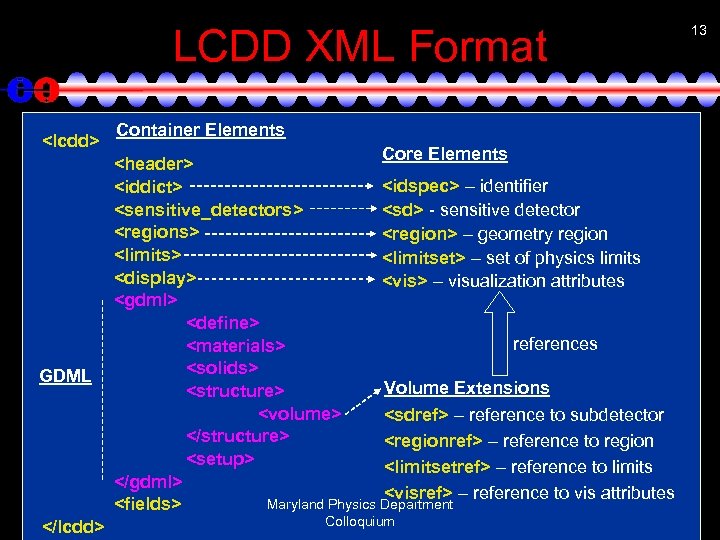
LCDD XML Format <lcdd> GDML </lcdd> Container Elements Core Elements <header> <idspec> – identifier <iddict> <sensitive_detectors> <sd> - sensitive detector <regions> <region> – geometry region <limits> <limitset> – set of physics limits <display> <vis> – visualization attributes <gdml> <define> references <materials> <solids> Volume Extensions <structure> <volume> <sdref> – reference to subdetector </structure> <regionref> – reference to region <setup> <limitsetref> – reference to limits </gdml> <visref> – reference to vis attributes Maryland Physics Department <fields> Colloquium 13
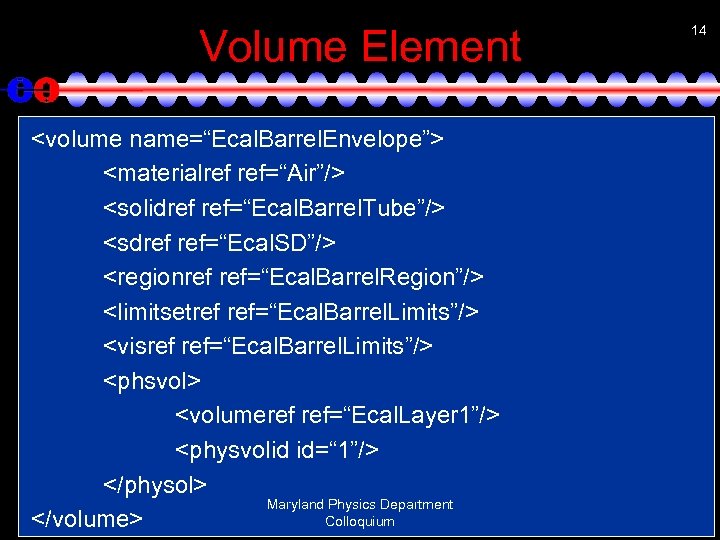
Volume Element <volume name=“Ecal. Barrel. Envelope”> <materialref ref=“Air”/> <solidref ref=“Ecal. Barrel. Tube”/> <sdref ref=“Ecal. SD”/> <regionref ref=“Ecal. Barrel. Region”/> <limitsetref ref=“Ecal. Barrel. Limits”/> <visref ref=“Ecal. Barrel. Limits”/> <phsvol> <volumeref ref=“Ecal. Layer 1”/> <physvolid id=“ 1”/> </physol> Maryland Physics Department Colloquium </volume> 14
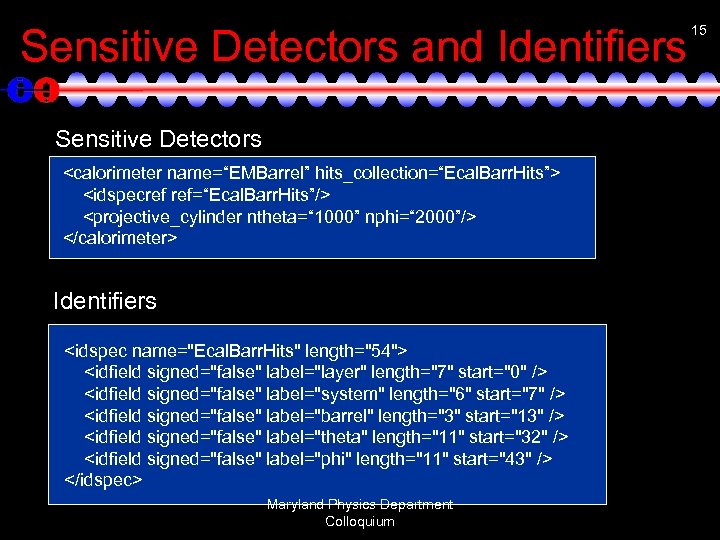
Sensitive Detectors and Identifiers Sensitive Detectors <calorimeter name=“EMBarrel” hits_collection=“Ecal. Barr. Hits”> <idspecref ref=“Ecal. Barr. Hits”/> <projective_cylinder ntheta=“ 1000” nphi=“ 2000”/> </calorimeter> Identifiers <idspec name="Ecal. Barr. Hits" length="54"> <idfield signed="false" label="layer" length="7" start="0" /> <idfield signed="false" label="system" length="6" start="7" /> <idfield signed="false" label="barrel" length="3" start="13" /> <idfield signed="false" label="theta" length="11" start="32" /> <idfield signed="false" label="phi" length="11" start="43" /> </idspec> Maryland Physics Department Colloquium 15
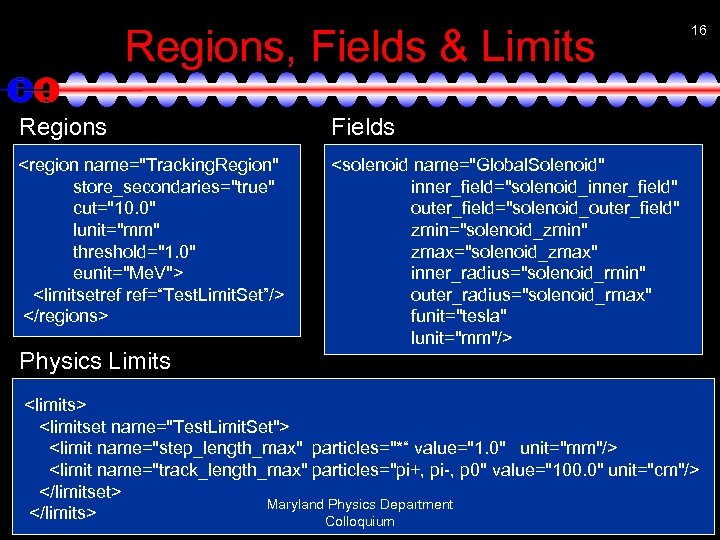
Regions, Fields & Limits Regions Fields <region name="Tracking. Region" store_secondaries="true" cut="10. 0" lunit="mm" threshold="1. 0" eunit="Me. V"> <limitsetref ref=“Test. Limit. Set”/> </regions> 16 <solenoid name="Global. Solenoid" inner_field="solenoid_inner_field" outer_field="solenoid_outer_field" zmin="solenoid_zmin" zmax="solenoid_zmax" inner_radius="solenoid_rmin" outer_radius="solenoid_rmax" funit="tesla" lunit="mm"/> Physics Limits <limits> <limitset name="Test. Limit. Set"> <limit name="step_length_max" particles="*“ value="1. 0" unit="mm"/> <limit name="track_length_max" particles="pi+, pi-, p 0" value="100. 0" unit="cm"/> </limitset> Maryland Physics Department </limits> Colloquium
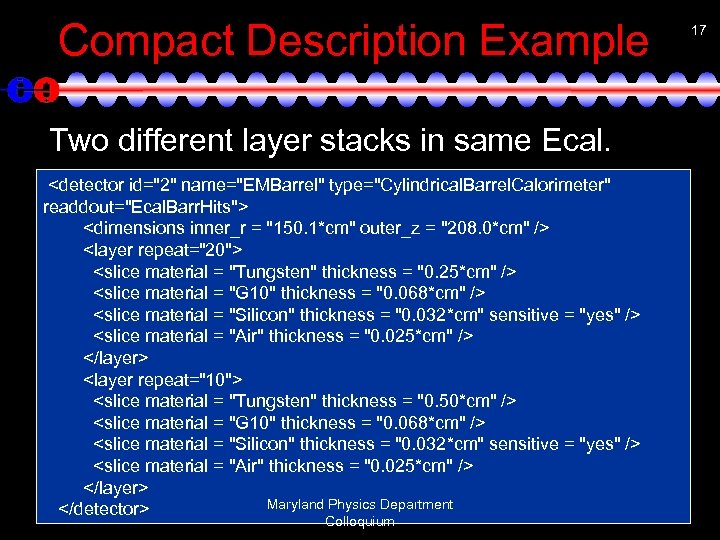
Compact Description Example Two different layer stacks in same Ecal. <detector id="2" name="EMBarrel" type="Cylindrical. Barrel. Calorimeter" readdout="Ecal. Barr. Hits"> <dimensions inner_r = "150. 1*cm" outer_z = "208. 0*cm" /> <layer repeat="20"> <slice material = "Tungsten" thickness = "0. 25*cm" /> <slice material = "G 10" thickness = "0. 068*cm" /> <slice material = "Silicon" thickness = "0. 032*cm" sensitive = "yes" /> <slice material = "Air" thickness = "0. 025*cm" /> </layer> <layer repeat="10"> <slice material = "Tungsten" thickness = "0. 50*cm" /> <slice material = "G 10" thickness = "0. 068*cm" /> <slice material = "Silicon" thickness = "0. 032*cm" sensitive = "yes" /> <slice material = "Air" thickness = "0. 025*cm" /> </layer> Maryland Physics Department </detector> Colloquium 17
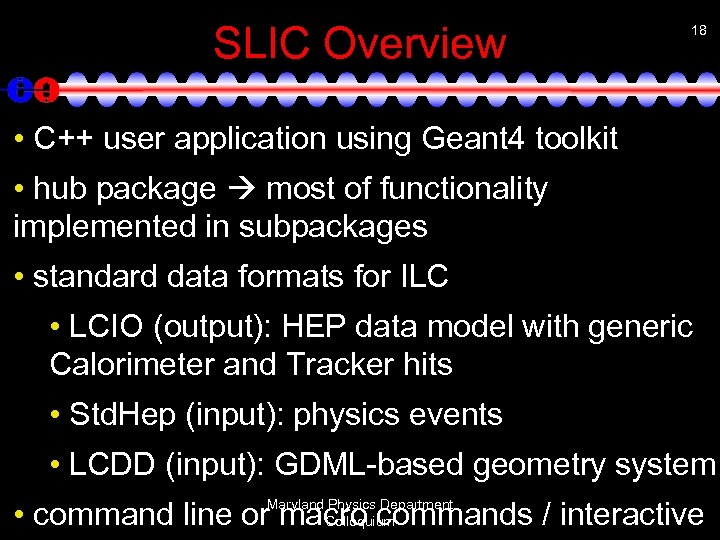
SLIC Overview 18 • C++ user application using Geant 4 toolkit • hub package most of functionality implemented in subpackages • standard data formats for ILC • LCIO (output): HEP data model with generic Calorimeter and Tracker hits • Std. Hep (input): physics events • LCDD (input): GDML-based geometry system • command line or macro commands / interactive Maryland Physics Department Colloquium
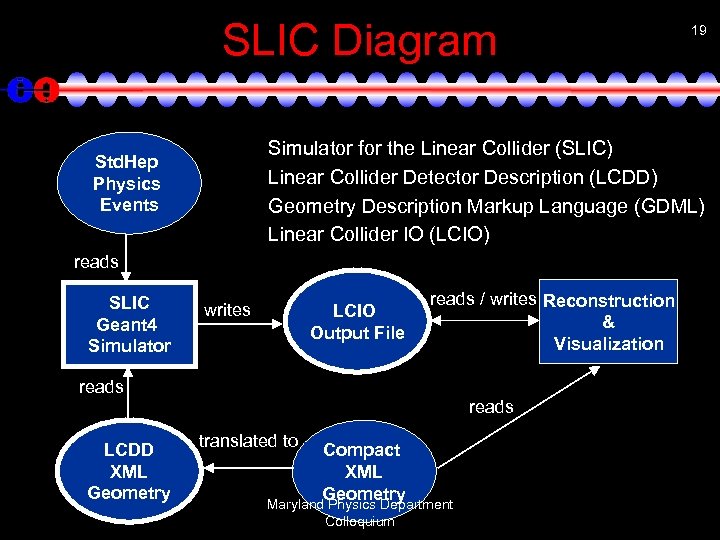
SLIC Diagram Simulator for the Linear Collider (SLIC) Linear Collider Detector Description (LCDD) Geometry Description Markup Language (GDML) Linear Collider IO (LCIO) Std. Hep Physics Events reads SLIC Geant 4 Simulator writes LCIO Output File reads / writes Reconstruction & Visualization reads LCDD XML Geometry 19 reads translated to Compact XML Geometry Maryland Physics Department Colloquium
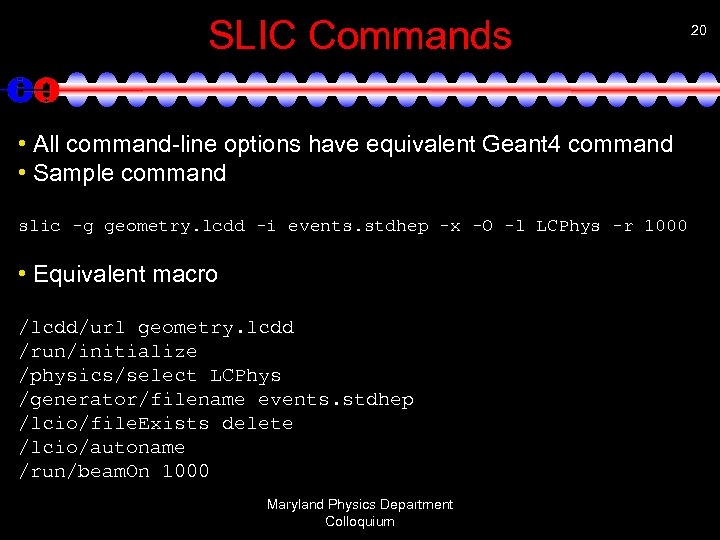
SLIC Commands • All command-line options have equivalent Geant 4 command • Sample command slic -g geometry. lcdd -i events. stdhep -x -O -l LCPhys -r 1000 • Equivalent macro /lcdd/url geometry. lcdd /run/initialize /physics/select LCPhys /generator/filename events. stdhep /lcio/file. Exists delete /lcio/autoname /run/beam. On 1000 Maryland Physics Department Colloquium 20
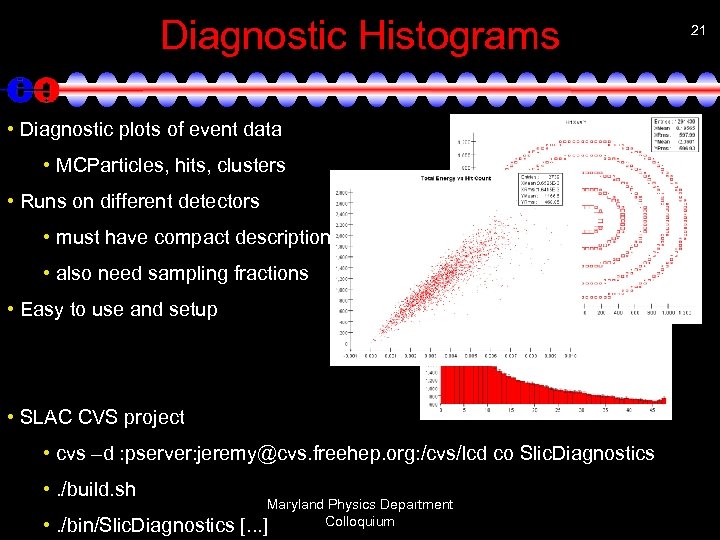
Diagnostic Histograms • Diagnostic plots of event data • MCParticles, hits, clusters • Runs on different detectors • must have compact description • also need sampling fractions • Easy to use and setup • SLAC CVS project • cvs –d : pserver: jeremy@cvs. freehep. org: /cvs/lcd co Slic. Diagnostics • . /build. sh • . /bin/Slic. Diagnostics Maryland Physics Department Colloquium [. . . ] 21
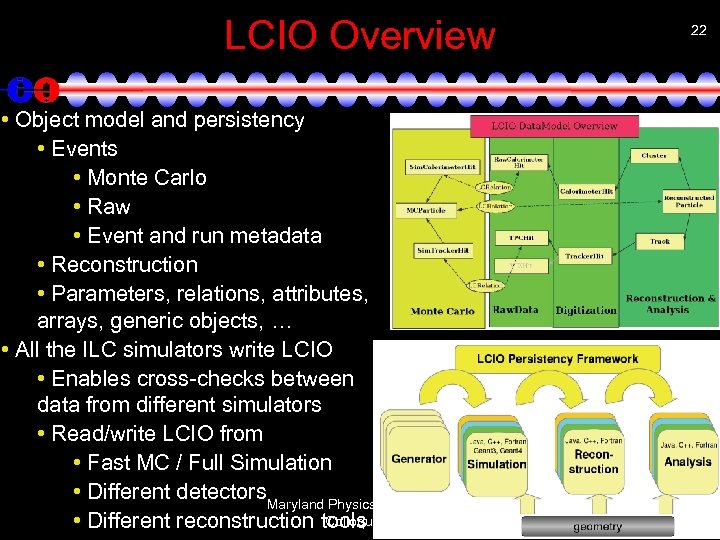
LCIO Overview • Object model and persistency • Events • Monte Carlo • Raw • Event and run metadata • Reconstruction • Parameters, relations, attributes, arrays, generic objects, … • All the ILC simulators write LCIO • Enables cross-checks between data from different simulators • Read/write LCIO from • Fast MC / Full Simulation • Different detectors. Maryland Physics Department Colloquium • Different reconstruction tools 22
Physics Lists: LCPhys 23 • standard Geant 4 EM physics • hadronic models • Bertini Cascade • 0 to 9. 9 Ge. V for p, n, pi+, pi • 0 to 13 Ge. V for K+, K-, K 0 L, K 0 S, Lambda, Sigma+, Sigma-, Xi 0, Xi • Low energy parameterized models • 9. 5 to 25 Ge. V • Quark-Gluon String Model: use for • 12 Ge. V to 100 Te. V for p, n, pi+, pi-, K+, K-, K 0 L, K 0 S • additional neutron processes • neutron-induced fission • neutron capture • gamma-nuclear Maryland Physics Department Colloquium
Other Available Physics Lists • FTFC • Fritjof with CHIPS • FTFP • Fritjof with precompound • LHEP • low / high energy parameterised • QGSC • Quark-Gluon String with CHIPS • QGSP • Quark-Gluon String with precompound • QGSP_BERT • Quark-Gluon string with precompoind + Bertini Cascade • LHEP_BERT • low / high energy parameterised + Bertini Cascade Maryland Physics Department Colloquium 24
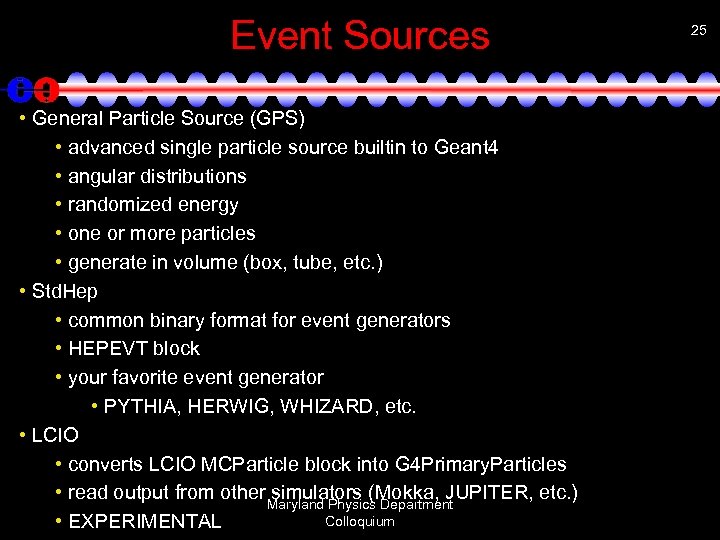
Event Sources • General Particle Source (GPS) • advanced single particle source builtin to Geant 4 • angular distributions • randomized energy • one or more particles • generate in volume (box, tube, etc. ) • Std. Hep • common binary format for event generators • HEPEVT block • your favorite event generator • PYTHIA, HERWIG, WHIZARD, etc. • LCIO • converts LCIO MCParticle block into G 4 Primary. Particles • read output from other Maryland Physics Department simulators (Mokka, JUPITER, etc. ) Colloquium • EXPERIMENTAL 25
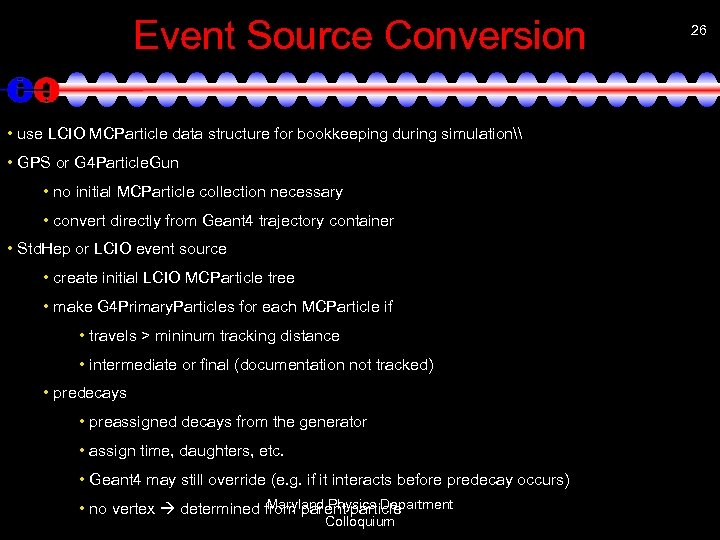
Event Source Conversion • use LCIO MCParticle data structure for bookkeeping during simulation\ • GPS or G 4 Particle. Gun • no initial MCParticle collection necessary • convert directly from Geant 4 trajectory container • Std. Hep or LCIO event source • create initial LCIO MCParticle tree • make G 4 Primary. Particles for each MCParticle if • travels > mininum tracking distance • intermediate or final (documentation not tracked) • predecays • preassigned decays from the generator • assign time, daughters, etc. • Geant 4 may still override (e. g. if it interacts before predecay occurs) Maryland Physics Department • no vertex determined from parent particle Colloquium 26
Software Distribution • SLIC requires • Geant 4, CLHEP, GDML, LCDD, Xerces, LCPhys, LCIO • Automated build system provided • Binary downloads • http: //www. lcsim. org/dist/slic • Linux, Windows (Cygwin), OSX • All packages (dist) or just runtime dependencies (bin) • Or checkout and build from scratch • cvs –d : pserver: anonyous@cvs. freehep. org: /cvs/lcd co Sim. Dist • cd Sim. Dist; . /configure; make • Installed at SLAC, NICADD, FNAL, IN 2 P 3, UC, . . . • Report any problems to jeremym@slac. stanford. edu Maryland Physics Department Colloquium 27
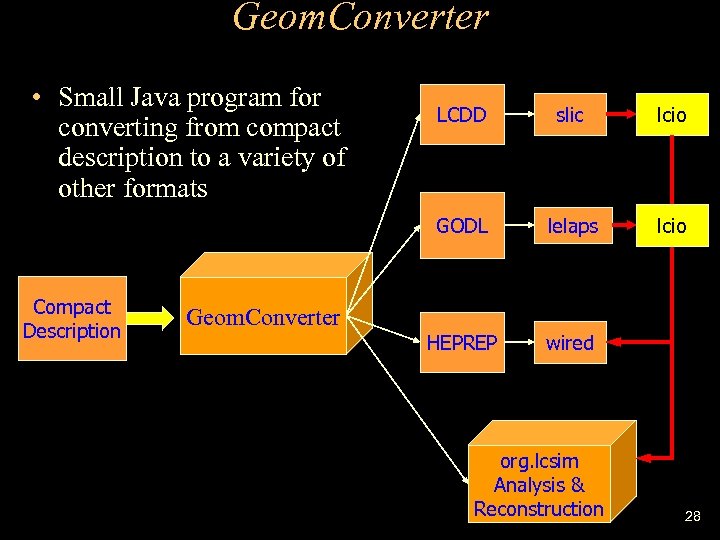
Geom. Converter • Small Java program for converting from compact description to a variety of other formats slic lcio GODL Compact Description LCDD lelaps lcio HEPREP wired Geom. Converter org. lcsim Analysis & Reconstruction 28
Detector Variants • Runtime XML format allows variations in detector geometries to be easily set up and studied: – Stainless Steel vs. Tungsten HCal sampling material – RPC vs. GEM vs. Scintillator readout – Layering (radii, number, composition) – Readout segmentation (size, projective vs. nonprojective) – Tracking detector technologies & topologies • TPC, Silicon microstrip, SIT, SET • “Wedding Cake” Nested Tracker vs. Barrel + Cap – Field strength – Far forward MDI variants (0, 2, 14, 20 mr ) 29
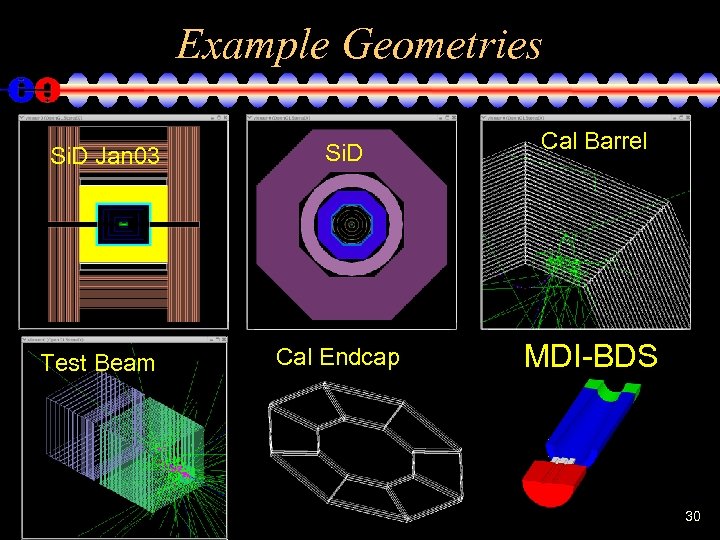
Example Geometries Si. D Jan 03 Si. D Cal Barrel Test Beam Cal Endcap MDI-BDS 30
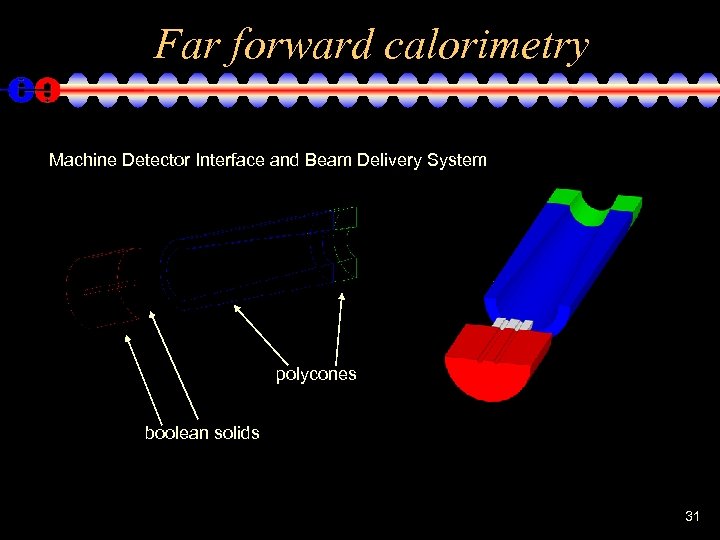
Far forward calorimetry Machine Detector Interface and Beam Delivery System polycones boolean solids 31
Summary • The American Linear Collider Physics Group simulation group has developed a suite of tools being used to design detectors for the ILC. • Flexible, fully-featured Geant 4 -based detector response simulator, slic, uses runtime detector geometry description. – Supports arbitrarily complex geometries (lcdd) – Many elements common to collider detectors are also available through a compact description • provides bindings to fast. MC, visualization, reconstruction. 32
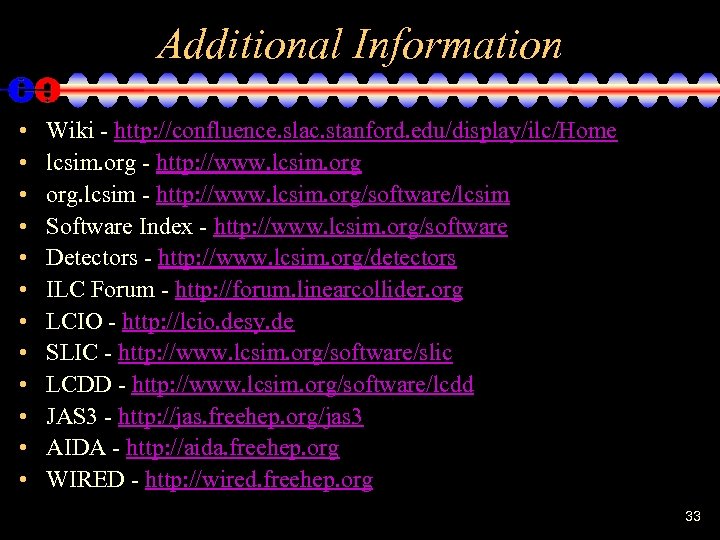
Additional Information • • • Wiki - http: //confluence. slac. stanford. edu/display/ilc/Home lcsim. org - http: //www. lcsim. org. lcsim - http: //www. lcsim. org/software/lcsim Software Index - http: //www. lcsim. org/software Detectors - http: //www. lcsim. org/detectors ILC Forum - http: //forum. linearcollider. org LCIO - http: //lcio. desy. de SLIC - http: //www. lcsim. org/software/slic LCDD - http: //www. lcsim. org/software/lcdd JAS 3 - http: //jas. freehep. org/jas 3 AIDA - http: //aida. freehep. org WIRED - http: //wired. freehep. org 33
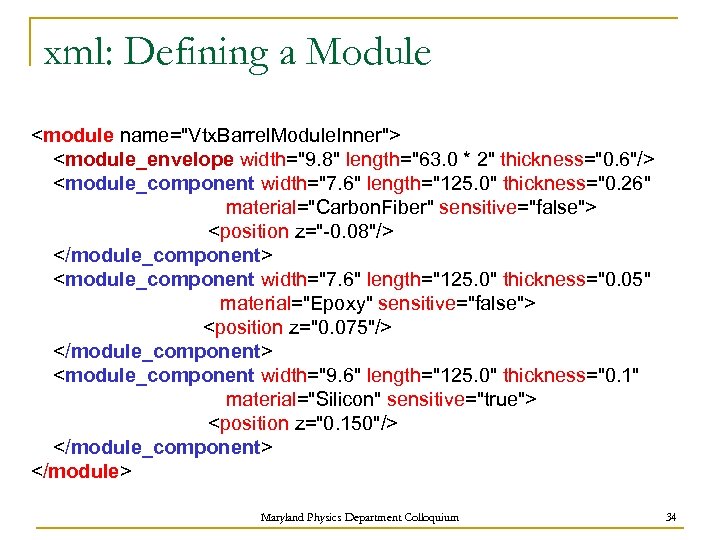
xml: Defining a Module <module name="Vtx. Barrel. Module. Inner"> <module_envelope width="9. 8" length="63. 0 * 2" thickness="0. 6"/> <module_component width="7. 6" length="125. 0" thickness="0. 26" material="Carbon. Fiber" sensitive="false"> <position z="-0. 08"/> </module_component> <module_component width="7. 6" length="125. 0" thickness="0. 05" material="Epoxy" sensitive="false"> <position z="0. 075"/> </module_component> <module_component width="9. 6" length="125. 0" thickness="0. 1" material="Silicon" sensitive="true"> <position z="0. 150"/> </module_component> </module> Maryland Physics Department Colloquium 34
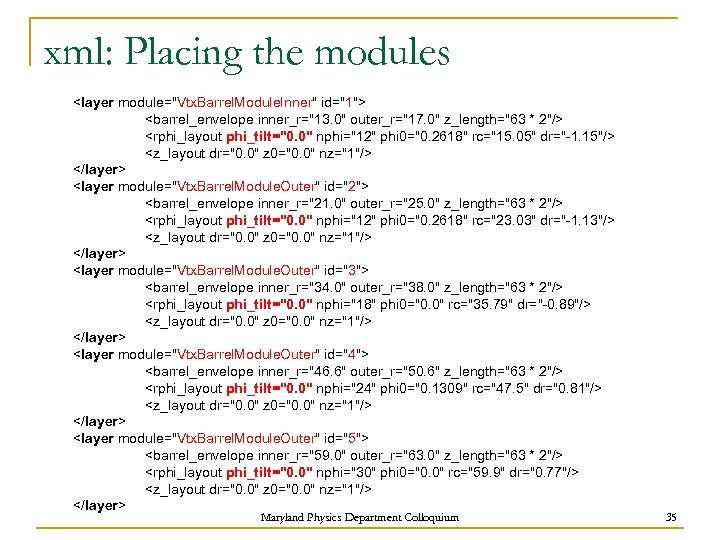
xml: Placing the modules <layer module="Vtx. Barrel. Module. Inner" id="1"> <barrel_envelope inner_r="13. 0" outer_r="17. 0" z_length="63 * 2"/> <rphi_layout phi_tilt="0. 0" nphi="12" phi 0="0. 2618" rc="15. 05" dr="-1. 15"/> <z_layout dr="0. 0" z 0="0. 0" nz="1"/> </layer> <layer module="Vtx. Barrel. Module. Outer" id="2"> <barrel_envelope inner_r="21. 0" outer_r="25. 0" z_length="63 * 2"/> <rphi_layout phi_tilt="0. 0" nphi="12" phi 0="0. 2618" rc="23. 03" dr="-1. 13"/> <z_layout dr="0. 0" z 0="0. 0" nz="1"/> </layer> <layer module="Vtx. Barrel. Module. Outer" id="3"> <barrel_envelope inner_r="34. 0" outer_r="38. 0" z_length="63 * 2"/> <rphi_layout phi_tilt="0. 0" nphi="18" phi 0="0. 0" rc="35. 79" dr="-0. 89"/> <z_layout dr="0. 0" z 0="0. 0" nz="1"/> </layer> <layer module="Vtx. Barrel. Module. Outer" id="4"> <barrel_envelope inner_r="46. 6" outer_r="50. 6" z_length="63 * 2"/> <rphi_layout phi_tilt="0. 0" nphi="24" phi 0="0. 1309" rc="47. 5" dr="0. 81"/> <z_layout dr="0. 0" z 0="0. 0" nz="1"/> </layer> <layer module="Vtx. Barrel. Module. Outer" id="5"> <barrel_envelope inner_r="59. 0" outer_r="63. 0" z_length="63 * 2"/> <rphi_layout phi_tilt="0. 0" nphi="30" phi 0="0. 0" rc="59. 9" dr="0. 77"/> <z_layout dr="0. 0" z 0="0. 0" nz="1"/> </layer> Maryland Physics Department Colloquium 35
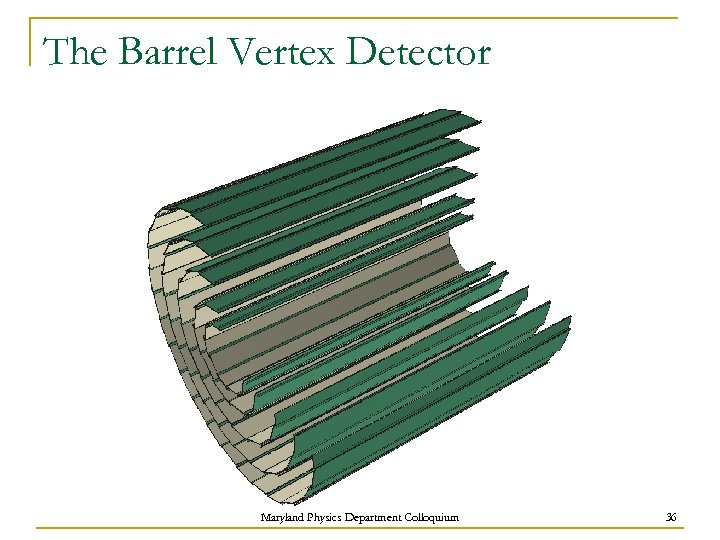
The Barrel Vertex Detector Maryland Physics Department Colloquium 36
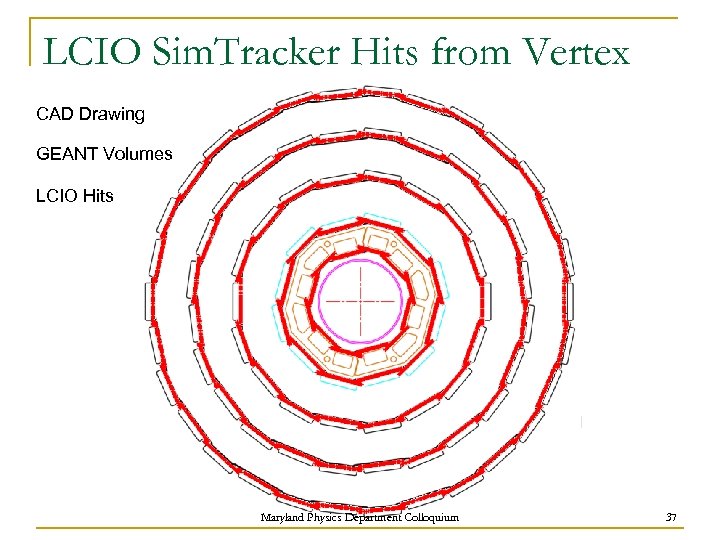
LCIO Sim. Tracker Hits from Vertex CAD Drawing GEANT Volumes LCIO Hits Maryland Physics Department Colloquium 37
Скачать презентацию Intelligent Design Detector Norman Graf SLAC Super B
97bd3f1bc3a95431ec63c6fa1e8df640.ppt