 Скачать презентацию Intelli Grid Enabling The Power Delivery System of
7da821223658c3e5054013aa15094cb3.ppt
- Количество слайдов: 13



Intelli. Grid: Enabling The Power Delivery System of the Future Don Von Dollen EPRI Intelli. Grid Program 9 th International Symposium on Power-Line Communications (ISPLC 2005) Vancouver, BC April 6, 2005
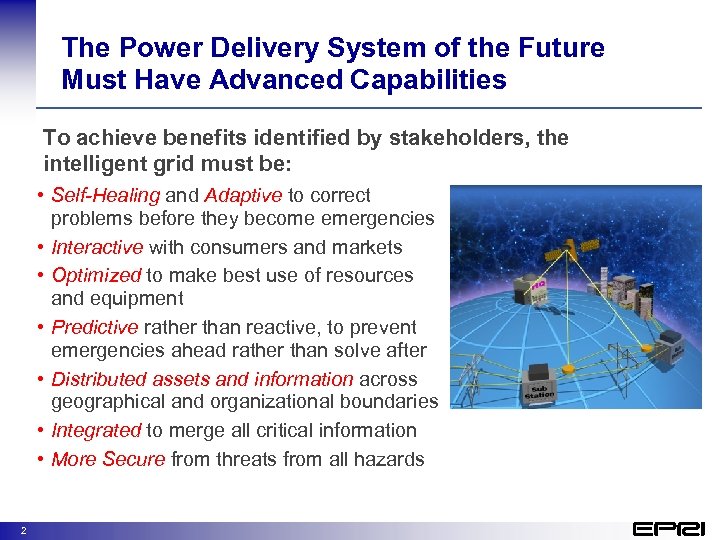
The Power Delivery System of the Future Must Have Advanced Capabilities To achieve benefits identified by stakeholders, the intelligent grid must be: • Self-Healing and Adaptive to correct problems before they become emergencies • Interactive with consumers and markets • Optimized to make best use of resources and equipment • Predictive rather than reactive, to prevent emergencies ahead rather than solve after • Distributed assets and information across geographical and organizational boundaries • Integrated to merge all critical information • More Secure from threats from all hazards 2
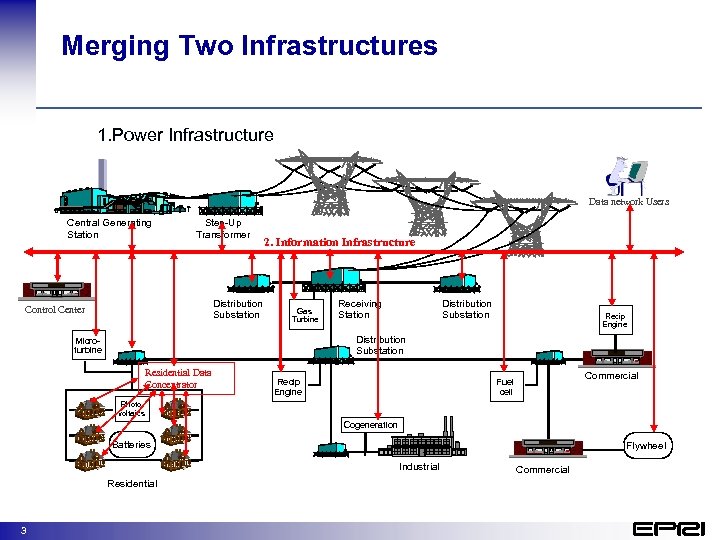
Merging Two Infrastructures 1. Power Infrastructure Data network Users Central Generating Station Step-Up Transformer Distribution Substation Control Center 2. Information Infrastructure Gas Turbine Receiving Station Distribution Substation Recip Engine Distribution Substation Microturbine Residential Data Concentrator Recip Engine Commercial Fuel cell Photo voltaics Cogeneration Batteries Flywheel Industrial Residential 3 Commercial
What is Impeding the Industry? • Lack of interoperability • Limited methods or tools for designing complex systems • Incomplete, overlapping and conflicting standards • Lack of a common “vision” • Regulatory and financial uncertainty • Perceived investment needed 4
The Intelli. Grid Architecture 1. An open, standards-based architecture for integrating the data communications networks and intelligent equipment needed to support the Power Delivery System of the Future 2. Provides utilities and others with the tools and processes for designing communications and automation systems 3. Recommends technologies and standards to use 5 Available for Download and Public Use: www. epriintelligrid. com
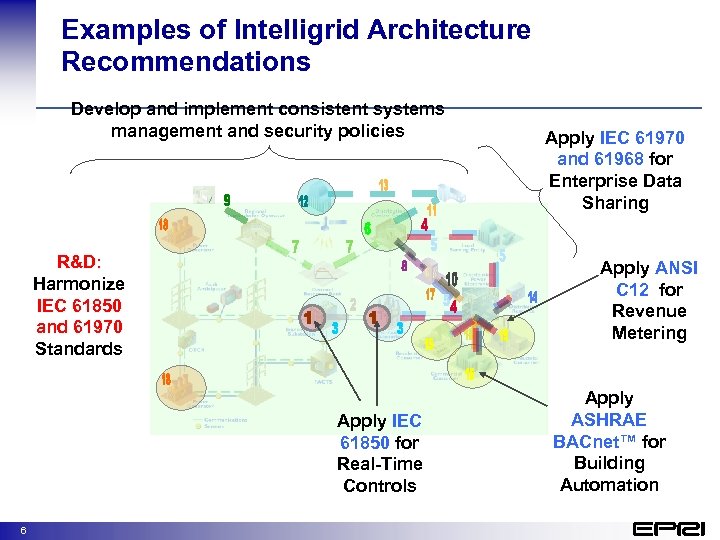
Examples of Intelligrid Architecture Recommendations Develop and implement consistent systems management and security policies R&D: Harmonize IEC 61850 and 61970 Standards Apply ANSI C 12 for Revenue Metering Apply IEC 61850 for Real-Time Controls 6 Apply IEC 61970 and 61968 for Enterprise Data Sharing Apply ASHRAE BACnet™ for Building Automation
Intelligrid Architecture Business Drivers • Capital Cost Savings – Competitive Procurement of intelligent equipment through Standards and Open Systems – Multi-vendor support and avoidance of single vendor “lock-in” – Extensible and Scalable “Industry-wide” • Life-Cycle Cost Savings – More uniform Standards based systems – Extensible for the Future – More capable, easier to maintain – Immune to single vendor limitations • Security Policy Implementation 7
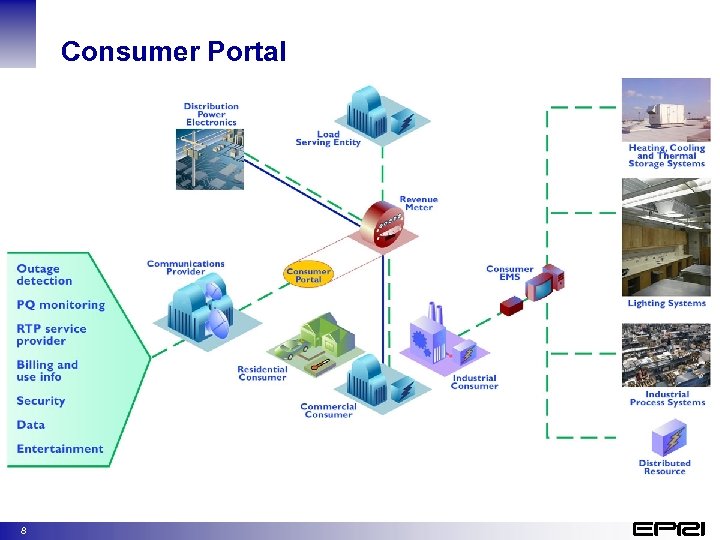
Consumer Portal 8
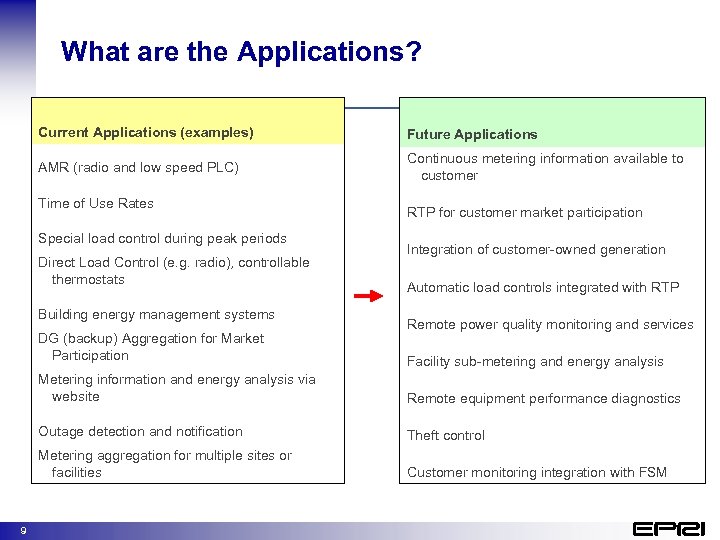
What are the Applications? Current Applications (examples) Future Applications AMR (radio and low speed PLC) Continuous metering information available to customer Time of Use Rates Special load control during peak periods Direct Load Control (e. g. radio), controllable thermostats Building energy management systems DG (backup) Aggregation for Market Participation RTP for customer market participation Integration of customer-owned generation Automatic load controls integrated with RTP Remote power quality monitoring and services Facility sub-metering and energy analysis Metering information and energy analysis via website Outage detection and notification Theft control Metering aggregation for multiple sites or facilities 9 Remote equipment performance diagnostics Customer monitoring integration with FSM
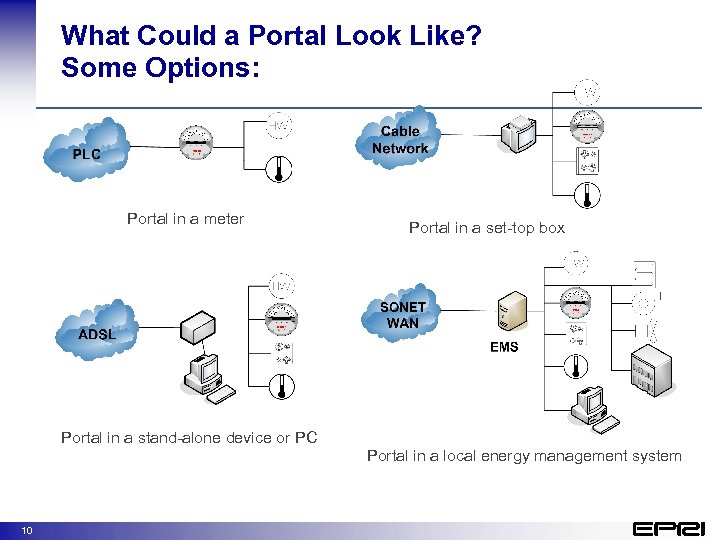
What Could a Portal Look Like? Some Options: Portal in a meter Portal in a set-top box Portal in a stand-alone device or PC Portal in a local energy management system 10
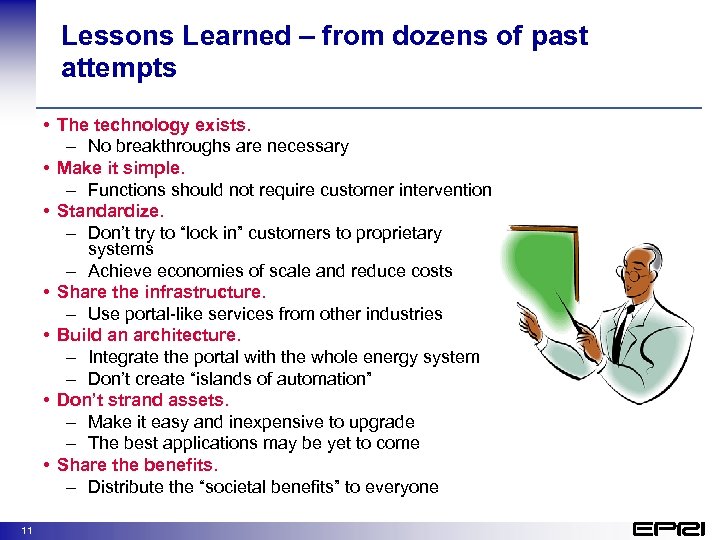
Lessons Learned – from dozens of past attempts • The technology exists. – No breakthroughs are necessary • Make it simple. – Functions should not require customer intervention • Standardize. – Don’t try to “lock in” customers to proprietary systems – Achieve economies of scale and reduce costs • Share the infrastructure. – Use portal-like services from other industries • Build an architecture. – Integrate the portal with the whole energy system – Don’t create “islands of automation” • Don’t strand assets. – Make it easy and inexpensive to upgrade – The best applications may be yet to come • Share the benefits. – Distribute the “societal benefits” to everyone 11
What Could a Portal Look Like? • A consumer portal is an idea, not a particular device! • Intelli. Grid is developing a reference design – A standard “virtual appearance” for a portal – A clearly defined set of interfaces – May be incorporated into a variety of devices – May be distributed among several devices • The physical device(s) may vary, but the virtual device must be standardized to ensure – Interoperability between vendors – Reduction in cost due to economies of scale • Some vendors already provide portal-like devices, but they are generally not standard and not interoperable. 12
Intelli. Grid Consumer Portal Project • Define requirements so that vendors can build components and systems that are interoperable (open systems). – Information models, object models • Define requirements so that systems will be expandable to meet needs of future service offerings. • Engage stakeholders to create a consensus on these requirements definitions. • Demonstrate the feasibility and performance of systems that meet these requirements. • Move these requirements into the standards process to enhance the applications in the market. 13
Скачать презентацию Intelli Grid Enabling The Power Delivery System of
7da821223658c3e5054013aa15094cb3.ppt