


 Скачать презентацию Intellectual Property Rights And Forensic Science Prof Dr
d06beff124af49321f206d44c4aecc79.ppt
- Количество слайдов: 38
 Intellectual Property Rights And Forensic Science Prof Dr P Chandra Sekharan Professor-Director, School of Science and Forensic Sciences And Pro Vice-Chancellor National law University, Jodhpur
 Introduction • The term ‘intellectual property’ (IP) refers to property created with the use of intellect. • IP refers to all creations of mind which are vested with the status of property because of the commercial value associated with the intellectual creation. • Several IPs are commercially very valuable and hence they are protected by different ‘intellectual property rights’ (IPR).
 • The law that involves the creation, vesting and the use of IP rights is known as intellectual property laws IPR can broadly be divided into two categories i) industrial property rights ii) Copyrights
 • The vesting of rights over matter that will be useful for industries and in commerce refers to industrial property rights, which include: patents, trademarks, industrial designs, and geographic indications of source. • The literary and the artistic works are referred to as copyright which is generally vested in novels, poems, plays, musical works, artistic works such as drawings, paintings, photographs, sculptures, and architectural designs.
 • Intellectual property rights do not belong to India and they were imported from the West. • Culturally the Indians believe in a system where knowledge is considered free. It is also considered to be the ‘dharma’ duty or to transfer knowledge from generation to generation - which is reflected by the basic structure of the educational system of “Gurukula. ”
 • We must realize that nature’s bounty is plenty in this country and therefore we never attached any commercial value to the creations of the mind. • This is patently exhibited in the tapestry of Indian civilization in the sense that all sculpture and other artistic works are exhibited openly in temples and other public places. • Because of the antique value of these sculptures and pieces of art work, commercial value is attached to them nowadays.
 Origin of IP System • Historically the origin of the IP system can be traced back to the West. In and around 1300 A. D. , the Alps mountains were essentially an ore-mining area. According to the customs and traditions prevailing there, the property rights of mining, timber use and water use are vested with those who first found the ore-site.
 • Water mills were established to help mining works and water millers requested special privileges for their mines against other competitors. This was the birth of IPR establishing special privileges in return for useful creations. History reveals that the first patent was granted to a German in 1409 in Venice • The development of the Venetian IP system had the influence over the development of the British and French systems which in turn had influenced the American system. To day the IP system of the US is one of the most complex and well developed areas of law.
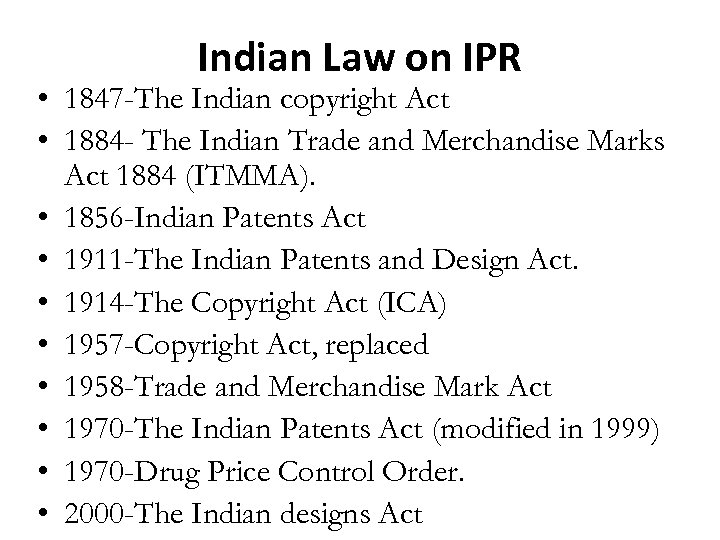 Indian Law on IPR • 1847 -The Indian copyright Act • 1884 - The Indian Trade and Merchandise Marks Act 1884 (ITMMA). • 1856 -Indian Patents Act • 1911 -The Indian Patents and Design Act. • 1914 -The Copyright Act (ICA) • 1957 -Copyright Act, replaced • 1958 -Trade and Merchandise Mark Act • 1970 -The Indian Patents Act (modified in 1999) • 1970 -Drug Price Control Order. • 2000 -The Indian designs Act
 • The above repeated drama to introduce patent statute in India reflects the defensive acceptance of the patent system in India. • India did not keep in touch with the developments in the IP systems across the world and chose to ignore the importance of this area of law. • Result- country was forced to accept a system that possibly does not really suit its economic needs.
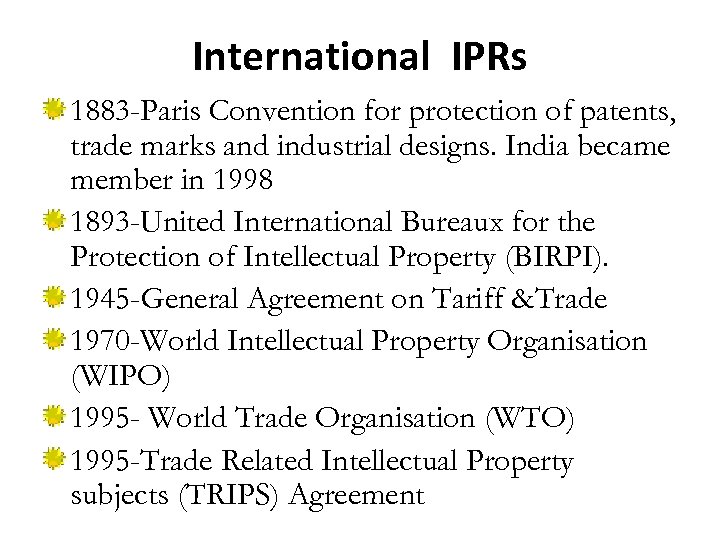 International IPRs 1883 -Paris Convention for protection of patents, trade marks and industrial designs. India became member in 1998 1893 -United International Bureaux for the Protection of Intellectual Property (BIRPI). 1945 -General Agreement on Tariff &Trade 1970 -World Intellectual Property Organisation (WIPO) 1995 - World Trade Organisation (WTO) 1995 -Trade Related Intellectual Property subjects (TRIPS) Agreement
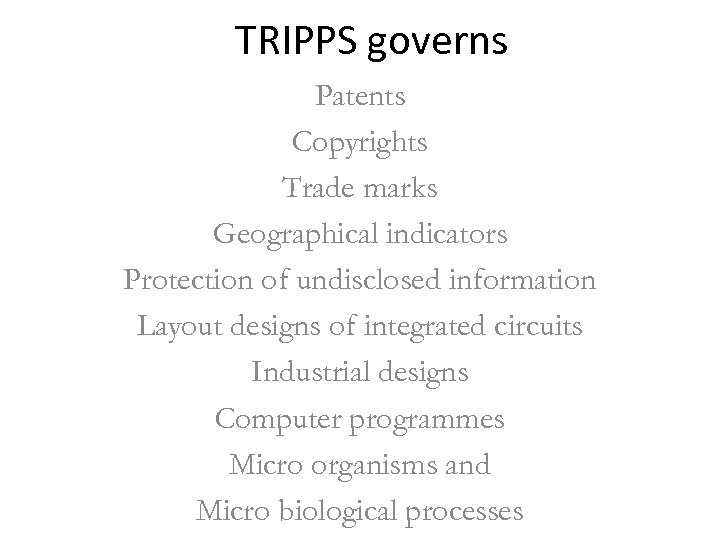 TRIPPS governs Patents Copyrights Trade marks Geographical indicators Protection of undisclosed information Layout designs of integrated circuits Industrial designs Computer programmes Micro organisms and Micro biological processes
 Traditional knowledge • Traditional knowledge is not recognised as an IP. This is due to the deep rooted policy of the west that if the subject matter of patent law already exists in public domain it cannot be removed and given monopoly rights. It is this policy of the west which refuses intellectual property protection for the traditional knowledge found in the developing countries.
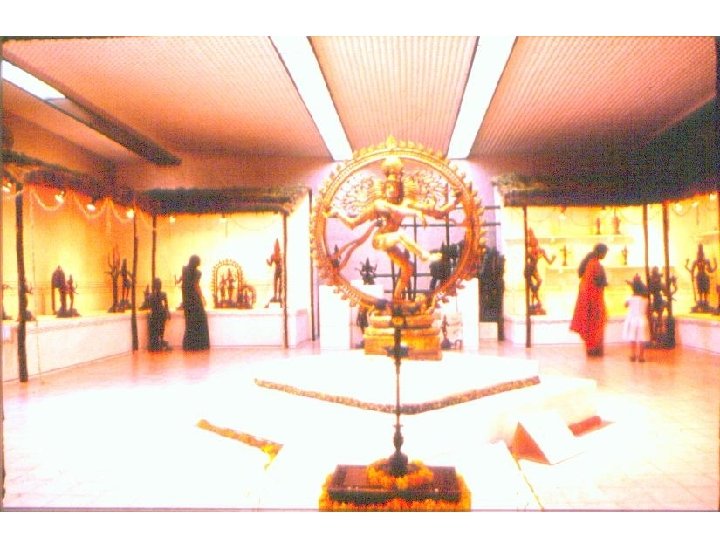
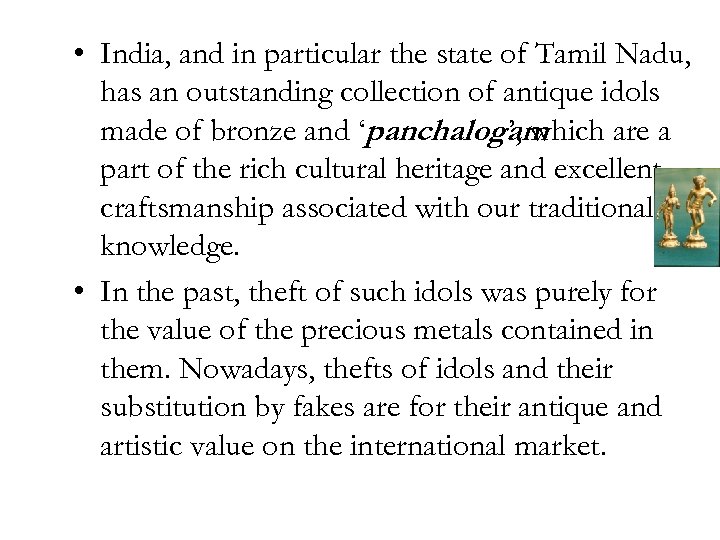 • India, and in particular the state of Tamil Nadu, has an outstanding collection of antique idols made of bronze and ‘panchalogam ’, which are a part of the rich cultural heritage and excellent craftsmanship associated with our traditional knowledge. • In the past, theft of such idols was purely for the value of the precious metals contained in them. Nowadays, thefts of idols and their substitution by fakes are for their antique and artistic value on the international market.
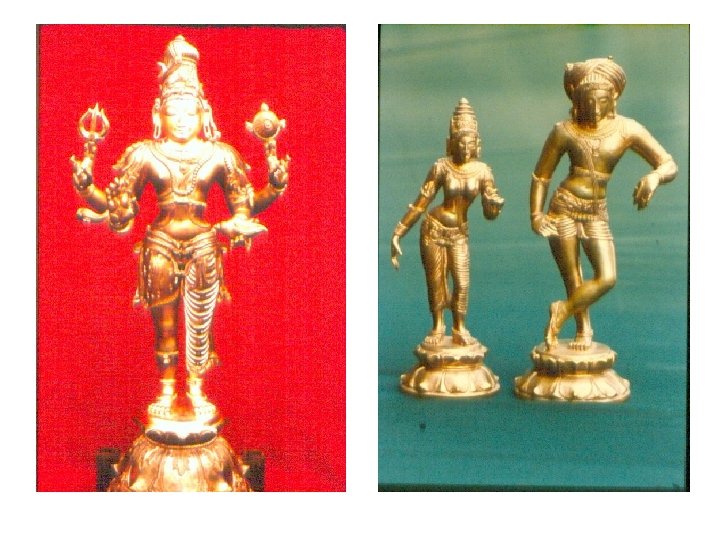
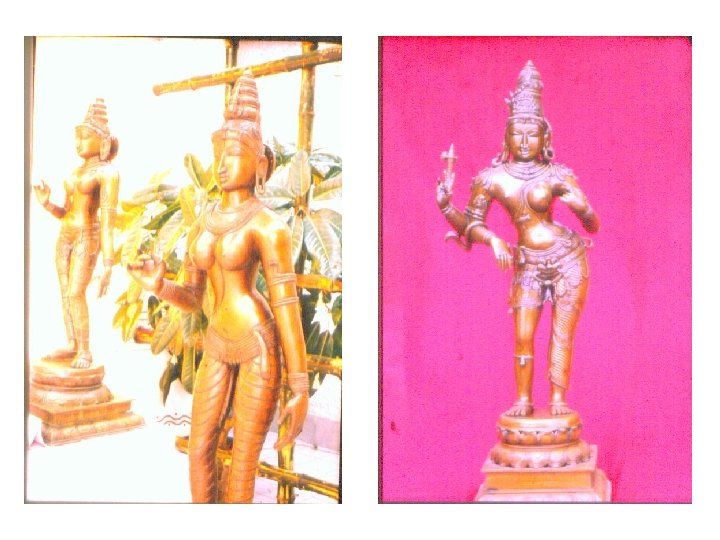
 • The identification of the period, region, dynasty, and description in respect of the bronzes may perhaps be a matter of expert knowledge based on the visual and stylistic judgement on an archaeologist or antiquarian. • But, to stand the test in courts of law, more scientific (forensic) methods are needed to produce positive and more reliable evidence.
 Trademarks • The trademarks provides the identity and origin of a product like how a name identifies an individual. • Interestingly, this important area of intellectual property traces its origin not to Britain or the US but to India and China. • History holds that as far back as 3, 000 years ago, Indian craftsmen used to engrave their signatures on their artistic creations before sending them to Iran.
 • These creations have also been later found in the ruins of Mohanjadero Harappa. and • Manufacturers from China sold goods bearing their marks in the Mediterranean area over 2, 000 years ago. It is also said that at one time a thousand different Roman pottery marks were in use. • Interestingly, copying of the marks was also prevalent even in the ancient days. With the flourishing trade of the Middle Ages, the use of signs to distinguish the goods of merchants and manufacturers likewise expanded several hundred years ago. It is said that the marks enabled the craftsmen to sell their products beyond the locality
 Forensic Science • Forensic Science is the application of Laws of Nature to Laws of Man. -F. E. Camps • Forensic Science is the conglomeration of all bits of human knowledge, experience and endeavour which are used as fact finding tools for all legal requirements. -Chandra Sekharan-
 • In cases of Trademark violations what the forensic scientist has to look for is to compare the spurious product with the genuine one and find out how it differs from the genuine ones. • The forensic analysis would include not only the physico-chemical analysis of identifying and quantifying various constituents of the product, design, size, shape and weight, but also the labels including trademarks that are printed on the container or sometimes on the object themselves. • In unique pieces of arts and sculptures, this sort of comparison won’t work.
 Pathur Nataraja Case • A farm worker accidentally came across a number of antique bronzes buried underneath the ruins of Pathur Shiva Temple. • He removed all of them to another place and buried them covering with hay. • Later he sold them the main idol of Nataraja (Shiva in dancing pose) for paltry sum of five hundred rupees. • He was caught by the police while he was loading the remaining idols in a standard- 20 van and the idols were brought to me.
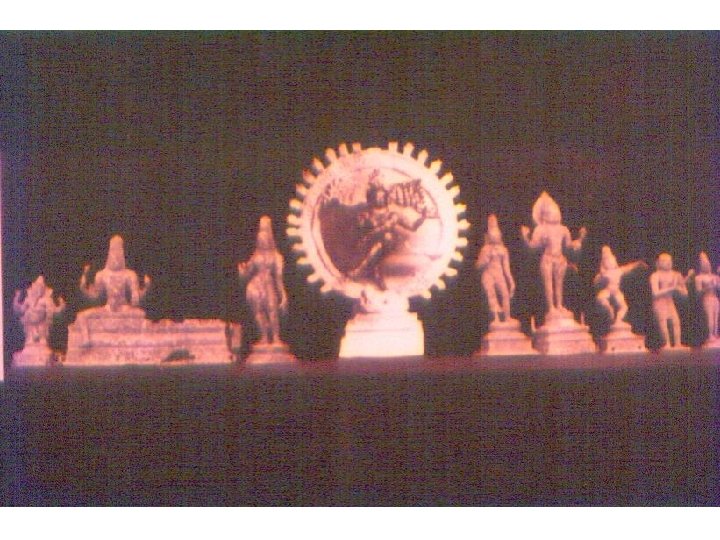
 • The police found out that the Nataraja idol had finally reached one antique dealer in Bombay and he has purchased the same for 25 thousand rupees and later sold it to a foreigner whom he cannot identify. • The police alerted the Interpol and they had found the idol in the British Museum, where a Canadian Oil-Firm, which purchased the idol for three million pounds, gave it for cleaning and curing.
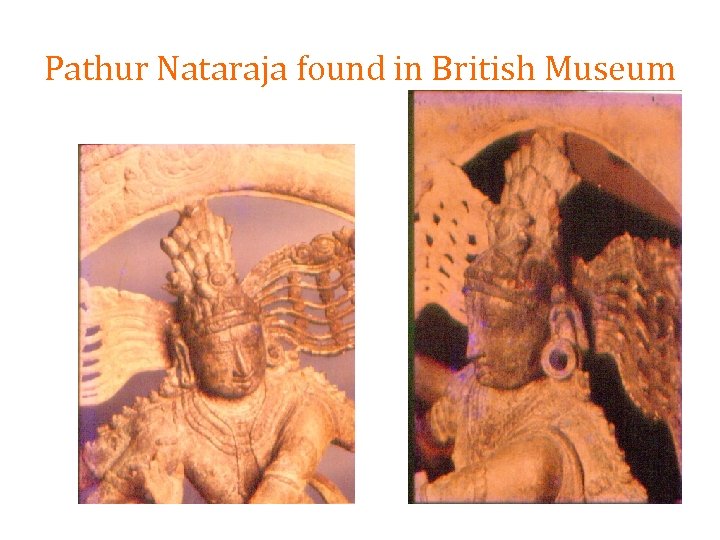 Pathur Nataraja found in British Museum
 • Normally, in a Shiva temple, apart from the main presiding deity, there should be fourteen processional deities as per Shashtras. • The processional deities are mainly bronze castings, while the presiding deity will be a stone sculpture (Linga). Chidambaram Temple is the only place where the main deity is in the form of Nataraja & is made of ‘Panchaloga ’ • The bronzes made during Chola periods are of very high artistic values. The main piece will be that of Lord Nataraja.
 • Two pieces will be that of the consort (‘Parvathi of Lord Shiva, one of them is ’) named as ‘Sivakamiin local parlance in ’ South India and other as ‘Thani Amman ’. • The other pieces are that of Pikshandeswar, Karthik, Vinayak and other saints. According to the traditional knowledge of iconometry the height of these idols have to be in specific proportion in height as compared to that of the main deity namely Shiva.
 • The Scotland Yard Police, London, have seized the idol and took measurements of the idol and also photographed it at different angles and sent them to me for examination. • Using iconometric principles, I found that the idol in London belonged to the Pathur group but this evidence was not enough. • On closer examination, I found that besides the soil sticking to idols, there were also exploratory termite galleries in the remaining thirteen idols with me.
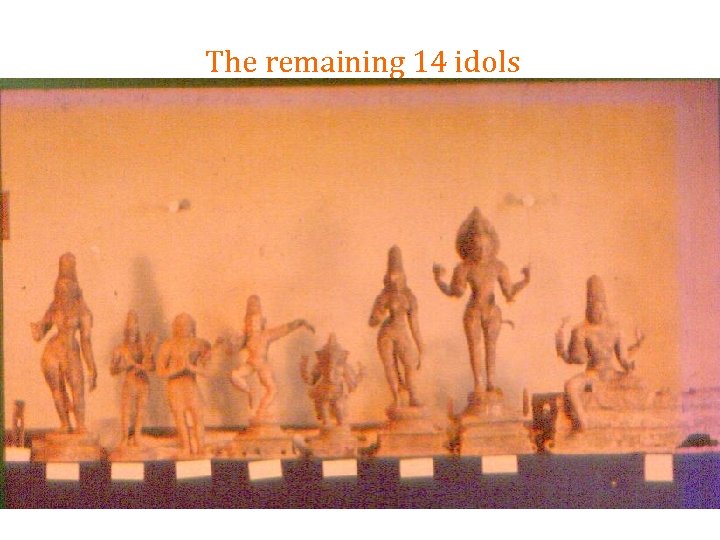 The remaining 14 idols
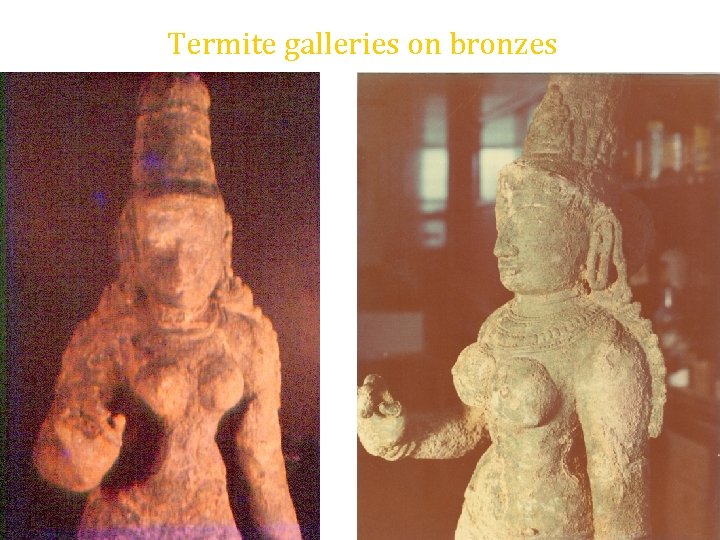 Termite galleries on bronzes
 I expected if the Shiva Idol in London belonged to this group then it would also have similar soil and termite galleries. I therefore went to London to examine the Shiva idol there and to my luck, I found the presence of exploratory galleries on the pedestal even though the museum chemists already cleaned the remaining parts of the idol.
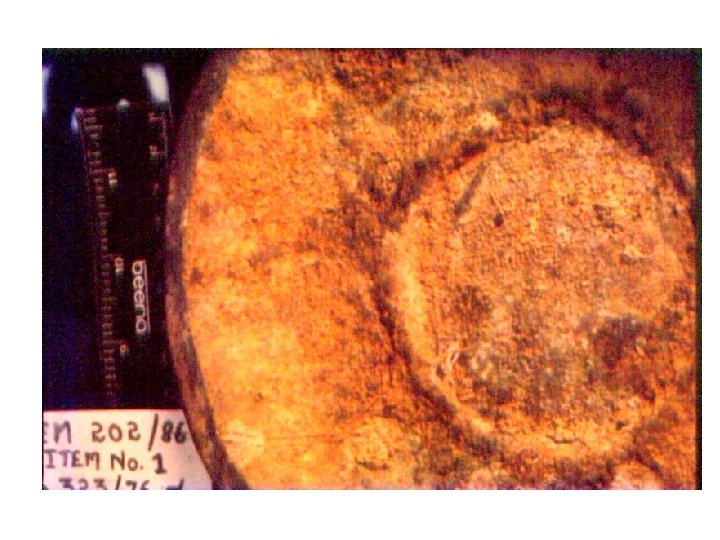
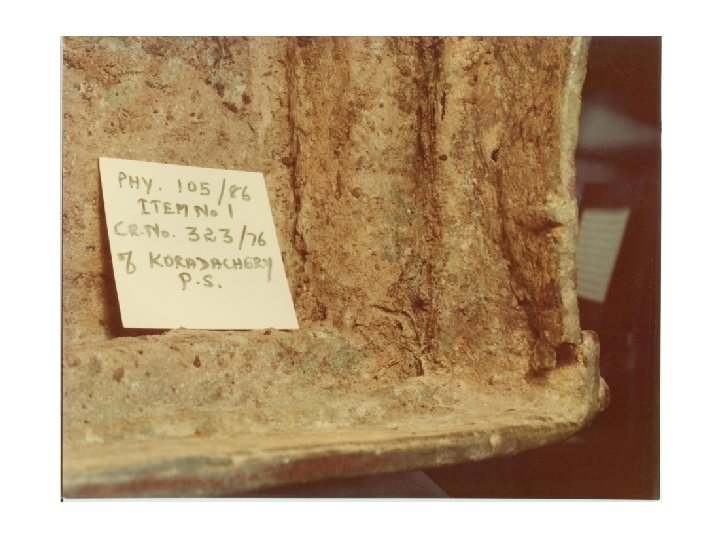
 • I carried out soil-analysis, determined the specimen of termites, compared termite galleries and opined that Shiva idol definitely belonged to the Pathur group. • The case went to Royal High Court, London that wanted me to bring all the remaining idols with me to the court. • The court wanted me to inform them, which one is the real consort of Lord Shiva since the idols of Shivakami and Thani Amman look alike in stance, height and other features.
 • This question was put to me in the court, as I didn’t include this aspect in my written report. • Our “Shashtras” came to my rescue, according to which Shivakami is said to have danced all along with Lord Shiva from Kailash until they descended at Chidambaram. • Therefore, I expected the tassels in the case of Shivakami to be different from that of Thani Amman and very quickly observed in the Court that such a difference was present between the two idols and therefore, I identified Shivakami easily
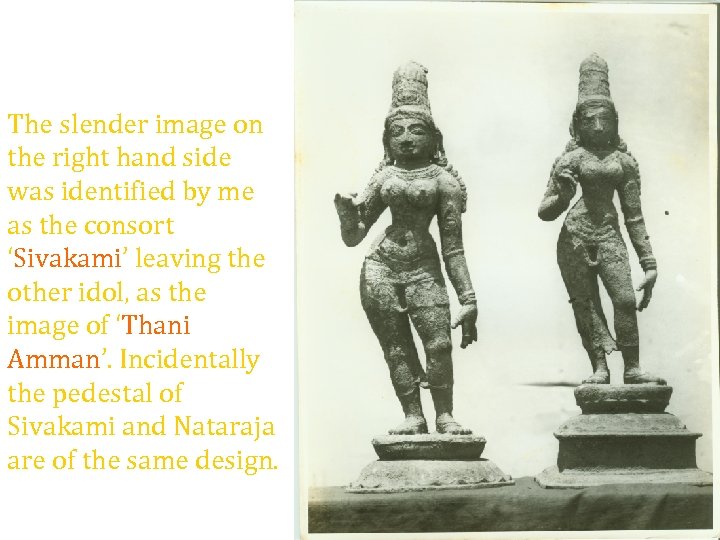 The slender image on the right hand side was identified by me as the consort ‘Sivakami’ leaving the other idol, as the image of ‘Thani Amman’. Incidentally the pedestal of Sivakami and Nataraja are of the same design.
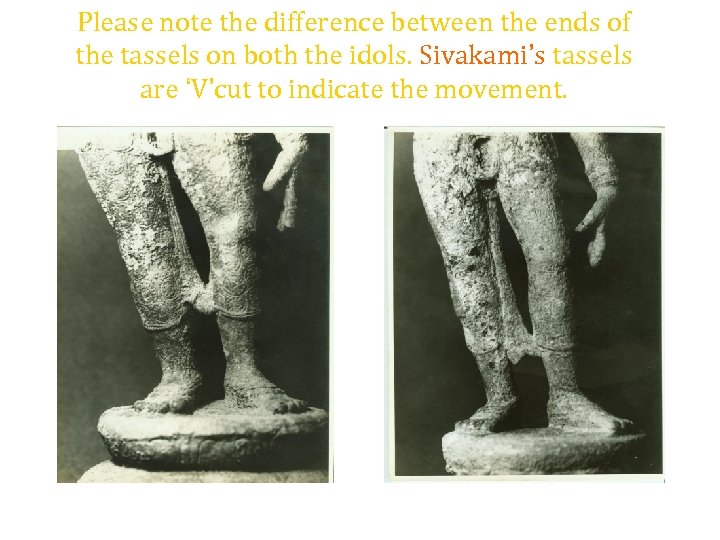 Please note the difference between the ends of the tassels on both the idols. Sivakami’s tassels are ‘V’cut to indicate the movement.