 Скачать презентацию Intellectual Property Protecting your brand profiting from it
7ac76fb77befbd9676ece81c01ce653c.ppt
- Количество слайдов: 41




Intellectual Property Protecting your brand profiting from it
Introduction 1. Social Media - Issues related to corporate use - Issues related to third party/employee use 2. Protecting Copyright in the Digital Age - Rights in data Copyright in software Copyright and anti-circumvention laws 3. Brand Protection - Colour as a trade mark Practical issues from an in-house perspective 4. Patent Box 5. Questions? Page 2
1. Social Media
Social Media Page 4
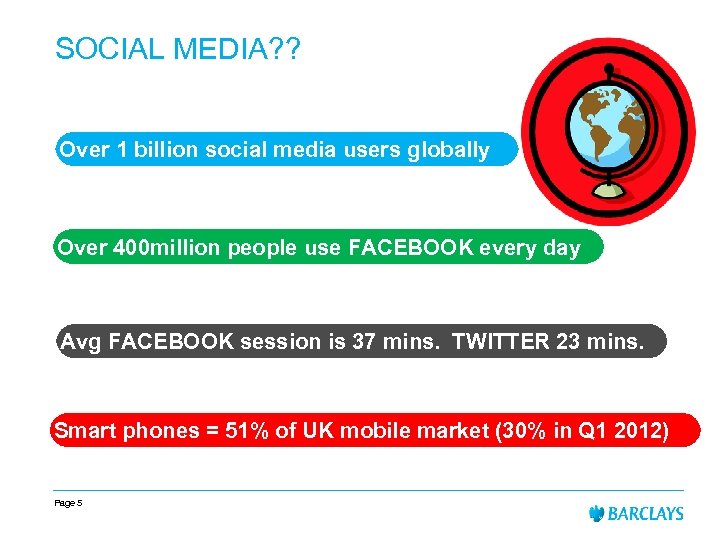
SOCIAL MEDIA? ? Over 1 billion social media users globally Over 400 million people use FACEBOOK every day Avg FACEBOOK session is 37 mins. TWITTER 23 mins. Smart phones = 51% of UK mobile market (30% in Q 1 2012) Page 5
![(i) Corporate use of Social Media 1. TERMS & CONDITIONS a. Barclays [and B&B]](https://present5.com/presentation/7ac76fb77befbd9676ece81c01ce653c/image-6.jpg "(i) Corporate use of Social Media 1. TERMS & CONDITIONS a. Barclays [and B&B]")
(i) Corporate use of Social Media 1. TERMS & CONDITIONS a. Barclays [and B&B] publish news, photos and other material to Twitter or Facebook. b. The sites' use of this material is governed by terms and conditions. c. Facebook's T & Cs grant them a licence of the IP in any content posted. d. Facebook allows only restricted use of data gathered through advertising (eg cannot sell to third party). Page 6
(i) Corporate use of Social Media • Last year the online photo and social networking site Instagram introduced the following condition of use: "to help us deliver interesting paid or sponsored content or promotions, you agree that a business or other entity may pay us to display your username, likeness, photos, and/or actions you take, in connection with paid or sponsored content or promotions, without any compensation to you. " • Page 7 Instagram eventually clarified that selling its 100 million users' photos was not its intention.
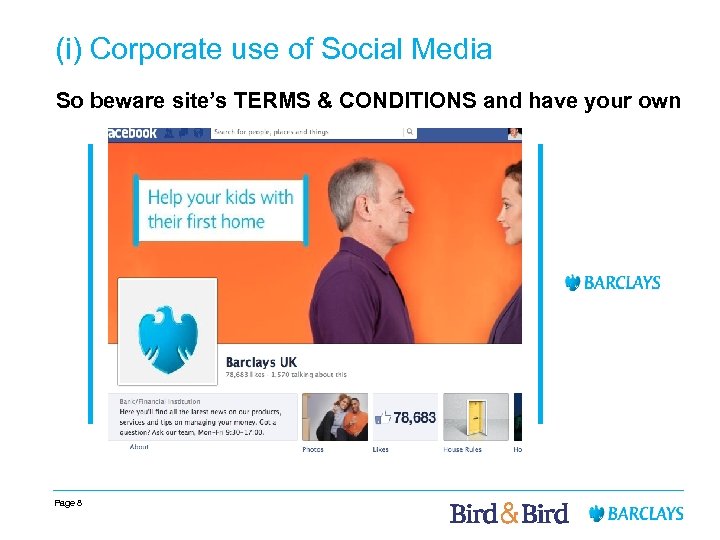
(i) Corporate use of Social Media So beware site’s TERMS & CONDITIONS and have your own Page 8
(i) Corporate use of Social Media 2. Advertising generally a. Consumer Protection from Unfair Trading Regs – General – unfair commercial practices – Specific – misleading actions – or in some way deceitful – Blacklist – 31 (eg advertorials) b. Code of Non-broadcast advertising. . . (CAP) – Legal, decent, honest and truthful – Communications must not materially mislead or be likely to do so. Page 9
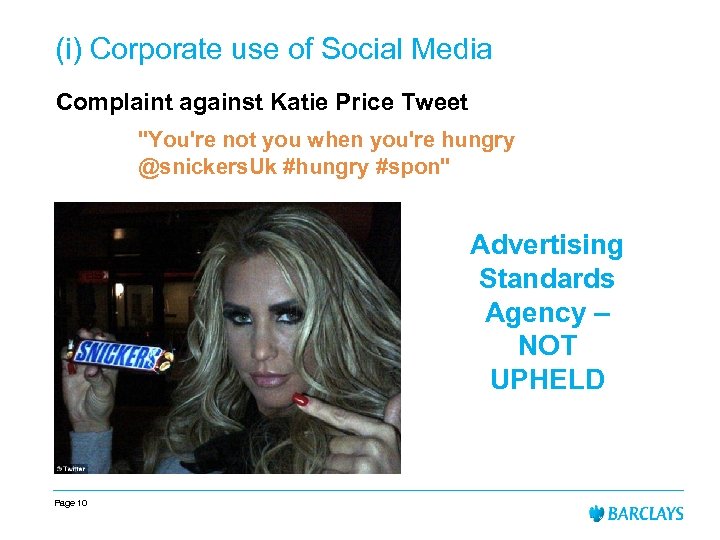
(i) Corporate use of Social Media Complaint against Katie Price Tweet "You're not you when you're hungry @snickers. Uk #hungry #spon" Advertising Standards Agency – NOT UPHELD Page 10
(i) Corporate use of Social Media 3. Multiple jurisdictions (FSMA) a. Authorised persons & financial promotions 4. Market abuse (FSMA) a. Speed – inside information b. Accuracy - creating a false or misleading impression. 5. FSA Handbook a. Non-promotional communications b. Financial promotion (COBS 4, BCOBS 2, ICOBS, MCOB 3) c. Image advertsing Page 11
(i) Corporate use of Social Media 6. FSA – practical matters a. New media may date more quickly than traditional media b. Suitable method for the type of communication. For example, Twitter limits the number of characters – Misleading? – Risk information to be displayed prominently and fairly? c. Geoblocking d. Complaints Page 12
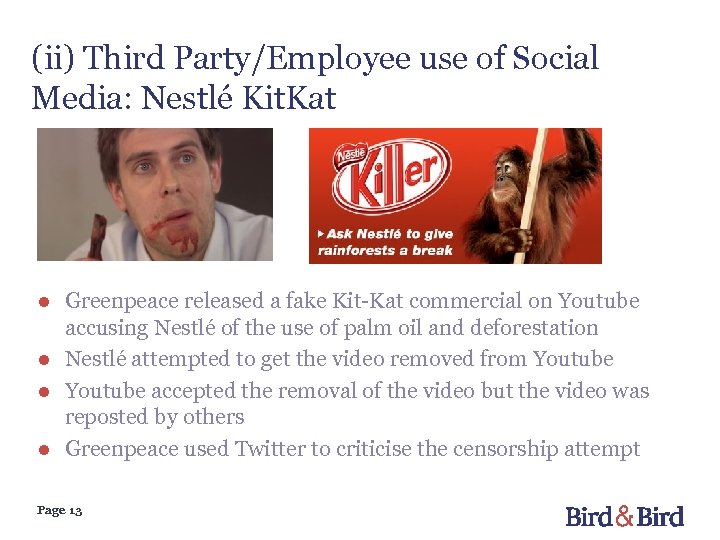
(ii) Third Party/Employee use of Social Media: Nestlé Kit. Kat ● Greenpeace released a fake Kit-Kat commercial on Youtube accusing Nestlé of the use of palm oil and deforestation ● Nestlé attempted to get the video removed from Youtube ● Youtube accepted the removal of the video but the video was reposted by others ● Greenpeace used Twitter to criticise the censorship attempt Page 13
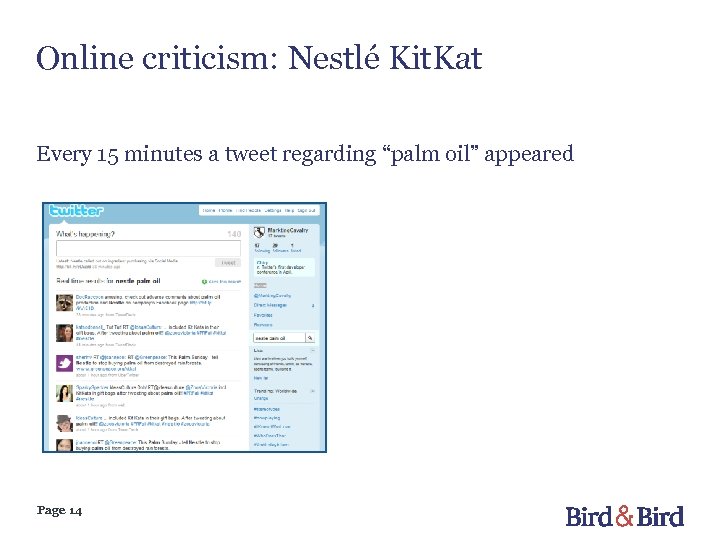
Online criticism: Nestlé Kit. Kat Every 15 minutes a tweet regarding “palm oil” appeared Page 14
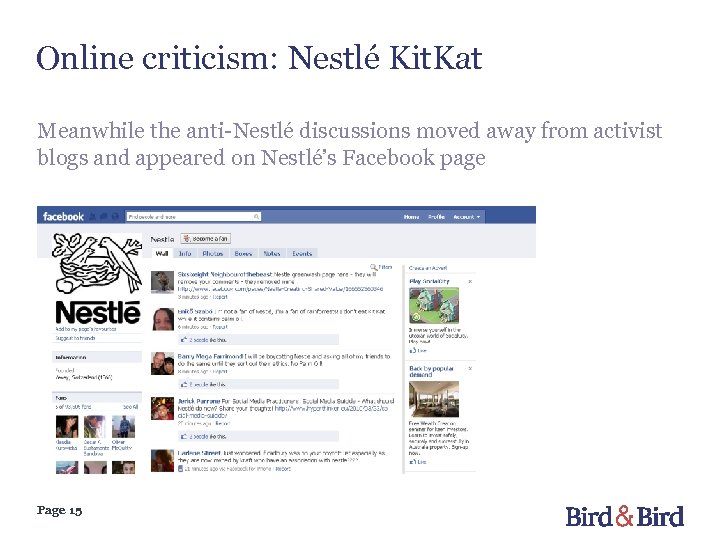
Online criticism: Nestlé Kit. Kat Meanwhile the anti-Nestlé discussions moved away from activist blogs and appeared on Nestlé’s Facebook page Page 15
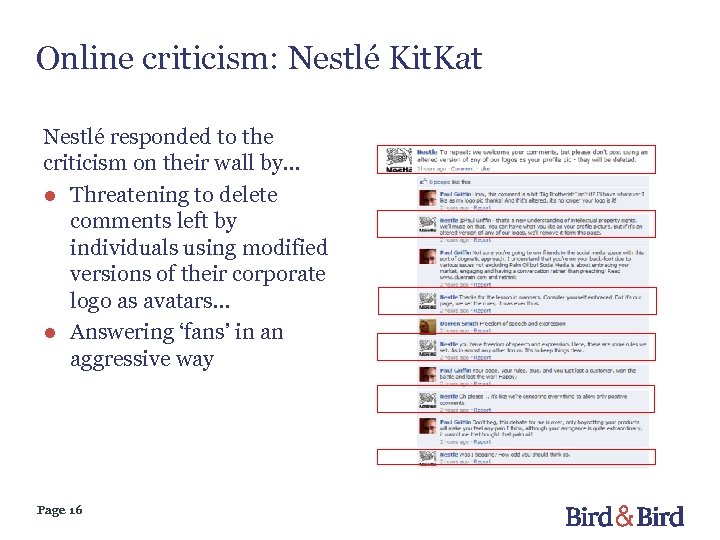
Online criticism: Nestlé Kit. Kat Nestlé responded to the criticism on their wall by… ● Threatening to delete comments left by individuals using modified versions of their corporate logo as avatars… ● Answering ‘fans’ in an aggressive way Page 16
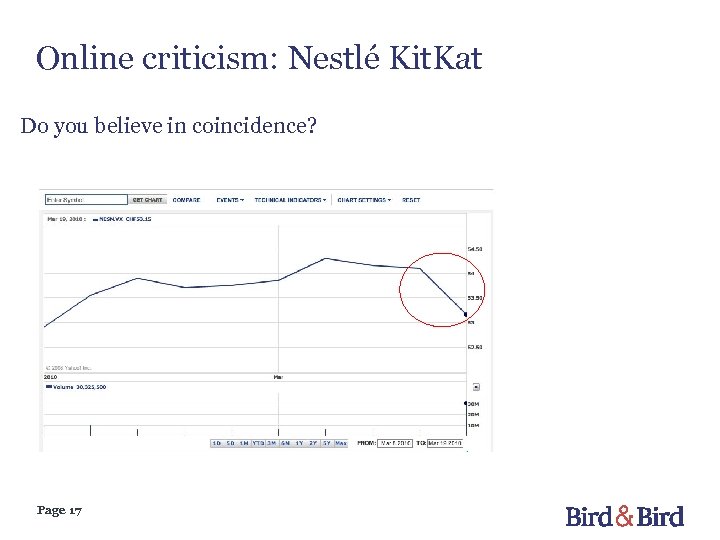
Online criticism: Nestlé Kit. Kat Do you believe in coincidence? Page 17
Policing use of your brand reputation in social media ● Identify which social media platforms your customers use and which are most relevant to your business ● Do not overreact ● Be proactive and implement clear policies and procedures ● Install a monitoring program ● Leverage tools offered by the social network ● Be creative – threatening litigation may lead to a backlash (Freedom of speech versus the protection of reputation/brand) Page 18
2. Protecting Copyright in the Digital Age
(i) Rights in Data ● Sui generis database right - Protects databases not data Where investment in obtaining verification or presentation Infringed by acts of extraction or reutilisation of substantial part Also infringed by repeated extraction/reutilisation of insubstantial parts ● Database Copyright - Protects databases - Higher originality threshold – selection or arrangement of data has to be author's own intellectual creation Page 20
(i) Rights in Data Forensic Telecommunications Services Limited v the Chief Constable of West Yorkshire Police and Stephen Hirst [2011] EWHC 2892 (Ch) • Compilation or table of mobile phone permanent memory absolute (PM abs) addresses (used to recover evidence for criminal investigations) • Copyright did not subsist in individual PM addresses • Copyright did also not subsist in the database of addresses as selection and arrangement not authors' own intellectual creation • Database rights did subsist as there had been considerable investment in the obtaining of the addresses • Confidential information subsisted. Commercially valuable information. Ds should have been aware that had an obligation to keep confidential. Page 21
(ii) Copyright in Software Legal background • Copyright subsists in "original" literary and artisitc works • Software Directive, Article 1(3) provides that a computer program shall be protected "if it is original in the sense that it is the authors own intellectual creation" • Copyright can subsist in: • Computer program itself – source code and object code • Preparatory materials and manuals • Other copyright works incorporated into computer programs eg design and layout of a screen, embedded sound and film, etc • The architecture of a computer system Page 22
(ii) Copyright in Software Copying ? • Copyright prevents the whole or "substantial part" of copyright work being copied • Copying does not need to be intentional • Unconscious recollection of code by programmer who then reproduces it would infringe in the same was as if intentionally memorised • Indirect copying • Work does not infringe just because it is similar so long as no copying has taken place. Page 23
SAS Institute Inc ("SAS") v World Programming Ltd ("WPL") CJEU C-406/10 2 nd May 2012 • Software created by WPL emulated functionality of SAS software. Enable users to execute application software written in SAS specific coding language. • SAS claimed that in creating its software – WPL infringed copyright in SAS manual and indirectly infringed copyright in the software. • SAS claimed that WPL's manual infringed copyright in the SAS manual. • SAS claimed that in studying, observing and testing the SAS learning edition software WPL had breached the terms of its licence to use it. Page 24
SAS Institute Inc ("SAS") v World Programming Ltd ("WPL") CJEU C-406/10 2 nd May 2012 CJEU Decision: • The functionality of a computer program, its programming language nor format of data files protected by copyright because not forms of expression for purposes of Article 1(2) Software Directive • BUT did not necessarily mean that SAS language and format of SAS data files were not protected as works. • Article 5(3) Software Directive allows a licensee to observe, study and test programme to determine the ideas and principles behind it so long as acts covered by the licence. Page 25
SAS Institute Inc ("SAS") v World Programming Ltd ("WPL") CJEU C-406/10 2 nd May 2012 • CJEU also held that infringement occurs where elements from a user manual are reproduced in another manual or computer programme • So long as reproduction constitutes expression of the intellectual creation of the author of the copyright protected user manual • Decision still to be considered/applied by the English High Court Page 26
(ii) Copyright in Software Open Source Software ("OSS") • 80% of organisations expected to have OSS within their own software code base. • Potential for conflicts between OSS licences and traditional proprietary licences. • Risk of core product portfolio becoming subject to T&Cs of an OSS licence. • Companies such as Black Duck can audit software to determine how much OSS is used. Page 27
(ii) Copyright in Software Ownership/Copying • Software developed by a contractor who is not an employee will belong to the contractor in the first instance. • Company should ensure it takes an assignment. • Risk of copying by third party developers/competitors. • Include "sleepers" – lines of code with no function which can identify the origin of the software. Page 28
(iii) Copyright and Anti-Circumvention Laws • Copyright law prevents the circumvention of technological barriers for using computer programs in ways which the right holders do not wish to allow. Sony Computer Entertainment v Paul Owen and Others [2002] EWHC 45 (Ch) • Use of Messiah chips in Playstation 2 s enabled users to play games which had been copied or which were from other countries. Page 29
3. Brand Protection
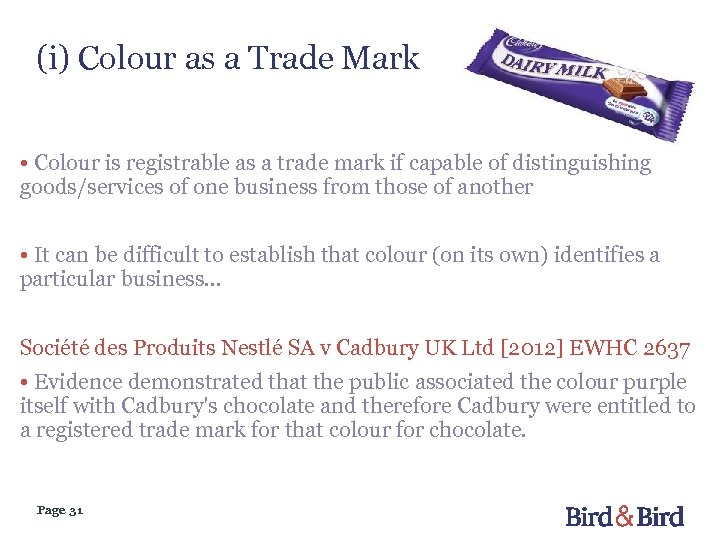
(i) Colour as a Trade Mark • Colour is registrable as a trade mark if capable of distinguishing goods/services of one business from those of another • It can be difficult to establish that colour (on its own) identifies a particular business… Société des Produits Nestlé SA v Cadbury UK Ltd [2012] EWHC 2637 • Evidence demonstrated that the public associated the colour purple itself with Cadbury's chocolate and therefore Cadbury were entitled to a registered trade mark for that colour for chocolate. Page 31
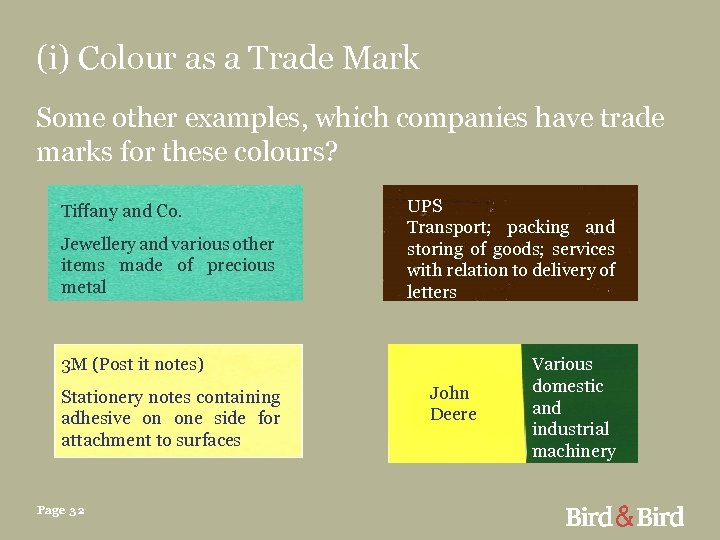
(i) Colour as a Trade Mark Some other examples, which companies have trade marks for these colours? Tiffany and Co. Jewellery and various other items made of precious metal UPS Transport; packing and storing of goods; services with relation to delivery of letters 3 M (Post it notes) Stationery notes containing adhesive on one side for attachment to surfaces Page 32 John Deere Various domestic and industrial machinery
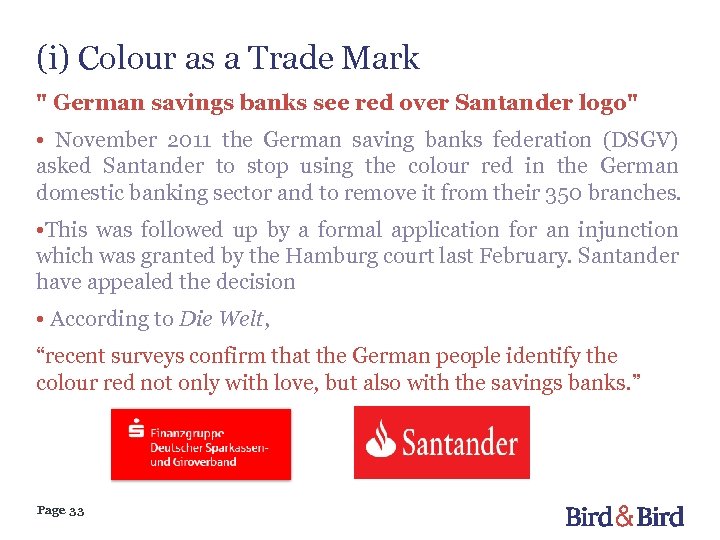
(i) Colour as a Trade Mark " German savings banks see red over Santander logo" • November 2011 the German saving banks federation (DSGV) asked Santander to stop using the colour red in the German domestic banking sector and to remove it from their 350 branches. • This was followed up by a formal application for an injunction which was granted by the Hamburg court last February. Santander have appealed the decision • According to Die Welt, “recent surveys confirm that the German people identify the colour red not only with love, but also with the savings banks. ” Page 33
(ii) Practical Issues - an In-House Perspective • Who is responsible? • MONITORING • Scorched earth policy? • What to cover? e. g online, Mobile Apps etc • Use of external monitoring company • Company's position vs behaviour • Internal education as to policy Page 34
4. The Patent Box Are you ready?
10% Corporation Tax - outline principles • Effectively reduces corporation tax from 23% to 10% on profits attributable to patented innovation • Patent must be granted in UK, EPO (& some other EU countries) • Retrospectively covers 6 years when pending grant • Applies to Worldwide profits on Relevant IP Income (RIPI). NB Includes income from selling patented products or products incorporating patented invention or spare parts • BUT must offset (1) Routine Return & (2) Marketing Return • Must satisfy Development & Active Ownership conditions • Little correlation to patent scope Page 36
Who can benefit? • Company must be liable to UK corporation tax • Own IP or be the exclusive licensee • Have undertaken "qualifying development", ie: • creating, or significantly contributing to creating invention; or • performing a significant amount of activity to develop the patented invention, any product or any process incorporating the patented invention. • Beware of pitfalls: • 'Significant' • Change of ownership • Group Companies & the 'Active Ownership' condition • Anti-avoidance Page 37
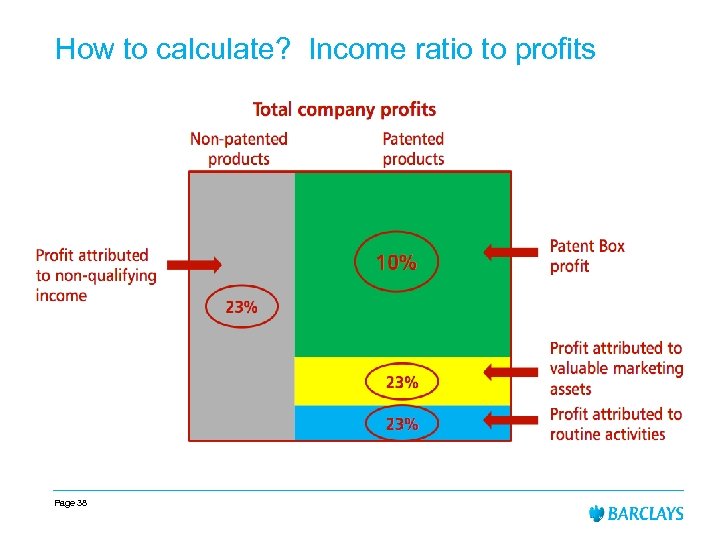
How to calculate? Income ratio to profits Page 38
Considerations & Practical Issues? • Need to map patents to products • Are systems in place to capture Patent Box requirements? • NB Company structure – who holds the rights and who makes the trade? • Is your subject matter patentable? Impact on trade secrets? • Speed to grant & narrowing claims • Monitoring competitors? • What if revoked? • Extension of the ‘Nuisance factor’. . . ? Page 39
5. Any Questions?
Thank you Bird & Bird LLP is a limited liability partnership, registered in England Wales with registered number 0 C 340318 and is authorised and regulated by the Solicitors Regulation Authority. Its registered office and principal place of business is at 15 Fetter Lane, London EC 4 A 1 JP. Bird & Bird is an international legal practice comprising Bird & Bird LLP and its affiliated and associated businesses and has offices in the locations listed on our web site: twobirds. com. The word “partner” is used to refer to a member of Bird & Bird LLP or an employee or consultant, or to a partner, member, director, employee or consultant in any of its affiliated and associated businesses, who is a lawyer with equivalent standing and qualifications. A list of members of Bird & Bird LLP, and of any non-members who are designated as partners and of their respective professional qualifications, is open to inspection at the above address. www. twobirds. com
Скачать презентацию Intellectual Property Protecting your brand profiting from it
7ac76fb77befbd9676ece81c01ce653c.ppt