


 Скачать презентацию INTELLECTUAL PROPERTY LAW LITIGATION OVERVIEW Jason S
23e5704f1e6da9f5ade0c601097e7b1d.ppt
- Количество слайдов: 93
 INTELLECTUAL PROPERTY LAW & LITIGATION OVERVIEW Jason S. Miller 407 -418 -6263 Jason S. miller@lowndes-law. com February 16, 2012 ©Jason S. Miller 2012, All rights reserved
 What is Intellectual Property (IP)? Intangible Property Rights including, for example, ideas, inventions and other innovations, expression, indications of origin and confidential information Patent Copyright Trademark Trade Secret (protected by State law) Almost all aspects of technology, innovation, and/or works of authorship (including software) or art are addressable as IP IP rights arises from Operation of Law In U. S. , Constitutional Basis – Article I, Section 8, Clause 8: “To promote the Progress of Science and useful Arts, by securing for limited Times to Authors and Inventors the exclusive Right to their respective Writings and Discoveries” Trademark rights arise from the Commerce Clause
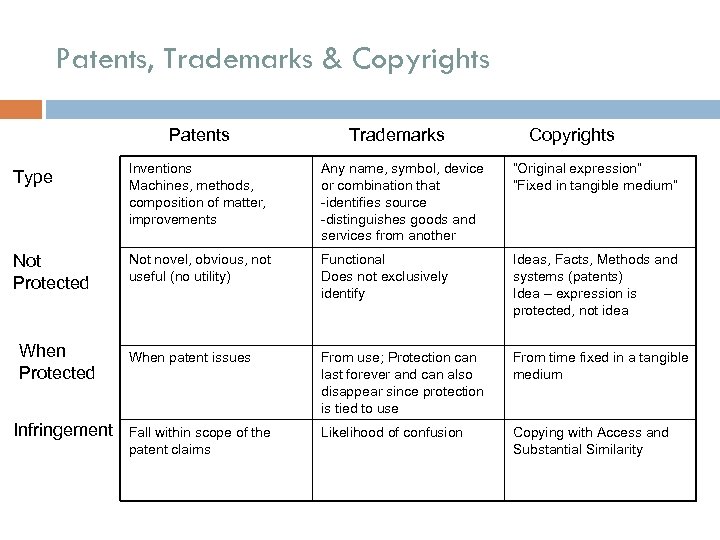 Patents, Trademarks & Copyrights Patents Trademarks Copyrights Type Inventions Machines, methods, composition of matter, improvements Any name, symbol, device or combination that -identifies source -distinguishes goods and services from another “Original expression” “Fixed in tangible medium” Not Protected Not novel, obvious, not useful (no utility) Functional Does not exclusively identify Ideas, Facts, Methods and systems (patents) Idea – expression is protected, not idea When patent issues From use; Protection can last forever and can also disappear since protection is tied to use From time fixed in a tangible medium Fall within scope of the patent claims Likelihood of confusion Copying with Access and Substantial Similarity When Protected Infringement
 What is a patent? Legal document that defines an invention and confers a right upon the owner Similar to a property deed Basic Philosophy Limited Monopoly Bargained for exchange with government to promote innovation Gov’t granting the right to exclude others from making, using, offering for sale, selling and/or importing what is claimed A negative right of exclusion only New! Leahy-Smith America Invents Act (AIA) Enacted September 16, 2011 First major change to U. S. Patent laws in over 60 years
 What is a Patent (cont. )? In the U. S. , Granted by the U. S. Patent & Trademark Office (USPTO) Part of the Commerce Department Protects: Manufactured items, Equipment, Processes, Compositions and Improvements to the above Term: 20 Years From Filing or priority date – extensions available based on PTO delay Territory: United States and its territories Rights Arise: Upon issuance of a patent, arising from a patent application filed prior to public use, disclosure or sale
 AIA changes to existing law Switch to a “first-to-file” System Prior User Rights New definitions of prior art Post-grant opposition proceedings Pre-grant submission of prior art Derivation Supplemental examination Tax strategy patents no longer allowed Patent marking and false marking claims Best mode requirements PTO fees Joinder
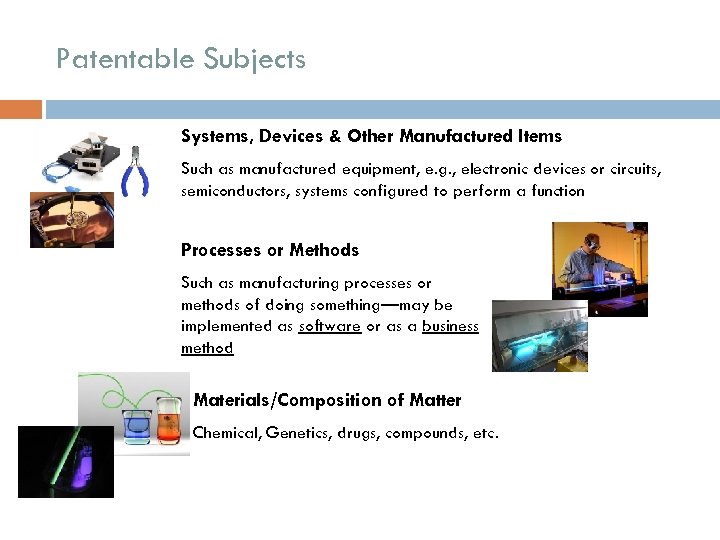 Patentable Subjects Systems, Devices & Other Manufactured Items Such as manufactured equipment, e. g. , electronic devices or circuits, semiconductors, systems configured to perform a function Processes or Methods Such as manufacturing processes or methods of doing something—may be implemented as software or as a business method Materials/Composition of Matter Chemical, Genetics, drugs, compounds, etc.
 Patentability Requirements Novelty Does not exist in the prior art; Not previously disclosed OK if Modification of an existing product/process, or use of something “old” in new/different way Usefulness Utility - Performs a useful function, does it work? An easy requirement to meet in mechanical and electrical arts. Sometimes difficult in chemical and life sciences – “I have a new compound, I just don’t know what it does yet” – therefore, no utility z Non-obviousness A knowledgeable but relatively unimaginative person working in your field would not have been led directly to the invention in light of the available information at the time of invention. This is difficult to describe in general, as lawyers the focus on non-obviousness is generally based on prior case law for guidance. A rejection under obviousness generally involves “combining” one or more references to meet all of the limitations and elements of the claimed invention
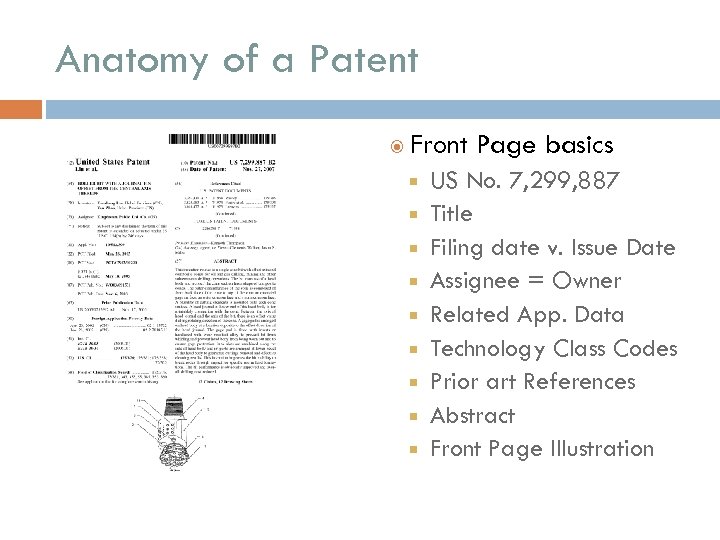 Anatomy of a Patent Front Page basics US No. 7, 299, 887 Title Filing date v. Issue Date Assignee = Owner Related App. Data Technology Class Codes Prior art References Abstract Front Page Illustration
 Anatomy of a Patent Specification Must set forth the precise invention for which a patent is solicited Must “teach” one skilled in the art how to practice, make and recreate the invention Must describe completely a specific embodiment of the invention Must explain a mode of operation whenever applicable Detailed description typically refers to drawings Must set forth the best mode contemplated by the inventor for carrying out the invention Must conclude with at least one claim
 Anatomy of a Patent Claims Must particularly point out and distinctly claim subject matter which applicant regards as the invention The portion of the patent which defines the scope of legal protection and around which questions of infringement will be judged by the courts
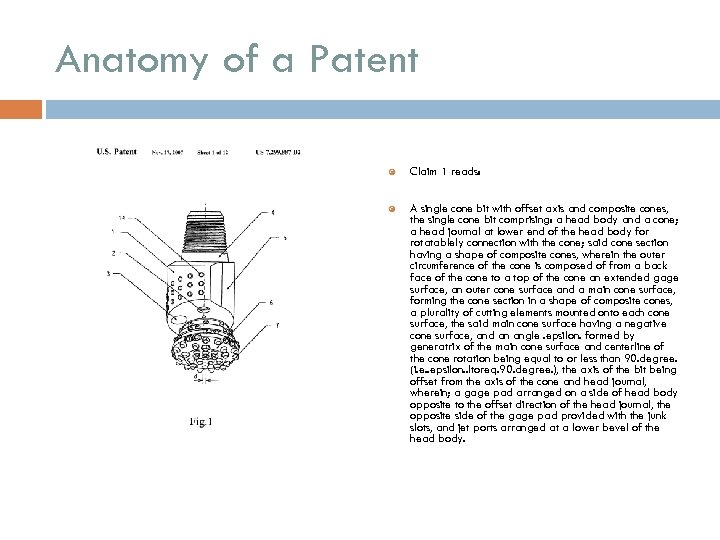 Anatomy of a Patent Claim 1 reads: A single cone bit with offset axis and composite cones, the single cone bit comprising: a head body and a cone; a head journal at lower end of the head body for rotatablely connection with the cone; said cone section having a shape of composite cones, wherein the outer circumference of the cone is composed of from a back face of the cone to a top of the cone an extended gage surface, an outer cone surface and a main cone surface, forming the cone section in a shape of composite cones, a plurality of cutting elements mounted onto each cone surface, the said main cone surface having a negative cone surface, and an angle. epsilon. formed by generatrix of the main cone surface and centerline of the cone rotation being equal to or less than 90. degree. (i. e. . epsilon. . ltoreq. 90. degree. ), the axis of the bit being offset from the axis of the cone and head journal, wherein; a gage pad arranged on a side of head body opposite to the offset direction of the head journal, the opposite side of the gage pad provided with the junk slots, and jet ports arranged at a lower bevel of the head body.
 What is a Copyright (©)? An original work of authorship, fixed in a tangible medium of expression. See, 17 USC 101 et seq.
 What is an “Original Work”? Any work that was independently created (not copied) and that contains a “modicum of creativity”. Feist Publications, INC. v. Rural Telephone Service Co. , 499 U. S. 340 (1991) The exact meaning of this phrase is open to debate however the threshold is extremely low.
 What is “Fixed in a Tangible Medium”? This phrase means that the work in question must be set in a form in which it can be perceived either directly or with the aid of a device. For a literary work this could be when it is first created on a computer or paper. For a musical work it could be either the phonographic recording or the sheet music. Things that are not fixed in a tangible medium are not subject to copyright protection, i. e. ideas, procedures, processes, systems, methods of operation, concepts, principles or discoveries.
 Types of works subject to protection Generally include: literary works; musical works; dramatic works; pantomimes and choreographic works; pictorial, graphic, and sculptural works; motion pictures and other audiovisual works; sound recordings; architectural works.
 What cannot be protected? Facts or any idea, procedure, process, system, method of operation, concept, principle, or discovery, regardless of the form in which it is described, explained, illustrated, or embodied in such work; Words and short phrases such as names, titles, and slogans; Typeface designs; Lists of ingredients; Blank forms that do not themselves convey information; Works consisting entirely of information that is common property containing no original authorship such as standard calendars, height and weight charts, tape measures and rulers, schedules, and tables.
 What does a copyright give you? Exclusive right to do and authorize: Reproduction Derivative works Distribution Public of the work of work by sale or transfer or license performance of work Display of work in public
 Limitations on a Copyright? Fair use: allows for limited copying of a work for purposes Very fact dependent Examples: Criticism Comment News reporting Teaching Scholarship Research
 How do you determine if something is Fair Use Consider: Purpose and character of the use whether the use is of a commercial nature or is for nonprofit educational purposes Nature of the copyrighted work Amount and substantiality of use Effect upon the value of the copyrighted work
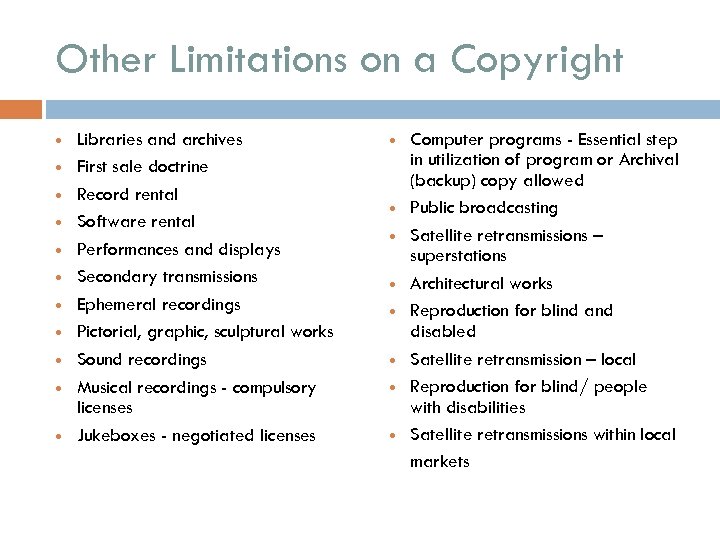 Other Limitations on a Copyright Libraries and archives First sale doctrine Record rental Software rental Performances and displays Secondary transmissions Ephemeral recordings Pictorial, graphic, sculptural works Sound recordings Musical recordings - compulsory licenses Jukeboxes - negotiated licenses Computer programs - Essential step in utilization of program or Archival (backup) copy allowed Public broadcasting Satellite retransmissions – superstations Architectural works Reproduction for blind and disabled Satellite retransmission – local Reproduction for blind/ people with disabilities Satellite retransmissions within local markets
 How to Obtain Copyright Protection attached upon creation. There is no need to register a work, but may do so. Registration is required, however, to enforce rights and provides additional benefits such as statutory damages for infringement.
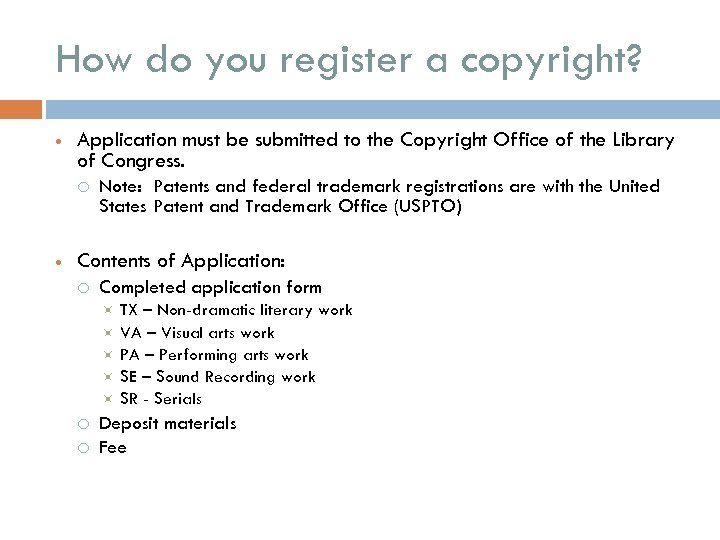 How do you register a copyright? Application must be submitted to the Copyright Office of the Library of Congress. Note: Patents and federal trademark registrations are with the United States Patent and Trademark Office (USPTO) Contents of Application: Completed application form TX – Non-dramatic literary work VA – Visual arts work PA – Performing arts work SE – Sound Recording work SR - Serials Deposit materials Fee
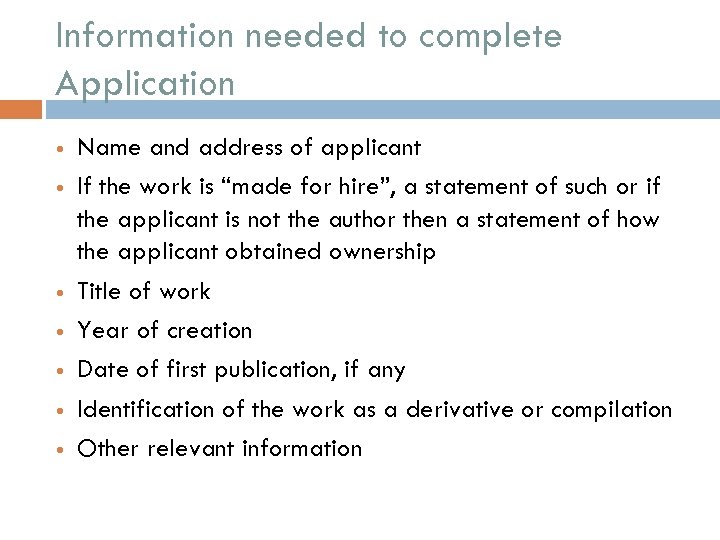 Information needed to complete Application Name and address of applicant If the work is “made for hire”, a statement of such or if the applicant is not the author then a statement of how the applicant obtained ownership Title of work Year of creation Date of first publication, if any Identification of the work as a derivative or compilation Other relevant information
 Deposit Materials Unpublished work Published work One complete copy as published Contribution or collective work Two complete copies of best edition Work first published outside US One complete copy of best edition Some exceptions apply For example, for computer programs a print out of the first and last 25 pages is ok
 Who owns a Copyright? Authors, if joint work What about employees? “Work made for hire” doctrine work prepared by an employee within the scope of his or her employment; or work specially ordered or commissioned for use as a contribution to a collective work, if the parties expressly agree in a written instrument signed by them that the work shall be considered a work made for hire Take away – get an assignment up front!
 What is the Term of a Copyright? In the U. S. : the life of the author plus 50 years, unless the work is anonymous, pseudonymous or a work-made-for-hire then, the lesser of 75 years from its publication or one hundred years from its creation.
 Copyright Notice Prior to 1978 failure to use a copyright notice on your copyrightable materials was fatal to your copyright and placed the material into the public domain. Omissions between January 1, 1978 and March 1, 1989 could be cured under certain circumstances. Since March 1, 1989, use of a copyright notice has been optional, but failure to mark your materials can provide infringers with an "innocent infringer" defense, preventing you from collecting actual or statutory damages for any infringing act committed before the infringer received actual notice. Example of Proper Notice: “© Your Name 20 XX” “© Your Name 20 XX, All rights reserved. ”
 Copyright Infringement What is it? 17 USC 501 et seq. – Anyone who violates the exclusive rights of the owner by making an unauthorized copying, distribution or derivation of a work Rights of owner set forth in 17 USC 106 Kinds of Infringement Direct Contributory Vicarious Liability of states
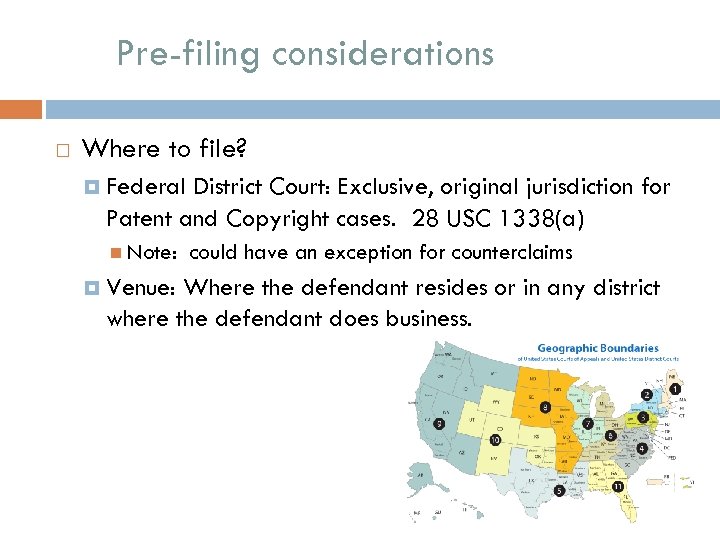 Pre-filing considerations Where to file? Federal District Court: Exclusive, original jurisdiction for Patent and Copyright cases. 28 USC 1338(a) Note: Venue: could have an exception for counterclaims Where the defendant resides or in any district where the defendant does business.
 Pre-filing considerations (cont. ) Jury or non-jury Nature and type of work involved Extent of copying Parties involved Registration certificate in hand? Certificate of registration is now a procedural prerequisite If registration is sought but refused serve complaint on Copyright office
 Proving your case Exclusive rights Ownership Access by defendant Substantial similarity of work Damages, if any Should you use an expert? Depends Should you use surveys?
 Defenses Fair Use See above Must be pled as an affirmative defense For computer programs Implied License Can be orally granted for non-exclusive grant Elements Right to make archival copy Right to dissect programs to determine functional interface Author creates for another Author delivers the work Author intends that party distribute and/or copy SOL (3 yrs. ) and/or laches Lack of Notice Fraud on the Copyright Office Misuse Parody Satire not necessarily a defense
 Remedies Damages- at option of copyright owner: Actual damages and profits made by infringer that are not taken into account in calculating actual damages. To establish an infringer’s profits, the copyright owner is required to present proof only of the infringer's gross revenue, and the infringer is required to prove his or her deductible expenses and the elements of profit attributable to factors other than the copyrighted work OR Statutory damages of $750 to $30, 000 for each infringement (court’s discretion as to actual amount). Can be increased to $150, 000 per infringement if the infringement was committed willfully.
 Other Remedies Injunction Seizure, impoundment and destruction of infringing goods Criminal offenses Attorney’s fees and costs
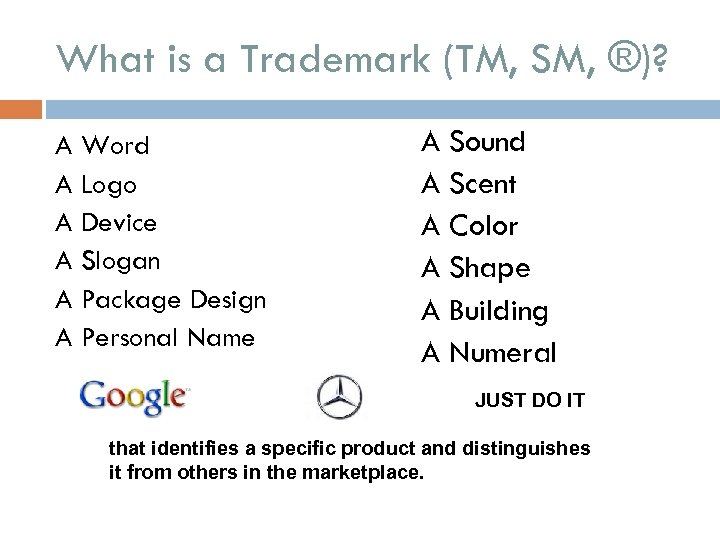 What is a Trademark (TM, SM, ®)? A Word A Logo A Device A Slogan A Package Design A Personal Name A Sound A Scent A Color A Shape A Building A Numeral JUST DO IT that identifies a specific product and distinguishes it from others in the marketplace.
 Functions of a Trademark - Indicates the source or origin of goods or services - Assures consumers of the quality of goods bearing the mark - Creates business goodwill and brand awareness
 Trademark v. Tradename Trade name: identifies a company or business; for example, The Coca-Cola Company Trademark: identifies the goods or services of that company; for example, Diet Coke Note: Just because the secretary of state's office advises that a corporate name is available, that does NOT mean that the same name is available as a trademark or service mark.
 How are Trademark rights obtained? Rights are obtained either: - By use; or - By registration
 Common Law Rights v. Registration Common Law Bound by the geographic area in which the product or service is marketed. Protection generally begins only after the product or service is actually available for sale on the market. Rights can be lost after deciding on a mark and before bringing a product to market if someone begins commercial sales first. Federal Registration • Valid in the whole country Priority based on date of application “Intent to Use” application allows applying for a mark before using it Gives trademark owners the ability to expand at their own pace
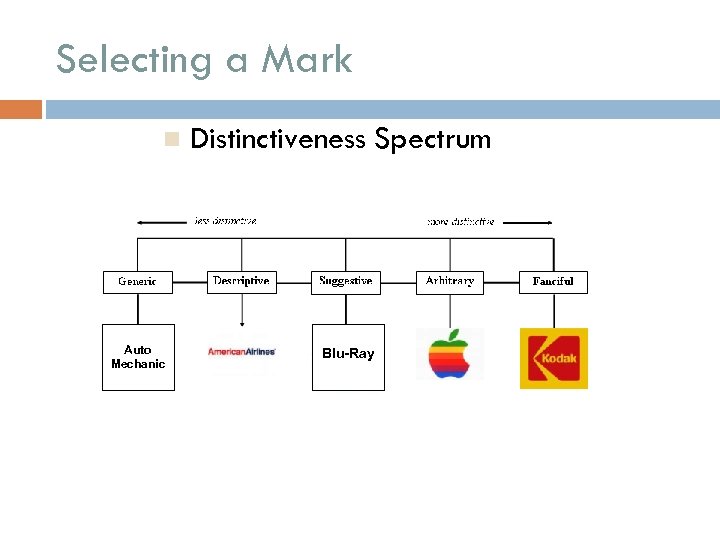 Selecting a Mark Auto Mechanic Distinctiveness Spectrum Blu-Ray
 Selecting a Mark Two Common Errors: Selecting Failing descriptive marks to “clear” the mark
 Selecting the Right Trademark The Strongest Type An invented word: GEICO The Weakest Type Immediately descriptive: Quality Cars
 Clearance of the Mark – WHY? To reduce the likelihood of infringement To gauge the strength of the mark Weak? Dilute?
 Trademark Availability A trademark is not available if: The mark or a confusingly similar mark is already federally registered or is the subject of a pending federal registration (assuming that the application is ultimately accepted); or The mark or a confusingly similar mark is already being used in the same market in connection with similar goods or services.
 How are Trademark rights obtained? Rights are obtained either: - By use; or By registration: Majority – first to file vs. first to use Some of the major commercial countries – first to file France Germany Japan Taiwan Spain United States – based on use Does allow for intent to use applications though
 Select Territories for Registration Trademark rights are territorial. Some regional systems exist: Community Trade Mark (Europe 27 member states) OAPI (Africa) Madrid Protocol – International filing system, but still depends on approval at the national level by the 57 member countries Select registration in countries in which the company will manufacture, distribute and/or license its mark United States – Trademark rights extend only to the areas in which a market presence has been established. United States – Presumption of exclusive rights through federal registration
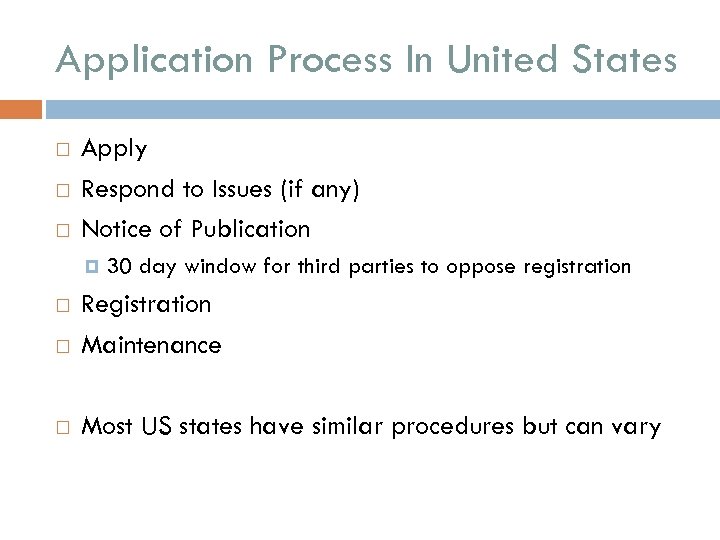 Application Process In United States Apply Respond to Issues (if any) Notice of Publication 30 day window for third parties to oppose registration Registration Maintenance Most US states have similar procedures but can vary
 Maintaining a Registration Continued Use Renewals Declaration of Use between year 5 and 6 Declaration of Use and Application for Renewal between year 9 and 10 and each 10 years thereafter Policing - Third parties’ unauthorized use Improper use by your own company Improper use by licensees
 Policing: Enforcement against Infringers Finding the bad guys Subscribe to Watch Services Internet Searches
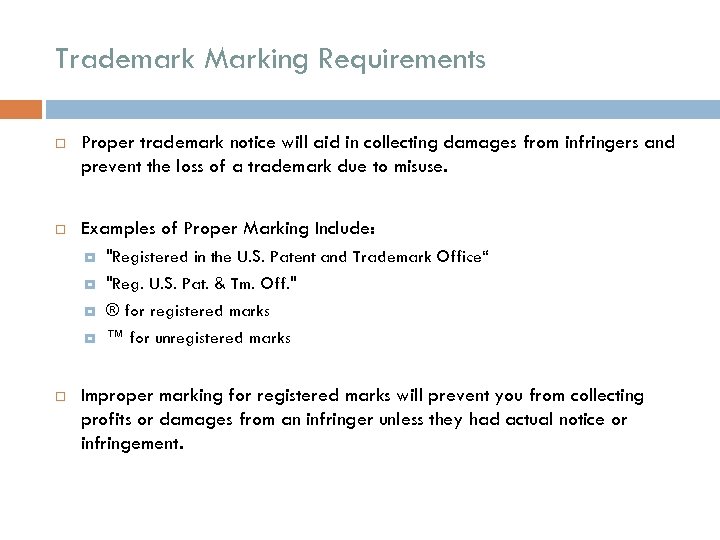 Trademark Marking Requirements Proper trademark notice will aid in collecting damages from infringers and prevent the loss of a trademark due to misuse. Examples of Proper Marking Include: "Reg. U. S. Pat. & Tm. Off. " ® for registered marks "Registered in the U. S. Patent and Trademark Office“ ™ for unregistered marks Improper marking for registered marks will prevent you from collecting profits or damages from an infringer unless they had actual notice or infringement.
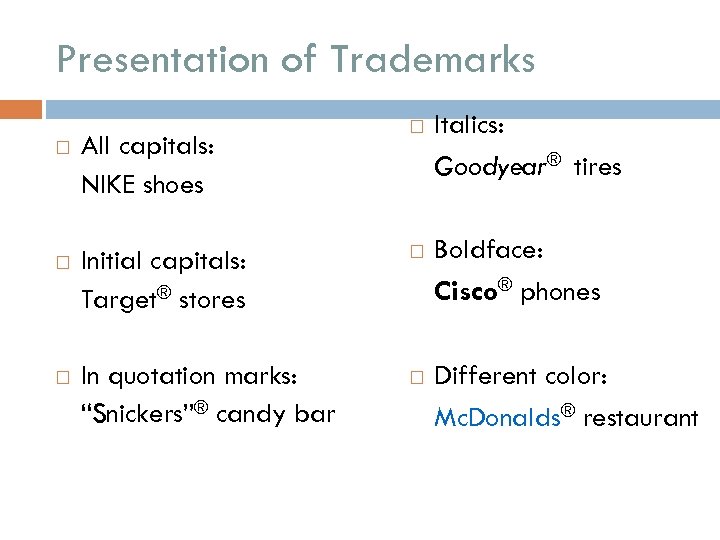 Presentation of Trademarks Italics: Goodyear® tires All capitals: NIKE shoes Initial capitals: Target® stores Boldface: Cisco® phones In quotation marks: “Snickers”® candy bar Different color: Mc. Donalds® restaurant
 Trademarks Should Not Be Altered Trademarks should always be presented in the same manner; be consistent No plurals (no: “two cokes”, “yes two coke soft drinks”) Do not use as verbs (please Xerox this) No possessive tense unless trademark itself is possessive (no Febreze’s fresh scent; yes the Febreze® spray’s fresh scent)
 Types of Relief Available for Registered Marks Opposition proceedings Cancellation proceedings Injunctive relief, corrective advertising, an account of profits, actual damages, statutory damages and/or attorneys’ fees UDRP claims Criminal penalties for trademark counterfeiting
 Relief for Unregistered Trademarks Based on common law rights: Federal and State Lanham Act 15 USC 1125 “Unfair Competition, ” “Passing Off, ” “Palming Off, ” “False Designation of Origin, ” “Dilution” Test: If consumers would be misled or Confused Use of Copyright Law
 Loss of Trademark Rights Genericide • Improper licensing Improper assignment • Failure to police Failure to comply with registered user requirements where required (statements of use, renewals, etc. ) Non-use • Cancellation
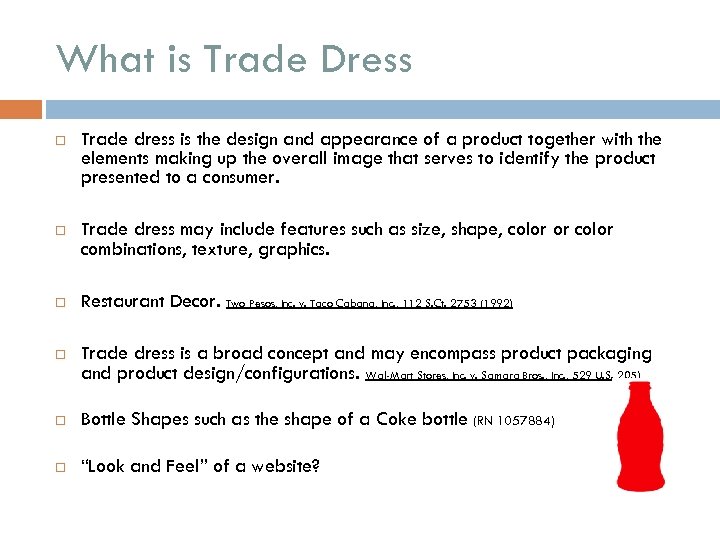 What is Trade Dress Trade dress is the design and appearance of a product together with the elements making up the overall image that serves to identify the product presented to a consumer. Trade dress may include features such as size, shape, color or color combinations, texture, graphics. Restaurant Decor. Two Pesos, Inc. v. Taco Cabana, Inc. , 112 S. Ct. 2753 (1992) Trade dress is a broad concept and may encompass product packaging and product design/configurations. Wal-Mart Stores, Inc. v. Samara Bros. , Inc. , 529 U. S. 205) Bottle Shapes such as the shape of a Coke bottle (RN 1057884) “Look and Feel” of a website?
 What is Not Trade Dress Items that do not have “secondary meaning” Methods of Doing Business (potentially protectable under patent law) Trade Secrets (proprietary information kept confidential by a company) Copyrightable Materials Trademarks
 Protectable Elements of Trade Dress Only “distinctive” aspects can be protected and can only develop “distinctiveness” through gaining secondary meaning through use in the market. “Secondary Meaning” is a term of art and refers to distinctiveness that has been acquired over time through use, marketing, advertising, etc.
 Protecting Against Trade Dress Infringement Trade dress may be registered with the USPTO if it satisfies the federal standards of trademark or service mark protection. Trade dress infringement is grounds for a civil action regardless of whether trade dress is registered. If the trade dress is unregistered the burden to show that the trade dress is protectable is on the owner. Types of relief available are similar to those available for trademark infringement
 Trademark or Trade dress litigation Pre-filing considerations and issues Subject matter jurisdiction Venue Concurrent with states Usual rules Who can sue? Manufacturer or provider of goods and services Exclusive licensee Non-exclusive licensee cannot sue What COA’s will be asserted? Is the mark now incontestable? How long has the defendant used the accused mark? Contributory infringement claim at issue? Tiffany v. e. Bay – for service provider to be liable, must have more than general knowledge that service is being used to sell counterfeit goods.
 Defenses No likelihood of confusion Fraud on the Trademark office Mark has been abandoned Misrepresenting source of goods/services Descriptiveness Mark is functional Antitrust violations exists by use of mark Parody Equitable principles
 Recurring issues Descriptiveness as a defense Need to prove “secondary meaning” Evidence that the mark has some meaning to the public beyond the obvious meaning of the terms or images of the mark itself. In other words, the primary significance of the mark has become a source identifier. Proving likelihood of confusion Surveys Third party uses
 Proving Likelihood of confusion Factors G/S competing with each other Same distribution channels Intent to mislead by accused infringer Similar sound, appearance or connotation Consumer sophistication Strength of each mark Instances of actual confusion
 Oppositions and cancellations proceedings Before the Trademark Trial and Appeal Board (TTAB) Does not affect common law rights, if any TTAB decision is reviewable by the Federal Circuit if timely filed (60 days) Taking such an appeal waives certain rights
 Internet topics Domain names and Cybersquatting Uniform Dispute Resolution Policy (UDRP) Federal Anti-cybersquatting Act Digital Millennium Copyright Act (DMCA) New legislation coming?
 Domain Names and Disputes - ICANN Internet Corporation for Assigned Name and Numbers Non-Profit company created in 1998 and tasked with managing the assignment of top level domain names (TLDs) and IP addresses Until 2000, ICANN only allowed 7 TLDs Now companies can buy there own TLD for a hefty fee!
 Registration of a Domain Name Registrars Go. Daddy. com, Network. Solutions. com Cost Depends on whether Name is already owned Not Owned: Approximately $10. 00 for one year Already Owned: Bidding Process
 Examples of Applicable Law UDRP – Uniform Domain Name Dispute Resolution Policy Anticybersquatting Consumer Protection Act Policy Administrative Rules 15 U. S. C. § 1125(d) Pending Legislation SOPA, etc.
 UDRP The UDRP is a dispute resolution policy implemented by ICANN that applies to all. biz, . com, . info, . name, . net, and. org top-level domains as well as some country codes. Some countries will require that you go through WIPO for a resolution Governs disputes over domain names and is meant to be a streamlined process for resolving dispute more quickly and less expensively than would be possible with a standard legal challenge
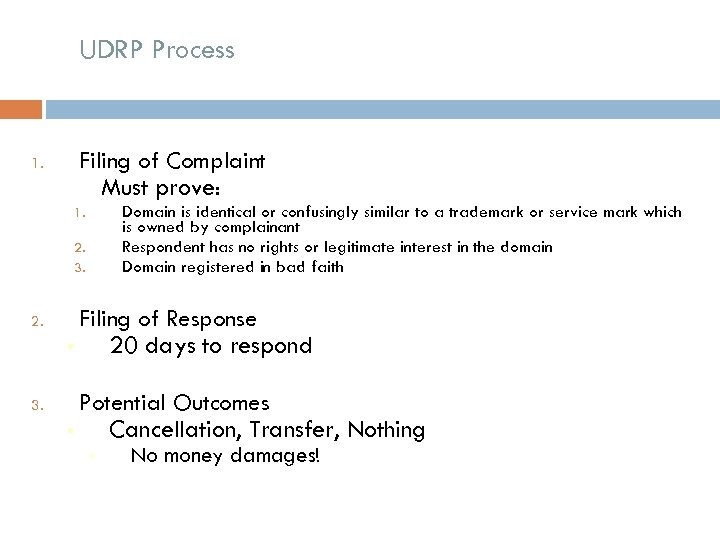 UDRP Process 1. Filing of Complaint Must prove: Domain is identical or confusingly similar to a trademark or service mark which is owned by complainant Respondent has no rights or legitimate interest in the domain Domain registered in bad faith 1. 2. 3. 2. 3. Filing of Response • 20 days to respond Potential Outcomes • Cancellation, Transfer, Nothing • No money damages!
 UDRP Additional Considerations Costs – One person v. three person panels Effect of Court Proceedings During pendency of hearing After decision rendered
 UDRP Real Life Example – madonna. com Facts: In 1998 a company purchased the domain name madonna. com from a third party owner for $20, 000. The purchaser began operating a pornographic website using the domain name. Complaint: Madonna, the entertainer, objected to this use and filed a complaint with WIPO Decision: The domain name is confusingly similar to a trademark “Madonna” in which the complainant has rights and registrant lacked a legitimate interest in the domain name because it was registered and used in bad faith Result: Domain Name was transferred to Madonna
 UDRP Conclusion In general the UDRP is a relatively quick and inexpensive process that can be used to resolve domain name disputes Transfer or cancellation only possible favorable outcomes Monetary damages unavailable Court proceedings can trump outcome
 Anticybersquatting Act Passed in 1999 and prohibits the “bad faith” registration of trademark infringing domain names and also applies to “bad faith” use of personal names. “Bad Faith” under Anticybersquatting Act defined more broadly than under UDRP Possible Outcomes include transfer of domain name, cancellation and monetary damages If trademark infringement found all remedies for trademark infringement are also available Unauthorized registration of a domain that is the same or confusingly similar to the personal name of a living person is prohibited if done for profit Downside is cost and expense to litigate
 Digital Millennium Copyright Act (DMCA) Digital Millennium Copyright Act Passed by the US Congress in 1998. Focuses on protection of electronic content. Covers many topics including anti-circumvention provisions to prevent circumvention of DRM software and safe harbor provisions to protect ISP’s from liability for copyright infringement Takedown procedure for ISPs Google
 Trade Secrets Becoming more popular form of protecting IP What is a trade secret? A trade secret is information that provides a business with a competitive advantage. Courts have provided trade secret protection to formulas, patterns, plans, designs, physical devices, processes, software, and “know-how. ” Please keep in mind that different courts may reach contrary conclusions concerning trade secret status with respect to what may appear to be identical matters.
 Examples of trade secrets Formula – Coca-Cola recipe Patterns, plans, or designs – schematics for an analog circuit Physical Device – machinery and equipment used to manufacture polyethylene Process – process to treat metal or to manufacture fiber glass “know how” – methods for testing procedures to assure the quality of a raw material
 Usual Factors to determining trade secret Is the information deemed to be a trade secret valuable to the business Is the information generally know or readily ascertainable? What steps have been taken top keep the information secret Restricting access to information Physical security Proprietary notices placed on all documents NDAs obtained from third parties To what extent do employees and others involved in the business know about the information
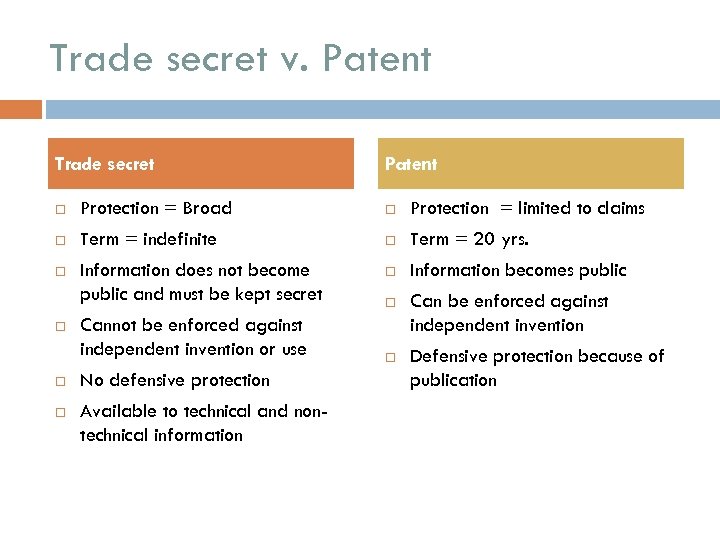 Trade secret v. Patent Trade secret Patent Protection = Broad Protection = limited to claims Term = indefinite Term = 20 yrs. Information does not become public and must be kept secret Information becomes public Can be enforced against independent invention Defensive protection because of publication Cannot be enforced against independent invention or use No defensive protection Available to technical and nontechnical information
 Misappropriation of trade secret Typically occurs when: Acquired, disclosed or used TS without permission of the holder, where such activities were done through improper means Must look to State statute for elements Remedies Exemplary Damages Attorneys fees and costs Injunction
 Ethical Considerations in IP Patents Trademarks Dealing with USPTO Copyrights Dealing with the USPTO Dealing with Library of Congress Litigation Dealing with Courts and opposing counsel
 Patents Power of Attorney filed with USPTO Power of attorney must be in writing and signed by a principal of the entity that owns the invention (37 CFR §§ 1. 31, 1. 32) Only inventors, or a registered patent attorney or patent agent may represent a party before the PTO in patent matters (37 CFR § 1. 31)
 Other patent considerations Representation of a client Who is the inventor? Who is the client? is the applicant? Representation of joint inventors
 Ownership issues for patents Handling the assignment Who owns the invention? Potential conflict of interest between inventor and employer Absence of contract requiring inventor(s) to assign invention
 Dealing with the USPTO – patent applications Both attorney and client owe a duty of Candor – to disclose known, material prior art (37 CFR § 1. 56) Declaration of Inventor (37 CFR § 1. 63) Information Disclosure Statement (37 CFR §§ 1. 97 – 1. 99) MPEP – Professionalism (37 CFR § 1. 3) Withdrawal from representation (37 CFR § 1. 36)
 Trademarks Representation before USPTO in Trademark Matters ((37 CFR § 11. 14) Power of Attorney (37 CFR § 2. 17(b)(1)(i)) Must be in writing and comply with PTO requirements (37 CFR § 2. 17(c)) The owner of an application or registration may appoint a practitioner through TEAS (Trademark Electronic Application System) for up to 20 applications or registrations that have identical owner name and attorney (37 CFR 2. 17(d)(1)) If filed on paper, there is no limit to the number of applications or registrations for which a practitioner may be authorized to represent the applicant or registrant
 Termination of Power of Attorney A power of attorney filed while an application is pending is deemed to end when the mark registers, when ownership of the application changes, or when the application is abandoned. A power of attorney filed after registration is deemed to terminate when the mark is cancelled or expired, or when ownership changes. If the power was filed in connection with an affidavit under Sec. 8, 12(c), 15 or 71 of the Trademark Act, renewal application under Sec. 9, or request for amendment or correction under Sec. 7, the power is deemed to end upon acceptance or final rejection of the filing.
 Termination of Power of Attorney (cont. ) Filing of a new power of attorney revokes the existing power. A written change of correspondence address does not revoke a power of attorney. A revocation of power of attorney may be signed by the applicant, registrant, or party to a proceeding; or by someone with legal authority to bind the applicant, registrant, or party. Withdrawal of attorney requires application to and approval by the Director or, upon motion, by the TTAB
 Affidavit of Use or of Continuing Use Required for Sec. 8 and 15 Declarations Required for Renewal Must not include goods or services that trademark owner is not selling If misstatement was intentional, fraud may be found Intent to deceive is required to establish fraud Standard of proof is clear and convincing evidence Registration will be cancelled if fraud is shown Mere negligence does not constitute fraud However, registration must be restricted to reflect commercial reality
 Dealing with the Copyright Office Accuracy of Copyright Registration Form Fraud on Copyright Office
 Litigation Rule 11 Pre-filing due diligence Discovery rules ESI Spoilation Local rules Representation to court Vexatious litigation Ethical rules and professionalism
 Thank You! Questions?