


 Скачать презентацию Intellectual property in the United Kingdom Creations
intellectual property 1.pptx
- Количество слайдов: 11
 Intellectual property in the United Kingdom
 Creations of the mind that provide exclusive called Intellectual Property. It lets people own the work they create. As an example, it may be musical, literary, and artistic works; discoveries and inventions; words, phrases, symbols, and designs. These exclusive rights allow owners of intellectual property to benefit from the property they have created, providing a financial incentive for the creation of an investment in intellectual property, and, in case of patents, pay associated research and development costs.
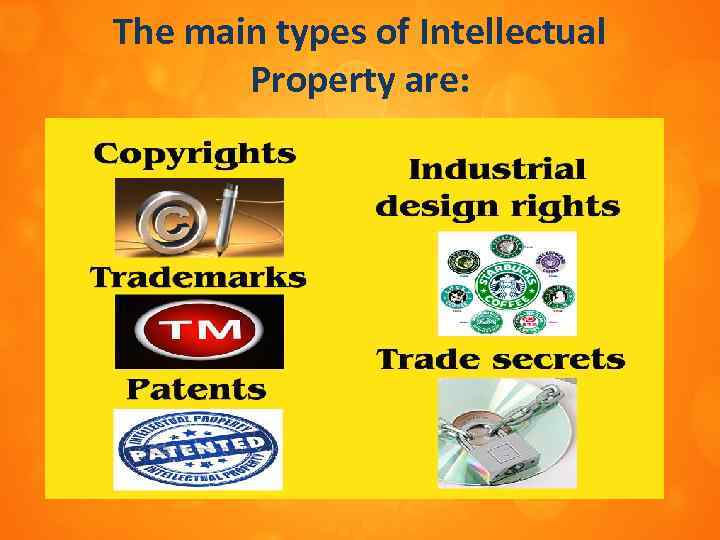 The main types of Intellectual Property are:
 • In the UK there is a government body responsible for intellectual property rights. It is called Intellectual Property Office. • It is an executive agency of the Department for Business, Innovation and Skills. Some work on copyright policy is shared with the Department of Culture, Media and Sport and plant breeders' rights are administered by the Plant Variety Rights Office, an agency of the Department for Environment, Food and Rural Affairs. • Intellectual Property Office also has responsibility for examining and issuing or rejecting patents, and maintaining registers of intellectual property including patents, designs and trade marks in the UK.
 • One of the documents which Intellectual Property Office uses is Copyright law of the United Kingdom. • The Act provides that an individual's work is automatically under copyright, by operation of law, as soon as it leaves his mind and is embodied in some physical form: be it a novel, a painting, a musical work written in manuscript, or an architectural schematic.
 Intellectual Property Office deals with 4 kinds of intellectual property: Patents Designs Trade marks Copyright
 What is a patent? A patent protects new inventions and covers how things work, what they do, how they do it, what they are made of and how they are made. It gives the owner the right to prevent others from making, using, importing or selling the invention without permission. • • Your invention must: be new have an inventive step that is not obvious to someone with knowledge and experience in the subject be capable of being made or used in some kind of industry not be: a scientific or mathematical discovery, theory or method; a literary, dramatic, musical or artistic work; a way of performing a mental act, playing a game or doing business; the presentation of information, or some computer programs; an animal or plant variety; a method of medical treatment or diagnosis; against public policy or morality.
 What is a Registered Design? • A Registered Design is a legal right which protects the overall visual appearance of a product or a part of a product in the country or countries you register it. • For the purposes of registration, a design is legally defined as being "the appearance of the whole or part of a product resulting from the features of, in particular, the lines, contours, colours, shape, texture or materials of the product or ornamentation”. • A Registered Design can be a valuable intellectual property right. It can form the basis of an infringement action against other parties, and will help you in stopping others from creating designs which are too similar to your own (within the same geographical area you have protected your design). • For its registration to be valid, a design must: a) be new b) have individual character.
 What is a trade mark (or brand)? • A trade mark is a sign which can distinguish your goods and services from those of your competitors (you may refer to your trade mark as your "brand"). It can be for example words, logos or a combination of both. The only way to register your trade mark is to apply to The Intellectual Property Office. • You can use your trade mark as a marketing tool so that customers can recognise your products or services. • Trade marks are acceptable if they are: distinctive for the goods and services you provide. In other words they can be recognised as signs that differentiates your goods or service as different from someone else's.
 What is a copyright? Copyright is an automatic right which applies when the work is fixed, that is written or recorded in some way. Copyright can protect: * literary works, including novels, instruction manuals, computer programs, song lyrics, newspaper articles and some types of database * dramatic works, including dance or mime musical works * artistic works, including paintings, engravings, photographs, sculptures, collages, architecture, technical drawings, diagrams, maps and logos * layouts or typographical arrangements used to publish a work, for a book for instance * recordings of a work, including sound and film * broadcasts of a work Copyright does not protect ideas for a work. It is only when the work itself is fixed, for example in writing, that copyright automatically protects it. This means that you do not have to apply for copyright.
 Breaking intellectual property laws is a crime. If you own an intellectual property (IP) right such as a copyright, design, patent or trade mark, then others can not manufacture, use, sell or import it without prior permission. Any counterfeiting is forbidden. Examples of counterfeiting could include, fake: – clothing – footwear – handbags – pharmaceuticals (trade mark crime). The unauthorised use of your IP is a criminal offence in some instances and can lead to prosecution under Section 92 of the Trade Mark Act in relation to Trade Mark infringement, and Sections 107 A and 198 of the Copyright, Design, and Patent Act in relation to Copyright infringement.