 Скачать презентацию Integration of Security and Fire with BAS Putting
32b2852379b17df906347dc66f53341e.ppt
- Количество слайдов: 20



Integration of Security and Fire with BAS: Putting More Information to Effective Use Frost & Sullivan April 27 th 2005 Sapan Agarwal
Introduction Integration of Security and Fire with BAS: Putting More Information to Effective Use • This presentation is designed to outline a wider group of research services by Frost & Sullivan which combine research in the building automation systems (BAS) market by our dedicated Building Technologies Group • It covers issues and concerns pertaining to integration across market verticals, including HVAC; Fire and Life Safety; & Building Security markets • The purpose of today’s briefing is to respond to the great increase in interest by the BAS community and beyond, to the proven potential of integrated systems Copyright Frost & Sullivan 2005
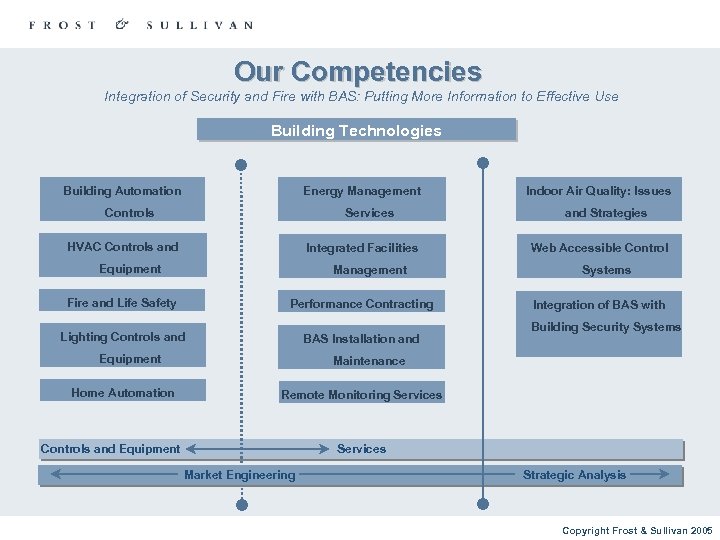
Our Competencies Integration of Security and Fire with BAS: Putting More Information to Effective Use Building Technologies Building Automation Energy Management Controls Services HVAC Controls and Integrated Facilities Equipment Management Fire and Life Safety Performance Contracting Lighting Controls and BAS Installation and Equipment Home Automation Indoor Air Quality: Issues and Strategies Web Accessible Control Systems Integration of BAS with Building Security Systems Maintenance Remote Monitoring Services Controls and Equipment Services Market Engineering Strategic Analysis Copyright Frost & Sullivan 2005
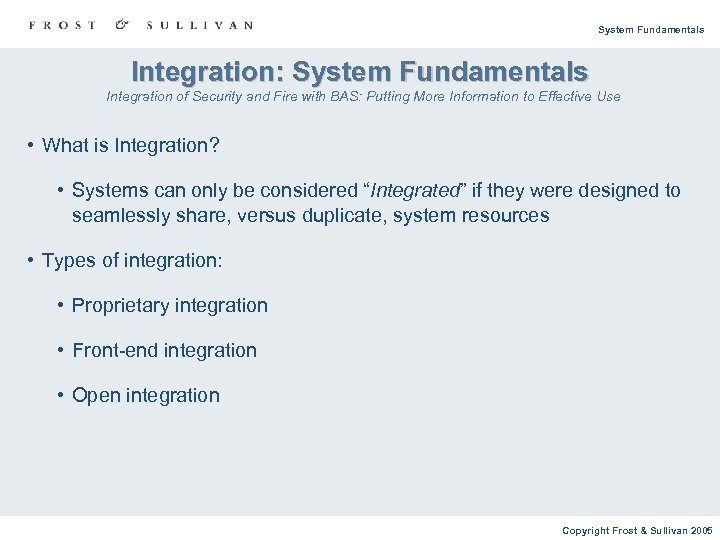
System Fundamentals Integration: System Fundamentals Integration of Security and Fire with BAS: Putting More Information to Effective Use • What is Integration? • Systems can only be considered “Integrated” if they were designed to seamlessly share, versus duplicate, system resources • Types of integration: • Proprietary integration • Front-end integration • Open integration Copyright Frost & Sullivan 2005
System Fundamentals Interfacing: System Fundamentals Integration of Security and Fire with BAS: Putting More Information to Effective Use • What is Interfacing? • Where two previously stand-alone systems are interfaced to each other via software and two-way communications to share data and commands • Types of integration: • Custom interfaces • Bundled custom interfaces • Front-end interfaces • Open interfaces Copyright Frost & Sullivan 2005
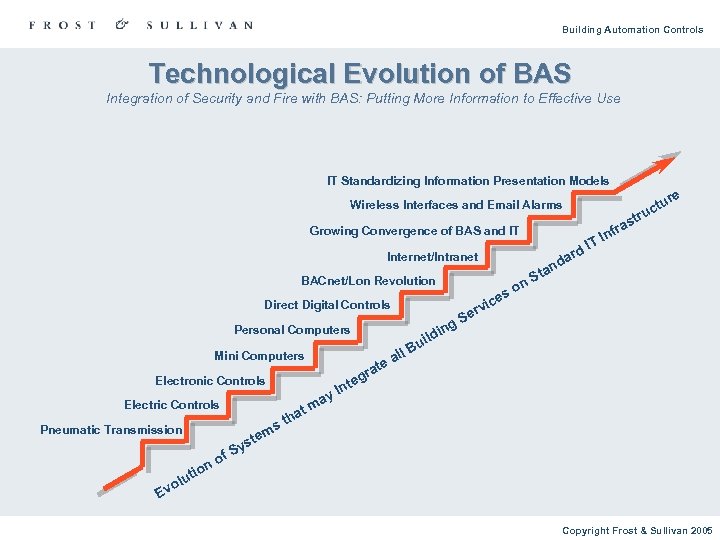
Building Automation Controls Technological Evolution of BAS Integration of Security and Fire with BAS: Putting More Information to Effective Use IT Standardizing Information Presentation Models re Wireless Interfaces and Email Alarms Growing Convergence of BAS and IT Internet/Intranet BACnet/Lon Revolution Direct Digital Controls Personal Computers Mini Computers Electronic Controls Electric Controls Pneumatic Transmission t tem ys f. S ha st y ma te gra nte ui ll B a ng ldi S rd da st IT ra Inf tu uc r n Sta n so ce i erv I no Ev io lut o Copyright Frost & Sullivan 2005
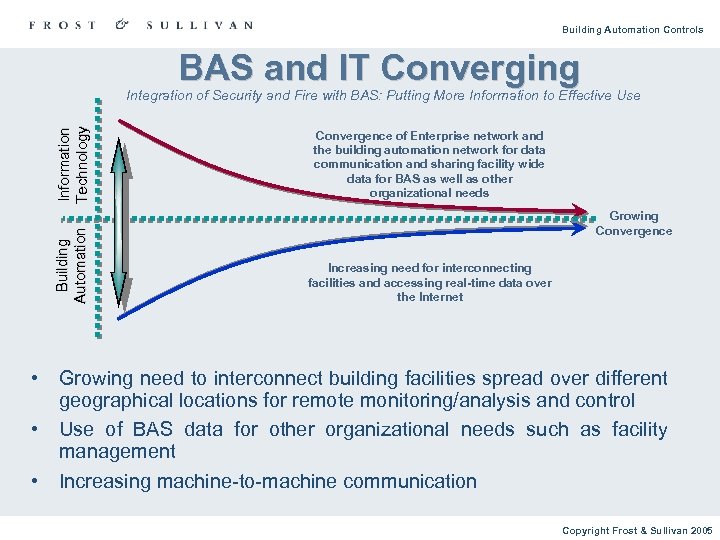
Building Automation Controls BAS and IT Converging Building Automation Information Technology Integration of Security and Fire with BAS: Putting More Information to Effective Use • • • Convergence of Enterprise network and the building automation network for data communication and sharing facility wide data for BAS as well as other organizational needs Growing Convergence Increasing need for interconnecting facilities and accessing real-time data over the Internet Growing need to interconnect building facilities spread over different geographical locations for remote monitoring/analysis and control Use of BAS data for other organizational needs such as facility management Increasing machine-to-machine communication Copyright Frost & Sullivan 2005
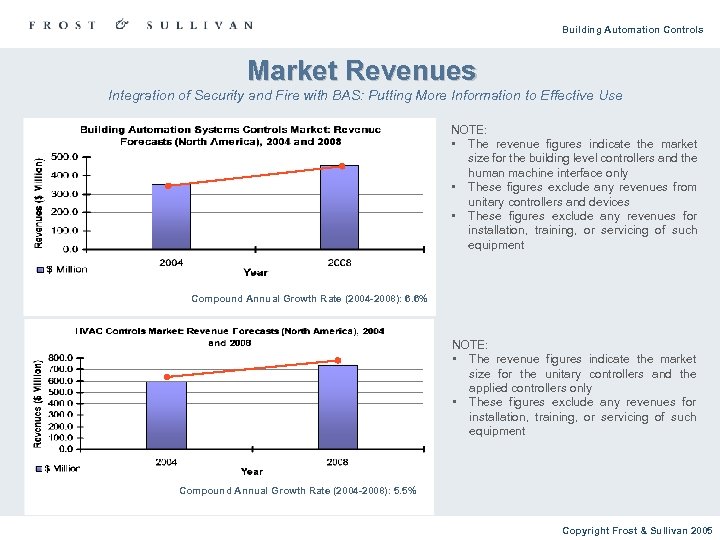
Building Automation Controls Market Revenues Integration of Security and Fire with BAS: Putting More Information to Effective Use NOTE: • The revenue figures indicate the market size for the building level controllers and the human machine interface only • These figures exclude any revenues from unitary controllers and devices • These figures exclude any revenues for installation, training, or servicing of such equipment Compound Annual Growth Rate (2004 -2008): 6. 6% NOTE: • The revenue figures indicate the market size for the unitary controllers and the applied controllers only • These figures exclude any revenues for installation, training, or servicing of such equipment Compound Annual Growth Rate (2004 -2008): 5. 5% Copyright Frost & Sullivan 2005
Building Security Time to Integrate Network and Building Security Integration of Security and Fire with BAS: Putting More Information to Effective Use • Fastest growing markets are physical security, biometrics and radio frequency identification (RFID) in the automatic identification sector • Businesses must realize the importance of integrating physical and digital security in the workplace by accepting that security is a single issue – rather than breaking it down in terms of digital and physical security • Facilities access makes the security of IT systems vulnerable. As per industry feedback, approximately 70. 0 percent of data theft from a company is physical theft • The need to cut costs is another driving factor for this convergence. Integration of the budgets for physical and IT security can deliver substantial efficiencies • The efficiencies become even more compelling when a common data repository is used for all identity related information Copyright Frost & Sullivan 2005
Building Security Moving Towards IP Centric Platform Integration of Security and Fire with BAS: Putting More Information to Effective Use • Digital age is ushering in a convergence of voice, data and video • “How” the information is stored and retrieved is becoming more important than “Where” it is stored • Security providers can use this information to provide additional services: • Supervision • Email notification • Browser interfaces • Audio/video • Up/download common configuration databases on the network Copyright Frost & Sullivan 2005
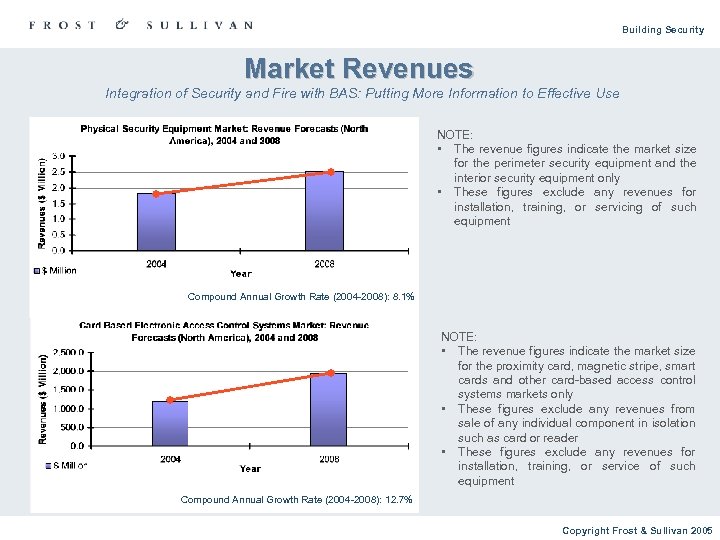
Building Security Market Revenues Integration of Security and Fire with BAS: Putting More Information to Effective Use NOTE: • The revenue figures indicate the market size for the perimeter security equipment and the interior security equipment only • These figures exclude any revenues for installation, training, or servicing of such equipment Compound Annual Growth Rate (2004 -2008): 8. 1% NOTE: • The revenue figures indicate the market size for the proximity card, magnetic stripe, smart cards and other card-based access control systems markets only • These figures exclude any revenues from sale of any individual component in isolation such as card or reader • These figures exclude any revenues for installation, training, or service of such equipment Compound Annual Growth Rate (2004 -2008): 12. 7% Copyright Frost & Sullivan 2005
Fire and Life Safety Fire Alarm Panels: Are We There As Yet? Integration of Security and Fire with BAS: Putting More Information to Effective Use • Fire is a regulated, code driven business. Interference of any other system with fire is being controlled by the governing agencies like NFPA to make it fail safe as versus fail secure • Interfacing of fire alarm systems with BAS and other building safety systems is on the rise • Audibility and intelligibility issues are enhancing the protection being provided by voice evacuation systems • Distributed intelligence with peer to peer network is being preferred as it offers better survivability for the systems • In a trend towards open and multiple protocols, end-users are asking for program and access codes to integrate two panels of different makes Copyright Frost & Sullivan 2005
Fire and Life Safety Fire Alarm Panels: Are We There As Yet? (2) Integration of Security and Fire with BAS: Putting More Information to Effective Use • Inherent barriers such as regulations, codes and mandates, and embedded industry practices inhibit the introduction of new technologies • Fire are passive systems with no user interaction required while security systems are highly interactive. This generates inherent conflicts in integration • The fire equipment manufacturers prefer a very clear demarcation between the fire and the other building systems • Although the fire industry is open to interface their systems at the island level yet it is not embracing the concept because flawed integration may compromise on the reliability of fire systems Copyright Frost & Sullivan 2005
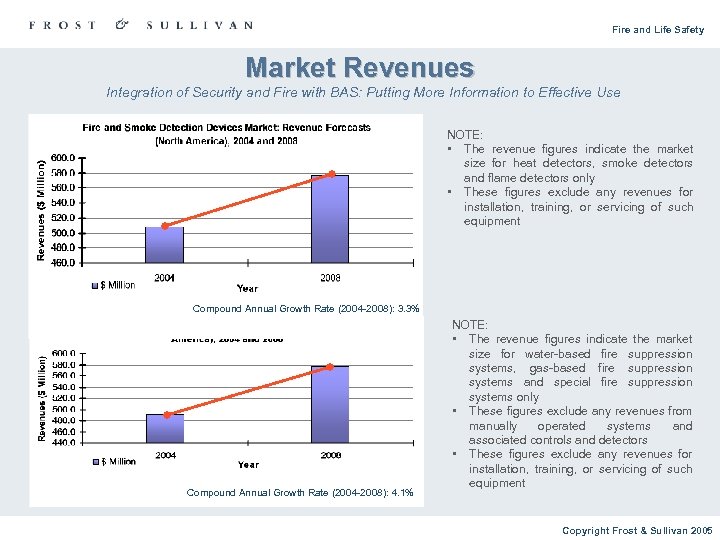
Fire and Life Safety Market Revenues Integration of Security and Fire with BAS: Putting More Information to Effective Use NOTE: • The revenue figures indicate the market size for heat detectors, smoke detectors and flame detectors only • These figures exclude any revenues for installation, training, or servicing of such equipment Compound Annual Growth Rate (2004 -2008): 3. 3% Compound Annual Growth Rate (2004 -2008): 4. 1% NOTE: • The revenue figures indicate the market size for water-based fire suppression systems, gas-based fire suppression systems and special fire suppression systems only • These figures exclude any revenues from manually operated systems and associated controls and detectors • These figures exclude any revenues for installation, training, or servicing of such equipment Copyright Frost & Sullivan 2005
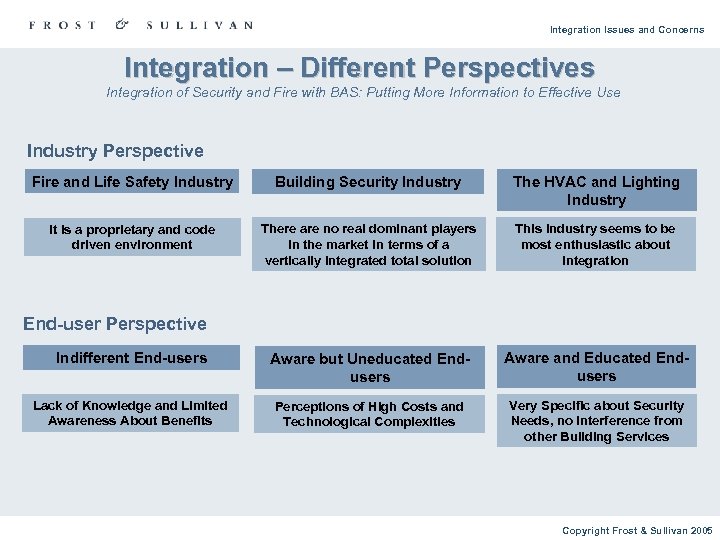
Integration Issues and Concerns Integration – Different Perspectives Integration of Security and Fire with BAS: Putting More Information to Effective Use Industry Perspective Fire and Life Safety Industry Building Security Industry The HVAC and Lighting Industry It is a proprietary and code driven environment There are no real dominant players in the market in terms of a vertically integrated total solution This industry seems to be most enthusiastic about integration Indifferent End-users Aware but Uneducated Endusers Aware and Educated Endusers Lack of Knowledge and Limited Awareness About Benefits Perceptions of High Costs and Technological Complexities Very Specific about Security Needs, no Interference from other Building Services End-user Perspective Copyright Frost & Sullivan 2005
Integration Issues and Concerns Key Trends and Challenges Integration of Security and Fire with BAS: Putting More Information to Effective Use • Accessibility to enormous information to be used in diverse applications across facilities promising growth for integration • Quick return on investments attributed to shared resources such as wiring, common databases etc. driving demands • Lack of specifications for integrated systems challenges consulting engineers to recommend integrated systems • Lack of standardization of data to be exchanged slowing growth of the market • Apprehensions of IT personnel about level of network security discouraging integration potential Copyright Frost & Sullivan 2005
Integration Issues and Concerns Road Map – The Integration Nirvana Integration of Security and Fire with BAS: Putting More Information to Effective Use • To view the roadmap for integration that lies ahead, it must be first understood that each building control system is made of the same basic computing hardware and software operating system • If the systems can be driven by the IT standards, integration capabilities may be taken to the next higher level • However, this is not likely to happen in a big way anytime soon for the simple reason that the present world is organized in a way where different industries (HVAC, lighting, security and fire) prefer to protect their own personal spaces • Also, integration may not be financially viable in legacy systems and older buildings. The building owners may not even be motivated to attempt such a venture • As a result, for a long time the focus for integration may continue to be new construction or major retrofit projects Copyright Frost & Sullivan 2005
Competitive Analysis How can Companies Grow in this Market? Integration of Security and Fire with BAS: Putting More Information to Effective Use • Provide complete technical solutions • Educate end-users on potential benefits of integration • Adhere to open systems and common standards for communication • Acquire, merge or partner with existing participants in different verticals Examples: • Carrier Corporation, a subsidiary of United Technologies Corporation acquired Automated Logic Corporation, April, 2004 • Schneider Electric acquired TAC in June, 2003 followed by acquisition of Andover Controls, August, 2004 • General Electric Corporation acquired Edwards Systems Technology, November, 2004 • Honeywell acquired Novar plc, December, 2004, Novar plc had acquired Alerton, March, 2003 • Richards-Zeta Building Intelligence, Inc. , Panduit and Cisco Systems, Inc. , entered into a collaborative effort for delivering complete IP centric solutions, February, 2005 Copyright Frost & Sullivan 2005
Relevant Research Services Integration of Security and Fire with BAS: Putting More Information to Effective Use • Published Research: • North American Building Automation Systems Protocols Analysis (Q 2, 2005) • Strategic Analysis: Integration of Building Security Systems with BAS • Strategic Analysis of the North American Web Accessible Control Systems Markets • North American BAS Controls Markets • North American Fire Alarm Equipment Markets • North American Fire Suppression Systems Markets • North American Lighting Controls Markets • End User Analysis • Custom Research Copyright Frost & Sullivan 2005

Contact Details Sapan Agarwal Michael Poole Program Leader Account Manager Building Technologies Environment and BT e) sapan_agarwal@frost. com p) 210. 247. 3842 e) mike. poole@frost. com Tolu Babalola Molly Norton NA Corporate Communications Account Manager p) 210 -477 -8427 Environment e) tolu. babalola@frost. com p) 210. 247. 2410 e) molly. norton@frost. com Copyright Frost & Sullivan 2005
Скачать презентацию Integration of Security and Fire with BAS Putting
32b2852379b17df906347dc66f53341e.ppt