


 Скачать презентацию Integration of micro CHP units Dr Jacques Deuse
a7830024999b0bcd4522c13302947d45.ppt
- Количество слайдов: 16
 Integration of micro CHP units Dr. Jacques Deuse Technical Director of EU-DEEP Project May 29 -30 2008 Micro CHP Workshop Paris
 29 -30 May 2008 Presentation outline ● The EU-DEEP Project ● Energy context, from “vertical integration” to open market ● Subset of questions from the EU-DEEP Project ● Distribution network design criteria ● The updated “fit & forget” principle ● Regulation of distribution network ● “Flexible” micro CHP ● Losses ● Conclusions 2
 29 -30 May 2008 The EU-DEEP Project A demand-pull approach ● Selection of the best market segments ● Choice of the best suited technology ● Integration into the system ● Solutions for Technical questions ● Then Market & Regulatory aspects ● Integration into the market ● Potential role of Information & Computer Technology ● Market access via “Local Trading Strategy” ● Integration of DER & LTS solutions ● Coordinating DER controller and LTS operation ● 5 one year test campaigns for l l 2 site tests and 3 aggregation experiments ● Economical optimisation via business models 3
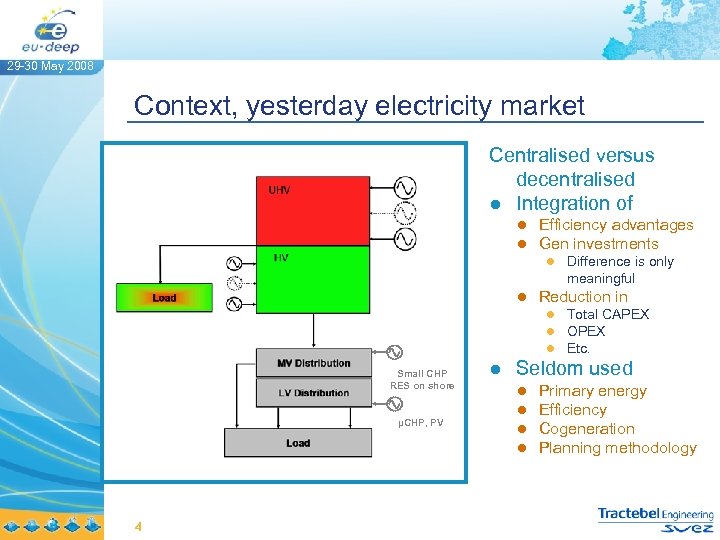 29 -30 May 2008 Context, yesterday electricity market Centralised versus decentralised ● Integration of ● Efficiency advantages ● Gen investments l Difference is only meaningful ● Reduction in l l l Small CHP RES on shore µCHP, PV 4 Total CAPEX OPEX Etc. ● Seldom used ● ● Primary energy Efficiency Cogeneration Planning methodology
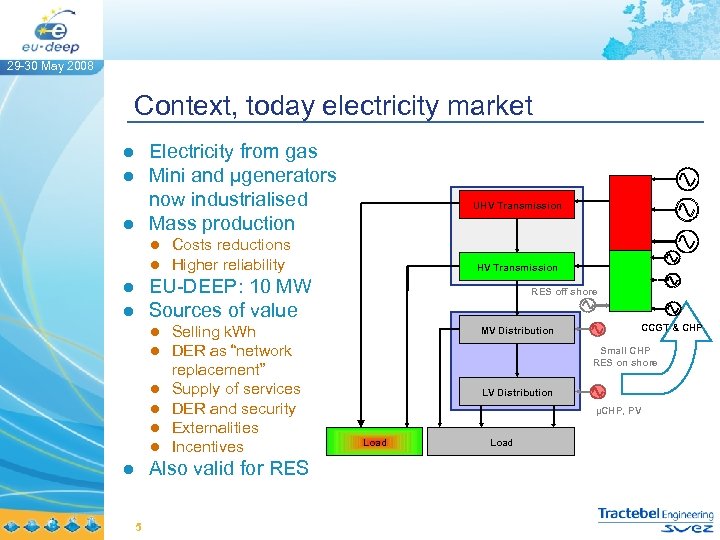 29 -30 May 2008 Context, today electricity market ● Electricity from gas ● Mini and µgenerators now industrialised ● Mass production UHV Transmission ● Costs reductions ● Higher reliability HV Transmission ● EU-DEEP: 10 MW ● Sources of value RES off shore ● Selling k. Wh ● DER as “network ● ● replacement” Supply of services DER and security Externalities Incentives ● Also valid for RES 5 MV Distribution CCGT & CHP Small CHP RES on shore LV Distribution µ µCHP, PV Load
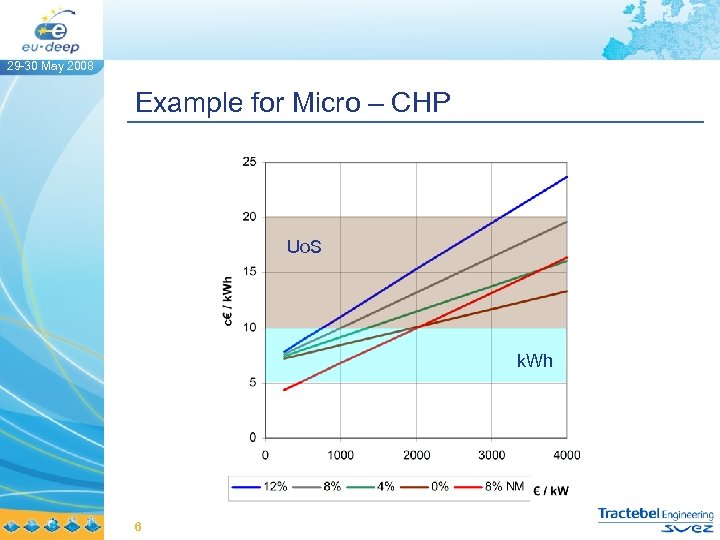 29 -30 May 2008 Example for Micro – CHP Uo. S k. Wh 6
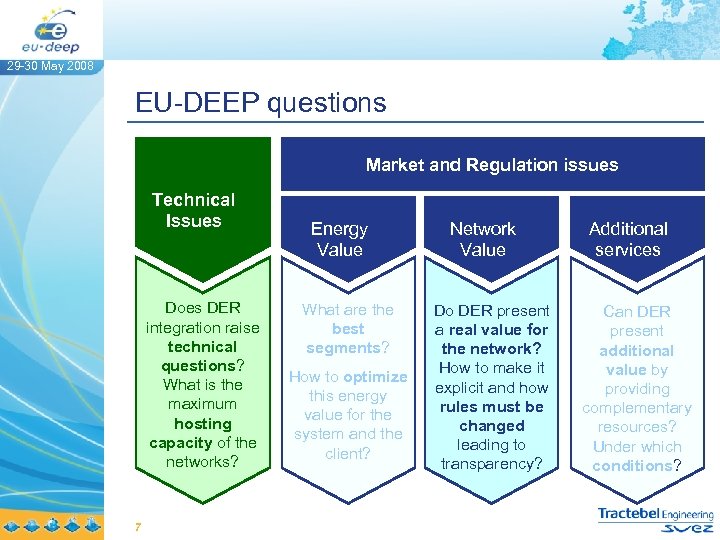 29 -30 May 2008 EU-DEEP questions Market and Regulation issues Technical Issues Does DER integration raise technical questions? What is the maximum hosting capacity of the networks? 7 Energy Value What are the best segments? How to optimize this energy value for the system and the client? Network Value Do DER present a real value for the network? How to make it explicit and how rules must be changed leading to transparency? Additional services Can DER present additional value by providing complementary resources? Under which conditions?
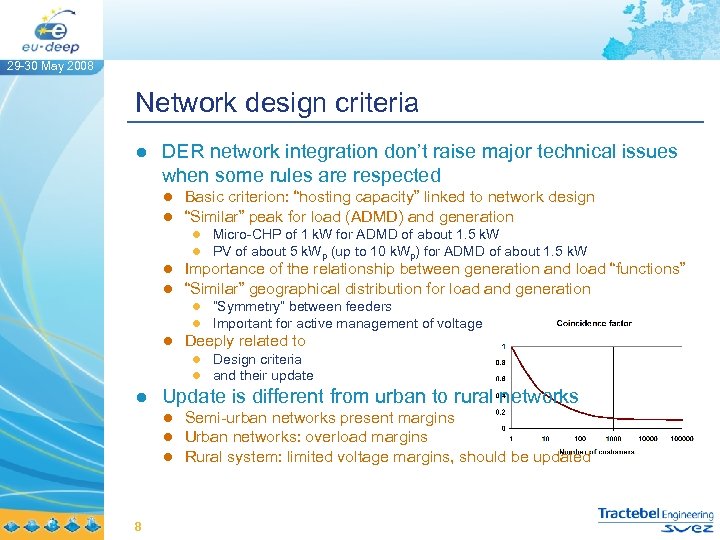 29 -30 May 2008 Network design criteria ● DER network integration don’t raise major technical issues when some rules are respected ● Basic criterion: “hosting capacity” linked to network design ● “Similar” peak for load (ADMD) and generation l l Micro-CHP of 1 k. W for ADMD of about 1. 5 k. W PV of about 5 k. Wp (up to 10 k. Wp) for ADMD of about 1. 5 k. W l l “Symmetry” between feeders Important for active management of voltage l l Design criteria and their update ● Importance of the relationship between generation and load “functions” ● “Similar” geographical distribution for load and generation ● Deeply related to ● Update is different from urban to rural networks ● Semi-urban networks present margins ● Urban networks: overload margins ● Rural system: limited voltage margins, should be updated 8
 29 -30 May 2008 Design, generation & load diversity ● PV in California ● ● ● Peak generation during hot weather Peak consumption due to HVAC at about 3 pm Adjusted PV orientation for synchronous peak generation High value as network replacement & as loss reduction Justifying “some” net metering Still, pending questions about design (k. Wpeak) ● PV in northern Europe ● ● ● No or few HVAC Peak generation takes place during off-peak conditions Few or no generation during peak period Limited or no value as network replacement or losses reduction Important pending questions about design (k. Wpeak) ● Micro CHP ● Partly symmetric role than PV in hot regions ● More complex for evaluating losses reduction 9
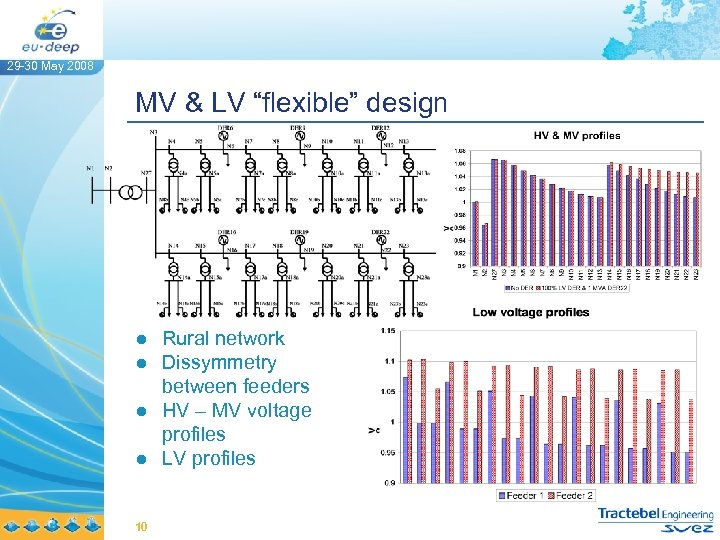 29 -30 May 2008 MV & LV “flexible” design ● Rural network ● Dissymmetry between feeders ● HV – MV voltage profiles ● LV profiles 10
 29 -30 May 2008 Updated “fit & forget” principle ● Distribution substation is able to operate at PN importing or exporting ● No voltage control problems with full “asymmetry” ● Operation at nominal medium voltage ● Distribution transformers must be operated at nominal transformer ratio ● In low load density region, bigger cross-section cables could be required ● Impact on cost of system, but limited impact for replacement or for new installation (installation costs dominate) ● In existing systems, the updated operating point could possibly lead to higher losses, as mean operational voltage could be reduced 11
 29 -30 May 2008 Regulation of Distribution Networks ● The value DER brings to the network must be made explicit ● Generation and load functions (and their interactions) are playing the first critical role ● Use of System charges and incentives cannot be mixed ● Generation and load must be dealt with separately ● A “marginal” allocation principle is used, based on a “fair appraisal” of all costs ● Network regulation should be implemented using “norm models” ● Interval metering is necessary, but is not sufficient ● The proposed Use of System charges scheme is “efficient” per se ● In the long run, it should reduce the cost of system 12
 29 -30 May 2008 Flexible Stirling micro CHP Creating value means ● “Integration” into the system ● Hence decoupling electricity and heat generations for ● Better price for electricity ● Better CO 2 performances ● This supposes ● An optimised design of µCHP & its storage ● Adaptation to the hosting Central Heating installation ● And in depth evaluation of the overall house heat balance ● Status of losses ● From conversion machine ● From heat storage 13
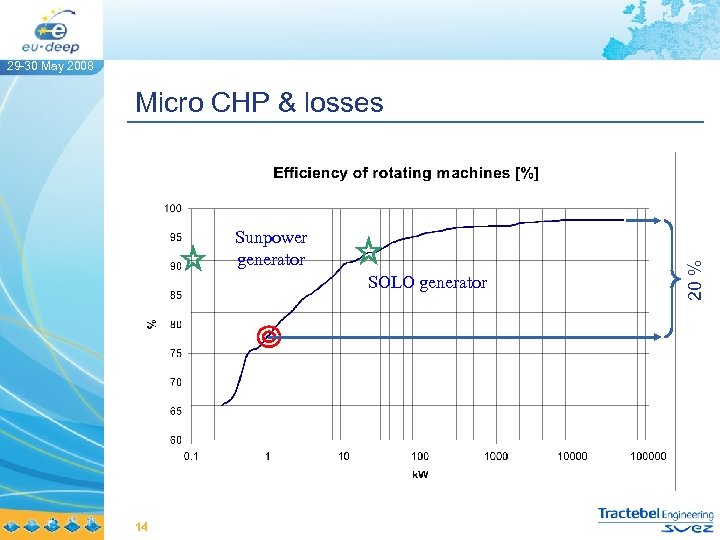 29 -30 May 2008 Sunpower generator SOLO generator 14 20 % Micro CHP & losses
 29 -30 May 2008 Conclusions ● EU-DEEP Project set up a new, “efficient”, regulatory framework that could be favourable for micro CHP ● But “flexible” micro CHP is required ● This means additional investments in heat storage ● The electrical output must be adjusted considering network design criteria ● Efficiency of conversion to electricity is less important than the global efficiency ● The constraints due to central heating installation must be carefully evaluated ● The status of losses (conversion & storage) requires attention 17
 29 -30 May 2008 Announcement 3 rd International Conference on Integration of Renewable and Distributed Energy Resources December 10 -12 th 2008 in Nice The European Commission funds this work as part of the EU-DEEP Project from the Sixth Framework Programme for Research and Technological Development Thank you for your attention 18