 Скачать презентацию Integrating the Scientific Community with a Measurement Based
9936710ff1672eafc98d9c7dbbed9a19.ppt
- Количество слайдов: 32



Integrating the Scientific Community with a Measurement Based, Multi-Sensor Data Processing and Distribution System Bryan Franz, Donna Thomas, Sean Bailey, Norman Kuring, Gene Feldman, Chuck Mc. Clain, John Wilding NASA Ocean Biology Processing Group AGU Meeting, December 2005, San Francisco, CA
The Ocean Biology Processing Group A Component of NASA’s Missions-to-Measurements Initiative • Heritage: Sea. Wi. FS, SIMBIOS, Sea. BASS, Sea. DAS • Designated NASA team responsible for the processing and distribution of ocean color measurements and SST from various spaceborne instruments. Ocean Color: CZCS, OCTS, Sea. Wi. FS, MODIS/Aqua SST: MODIS/Aqua, MODIS/Terra • Product Evaluation & Test Element (PEATE) for OC and SST, and Science Team Lead for OC on NPP/VIIRS. • Designated as the software development, processing, and distribution element for Sea Surface Salinity measurements from Aquarius.
NASA’s Goal To make available the highest quality ocean data products to the broadest user community in the most timely and efficient manner possible, and to provide sufficient documentation and support to facilitate the use of that data for global and regional studies.
Approach • highly integrated project structure with all elements co-located • flexible, mission-independent data processing system that constantly upgrades procedures, technologies, and hardware • comprehensive, centralized calibration and validation program closely coupled to the data processing and quality control system • multi-mission software development – common code for MODIS, Sea. Wi. FS, OCTS, CZCS, future sensors – common Level-2 & Level-3 formats • a project philosophy designed to support and involve as large a community as possible – providing opportunities for user input, evaluation, and feedback
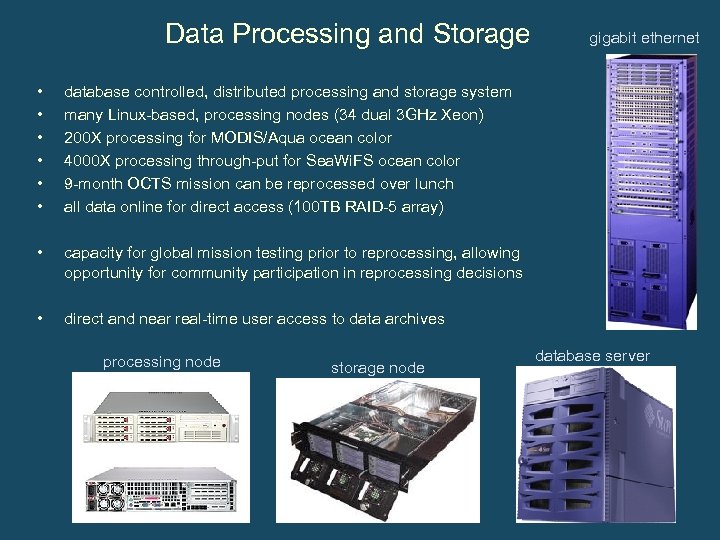
Data Processing and Storage • • • database controlled, distributed processing and storage system many Linux-based, processing nodes (34 dual 3 GHz Xeon) 200 X processing for MODIS/Aqua ocean color 4000 X processing through-put for Sea. Wi. FS ocean color 9 -month OCTS mission can be reprocessed over lunch all data online for direct access (100 TB RAID-5 array) • capacity for global mission testing prior to reprocessing, allowing opportunity for community participation in reprocessing decisions • gigabit ethernet direct and near real-time user access to data archives processing node storage node database server
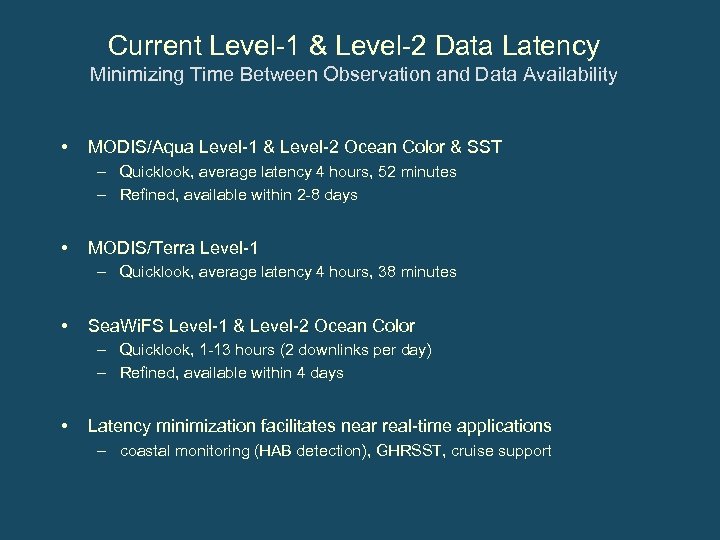
Current Level-1 & Level-2 Data Latency Minimizing Time Between Observation and Data Availability • MODIS/Aqua Level-1 & Level-2 Ocean Color & SST – Quicklook, average latency 4 hours, 52 minutes – Refined, available within 2 -8 days • MODIS/Terra Level-1 – Quicklook, average latency 4 hours, 38 minutes • Sea. Wi. FS Level-1 & Level-2 Ocean Color – Quicklook, 1 -13 hours (2 downlinks per day) – Refined, available within 4 days • Latency minimization facilitates near real-time applications – coastal monitoring (HAB detection), GHRSST, cruise support
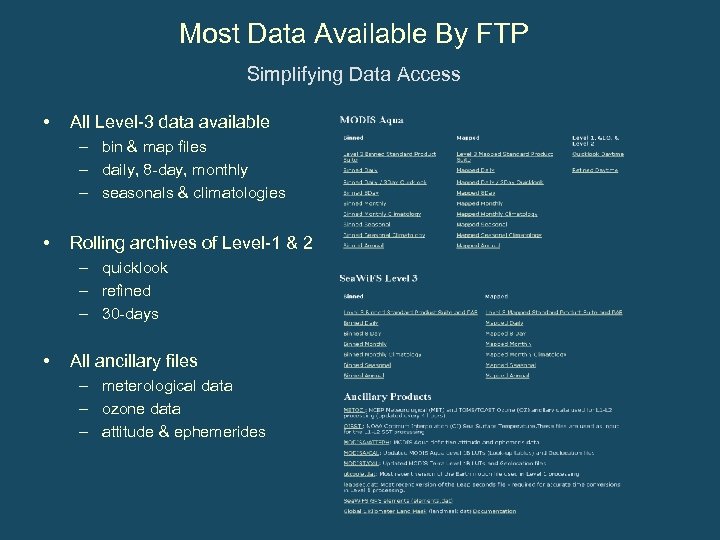
Most Data Available By FTP Simplifying Data Access • All Level-3 data available – bin & map files – daily, 8 -day, monthly – seasonals & climatologies • Rolling archives of Level-1 & 2 – quicklook – refined – 30 -days • All ancillary files – meterological data – ozone data – attitude & ephemerides
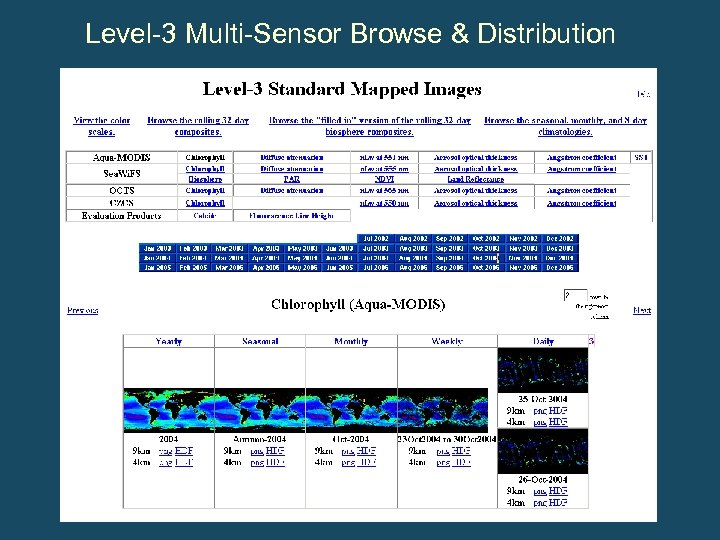
Level-3 Multi-Sensor Browse & Distribution
Level-1 & 2 Multi-Sensor Browse & Distribution
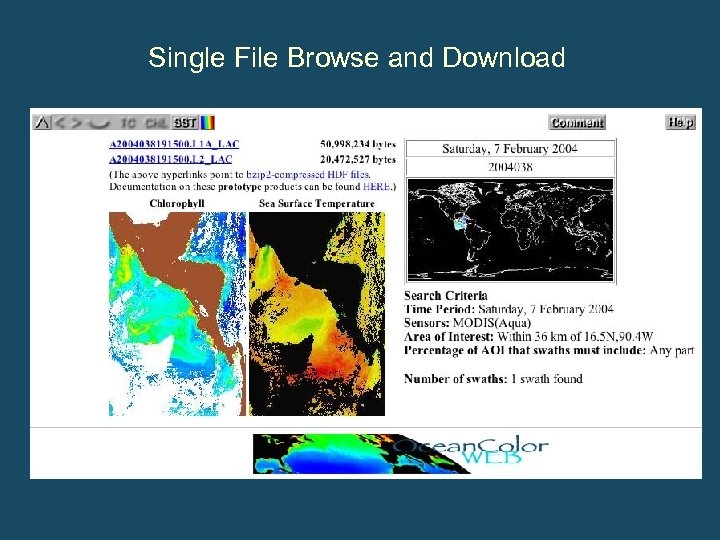
Single File Browse and Download
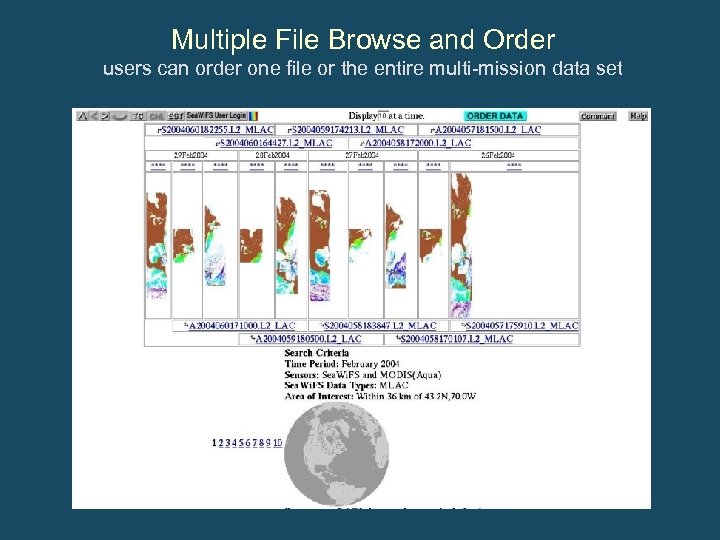
Multiple File Browse and Order users can order one file or the entire multi-mission data set
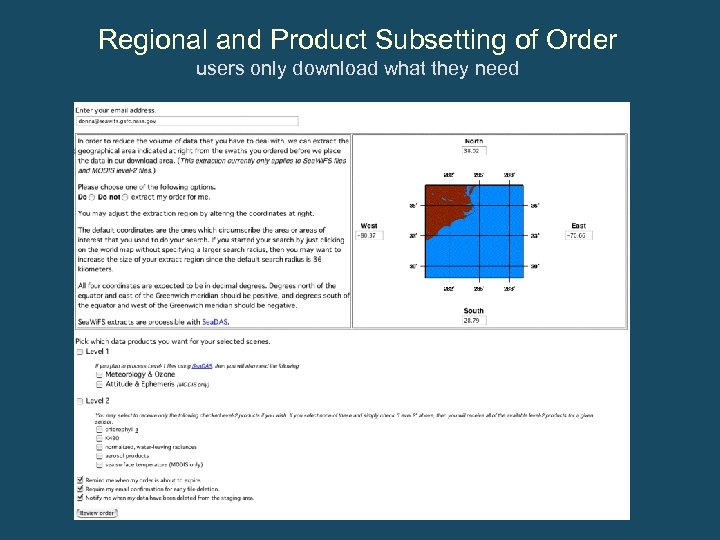
Regional and Product Subsetting of Order users only download what they need
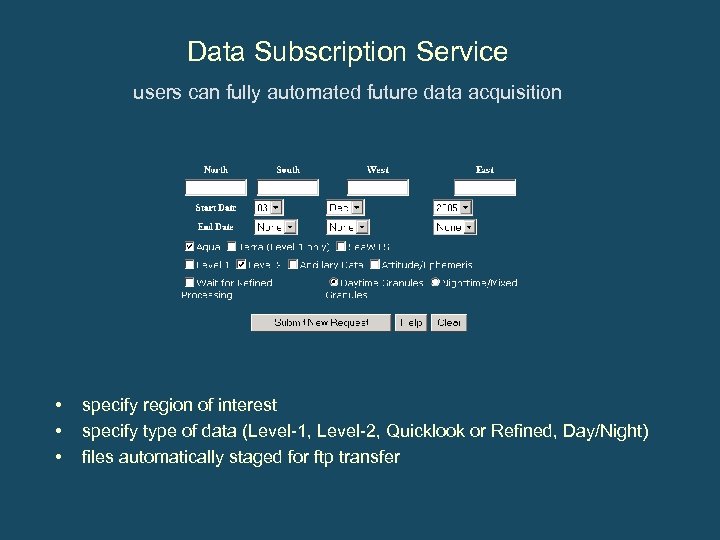
Data Subscription Service users can fully automated future data acquisition • • • specify region of interest specify type of data (Level-1, Level-2, Quicklook or Refined, Day/Night) files automatically staged for ftp transfer
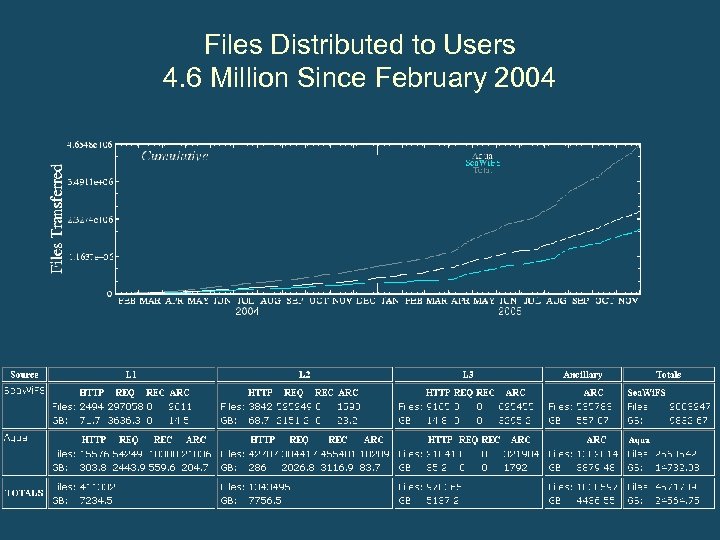
Files Distributed to Users 4. 6 Million Since February 2004
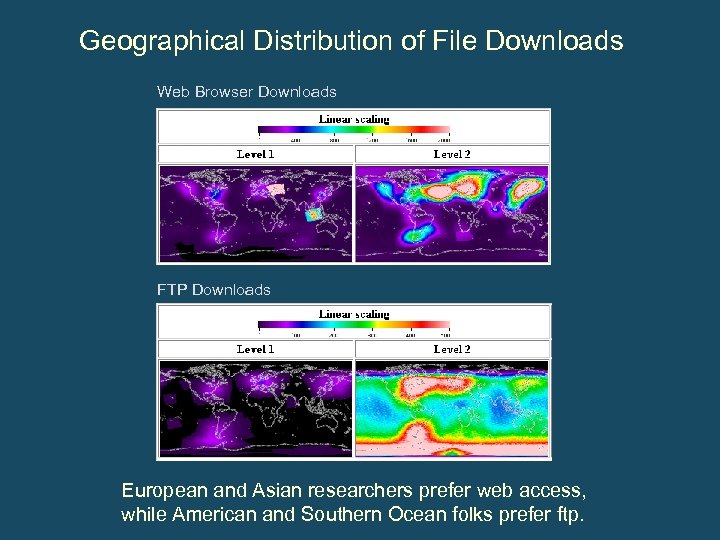
Geographical Distribution of File Downloads Web Browser Downloads FTP Downloads European and Asian researchers prefer web access, while American and Southern Ocean folks prefer ftp.
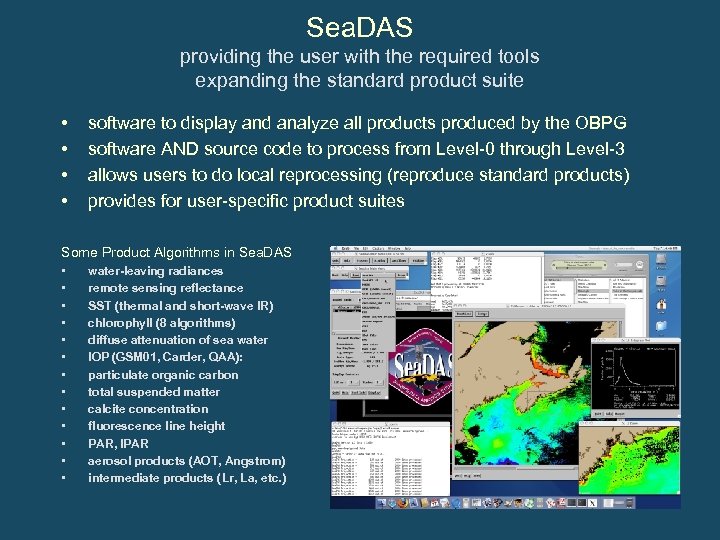
Sea. DAS providing the user with the required tools expanding the standard product suite • • software to display and analyze all products produced by the OBPG software AND source code to process from Level-0 through Level-3 allows users to do local reprocessing (reproduce standard products) provides for user-specific product suites Some Product Algorithms in Sea. DAS • • • • water-leaving radiances remote sensing reflectance SST (thermal and short-wave IR) chlorophyll (8 algorithms) diffuse attenuation of sea water IOP (GSM 01, Carder, QAA): particulate organic carbon total suspended matter calcite concentration fluorescence line height PAR, IPAR aerosol products (AOT, Angstrom) intermediate products (Lr, La, etc. )
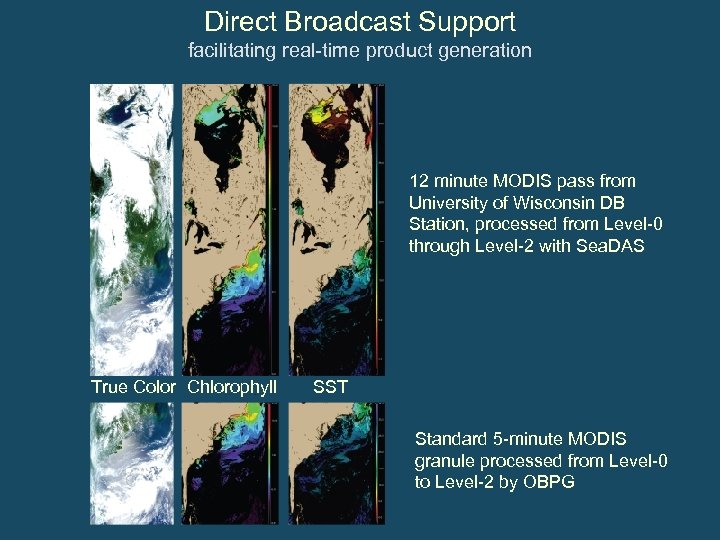
Direct Broadcast Support facilitating real-time product generation 12 minute MODIS pass from University of Wisconsin DB Station, processed from Level-0 through Level-2 with Sea. DAS True Color Chlorophyll SST Standard 5 -minute MODIS granule processed from Level-0 to Level-2 by OBPG
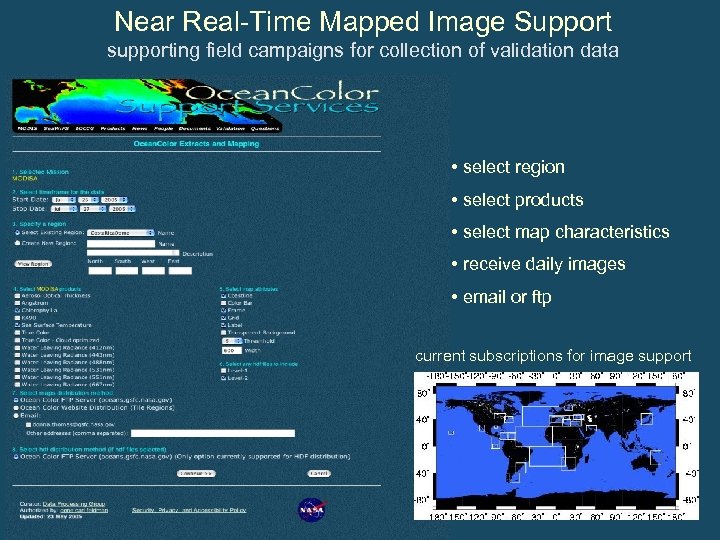
Near Real-Time Mapped Image Support supporting field campaigns for collection of validation data • select region • select products • select map characteristics • receive daily images • email or ftp current subscriptions for image support
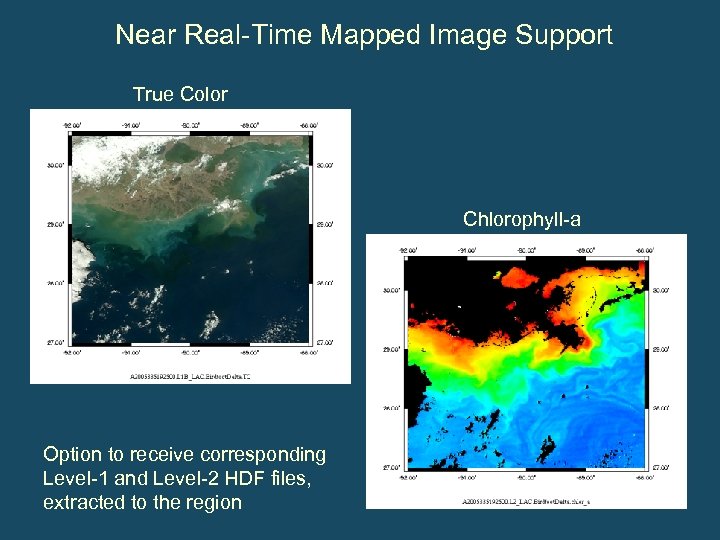
Near Real-Time Mapped Image Support True Color Chlorophyll-a Option to receive corresponding Level-1 and Level-2 HDF files, extracted to the region
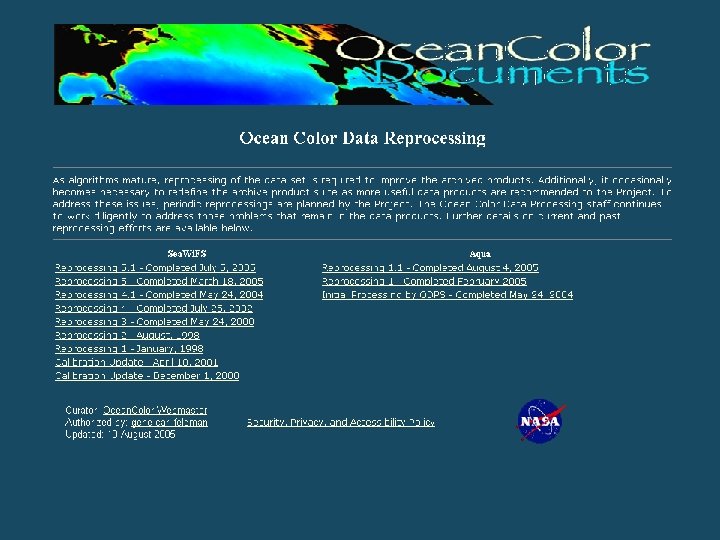
http: //oceancolor. gsfc. nasa. gov/

Notes
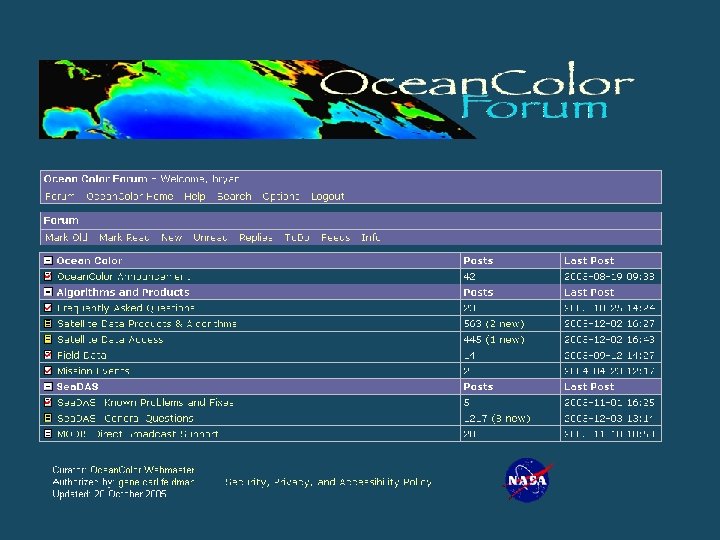
The Ocean Color Web http: //oceancolor. gsfc. nasa. gov was developed and is maintained by the Ocean Biology Processing Group (OBPG) at NASA's Goddard Space Flight Center as a means for disseminating information and data in support of NASA's Ocean Color program. The OBPG is responsible for the processing, validation, and distribution of Ocean Color and SST data from MODIS, and Ocean Color data from Sea. Wi. FS, OCTS, and CZCS. The Ocean Color web is the public interface to a fully automated data system for acquisition, processing, analysis, and distribution of data from these spaceborne sensors. Key features include web and ftp-based data access, timely availability of data products, data subscription services, parameter and regional subsetting, image support for field campaigns, extensive documentation, and user support forums. This paper presents an overview of the valuable Ocean Color Web resources that allow the scientific community to browse, download, and analyze Ocean Color and SST data from multiple satellites.
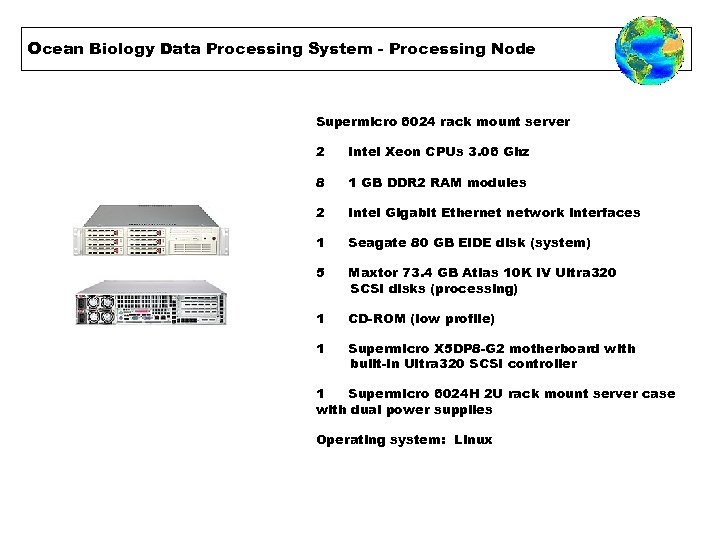
Ocean Biology Data Processing System - Processing Node Supermicro 6024 rack mount server 2 Intel Xeon CPUs 3. 06 Ghz 8 1 GB DDR 2 RAM modules 2 Intel Gigabit Ethernet network interfaces 1 Seagate 80 GB EIDE disk (system) 5 Maxtor 73. 4 GB Atlas 10 K IV Ultra 320 SCSI disks (processing) 1 CD-ROM (low profile) 1 Supermicro X 5 DP 8 -G 2 motherboard with built-in Ultra 320 SCSI controller 1 Supermicro 6024 H 2 U rack mount server case with dual power supplies Operating system: Linux
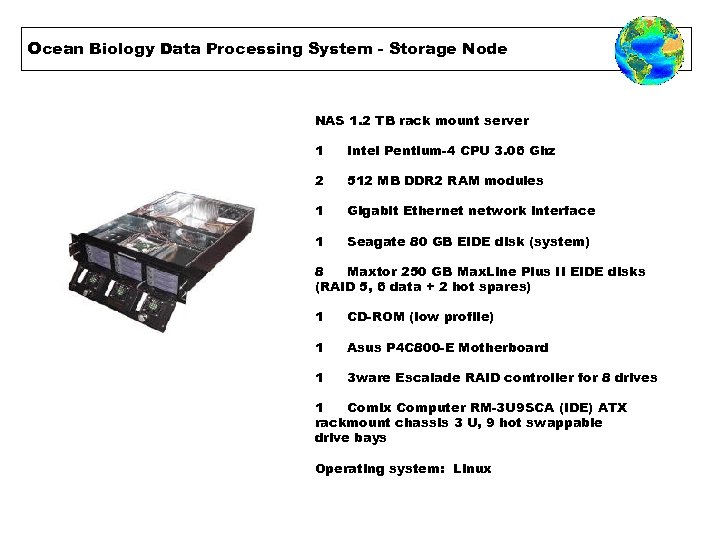
Ocean Biology Data Processing System - Storage Node NAS 1. 2 TB rack mount server 1 Intel Pentium-4 CPU 3. 06 Ghz 2 512 MB DDR 2 RAM modules 1 Gigabit Ethernet network interface 1 Seagate 80 GB EIDE disk (system) 8 Maxtor 250 GB Max. Line Plus II EIDE disks (RAID 5, 6 data + 2 hot spares) 1 CD-ROM (low profile) 1 Asus P 4 C 800 -E Motherboard 1 3 ware Escalade RAID controller for 8 drives 1 Comix Computer RM-3 U 9 SCA (IDE) ATX rackmount chassis 3 U, 9 hot swappable drive bays Operating system: Linux
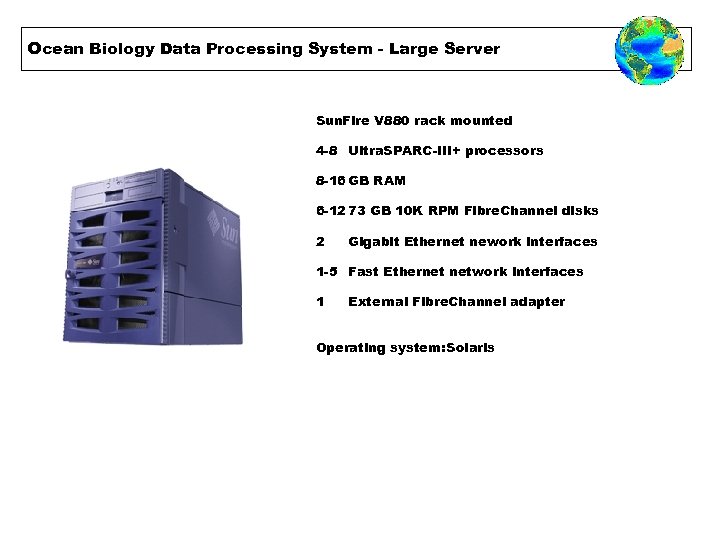
Ocean Biology Data Processing System - Large Server Sun. Fire V 880 rack mounted 4 -8 Ultra. SPARC-III+ processors 8 -16 GB RAM 6 -12 73 GB 10 K RPM Fibre. Channel disks 2 Gigabit Ethernet nework interfaces 1 -5 Fast Ethernet network interfaces 1 External Fibre. Channel adapter Operating system: Solaris
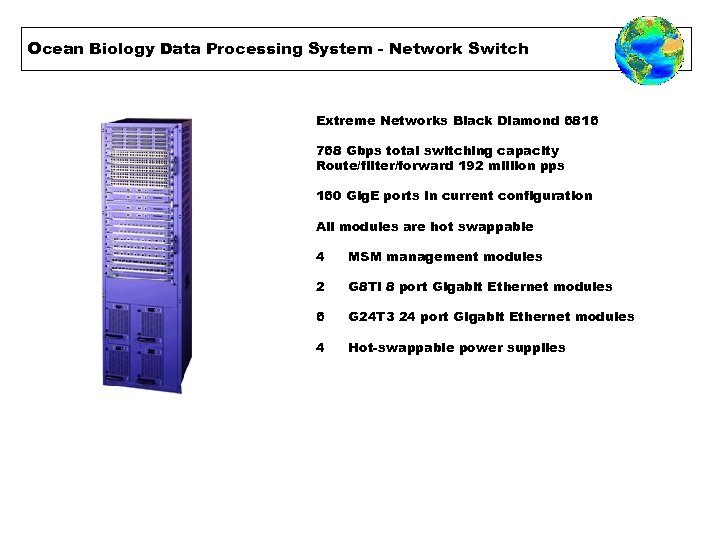
Ocean Biology Data Processing System - Network Switch Extreme Networks Black Diamond 6816 768 Gbps total switching capacity Route/filter/forward 192 million pps 160 Gig. E ports in current configuration All modules are hot swappable 4 MSM management modules 2 G 8 Ti 8 port Gigabit Ethernet modules 6 G 24 T 3 24 port Gigabit Ethernet modules 4 Hot-swappable power supplies
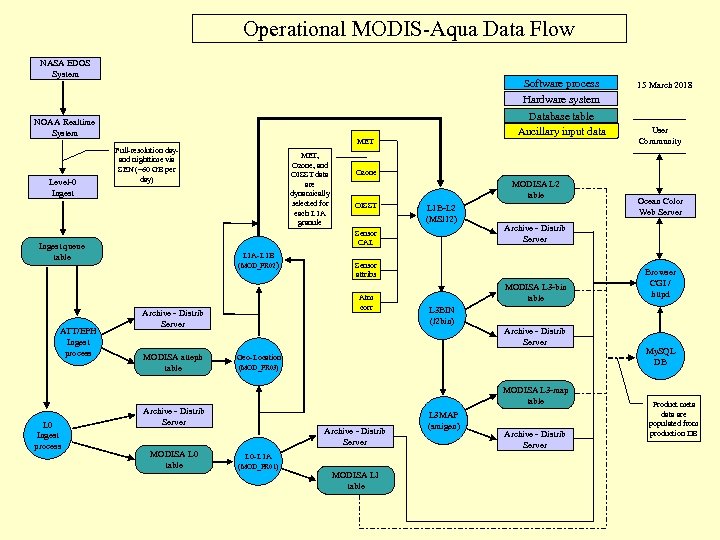
Operational MODIS-Aqua Data Flow NASA EDOS System Software process Hardware system NOAA Realtime System Level-0 Ingest MET Full-resolution dayand nighttime via SEN (~60 GB per day) MET, Ozone, and OISST data are dynamically selected for each L 1 A granule L 1 A-L 1 B (MOD_PR 02) MODISA L 2 table OISST L 1 B-L 2 (MSl 12) MODISA atteph table MODISA L 3 -bin table L 3 BIN (l 2 bin) Archive - Distrib Server Geo-Location (MOD_PR 03) MODISA L 3 -map table L 0 Ingest process Archive - Distrib Server MODISA L 0 table Archive - Distrib Server L 0 -L 1 A (MOD_PR 01) MODISA L 1 table L 3 MAP (smigen) Ocean Color Web Server Archive - Distrib Server Sensor attribs Atm corr Archive - Distrib Server User Community Ozone Sensor CAL Ingest queue table ATT/EPH Ingest process Database table Ancillary input data 15 March 2018 Archive - Distrib Server Browser CGI / httpd My. SQL DB Product meta data are populated from production DB
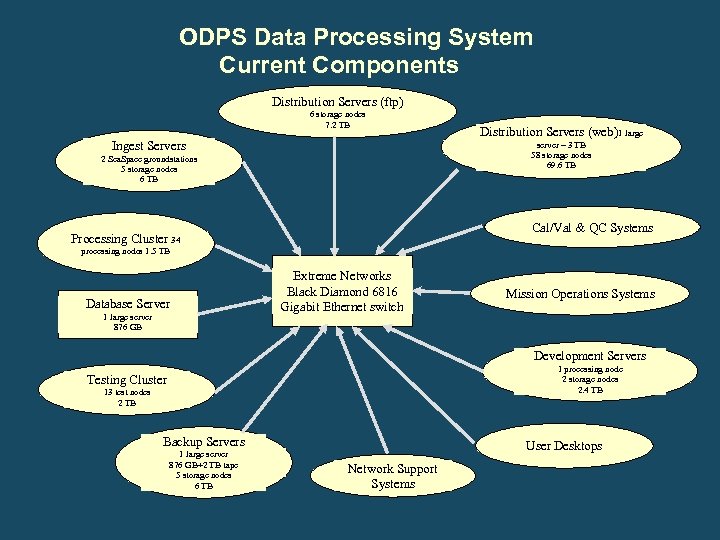
ODPS Data Processing System Current Components Distribution Servers (ftp) 6 storage nodes 7. 2 TB Ingest Servers Distribution Servers (web)1 large server – 3 TB 58 storage nodes 69. 6 TB 2 Sea. Space groundstations 5 storage nodes 6 TB Cal/Val & QC Systems Processing Cluster 34 processing nodes 1. 5 TB Database Server 1 large server 876 GB Extreme Networks Black Diamond 6816 Gigabit Ethernet switch Mission Operations Systems Development Servers 1 processing node 2 storage nodes 2. 4 TB Testing Cluster 13 test nodes 2 TB Backup Servers 1 large server 876 GB+2 TB tape 5 storage nodes 6 TB User Desktops Network Support Systems
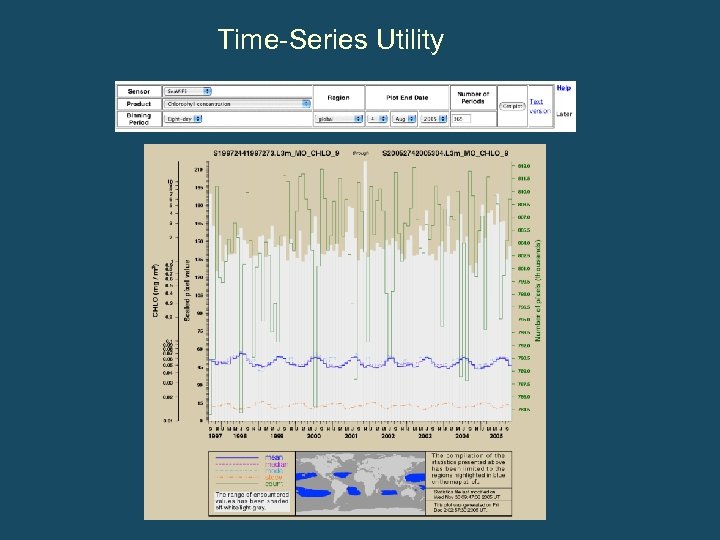
Time-Series Utility
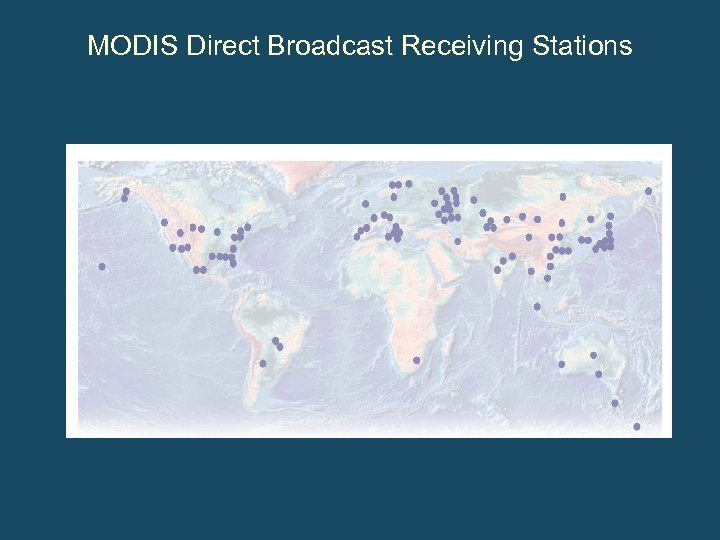
MODIS Direct Broadcast Receiving Stations
Скачать презентацию Integrating the Scientific Community with a Measurement Based
9936710ff1672eafc98d9c7dbbed9a19.ppt