 Скачать презентацию Integrating the ocean observing system Mobile platforms D
ea009a057f0d7721dee08b94159d3aed.ppt
- Количество слайдов: 14



Integrating the ocean observing system: Mobile platforms D. Roemmich, L. Boehme, H. Claustre, H. Freeland, M. Fukasawa, G. Goni, W. J. Gould, N. Gruber, M. Hood, E. Kent, R. Lumpkin, S. Smith, P. Testor Ocean. Obs 09, Venice, September 2009
Summary: Mobile platforms • Top priority is to sustain the present highly valuable observing system, while improving efficiency, data quality, and systematic coverage. • The physical and organizational infrastructures of the system require support to be maintained. • Autonomous platforms are the backbone of the observing system. In the next decade, expand their domain to be truly global, and broaden their range of applications. • Focus on the synergistic roles of other observing system elements. n. b. Ocean. Obs 09 docs are indicated by brown, i. e. Belbeoch et al. CWP
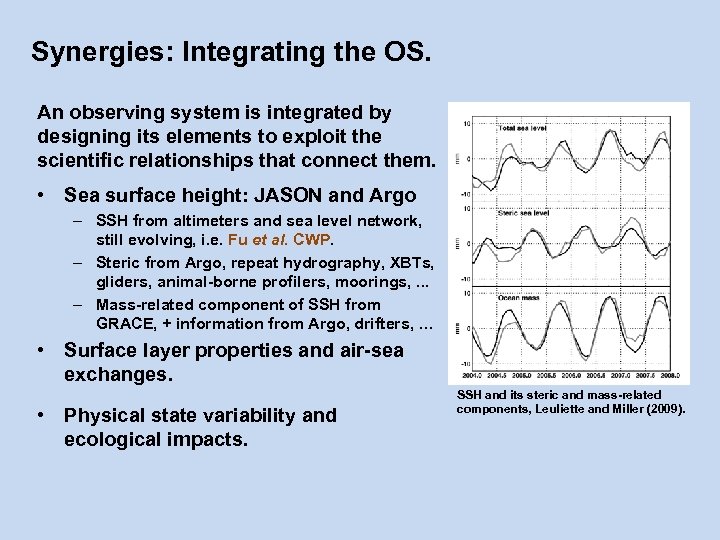
Synergies: Integrating the OS. An observing system is integrated by designing its elements to exploit the scientific relationships that connect them. • Sea surface height: JASON and Argo – SSH from altimeters and sea level network, still evolving, i. e. Fu et al. CWP. – Steric from Argo, repeat hydrography, XBTs, gliders, animal-borne profilers, moorings, . . . – Mass-related component of SSH from GRACE, + information from Argo, drifters, … • Surface layer properties and air-sea exchanges. • Physical state variability and ecological impacts. SSH and its steric and mass-related components, Leuliette and Miller (2009).
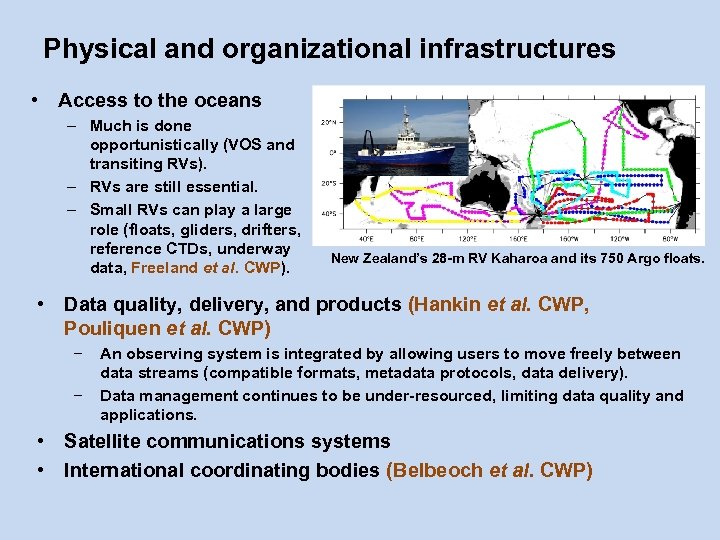
Physical and organizational infrastructures • Access to the oceans – Much is done opportunistically (VOS and transiting RVs). – RVs are still essential. – Small RVs can play a large role (floats, gliders, drifters, reference CTDs, underway data, Freeland et al. CWP). New Zealand’s 28 -m RV Kaharoa and its 750 Argo floats. • Data quality, delivery, and products (Hankin et al. CWP, Pouliquen et al. CWP) − − An observing system is integrated by allowing users to move freely between data streams (compatible formats, metadata protocols, data delivery). Data management continues to be under-resourced, limiting data quality and applications. • Satellite communications systems • International coordinating bodies (Belbeoch et al. CWP)
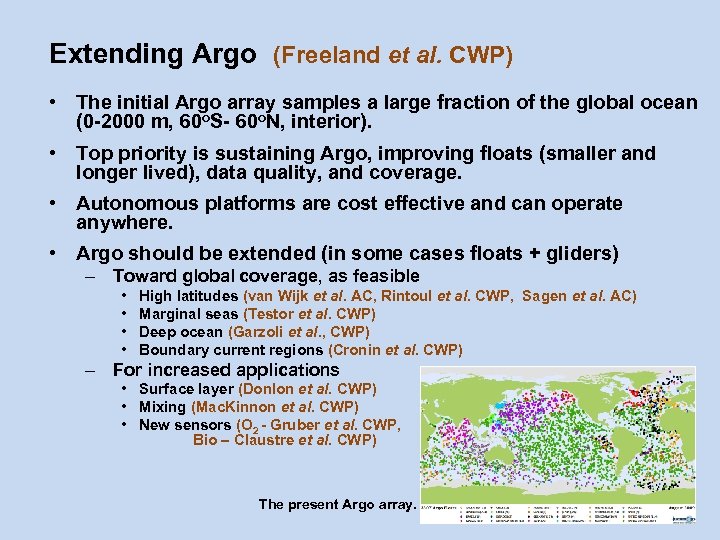
Extending Argo (Freeland et al. CWP) • The initial Argo array samples a large fraction of the global ocean (0 -2000 m, 60 o. S- 60 o. N, interior). • Top priority is sustaining Argo, improving floats (smaller and longer lived), data quality, and coverage. • Autonomous platforms are cost effective and can operate anywhere. • Argo should be extended (in some cases floats + gliders) – Toward global coverage, as feasible • • High latitudes (van Wijk et al. AC, Rintoul et al. CWP, Sagen et al. AC) Marginal seas (Testor et al. CWP) Deep ocean (Garzoli et al. , CWP) Boundary current regions (Cronin et al. CWP) – For increased applications • Surface layer (Donlon et al. CWP) • Mixing (Mac. Kinnon et al. CWP) • New sensors (O 2 - Gruber et al. CWP, Bio – Claustre et al. CWP) The present Argo array.
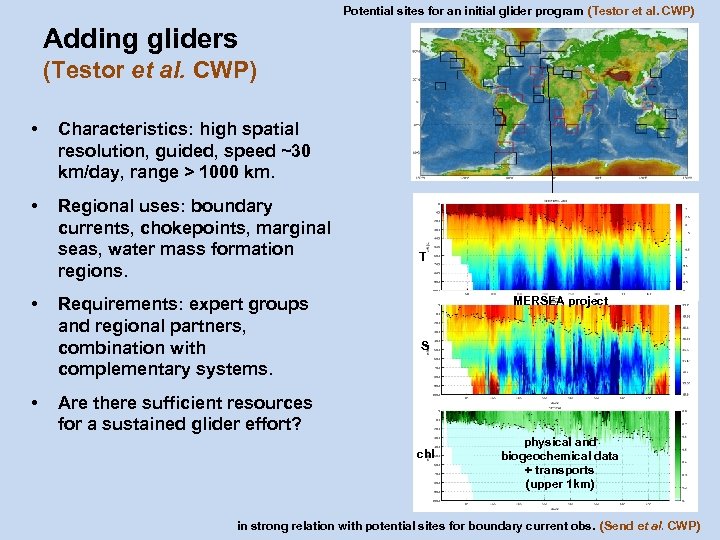
Potential sites for an initial glider program (Testor et al. CWP) Adding gliders (Testor et al. CWP) • Characteristics: high spatial resolution, guided, speed ~30 km/day, range > 1000 km. • Regional uses: boundary currents, chokepoints, marginal seas, water mass formation regions. • • Requirements: expert groups and regional partners, combination with complementary systems. T MERSEA project S Are there sufficient resources for a sustained glider effort? chl physical and biogeochemical data + transports (upper 1 km) in strong relation with potential sites for boundary current obs. (Send et al. CWP)
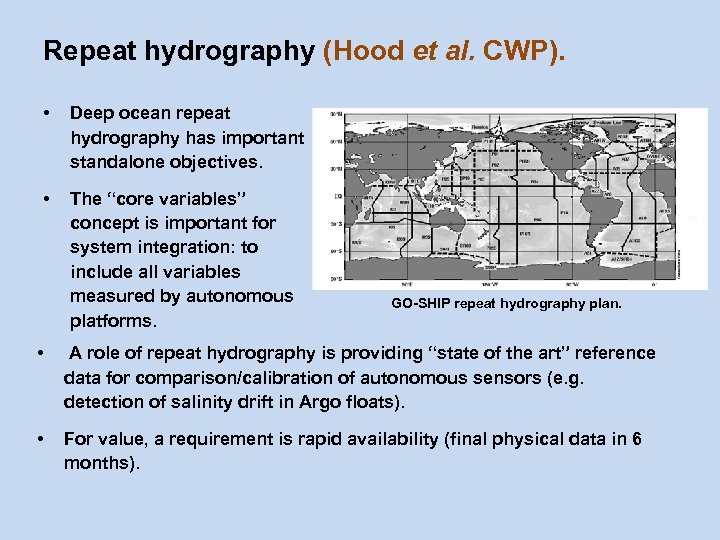
Repeat hydrography (Hood et al. CWP). • Deep ocean repeat hydrography has important standalone objectives. • The “core variables” concept is important for system integration: to include all variables measured by autonomous platforms. GO-SHIP repeat hydrography plan. • A role of repeat hydrography is providing “state of the art” reference data for comparison/calibration of autonomous sensors (e. g. detection of salinity drift in Argo floats). • For value, a requirement is rapid availability (final physical data in 6 months).
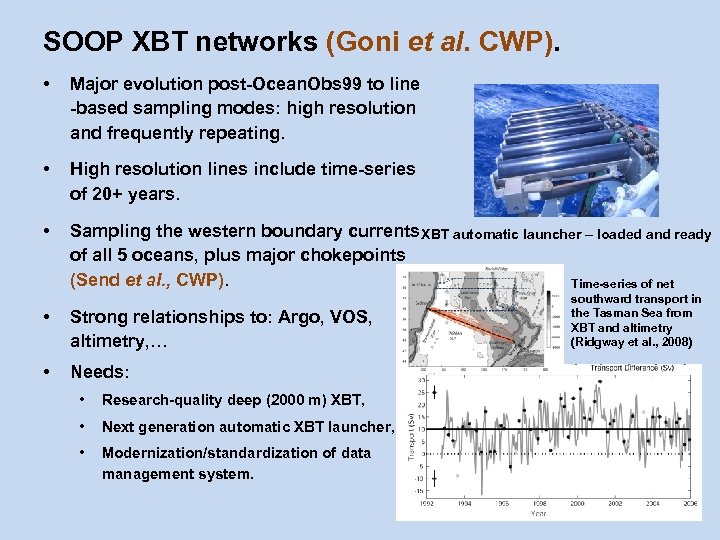
SOOP XBT networks (Goni et al. CWP). • Major evolution post-Ocean. Obs 99 to line -based sampling modes: high resolution and frequently repeating. • High resolution lines include time-series of 20+ years. • Sampling the western boundary currents XBT automatic launcher – loaded and ready of all 5 oceans, plus major chokepoints (Send et al. , CWP). Time-series of net • Strong relationships to: Argo, VOS, altimetry, … • Needs: • Research-quality deep (2000 m) XBT, • Next generation automatic XBT launcher, • Modernization/standardization of data management system. southward transport in the Tasman Sea from XBT and altimetry (Ridgway et al. , 2008)
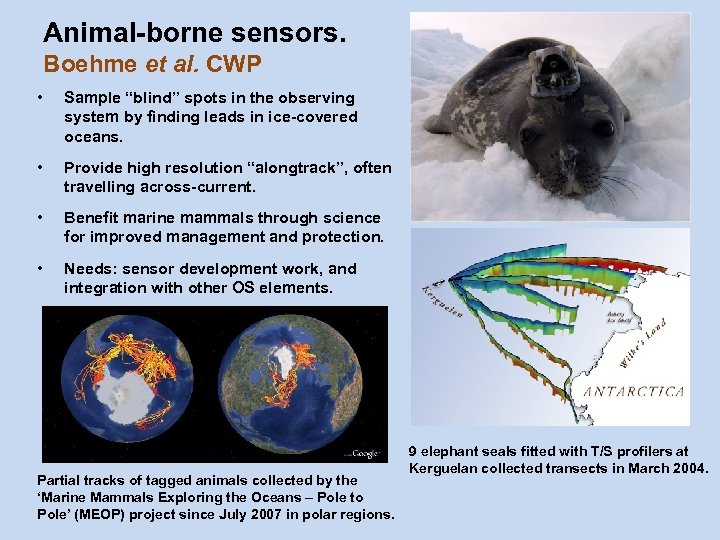
Animal-borne sensors. Boehme et al. CWP • Sample “blind” spots in the observing system by finding leads in ice-covered oceans. • Provide high resolution “alongtrack”, often travelling across-current. • Benefit marine mammals through science for improved management and protection. • Needs: sensor development work, and integration with other OS elements. Partial tracks of tagged animals collected by the ‘Marine Mammals Exploring the Oceans – Pole to Pole’ (MEOP) project since July 2007 in polar regions. 9 elephant seals fitted with T/S profilers at Kerguelan collected transects in March 2004.
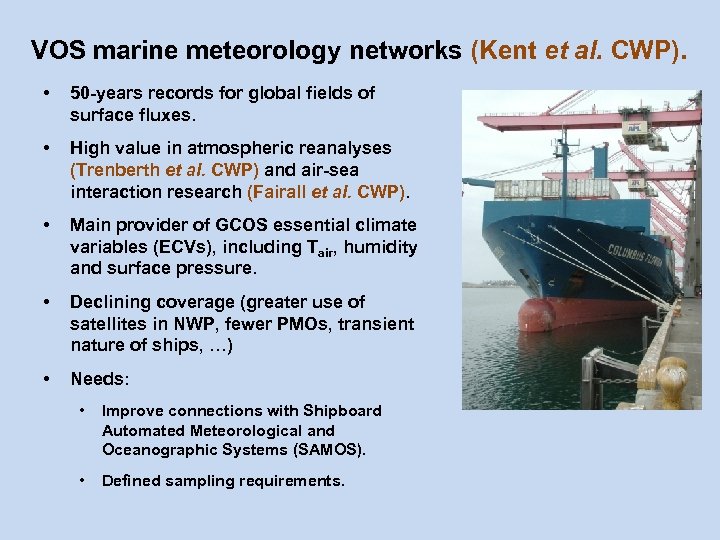
VOS marine meteorology networks (Kent et al. CWP). • 50 -years records for global fields of surface fluxes. • High value in atmospheric reanalyses (Trenberth et al. CWP) and air-sea interaction research (Fairall et al. CWP). • Main provider of GCOS essential climate variables (ECVs), including Tair, humidity and surface pressure. • Declining coverage (greater use of satellites in NWP, fewer PMOs, transient nature of ships, …) • Needs: • Improve connections with Shipboard Automated Meteorological and Oceanographic Systems (SAMOS). • Defined sampling requirements.
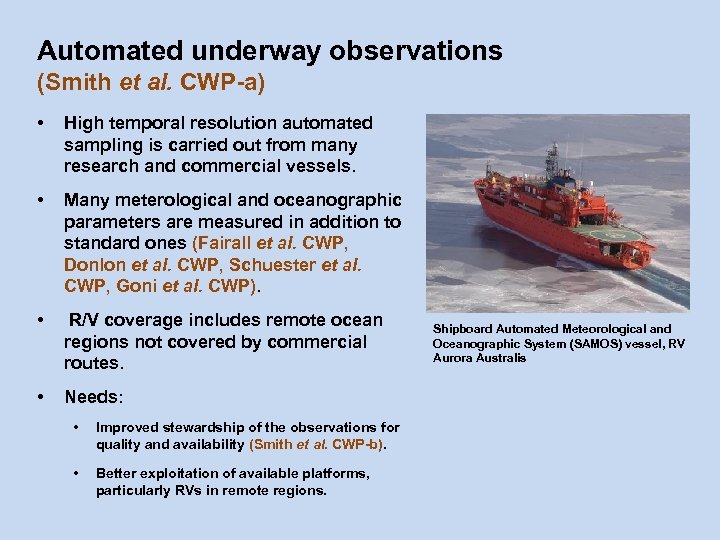
Automated underway observations (Smith et al. CWP-a) • High temporal resolution automated sampling is carried out from many research and commercial vessels. • Many meterological and oceanographic parameters are measured in addition to standard ones (Fairall et al. CWP, Donlon et al. CWP, Schuester et al. CWP, Goni et al. CWP). • R/V coverage includes remote ocean regions not covered by commercial routes. • Needs: • Improved stewardship of the observations for quality and availability (Smith et al. CWP-b). • Better exploitation of available platforms, particularly RVs in remote regions. Shipboard Automated Meteorological and Oceanographic System (SAMOS) vessel, RV Aurora Australis
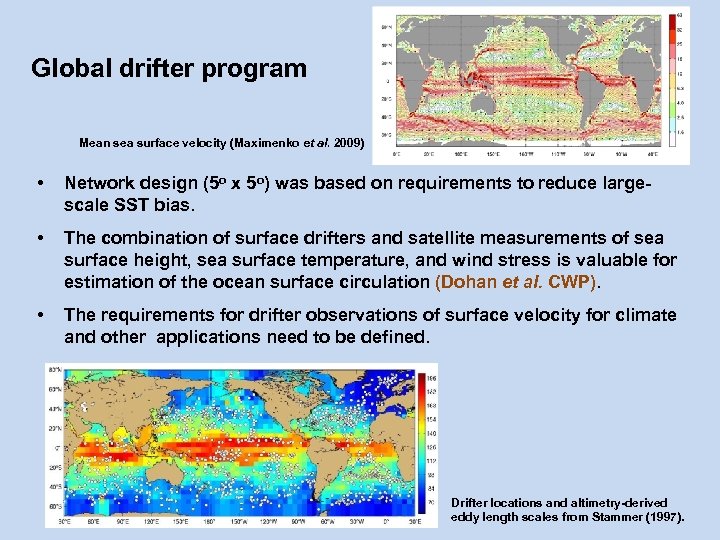
Global drifter program Mean sea surface velocity (Maximenko et al. 2009) • Network design (5 o x 5 o) was based on requirements to reduce largescale SST bias. • The combination of surface drifters and satellite measurements of sea surface height, sea surface temperature, and wind stress is valuable for estimation of the ocean surface circulation (Dohan et al. CWP). • The requirements for drifter observations of surface velocity for climate and other applications need to be defined. Drifter locations and altimetry-derived eddy length scales from Stammer (1997).
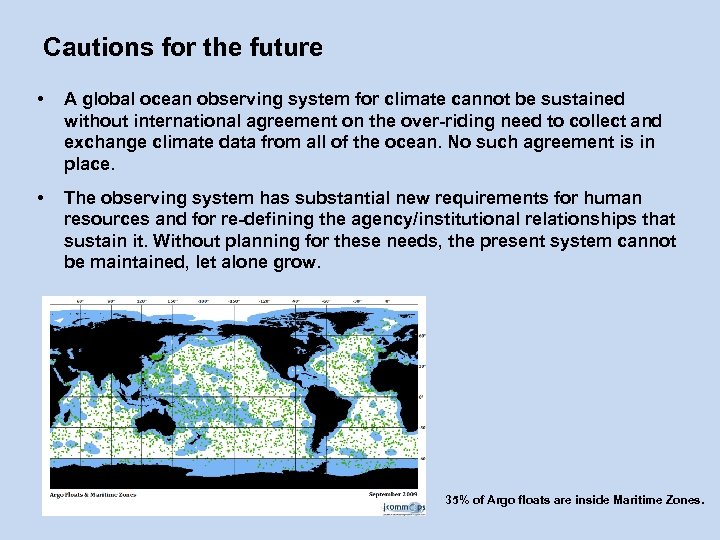
Cautions for the future • A global ocean observing system for climate cannot be sustained without international agreement on the over-riding need to collect and exchange climate data from all of the ocean. No such agreement is in place. • The observing system has substantial new requirements for human resources and for re-defining the agency/institutional relationships that sustain it. Without planning for these needs, the present system cannot be maintained, let alone grow. 35% of Argo floats are inside Maritime Zones.
Summary: Mobile platforms • Top priority is to sustain the present highly valuable observing system, while improving efficiency, data quality, and systematic coverage. • The physical and organizational infrastructures of the system require support to be maintained. • Autonomous platforms are the backbone of the observing system. In the next decade, expand their domain to be truly global, and broaden their range of applications. • Focus on the synergistic roles of other observing system elements.
Скачать презентацию Integrating the ocean observing system Mobile platforms D
ea009a057f0d7721dee08b94159d3aed.ppt