


 Скачать презентацию Integrating the Healthcare Enterprise IHE An initiative of
52e58f1738b281ceae676791df44a618.ppt
- Количество слайдов: 24
 Integrating the Healthcare Enterprise IHE An initiative of the ACC to improve data interoperability March 2005 ACC Scientific Sessions
 Why IHE? Cardiology has hard system and data integration problems - Multiple locations (office, in-patient, ED …) - Multiple devices and modalities - Long term patient care by many care providers Data integration is essential to quality patient care Care providers must work with industry to develop solutions to meet their needs - Implementations must be based on open standards March 2005 ACC Scientific Sessions 1
 Goals of IHE Advance standards-based healthcare data integration Improve clinical and administrative workflow Improve data flow – where it’s needed, when it’s needed Improve the efficiency and effectiveness of clinical practice March 2005 ACC Scientific Sessions 4
 What is IHE? A collaboration of clinicians and vendors - International and multi-specialty A proven systems integration process - Refined through seven years of experience Produces results on a yearly cycle - Problem identification, Technical specification, Vendor implementation, Test, Demonstration - Yearly cycle focuses on most important tractable problems March 2005 ACC Scientific Sessions 5
 Who is IHE? IHE is a joint initiative of: - American College of Cardiology (ACC) - Radiological Society of North America (RSNA) - Healthcare Information and Management Systems Society (HIMSS) Vendors/manufacturers in major supporting role Local sponsorship internationally IHE-Europe and IHE-Asia/Oceania IHE-Cardiology additional participating societies - - ASE, SCAI, ASNC, and more IHE-Cardiology in Europe sponsored by European Society of Cardiology (ESC) March 2005 ACC Scientific Sessions 6
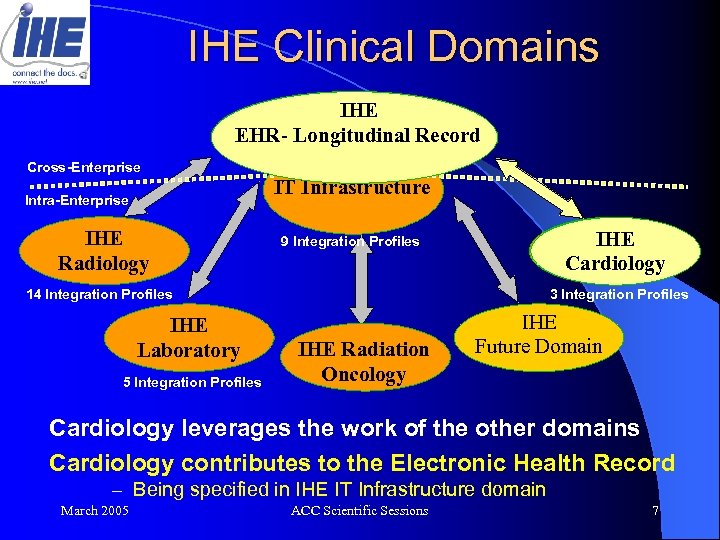 IHE Clinical Domains Cross-Enterprise Intra-Enterprise IHE EHR- Longitudinal Record IHE IT Infrastructure IHE Radiology IHE Cardiology 9 Integration Profiles 14 Integration Profiles IHE Laboratory 5 Integration Profiles 3 Integration Profiles IHE Radiation Oncology IHE Future Domain Cardiology leverages the work of the other domains Cardiology contributes to the Electronic Health Record – Being specified in IHE IT Infrastructure domain March 2005 ACC Scientific Sessions 7
 Cardiology and the Electronic Health Record ACC Vision of the Electronic Health Record (1999) - “The Digital Integrated Cardiac Record” - All care areas - Across organization boundaries EHR is a key area of IHE development - XDS – HIMSS 2005 To play in the EHR, data must be managed and properly identified So, this is where we started in Year 1 of IHE -Cardiology – lay the foundation March 2005 ACC Scientific Sessions 10
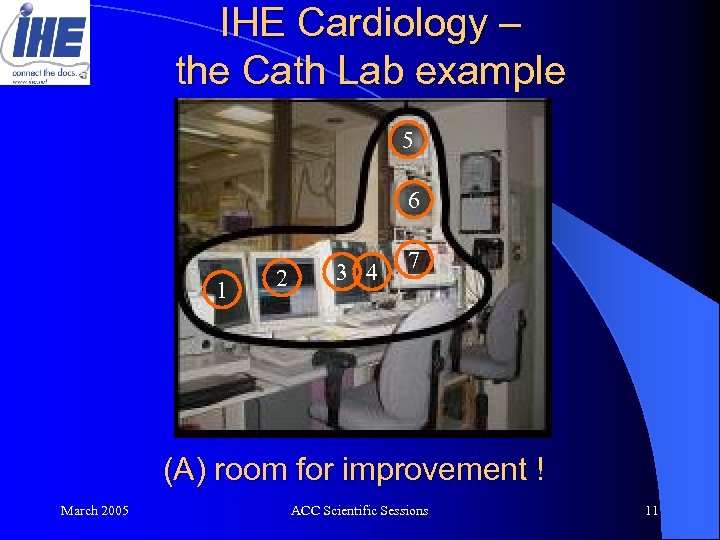 IHE Cardiology – the Cath Lab example 5 6 1 2 3 4 7 (A) room for improvement ! March 2005 ACC Scientific Sessions 11
 IHE Annual Cycle – Step 1 1. Cardiologists identify clinical problems to be addressed “Integration Profiles” 2. 3. 4. Engineers from vendors collaborate to define technical specification (using standards such as DICOM and HL 7) Vendors implement the technical specification and participate in the “Connectathon” and demos Vendors publish IHE Integration Statements, and users can buy IHE systems March 2005 ACC Scientific Sessions 12
 “I need to see the ECG!” Clinical Problem: - Diagnostic quality ECGs needed everywhere IHE Tasks: - Simple and fast access - Ubiquitous (Web based) communication - Integrated into other software systems Retrieve ECG for Display Integration Profile March 2005 ACC Scientific Sessions 14
 “Could you do a TTE on this patient right now since you are in the CCU anyway? ” Clinical Problems: - Lost and unbilled echo exams because carts are constantly on the move - Patient and order info manually entered (potential for errors) or not at all - Stress echo image ID inconsistent across vendors IHE Tasks: - Accurate and automatic demographic and order reconciliation - Verify all images are securely archived - Accurate display of Stress Images Echocardiography Workflow Profile March 2005 ACC Scientific Sessions 16
 “There is a patient being brought up to cath from the ER…” Clinical Problems: - Need to enter patient and procedure information into multiple systems in cath lab - No order created; emergent case (unidentified patient) - Change of rooms during procedure – data scattered - Inconsistently time-stamped events IHE Tasks: - Automate download of patient info to all systems - Accurate and automatic patient demographic and order reconciliation - Verify all data is securely archived in single “folder” - All data consistently time-stamped Cardiac Catheterization Workflow Profile March 2005 ACC Scientific Sessions 18
 IHE Annual Process – Step 2 1. Cardiologists identify clinical problems to be addressed - “Integration Profiles” 2. Engineers from vendors collaborate to define technical specifications (using standards such as DICOM and HL 7) Vendors implement the technical specification and participate in the “Connectathon” and demos 4. Vendors publish IHE Integration Statements, and users can buy IHE systems 3. March 2005 ACC Scientific Sessions 20
 IHE Annual Process – Step 3 1. 2. Cardiologists identify clinical problems to be addressed “Integration Profiles” Engineers from vendors collaborate to define technical specification (using standards such as DICOM and HL 7) 3. Vendors implement the technical specification and participate in the “Connectathon” and demos 4. Vendors publish IHE Integration Statements, and users can buy IHE systems March 2005 ACC Scientific Sessions 21
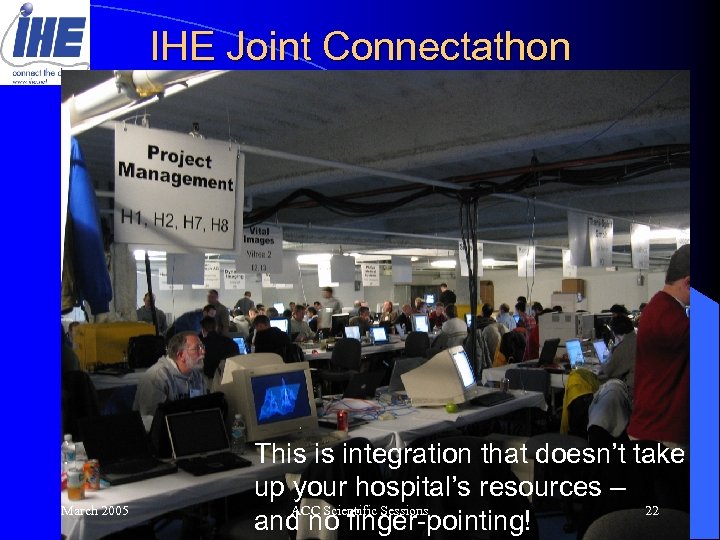 IHE Joint Connectathon January, 2005 Oak Brook, IL 300 engineers 43 companies 110 products – Working together in a collegial environment – 2800 monitored test cases executed in 5 days March 2005 This is integration that doesn’t take up your hospital’s resources – ACC Scientific Sessions 22 and no finger-pointing!
 IHE Annual Process – Step 4 1. 2. 3. Cardiologists identify clinical problems to be addressed “Integration Profiles” Engineers from vendors collaborate to define technical specifications (using existing standards such as DICOM and HL 7) Vendors implement the technical specification and participate in the “Connectathon” and demos 4. Vendors publish IHE Integration Statements, and users can buy IHE systems March 2005 ACC Scientific Sessions 23
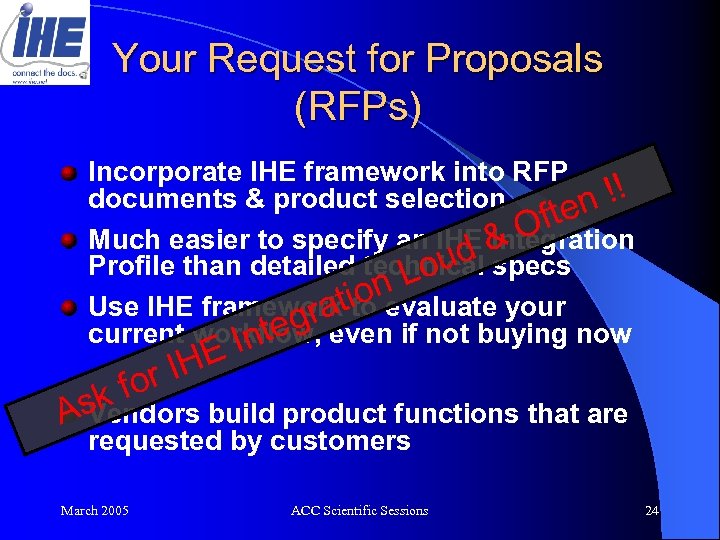 Your Request for Proposals (RFPs) Incorporate IHE framework into RFP !! documents & product selection ten Of Much easier to specify an IHE & d Integration Profile than detailed technical specs ou n. L Use IHE frameworktio evaluate your ra to teg current workflow, even if not buying now In IHE or kf Vendors build product functions that are As requested by customers March 2005 ACC Scientific Sessions 24
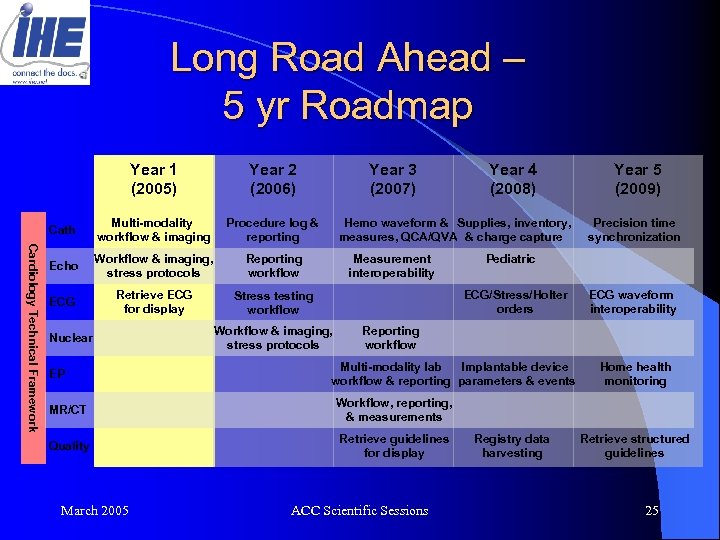 Long Road Ahead – 5 yr Roadmap Year 2 (2006) Cath Cardiology Technical Framework Year 1 (2005) Multi-modality workflow & imaging Procedure log & reporting Echo Workflow & imaging, stress protocols Reporting workflow ECG Retrieve ECG for display Stress testing workflow Nuclear EP Year 3 (2007) Year 4 (2008) Hemo waveform & Supplies, inventory, measures, QCA/QVA & charge capture Measurement interoperability Precision time synchronization Pediatric ECG/Stress/Holter orders Workflow & imaging, stress protocols Year 5 (2009) ECG waveform interoperability Reporting workflow Multi-modality lab Implantable device workflow & reporting parameters & events MR/CT Workflow, reporting, & measurements Quality Retrieve guidelines for display Home health monitoring March 2005 ACC Scientific Sessions Registry data harvesting Retrieve structured guidelines 25
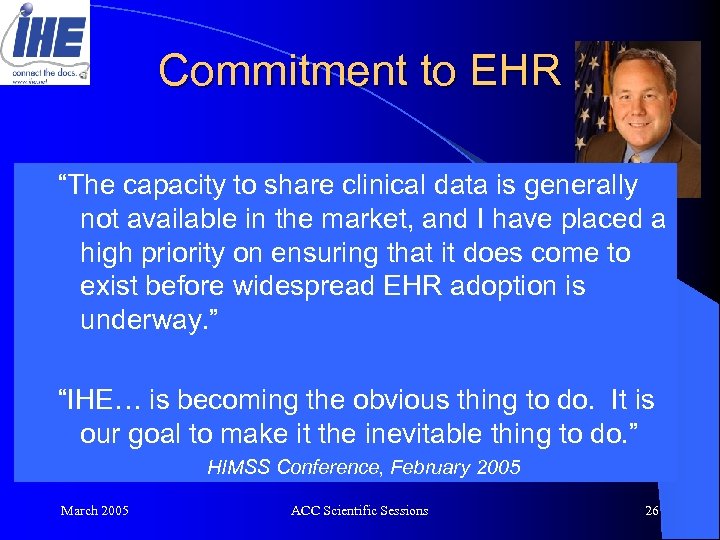 Commitment to EHR David J. Brailer, MD, clinical “The capacity to share Ph. D data is generally National Coordinator for Health Information I have placed a not available in the market, and Technology, US Department of high priority Health and Human Services (HHS) on ensuring that it does come to exist before widespread EHR adoption is Directive: Execute the Presidential Order for underway. ” widespread deployment of Health Information Technology within 10 years. “IHE… is becoming the obvious thing to do. It is our goal to make it the inevitable thing to do. ” HIMSS Conference, February 2005 March 2005 ACC Scientific Sessions 26
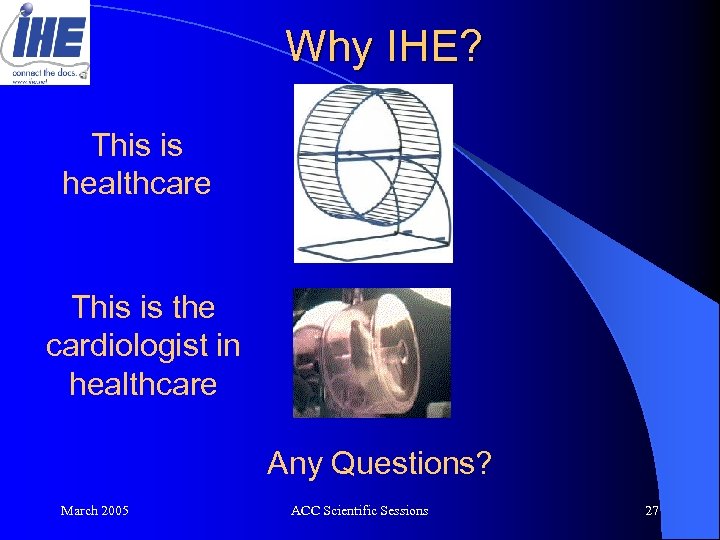 Why IHE? This is healthcare This is the cardiologist in healthcare Any Questions? March 2005 ACC Scientific Sessions 27
 Why IHE? (for vendors) Custom integration at customer site is a lose-lose - High cost – vendor and customer - Unpredictable and uncontrolled environment - Inefficient – solutions often must come from other locations (home office) with delays in delivery - Usually insufficiently documented – fragile and unmaintainable solutions - Resources expended on non-value-add effort - Ineffective use of available standards Bolt-on integration is a problem - Data sharing functions don’t work well if not designed into the product Exponential growth of pain as systems are added March 2005 ACC Scientific Sessions 28
 Goals of IHE (for vendors) Effective use of standards Reduce variability in interfaces Controlled integration testing environment - Defined timetable - No extraneous distractions Effective use of resources for integration testing Coordinated deployment of cross-system functions - Avoid chicken-and-egg syndrome Common approach creates the market in which vendors can sell and users can buy with confidence March 2005 ACC Scientific Sessions 29
 IHE Benefits (Vendors) Improves onsite customer support Reduces development cost Standardizes interface engineering Enables the vendors to focus on competitive features Improves customer satisfaction March 2005 ACC Scientific Sessions 30
 Four Clinical Scenario Demonstrations: - Cath/ECG: Emergent Angioplasty - Cath/ECG: Change of Rooms - Echo/ECG: “Add on” Mobile Procedure - Echo/ECG: Stress Echo Images Watch us “connect the docs”. March 2005 ACC Scientific Sessions 36