 Скачать презентацию Integrating the Healthcare Enterprise Contribution to an EHR
709e618a0068f94eb273e4b34b3c62ff.ppt
- Количество слайдов: 19



Integrating the Healthcare Enterprise Contribution to an EHR Strategy José Mussi – Director of Architecture, Canada Health Infoway
Goals of IHE l Increase the rate and quality of integration in healthcare environments. l Foster communication among vendors. l Prove that integration is attainable through the use of standards. l Improve the efficiency and effectiveness of clinical practice.
Introduction: EHR Challenges • One of the key integration challenges in healthcare today is achieving longitudinal electronic health records (EHR-LR) • Developing EHR solutions requires many integration profiles, some of which IHE has already addressed: • • The Retrieve Information Display (RID) profile defines a simple method for accessing clinical data • • The Patient Cross-Referencing (PIX) profile provides methods for linking patient ID across multiple enterprises The Audit Trail (ATNA) profile addresses the need to have centralized logs of activities for privacy related requirements IHE is now addressing one of the core profiles for the EHR: • The sharing and exchange of clinical documents across multiple healthcare settings
Introduction: EHR Cross-Enterprise Document Sharing First step towards the longitudinal dimension of the EHR: Focus: Clinical Information Exchange between EHRs in care settings to communicate with a distributed longitudinal EHR. Goal: Meet a broad range of EHR-LR (Longitudinal Record) needs with a distributed, cross-enterprise, document centric document content generic
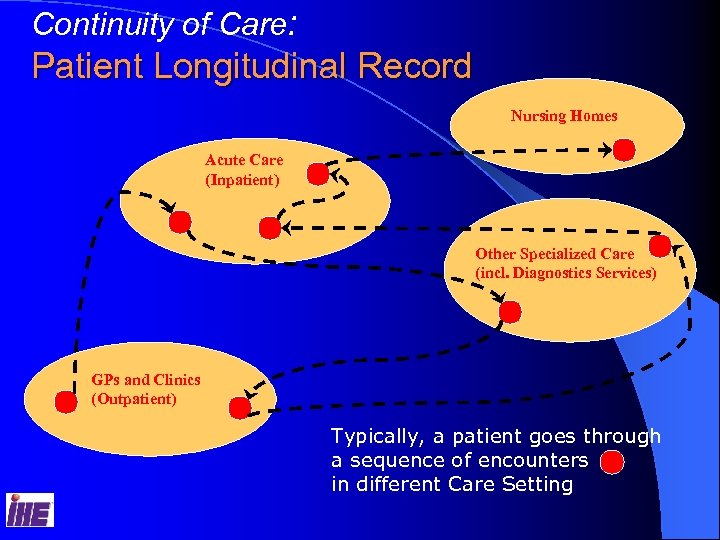
Continuity of Care: Patient Longitudinal Record Nursing Homes Acute Care (Inpatient) Other Specialized Care (incl. Diagnostics Services) GPs and Clinics (Outpatient) Typically, a patient goes through a sequence of encounters in different Care Setting
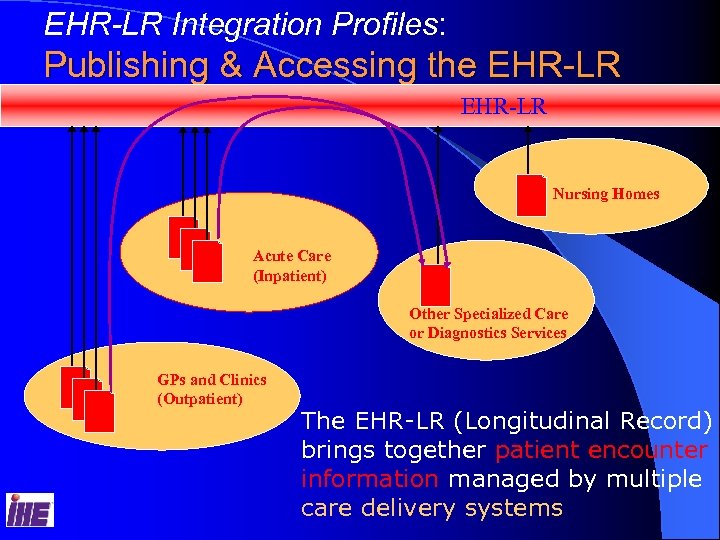
EHR-LR Integration Profiles: Publishing & Accessing the EHR-LR Nursing Homes Acute Care (Inpatient) Other Specialized Care or Diagnostics Services GPs and Clinics (Outpatient) The EHR-LR (Longitudinal Record) brings together patient encounter information managed by multiple care delivery systems
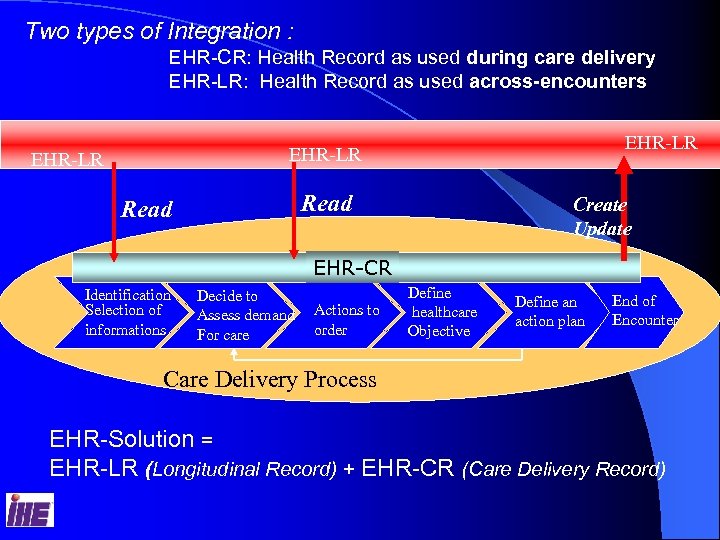
Two types of Integration : EHR-CR: Health Record as used during care delivery EHR-LR: Health Record as used across-encounters EHR-LR Read Create Update EHR-CR Identification Selection of informations Decide to Assess demand For care Actions to order Define healthcare Objective Define an action plan End of Encounter Care Delivery Process EHR-Solution = EHR-LR (Longitudinal Record) + EHR-CR (Care Delivery Record)
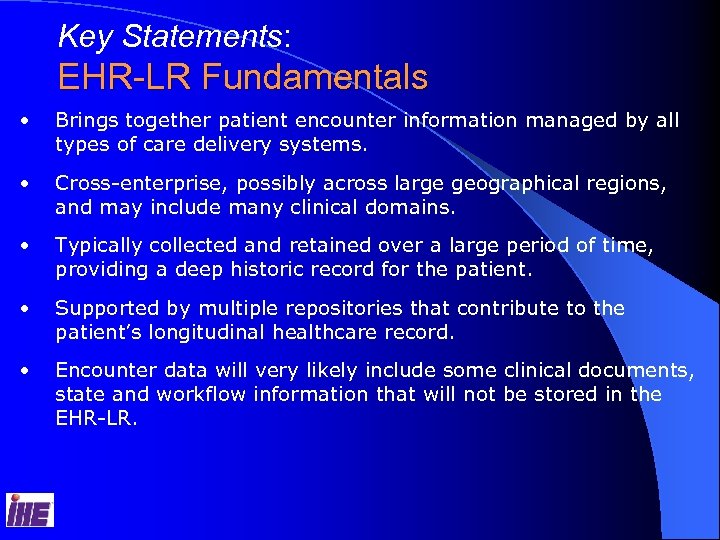
Key Statements: EHR-LR Fundamentals • Brings together patient encounter information managed by all types of care delivery systems. • Cross-enterprise, possibly across large geographical regions, and may include many clinical domains. • Typically collected and retained over a large period of time, providing a deep historic record for the patient. • Supported by multiple repositories that contribute to the patient’s longitudinal healthcare record. • Encounter data will very likely include some clinical documents, state and workflow information that will not be stored in the EHR-LR.
Key Statements: What is in the EHR-LR? • The EHR-LR data is made of discrete, persistent, clinical documents accessed by an unique identifier. • It may also contain other dynamic objects which are not being addressed by IHE at this time. • Metadata will be provided with each document by the EHR-CR and will be stored in the EHR-LR. • EHR-LR data formats will follow relevant clinical domain standards defined by field experts. EHR-CR is responsible for converting its internal data formats to the standard EHR-LR documents. • EHR-LR documents will kept in the EHR-CR or pushed to a separate EHR-LR repository.
Key Statements: Accessing the EHR-LR • EHR-LR shall make available a list of all published documents for a given patient/selection parameters. • The selection of documents is the responsibility of the EHRLR and not of the consumer applications. This is possible because of the document metadata kept in the EHR-LR. • The EHR-LR must ensure full content fidelity for all clinical documents that have been published. • The actual location of any particular document shall be transparent to the consumer application. • EHR-CR may provide clinical data by processing, extracting, or combining multiple documents.
Key Statements: Deploying IHE EHR-LR Profiles • The deployment of EHR-LR integration profiles will initially be focused on a small number of specialties (cardiology, oncology, etc), disease, and/or on key information for continuity of care (e. g. CCR summaries). • The scope of the EHR-LR profiles will expand progressively as other specialties are included in the use cases.
EHR-LR Integration Profile: Key Actors (Application Roles) l EHR-CR Source – Healthcare point of service system where clinical information is first collected l EHR-LR Directory – Index and metadatabase for all published clinical documents l EHR-LR Documents Repository – Maintains and stores published EHR-LR documents l EHR-LR Consumer – Application system that needs access to EHR-LR documents and information l EHR-CR Recipient – Healthcare point of service system that receives clinical documents as part of a continuity of care transfer
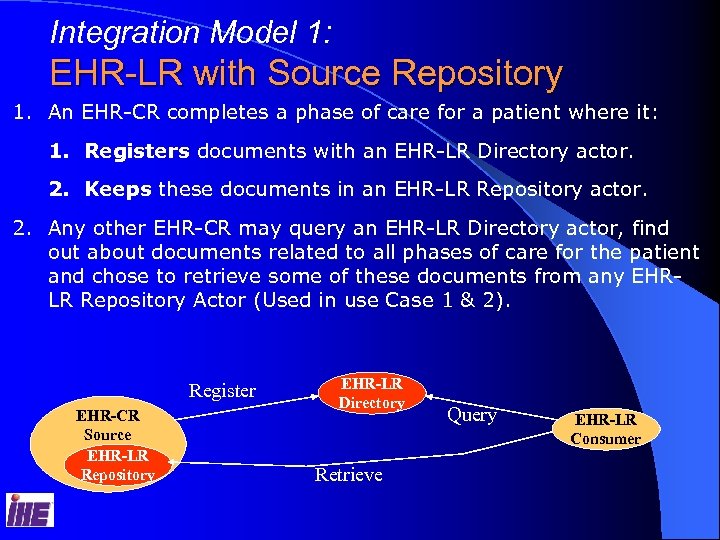
Integration Model 1: EHR-LR with Source Repository 1. An EHR-CR completes a phase of care for a patient where it: 1. Registers documents with an EHR-LR Directory actor. 2. Keeps these documents in an EHR-LR Repository actor. 2. Any other EHR-CR may query an EHR-LR Directory actor, find out about documents related to all phases of care for the patient and chose to retrieve some of these documents from any EHRLR Repository Actor (Used in use Case 1 & 2). Register EHR-CR Source EHR-LR Repository EHR-LR Directory Retrieve Query EHR-LR Consumer
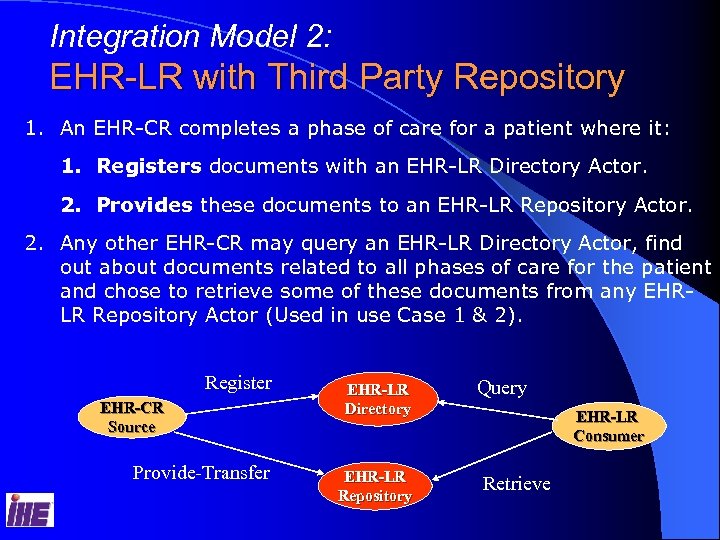
Integration Model 2: EHR-LR with Third Party Repository 1. An EHR-CR completes a phase of care for a patient where it: 1. Registers documents with an EHR-LR Directory Actor. 2. Provides these documents to an EHR-LR Repository Actor. 2. Any other EHR-CR may query an EHR-LR Directory Actor, find out about documents related to all phases of care for the patient and chose to retrieve some of these documents from any EHRLR Repository Actor (Used in use Case 1 & 2). Register EHR-CR Source Provide-Transfer EHR-LR Directory EHR-LR Repository Query EHR-LR Consumer Retrieve
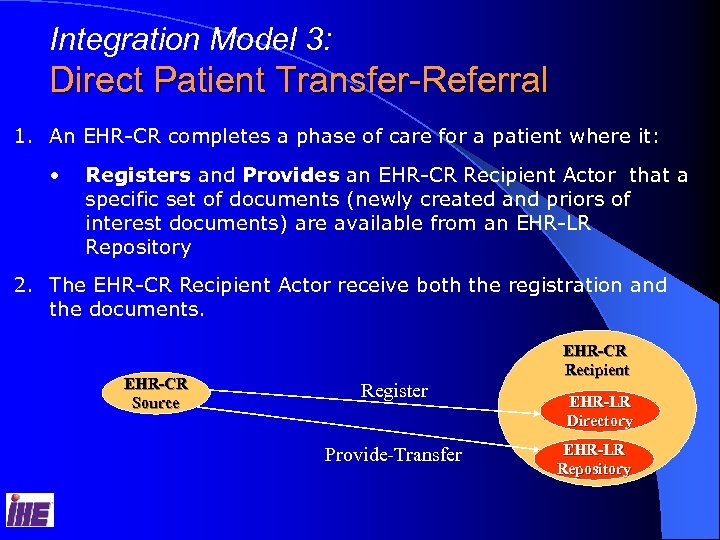
Integration Model 3: Direct Patient Transfer-Referral 1. An EHR-CR completes a phase of care for a patient where it: • Registers and Provides an EHR-CR Recipient Actor that a specific set of documents (newly created and priors of interest documents) are available from an EHR-LR Repository 2. The EHR-CR Recipient Actor receive both the registration and the documents. EHR-CR Source Register Provide-Transfer EHR-CR Recipient EHR-LR Directory EHR-LR Repository
Conclusion: EHR Cross-Enterprise Document Sharing • Leverages HL 7 CDA (Clinical Document Architecture) and ASTM CCR (Continuity of Care Record). • The proposed strategy addresses one of the key integration problems in the realization of the EHR vision. IHE does not claim to master and address the definition and all aspects of a complete and interoperable EHR System. • In collaboration with well established standards bodies and other EHR related initiatives world-wide (EHRCOM, CCR, HL 7, etc. ), IHE expects to contribute at a more cost-effective and rapid deployment.
IHE IT Infrastructure An open process for everyone! • To join IT Infrastructure planning or technical committee: • Contact Joyce Sensmeier, HIMSS. jsensmeier@himss. org • Suggest new profiles in IHE IT Infrastructure Planning Plan IHE at HIMSS 2005 • Produce new profiles in IHE IT Infrastructure Technical Committee
For more information…. l Web sites: www. himss. org / ihe www. rsna. org / ihe l Technical Documentation (www. rsna. org/ihe/tf/ihe_tf_index. shtml) – IHE IT Technical Framework 2004 – V 1. 0 – IHE Rad Technical Framework 2003 – V 5. 5 – IHE Laboratory Technical Framework 2004 – V 1. 0 l Non-Technical Brochures (www. rsna. org/ihe_faq. shtml) – IHE Fact Sheet and IHE FAQ – IHE Integration Profiles: Guidelines for Buyers – IHE Connectathon Results

Integrating the Healthcare Enterprise Thank You
Скачать презентацию Integrating the Healthcare Enterprise Contribution to an EHR
709e618a0068f94eb273e4b34b3c62ff.ppt