 Скачать презентацию Integrating the BOP in the National Accounts By
90bd03d5829520dc6dc842e2389c592d.ppt
- Количество слайдов: 31



Integrating the BOP in the National Accounts By Hazel Corbin Eastern Caribbean Central Bank Seminar on Developing a Programme for Implementation of 2008 SNA and Supporting Economics Statistics in CARICOM Region Kingston, Jamaica January 30 to February 1, 2013
Outline of Presentation n n n Background BOP Data Sources National Accounts Tables Compiled Links between BOP and NA Current Practices Future Plans
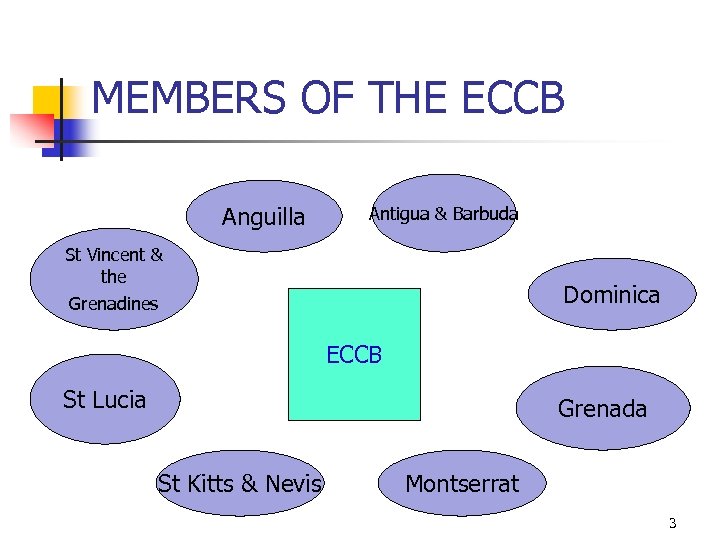
MEMBERS OF THE ECCB Anguilla Antigua & Barbuda St Vincent & the Dominica Grenadines ECCB St Lucia Grenada St Kitts & Nevis Montserrat 3
Background n n n BOP compilation for ECCU member countries began in 1980’s and started as a manual exercise TA was received from World University Services of Canada (WUSC), the Centre from Latin American Monetary Studies (CEMLA) and the Central Bank of Argentina to automate the process BOP estimates for member countries are compiled on an annual basis with technical assistance from the Eastern Caribbean Central Bank (ECCB)
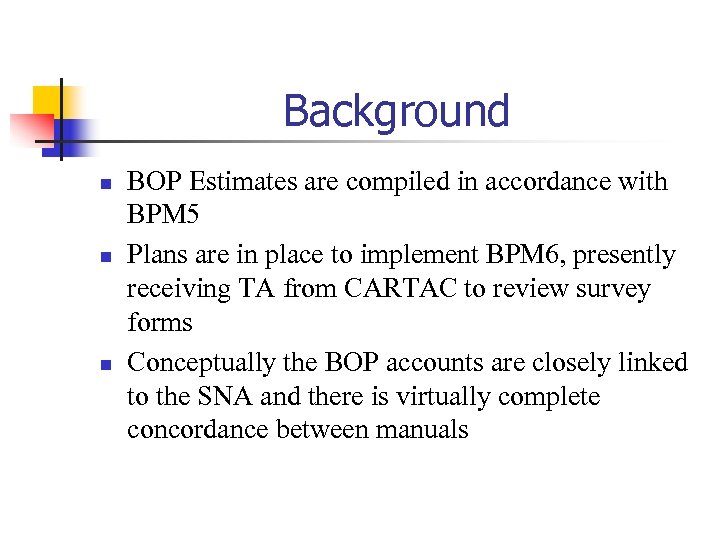
Background n n n BOP Estimates are compiled in accordance with BPM 5 Plans are in place to implement BPM 6, presently receiving TA from CARTAC to review survey forms Conceptually the BOP accounts are closely linked to the SNA and there is virtually complete concordance between manuals
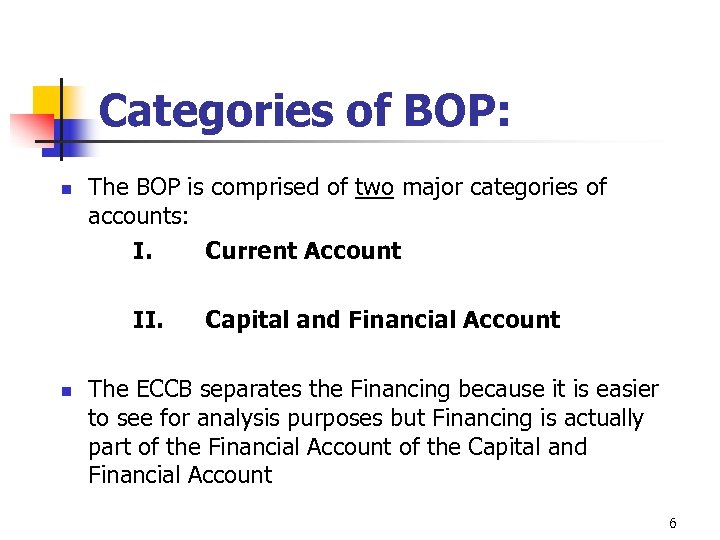
Categories of BOP: n The BOP is comprised of two major categories of accounts: I. Current Account II. n Capital and Financial Account The ECCB separates the Financing because it is easier to see for analysis purposes but Financing is actually part of the Financial Account of the Capital and Financial Account 6
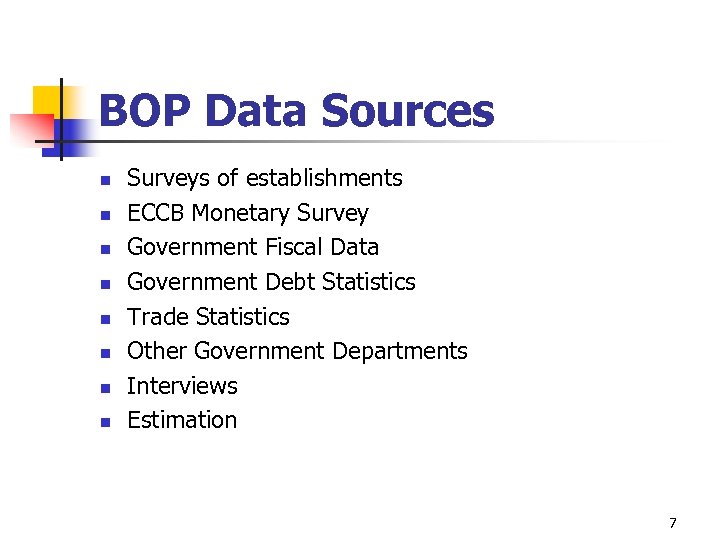
BOP Data Sources n n n n Surveys of establishments ECCB Monetary Survey Government Fiscal Data Government Debt Statistics Trade Statistics Other Government Departments Interviews Estimation 7
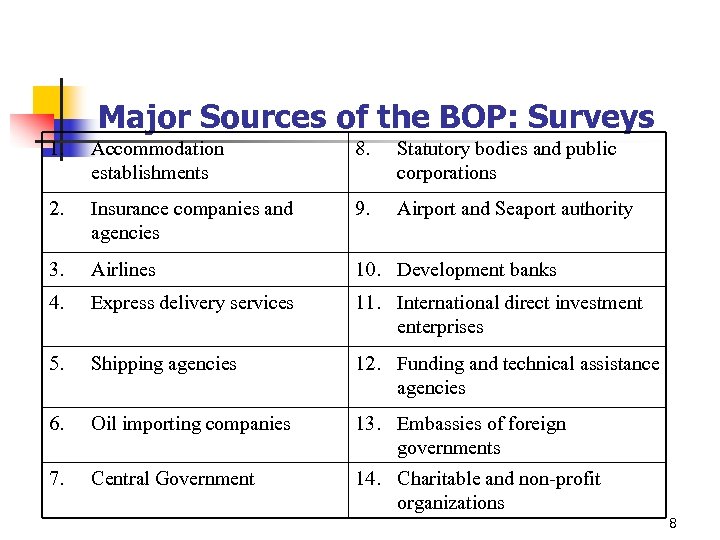
Major Sources of the BOP: Surveys 1. Accommodation establishments 8. Statutory bodies and public corporations 2. Insurance companies and agencies 9. Airport and Seaport authority 3. Airlines 10. Development banks 4. Express delivery services 11. International direct investment enterprises 5. Shipping agencies 12. Funding and technical assistance agencies 6. Oil importing companies 13. Embassies of foreign governments 7. Central Government 14. Charitable and non-profit organizations 8
National Accounts Of ECCU Member Countries n The national accounts consists mainly of: n n n GDP by Economic Activity in current and constant prices Tables on the Expenditure of GDP in current prices Supply and Use Tables Quarterly GDP Index Other macro-economic indicators
Links between BOP and NA n BPM 5 and SNA 93 and by extension, BPM 6 and 2008 SNA follow similar concepts of: n n n Residency - both invoke the concepts of economic territory and center of economic interest Valuation – market price is the primary concept for valuation Time of Recording – the BOP and the national accounts are constructed in principle on an accrual basis
Links between BOP and NA n n n BPM 6 is now fully consistent with SNA The income account of BOP is now called the primary account The current transfers account is now the secondary income account
Links between BOP and NA n The linkage of the BOP and the SNA are reinforced by the fact that in almost all countries the BOP data are compiled first and subsequently incorporated into the national accounts
Links between BOP and NA n n The SNA coverage of exports of goods and services is identical to the BOP coverage In BOP, exports and imports of services are disaggregated in more detail to provide data for analysis and policy decisions- particularly for negotiations in international trade in services needed for international agreements
Links between BOP and NA n n Flows reflected in BOP affect in some ways the activities of the total economy Activities relating to production, generation and distribution of income, consumption and accumulation could be affected by BOP transactions
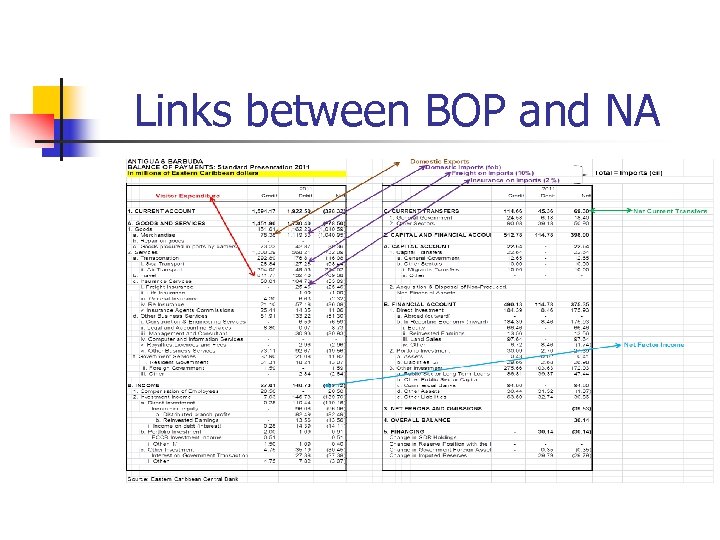
Links between BOP and NA n n Apart from income flows generated domestically and included in gross value added or GDP there are income flows to or from the rest of the world. These flows constitute additional sources of income: n n n Compensation of Employees Property Income Taxes on Production and Imports Current Taxes on Income and Wealth Other Current Transfers
Links between BOP and NA n They are included in the measurement of n n n Gross National Income Gross Disposable Income National Saving- the balancing item between Disposable Income and final consumption
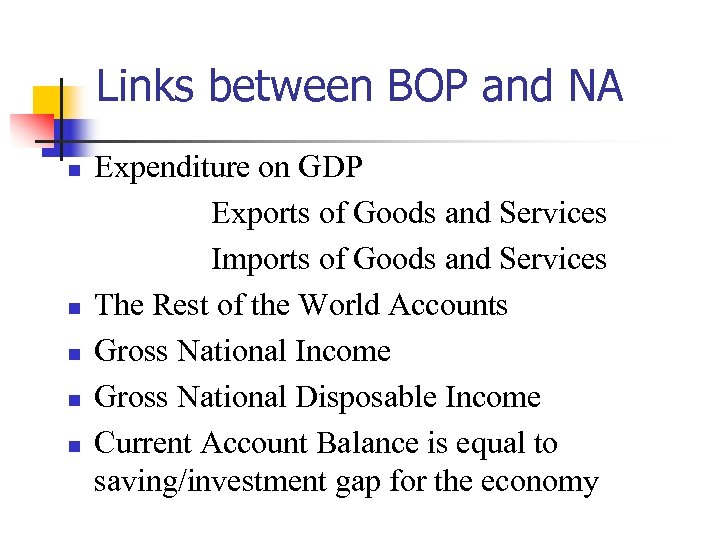
Links between BOP and NA n n n Expenditure on GDP Exports of Goods and Services Imports of Goods and Services The Rest of the World Accounts Gross National Income Gross National Disposable Income Current Account Balance is equal to saving/investment gap for the economy
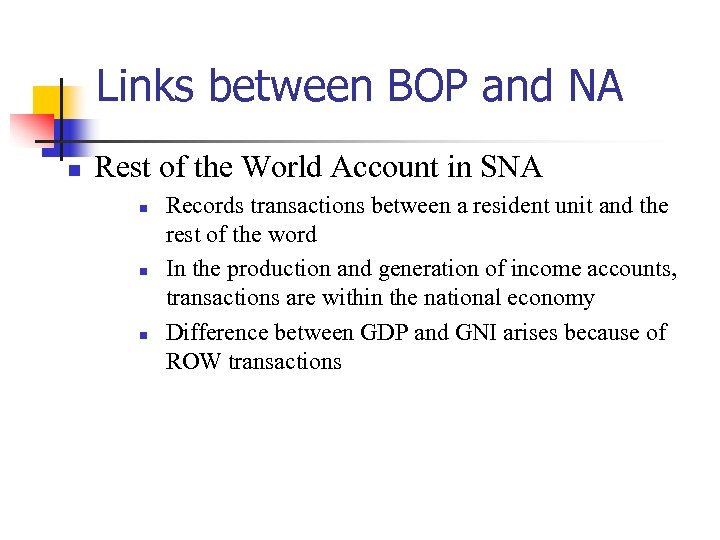
Links between BOP and NA n Rest of the World Account in SNA n n n Records transactions between a resident unit and the rest of the word In the production and generation of income accounts, transactions are within the national economy Difference between GDP and GNI arises because of ROW transactions
Links between BOP and NA
Links between BOP and NA
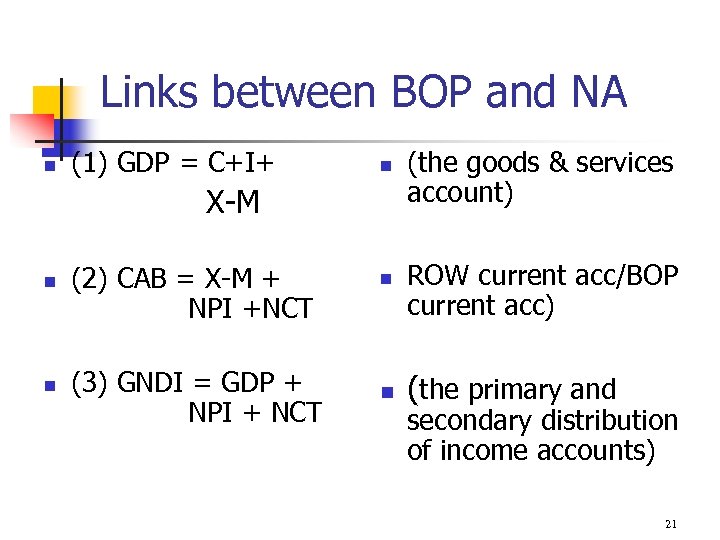
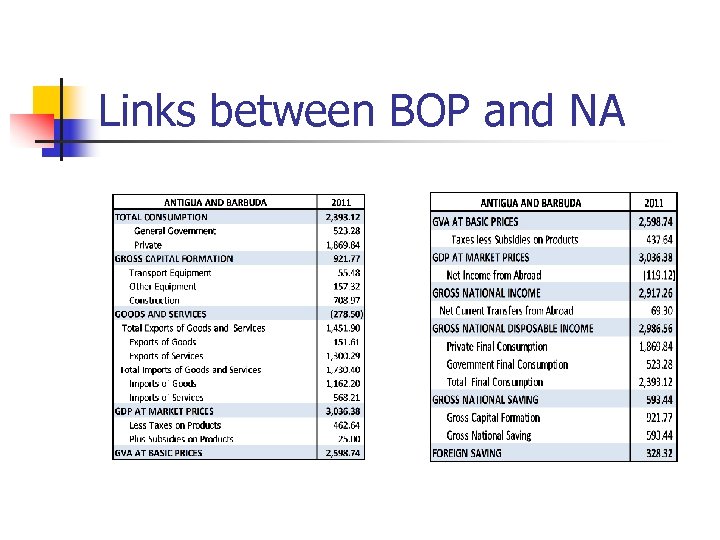
Links between BOP and NA n (1) GDP = C+I+ n X-M n n (2) CAB = X-M + NPI +NCT (3) GNDI = GDP + NPI + NCT n n (the goods & services account) ROW current acc/BOP current acc) (the primary and secondary distribution of income accounts) 21
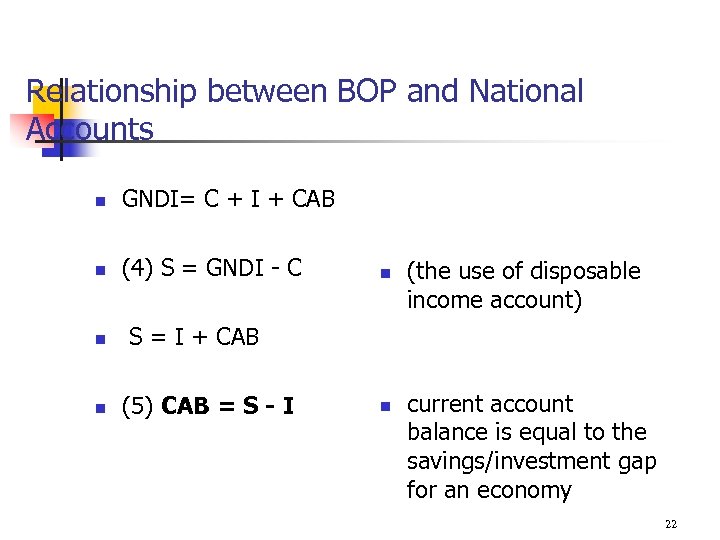
Relationship between BOP and National Accounts n GNDI= C + I + CAB n (4) S = GNDI - C n S = I + CAB (5) CAB = S - I n n (the use of disposable income account) n current account balance is equal to the savings/investment gap for an economy 22
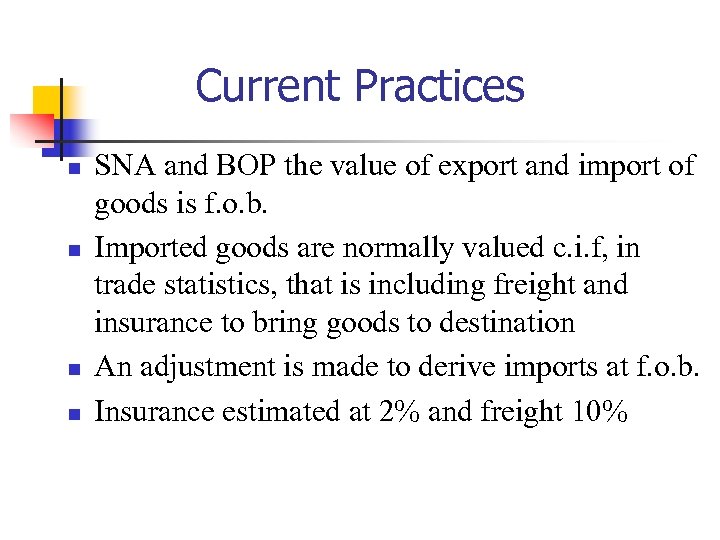
Current Practices n n SNA and BOP the value of export and import of goods is f. o. b. Imported goods are normally valued c. i. f, in trade statistics, that is including freight and insurance to bring goods to destination An adjustment is made to derive imports at f. o. b. Insurance estimated at 2% and freight 10%
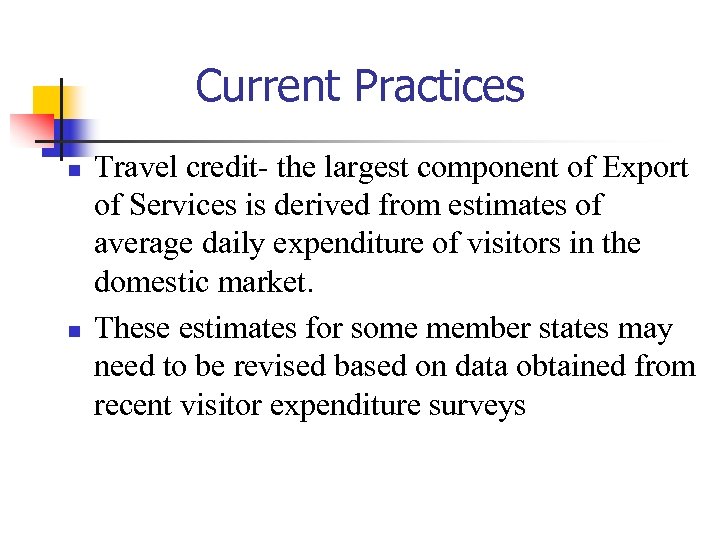
Current Practices n n Travel credit- the largest component of Export of Services is derived from estimates of average daily expenditure of visitors in the domestic market. These estimates for some member states may need to be revised based on data obtained from recent visitor expenditure surveys
Current Practices n n n . Workers remittances are important in ECCU and are included in current transfers in BOP Prior to 2004, official remittances data were obtained from EC 0/EC 1 returns received from the commercial banks Respondents were required to provide detailed information to the Ministry of Finance on the source of inflows and outflows of foreign exchange
Current Practices n n . Capital markets in the ECCU were liberalized in September 2004 which affected the quality of official remittance data received from commercial banks. Current data on remittances are estimates at this time and are compiled based on available qualitative and quantitative information such as developments in the remittance source countries as well as the domestic economies source of inflows and outflows of foreign exchange
Current Practices n n n . Projects in place to improve the estimation of remittances to the ECCU In the ECCU, the regulation and supervision of remittance service providers is ongoing through the establishment of Single Regulatory Units (SRUs) in each member country These Units would be responsible for regulating other financial institutions that do not fall under the ECCB
Future Plans n n n Complete revision of the BOP survey forms completed in 2008 Presently receiving TA from CARTAC to review the revised BOP survey forms The next step is the development of the BOP compilation software for implementation of BPM 6
Future Plans n Plans are also in place to develop IIP accounts as a pilot project for one of the ECCU member states during 2013
Summary and Conclusion n n The BOP estimates are completely integrated in the SNA database in the ECCU member states The ECCB continues to provide technical assistance in both BOP and national accounts thus ensuring harmonization of methodology adopted

The End… Thank You
Скачать презентацию Integrating the BOP in the National Accounts By
90bd03d5829520dc6dc842e2389c592d.ppt