


 Скачать презентацию Integrating FIA with Other Research Activities The Delaware
263783211e80ffb0f2b44c2246934bb7.ppt
- Количество слайдов: 27
 Integrating FIA with Other Research Activities The Delaware River Basin Project & The North American Carbon Program Richard Birdsey Program Manager Global Change Research
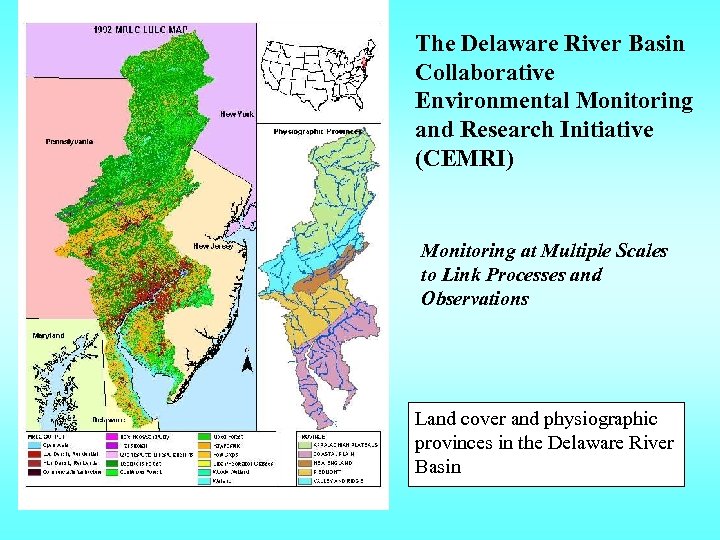 The Delaware River Basin Collaborative Environmental Monitoring and Research Initiative (CEMRI) Monitoring at Multiple Scales to Link Processes and Observations Land cover and physiographic provinces in the Delaware River Basin
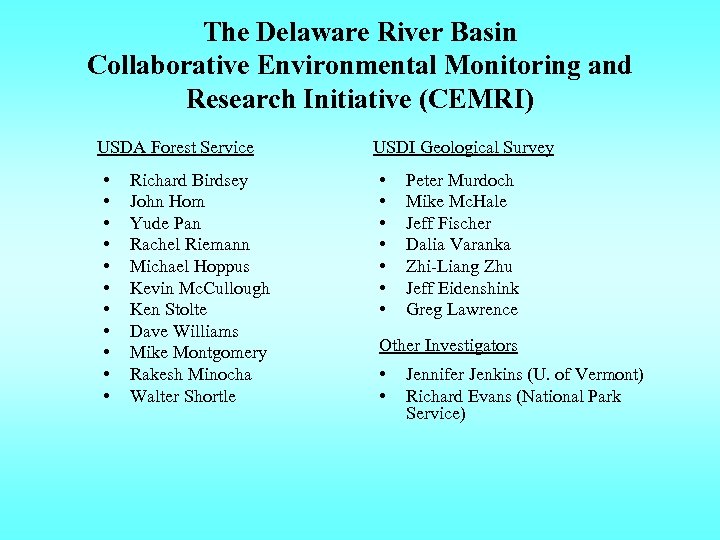 The Delaware River Basin Collaborative Environmental Monitoring and Research Initiative (CEMRI) USDA Forest Service • • • Richard Birdsey John Hom Yude Pan Rachel Riemann Michael Hoppus Kevin Mc. Cullough Ken Stolte Dave Williams Mike Montgomery Rakesh Minocha Walter Shortle USDI Geological Survey • • Peter Murdoch Mike Mc. Hale Jeff Fischer Dalia Varanka Zhi-Liang Zhu Jeff Eidenshink Greg Lawrence Other Investigators • • Jennifer Jenkins (U. of Vermont) Richard Evans (National Park Service)
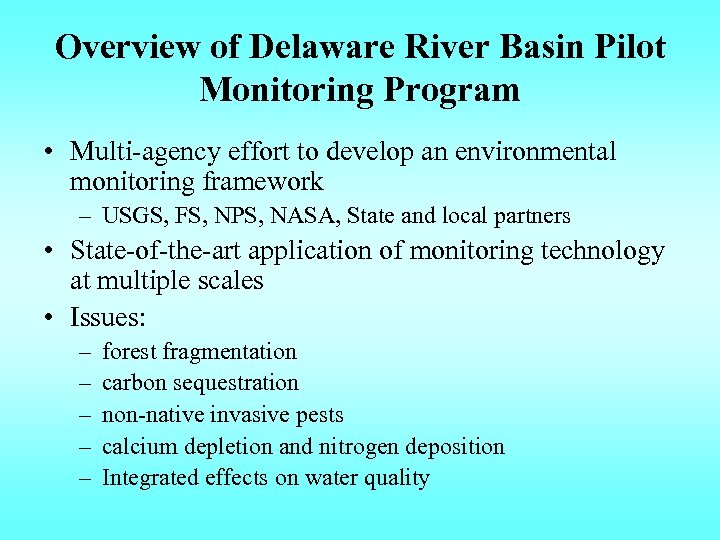 Overview of Delaware River Basin Pilot Monitoring Program • Multi-agency effort to develop an environmental monitoring framework – USGS, FS, NPS, NASA, State and local partners • State-of-the-art application of monitoring technology at multiple scales • Issues: – – – forest fragmentation carbon sequestration non-native invasive pests calcium depletion and nitrogen deposition Integrated effects on water quality
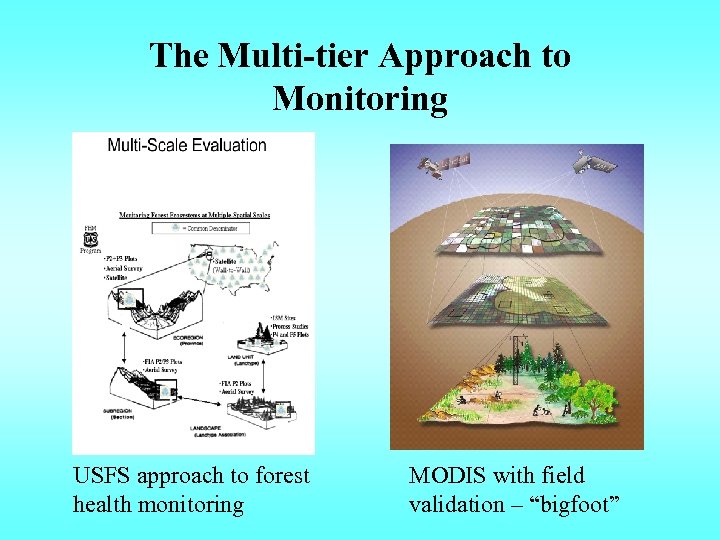 The Multi-tier Approach to Monitoring USFS approach to forest health monitoring MODIS with field validation – “bigfoot”
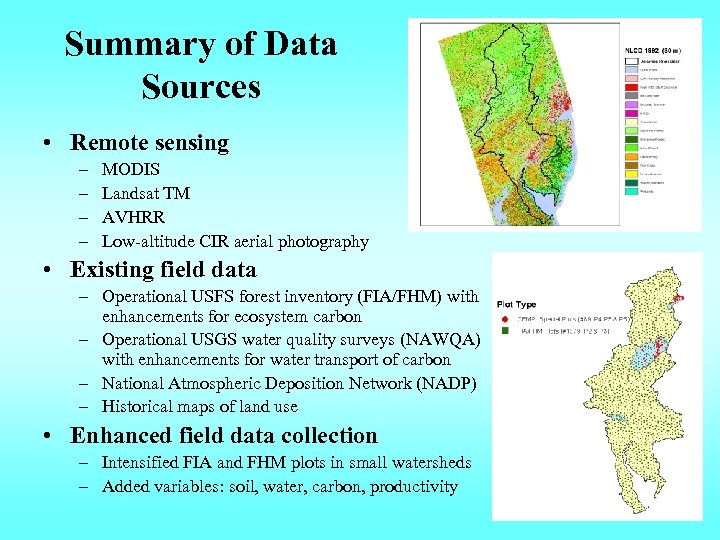 Summary of Data Sources • Remote sensing – – MODIS Landsat TM AVHRR Low-altitude CIR aerial photography • Existing field data – Operational USFS forest inventory (FIA/FHM) with enhancements for ecosystem carbon – Operational USGS water quality surveys (NAWQA) with enhancements for water transport of carbon – National Atmospheric Deposition Network (NADP) – Historical maps of land use • Enhanced field data collection – Intensified FIA and FHM plots in small watersheds – Added variables: soil, water, carbon, productivity
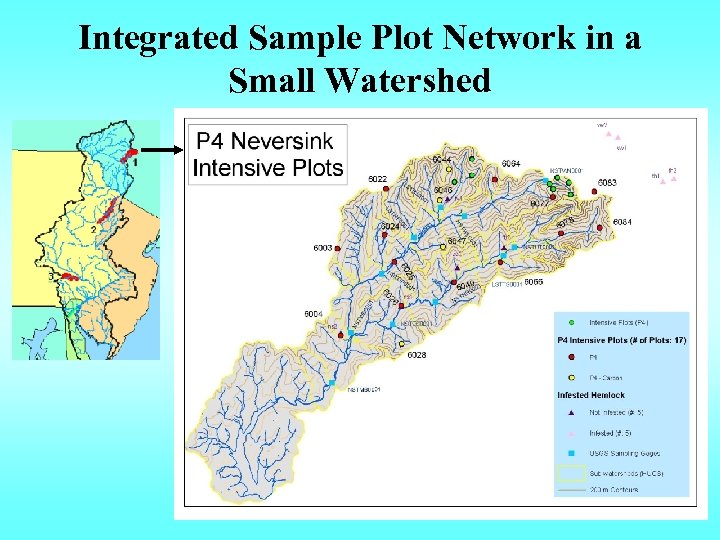 Integrated Sample Plot Network in a Small Watershed Delaware Water Gap National Recreation Area (outlined in red)
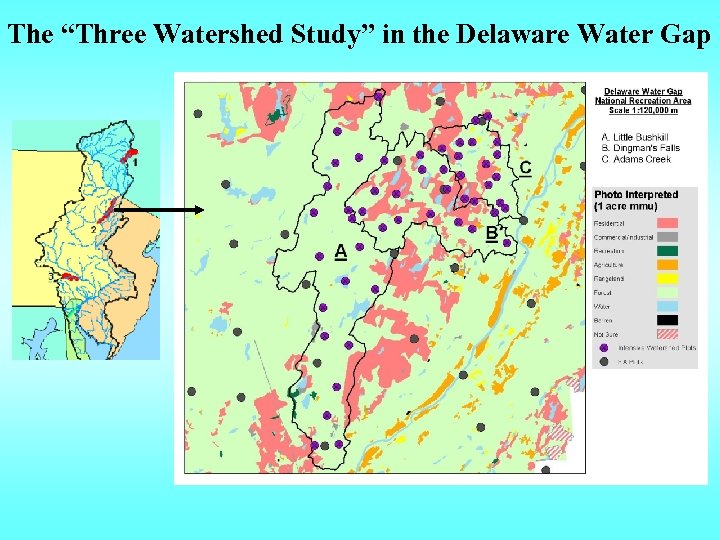 The “Three Watershed Study” in the Delaware Water Gap
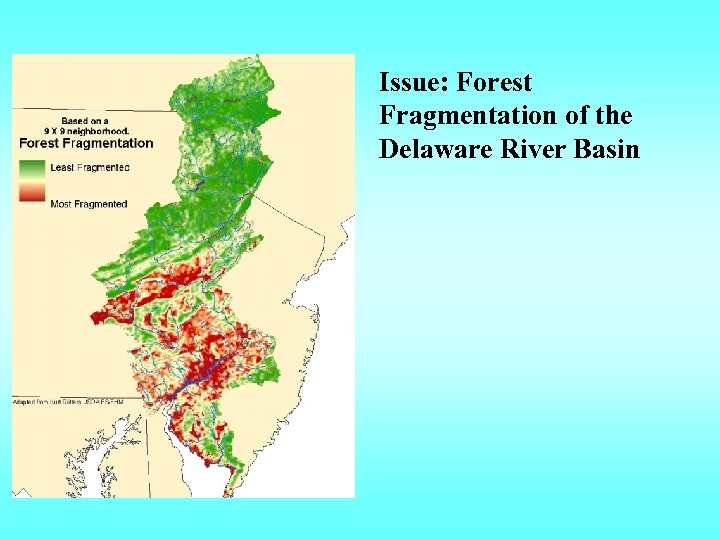 Issue: Forest Fragmentation of the Delaware River Basin
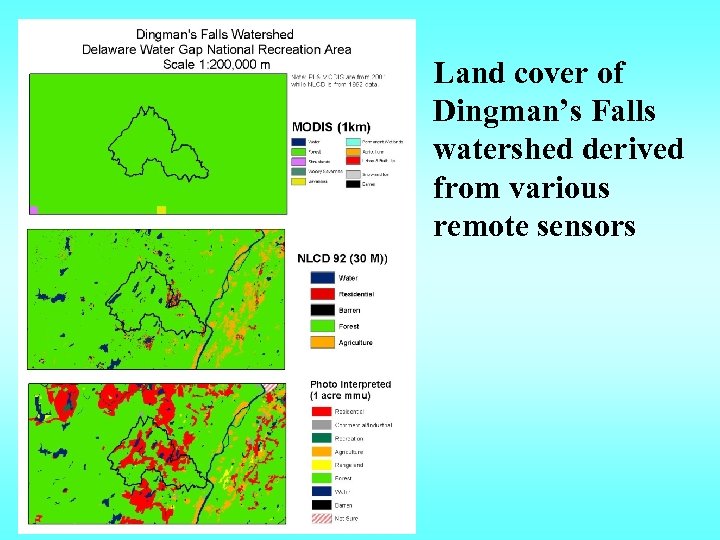 Land cover of Dingman’s Falls watershed derived from various remote sensors
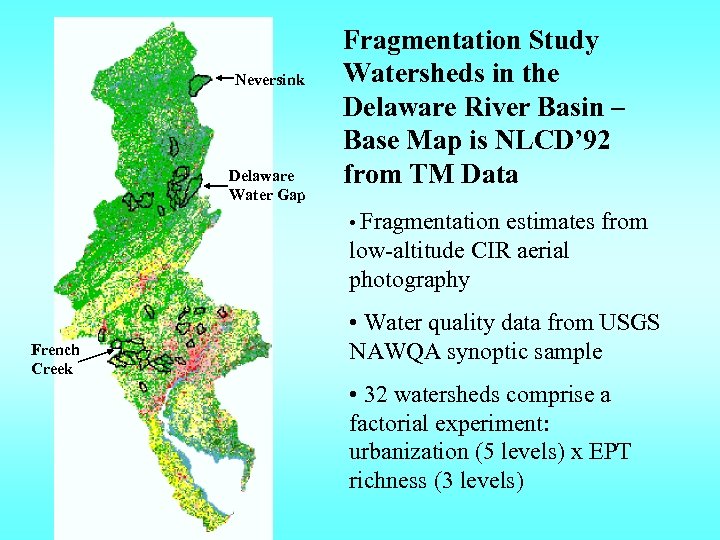 Neversink Delaware Water Gap Fragmentation Study Watersheds in the Delaware River Basin – Base Map is NLCD’ 92 from TM Data • Fragmentation estimates from low-altitude CIR aerial photography French Creek • Water quality data from USGS NAWQA synoptic sample • 32 watersheds comprise a factorial experiment: urbanization (5 levels) x EPT richness (3 levels)
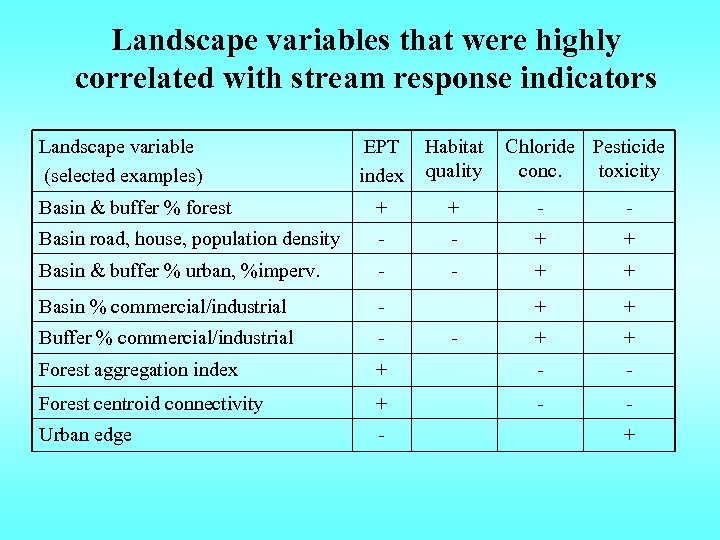 Landscape variables that were highly correlated with stream response indicators Landscape variable (selected examples) EPT index Habitat quality Basin & buffer % forest + + - - Basin road, house, population density - - + + Basin & buffer % urban, %imperv. - - + + Basin % commercial/industrial - + + Buffer % commercial/industrial - + + Forest aggregation index + - - Forest centroid connectivity + - - Urban edge - - Chloride Pesticide conc. toxicity +
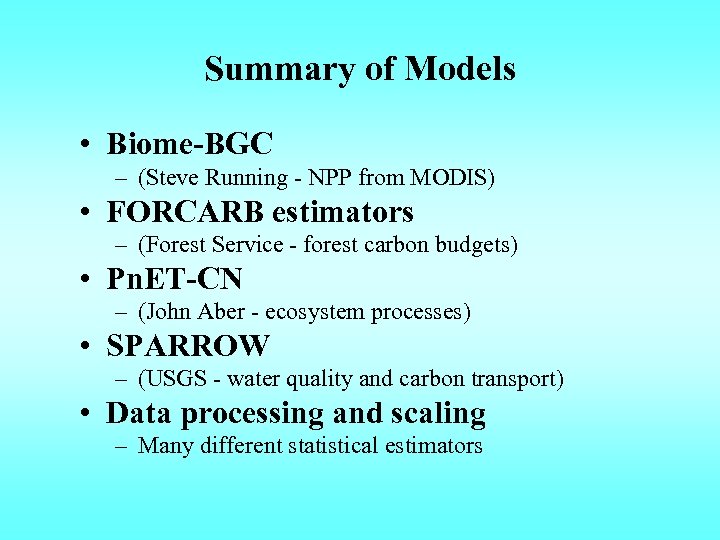 Summary of Models • Biome-BGC – (Steve Running - NPP from MODIS) • FORCARB estimators – (Forest Service - forest carbon budgets) • Pn. ET-CN – (John Aber - ecosystem processes) • SPARROW – (USGS - water quality and carbon transport) • Data processing and scaling – Many different statistical estimators
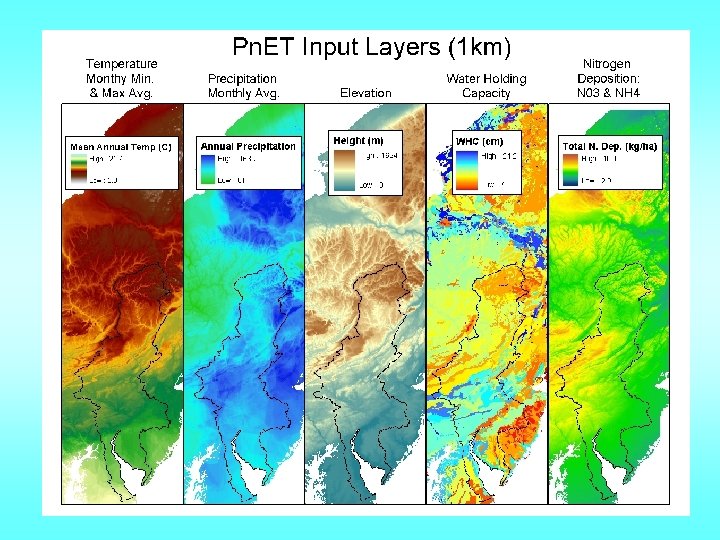
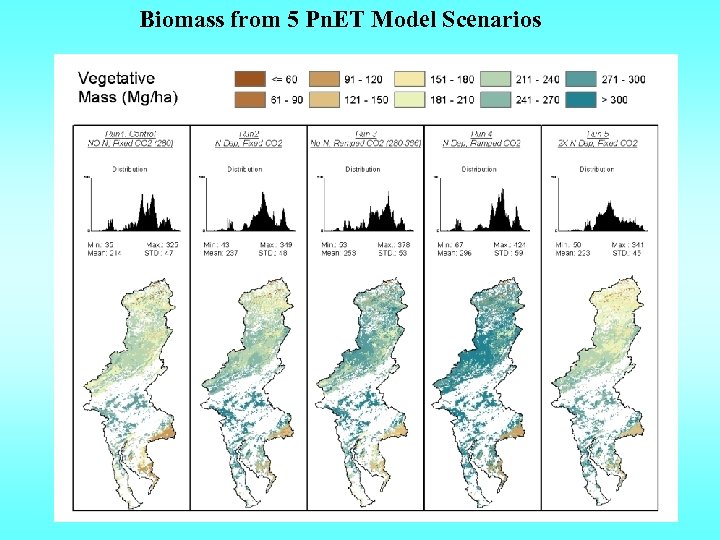 Biomass from 5 Pn. ET Model Scenarios
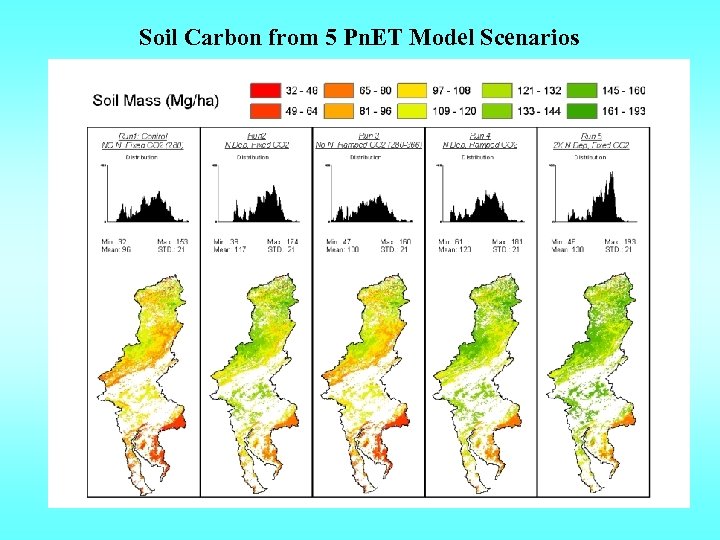 Soil Carbon from 5 Pn. ET Model Scenarios
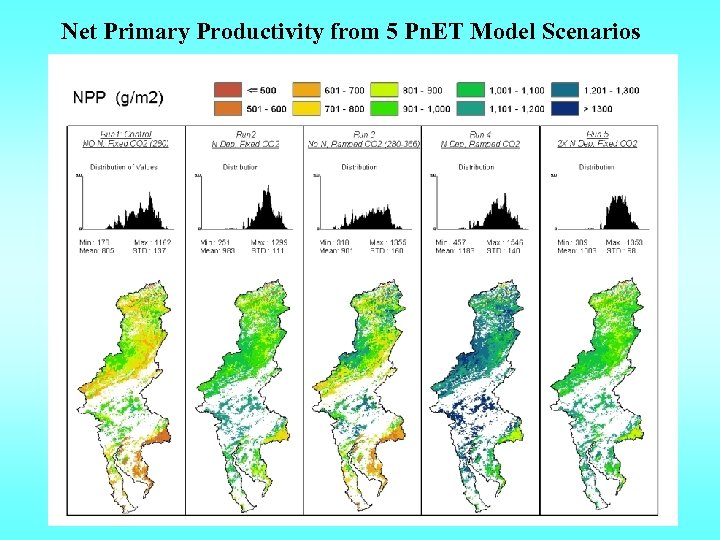 Net Primary Productivity from 5 Pn. ET Model Scenarios
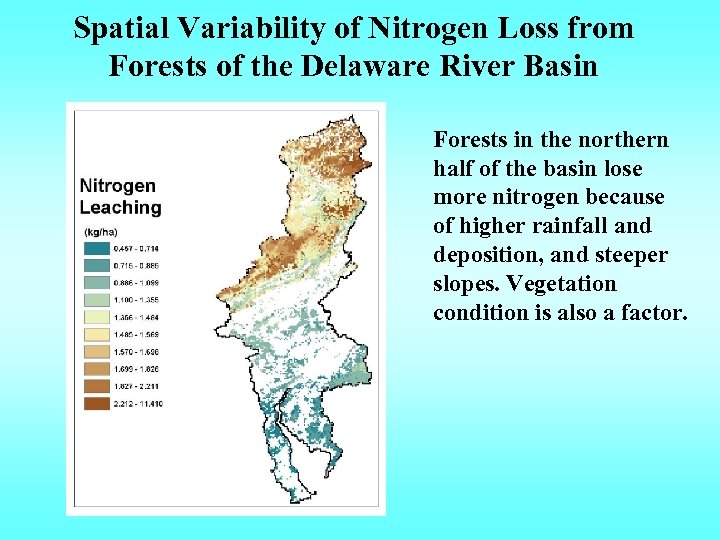 Spatial Variability of Nitrogen Loss from Forests of the Delaware River Basin Forests in the northern half of the basin lose more nitrogen because of higher rainfall and deposition, and steeper slopes. Vegetation condition is also a factor.
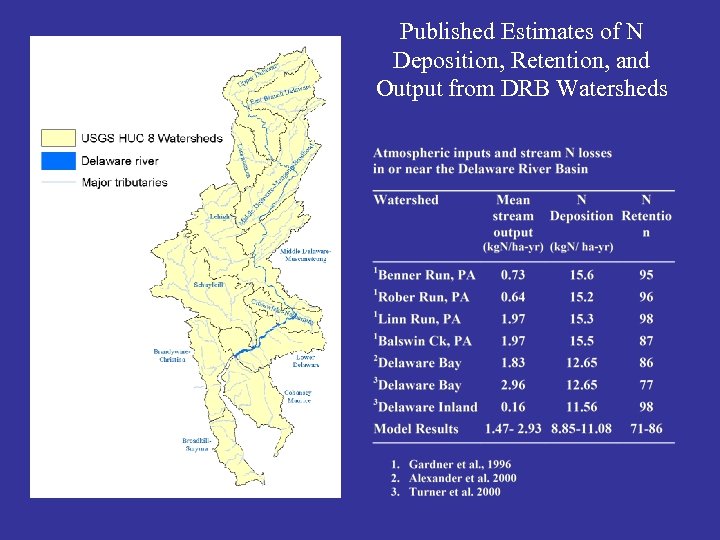 Published Estimates of N Deposition, Retention, and Output from DRB Watersheds
 Expected Results and Products • Integrated data sets: vegetation/soils/air/water from ground and space • Analytical tools: models for scenario analysis • “Carbonshed” budgets at several scales • Improved operational inventories • Environmental trend analysis related to identified issues • Process models to link across scales • Project evaluation – has collaborative monitoring delivered better information? • Conservation education • Comparison of estimates from MODIS with ground data • Science applications meeting with Delaware River Basin Commission
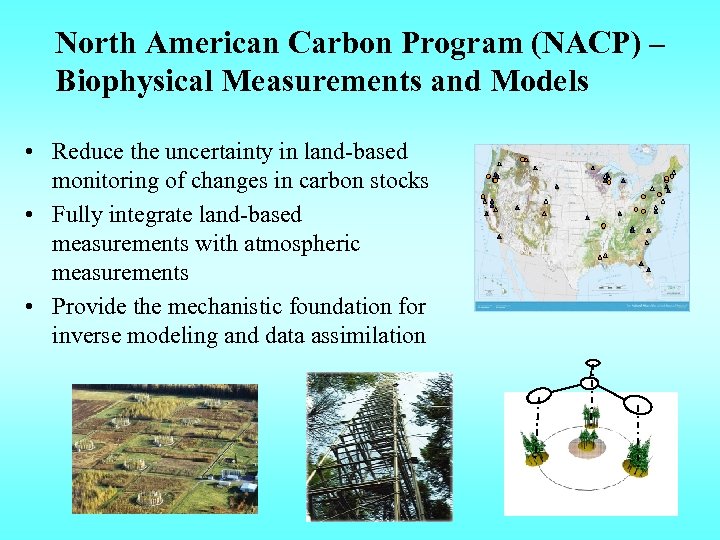 North American Carbon Program (NACP) – Biophysical Measurements and Models • Reduce the uncertainty in land-based monitoring of changes in carbon stocks • Fully integrate land-based measurements with atmospheric measurements • Provide the mechanistic foundation for inverse modeling and data assimilation
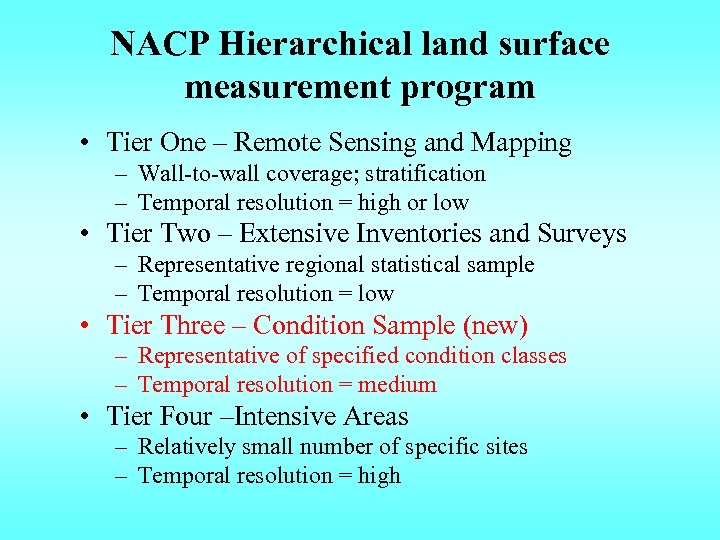 NACP Hierarchical land surface measurement program • Tier One – Remote Sensing and Mapping – Wall-to-wall coverage; stratification – Temporal resolution = high or low • Tier Two – Extensive Inventories and Surveys – Representative regional statistical sample – Temporal resolution = low • Tier Three – Condition Sample (new) – Representative of specified condition classes – Temporal resolution = medium • Tier Four –Intensive Areas – Relatively small number of specific sites – Temporal resolution = high
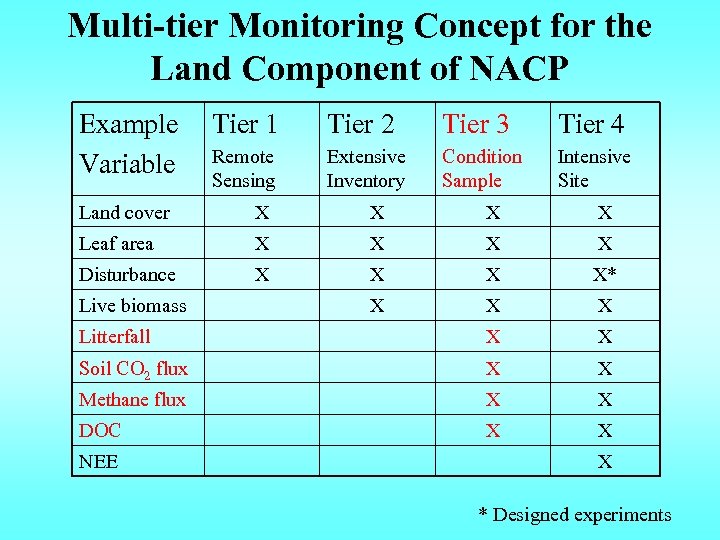 Multi-tier Monitoring Concept for the Land Component of NACP Example Variable Tier 1 Tier 2 Tier 3 Tier 4 Remote Sensing Extensive Inventory Condition Sample Intensive Site Land cover X X Leaf area X X Disturbance X X* X X X Litterfall X X Soil CO 2 flux X X Methane flux X X DOC X X Live biomass NEE X * Designed experiments
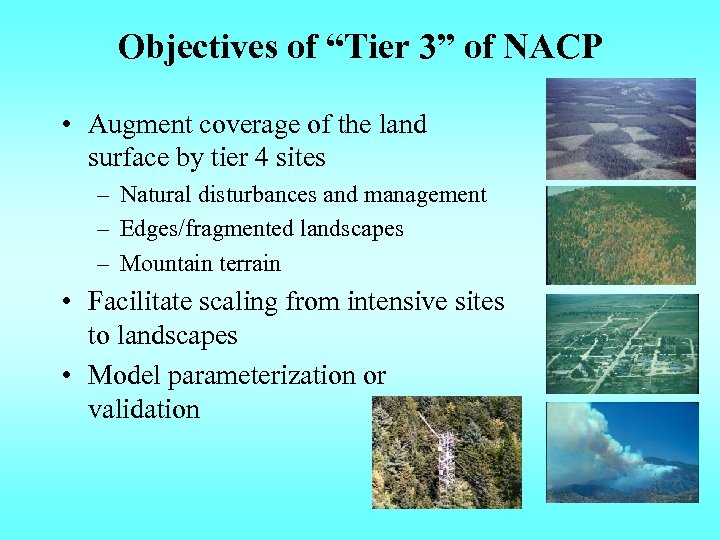 Objectives of “Tier 3” of NACP • Augment coverage of the land surface by tier 4 sites – Natural disturbances and management – Edges/fragmented landscapes – Mountain terrain • Facilitate scaling from intensive sites to landscapes • Model parameterization or validation
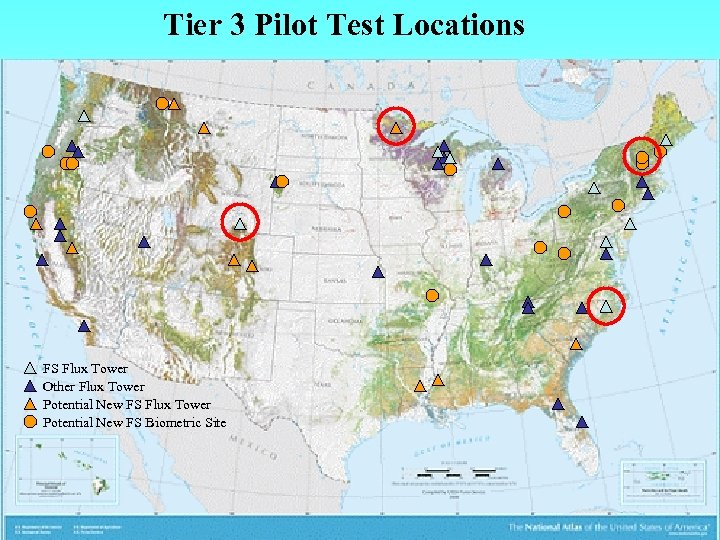 Tier 3 Pilot Test Locations FS Flux Tower Other Flux Tower Potential New FS Biometric Site
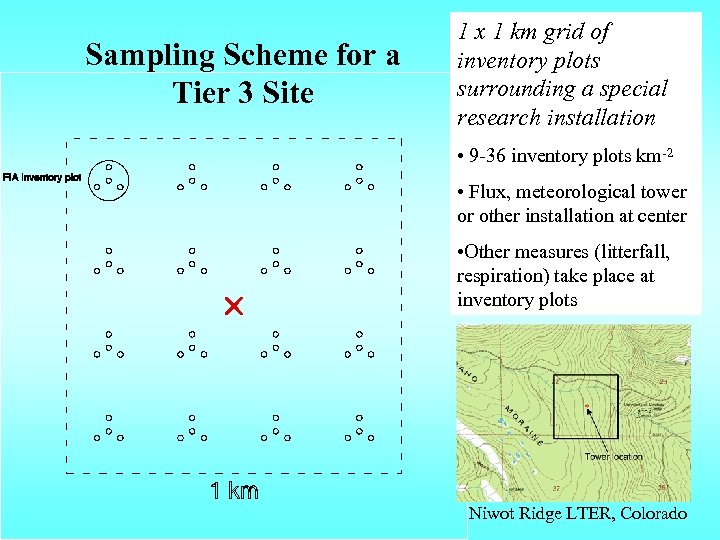 Sampling Scheme for a Tier 3 Site 1 x 1 km grid of inventory plots surrounding a special research installation • 9 -36 inventory plots km-2 • Flux, meteorological tower or other installation at center • Other measures (litterfall, respiration) take place at inventory plots Niwot Ridge LTER, Colorado
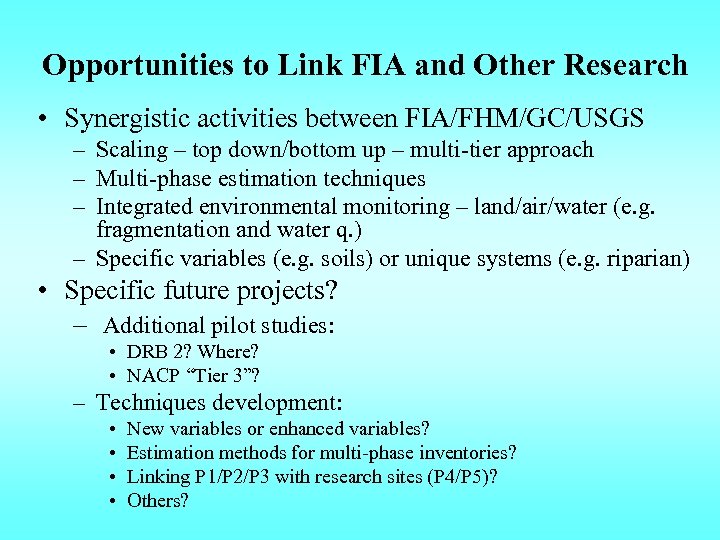 Opportunities to Link FIA and Other Research • Synergistic activities between FIA/FHM/GC/USGS – Scaling – top down/bottom up – multi-tier approach – Multi-phase estimation techniques – Integrated environmental monitoring – land/air/water (e. g. fragmentation and water q. ) – Specific variables (e. g. soils) or unique systems (e. g. riparian) • Specific future projects? – Additional pilot studies: • DRB 2? Where? • NACP “Tier 3”? – Techniques development: • • New variables or enhanced variables? Estimation methods for multi-phase inventories? Linking P 1/P 2/P 3 with research sites (P 4/P 5)? Others?